After Farcaster's transformation, Lens Protocol has changed ownership, leaving no trace of the Web3 social dream
 Core Viewpoint

 In the past, the so-called traffic explosion was almost entirely driven by airdrop expectations and speculative games, rather than stemming from genuine communication needs.
Author: zhou, ChainCatcher
On January 20, Mask Network announced the takeover of the decentralized social protocol Lens Protocol. This is another decentralized social platform that has announced a shift in its development focus, following Farcaster.
Just last December, Farcaster announced a strategic transformation, abandoning its social-first strategy in favor of building a wallet-centric application model. The adjustments made by these two leading protocols in a short period reflect the entanglement and struggle within the entire decentralized social space.
It is reported that Lens Protocol was launched by Aave founder Stani Kulechov in early 2022. At that time, Stani was briefly banned from social media due to comments he made, which prompted him to create a system that challenges data monopolies and allows users to truly own their social relationships.
The core of Lens is a set of on-chain social graphs, where users' profiles, follow relationships, and content interactions exist in the form of NFTs or on-chain data.
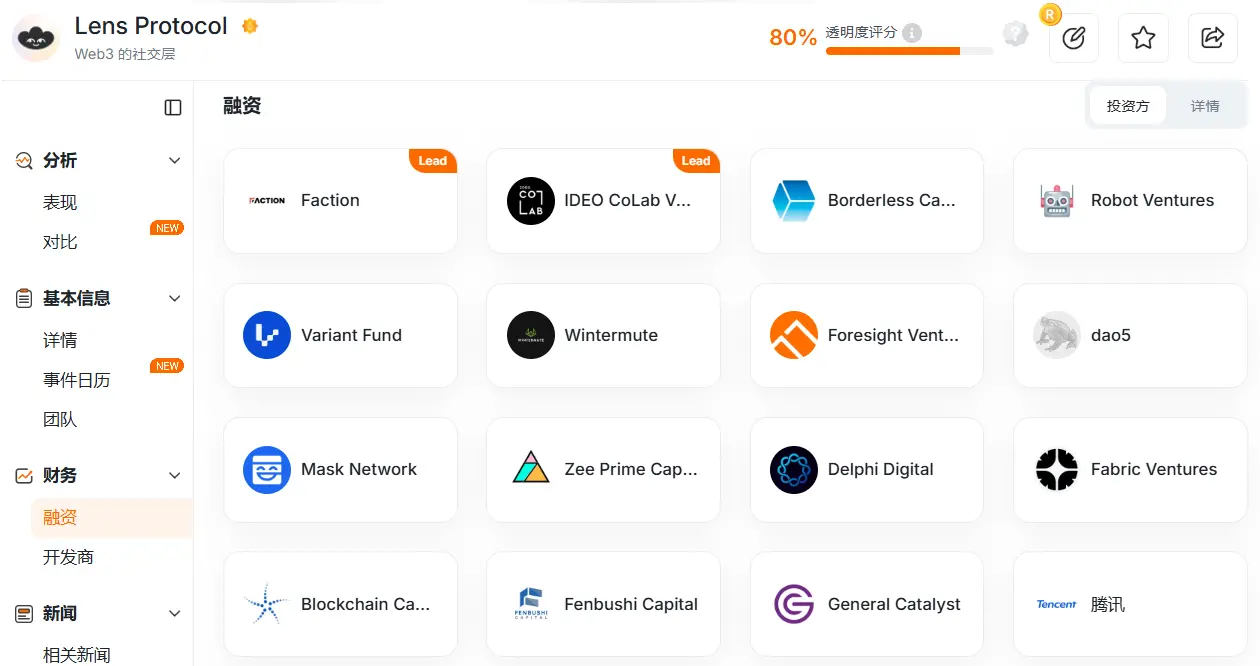
In terms of capital, according to RootData, Lens Protocol has raised over $46 million, with investors including Tencent, Robot Ventures, Wintermute, Circle Ventures, and Variant Fund. There were previous reports of plans to raise a new round of financing at a valuation of $500 million.
Over the past few years, Lens has transitioned from the Polygon testnet to the mainnet and achieved modular functionality through the V2 version in 2023. With the entry into a fully permissionless phase in 2024 and the launch of the Lens Chain based on ZKsync in 2025, the protocol has addressed the technical bottleneck of high transaction costs.
However, the technical success has not translated into ecological prosperity. According to Coingecko data, the protocol currently has 665,000 NFTs held by 575,000 unique holders, with a total market value of $138,000.
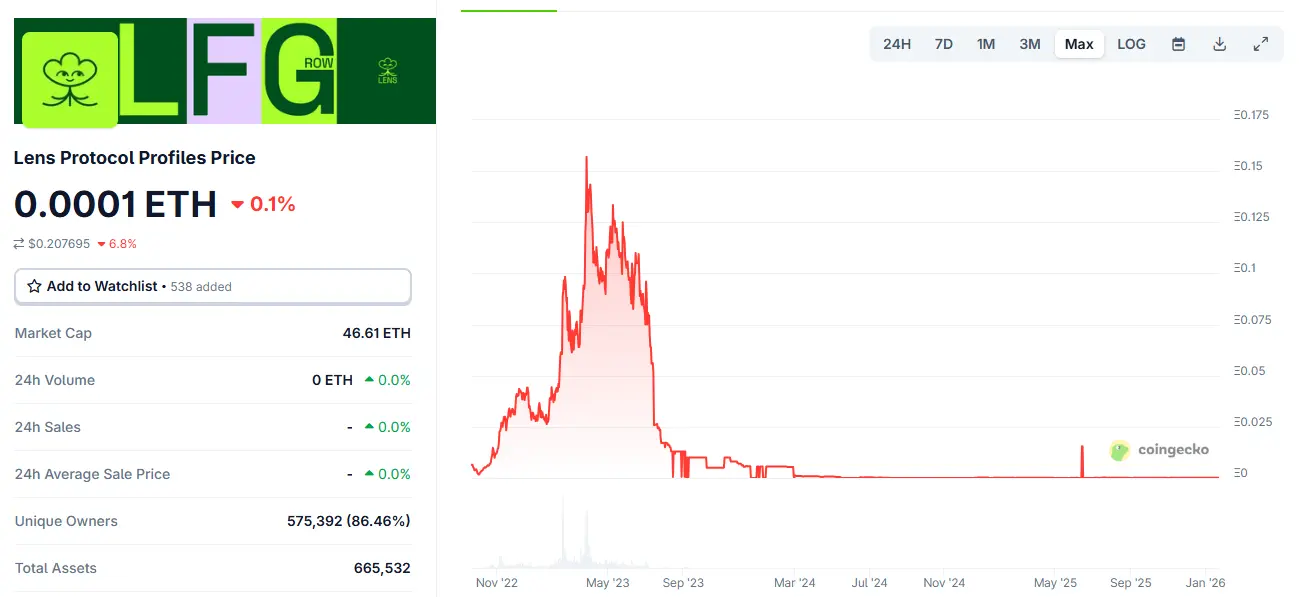
Previously, Lens officials mentioned in a migration announcement that as of February 2025, the protocol had approximately 647,000 minted Profile accounts, with a total of 31 million posts, but only about 45,000 weekly active users. This indicates that the majority of the hundreds of thousands of accounts may have been registered early on to seek potential airdrops, while the proportion of truly engaged active users generating high-quality interactions is minimal.
This also reflects the shortcomings of the original Lens team; they may excel in DeFi protocol design and smart contract governance, but their experience in refining consumer-grade products is relatively weak. Stani stated that the management of Lens would be handed over to Mask Network, while the original team would transition to technical advisors, returning to their strengths in the DeFi field for innovation.
As the successor, Mask Network has long focused on bridging Web2 and Web3 social connections. Founded by Suji Yan in 2018, it aims to allow users to enjoy secure, decentralized social messaging, payment networks, file storage, and file sharing without leaving mainstream social media networks.
According to Rootdata, Mask Network has raised over $57 million, with investors including HashKey, Hash Global, DCG, YZi Labs, and others, and has launched its native governance token MASK, which currently has a fully diluted valuation of approximately $60 million.
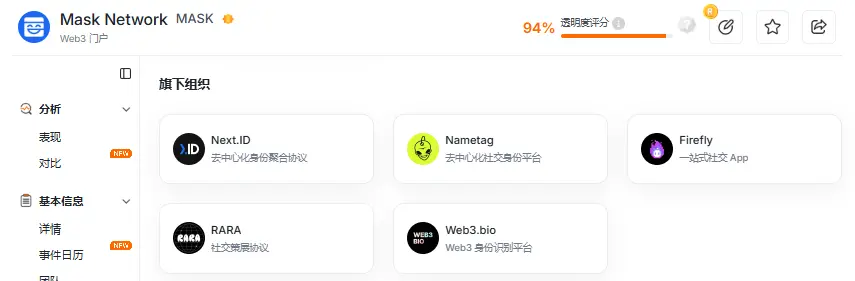
Currently, Mask has several core components, including the Firefly aggregation application, Next.ID identity protocol, and Web3.bio.
It is worth mentioning that as early as 2023, Mask Network participated in the seed round financing of Lens and has been an early supporter and ecological participant of Lens. In 2025, it also completed a strategic acquisition of Orb.club, a native social application on the Lens chain.
Mask founder Suji Yan stated that Mask's mission is to make decentralized social functions easy to use and intuitive, which aligns with the next development phase of Lens.
However, for Mask, this may be an attempt to break through at the application layer, but for the entire sector, it is merely a reckoning of the social dream.
Looking back over the past few years, the so-called traffic explosion has been driven almost entirely by airdrop expectations and speculative games, rather than stemming from genuine communication needs.
SocialFi has overly emphasized "Fi" while neglecting "Social." With the withdrawal of the Lens founding team and the shift of Farcaster, the initial grand narrative of Web3 social to "disrupt traditional social giants" has already fallen apart.
 Risk warning
 Risk warning




Popular articles