Crypto ETF Weekly | Last week, the net outflow of Bitcoin spot ETFs in the U.S. was $1.324 billion; the net outflow of Ethereum spot ETFs in the U.S. was $600 million

 VanEck Avalanche spot ETF will be listed on NASDAQ.
整理:Jerry,ChainCatcher
Performance of Crypto Spot ETFs Last Week
U.S. Bitcoin Spot ETFs Net Outflow of $1.324 Billion
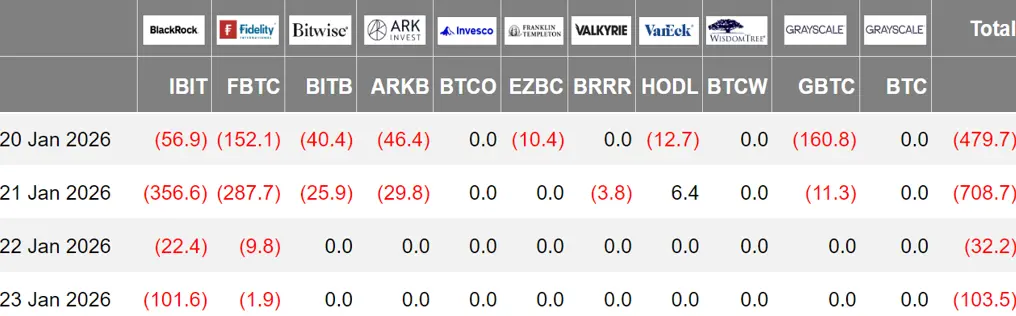
Last week, U.S. Bitcoin spot ETFs experienced a net outflow over four days, totaling $1.324 billion, with a total net asset value of $11.588 billion.
Eight ETFs were in a net outflow state last week, with outflows primarily from IBIT, FBTC, and GBTC, which saw outflows of $537 million, $451 million, and $172 million, respectively.
Data Source: Farside Investors
U.S. Ethereum Spot ETFs Net Outflow of $600 Million
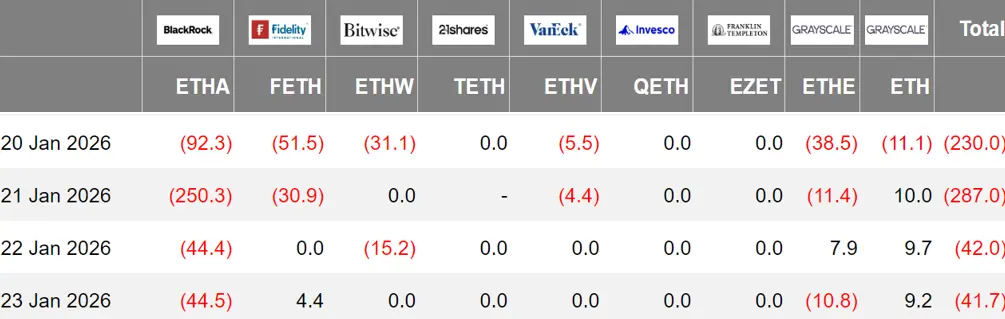
Last week, U.S. Ethereum spot ETFs experienced a net outflow over four days, totaling $600 million, with a total net asset value of $1.770 billion.
The outflow last week primarily came from BlackRock's ETHA, with a net outflow of $431 million. Five Ethereum spot ETFs were in a net outflow state.
Data Source: Farside Investors
No Fund Inflows for Hong Kong Bitcoin Spot ETFs
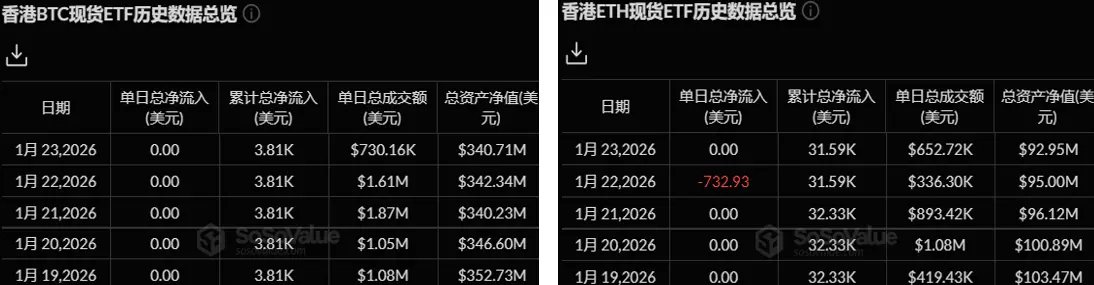
Last week, Hong Kong Bitcoin spot ETFs had no fund inflows, with a net asset value of $34 million. The holdings of the issuer, Harvest Bitcoin, decreased to 290.75 BTC, while Huaxia maintained 2390 BTC.
Hong Kong Ethereum spot ETFs saw a net outflow of 732.93 ETH, with a net asset value of $9.295 million.
Data Source: SoSoValue
Performance of Crypto Spot ETF Options
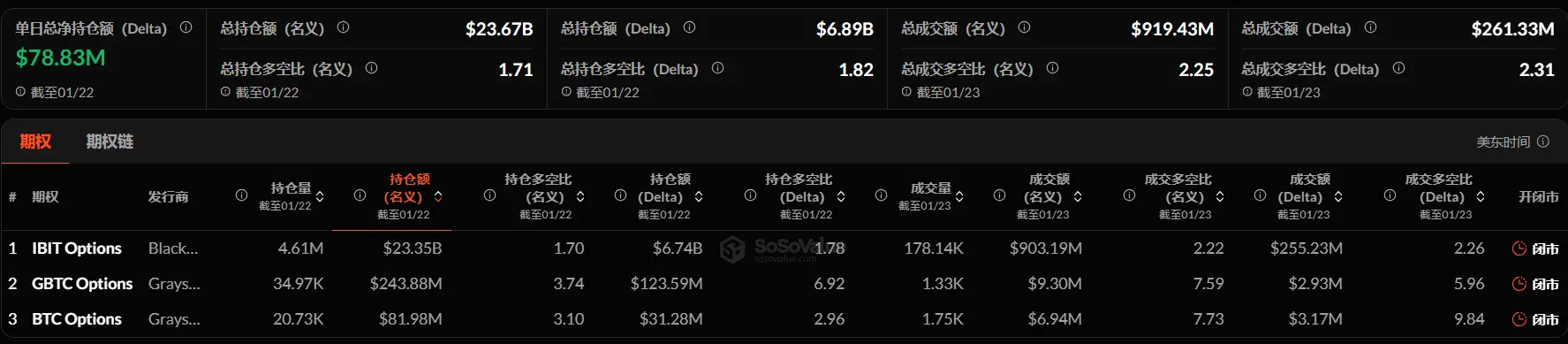
As of January 23, the nominal total trading volume of U.S. Bitcoin spot ETF options was $919 million, with a nominal total long-short ratio of 2.25.
As of January 22, the nominal total open interest of U.S. Bitcoin spot ETF options reached $23.67 billion, with a nominal total long-short ratio of 1.71.
The market's short-term trading activity for Bitcoin spot ETF options has increased, with overall sentiment leaning bullish.
Additionally, the implied volatility is 41.99%.
Data Source: SoSoValue
Overview of Crypto ETF Dynamics Last Week
VanEck Avalanche Spot ETF to Begin Trading on Nasdaq
The VanEck Avalanche Spot ETF (ticker: VAVX) will officially begin trading on Nasdaq next Monday.
Flow Traders has been designated as the primary market maker for this ETF.
Cyber Hornet Applies for S&P Crypto 10 ETF, Potentially the First S&P-linked Spot Crypto Basket ETF
Cyber Hornet has submitted an application for the S&P Crypto 10 ETF (CTX), which may become the first spot composite ETF linked to the S&P Crypto Index. The ETF plans to hold: 69% Bitcoin, 14% Ethereum, 5% XRP, 4% BNB, 2% Solana, 1% TRON, 0.5% Cardano, 0.4% Bitcoin Cash, 0.3% Chainlink, and 0.2% Stellar.
ARK Invest Submits Applications for Two Cryptocurrency ETFs Linked to CoinDesk 20 Index
Ark Invest Tracker announced that ARK has submitted applications for two cryptocurrency ETFs linked to the CoinDesk 20 Index: ARK CoinDesk 20 Crypto ETF (including Bitcoin) and ARK CoinDesk 20 ex-Bitcoin Crypto ETF (excluding Bitcoin).
Grayscale Has Submitted S-1 Filing for BNB ETF to the SEC
According to market news, Grayscale has submitted S-1 filing documents related to the BNB ETF to the SEC.
Nasdaq Applies to Remove 25,000 Contract Limit on Bitcoin and Ethereum ETF Options
Nasdaq has submitted a rule change application to the SEC seeking to remove the position limit on spot Bitcoin and Ethereum ETF options, aligning crypto ETF options with other commodity fund rules.
The proposal was submitted on January 7 and became effective on Wednesday, removing the 25,000 contract limit for institutions like BlackRock, Fidelity, Bitwise, Grayscale, ARK/21Shares, and VanEck for Bitcoin and Ethereum ETF options. The SEC waived the standard 30-day waiting period, allowing the rule to take effect immediately, but retains the authority to suspend it within 60 days.
Nasdaq stated that this move will ensure that crypto ETF options are treated equally with other commodity options, eliminating unequal restrictions. The SEC has opened a comment period, with a final decision expected by the end of February.
Thailand SEC Releases Three-Year Strategic Plan to Launch Crypto ETF Regulatory Framework
The Thailand Securities and Exchange Commission (SEC) has released a three-year strategic plan focusing on developing a regulatory framework for crypto ETFs and promoting asset tokenization. Thailand SEC Secretary-General Pornanong Budsaratragoon stated that the plan aims to develop digital assets as a formal investment category and enhance local market competitiveness.
According to the plan, the Thailand SEC expects to issue regulatory guidelines for crypto ETFs early this year and explore issuing them in trust form. Meanwhile, the Thailand Futures Exchange (TFEX) is studying the launch of crypto futures trading. In terms of security regulation, the Thailand SEC intercepted 47,692 accounts used for fraudulent crypto activities in 2025 and handled over 12,000 investor inquiries. Currently, the market value of Thailand's digital assets is approximately $3.19 billion, with a daily trading volume of $95 million. Additionally, the Thai government has approved a capital gains tax exemption for crypto transactions conducted through authorized service providers from 2025 to 2029.
21Shares Spot DOGE ETF Supported by Dogecoin Foundation Listed on Nasdaq
According to Decrypt, the 21Shares Spot DOGE ETF, supported by the Dogecoin Foundation, was listed on Nasdaq today, with the trading ticker TDOG.
This product is the first spot Dogecoin ETF in the U.S. to receive official approval from the SEC, allowing retail and institutional investors to access Dogecoin through traditional brokerage accounts. The president of 21Shares stated that the primary target customers for this ETF are young, affluent mainstream investors. This is the third spot DOGE ETF to enter the U.S. market, following products launched by Bitwise and Grayscale.
ETF issuer F/m Investments, managing approximately $18 billion, has applied for regulatory approval from the SEC to tokenize its ETF shares and record them on a licensed blockchain ledger. The product intended for tokenization is its U.S. Treasury 3-Month Bill ETF (TBIL, Nasdaq ticker: TBIL).
F/m Investments stated that this is the first time an institution has explicitly applied to the SEC for an exemption regarding "the tokenization of registered investment company ETF shares." The company noted that if approved, the existing ETF shares of TBIL will be represented on-chain on the licensed ledger with the same CUSIP code, and will maintain consistency in rights, fees, voting rights, and economic terms with existing ETF shares, remaining subject to the Investment Company Act of 1940.
The company also emphasized that the relevant arrangements will continue to retain board oversight, daily information disclosure, and third-party custody and auditing mechanisms. F/m Investments CEO Alexander Morris stated that the trend of tokenizing traditional financial instruments is inevitable.
Ondo Finance Expands Tokenized U.S. Stocks and ETFs to Solana Chain
According to CoinDesk, Ondo Finance announced the expansion of its tokenized stock and ETF business to the Solana blockchain, bringing over 200 tokenized U.S. stocks and ETFs to the network for the first time, further expanding its platform Ondo Global Markets beyond Ethereum and BNB Chain.
According to CryptoNews, crypto trading platform Bitpanda announced that it will launch a unified investment platform that integrates stocks, ETFs, cryptocurrencies, and precious metals into a single regulated application.
The expanded platform will go live on January 29, allowing users to access over 10,000 stocks and ETFs, as well as Bitpanda's existing cryptocurrency and metal products.
ChainCatcher previously reported that Bitpanda is preparing for an initial public offering (IPO) in Frankfurt as early as this year, with a sought valuation between €4 billion and €5 billion.
Grayscale Applies to Convert Its Near Trust into an ETF Fund
Grayscale has submitted an S-1 filing to the SEC, applying to convert the Grayscale Near Trust into the Grayscale Near Trust ETF. Currently, the trust shares are traded on the OTCQB market under the ticker "GSNR."
Once the registration statement attached to its prospectus becomes effective, the trust intends to list these shares on the New York Stock Exchange Arca (referred to as "NYSE Arca") under the ticker "GSNR."
Views and Analysis on Crypto ETFs
Bloomberg senior ETF analyst Eric Balchunas analyzed that the recent returns of the silver ETF SLV are "quite exaggerated," but the net inflow of funds over the past six months is only about $1 billion, which does not match its surge. In contrast, the Bitcoin spot ETF IBIT has still accumulated over $6 billion in capital inflows despite a price pullback of about 24%.
Balchunas believes this is a "very good signal" for Bitcoin's long-term prospects. He pointed out that when market conditions are favorable, any ETF can attract funds, but the true "hard power" star ETFs are those that can continue to attract capital during prolonged downturns and increased volatility.
Wintermute released a recent article stating that 2025 did not bring the expected market upturn, but it may be seen as the beginning of cryptocurrencies transitioning from speculative attributes to a more mature asset class.
The traditional four-year cycle model is failing. Market performance is no longer dominated by self-fulfilling time narratives but depends on the direction of liquidity flows and the concentration of investor attention. In 2025, there was no situation where funds overflowed from Bitcoin to Ethereum and then to the altcoin market; as retail interest shifted to the stock market, 2025 became an extremely centralized year. The average rebound cycle for altcoins shortened to 20 days (compared to 60 days in 2024). A few leading assets absorbed the vast majority of new funds, while the broader market struggled.
To break through the limitations of leading assets, at least one of the following three must occur: · ETFs and digital asset trusts expand their investment scope · Leading assets like BTC and ETH strongly lead the market · Retail attention (from the stock market, etc.) returns. The ultimate outcome will depend on whether these catalysts can truly expand liquidity beyond a few large-cap assets or whether market centralization continues to intensify. Understanding the potential flow of capital and the necessary structural changes will determine the market logic for 2026.
 Risk warning
 Risk warning