With a valuation of 2 billion dollars in three years, how did RedotPay do it?
 Core Viewpoint

 Capital values who can make users keep their money, and the market is currently paying a premium for this potential banking attribute.
Author: Zhou, ChainCatcher
By the end of 2025, Hong Kong-based crypto payment company RedotPay completed a $107 million Series B funding round led by Goodwater Capital, with top institutions such as Sequoia China, Pantera Capital, and Circle Ventures also participating.
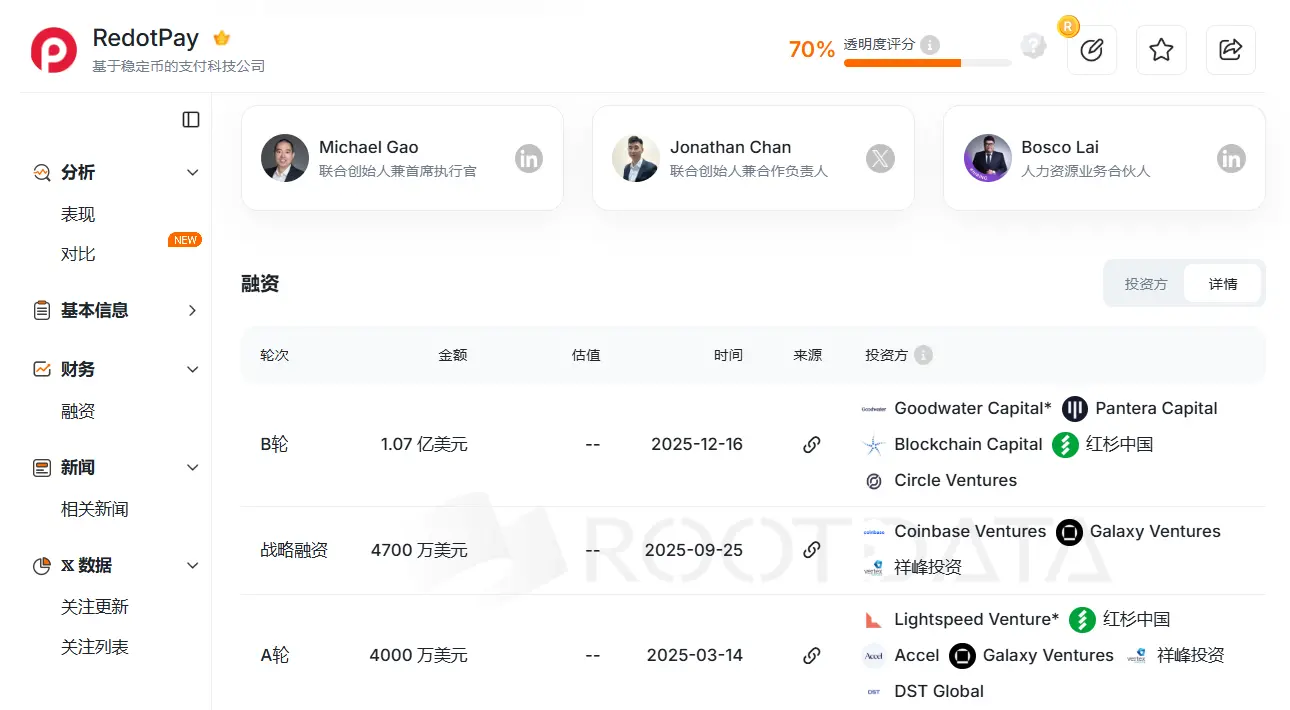
Image from RootData
Why Become a Dark Horse in the Payment Track?
The story of RedotPay began in early 2023, with its co-founder and CEO Michael Gao having served at top banks like HSBC and DBS, and being a core member of crypto technology service provider ChainUp. Additionally, the company's COO Troy Yao and CTO Xinman Fang both have years of experience in the crypto industry or software development, coming from platforms like Huobi or VCB.
According to insiders, RedotPay was initially incubated by Yuan Dawei, who began researching Bitcoin in 2010, was one of the early co-founders of Huobi, and is the founder of KuShen Wallet. He has significant influence and trust within the early Bitcoin investor community and miner groups, and has been one of the operators behind several popular tokens in recent years, well-versed in the early user growth and narrative logic of the crypto industry.
The team's background determined that RedotPay follows a typical Chinese internet strategy, which is to aggressively capture market share at any cost, and once economies of scale are achieved, to continue financing, ultimately monetizing through diversified financial services.
Specifically, RedotPay's core business is driven by a Visa co-branded debit card, allowing users to deposit cryptocurrencies like USDT and BTC into the app, and then use the card for instant settlements across the global Visa payment network, including offline ATM withdrawals, supermarket purchases, online subscriptions, and Apple Pay/Google Pay, with the system automatically completing the conversion from cryptocurrency to fiat.
On this basis, RedotPay further developed Global Payout (local fiat payment), a P2P fiat trading area, and an Earn & Credit financial module with interest-earning and lending functions.
- Visa Payment Card: Supports direct settlement with stablecoins, covering over 100 countries worldwide.
- Global Payout: Supports direct withdrawal of local fiat (e.g., BRL, NGN).
- OTC and P2P Market: By introducing local OTC merchants, users can directly buy or sell cryptocurrencies with local currency.
- Earn Interest: Enhances the duration of funds through financial products.
- Crypto Credit: Provides credit limits backed by cryptocurrency collateral.
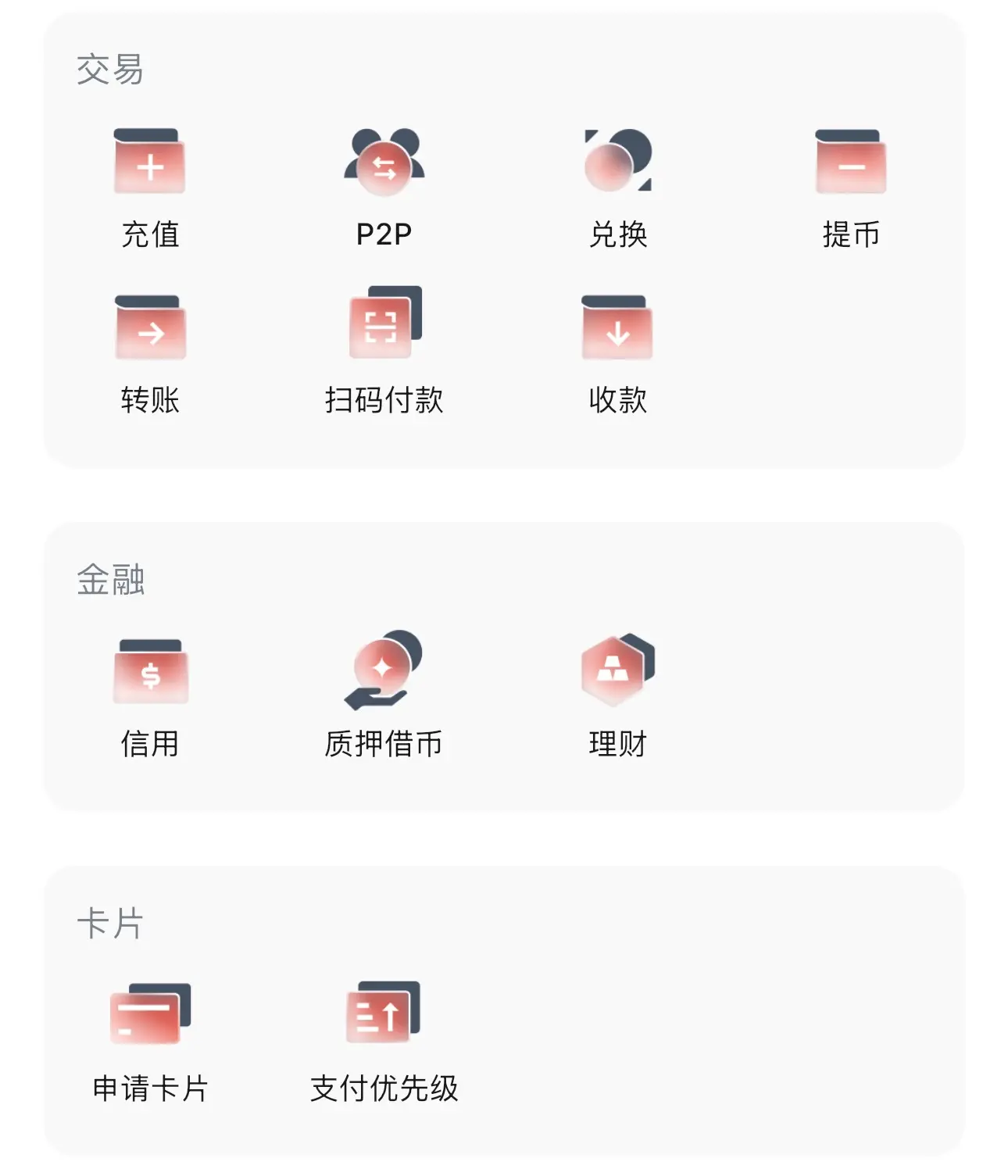
Image from RedotPay APP
RedotPay's early landscape is highly focused on emerging markets with significant fiat currency fluctuations, such as Nigeria, Brazil, and Southeast Asia.
- May 2023: RedotPay officially launched in Hong Kong and quickly obtained an MSO license.
- October 2023: Officially launched virtual Visa cards and physical cards, supporting Apple Pay and Google Pay.
- August 2024: User count surpassed 5 million.
- March 2025: Completed a $40 million Series A funding round led by Lightspeed.
- June 2025: Officially launched Global Payout (global payment) feature.
- September 2025: Secured $47 million in strategic investment, bringing in capital from Coinbase Ventures and others, with a valuation reaching $1 billion.
- October 2025: Announced that the P2P market supports transactions in over 50 local fiat currencies.
- December 2025: Completed a $107 million Series B funding round, attracting top institutions like Sequoia China, Pantera Capital, and Circle Ventures. Meanwhile, the official disclosure indicated that its global registered users exceeded 6 million, with an annual payment volume exceeding $10 billion, covering over 100 countries, and achieving profitability.
According to insiders, the actual number of registered users globally has surpassed 10 million, with the latest valuation possibly reaching $2 billion. From its official start in 2023 to achieving stable profitability today, RedotPay has accomplished this in less than three years, which is rare in the illiquid crypto market.
Its growth logic is a combat model known as the "Army System." Simply put, it is abandoning high-cost online user acquisition in favor of building an offline distribution network.
An anonymous crypto card entrepreneur emphasized that RedotPay initially relied almost entirely on this grassroots promotion system, maintaining a high card issuance fee and transaction fees to leave a significant profit margin for the offline promotion teams. Currently, the issuance fee for its virtual card is $10, while the physical card is $100, and each transaction includes about a 1% fee.
The high profit-sharing mechanism turns every local KOL, OTC merchant, community leader, and even small loan intermediaries into promoters of RedotPay.
An industry observer noted that RedotPay's traffic experienced a stepwise increase in early 2025, with almost all coming from users actively searching, indicating that it has formed a word-of-mouth diffusion among target user groups, making its customer acquisition efficiency top in the industry during the early stages.
According to official data, as of November 2025, RedotPay added over 3 million new users in that year alone, with annual payment volume increasing nearly threefold year-on-year. Industry insiders suggest that among RedotPay's users, there may be a group of core users with high consumption capacity and frequency, contributing a significant portion of revenue.
Valuation Premium Behind the NeoBank Closed Loop
However, how far can a strategy relying on high fees for incentives go?
Although users are currently willing to pay high costs, the model of 'feeding' offline agents with high fees essentially exchanges financial spreads for growth speed.
In the fiercely competitive environment of crypto payments in 2026, RedotPay seems to be caught in a paradox: to maintain the loyalty of agents, it must keep high profit-sharing; yet to fend off encroachment by licensed large firms, it must lower fees.
The high valuation given by the capital market clearly reflects more than just a payment for the buy-sell spread. In fact, capital values who can keep users' money, and the market is currently paying a premium for this potential banking attribute.
What truly makes RedotPay valuable is that they have achieved a high degree of completion in transitioning from a payment tool to a crypto-native bank (NeoBank).
Pure payment channels have low gross margins and are easily replaceable, while RedotPay constructs a complete financial closed loop of "deposit-earn-borrow-consume" through Earn interest and Crypto Credit lending functions, preventing users from leaving immediately after depositing.
Under this logic, users deposit USDT into the app, retain funds through the Earn (interest-earning) function, and then use Credit (collateralized borrowing) to obtain fiat limits for consumption. As industry observers have noted, even if only 10% of the $10 billion transaction volume is converted into retained deposits, the resulting interest spread and financial derivative income will far exceed traditional payments.
BKJ's market head, Boyan, believes that the key to RedotPay's success lies in its early willingness to make product decisions around real usage scenarios, as genuine user needs are the driving force for development.
However, behind the seemingly beautiful closed loop lies a liquidity game. Boyan also cautioned that once there is insufficient risk control buffer between earning interest, credit, and consumption, the highly intertwined financial closed loop may face significant pressure risks during extreme market conditions or liquidity crunches.
Beneath the shell of NeoBank, whether assets achieve true legal isolation is the next question it must answer.
Compliance Concerns and Boundary Race
From another perspective, RedotPay is actually seizing the window period where regulation has not fully covered emerging markets, completing a race regarding efficiency and compliance boundaries.
After all, the prosperity of the payment track always exists under the Damocles sword of compliance.
Chaintech founder Kevin Piao emphasized that the well-known "compliance cliff" theory is equally applicable in the Web3 payment field, meaning that the smaller the scale, the safer it is, while the larger the scale, the more dangerous it becomes.
Early rapid growth often stems from exploiting regulatory gray areas or the lag in bank risk control. However, when transaction volumes exceed a certain threshold (e.g., tens of millions of dollars monthly), it triggers in-depth compliance audits by issuers and clearing networks (Visa/Mastercard). Many once-popular crypto card companies have failed at this stage.
Although RedotPay has been actively laying out compliance and incurring high compliance maintenance costs, the challenges it faces still lie in the dynamic upgrading of regulatory standards.
RedotPay adopts a "puzzle-like compliance" structure. Although it holds MSO (Money Service Operator), Money Lender licenses, and TCSP (Trust or Company Service Provider) licenses in Hong Kong, and has obtained VASP registration in Lithuania, Argentina, and other places, this does not mean it can rest easy.
Lawyer Liu Honglin from Mankun Law Firm analyzed that this combination overall belongs to 'business can run, and can explain to regulators,' but it is not a single license that covers all matters.
Why is it called a puzzle? Because it actually stacks several traditional financial services with completely different legal classifications, such as payment collection, currency exchange, remittance, cross-border payment, lending, and interest-earning.
The biggest risk of this structure is that certain links in the product chain may only "look similar," but legally they still reside in gray areas.
Lawyer Liu Honglin pointed out that the Hong Kong MSO essentially regulates "fiat currency exchange," but "stablecoin to fiat currency" may not automatically be considered an exchange business in many countries. Moreover, the real regulatory gray area focuses on the execution of collateral in crypto-backed lending and the nature of Earn products.
Regarding the Earn interest function, which has attracted significant capital attention, Lawyer Liu bluntly stated that such products are easily viewed as unregistered securitized products or collective investment schemes under the regulatory perspectives of multiple countries. "If regulators believe you are issuing financial products with expected returns to the public, you should be subject to securities law regulation, rather than circumventing it with 'crypto innovation.' The previous heavy penalties against BlockFi by the SEC serve as a cautionary tale."
In the Crypto Credit (crypto-backed lending) segment, although the lender's license resolves the "lending qualification," the legal certainty of crypto assets as collateral is far weaker than traditional collateral. In the event of extreme market conditions or liquidation disputes, whether its collateral rights can be supported by the court currently lacks a mature legal framework.
Conclusion
The crypto market in 2026 is witnessing more projects moving towards compliance and institutionalization, with RedotPay and its competitors accelerating the improvement of product and ecosystem layouts. In January of this year, its core competitor Rain announced the completion of a $250 million Series C funding round, with a valuation reaching $1.95 billion.
For RedotPay, licenses are merely a shell; continuous compliance is the essence, and this is the most fragile link for the team. Whether it can repair its puzzle structure through compliance efforts before regulatory tightening will determine whether it ultimately becomes a financial giant in the crypto world or merely a shooting star in the history of payments.
In summary, this race concerning efficiency, greed, and boundaries has already entered its second half.
 Risk warning
 Risk warning



Popular articles