Please be kind to Jack Yi
 Core Viewpoint

 In a market still dominated by anonymous dealers, platform manipulation, and information asymmetry, Yi Lihua's open card operation deserves respect.
Author: Gu Yu, ChainCatcher
With the sharp decline in BTC and ETH prices in recent days, the positions of Jack Yi, founder of Trend Research and Liquid Capital (formerly LD Capital), have drawn significant attention from many investors in the crypto space. His leveraged position of 650,000 ETH is now precarious in the current market, just a step away from liquidation.
For this staunch ETH bull, a rare on-chain trader, and a representative of the Asian crypto institutional sector, the current situation is indeed somewhat cruel and lamentable. After all, concepts like "transparency," "bullish sentiment," and "research-driven investment" align with the mainstream values of crypto, and Yi's current "battle" is, to some extent, a "battle for the legitimacy" of the crypto industry.
So how did all this happen? Why did Yi go from successfully selling at the top to buying at the bottom and getting trapped? What insights and lessons can we draw from this?
From Bottom Fishing to Selling at the Top
Jack Yi is an early OG in the Chinese crypto community, having invested in hundreds of blockchain projects since 2015. Early investment cases include EOS, Quantum Chain, VeChain, and in 2017, he invested in well-known projects like Near, CertiK, and MEXC through LD Capital.
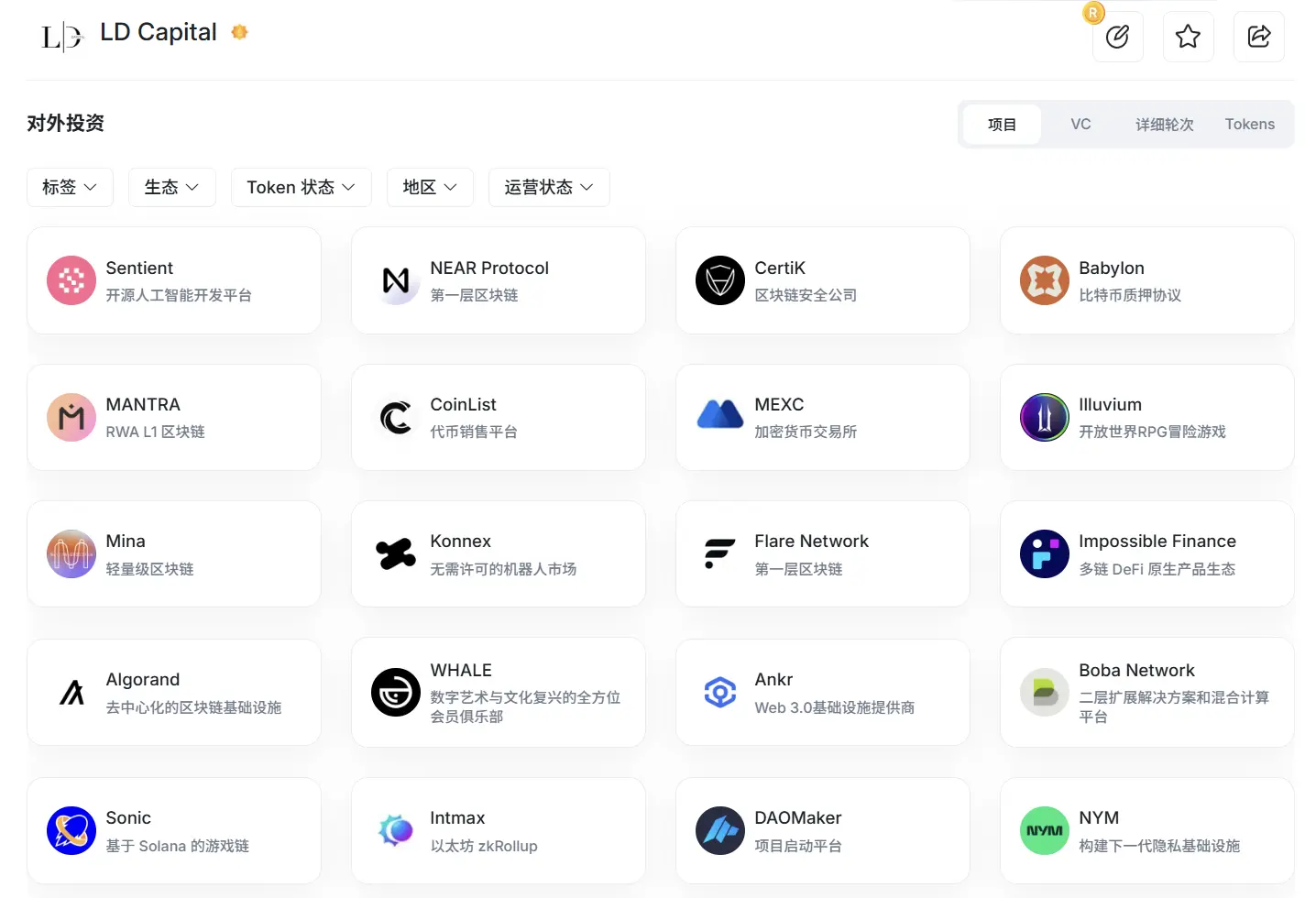
Some investment cases of LD Capital Source: RootData
Since early 2025, Yi's focus has shifted from the primary crypto market to the secondary market. In April 2025, the price of ETH fell to a new low since 2022, dropping to as low as $1,385. Yi's bottom fishing quietly began at this time.
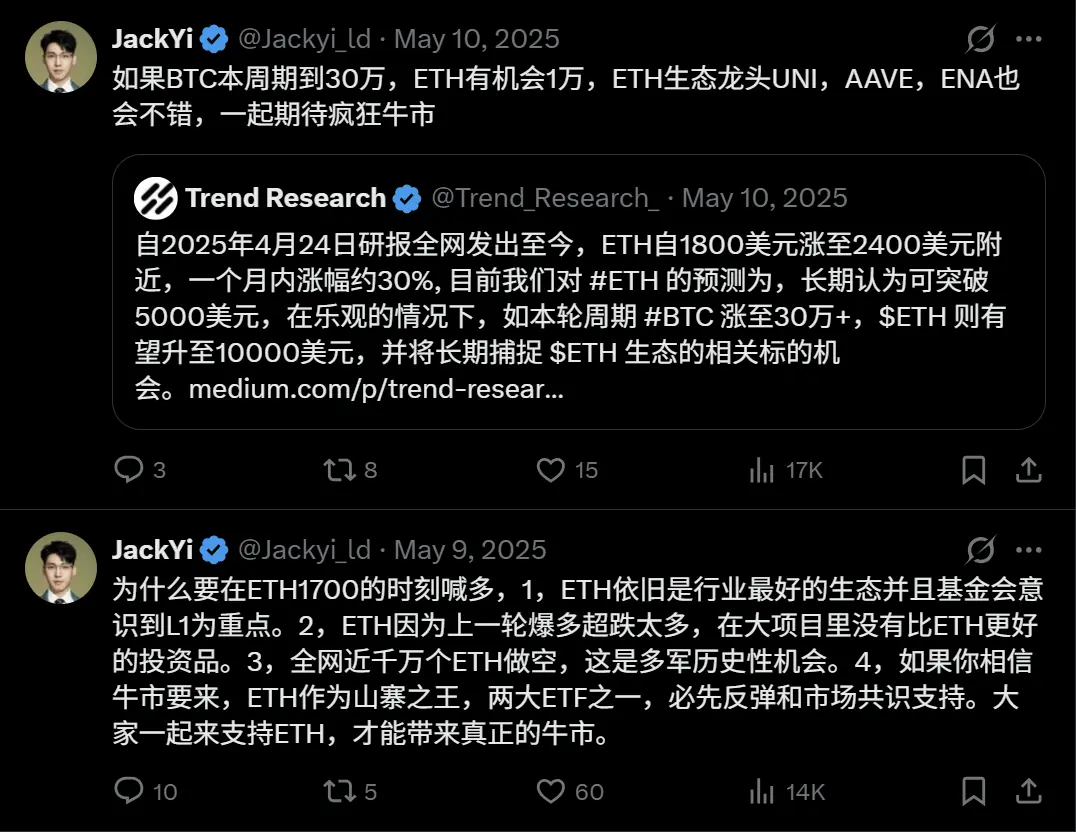
At the end of April, Trend Research publicly released a report bullish on ETH when the price rose to $1,800, stating, "Under the trend, more upward movement in the crypto market is imminent."
By the end of May 2025, Trend Research's frequent large on-chain purchases were discovered and disclosed by on-chain analyst Yu Jin, and Yi promptly claimed these addresses on X. At this point, ETH had risen to $2,600, and Trend Research's on-chain addresses held a total of 133,000 ETH, worth $360 million.
However, it should be noted that Trend Research's operations were not entirely cash purchases; a significant portion of the funds used to buy ETH was borrowed against early purchased ETH on Aave, effectively leveraging the position several times.
In June 2025, Trend Research published another article titled "Written on the Eve of a Surge: Why We Are Bullish on ETH," mentioning that the institution remains optimistic about ETH's underlying logic: the Trump administration's commitment to establishing a stablecoin system… and that the most important infrastructure for stablecoins and on-chain finance is Ethereum. The influx of stablecoins and the continuous development of RWA will bring further prosperity to DeFi, increasing Ethereum's consumption and GAS revenue, thereby boosting its market value.
At this time, the price of ETH was around $2,800. Yi publicly stated that he believed ETH's long-term price could exceed $5,000, and in an optimistic scenario, BTC's price could rise above $300,000, with ETH expected to reach $10,000. Meanwhile, Yi indicated that he had purchased 100,000 ETH options.
In July 2025, Yi tweeted that the market had completely entered a long bull market, and there might no longer be traditional four-year cycle patterns. Stablecoins and blockchain represent the best opportunity for the globalization of the dollar for the United States, investing in cryptocurrencies with one hand and earning interest on stablecoins with the other, leading to a continuous influx of new users and funds into the market.
After that, Yi almost increased his position every month until early October when he began to warn about market risks and quickly transferred most of his ETH holdings to Binance for sale, at that time around $4,700, just escaping the October 11 incident. He later stated that he saw signs of a market downturn from investment research data.
Through this round of precise bottom fishing (starting to build positions around $1,800 in the first half of the year) and realizing profits at the peak, Yi achieved significant doubled profits and solidified his influence as a top trend investor in the Chinese-speaking community.
Second Position Building and Being Trapped
In the reshuffled market after the October 11 incident, Yi saw another opportunity to build positions. At the beginning of November, Yi tweeted again that ETH was starting to rebound and continued to be optimistic about the subsequent market and the strategy of buying on dips. He later stated that the $3,000-$3,300 range was the spot buying zone for ETH.
As ETH continued to pull back, Yi indicated that under the dip-buying strategy, he had fully loaded on ETH at a price of $2,700, and then continued to increase his position through leveraged borrowing during the decline, reaching over 650,000 ETH by January this year, with an average cost reportedly at $3,180.
"When ETH dropped to just over $1,000, we saw through the main force's intention to clear out the ETH OG bulls and successfully bottomed out. When ETH rose to over $4,500, we saw through the market's rise to the peak of the oscillation and successfully liquidated. Trend Research has proven successful bottom fishing and selling at the top in 2025; we will not change our investment strategy due to emotions," Yi was still encouraging the market in January.
But no one could have predicted that the market would hit this seasoned investor hard at this time, with ETH prices continuously breaking through key levels of $2,200, $2,000, and $1,800 in early February, approaching his liquidation price.
In just a few days, Yi continuously sold off about 200,000 ETH to stop losses, lowering his liquidation price to around $1,600, narrowly escaping a disaster in the early morning crash today. According to on-chain analyst Yu Jin's analysis today, Trend Research has incurred a loss of $763 million this time, not only giving back all the previous profits but also losing $448 million in principal.
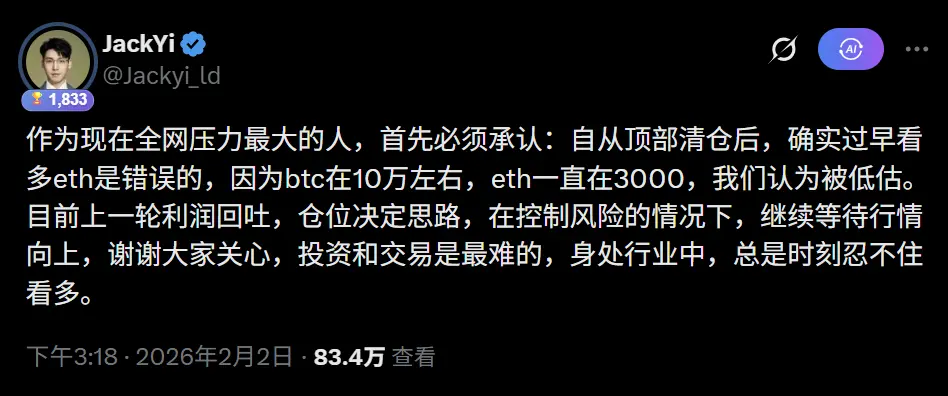
In recent days, Yi has tweeted to admit his mistakes, "Since clearing out at the top, it was indeed a mistake to be overly bullish on ETH too early, because BTC was around $100,000 while ETH was stuck at $3,000, which we believed was undervalued. Currently, the previous round of profits has been given back, and position size determines mindset. Under the premise of controlling risk, we will continue to wait for the market to move up. Thank you all for your concern; investing and trading are the hardest, and being in the industry, I always can't help but be bullish."
"Why do I always find it hard to resist being bullish? It relates to my past entrepreneurial experience. Back then, I couldn't find a job and started my own business. After earning my first pot of gold, I didn't dare to spend lavishly and instead invested in tech projects. Entering the crypto space in 2015, I hit the golden age, which was a continuous journey of being bullish. But later, in the bear market, I suffered significant losses and couldn't withstand the bear market, leading to an early liquidation of BTC, ultimately missing out on the big bull market after March 12. We have experienced two rounds of bear markets before the bull market, so this time, after selling at the top, I was relatively confident in bottom fishing too early and will continue to wait while controlling risk."
Zhusu, founder of Three Arrows Capital, posted on X discussing this matter, "In my experience, selling at a high is often more dangerous than selling during a downturn. This is because the excitement from selling at a high can lead to premature additional buying and overconfidence. I suspect Jack Yi, after making nine-figure profits on October 10, made a similar arrogant mistake."
However, after experiencing these twists and turns, Yi still expressed his firm view on the future market, "As a bull in this round, we remain optimistic about the performance of the new bull market: ETH reaching above $10,000, BTC exceeding $200,000. We only made some adjustments to control risk. I know everyone is disappointed with the industry and the leaders, especially after the October 11 incident, which brought liquidity shortages and some platform manipulations, but I believe the long-term trend in the crypto space remains unchanged. Now is the best buying period for spot assets. Volatility is the biggest characteristic of the crypto space; countless bulls have been thrown off by this volatility, but often the subsequent rebounds are doubled."
Currently, the price of ETH has rebounded to around $1,900, and the risk of Trend Research's position has significantly decreased, but the impact and insights from this event will continue to resonate.
The Market Needs More Bullish Sentiment and Transparency
As one of the few representatives who choose "on-chain transparency," openly sharing all thoughts and position dynamics, Yi's every statement and action has become an invisible mirror for the industry: reflecting the belief in trend investing while amplifying the non-linear risks of leverage; showcasing the power of logic realization in a bull market while exposing the fragile balance between emotions and positions during a pullback phase.
However, in a market still dominated by anonymous manipulators, platform manipulation, and information asymmetry, Yi's public choice itself is a rare courage—he verifies his judgments through real on-chain operations rather than mere rhetoric. This approach, while bringing immense personal pressure and temporary floating losses, provides countless retail investors and small to medium institutions with the most intuitive textbook: how to sell at the top in a bull market, how to bottom fish in a bear market, how to manage leverage, and how to restrain emotions.
In the highly volatile and uncertain arena of the crypto market, no matter how glorious past successes or profound cyclical insights may be, they cannot completely exempt participants from the market's cruel lessons—because every cycle will test participants anew with different forms, intensities, and variables. In this cycle, the crypto market has become closely intertwined with the macroeconomic environment (CPI, US stocks, gold, etc.) and geopolitical events, and any significant changes outside the industry could reverse the cyclical trends within.
This experience once again proves that what truly determines whether investors can navigate through cycles is not the correctness of a single directional choice, but whether they reserve enough survival space for each judgment amid ongoing uncertainty, and their ability to stop losses and restart promptly when errors occur. Respecting the market is a principle that every investor must always adhere to.
Additionally, it is worth noting that Trend Research, as one of the top three ETH holding entities in the market, has become a barometer for institutional crypto investors in the Asia-Pacific region, and its successes and failures are also related to the voice and status of the Asian market in the crypto industry. There are also views in the market that the Asian market, as a significant liquidity support for the current crypto market, has a high proportion of retail structure and more intense emotional transmission. Once the bullish sentiment is broken, there is a risk that the Asian market will long-term become a passive recipient of North American narratives and liquidity.
Fortunately, Yi and his Trend Research are still at the table. The crypto industry needs more steadfast "bulls," more "transparency," and more "Jack Yis."
It should be known that the story of Trend Research will be seen by more mainstream institutions and deep-pocketed entities. The crypto industry needs more stories that emphasize research, adhere to investment discipline, and control risks to achieve returns, rather than more MEME-style wealth transfers. The former can bring in incremental investors, while the latter can only exacerbate the casino-like nature of the crypto industry.
 Risk warning Risk warning