Interlace releases Agent Card, aimed at building a controllable payment mechanism for AI Agents

 The global Web3 fintech platform Interlace has launched the Agentic Payment virtual card, which addresses the pain points of fund security and boundary control in AI automatic payments, targeting the trillion-dollar smart trading market.
Recently, the global Web3 fintech infrastructure platform Interlace announced the launch of Agentic Payment, providing secure and controllable virtual card products (Agent Card) for AI Agents.
Interlace founder and CEO Michael Wu stated that as AI begins to initiate tasks, invoke services, and complete transactions on behalf of humans, payments will no longer just be an execution action but need to be restructured as a fundamental capability that can be called by the system. The launch of the Agent Card by Interlace is not merely a product innovation but an adjustment and reconstruction of the payment path in response to changes in transaction entities.
AI moves from participating in decision-making to direct transactions, with autonomous payment needs gradually emerging
Currently, AI technology is evolving from model capabilities to systematic applications, transitioning from an auxiliary tool to an entity with execution capabilities, which is also driving changes in transaction forms. Payment processes that were primarily initiated by humans are beginning to be partially taken over by automated systems.
From an industry development perspective, the evolution of Agentic Payment has certain phased characteristics. In 2024, some players represented by Web3 will begin to explore AI scenarios around programmable payments, still in the early stage of capability advancement; 2025 will become an important turning point, with mainstream card networks like Visa and Mastercard successively launching related solutions, marking the entry of this direction into the mainstream payment system's focus, gradually shifting the industry's focus to infrastructure construction such as protocols and standards; entering 2026, with the enhancement of the new generation of AI Agent capabilities, the market will begin to discuss its role in autonomous execution and transactions, further expanding the boundaries of related applications.
Industry data also confirms this trend: global AI spending is expected to reach $2.52 trillion by 2026; the AI Agent market size is expected to reach $10.91 billion and maintain a high growth rate in the coming years; at the same time, AI-driven transaction behaviors (Agentic Commerce) are expected to form a scale of $3-5 trillion by 2030.
As AI moves beyond mere analysis and recommendations to gradually participate in specific transaction processes such as subscription renewals, advertising placements, and travel bookings, payment capabilities begin to become a key part of its execution loop. However, in reality, traditional payment systems still have certain limitations in adapting to automated execution, high-frequency invocation, and risk control, especially in terms of authorization boundaries, fund security, and process traceability, which still need improvement.
Four core capabilities, Interlace builds a controllable payment system for AI Agents
In this context, Interlace further focuses the issue on: how to establish clear and executable boundaries while empowering AI with execution capabilities. As Michael Wu emphasized, the key to AI payments is not "whether it can complete the payment," but "whether it can execute within a controllable range."
During the Space event co-hosted with Web3 leading media Metaera on April 9, Henry Chan, head of compliance and operations at Interlace, shared detailed insights on the core mechanisms and application methods of the Interlace Agent Card, combining practical scenarios such as SaaS subscriptions, travel bookings, and advertising placements.

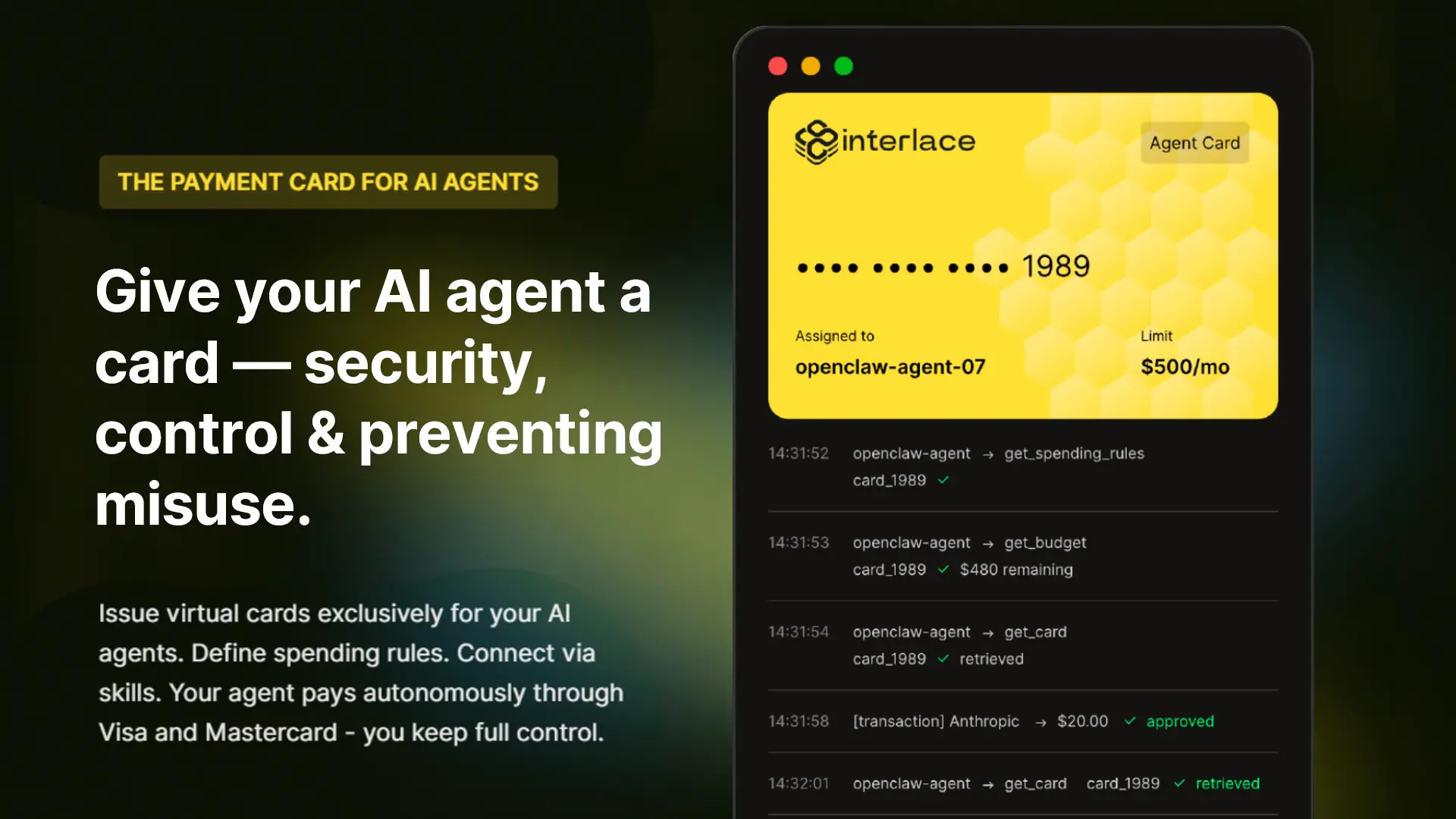
From a product perspective, its core is a dedicated virtual card (Agent Card) for AI Agents, which introduces rule control and fund management mechanisms, allowing payment behaviors to be automated while maintaining controllability.
To address users' common concerns about fund security risks, users can pre-set transaction conditions such as time frames, amount limits, and merchant types through the Interlace Agent Card. For example, limiting transactions to weekdays from 9 AM to 6 PM, allowing only SaaS/travel/advertising merchants, or setting transaction limits of $100 per transaction and $500 per month. Notably, these rules not only take effect at the application level but are also synchronized to the card organization (such as Visa, Mastercard) network for execution, fundamentally reducing the possibility of rules being circumvented by technical means.
At the same time, the Interlace Agent Card adopts Just In Time (JIT) funding allocation, meaning the card balance is always maintained at 0, with funds released instantly only after transaction authorization is approved, and the balance returns to 0 after the transaction is completed, thereby reducing the risks associated with fund exposure.
In terms of access methods, Agents can access payment capabilities through simple configurations, such as uploading skills.md or MCP configuration files, to invoke budget, rules, and card-related functions without complex system integration, allowing payment capabilities to be embedded within their task execution processes. Additionally, the rule verification and execution paths during the transaction process will be recorded to support subsequent audits and tracking.
From an application perspective, the four core capabilities mainly address issues that may arise from AI Agents participating in transactions, such as unclear authority boundaries, uncontrollable fund usage, and insufficient process visibility, while also providing a practical path for payment implementation in Agent-to-Real-World scenarios.
Leveraging mature payment infrastructure capabilities to promote AI payment implementation
As the industry develops, the Agentic Payment field is gradually forming different divisions of labor: traditional financial network players (such as Visa, Mastercard) focus on integrating AI into existing payment network systems, while Web3 and stablecoin payment players explore machine-native settlement methods. Financial technology platforms, including Interlace, focus on building system-level capabilities to solve the access and execution issues of Agent payments in real-world scenarios.
As a provider of Web3 payment infrastructure, Interlace has processed over $18 billion in payments, issued more than 7 million cards, and served over 7,500 enterprise clients. These existing network capabilities provide foundational support for payment execution in AI scenarios.
Michael Wu stated, "Interlace's core positioning is to be a provider of system adaptation capabilities for real-world payments, rather than merely a supplier of payment products. The large-scale implementation of AI Agents must rely on existing payment networks, merchant resources, and compliance systems, which is also the core reason why Interlace chooses to focus on Agent-to-Real-World scenarios. We hope to empower all players entering the Agentic Payment field with card issuance capabilities, system construction capabilities, and connections to real-world payment networks, allowing them to quickly realize the commercialization of AI payments without building an adaptation layer from scratch."
It is worth noting that Interlace will appear at the Hong Kong Web3 Carnival, participating in events such as The Scaling Summit and RWA & Payments 2026, to discuss the integrated development of AI and Web3 payments with industry partners and share innovative practices in stablecoin payment infrastructure, further promoting the implementation of Agentic Payment scenarios and technological development.
 Risk warning



Popular articles