BNB Chain Spring Report: From New Heights in RWA to Leading the AI Agent Economy, a "Structural Leap" is Happening
 Core Viewpoint

 How to create a full-link growth flywheel of assets, talent, technology, and value feedback?
Author: momo, ChainCatcher
During the recently concluded Hong Kong Web3 Carnival, BNB Chain climaxed the BNB HK Super Meetup with a drone show, marking its largest ecological gathering in the Chinese-speaking market in recent times.
However, more impressive than the drones are the figures BNB Chain has delivered on-chain. In Q1 2026, this "spring report card" is solid and striking, with multiple key indicators reaching new highs, even topping the charts:
On one hand, real assets are accelerating on-chain. The total locked value of RWA on BNB Chain has reached $3.8 billion, setting a historical record.
On the other hand, on-chain usage and liquidity continue to expand. Its number of monthly active stablecoin sending addresses ranks first globally, while the number of on-chain AI agents has reached 68,991, surpassing mainstream public chains like Ethereum, making it the network with the highest deployment of AI agents.
At the same time, the ecological supply and value feedback mechanisms are being strengthened synchronously. BNB Chain, in collaboration with YZi Labs, has launched roadshows at top universities in the U.S. such as Stanford, Harvard, and UC Berkeley; simultaneously, it completed its 35th quarterly burn, destroying a total of 1,569,307 BNB, valued at over $1 billion, further reinforcing long-term value feedback.
For a public chain that is already in a leading position, this kind of "multi-dimensional synchronous strengthening" is significant not for validating its existing closed loop, but for indicating a more important change: a structural leap from "on-chain ecological closed loop" to "infrastructure platform oriented towards the real world and new productive forces."
In other words, BNB Chain is no longer just a self-circulating crypto network through DeFi, trading, and user growth, but has become a value network that simultaneously accommodates RWA, AI agents, and other more outwardly demanded needs. This is the key perspective for understanding BNB Chain's current growth.
I. RWA: Doubling Growth, Entering Acceleration Phase
RWA is undoubtedly one of the most significant highlights of BNB Chain's ecological growth. Over the past period, it has gradually formed a complete link from asset issuance, liquidity support to DeFi utility, entering an acceleration phase.
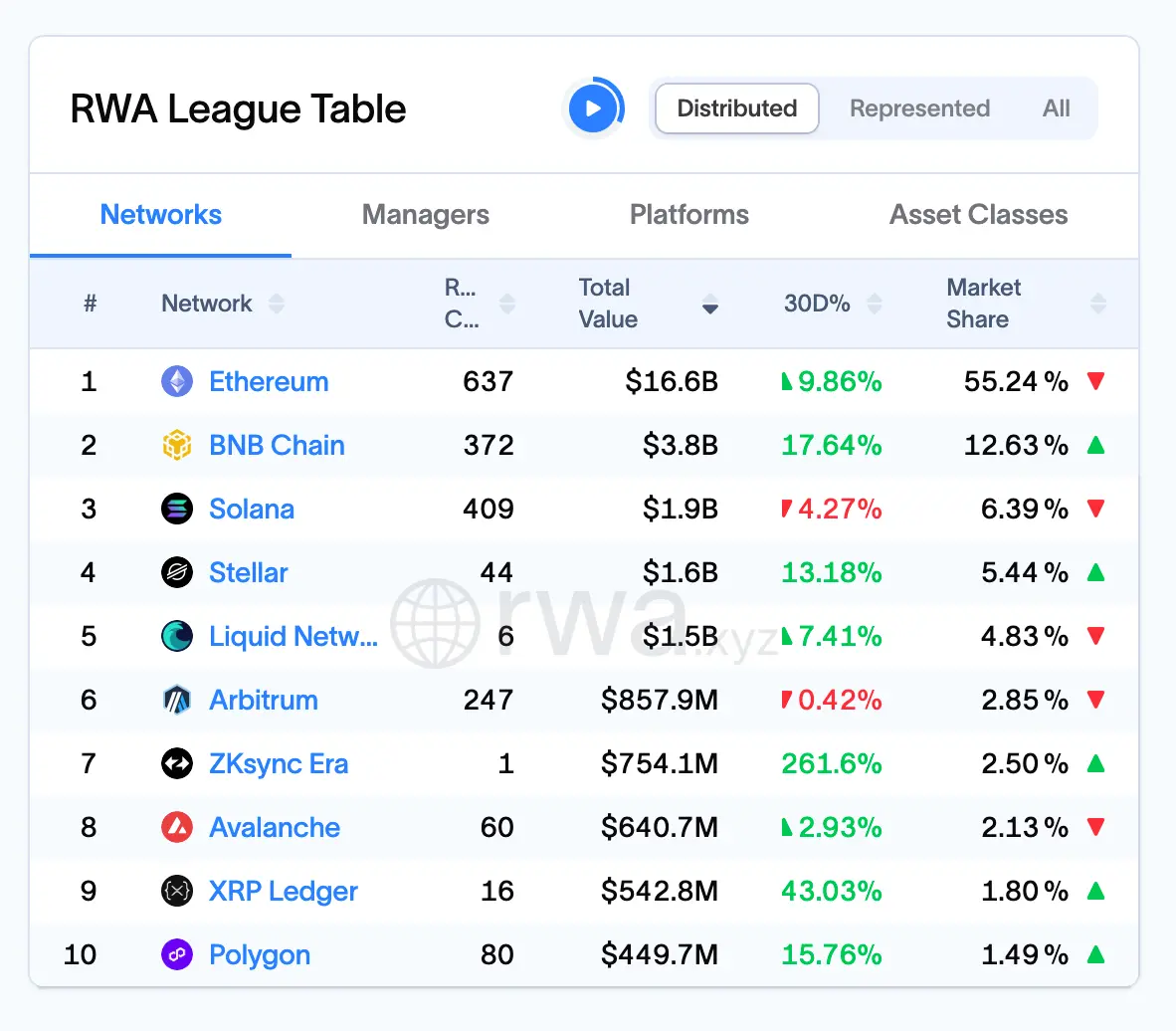
In terms of scale, BNB Chain has become the largest RWA public chain outside of Ethereum. Data from RWA.xyz shows that its total locked value of RWA has reached $3.8 billion, setting a historical record, with 372 types of assets and 44,446 holders on-chain.
However, more noteworthy than the scale itself is the speed and slope of its growth. Starting from the end of 2024, by the end of 2025, BNB Chain completed a surpassing of Solana within just one year, rising to become the second-largest RWA public chain. Entering 2026, this trend has further accelerated—RWA scale has rapidly grown from about $2 billion at the beginning of the year to the current $3.8 billion, nearly doubling; in contrast, Ethereum and Solana's growth rates during the same period were approximately 46% and 37%, respectively.
At the same time, BNB Chain's asset structure is also rapidly diversifying. Against the backdrop of a hot market for TradFi asset trading over the past year, its consistent ability to capture market trends and user demands has once again emerged, becoming an important platform for this round of asset on-chain. The current ecosystem covers gold/commodities (such as Tether Gold, PAX Gold), U.S. Treasury bonds and income products (such as BUIDL, USYC, BENJI, OUSG), stock/index assets, and various income-generating products, initially forming a diversified asset supply system.
Among them, XAUT's performance is particularly typical. This asset's market capitalization has exceeded $3.3 billion, and after launching on BNB Chain on March 26, it quickly became the largest single asset on-chain within a month. This speed not only reflects the asset's inherent attractiveness but also demonstrates BNB Chain's capability in distributing and accommodating liquidity, allowing users to gain exposure to physical gold directly on-chain without bearing the custody costs, premiums, and complex settlement processes associated with traditional gold investments, seamlessly integrating with DeFi scenarios.
Furthermore, BNB Chain's current RWA ecosystem is showing a trend of increasing institutional participation. Its partners include traditional finance and asset management institutions such as BlackRock, Franklin Templeton, VanEck, Securitize, and Ondo. This change may also be one of the important reasons for its rapid scale-up, as institutional-level assets and products gradually enter on-chain, enhancing asset quality and, to some extent, driving the simultaneous expansion of funds and liquidity, thereby amplifying the overall growth slope.
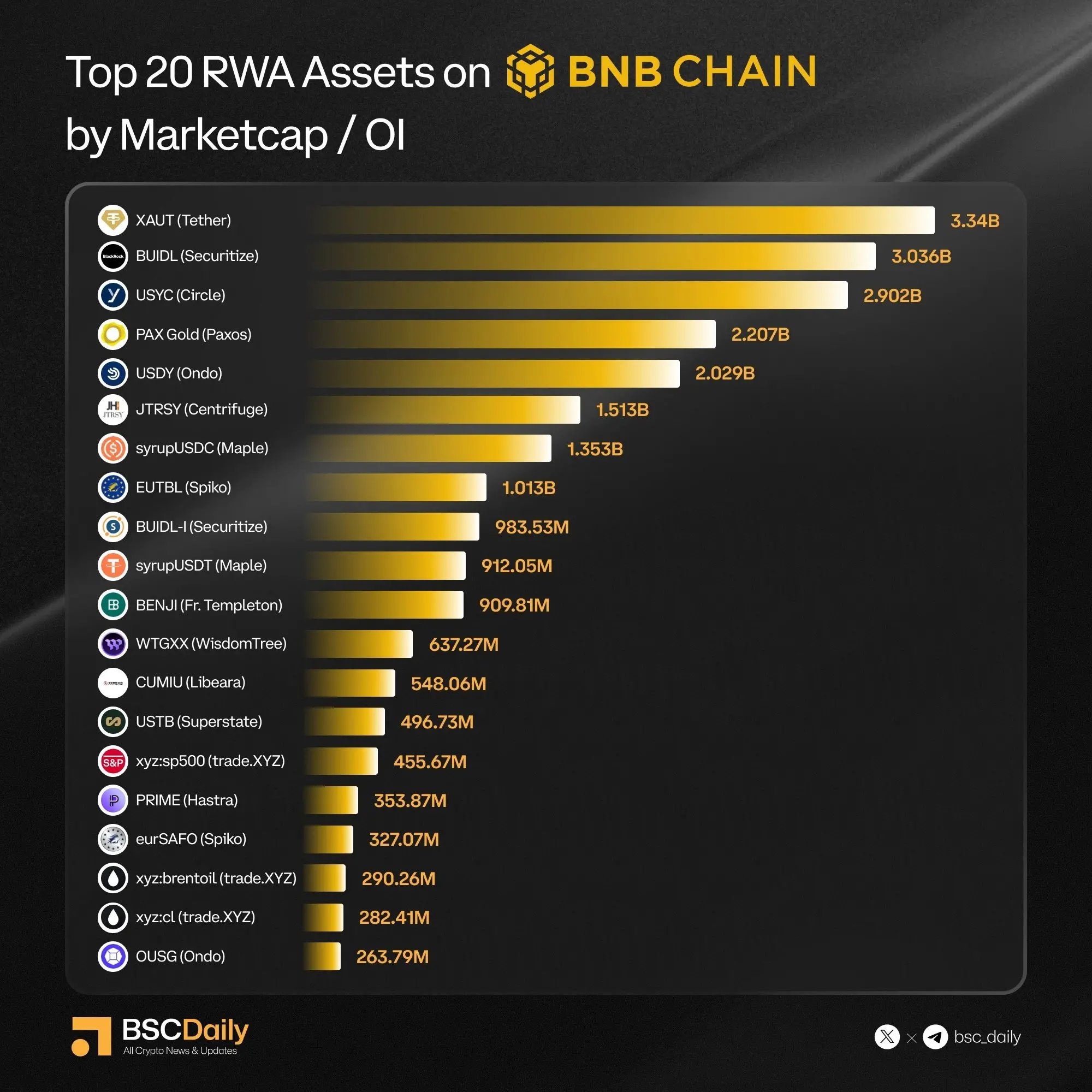
Ranking of the top 20 RWA products by market capitalization on BNB Chain; Source: BSCDaily, data as of April 22
However, for institutions and RWA projects, asset tokenization is not difficult; the real challenge lies in how to sell these tokenized assets and get real users/institutions to hold and use them. Without effective distribution channels, even the best assets are merely "sleeping assets."
According to data from RWA.xyz, the distribution ratio of RWA assets on BNB Chain has reached 100%, meaning that all on-chain assets can freely transfer and distribute, rather than remaining at the issuance end, demonstrating strong distribution and accommodation capabilities.
Focusing on this key point, BNB Chain's advantages are gradually becoming clear, mainly reflected in three aspects:
First is the full-stack infrastructure capability. From issuance contracts, KYC/AML, and ownership records to settlement and compliance layers, BNB Chain has formed a relatively complete enterprise-level solution and has synergized with a series of RWA infrastructure projects such as Securitize, Centrifuge, Ondo, and Backed Finance.
Second is the liquidity foundation driven by stablecoins. As of April 27, 2026, the total market capitalization of stablecoins on BNB Chain has exceeded $14.4 billion, with a transfer volume of $194.6 billion in the past 30 days, accounting for about 40% of global transaction volume. Notably, it holds only about 5% of the stablecoin supply but supports nearly 40% of transactions, indicating a very high capital turnover efficiency in actual usage scenarios (especially at the retail end).
Finally, there is DeFi distribution and user base. BNB Chain has approximately 817 million cumulative addresses and over 50 million monthly active addresses, with stablecoin monthly active sending addresses exceeding 15 million, ranking first globally. At the same time, on-chain DEX and lending DeFi infrastructures maintain high activity levels, allowing RWA assets to quickly gain trading depth and usage scenarios, rather than remaining as "on-chain certificates."
In summary, BNB Chain's advantages in the RWA track are not just "more assets," but rather that it has gradually opened up the complete path of "asset on-chain—liquidity accommodation—user distribution," allowing RWA to transition from "issuable" to "circulable and usable."
II. AI Agent Economy: Becoming the Public Chain with the Most On-Chain Agent Deployments
At the beginning of this year, as the AI Agent track continued to heat up, the agent economy once again became one of the most watched emerging tracks in Web3. In less than four months this year, AI agents have evolved from simple automation scripts to intelligent entities with on-chain identities, capable of autonomous decision-making, executing transactions, and holding assets, gradually becoming the core productive force of the Web3 ecosystem. The number of AI agents registered under the global ERC-8004 standard has surged from 337 at the beginning of the year to 164,000.
On BNB Chain, the number of AI agents has surged to over 68,991, accounting for more than 40% of the entire network, making it the public chain with the highest deployment of AI agents, far surpassing competitors like Ethereum and Base.
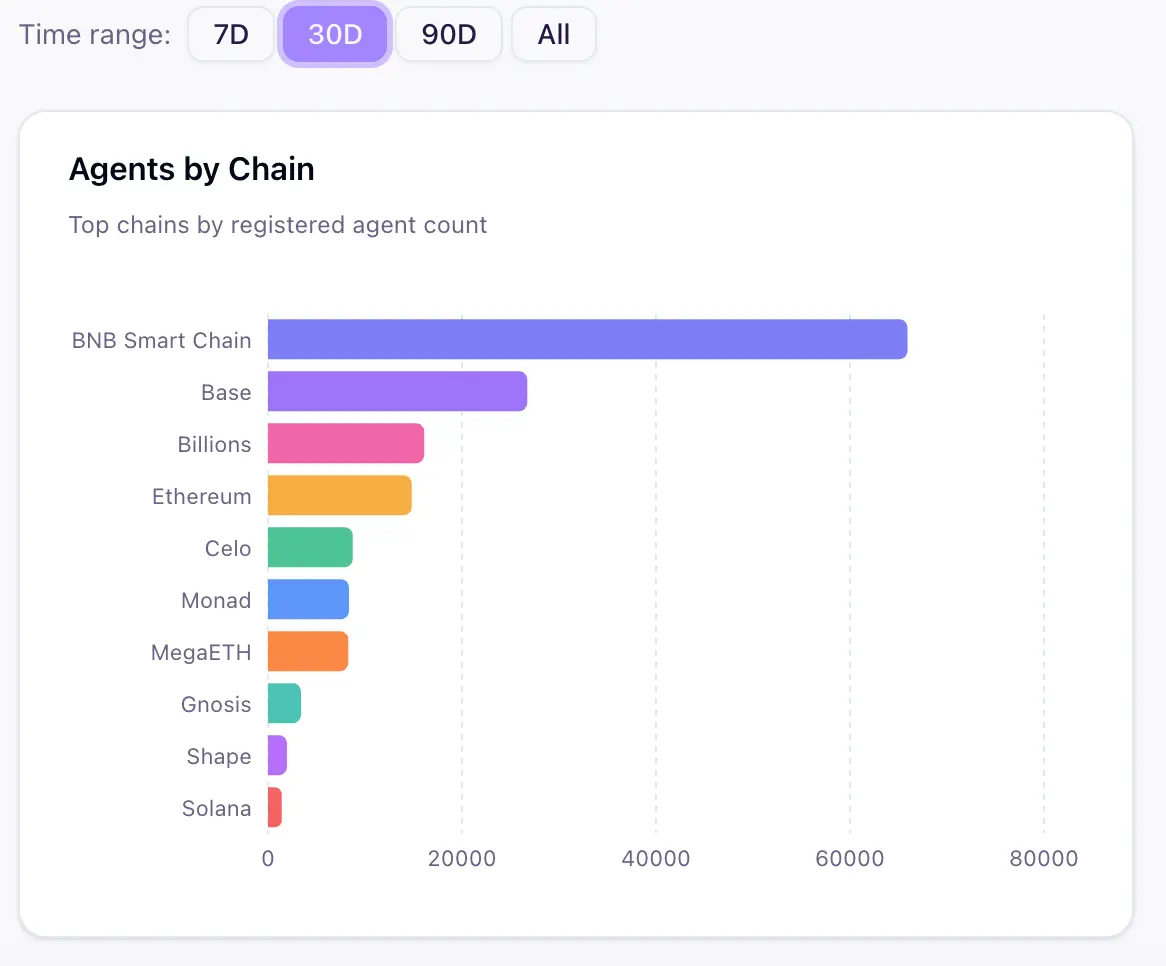
Data source: 8004scan
BNB Chain's leading advantage is not only reflected in deployment scale but also in standard innovation and practical usability.
In terms of deployment volume and on-chain activity of the ERC-8004 standard (which enables verifiable and portable identities for AI agents), BNB Chain is in a leading position. Its native BAP-578 standard (Non-Fungible Agent, NFA) further endows agents with complete on-chain economic attributes. This standard has undergone a comprehensive upgrade based on compatibility with ERC-8004, enabling AI agents to possess complete on-chain ownership, tradability, and upgradability, while supporting persistent intelligent memory, a Merkle tree-based learning proof mechanism, as well as advanced features like asset holding and autonomous execution.
As the number of agents surges, the agent economy is forming a parallel ecosystem independent of humans. BNB Chain's high-performance technical support and vibrant application ecosystem provide a first-mover advantage for developing the agent economy.
III. Cultivating "Reserve Forces" in Universities: From "Competing for Applications" to "Competing for the First Line of Code"
If RWA and AI agents represent BNB Chain's expansion capabilities within the existing ecosystem, another front points to a more fundamental question: who can define where the next generation of applications will emerge.
As infrastructure competition enters deeper waters, simply competing on TPS, transaction fees, or ecological incentives has become insufficient to create a gap. What truly determines long-term ecological density is no longer "how many applications are on-chain," but rather where these applications were originally built.
Competition is shifting from "competing for applications" to "competing for the first line of code from developers."
Based on this logic, BNB Chain, in March, launched the "Dev Roadshow" global university developer roadshow in collaboration with YZi Labs, starting at New York University (NYU) and subsequently covering top North American universities such as Stanford, Harvard, MIT, and UC Berkeley.
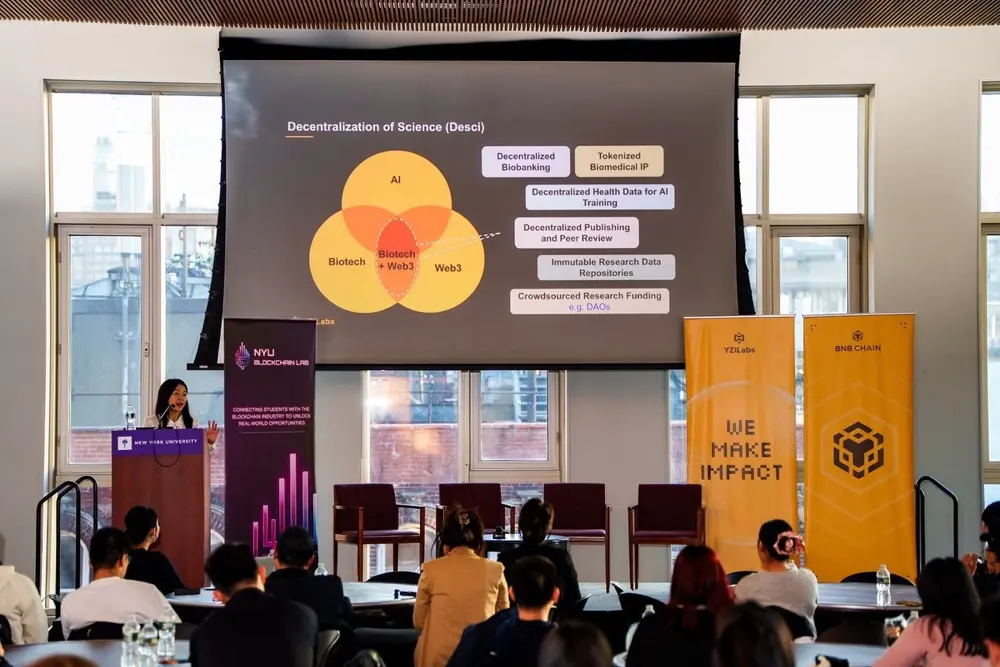
At each event, BNB Chain adopts a face-to-face workshop format on campus, including live demonstrations from BNB Chain and YZi Labs, sharing practical developer resources, open Q&A sessions, and networking exchanges with local blockchain communities.
These campus workshops are not only technical presentations but also a form of "infrastructure extension." From smart contract development, AI agent deployment (including BAP-578 standard practices), RWA asset design, DeFi applications, to on-chain performance optimization and other cutting-edge content, BNB Chain is helping students quickly get acquainted with the BNB Chain tech stack and understand the real on-chain building path.
BNB Chain officials stated that this roadshow aims to "directly reach the campus developer community," providing tools, resources, and ecological opportunities for the next generation of Web3 builders, supporting them in transforming ideas from their dormitories into real on-chain products.
Overall, the core of this action lies not just in "entering campuses" but in advancing the developer supply side. In the past, developer growth mainly relied on Web2 conversion or incentive-driven approaches, where the former has high migration costs and the latter has unstable retention. The university path attempts to complete screening and education before the formation of the technical path.
IV. Value Feedback: From Burn Mechanism to "Long-Term Scarcity Engine"
Against the backdrop of the overall market entering an adjustment cycle, the supply-demand structure itself has once again become an important variable affecting asset pricing.
On April 16, the BNB Foundation completed its 35th quarterly token burn, destroying a total of 1,569,307.34 BNB on the BNB Smart Chain (BSC), valued at approximately $1.02 billion based on the price at that time. After the burn, the total supply of BNB further decreased to about 134.8 million, continuing to converge towards the "100 million cap target."
This burn adopted the Auto-Burn mechanism, which automatically calculates the burn amount based on the price of BNB and the quarterly block generation volume of BNB Smart Chain, with the burned tokens permanently sent to an unrecoverable dead address. As a result, since the launch of this mechanism, BNB has continuously decreased from an initial total supply of about 200 million to the current level, forming a clear long-term contraction curve.
Quarterly burns are not merely simple supply adjustments but are an important component of BNB Chain's value feedback system. They directly reinforce BNB's scarcity attributes, forming a potential supply contraction effect against the backdrop of continuous growth in ecological activities, providing solid support for the long-term value of the token.
V. Technical Support: Building Infrastructure for High-Frequency Real Economy
The prosperity of any application layer fundamentally relies on the long-term stable operation of the underlying network in real production environments.
Core scenarios such as transactions, stablecoin payments, and RWA asset circulation on BNB Chain have long been in a high-frequency, high-concurrency state, which requires the network not only to "run fast" but also to maintain stability under sustained high loads, rather than relying on short-term peaks to prove performance. Against this backdrop, BNB Chain achieved zero downtime throughout 2025, maintaining high availability amid intense trading and large-scale asset circulation.
After entering 2025, BNB Chain underwent systematic upgrades to its underlying protocol and execution layer, through four hard forks: Pascal, Lorentz, Maxwell, and Fermi, reconstructing block generation, execution engines, and network transmission capabilities, bringing on-chain performance into a new phase: block time gradually compressed to 0.45 seconds, finality improved to 1.125 seconds, and network throughput expanded to approximately 133 million gas/second, theoretically supporting a processing scale of about 11.49 trillion gas/day (133 million gas/second × 86,400 seconds/day).
On this basis, the technical roadmap for 2026 further shifts from "performance enhancement" to "high-load real usability optimization." The goal is to achieve about 20,000 TPS under sub-second finality while continuously reducing gas costs through execution layer optimizations and further compressing confirmation delays through consensus and network layer improvements.
The upcoming Osaka / Mendel hard fork, set to launch on April 28, continues this direction but shifts the focus from "faster" to "more stable." The upgrade includes optimizations to block size limits, adjustments to gas billing mechanisms, and enhancements to rapid final confirmation capabilities, with the core goal of improving network resilience and enterprise-level stability in high-concurrency complex transaction environments.
Overall, BNB Chain's technical evolution has shifted from single-point performance breakthroughs to overall engineering optimizations aimed at real economic systems, providing sustainable underlying support for high-frequency applications such as RWA, AI agents, and stablecoin payments.
Conclusion
Although the AI wave is attracting significant attention in Web3, the industry as a whole is still in a phase of exploration and adjustment, which also prompts more infrastructure projects to actively seek new narratives and growth paths. BNB Chain is proactively approaching mainstream users through the RWA track, effectively promoting the landing and large-scale adoption of real applications, striving to gradually transform from a traditional "infrastructure provider" to a "platform for the large-scale landing of RWA."
At the same time, BNB Chain responds quickly and accurately to industry hotspots. In the rise of the AI agent economy, its solid technical foundation has played a key role, enabling it to simultaneously harness the two growth engines of RWA and AI agents, delivering an impressive report card in the spring of 2026.
More importantly, BNB Chain has not stopped at the hotspots but is simultaneously launching long-term layouts. By cultivating talent through developer roadshows at top North American universities and continuously reinforcing value feedback through quarterly burn mechanisms, BNB Chain is building a self-reinforcing loop of technology, assets, talent, and long-term value.
 Risk warning



Popular articles