OKX Boost Q1 Data Report: 23 Projects Distributed Over $11 Million in Incentives, Average Transparency Score Over 70%
 Core Viewpoint

 In Q1 2026, OKX Boost achieved a dual breakthrough in scale and conversion: attracting over 460,000 addresses to participate, providing a prize pool of 11 million USD, and a 45% "graduation listing rate" effectively validating its value as a high-quality project "incubator."
Author: RootData
Since its launch in September 2025, OKX Boost has become an important early-stage bridge between on-chain innovation projects and real users. For everyday users, it offers a low-barrier, relatively transparent participation channel. For project teams, it serves as a testing ground to gauge user interest and market reaction, while also acting as a launchpad toward OKX’s main exchange liquidity, providing valuable reference for potential spot or futures listings.
To provide the industry with clearer insights, RootData has launched a dedicated OKX Boost project collection and conducted a systematic analysis of all projects launched in Q1 2026. Below are the core data and key observations.
1. Strong User Participation: Average Over 20,000 Addresses per Campaign, Total Reward Pool Exceeding $11 M
In Q1 2026, OKX Boost hosted 23 campaigns (some projects ran across two phases), accounting for nearly 37% of all Boost projects to date.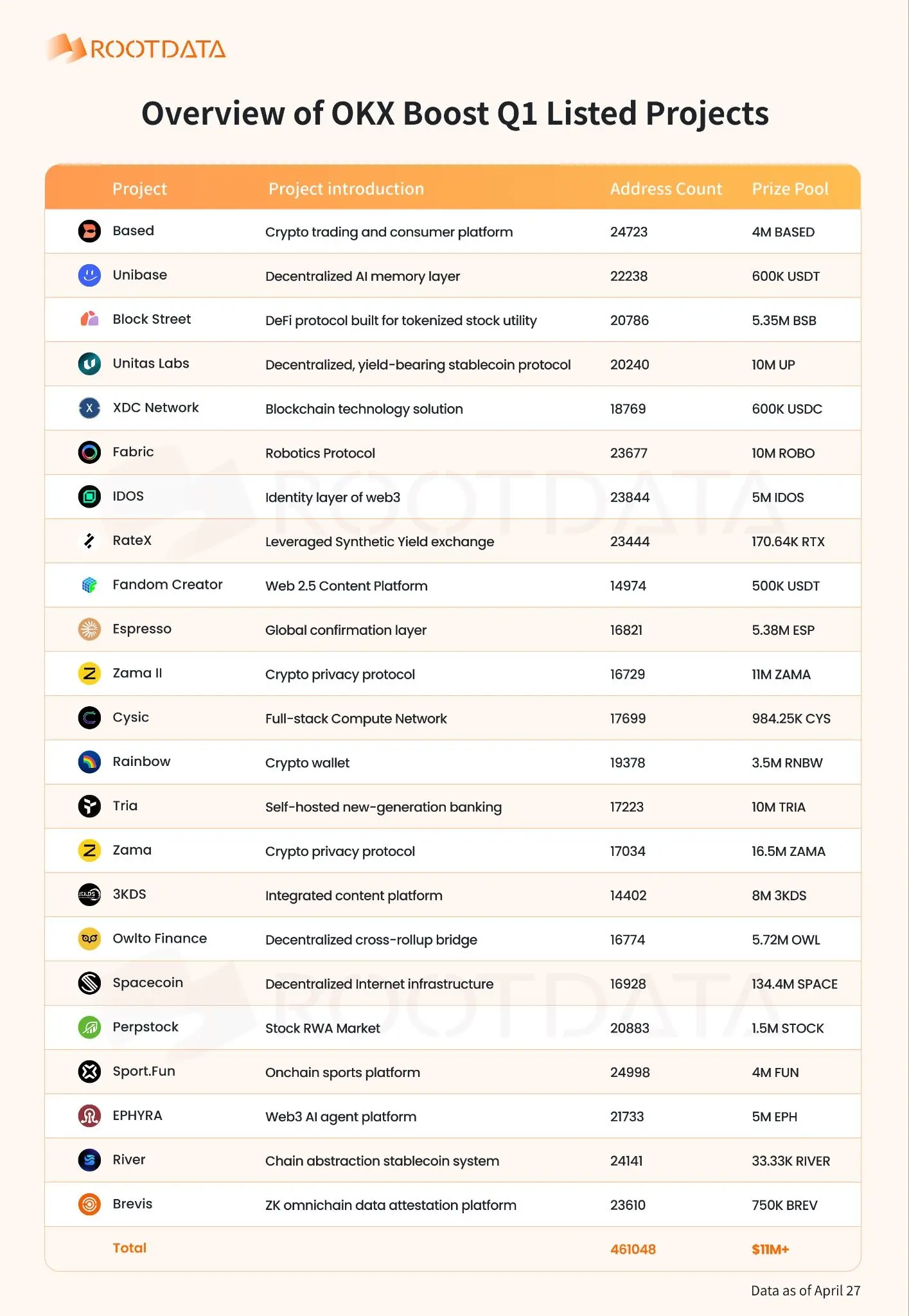
These campaigns collectively distributed over $11 million in incentives (calculated at the closing price of the reward tokens at claim time) and attracted 461,048 total participations. On average, each campaign saw nearly 20,000 participants, with an average reward pool value of approximately $500,000 per project.
Notably, several projects that used their native tokens as rewards saw significant price appreciation during the campaign, resulting in substantially higher actual value for users. For example, Spacecoin’s single-phase reward pool reached $2.31 million when measured at claim-time closing prices.
Other standout reward pools included XDC Network ($600K), Unitas Labs ($550K), River ($540K), EPHYRA ($500K), and Fandom Creator ($500K).
2. High Transparency: Average Score Over 70%
RootData’s Transparency Score (out of 100%) measures the completeness and quality of a project’s public disclosure across team, funding, on-chain data, and other key dimensions.
The average transparency score for Q1 Boost projects was 71.8%, indicating solid overall information disclosure and a meaningful quality threshold set by the platform. The top 10 projects by transparency were predominantly in infrastructure, ZK privacy, and AI sectors — areas that typically face longer verification cycles and higher community expectations for disclosure.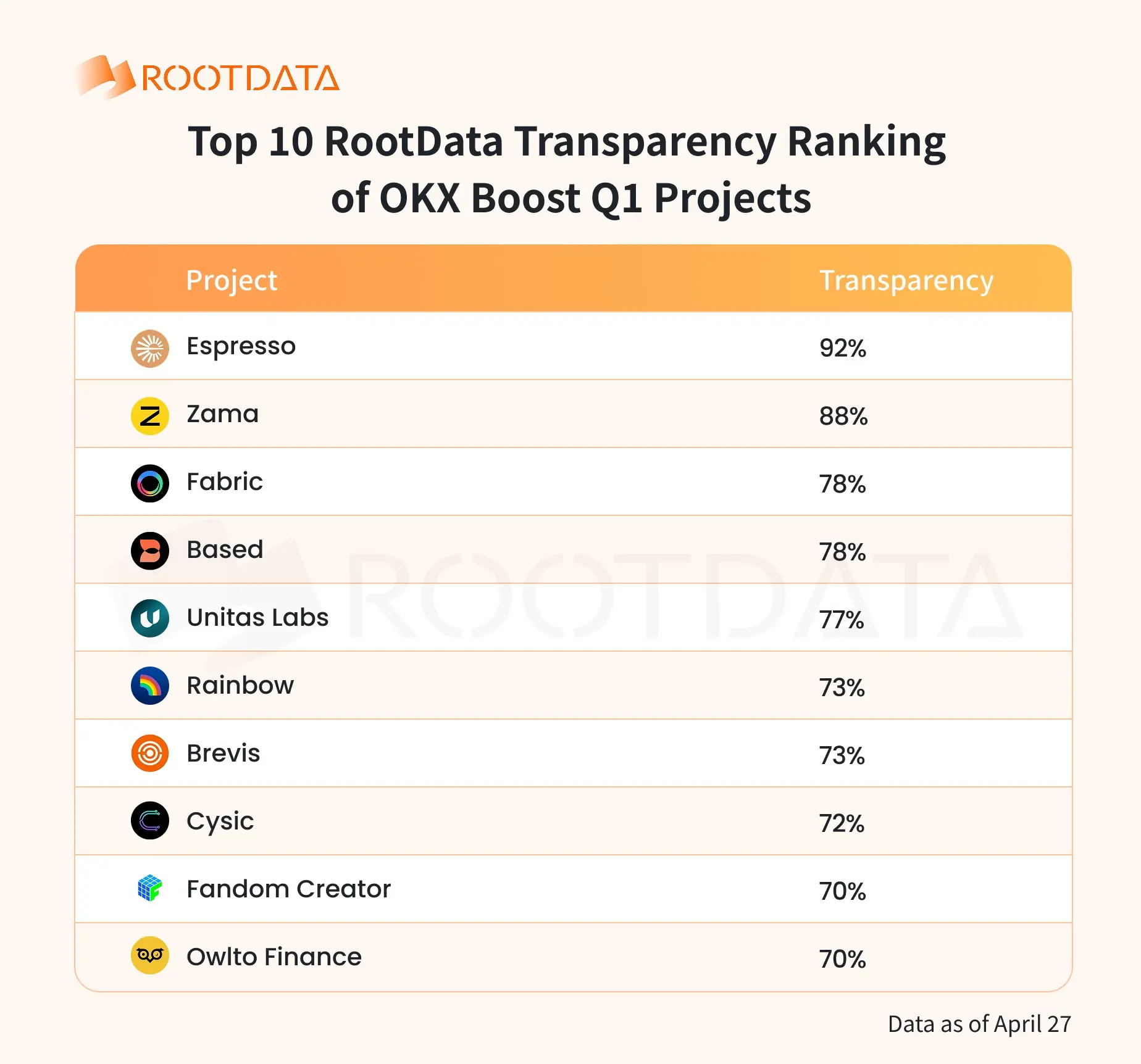
OKX Boost and RootData have recently announced a data partnership focused on project transparency. Going forward, Boost project disclosures will become more standardized and verifiable, further encouraging teams to improve transparency and giving users clearer, more reliable decision-making data.
3. 45% Graduation Rate: Transparency as a Key Screening Metric
“Graduation” is defined as a project successfully listing on OKX’s spot or perpetual futures market, marking its transition from the Boost program to broader liquidity.
Of the 23 Q1 campaigns (22 unique projects after removing duplicates), 10 projects graduated, achieving a 45% graduation rate.
This means nearly half of the projects successfully moved from incentive-driven campaigns to full exchange listings. OKX Boost is clearly strengthening its role as a “launchpad” and early screening mechanism, supplying high-potential projects and valuable data to OKX’s main trading platform.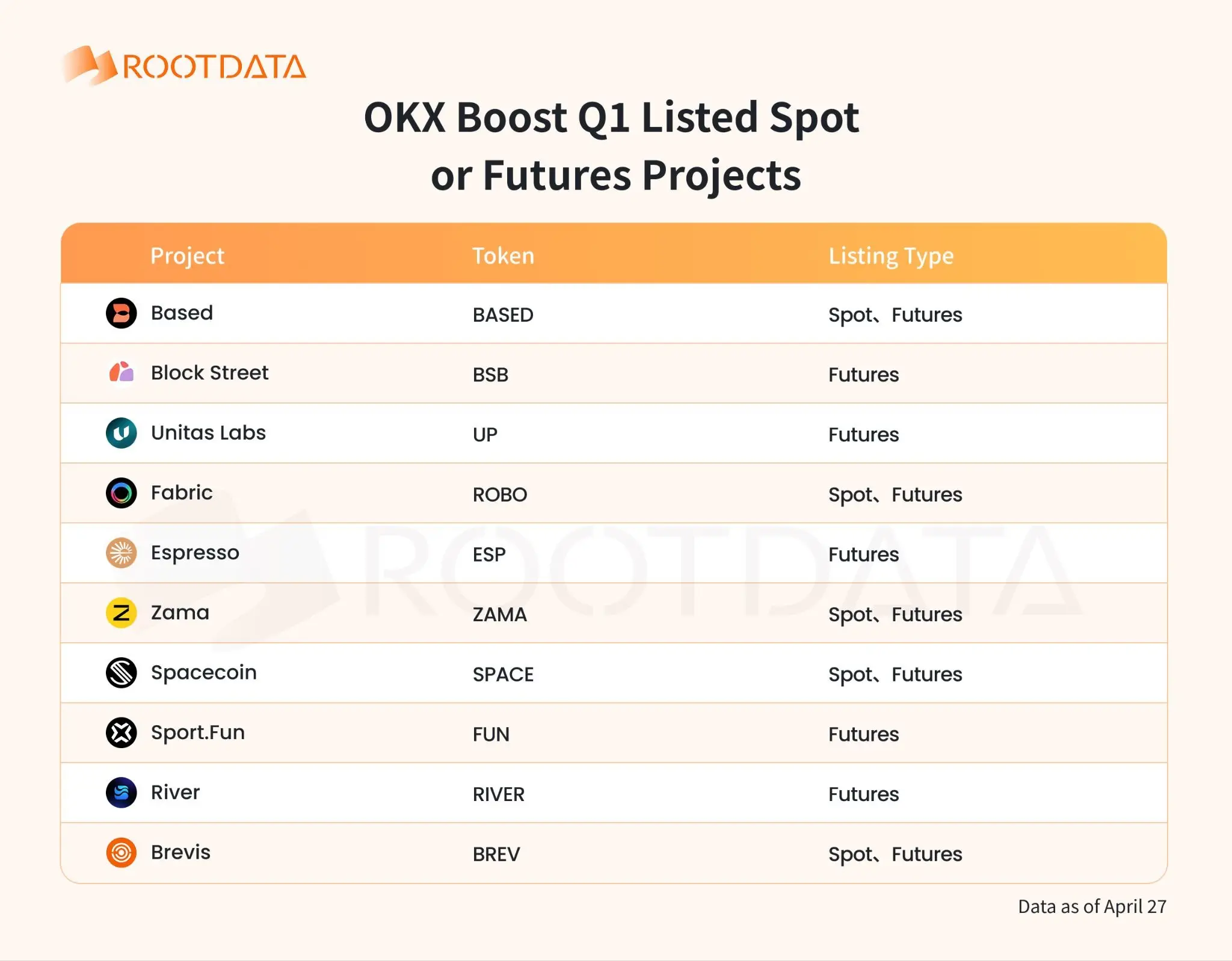
Perpetual futures have become the primary graduation path: all 10 graduated projects listed perpetual contracts, and half of them went on to secure spot listings as well. The number of projects graduating directly to perpetuals has risen noticeably in Q1, with some achieving graduation in as little as one week — indicating OKX is accelerating liquidity support for quality early-stage projects.
Graduated projects spanned infrastructure (Espresso, Brevis, Spacecoin — focused on ZK privacy and L2 scaling), DeFi (Unitas Labs, River — stablecoins and lending), and AI (Fabric, Based — AI agents and robotics).
Transparency strongly correlates with graduation quality. Among the 10 graduated projects, 7 scored above 70%, with an average of 74.5%. The highest-scoring projects — Espresso (92%) and Zama (88%) — both successfully listed perpetuals and spot pairs.
As OKX Boost’s cooperation with RootData deepens, standardized disclosure is becoming the norm. Transparency is expected to carry even greater weight in future graduation decisions and is emerging as a core competitive advantage for projects seeking user trust and platform resources.
4. Sector Trends: Infrastructure and DeFi Dominate, AI and Social Gaining Momentum
Q1 Boost projects covered infrastructure, DeFi, AI, and social/entertainment sectors.
-
Infrastructure led with 9 projects (41%), spanning L1/L2, cross-chain, DePIN, wallets, and ZK identity solutions — reflecting OKX Boost’s emphasis on foundational technology innovation.
-
DeFi accounted for 7 projects (32%), mainly in stablecoins, lending, and derivatives. Notably, two RWA projects (PerpStock and Block Street) were included, highlighting OKX’s growing focus on the RWA sector.
-
AI/AI Agents and Social & Entertainment each had 3 projects (14%). AI projects Fabric and Cysic saw strong participation, with Fabric already graduating to spot trading. In social/entertainment, Sport.Fun attracted 25,000 participants — the highest in Q1 — while Fandom Creator offered a $500K reward pool, demonstrating the power of IP and user operations in this category.
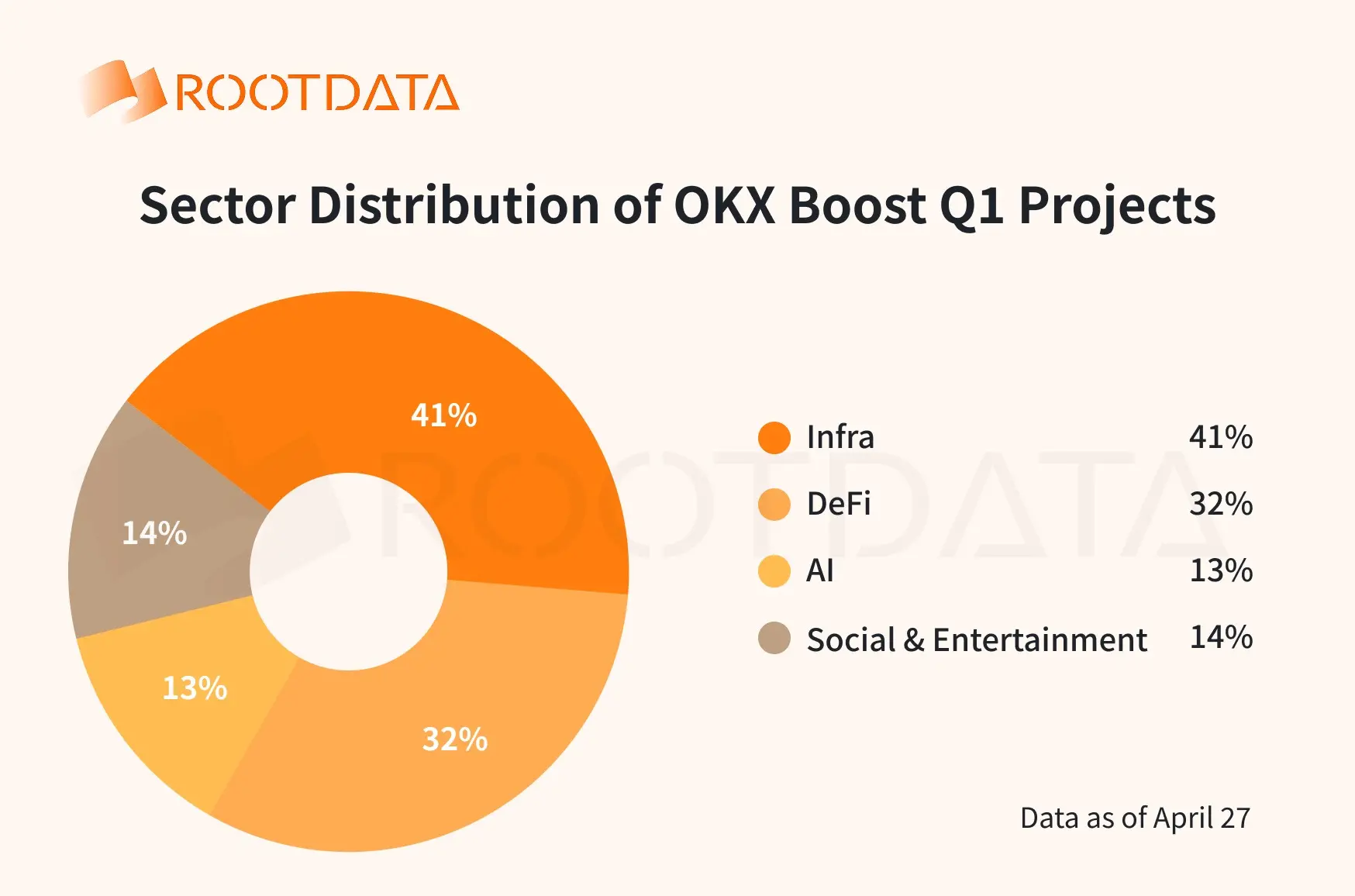
Overall, OKX Boost favors practical, utility-driven projects rather than short-term memecoins, aligning well with OKX’s relatively rational user base.
Summary
In Q1 2026, OKX Boost achieved notable breakthroughs in participation scale, project quality, and listing conversion rate. Behind the 460,000+ addresses and $11 million+ reward pool lies strong user demand for quality early-stage projects. The 45% graduation rate validates Boost’s effectiveness as a project incubator and launchpad.
Most importantly, transparency has become a key differentiator — high-scoring projects clearly outperform in graduation. As the partnership between OKX Boost and RootData deepens, standardized disclosure will shift from a “bonus” to a “requirement,” further raising the platform’s project quality threshold.
OKX Boost is not only a channel for users to capture early value, but also an increasingly standardized data window for observing trends in the Web3 primary market.
 Risk warning Risk warning