






Get to know ARC in 5 minutes: Circle's "second growth curve"
 Arc is not just another general-purpose public chain pursuing high TPS, but rather a comprehensive upgrade by Circle attempting to unify the issuance of USDC, cross-chain transactions, payments, institutional clearing, compliance privacy, and AI Agent payments onto the same execution layer.
Arc is not just another general-purpose public chain pursuing high TPS, but rather a comprehensive upgrade that Circle attempts to unify the issuance of USDC, cross-chain transactions, payments, institutional settlement, compliance privacy, and AI Agent payments onto the same execution layer. If the core of the previous round of stablecoin competition was "who issued more dollar assets," the next phase represented by Arc may be "who controls the settlement layer of stablecoin liquidity."
1. Project Overview
Arc is a native Layer1 public chain for stablecoins first disclosed by Circle in August 2025, with the mainnet white paper officially released on May 11, 2026. The mainnet is planned to go live this summer. Arc uses USDC as its native Gas token, focusing on sub-second finality, an embedded foreign exchange settlement engine, and a protocol-level compliance framework, employing the Malachite consensus engine to achieve a higher level of throughput. Arc is the core vehicle for Circle to upgrade itself from a USDC issuer to an operator of the stablecoin settlement layer.
The launch of Arc is deeply tied to Circle's capital strategy. Circle completed its IPO on the NYSE in June 2025 (stock code CRCL), and the market valuation of Circle has risen to about $30 billion post-listing. Arc is the core infrastructure supporting this valuation anchor, emphasizing bringing real financial activities on-chain, including cross-border payments, stablecoin foreign exchange, asset tokenization, lending, fund management, capital market settlement, and future micro-payments between AI Agents.
Unlike most Layer1 projects that first build ecosystems, Arc's approach is the opposite; Circle already has USDC, the world's second-largest stablecoin network, and is now adding a dedicated settlement chain. If the core of the previous round of stablecoin competition was "who issued more dollar assets," the next phase represented by Arc is "who controls the default infrastructure for stablecoin liquidity."
2. Team Background
Arc is led by Circle Internet Group. Circle was founded by Jeremy Allaire and Sean Neville in 2013 and is the issuer of the world's largest compliant dollar stablecoin, USDC. As of May 2026, the circulation of USDC is approximately $76 billion, with a stablecoin market share second only to USDT. The core team at Circle has deep experience in compliance, settlement, and traditional financial infrastructure. Its CEO, Jeremy Allaire, has long been involved in discussions on US stablecoin regulation and EU MiCA policies, which also emphasizes compliance, auditability, and institutional adaptability in the underlying architecture design of Arc.
The recent surge in interest for Arc was directly catalyzed by two events on May 11. First, Circle disclosed the private placement of the ARC token in its Q1 2026 financial report, raising $222 million, corresponding to a $3 billion FDV for the Arc network. Participants include leading institutions such as a16z, BlackRock, and Apollo Funds. Second, Circle released the ARC white paper, systematically disclosing the token economic model for the first time, with the mainnet expected to launch in the summer of 2026. The public testnet for Arc has been live since October 2025, with partners including BlackRock, Visa, Mastercard, and AWS. According to the Arc white paper, as of early May, the Arc testnet has processed approximately 244 million transactions.
3. Main Advantages of ARC
USDC Native Gas and Sub-Second Settlement
Arc uses USDC as its native Gas token, reducing budget uncertainty for enterprise users caused by Gas volatility. Developers do not need to hold volatile assets for the infrastructure layer, and enterprise users can complete financial accounting directly with stablecoins. In terms of settlement, Arc provides sub-second certainty, targeting payment and financial settlement scenarios.
Optional Privacy, EVM Compatibility, and Protocol-Level Compliance
Arc retains EVM compatibility, significantly reducing migration costs for developers; it also supports optional privacy, balancing on-chain transparency with financial-grade data protection. Its compliance framework is embedded at the protocol level, natively supporting account permissions, sanction list verification, and institutional KYC tagging, while introducing privacy technologies such as zero-knowledge proofs (ZK), allowing transaction parties to selectively disclose transaction amounts, account relationships, or business data while meeting regulatory audit requirements.
This design, which is auditable but not overly public, better aligns with the dual demands for data compliance and business privacy from financial institutions, payment companies, and RWA scenarios, making it one of the key features that distinguish Arc from general Layer1 solutions.
Institutional-Level Stablecoin Infrastructure and AI Agent Payment Network
Arc is positioned not just as a stablecoin settlement chain, but as a next-generation stablecoin financial infrastructure built for institutional scenarios. Its native integration of Circle's USDC, institutional-level deposit and withdrawal channels, and developer tools allows financial institutions, payment service providers, and stablecoin issuers to complete fund scheduling and compliance settlement under a unified framework, reducing the integration and operational complexity brought by multi-layered intermediate infrastructure.
At the same time, Arc is attempting to extend stablecoin payment infrastructure to AI Agent economic scenarios. Circle is advancing the construction of financial infrastructure for the Agentic Economy and exploring the stablecoin payment capabilities of AI Agents in collaboration with ecosystem participants like AWS, aiming to enable AI Agents to automatically complete micro-payment processes such as API calls, data access, computing power procurement, and service settlement based on USDC, thus promoting machine-to-machine payments as a new application scenario for stablecoins.
4. ARC's Token Economics
The initial total supply of ARC is 10 billion tokens, with the distribution structure as follows: 60% for the ecosystem (for token sales, developer funding, network growth, ecosystem incentives), 25% for Circle (protocol development, operational support, validator infrastructure, governance participation), and 15% for long-term reserves (strategic flexibility, systemic risk buffer, long-term ecosystem stability). It is worth noting that the white paper clearly states that ARC does not represent equity, debt, or profit rights in Circle, nor does it constitute a claim on Circle's assets or profits.
The main functions of ARC include staking, governance, fee capture, platform-level rights, and ecosystem coordination. The most noteworthy aspect is its fee mechanism, where Arc users can pay protocol fees with assets like USDC, but the protocol layer will uniformly convert the fees into ARC, with a portion allocated to validators and stakers, and another portion permanently burned to offset inflation. The initial annual inflation of ARC is about 2%-3%, gradually decreasing as the network develops; the long-term goal is to achieve inflation neutrality under supply-demand balance through the fee recycling and burning mechanism generated by network usage.
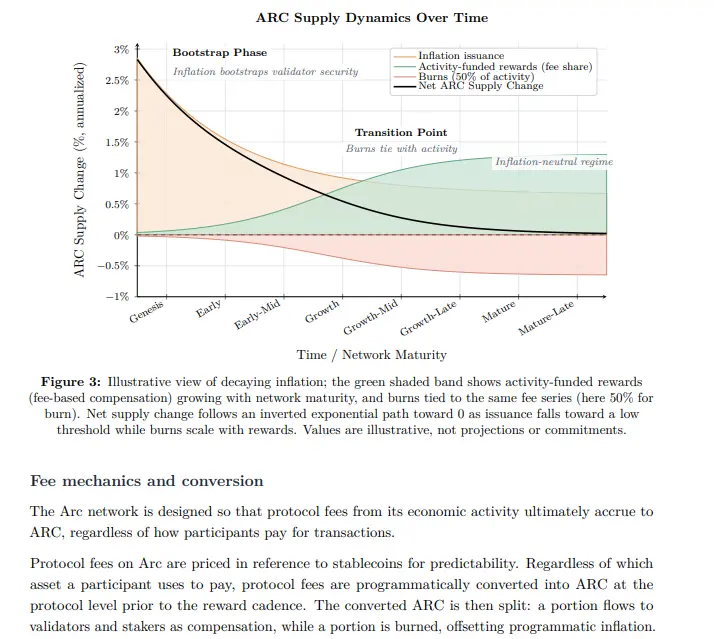
Source:++https://6778953.fs1.hubspotusercontent-na1.net/hubfs/6778953/PDFs/arc_whitepaper.pdf++
5. How to Participate
First, users can obtain Arc test tokens through the Circle Faucet for subsequent testnet interactions. Developers can further refer to Arc Docs, where the official documentation provides guidance on connecting to Arc test RPC, deploying contracts, using USDC to pay Gas, sending stablecoins, cross-chain bridging, and more.
Meanwhile, the Arc ecosystem has also opened an application channel for project teams through the Circle Developer Grants. This program primarily targets teams building on the Arc and Circle Developer Platform, focusing on supporting AI Agent payments, P2P payments, fund management, and other directions. Selected projects have the opportunity to receive USDC funding, joint marketing, technical support, and Circle ecosystem resources.
Ordinary users can participate in official community tasks. Users can enter the Arc Community and register and verify using a Google email or LinkedIn account. This activity divides levels based on points, with higher levels theoretically having higher priority for future activities such as new token launches, whitelists, or airdrops. From a participation strategy perspective, ordinary users can prioritize completing daily activities, reading content, watching videos, commenting, and posting to continuously improve their levels; users with content capabilities or community resources can try publishing high-quality articles, participating in video sharing, or offline events to earn higher points. Additionally, users can join the official Discord to stay updated on early identity roles, ecosystem activities, and subsequent testnet tasks.
6. Competitive Landscape
Arc is pushing Circle from a company reliant on stablecoin issuance and reserve income towards a settlement network, developer entry point, and institutional on-chain infrastructure platform. The growth of USDC in the past mainly came from the expansion of circulation scale and reserve interest income in the high-interest environment in the U.S.; the second growth curve provided by Arc is to expand USDC from on-chain dollars to enterprise payments, RWA settlement, cross-chain liquidity, and AI Agent micro-payments at the execution layer.
However, Arc's competitive advantages also come with two types of risks. First, there is tension between centralization and neutrality. Arc is early on led by Circle in upgrades, security responses, and validator management, which institutions may favor for trusted governance, but crypto-native users may question its neutrality. Second, while USDC as Gas enhances user experience, it also weakens the direct holding demand for ARC, making ARC's value capture more reliant on fee conversion, staking, and burning. Based on this, CoinW Research Institute believes that evaluating ARC should not only consider conventional metrics like daily active addresses but also focus on real fee scale, USDC settlement scale, the number of institutional applications launched, and burn coverage rate.
For users, participation in ARC can be divided into two paths: indirect observation and direct participation. On the indirect observation level, CRCL stock can serve as a window to observe Circle's overall business, but it is also influenced by the U.S. stock market, performance, interest rates, and regulatory expectations. Users can pay attention to indicators such as CRCL market capitalization and the extent of price retracement relative to the post-IPO peak. On the direct participation level, users will need to wait for the public sale after the ARC mainnet goes live; currently, users can participate in the early ecosystem through official community interactions and testnet engagement. Circle's disclosure of the ARC token private placement under its public company identity is essentially exploring a new way of parallel financing with "equity + token" within the existing framework. If this model is successfully implemented, it may provide a practical reference for subsequent compliant institutions issuing tokens.
 Risk warning
Popular articles