








It is Bankless that needs Ethereum, not Ethereum that needs Bankless
 Core Viewpoint

 The role of Bankless is being replaced by a more decentralized, more specialized, and more diverse "narrative network."
Author: Gu Yu, ChainCatcher
Under the shadow of a series of negative news, including the continuous departure of core figures from the foundation and multiple institutions selling off ETH, the Ethereum ecosystem once again welcomes sensational news.
Today, David Hoffman, co-founder of Bankless, confirmed in a post on the X platform that he has liquidated all his ETH holdings. At the same time, news of large-scale layoffs at Bankless and the separation of its two founders has emerged.
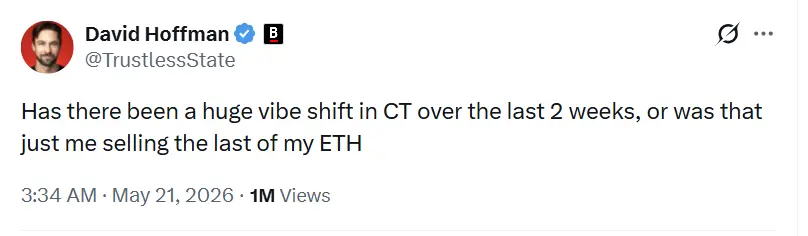
In response, well-known KOL Chen Jian provided a vivid metaphor—"David, the founder of the Ethereum party newspaper Bankless, selling all his ETH is almost equivalent to Huang Changye's defection to North Korea back in the day." The impact of this statement is enough to send chills down the spine of anyone who understands Bankless's position in the Ethereum ecosystem.
However, in the context of the cryptocurrency industry becoming increasingly mainstream and institutionalized, and the transfer of narrative power regarding Ethereum being largely completed, Bankless's withdrawal is actually understandable and may not necessarily be negative news for Ethereum.
I. Bankless: Once the "Public Relations Department" of Ethereum
Before delving into this seismic event, it is essential to understand what Bankless truly represents in the Ethereum ecosystem.
Bankless is far more than just a crypto media platform. It originally started as a podcast and a Substack subscription channel, with a simple core idea: to replace traditional banking with self-custody, DeFi, and Ethereum as the settlement layer of a new financial system.
The two co-founders, David Hoffman and Ryan Sean Adams, strongly advocate that Ethereum is "extremely reliable currency." They built a media brand around Ethereum, maximizing its exposure and becoming two of the loudest supporters of Ethereum in the industry. Today, Bankless is recognized as one of the most influential media brands in the crypto world, particularly within the Ethereum ecosystem.
David Hoffman is especially known for his firm personal beliefs. During the bear market in 2018, when the price of Ethereum fell to $300, he actively bought Ethereum. Thus, he became a symbol of Ethereum extremism in the cryptocurrency Twitter sphere.
Bankless's unique position lies in the fact that it is not only a "reporter" of the Ethereum ecosystem but also a co-builder of the Ethereum narrative itself.
"Ethereum is ultrasound money," "Ethereum will usher in the industrial revolution of the internet," "Ethereum is digital oil"… A series of his viewpoints have been widely disseminated in the crypto industry, injecting a continuous stream of belief and fuel into the Ethereum ecosystem.
From discussions with Vitalik Buterin to in-depth analyses of Ethereum's roadmap, and continuously providing theoretical packaging for new narratives like L2, DeFi, and re-staking, Bankless has long served as both the "information hub" and "spiritual lighthouse" of the Ethereum community. The two co-founders have also long played the role of core evangelists for Ethereum—Hoffman himself has publicly stated that 99% of his personal wealth is held in Ethereum.
Chen Jian likened Bankless to the "party newspaper of Ethereum"—the precision of this metaphor lies in its revelation that Bankless's role has long transcended that of an ordinary commercial media outlet, instead serving as a value output machine with a certain "quasi-official" or "semi-official" status within the ecosystem.
However, in the past year or two, Bankless's narrative power within the Ethereum ecosystem has noticeably weakened, and it has rarely put forth distinctive viewpoints with high dissemination potential and unique perspectives.
II. What Exactly Happened
Earlier today, Bankless co-founder David Hoffman announced that he has sold all the ETH he held. Another co-founder, Ryan Sean Adams, subsequently retweeted, stating that the first phase of Bankless has ended, and his six-year collaboration with David exploring crypto, DeFi, and Ethereum has come to a close, entering a second phase where he will transition to a supporting role to continue providing support for Bankless.
Soon after, Lucas Campbell, co-founder of FireEyes DAO and former research analyst at Bankless, further revealed on X that Bankless had evidently laid off most of its team members yesterday, and its founders did not issue a single thank you or public statement to help team members find new opportunities.
Bankless's business development director, Jean-Paul Faraj, posted on X reflecting on his experiences during his time at Bankless, stating that today is his last day at Bankless, which indirectly confirms the accuracy of the large-scale layoff news.
This series of messages conveys at least two clear signals: first, Bankless co-founder David Hoffman is no longer a staunch bull on ETH; second, after the large-scale layoffs, Bankless will struggle to maintain the current frequency and intensity of content output, losing its status as Ethereum's "public relations department."
There were already signs of this. Just a day ago, Ryan Sean Adams had posted criticizing the Ethereum Foundation, stating, "The future of Ethereum can no longer rely on the Ethereum Foundation (EF). While EF is important, Ethereum needs new institutions to step in and fill the gaps. We need an organization that truly wants Ethereum assets (ETH) to win—growing in quantity—and is willing to speak out and take action. EF is not that, and it never will be."
Additionally, David Hoffman publicly stated in a podcast this month that he has sold his long-held, symbolically significant CryptoPunk and primarily exchanged the proceeds for Zcash (ZEC).
III. The End of a Phase Mission
In Ryan Sean Adams's response, there is a noteworthy expression: the first phase mission of Bankless has ended, and it is now moving into the second phase. So, what exactly was the specific mission of Bankless's first phase? What will the next mission be?
As mentioned earlier, Bankless previously largely acted as a semi-official "public relations department" for Ethereum, continuously conveying the specific roles and concepts of new technologies like Layer 2 to the crypto community, "recharging faith" in the market.
In the early stages of Ethereum's transition from a "geek toy" to a "crypto world computer," this high-density, high-belief content output was essential—it helped Ethereum gather the most loyal community amidst the siege of countless public chains and supported the initial narrative premium of ETH.
But the problem is that this phase mission has largely been completed.
In the past year or two, the purely narrative-driven approach within the crypto industry has noticeably weakened, with growth in adoption increasingly relying on the integration of traditional financial systems, especially in the fields of payments and RWA (real-world assets). Ethereum no longer needs to persuade people to "not trust banks" with a few passionate articles; it needs to genuinely have banks, asset management companies, and publicly listed companies treat Ethereum as infrastructure.
As the target audience shifts, the baton of narrative has quietly changed hands.
Asset management companies represented by Bitwise, VanEck, and BlackRock have begun to convey the value proposition of ETH to the traditional financial world through ETF products, research reports, and public statements. MicroStrategy, although focused on Bitcoin, has pioneered the model of "public companies purchasing crypto assets," which has been emulated by other companies, and some publicly listed companies have begun to include ETH on their balance sheets. Figures with traditional financial backgrounds, such as Tom Lee and Larry Fink, have become new faces explaining Ethereum's concepts to the mainstream world. Their language is more compliant, more professional, and more easily accepted by traditional capital.
The role of Bankless is being replaced by a more decentralized, professional, and diverse "narrative network."
For a long time, Ethereum's "moat" has not been technological leadership or user scale, but rather a complete value narrative system woven together by Vitalik, the Ethereum Foundation, core developers, and media evangelists like Bankless. Technology can be imitated, ecosystems can be replicated, but this community of faith that has accumulated since 2015 is almost irreplaceable.
Now, although Bankless is fading, its role is not in a vacuum; rather, there is a large group of new forces more aligned with the current stage of Ethereum's development naturally taking over, including various institutional research departments, mainstream entrepreneurs, on-chain data platforms, and more.
From this perspective, Bankless's withdrawal is not a crisis; instead, it is an inevitable result of the maturation and decentralization of the Ethereum narrative system. A healthy ecosystem should not rely on a single "semi-official" media outlet to maintain faith for the long term. When Ethereum has already entered the sights of the mainstream financial world, and when ETF capital flows can influence market sentiment more than any podcast, the historical mission of the "public relations department" has already been completed.

 Risk warning




Popular articles





