Binance Live AMA In-Depth Review: Polaris is Building the Ultimate Security Foundation for Web3

 Directly addressing the pain point of billions in liquidations, Polaris has launched AI-driven Web3 on-chain insurance, pioneering "thousand people, thousand prices" dynamic rates and second-level automatic claims, building the ultimate defense armor for users' crypto assets.
The cryptocurrency market is experiencing extreme volatility, with BTC and ETH repeatedly battling at key support levels. ETFs have seen a net outflow for 8 consecutive days, with funds amounting to $1.88 billion quietly leaving the market. In such extreme conditions, the liquidation amount across the entire network of derivatives often reaches billions, leading to a significant outflow of capital. Each year, the evaporation of funds due to contract liquidations exceeds $100 billion, and losses from DeFi security incidents have reached as high as $780 million. Behind every cold number is the real wealth of individuals being wiped out.
Behind these extreme liquidity games lies a core contradiction that has long been selectively ignored by the industry, yet is extremely dangerous: the total market capitalization of the cryptocurrency market is now close to $2.5 trillion, and the total locked value of DeFi protocols has consistently remained at the hundred billion dollar level. However, the coverage rate of cryptocurrency asset protection still hovers below 5%.
If we turn our attention to the traditional financial sector, the insurance penetration rate averages between 60% and 80%. This means that even conservatively estimating that only half of the on-chain assets have hedging needs, there remains a nearly completely blank wilderness in the vast territory of the crypto world, where the total addressable market (TAM) exceeds $1.5 trillion.
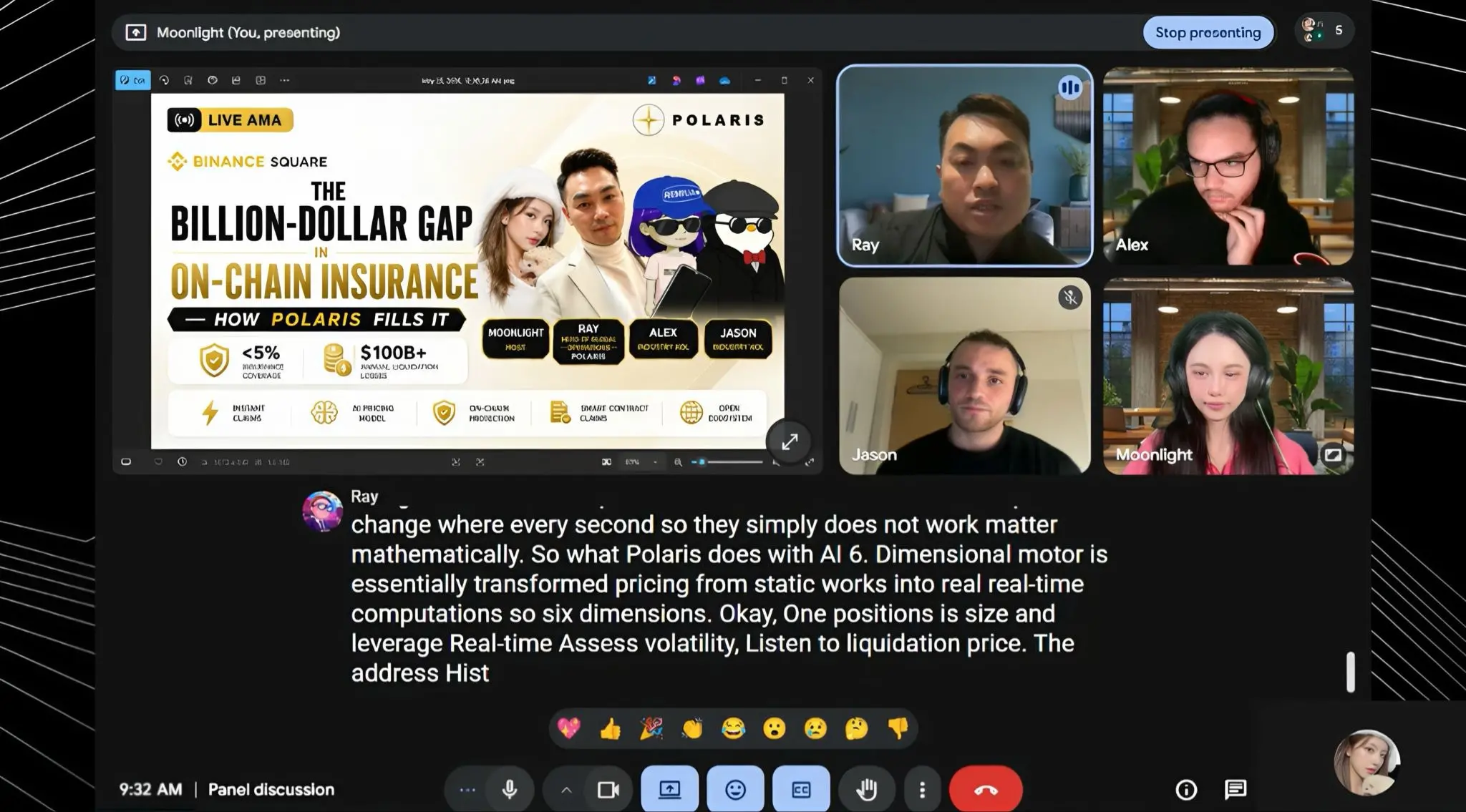
In this high-risk market, which loses hundreds of billions annually, why has a standardized protection scheme never been successfully implemented? On the evening of May 27, a deep dialogue focusing on the safety of on-chain assets took place on Binance Live. Hosted by top Web3 anchor Moonlight, it featured Polaris's Global Operations Growth Officer Ray, along with well-known European crypto KOLs Alex and Jason, gathered in the live broadcast room. They engaged in in-depth discussions on core topics such as the technical accumulation of on-chain risk control, underlying actuarial logic, and the future development path of Web3 insurance.

First Analysis: Extreme Misalignment of Rigid Demand and Structural Supply Failure
When analyzing the slow development of the safety track, the industry often falls into a misguided assumption that crypto users inherently possess a high risk appetite and are "bloodthirsty traders," thus lacking the demand for hedging and risk aversion. Ray, the operations head of Polaris, refuted this stereotype during the AMA: the demand not only exists but is extremely rigid and has been long suppressed. The real bottleneck lies entirely in the structural failure of the supply side.
Faced with a huge market vacuum, traditional financial giants have not been oblivious but have remained helpless. Why can't traditional insurance cover on-chain assets? The answer is not a matter of willingness but of capability. The black-and-white terms of mainstream global insurance companies explicitly exclude virtual assets from coverage. Five insurmountable natural barriers lie behind this:
First, the underlying compliance rules that exclude virtual assets limit the entry of traditional institutions. Second, the traditional actuarial system cannot perform real-time pricing, and its actuarial tables lag severely behind the millisecond-level changes in on-chain data. Third, the inertia of traditional processes, which heavily rely on manual underwriting, cannot cope with the 24/7 operation of the crypto market. Additionally, the centralized custody requirements of traditional finance inherently contradict the decentralized self-custody logic of crypto assets. Finally, the high cross-border compliance costs faced by attempts to cover global anonymous users are enough to deter large traditional insurance institutions.
This is not an optimization problem that can be solved with minor adjustments but a complete disconnection of the underlying architecture. The traditional actuarial system heavily relies on the law of large numbers and long-cycle data backtesting, with the frequency of rate table updates typically calculated on a monthly or even quarterly basis. This methodology is extremely effective in assessing slowly changing physical world risks, such as human lifespan and vehicle accident probabilities. However, the indicators in the crypto market are like a storm. Asset prices, real-time volatility, and the absolute distance to the liquidation price are all undergoing dramatic changes. Using a static table updated monthly to lock in a risk exposure that flashes every second renders its calculation accuracy completely ineffective from the outset.
Second Analysis: Dimensional Incompatibility of the Old On-Chain System and Three Major Deadlocks
Since traditional insurance institutions are powerless, how do on-chain native decentralized solutions perform? In fact, several projects have attempted to address this area over the past few years, but regrettably, the penetration rate of the entire track has remained below the critical line of 5% for five years, with TVL stagnating and failing to achieve any qualitative breakthroughs.
Ray sharply pointed out three key deadlocks faced by existing DeFi solutions.
The first is the serious lag in claims processing times. Currently, the claims cycle of mainstream solutions generally remains between 3 to 30 days and heavily relies on lengthy community voting processes for claims verification. For users facing contract liquidations, when a highly leveraged position is forcibly closed in extreme market conditions and the margin instantly drops to zero, what they need most is immediate capital recovery and hedging. Users require "instantaneous" compensation, not "submit for review and wait weeks for" charity. The time misalignment directly stifles the core demand.
The second is the abyss of adverse selection caused by uniform pricing. Many early projects adopted a "one-size-fits-all" uniform rate mechanism to reduce development difficulty. This has a fatal flaw in financial risk management. When conservative traders and high-risk aggressive traders face the same rate, low-risk users are effectively subsidizing high-risk users. Quality conservative users will leave in droves due to unfairness; conversely, high-risk aggressive users will flock to it as an arbitrage opportunity. Ultimately, the underwriting capital pool will be completely filled with high-risk individuals, and the pressure on payouts will continue to accumulate until the capital pool is completely breached. This is the inevitable punishment of mathematical laws.
The third is the extremely narrow coverage of insurance products. Existing products can only insure a very limited number of scenarios, supporting only a few specific protocols and situations. The vast majority of risks faced by users in real on-chain games, such as widespread contract liquidations and various stablecoin depegging, cannot find matching protective tools. These three deadlocks intertwine to form an insurmountable ceiling.
Third Analysis: AI-Driven Personalized Pricing and Breaking the Second-Level Storm
Faced with the numerous deadlocks of the old system, Polaris offers a disruptive path forward—completely liberating risk pricing from the static monthly reports of actuaries and driving real-time calculations through AI.
In this dialogue, Ray clearly stated that AI risk pricing is not merely a conceptual packaging but a substantial technological revolution that pushes risk control from "static statistics" to "dynamic real-time calculations." The 6-dimensional risk assessment system that Polaris is building is a digital brain that never sleeps. This engine can perform multi-factor weighting and real-time precise pricing.
These 6 core dimensions include: position size and leverage ratio, real-time volatility of the underlying asset, absolute distance to the liquidation price, historical liquidation frequency of the wallet address, macro market sentiment and funding rates, and potential on-chain anomaly signals.
Through these 6 dimensions of data, the AI engine can output highly personalized quotes for each interaction, achieving millisecond-level dynamic premium adjustments. For example, a conservative user using low leverage with a deep safety cushion and no history of liquidation paying the same fee as another high-risk user using ultra-high leverage and frequently facing liquidation is extremely absurd. In Polaris's AI pricing logic, risk speaks for itself through data. The pricing logic evolves from a crude "one-size-fits-all" to precise "personalized pricing." This not only provides users with an extremely fair experience but fundamentally dismantles the hidden dangers of adverse selection, ensuring that the underwriting capital pool possesses long-term resilience to withstand market fluctuations.
Equally disruptive is the reconstruction of the claims process and the position linkage mechanism. Polaris has achieved the functionality of automatically adjusting coverage amounts based on position increases or decreases, dynamically raising rates in extreme market conditions, thus effectively protecting the underwriting pool and all users. Additionally, the claims logic is fully parameterized; when the data captured by on-chain oracles precisely meets the trigger conditions, smart contracts will execute automatically. Liquidation equals payout, with funds reaching users in seconds, completely eliminating the need for manual review or waiting. This truly achieves a resonance between risk protection and transaction speed.
Fourth Analysis: Trust Reconstruction and Absolute Code Transparency
In the grand narrative of Web3 and the context of decentralization, any protocol that requires users to relinquish data or asset control faces a high trust barrier. The construction of trust no longer relies on the glamorous institutional buildings of Wall Street or a piece of paper license but is built on pure transparency and verifiable trustlessness.
In response to this pain point, Ray provided clear guidelines: verifiability always takes precedence over verbal promises.
In the entire fulfillment chain of Polaris, all policy terms are solidified in smart contracts and publicly available without any blind spots across the network. Users do not need to rely on the moral bottom line of the team; they only need to trust that the code deployed on the blockchain indeed performs the tasks it claims. The claims logic also operates automatically on-chain, allowing users to visit the blockchain explorer at any time to read the open-source code and verify the on-chain hash records of each claim. When all processes can be publicly audited and all trigger conditions are rigidly executed by objective code, trust transforms from an emotional dependency that needs to be "persuaded" into an objective fact that can be "verified."
At the same time, this system possesses self-evolution capabilities. Each piece of data from underwriting and claims will feed back into the AI model. Data-driven optimization allows the platform to continuously improve; as data accumulates, the AI will become increasingly intelligent, forming a deep and difficult-to-replicate technological barrier.
Fifth Analysis: Boundless Ecosystem and Solid Strategic Navigation
The types of assets in the on-chain world are complex and varied, with different underlying protocols and differentiated user profiles giving rise to extremely diverse and infinitely dispersed risk control needs. Contract traders fear instant liquidations, DeFi lending pools worry about smart contract vulnerabilities, stablecoin holders are alert to exchange rate depegging, and cross-chain hubs constantly face the shadow of bridge funds being stolen.
Faced with infinite scenarios and limited production capacity, if one merely limits itself to a single self-operated scenario, its growth ceiling is destined to be narrow. In response, Polaris has chosen a grand strategic expansion path—building a comprehensive coverage network of multiple insurance types combined with an open ecosystem.
Polaris's core path is to package the most advanced AI real-time pricing engine and on-chain automatic settlement system into standardized API interfaces. This means that third-party projects can quickly build their own customized insurance products by calling models and contracts through standardized APIs. At the same time, this opens the door for traditional insurance institutions, allowing them to seamlessly access AI pricing and on-chain settlement systems, issuing Web3 insurance products with one click.
This open architecture will give rise to an unmatched positive feedback loop. Polaris's positioning is very clear; it takes technology service fees as its core revenue source, never consuming users' premiums. The larger the ecosystem, the stronger the synergy.
Ultimate Vision: Invisible Defensive Armor Will Become a Standard Configuration
At the end of this high-energy dialogue, Ray painted the ultimate blueprint for Polaris's future.
In the mature cryptocurrency market of the future, the question "Does your protocol have a protection base?" will become as rigid a standard for measuring the reliability of all projects as "Has your code passed an audit?" Audits address the technical mine clearance of "Are there vulnerabilities in the code?" while protection protocols address the ultimate fallback of "If extreme black swans occur, who will bear the losses?" The two are like the two sides of a coin, both indispensable.
The more profound impact is that on-chain protection will completely shed the stereotypical label of "after-the-fact patching" and evolve into an inseparable "pre-embedded" native component of transaction structures. Polaris's vision is to become the infrastructure layer for on-chain insurance, making protection native. When users open a contract position or deposit into a DeFi protocol, protection is automatically embedded. This ultimate security experience will be as invisible and imperceptible as today's internet's HTTPS protocol, yet as indispensable as air, becoming the default foundation for every on-chain interaction.
This one-hour Binance Live AMA, which attracted massive user attention, discussed issues that have long surpassed the functional logic of a single application. Starting from the pain point of contract liquidation insurance, Polaris is steadily building a comprehensive risk control matrix that encompasses diverse scenarios such as smart contract vulnerabilities and stablecoin depegging.
Faced with a security gap of hundreds of billions and an almost completely blank incremental blue ocean, the efficiency and precision brought by AI pricing and millisecond-level claims have already formed a generational crushing advantage. In this grand process of reshaping decentralized risk control order, Polaris's unbreakable technological fortress will surely safeguard every on-chain asset traversing the dark forest, ushering in true ultimate protection.
 Risk warning