Grayscale: The Three Major Evolution Stages of Stock Tokenization and a Review of Core Beneficiary Public Chains
 Core Viewpoint
 Gray Report: Global stock tokenization is accelerating in three phases, with Ethereum, Solana, and Avalanche expected to be the biggest beneficiaries.
Author | Grayscale Research Director Zach Pandl
Compiled by | Wu Says Blockchain
The tokenization process of the global stock market is advancing. Tokenized stocks are expected to bring various benefits to users, including 24/7 trading. The next significant development will be the DTCC's [1] launch of a tokenization pilot on the Canton Network [2]. This pilot will allow tokenized stocks and other assets to circulate within a regulated financial system through blockchain infrastructure.
We believe that the tokenization of the stock market will progress in three stages, each bringing value to different types of blockchain infrastructure (see Chart 1).
The first stage is the third-party "wrapper" model [3]. In this model, the issuer holds the stocks through a special purpose vehicle (SPV) [4], and the tokenized stocks represent a claim on the equity of that SPV. Currently, over 70% of tokenized stocks by market capitalization adopt this model. Wrapped tokenized stocks do not represent true ownership of the stocks but can be used in DeFi and may appeal to retail investors. These assets are currently traded on networks such as Ethereum, Solana, and BNB Chain.
The second stage is the "entitlement" model [5], with the DTCC's pilot being a representative of this model. Instead of creating new versions of securities, the DTCC is bringing existing qualified securities on-chain through its regulated post-trade infrastructure, with the Canton Network serving as the first blockchain network for this pilot.
The third stage is the issuer-led model, where companies directly issue securities natively on-chain. Last week, Securitize [6] became the first publicly listed company to tokenize its common stock when it went public on the New York Stock Exchange. We believe this model has the greatest long-term potential but still requires further regulatory clarity. In our view, the issuer-led model will be more favorable for open architecture blockchains like Ethereum and Solana, as well as hybrid networks like Avalanche.
These three tokenization models are likely to coexist for many years to come.
Key Point: There are various models for tokenized stocks. We believe that the blockchain networks most likely to benefit from tokenization growth include Ethereum, Solana, BNB Chain, Avalanche, and Canton Network.
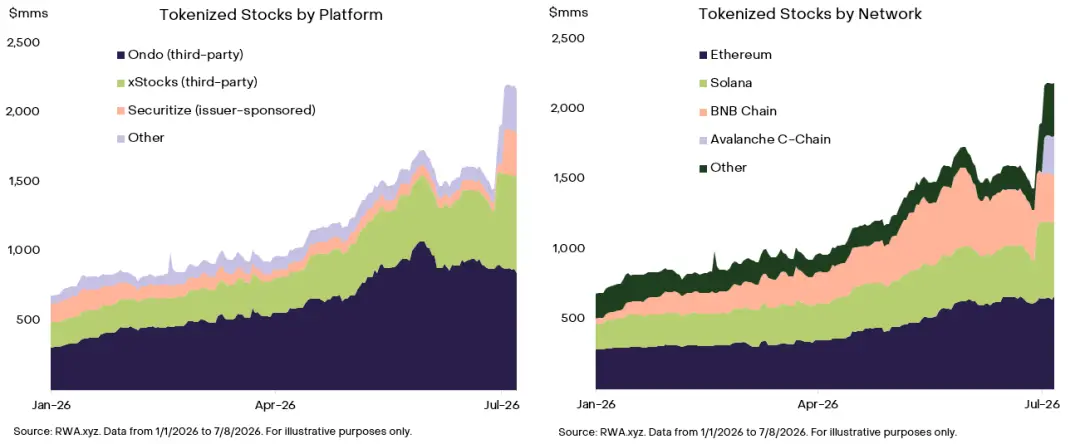
Chart 1: Third-party platforms currently dominate the tokenized stock market, while Ethereum, Solana, and BNB Chain hold the majority share of on-chain assets.
Notes:
[1] DTCC: The Depository Trust & Clearing Corporation, one of the core post-trade infrastructures for securities in the United States, primarily responsible for clearing, settlement, and custody services after securities transactions.
[2] Canton Network: A blockchain network for institutional financial assets, emphasizing privacy, compliance, and the circulation of assets between different financial institutions.
[3] Wrapper model: Understandable as the "wrapping model," where a third-party platform holds the underlying stocks through an intermediary structure and issues on-chain tokens representing the related rights. Investors hold claims on that structure rather than direct ownership of the stocks themselves.
[4] SPV: Special Purpose Vehicle. In tokenized stocks, it typically refers to an entity established by the issuer to hold the underlying stock assets, with the tokens held by investors representing claims on that entity.
[5] Entitlement model: Understandable as the "entitlement confirmation model," which does not reissue a new security but records or maps existing qualified securities onto the chain through a regulated post-trade system, allowing them to circulate within blockchain infrastructure.
[6] Securitize: A digital securities and real-world asset tokenization platform. It is mentioned in the text that it tokenized its common stock simultaneously when it went public on the NYSE.
 Risk warning