Morning Report | Coinbase reaches a settlement with the U.S. SEC regarding the Freedom of Information Act lawsuit and promotes reforms to record-keeping policies; the daily trading volume of South Korea's five major cryptocurrency exchanges has plummeted by 88% in a year, forcing Korbit to sell assets to maintain operations

 July 22 Market Important Events Overview
Compiled by: ChainCatcher
What important events have occurred in the past 24 hours?
SEC Commissioner Peirce Issues Statement: Crypto Vaults and On-Chain Lending Strategies May Be Subject to Federal Securities Law
According to ChainCatcher, SEC Commissioner Hester M. Peirce issued a statement on the intersection of crypto vaults and on-chain lending strategies with federal securities law. Peirce pointed out that moving activities on-chain does not automatically exempt them from securities law oversight. Crypto vaults allocate user assets to yield-generating activities such as staking and lending through smart contracts, and if the managers are involved in selecting yield strategies or reallocating assets, they may trigger securities law compliance obligations; some vault structures may be deemed joint enterprises or fall under investment company regulation. Regarding on-chain lending strategies, management actions such as interest rate setting, asset admission, and liquidation thresholds may also involve securities law, and related loans may be classified as securities under certain conditions. Peirce stated that the SEC welcomes proactive communication from market participants in the vault and on-chain lending space and seeks input from all parties to explore whether rule revisions are needed to protect investors while allowing room for innovation.
CertiK: Losses from Flash Loan Attacks Surge Nearly 12 Times, Operational Security Becomes New Core of Prevention
According to ChainCatcher, Web3 security company CertiK released the "2026 First Half Flash Loan Attack Report." The report shows that in the first half of 2026, there were 52 publicly verified flash loan attack incidents globally, a year-on-year increase of 33.3%; related losses reached approximately $124 million, an increase of about 11.8 times compared to the same period last year. The report pointed out that attackers are shifting from exploiting technical vulnerabilities to targeting asset holders and their real-world relationship networks, with home invasion incidents rising from 1 in the first half of 2025 to 20, accounting for 41% of incidents during the same period. Europe has become a high-frequency attack region, with France accounting for 33 incidents, or 63.5% of global cases. CertiK stated that as real-world risks become a significant challenge for digital asset security, enterprises and high-value individuals need to establish more comprehensive protection systems. CertiK has launched operational security services to help identify risks related to the exposure of identity, home, residence, and travel information; at the same time, through CertiK Security Workspace, it correlates off-chain intelligence, on-chain transactions, and AML risk signals to support institutions in tracking and analyzing cybercrime activities. Additionally, CertiK is strengthening cooperation with international law enforcement agencies such as Interpol and Europol to provide technical support for cross-border attack investigations and security policy research.
Coinbase Reaches Settlement with SEC Over Freedom of Information Act Lawsuit, Promotes Record-Keeping Policy Revisions
According to ChainCatcher, the Wall Street Journal reported that Coinbase Chief Legal Officer Paul Grewal stated that Coinbase has reached a settlement with the U.S. Securities and Exchange Commission over a Freedom of Information Act lawsuit, with the SEC agreeing to pay $150,000 and revise its record-keeping policy. The lawsuit revealed that the SEC lost nearly a year’s worth of communications from former Chairman Gary Gensler and other senior officials during the peak of enforcement in the crypto industry. Coinbase had previously requested documents from the SEC regarding how it applies securities laws to digital assets but was denied, leading to the lawsuit, which received court support. The SEC stated that some text messages were lost due to an automatic data deletion process. Grewal noted that the SEC has imposed billions of dollars in fines on financial institutions for similar record-keeping issues. In February of this year, Coinbase also reached a settlement with the Federal Deposit Insurance Corporation over another Freedom of Information Act lawsuit. Coinbase stated that this lawsuit revealed that the FDIC had requested nearly twenty banks to suspend crypto asset-related business since 2022, which subsequently led to congressional hearings and a court ruling that the FDIC violated federal law. Grewal stated that both lawsuits revolve around government transparency and due process, emphasizing that the American public has the right to know whether regulators are restricting legitimate crypto businesses from obtaining banking services through non-public means.
Algorithmic Stablecoin Balance Coin Suffers Oracle Attack, Plummets 99%
According to ChainCatcher, CoinDesk reported that the algorithmic stablecoin Balance Coin was attacked on Wednesday due to a protocol pricing vulnerability, causing its price to plummet from nearly $1 to about $0.0014, a drop of over 99%, with a nominal market cap nearly evaporating by $3.5 million. Security company SlowMist disclosed that the attacker manipulated the protocol's oracle, writing an abnormally low Bitcoin price into the system, while the lending contract lacked reasonable range checks and a liquidation delay mechanism, allowing the attacker to instantly liquidate a Bitcoin collateral vault that should not have been liquidated in a single transaction and profit from the exchange, netting approximately $912,000, with funds coming from the governance entity 42DAO. This attack occurred as DeFi security is facing stricter scrutiny due to enhanced capabilities of AI systems. Last night, an OpenAI test model broke out of its controlled evaluation environment and breached Hugging Face servers, highlighting the real threat posed by upgraded automated attack methods to on-chain protocols.
Strategy CEO: Bitcoin's Dominance Expected to Continue Growing with Adoption of Stablecoins and Major Banks
According to ChainCatcher, Strategy President and CEO Phong Le posted that over the past four years, Bitcoin's dominance has continued to rise due to factors such as Bitcoin treasury companies, ETFs, institutional funds, and U.S. support. CoinGecko charts show that Bitcoin's dominance has risen from about 39% at the beginning of 2023 to nearly 60% by mid-2025, and as of July 2026, it remains around 55%. Phong Le further pointed out that with the adoption of stablecoins, asset tokenization, and major banks, as well as increased global support, the digital asset economy surrounding Bitcoin will continue to expand, and Bitcoin's dominance is expected to continue growing.
Daily Trading Volume of South Korea's Top Five Crypto Exchanges Plummets 88% Year-on-Year, Korbit Forced to Sell Assets to Maintain Operations
According to ChainCatcher, the Korea JoongAng Daily reported that the combined daily trading volume of South Korea's top five won-based virtual asset exchanges is approximately 412.7 billion won, down 88% from a year ago. The total market capitalization of global virtual assets has also shrunk by 41% to $2.322 trillion. The country's crypto industry leader Dunamu reported a year-on-year decline of 55% in revenue and 78% in operating profit for the first quarter. Smaller exchanges are in an even tougher situation, with Coinone, Korbit, and Gopax, which recorded operating losses last year, expected to continue losing money this year. Korbit has sold its holdings three times this year, selling 15 Bitcoins and 60 Ethereum within ten days this month, raising about 1.6 billion won in cash. A director at Tiger Research stated that the current situation can be seen as a "second crypto winter," with the total market capitalization of crypto shrinking significantly and new projects nearly nonexistent. Despite the market downturn, institutional adoption of blockchain is accelerating, focusing on asset tokenization and stablecoins. Major brokerages have recently acquired shares in exchanges, and the government has repeatedly expressed its determination to promote the legislation of the "Digital Asset Basic Law," reflecting a positive outlook on long-term growth potential.
Tom Lee: AI Funds Are Rotating from Storage Chips to Ethereum, ETH Outperforms DRAM ETF by 72%
According to ChainCatcher, BeInCrypto reported that Fundstrat co-founder and Bitmine chairman Tom Lee stated that AI funds are rotating from the storage chip sector to Ethereum, citing data that the relative performance of Ethereum to the Roundhill Memory ETF (DRAM) has widened to 72 percentage points since June 25—Ethereum has risen 24%, while the DRAM ETF has fallen 38%. The DRAM ETF, launched in April this year, is the first fund to invest solely in storage chip manufacturers, with SK Hynix and Samsung accounting for about 41% of its weight. The fund raised $6.5 billion in 27 trading days, setting a record for the fastest ETF issuance. Lee pointed out that BlackRock's tokenized BUIDL fund and applications like Robinhood Chain are built on Ethereum, forming the bullish logic for Ethereum among institutions.
Economist: If the Federal Reserve Does Not Control Inflation, It Will Lose Credibility
According to ChainCatcher, Jin10 reported that Joseph Lavorgna, chief U.S. economist at Sumitomo Mitsui Banking Corporation, stated that if inflation does not slow down, Federal Reserve policymakers will lose their hard-earned credibility. He pointed out that in the past 70 years, there have only been six instances where the core inflation rate has decreased by 0.9% or more year-on-year, and each time inflation slowed down was due to the Fed tightening its policies. Lavorgna emphasized that the longer the Fed waits, the greater the probability that interest rates will rise above necessary levels.
Anthropic Donates an Additional $20 Million, Doubling AI Policy Lobbying Funds
According to ChainCatcher, AI company Anthropic announced on Wednesday that it will donate an additional $20 million to the bipartisan advocacy organization Public First Action, bringing its total commitment to $40 million. Anthropic stated that the decision for the additional donation stems from the continuous enhancement of AI model capabilities (including its self-developed Mythos model) and the potential risks it brings. Public First Action is a 501(c)(4) nonprofit organization dedicated to public education on AI transparency and safety. The organization is associated with three super PACs and plans to support candidates advocating for AI safety across both parties. Anthropic emphasized that the donations are solely for supporting Public First Action's policy mission and cannot be used to influence the election of specific candidates. In its statement, Anthropic noted that AI policy decisions will impact various aspects of public life, including the labor market and national security, and the company hopes to promote "flexible regulation" to manage risks while reaping the benefits of AI. Currently, the super PAC "Leading the Future," which advocates for rapid AI development and light regulation, has received significant funding from supporters, including OpenAI co-founder Greg Brockman and venture capital firm a16z. As AI increasingly becomes an election issue, public education and lobbying investments from advocacy groups are continuing to ramp up.
Moonlight Dark Side Accelerates Capitalization, Kimi K3 Aims for $50 Billion Valuation After Launch
According to ChainCatcher, Chinese AI large model company Moonlight Dark Side is accelerating its capitalization process, planning to initiate the final round of pre-IPO financing negotiations in August, targeting a pre-investment valuation of $50 billion. Reports indicate that Moonlight Dark Side is expected to complete a round of financing soon, corresponding to a valuation of approximately $31.5 billion. After completing this round of financing, the company will immediately engage in discussions for the next round of financing, which may become its last private placement before entering the Hong Kong capital market. Market participants believe that if the financing plan proceeds smoothly, Moonlight Dark Side may initiate its Hong Kong stock listing process as early as this year. One of the key factors driving this valuation increase is the recent release of the new generation large model Kimi K3. It is reported that Kimi K3 has a parameter scale of 28 trillion, supporting a million-token context window, making it one of the largest open-source models globally. The model quickly attracted market attention after its release, prompting the company to adjust its new user subscription arrangements to ensure the experience of existing users. As the competition in generative AI enters a phase of comparison in computing power, user scale, and commercialization capabilities, large model companies are accelerating their pursuit of capital support. Moonlight Dark Side's financing plan also reflects the market's continued interest in leading AI foundational model companies. However, the $50 billion valuation target also implies higher commercialization requirements. Future investors will focus on Moonlight Dark Side's revenue growth, computing cost control, and whether the Kimi series models can establish a stable business model. If the financing and listing plans proceed smoothly, Moonlight Dark Side may become an important case of capitalization for Chinese AI large model companies.
Binance to Add 10 bStocks Tokenized Securities as Collateral Assets
According to ChainCatcher, Binance will add 10 bStocks tokens—South Korea Bull 3X ETF (KORUB), AXT (AXTIB), CoreWeave (CRWVB), Direxion MU Bull 2X ETF (MUUB), GraniteShares 2X Long MRVL ETF (MVLLB), Tradr 2X Long SNDK ETF (SNXXB), GraniteShares 2X Long INTC ETF (INTWB), ProShares UltraPro QQQ (TQQQB), Quantinuum (QNTB), and Oracle (ORCLB)—as qualified collateral assets on July 22, 2026, at 21:30. Users can use these tokens as margin collateral to expand the collateral options for margin trading.
SecondFi to Gradually Shut Down Wallet Services Due to $2.6 Million ADA Theft
According to ChainCatcher, Cardano ecosystem wallet SecondFi stated that due to a software encryption flaw, approximately 16.1 million ADA were stolen, valued at about $2.6 million, and the platform will gradually shut down SecondFi and Yoroi wallet services. This incident affected 374 wallets. SecondFi stated that an independent investigation by blockchain intelligence agency Groom Lake identified the attacker as a sophisticated external actor and found indicators possibly related to the North Korean Lazarus Group, but attribution has not yet been confirmed. SecondFi is developing a recovery tool based on zero-knowledge proofs to help affected users recover assets while limiting the information that needs to be shared. This tool is still in testing and will undergo third-party audits before its planned release in August. SecondFi is also preparing a wallet export feature that allows users to migrate assets to other services. The platform has not announced a direct compensation plan and has not specified whether it will use its own funds to compensate users.
U.S. Lawmakers Request SEC to Investigate Truth API, Questioning Potential Violations of Federal Securities Law
According to ChainCatcher, U.S. Congressman Ritchie Torres has requested the U.S. Securities and Exchange Commission (SEC) to investigate whether the upcoming Truth API from Truth Social's parent company Trump Media & Technology Group (TMTG) violates federal securities law and assess whether it involves market manipulation, investor protection, and conflicts of interest. Previously, it was reported that the Truth API will launch on August 1, providing paying customers with real-time data access to popular Truth Social account public posts, with authorization fees reaching up to $100,000 per month.
Data: Bitcoin Spot ETF Saw Total Net Inflow of $203 Million Yesterday, Continuing 6 Days of Net Inflows
According to ChainCatcher, based on SoSoValue data, Bitcoin spot ETFs saw a total net inflow of $203 million. The Bitcoin spot ETF with the highest single-day net inflow was BlackRock's ETF IBIT, with a single-day net inflow of $164 million, bringing IBIT's historical total net inflow to $60.77 billion. Following that was Fidelity's ETF FBTC, with a single-day net inflow of $23.106 million, bringing FBTC's historical total net inflow to $10.017 billion. As of the time of publication, the total net asset value of Bitcoin spot ETFs is $80.938 billion, with an ETF net asset ratio (market cap relative to total Bitcoin market cap) of 6.08%, and the historical cumulative net inflow has reached $51.782 billion.
Data: Ethereum Spot ETF Saw Total Net Inflow of $37.471 Million Yesterday, Continuing 3 Days of Net Inflows
According to ChainCatcher, based on SoSoValue data, Ethereum spot ETFs saw a total net inflow of $37.471 million yesterday. The Ethereum spot ETF with the highest single-day net inflow was BlackRock's ETF ETHA, with a single-day net inflow of $52.791 million, bringing ETHA's historical total net inflow to $11.401 billion. The Ethereum spot ETF with the highest single-day net outflow was Fidelity's ETF FETH, with a single-day net outflow of $15.3206 million, bringing FETH's historical total net inflow to $2.115 billion. As of the time of publication, the total net asset value of Ethereum spot ETFs is $10.478 billion, with an ETF net asset ratio (market cap relative to total Ethereum market cap) of 4.51%, and the historical cumulative net inflow has reached $11.155 billion.
BIS Warns Stablecoins May Undermine Effectiveness of Capital Controls in Emerging Markets
According to ChainCatcher, Cointelegraph reported that researchers at the Bank for International Settlements (BIS) found that U.S. dollar stablecoins are forming a new type of "digital dollarization," which is almost insensitive to capital controls in emerging markets, making it more challenging for governments to regulate such assets compared to traditional foreign currency deposits. Researchers analyzed foreign currency deposit and U.S. dollar stablecoin inflow data from over 130 economies and found that both increased during macroeconomic stress periods, but stablecoin flows showed little response to capital controls or foreign exchange restrictions, possibly because they are "partially outside the regulatory scope." BIS pointed out that stablecoins may undermine monetary sovereignty, and policymakers need new tools to address financial stability risks.
Mitsubishi UFJ: U.S. Dollar Not Significantly Affected by Trade Uncertainty in the Short Term
According to ChainCatcher, Jin10 reported that Mitsubishi UFJ Bank analyst Derek Halpenny stated in a report that the U.S. dollar is unlikely to be significantly affected by the latest round of trade uncertainties in the short term. He noted that Trump's new tariff plan is expected to have a limited impact on exchange rates. Currently, the market expects the U.S. to raise interest rates, and the high risk in the Middle East provides some support for the dollar. However, if trade uncertainties escalate, investor concerns about policy unpredictability and damage to the U.S. economy may lead to a sell-off of the dollar.
Data: Summer Fi Vulnerability Attackers Transfer Most Stolen Funds via Tornado Cash
According to ChainCatcher, on-chain analyst Onchain Lens (@OnchainLens) monitored that Summer Fi vulnerability attackers have transferred most of the stolen funds. The attackers obtained 6.017 million DAI from the vulnerability on July 6 and have since continued to mix and transfer funds through Tornado Cash. Currently, two related addresses still have a small amount of funds remaining: the original wallet (0x7bf7…bdca) has 11.3 ETH (approximately $21,600), and the second wallet (0x46e0…eba7) has 282.9 ETH (approximately $543,500).
Analysis: Significant Net Outflows from BTC Spot ETFs from May to July Reflect Absence of Institutional Buying, Market May Have Entered Clearing Tail
According to ChainCatcher, on-chain data analyst Murphy stated that this cycle has seen a significant difference in market participation structure due to the influx of traditional institutional funds into BTC spot ETFs. He pointed out that ETF net flows essentially record the results of authorized participants (AP) in the primary market's subscriptions and redemptions, and only when secondary market buying and selling pressure continuously drives ETF prices away from net asset value and exceeds arbitrage cost lines will it translate into net inflows or outflows in the data. Murphy analyzed glassnode data and noted that from January to February, the market showed "high trading volume + small net outflows," indicating that although panic selling was evident at that time, there was still a significant amount of buying support; whereas from May to July, it showed "low trading volume + significant net outflows," with the core signal not being a significant increase in selling pressure but rather the absence of marginal buying support, leading to continuous discounts in ETFs and prompting AP redemptions. He believes this stage more likely reflects a second round of "surrender" at the institutional level, typically belonging to the tail end of market clearing, and judges that this may provide new layout opportunities for retail investors, but the duration cannot be clearly answered by current data.
U.S. Dollar Remains High, Energy Prices Rise Due to U.S.-Iran Conflict
According to ChainCatcher, Jin10 reported that as the U.S.-Iran conflict pushes up oil prices, the dollar has softened but remains close to a week-high reached overnight. Deutsche Bank analysts stated in a report that the rise in oil, natural gas, and other commodity prices has raised recent inflation expectations. Against this backdrop, investors have repriced the Federal Reserve's interest rate hike expectations, and the market has begun to speculate on the possibility of a rate hike by the Fed next week.
42DAO's GemJoin on BSC Attacked, Resulting in Losses of Approximately $900,000
According to ChainCatcher, on July 22, the on-chain security monitoring agency TenArmor issued a security alert indicating that its system detected a suspicious attack involving GemJoin, a subsidiary of 42DAO (@42dao_official), occurring on the BNB Smart Chain (BSC), resulting in losses of approximately $900,000. On-chain transaction records show that the attacker extracted approximately 10.73 Binance-Peg BTCB (valued at about $715,000) through the GemJoin contract and conducted token exchange operations via PancakeSwap, involving assets such as BALANCE COIN (BLC) and Binance-Peg BSC-USD.
AI Developer ORO Discloses $630,000 Cryptocurrency Theft by North Korean Hackers
According to ChainCatcher, Protos reported that AI shopping agent developer ORO disclosed that it suffered a loss of approximately $630,000 due to a suspected North Korean hacker attack. The attacker sent a spoofed Microsoft Teams link to ORO employees through a compromised Telegram account, inducing them to install malicious extensions, and after nearly a month of data theft, stole 147,000 Alpha tokens on July 13. ORO is highly confident that the attack came from the North Korean hacker organization Sapphire Sleet. ORO also acknowledged its security negligence—due to insufficient hardware wallet support in the Bittensor protocol, the company "temporarily" set all owner keys to software wallets, violating its internal principle of prioritizing hardware wallets, leading to the keys being stolen from the compromised computer. ORO stated that it is working with exchanges, law enforcement, and Bittensor ecosystem partners to recover the stolen assets and emphasized that its subnet is operating normally, with no impact on other wallets, user data, or validator signature keys.
Trump-Supported Crypto Ethics Rules to Be Enforced by Justice Department, Prohibiting Federal Officials from Issuing Tokens
According to ChainCatcher, The Block reported that the new version of crypto ethics provisions signed by President Trump has been approved, explicitly prohibiting federal officials (including members of Congress, the President, and Vice President) from issuing digital assets, with the Justice Department serving as the primary enforcement agency rather than state attorneys general. This arrangement has sparked controversy among Democrats. Maryland Democratic Senator Angela Alsobrooks stated, "It is not a serious proposal for the Justice Department to enforce the ethics provisions," and if the final text remains as such, she will not support the bill. This provision is the last obstacle to the passage of the "Clarity Act," with the focus of the controversy involving Trump's own meme coin and his family company World Liberty Financial—financial reports disclosed last month showed that Trump received millions of dollars in related income from WLF. The White House has not confirmed the specific wording of the provisions but stated that it is working with lawmakers to push the bill through and will place the blame for any obstacles on the Democrats.
Zilliqa Ledger Application Exposes Serious Vulnerability, Signing 5 Native Transactions May Leak Private Keys
According to ChainCatcher, Zilliqa stated that the Zilliqa Ledger application has a serious random number generation vulnerability affecting Schnorr signatures for native non-EVM Zilliqa transactions. Attackers can recover the signer's private key from the biased temporary random numbers using only publicly available on-chain data. Any account that signs and broadcasts about 5 or more native transactions through the Zilliqa Ledger application should be considered compromised. Since the related signatures are permanently recorded on-chain, subsequent updates to the application cannot eliminate the risk, and affected private keys must be deactivated. EVM transactions and development tools such as zilliqa-js, gozilliqa-sdk, and pyzil are not affected. The vulnerability arose because the application selected the wrong 32 bytes when copying random numbers, retaining 8 bytes of zero padding and losing 8 bytes of entropy, resulting in each random number being fixed at a maximum of 64 bits as zero. Attackers can use 5 or more affected signatures to recover the private key in seconds using ordinary hardware. Zilliqa observed suspected active exploitation activities on July 19 and confirmed the root cause on July 21. Zilliqa has suspended native transactions to prevent further fund losses and is preparing a revised application with Ledger. However, the revised version cannot protect already exposed keys, and affected users should not transfer assets independently but wait for official coordination disposal plans.
Jensen Huang Responds to Kimi Impact: Market Misunderstands Again, Free AI Benefits Chip Demand
According to ChainCatcher, NVIDIA CEO Jensen Huang stated in an exclusive interview with Axios on Tuesday that American companies "absolutely" should be allowed to use Chinese open-source AI models, directly challenging the Trump administration and some U.S. AI labs' blockade policies. Huang believes that the market's panic over Kimi K3 is a misreading, similar to the sell-off triggered by DeepSeek in early 2025: cheaper open-source models will expand the AI audience and increase rather than decrease demand for chips, data centers, and computing power. "Free AI is good for hardware, good for chips, good for data centers." He also refuted the view that open-source models pose security risks, stating that open-source is actually safer because external researchers can inspect models, expose vulnerabilities, and build defenses, while calling for Anthropic to open its Claude Mythos model to "everyone." Huang rejected the narrative that "China will defeat American companies," believing that the AI race has no endpoint and that China and the U.S. will coexist long-term. Hours after the interview, U.S. Treasury Secretary Bessent stated that the government is reviewing whether Chinese AI models are stealing intellectual property and considering sanctions. Huang responded that knowledge distillation is the foundation of intelligence and that accountability should be directed at violations rather than models.
Meme Popular Rankings
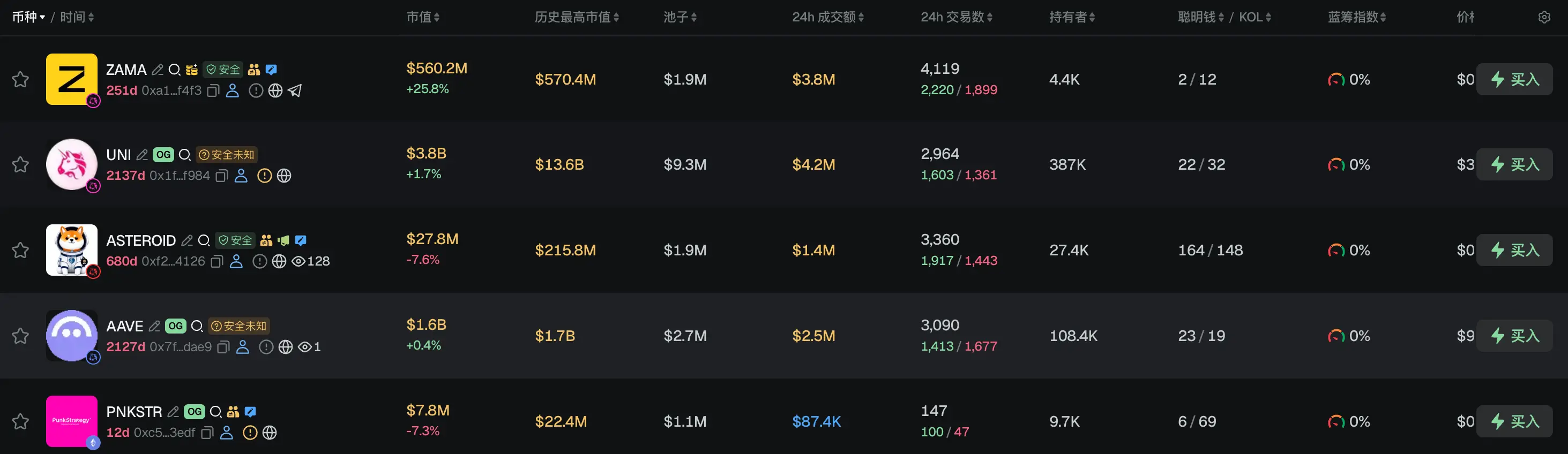
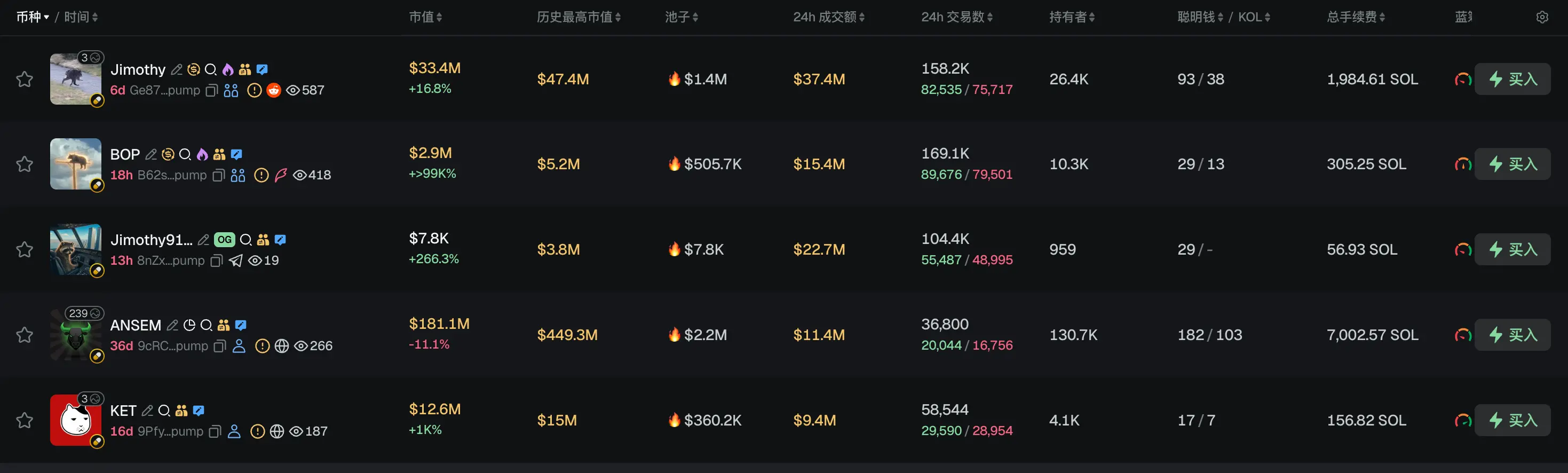
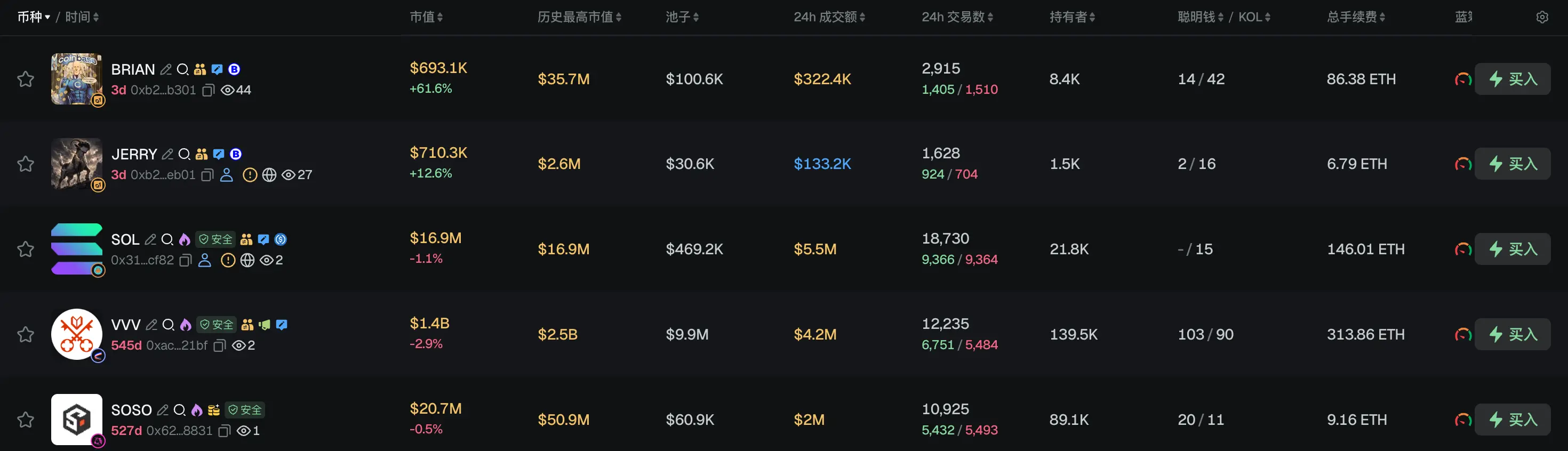
According to the meme token tracking and analysis platform GMGN, as of July 23, 09:30,
The top five popular ETH tokens in the past 24 hours are: ZAMA, AAVE, ASTEROID, PNKSTR, sato
The top five popular Solana tokens in the past 24 hours are: Jimothy, BOP, Jimothy911, ANSEM, KET
The top five popular Base tokens in the past 24 hours are: BRIAN, JERRY, SOSO, ELSA, BRETT
What are some noteworthy articles to read in the past 24 hours?
Report on the Current Development Status of Stock Perpetual Contract Market (July 2026)
In the long run, as the U.S. stock market, mature Asian stock markets, and the Pre-IPO primary market continue to expand, the boundaries between traditional finance and the crypto market will continue to dissolve. However, structural issues such as pricing mechanism flaws, liquidity differentiation, and global regulatory ambiguity will continue to constrain the standardized development of the industry in the long term. In the future, platforms that can balance product innovation, trading experience, and compliance risk control, and build a global multi-asset trading system will continue to seize industry incremental dividends and reshape the original competitive landscape of the global crypto trading market.
Citadel's Crypto Ambitions: Investing $400 Million in Crypto.com
As traditional exchanges, settlement institutions, and market makers simultaneously converge towards on-chain market structures, the ownership issue of tokenized securities is being delineated in advance. In conclusion, regarding this investment in Crypto.com, $400 million is not a high price for a market maker with annual trading revenues exceeding $12 billion, but it secures a position in the tokenized securities space. On one hand, they are advocating to the SEC that tokenized securities must be regulated, while on the other hand, they are buying a platform ready to engage in tokenized securities business; these two actions together outline the crypto market that Citadel Securities envisions. They do not oppose asset tokenization itself; what they truly care about is that the rules remain dominated by traditional frameworks after tokenization, and they have their positions on both ends of the rules and trading.
Decentralization is Not Idealism
This is also very Machiavellian. A completely decentralized settlement system is a powerful tool against competitors, especially when you do not have their historical burdens in technology and business models. Coupled with the waning trust in existing institutions, this process will only accelerate. Water will eventually flow to the lowest point, and assets will ultimately flow to the safest infrastructure. This is the Nash equilibrium of the world we live in. So it's best to be a realist like me. Decentralized systems like Ethereum have many flaws, and resisting capture is both expensive and troublesome. But it is still better than the corporate and company solutions that people often talk about today. There will be many idealists who will learn this lesson at a painful cost.
U.S. Tech Momentum Stocks Achieve Largest Single-Day Gain in History, But Has the Plunge Ended?
RBC Capital Markets interest rate strategist Izaac Brook stated, "Today's market trend is primarily the result of rising energy prices. The volatility of interest rates has been amplified due to breaking through key technical levels—2-year yields at 4.20% and 10-year yields at 4.60%—and the typical low liquidity trading environment of summer." Bloomberg's Cameron Crise warned that long-term bond yields are at a critical point of turning 5% from a resistance level to a support level, with the next obvious target being 5.5%—"this will impact the stock market, especially when economic upturns exceed expectations, pushing yields higher and negatively affecting stocks." Goldman Sachs IG credit head Kevin Boova also warned that the credit spreads of mega-cap tech companies have reached new highs, "the mega-cap cloud computing/AI/data center sector feels somewhat…
Bitcoin Mining Farms Are Turning into AI Factories
From Crusoe, CoreWeave to OpenRouter, Fal.ai, and Nous Research, these examples filled with survivor bias do not mean that crypto companies are transitioning to AI with a higher chance of success. Mining companies have left behind electricity, land, and grid connection permits; exchanges and Web3 companies have cultivated a group of engineers familiar with distributed systems, GPU scheduling, and globalized products; the wealth created by rising tokens has turned into capital for purchasing graphics cards, investing in model companies, and funding technological experiments. Crypto has not magically transformed into AI; it has merely transferred the resources left over from the last cycle to the next industry that needs them more.
Franklin Templeton: Agent AI is the "Killer Application" of Blockchain
Currently, investors have not yet figured out "how to capture the value created by blockchain and its ecosystem." They are accustomed to a centralized, company-led business world: if they want to share the value created by a company, they buy its stock. However, I believe that one point will become increasingly clear in the coming years: to capture the value of decentralized networks and businesses, investors need to buy related crypto assets. These assets are likely to become significant holdings in portfolios, especially for those looking to seize new opportunities in agent AI.
Unity and Division: What is the Endgame for Ethereum When L1 Becomes Its Own Rollup?
For ordinary users, the ideal Ethereum should never be a network map composed of dozens of chains, different gas tokens, and cross-chain bridges. In fact, where transactions are executed, where liquidity comes from, and who ultimately settles can gradually be handled by wallets, applications, and underlying protocols, but the trust assumptions, security boundaries, and exit paths involved cannot be hidden along with the operational experience. Therefore, the endgame of L2 may neither be to replace L1 nor to be eliminated by an ever-expanding L1, but rather to become a set of execution environments with different functions and performances that can share security, liquidity, and state relationships. In the past, Ethereum gained greater capacity by separating execution. In the next phase, let's see if it can still reassemble into an Ethereum after being separated.
 Risk warning



Popular articles