How did Changxin, with a target price of 116 yuan and a market value of 7.9 trillion, come about?
 Core Viewpoint

 Nomura initiates coverage on Changxin Storage, with a target price of 116 yuan implying a 1239% increase, based on an EPS of 5.8 yuan in 2028 × 20 times PE, but the assumption of a 90% gross margin extrapolating the cyclical peak as normal is highly controversial.
Author: Dreams of the Fourth Dimension
Today, Nomura released its first coverage report on Changxin Memory, rating it as a buy with a target price of 116 yuan. The report's cover also noted an issue price of 8.66 yuan, implying an upside potential of +1239.5%. This is also the highest target price given by foreign institutions for Changxin Memory that I have seen so far, making it the most aggressive valuation report in the current market.
1. How was the 116 yuan calculated?
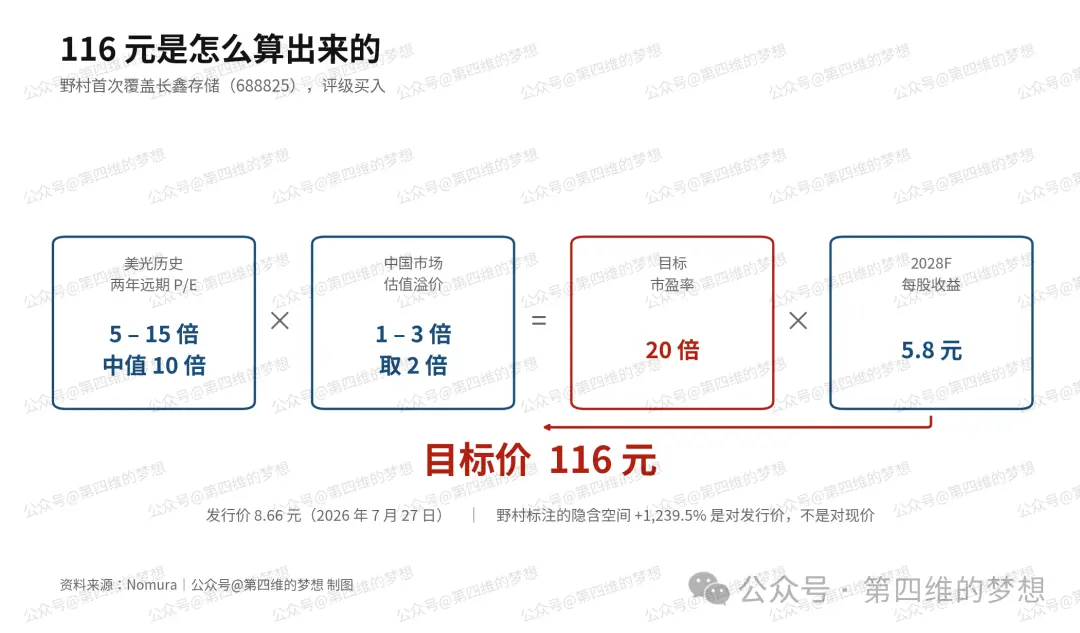
The valuation is based on 20 times the forecasted earnings per share of 5.8 yuan for 2028, resulting in a target price of 116 yuan.
The key is the 20 times anchor. Nomura's derivation is in two steps. The first step is to reference Micron. Nomura believes Micron is Changxin's closest competitor, and Micron's two-year forward price-to-earnings ratio has fluctuated between 5 and 15 times over the past five years, with a median of 10 times. The second step is to add a valuation premium for the Chinese market. Nomura used a comparative sample: ACM Research in Shanghai and its U.S. parent company ACM Research, where the price-to-earnings ratio for the same business in A-shares and U.S. stocks has long been in a 1 to 3 times relationship. Based on this, Nomura assumes that Changxin will also trade at a valuation of 1 to 3 times that of Micron, resulting in a corresponding range of 10 to 30 times, taking the median of 20 times.
Thus, the figure of 116 yuan is essentially Micron's historical valuation center × the premium coefficient for the Chinese market × Nomura's own earnings forecast for 2028.
2. Nomura's profit forecast is aggressive, to say the least
Operating revenue: Actual 61.799 billion yuan in 2025, forecasted 290.666 billion yuan in 2026, 560.788 billion yuan in 2027, and 773.323 billion yuan in 2028.
Net profit attributable to the parent company: Actual 1.875 billion yuan in 2025, forecasted 130.315 billion yuan in 2026, 277.248 billion yuan in 2027, and 393.070 billion yuan in 2028.
Nomura thus gives a compound annual growth rate of 63% for revenue and 74% for net profit attributable to the parent company from 2026 to 2028. The diluted earnings per share will rise from 2.05 yuan in 2026 to 5.79 yuan in 2028.
Based on the issue price of 8.66 yuan, the corresponding price-to-earnings ratios are 4.2 times in 2026, 2.1 times in 2027, and 1.5 times in 2028. The price-to-book ratio in 2028 is 0.6 times. This means that if Nomura's model holds, those who buy at the issue price will have a book net asset value more than double what they paid three years later. The return on equity will be 84% in 2026. By the end of 2028, cash on hand will be 1,085.5 billion yuan, with net cash of 933.5 billion yuan.
Here, a detail that is easily overlooked must be added. Nomura's forecast for net profit after tax in 2026 is 173.753 billion yuan, but minority shareholders will take away 43.438 billion yuan, leaving only 130.315 billion yuan for the parent company. Changxin's equity structure has a large proportion of minority shareholder rights, which stabilizes around 25% in Nomura's model. When looking at Changxin's profits, it is essential to focus on the line attributable to the parent company; otherwise, one might overestimate by a quarter.
Then, I would like to remind that the most aggressive assumption in Nomura's model lies in the gross margin. Changxin's gross margin in 2025 is 41.0%, while Nomura predicts 83.7% in 2026, 89.2% in 2027, and 90.5% in 2028.
Why can it reach 90%? Because in this table, operating costs hardly change. Operating costs are 36.465 billion yuan in 2025, forecasted at 47.451 billion yuan in 2026, and 73.560 billion yuan in 2028. During the same period, revenue rises from 61.799 billion yuan to 773.323 billion yuan. Over three years, revenue increases by 12.5 times, while operating costs only double.
In other words, Nomura assumes that most of the revenue increase for Changxin in these years comes from price increases rather than spending more money, with the increased prices almost entirely flowing into profits. This is not without precedent in the storage industry's upcycle; price elasticity is indeed much greater than cost elasticity, but projecting this all the way to 2028 and extending it to a 90% gross margin treats the best period of the cycle as the norm.
3. Demand Side: Nomura says memory usage will increase more than sevenfold in the next five years
Supporting the above table is Nomura's judgment on memory demand. Nomura's starting point is agentic AI. The report breaks down an intelligent agent task into eight stages: user request arrival, model weight loading, pre-filling, inference planning, tool invocation, context integration, multi-step iteration, and generating replies.
The key lies in the sixth and seventh steps. Each time an external tool is invoked, the returned results must be reassembled into the context, and the model must process the lengthening context again, causing the KV cache to expand. The intelligent agent will repeatedly run the "inference---tool invocation---integration" cycle, with each cycle lengthening the context further. Nomura judges that the peak memory pressure occurs in the seventh step of multi-step iteration, at which point it may approach the capacity limit of HBM.
Nomura thus proposes a multiplicative structure: memory demand equals the product of the number of users × usage duration × task complexity × inference token consumption × agent penetration rate. The multiplicative nature means that even moderate growth in individual components will lead to exponential amplification of the total. Nomura estimates that by 2030, the number of concurrent intelligent agent tasks globally will increase 50 times compared to 2026.
However, on the other side, there are significant improvements in technical efficiency that cannot be ignored. Nomura specifically evaluated memory efficiency technologies, including KV quantization, grouped query attention (GQA), PagedAttention, prefix caching, and multi-head latent attention (MLA), among others. These technologies can be stacked, theoretically compressing memory usage by 4 to 40 times. However, Nomura believes that the actual savings are unlikely to exceed 5 times. This is because the primary source of compression effect is the quantization of weights and KV, which reduces FP32/FP16 to INT8/INT4, and this has a precision lower limit; other methods are merely supplementary.
Balancing both sides, Nomura concludes that even with a 4 times efficiency discount applied, global memory usage will still grow more than sevenfold from 2026 to 2030, with a compound annual growth rate exceeding 60%, and this is calculated under the assumption of zero growth for non-AI applications.
Nomura also cited a supporting evidence. The CEO of Cloudflare publicly stated that for the first time in internet history, bot traffic has surpassed human traffic. Nomura raised a qualitative question: If AI no longer needs humans to issue commands one by one and can run tasks continuously on its own, what is the ceiling for demand? Nomura's answer is that the constraints at that point will only be three: whether humans are willing to authorize (safety concerns), whether the infrastructure is sufficient (power, chips, data centers, and most importantly, talent), and the capital expenditure limits of cloud providers and enterprises.
4. Supply Side: Even if you want to chase, you can't catch up
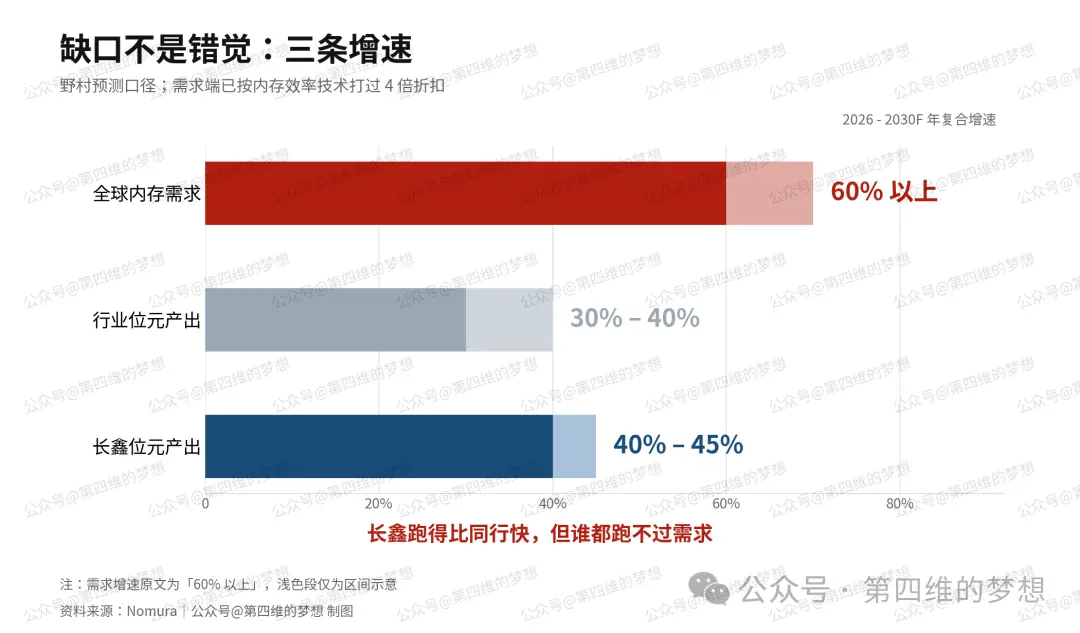
What is the other side of the demand growing at a compound rate of over 60%? Nomura estimates that the compound growth rate of bit output from global memory manufacturers is only 30% to 40%, and the supply-demand gap will remain long-term.
What’s more troublesome is that this gap cannot be filled just by spending more money. Nomura identifies the bottlenecks as clean rooms, equipment, materials, and personnel; semiconductor capacity expansion is hitting these walls, and the most difficult to quickly scale is skilled engineers.
Nomura also discussed alleviation measures, using NAND for offloading, with a capacity over 100 times that of DRAM, at the cost of being slower, and promoting high bandwidth flash (HBF). However, Nomura also stated that HBF is not yet ready for mass production, and replacing DRAM with NAND on a large scale will only tighten NAND supply as well, limiting the effectiveness of alleviating DRAM tightness. Nomura's original words are that these solutions only slow the speed of the trend, rather than reversing it.
In response to market concerns about manufacturers' reckless capacity expansion leading to a cycle reversal, Nomura provided a counterpoint. Over the past 15 years, the capital intensity of the DRAM industry has mostly been in the range of 25% to 45%, but due to the explosive growth in market size driven by AI demand since September 2025, this ratio may drop to only 15% in 2026. This means that, by historical standards, the current industry investment relative to market size is relatively low, and the market can absorb capital expenditures far above current levels.
However, Nomura also mentioned that as storage prices have surged since September 2025, both manufacturers and customers will gradually realize that stabilizing prices is healthier, and long-term supply agreements (LTA) are being signed one after another. Starting in 2028, Nomura believes that the focus of storage manufacturers will shift from pushing prices to reasonable capacity expansion.
5. Changxin itself: Capacity, market share, yield, unit price
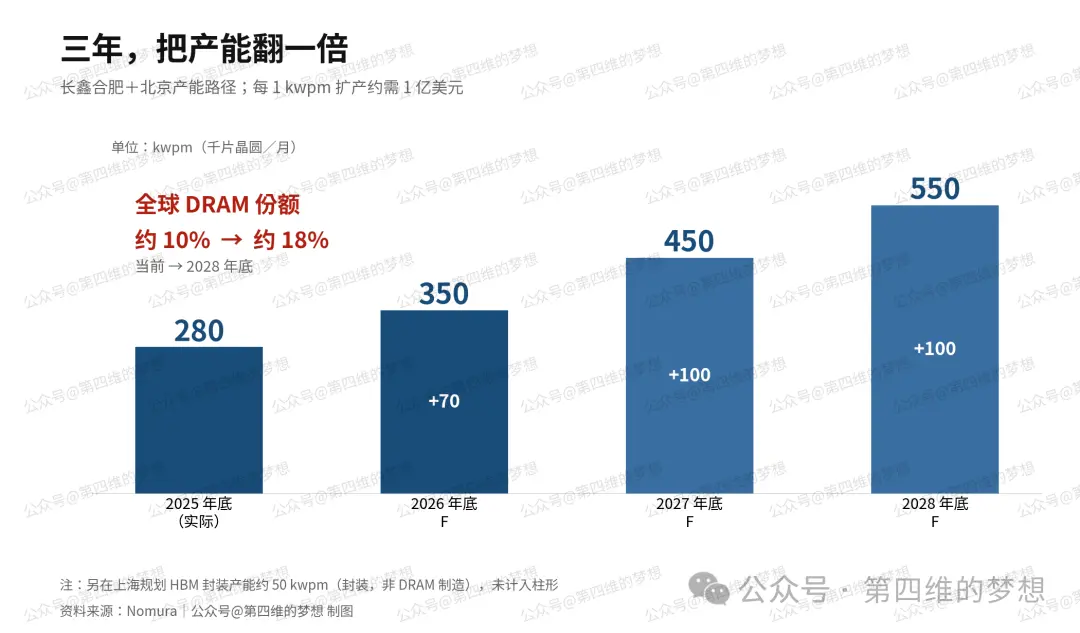
Returning to the company itself. Nomura's capacity path is as follows: by the end of 2025, Hefei and Beijing will have a combined capacity of about 280 kwpm (thousand wafers per month). By the end of 2026, this will increase to 350 kwpm. An additional 100 kwpm will be added in both 2027 and 2028, reaching 550 kwpm by the end of 2028. Additionally, HBM packaging capacity is being built in Shanghai, with a potential scale of 50 kwpm; this part is for packaging rather than DRAM manufacturing.
How much will it cost to expand capacity? Nomura's empirical value is that each 1 kwpm of DRAM capacity requires about 100 million dollars. Changxin raised 57.9 billion yuan in its IPO on the Sci-Tech Innovation Board on July 27, and if the green shoe is fully exercised, it could reach up to 66.6 billion yuan.
Assuming full production operation, Nomura estimates that Changxin's wafer shipment volume will have a compound growth rate of 20% to 25% from 2026 to 2030. Coupled with advancing the process node every two years, the bit output compound growth rate will be 40% to 45%.
The industry bit growth rate is 30% to 40%, Changxin's is 40% to 45%, and demand growth is over 60%. Changxin is growing faster than its peers but still cannot keep up with demand. Therefore, Nomura's conclusion is that Changxin will continue to capture market share from global peers while the entire industry remains in short supply.
The target market share is to increase the global DRAM share from the current approximately 10% to about 18% by the end of 2028. For reference, Nomura mentioned that Micron's share is over 20%, with a market value of 960 billion dollars as of July 20, 2026.
Technically, Nomura estimates that Changxin's mainstream process in 2026 will be at the 1x-1y node (approximately 16 to 17 nanometers), with a DDR5 yield of about 80% and a DDR4 yield of over 90%; starting in 2027, it will advance to the 1z-1a node (approximately 10 to 15 nanometers) and have the capability for HBM3 mass production. The entire process does not use EUV, relying on DUV for advancement.
Regarding HBM, Nomura mentioned that Changxin has sent HBM3 samples to a leading domestic ICT company and other companies, but certification takes time. HBM3e is still under development.
The pricing section is what I find to be the most informative part. Nomura's channel survey of leading domestic mobile phone and PC/server manufacturers found that Changxin's quotes are lower than those of overseas leaders, but not by much, about 0% to 20% lower, mainly due to policies supporting local procurement.
However, the cost differences are real. Nomura estimates that due to the mainstream process lagging behind overseas leaders by about five years, Changxin's good die per wafer is only a few hundred, while overseas leaders exceed a thousand. Therefore, Changxin's average selling price per wafer in 2026 is only about 14,000 to 15,000 dollars. As the process transitions from 16-17 nanometers to 14-15 nanometers from 2027 to 2028, and the single wafer bit output increases, Nomura expects this figure to rise to 21,000 to 25,000 dollars.
Another background figure: According to WSTS, in 2025, China will account for about 25% of the global DRAM market, but Nomura estimates that domestic manufacturers (including Changxin and others) will only account for about 10% of the global market by value, meaning that the self-sufficiency rate of domestic DRAM is only about 30%. This is the direct basis for Nomura's belief that Changxin still has a large share to capture in the domestic market.
On the customer side, over 85% of Changxin's revenue is completed through distributors, with the concentration of the top five customers being 68.08% in 2025. The disclosed end customers include Alibaba Cloud, ByteDance, Tencent, Lenovo, Xiaomi, Transsion, Honor, OPPO, and vivo. In terms of product structure, the LPDDR series accounts for 66.43% of revenue in 2025, while the DDR series accounts for 31.87%, up from 20.16% in 2023, with the ramp-up of DDR5 server products being the main reason for this shift.
Additionally, Nomura mentioned that Changxin is collaborating with GigaDevice on DRAM-on-logic wafer-to-wafer (WoW) stacking, targeting automotive intelligent cockpits, high-end mobile phones/PCs, and edge AI scenarios such as robotics. Nomura believes that this technology will begin to gain significant momentum starting at the end of 2027.
I believe that the assumption of a 90% gross margin mentioned earlier is clearly unsustainable. Directly projecting the peak of the cycle as a long-term norm does not align with the operational rules of the storage industry. Therefore, the correct approach should be to not view the profit assumptions and target prices as long-term centers, but rather as upper limits calculated under conditions of extreme supply-demand tension, with prices and profitability both in an optimistic state. Logic and technology, we are still on the way!
 Risk warning Risk warning