








RootData: The trading volume of perpetual contracts for exchange stocks dropped by nearly 90% over the weekend, but participation in stock expected pricing remains
According to data from RootData's stock perpetual contract exchange rankings, nearly 30 exchanges that have launched stock perpetual contracts still significantly adhere to the trading rhythm of traditional stock markets: trading volume drops sharply on weekends, and the morning session on Monday warms up as the traditional market approaches recovery, but has not yet returned to the intensity of a full trading day.
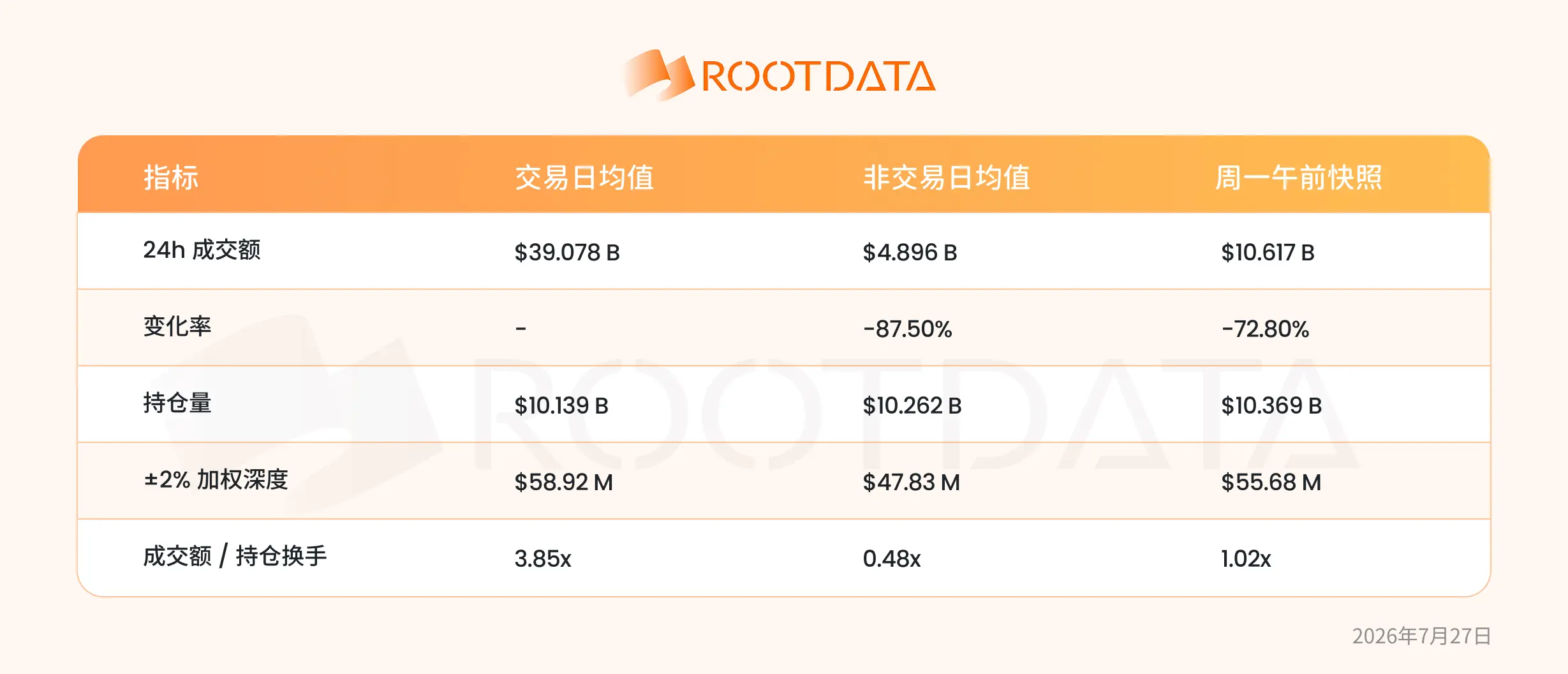
Comparing trading days with non-trading days, the 24h trading volume of stock perpetual contracts dropped from approximately $39.078 billion to $4.896 billion, a decrease of about 87.5%. However, during the same period, the open interest slightly increased from $10.139 billion to $10.262 billion, indicating that positions have not been withdrawn on a large scale; what has truly decreased is active trading and turnover. A snapshot taken on the morning of Monday, July 27, shows that the 24h trading volume rebounded to $10.617 billion, an increase of about 116.8% compared to Sunday, indicating that market activity is recovering.
In terms of liquidity, the weighted market depth (±2%) decreased from approximately $58.92 million to about $47.83 million, a decline of about 18.8%; it rebounded to around $55.68 million on Monday morning, nearing trading day levels. This indicates that the speed of order book recovery is faster than that of actual trading recovery, and market depth has not plummeted as sharply as trading volume.
From the performance of exchanges, leading platforms such as Binance, OKX, and Bitget maintained relatively narrow spreads and strong depth on Monday morning; Hyperliquid performed well in rankings, but its trading volume was still below trading day levels; some long-tail platforms still face issues with excessively wide spreads, making it temporarily impossible to assess true liquidity.
RootData Research believes that the most prominent value of these stock perpetual contract exchanges is to allow stock risks to be traded, priced, and hedged even on non-trading days of the traditional stock market. The traditional stock market is closed on weekends, with official prices remaining at the previous trading day's closing price, while stock perpetual contract exchanges still have trading, open interest, order books, and spreads on Sundays, indicating that crypto exchanges have broken through the "trading time" limitations of stocks.
However, from the current data, they are participating in expected pricing rather than official pricing, making them more suitable for expressing events, emotions, macroeconomic changes, and risk preference shifts on non-trading days. Due to decreased trading volume over the weekend, widened spreads, and some platforms having abnormal data metrics, they currently resemble a "stock pre-opening price discovery layer," having participated in stock pricing but not yet obtaining the primary pricing power of the traditional stock market, nor have they surpassed the liquidity of the traditional stock market.

 Risk warning Risk warning


