From Polymarket to US Stock Trading: How Events Map to Asset Prices
 Core Viewpoint

 Don't pay attention to what those experts and big players say, but rather focus on what the market has done.
Original Damon@Go2Mars
Polymarket has a large number of finance-related prediction events: CPI, non-farm payrolls, FOMC, regulatory policies, and major company earnings reports, all of which can affect the pricing of U.S. stocks; however, before these events occur, traders usually can only see analyst predictions or media opinions, often using their suggestions as references.
But, are they always correct?
In the trading market, changes in trend direction are quite common, so the viewpoint from one moment may not apply to the next moment. The emergence of Polymarket bridges this time gap, as its unique mechanism converts different outcomes into real-time prices, allowing traders to observe which scenarios the market is pricing. Its function can be summarized as:
Event probability → Market expectations → Changes in interest rates, earnings, or risk preferences → Repricing of U.S. stocks
By penetrating asset prices through event probability expectations and sorting out the entire logical chain, we may discover something.
1. Observing What the Market is Pricing
Polymarket contract prices range from $0 to $1. In cases of good liquidity, the price can be roughly understood as the market's implied probability of a certain outcome. For example, a YES price of $0.60 means the market roughly assigns a 60% probability to that outcome.
This number is not an objective prediction and does not guarantee accuracy. It more reflects the trading price formed by participants under current information, liquidity, and risk preferences. For U.S. stock traders, both the probability level and changes in probability are of reference significance:
The probability level reflects the current market's baseline expectations;
Probability changes reflect how new information is altering market judgments;
Depth reflects whether this expectation is supported by real funds.
For instance, before the CPI is announced, if the probability of "core inflation being higher than expected" rises from 25% to 45%, it indicates that the market is increasing its pricing for inflation risk. At this point, even if the data has not yet been released, U.S. Treasury yields, the dollar, and overvalued tech stocks may react in advance.
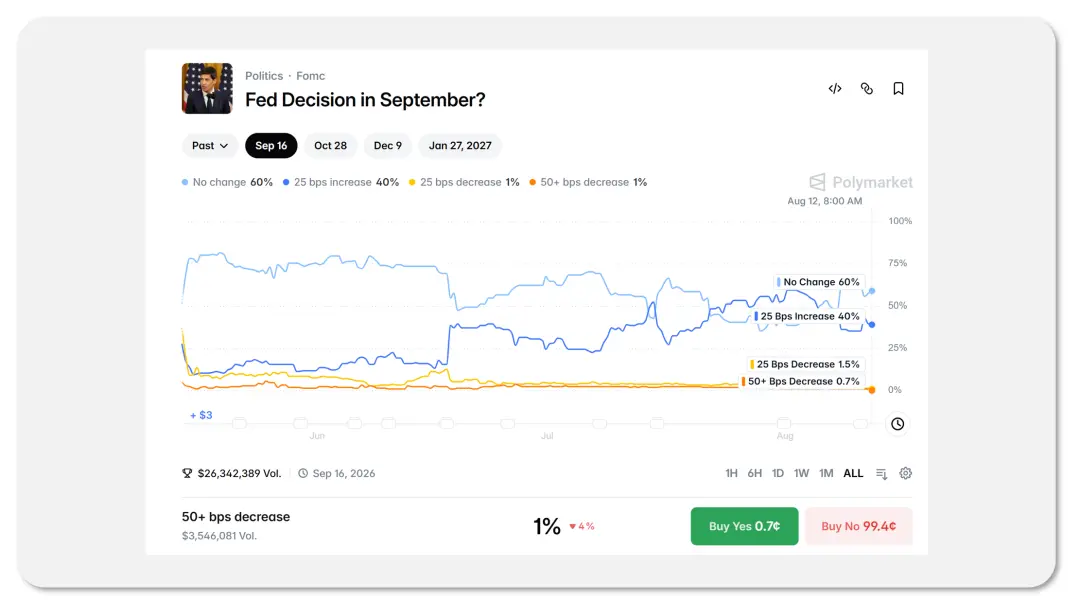
Therefore, the first use of Polymarket is to help traders identify the current expectation anchor of the market and the direction in which expectations are moving.
2. Finding Deviations Between Event Expectations and Asset Prices
In news trading, what is traded is not the event headline, but the deviation of the event outcome from prior expectations.
Assuming the market has assigned a 70% probability to the CPI exceeding expectations, then if the data ultimately comes in slightly above expectations, it may not lead to a significant drop in tech stocks, as this outcome may have already been fully priced in. Conversely, if the market only assigns a 20% probability, and the data significantly exceeds expectations, U.S. Treasury yields and growth stock valuations may experience a larger adjustment.
Thus, the existence of PM can quickly help traders pinpoint two questions:
Which outcome has already been fully priced in by the market?
Which outcome, once it occurs, may produce a shock that exceeds the current pricing?
If further explored, traders can also compare event probabilities with the performance of related assets:
If the probability of rising inflation significantly increases, but U.S. Treasury yields and the dollar do not rise in tandem, it may indicate that the bond market does not recognize this change, or it may mean that the asset has not yet completed pricing.
Conversely, if the Polymarket probability changes little, but yields and VIX rise rapidly, it indicates that the market may be trading other risks not yet reflected by Polymarket.
Therefore, PM and the U.S. stock market can achieve bilateral verification. Under real-time monitoring, there will be temporary pricing inconsistencies between the two markets, creating opportunities.
3. Mapping Events to Related Assets
Event probabilities only have trading significance when mapped to specific pricing variables.
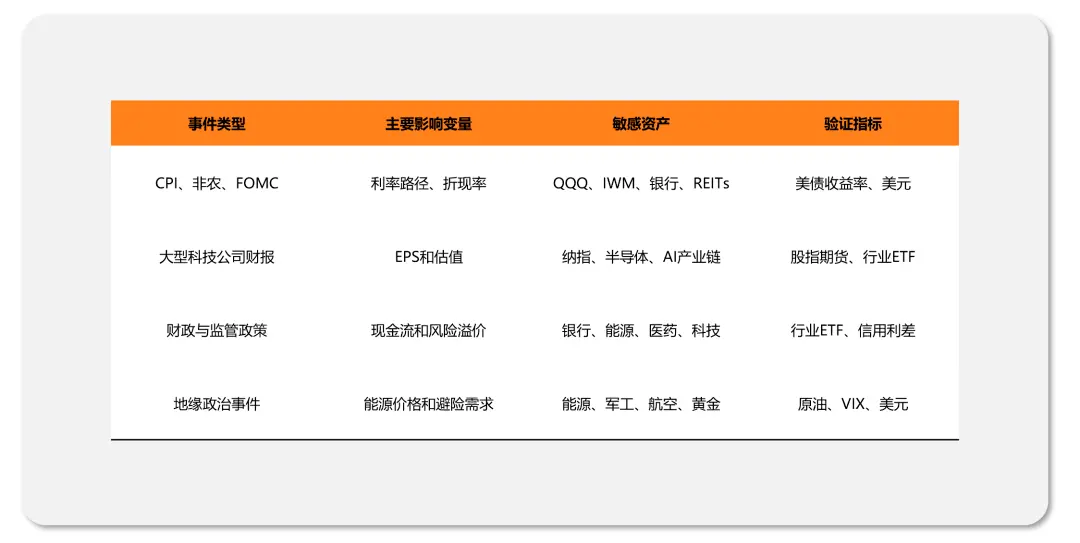
Among them, the most common impact path of macro events on U.S. stocks is through interest rates.
When inflation or employment data is strong, the market may increase the probability of maintaining high interest rates, leading to rising U.S. Treasury yields and pressure on high-valuation growth stocks; when data is moderately weak and does not trigger recession concerns, expectations for rate cuts may rise, supporting valuations of growth stocks and small-cap stocks.
However, this relationship is not fixed. Weak employment may lead to expectations of rate cuts or trigger recession concerns. The ultimate direction depends on whether the market is more focused on inflation, growth, or liquidity at that time. Therefore, Polymarket can only provide scenario probabilities and cannot replace judgments on the market's main line.
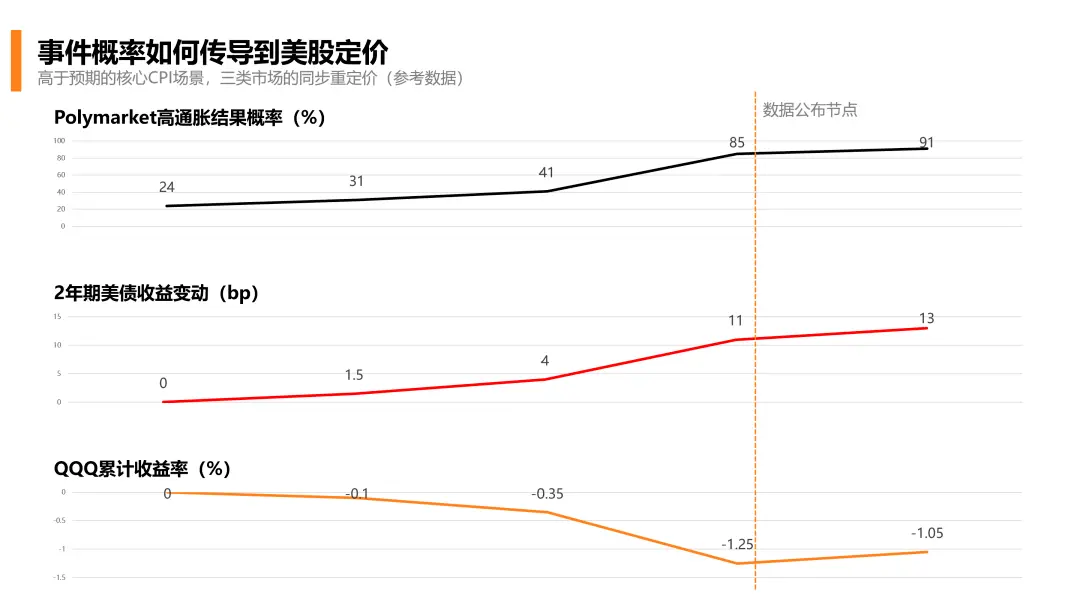
4. Actual Usage Process
Before important events occur, traders can analyze in the following order:
Clarify the settlement rules and announcement time of the event;
Observe the probability levels, speed of changes, and market depth of Polymarket;
Determine whether the event primarily affects interest rates, earnings, or risk preferences;
Identify the indices, sectors, or individual stocks most sensitive to this;
Use U.S. Treasury yields, the dollar, VIX, and the options market for verification;
Choose to trade, hedge, or refrain from participation based on pricing deviations.
The truly valuable signals are often not "the probability of a certain event occurring is very high," but rather that inconsistencies have emerged between event probabilities, related assets, and other markets that are worth studying.
5. Conclusion
Polymarket's most reasonable positioning is as an event expectation observer, cross-market verification tool, and tail risk reference.
It truly helps traders solve three questions: what the market has currently priced in, which low-probability outcomes may bring larger price shocks, and whether there are noteworthy reactions between event probabilities and related assets.
The key to professionally using Polymarket is not to trade immediately upon seeing probability changes, but to place those probability changes within the asset pricing framework of interest rates, earnings, and risk premiums, and then validate with real market prices.
After all, it’s not about what those experts and big players say, but about what the market is doing.
 Risk warning