Computing power is becoming more expensive, and AI applications must be restructured

 The general large model sets the upper limit of capabilities, while the execution architecture determines how many real results a unit of computing power can produce.
1. Hardware Assetization: The Path of Computing Power is Narrowing
The cost structure of AI applications has changed. The competitive logic of the past two years has been built on an unconditional belief in the Scaling Law: larger models, more parameters, more GPUs, and longer contexts. General large models like GPT and Claude have proven the effectiveness of this path in establishing an intelligent foundation.
However, this logic has begun to be constrained by hardware supply, inference costs, and business delays at the application layer.
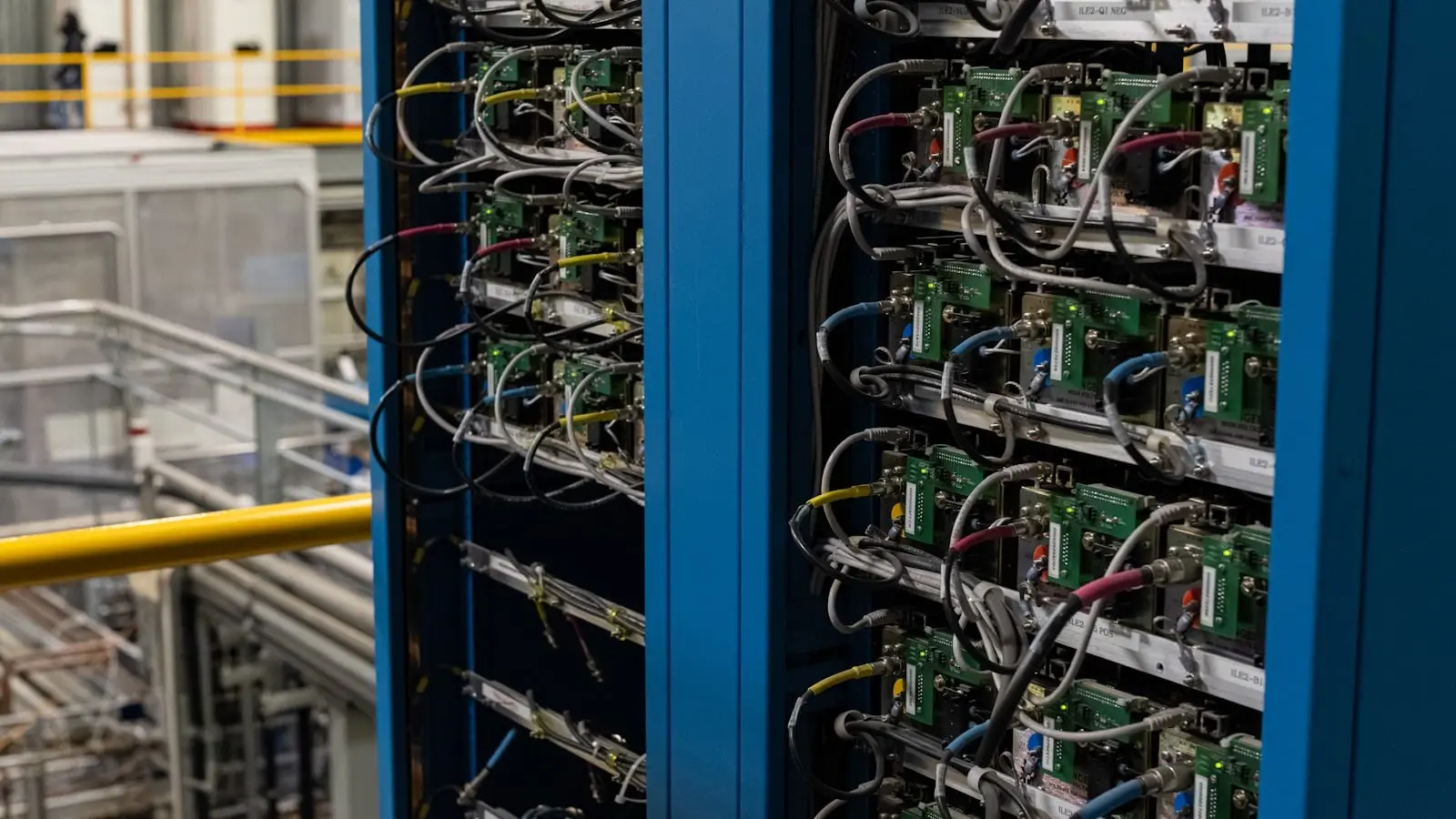
The most obvious pressure comes from the assetization of hardware. High-end GPUs are no longer ordinary computing resources but have evolved into scarce assets. The prices of core hardware like H100, H200, and the latest B300 series have risen significantly compared to the beginning of the year. Current market quotes have increased by nearly 50%, with some models even having prices but no availability. Behind this is a complex supply chain bottleneck: tight HBM storage capacity, limitations on advanced packaging, and extreme requirements for power and cooling infrastructure in data centers. The bottleneck of computing power is no longer about whether one can afford a GPU; it has become a supply chain problem involving energy layout and delivery cycles. 
Inference costs are also approaching the profit line at the application layer. The stronger the model, the more expensive each inference becomes; the longer the context, the greater the token consumption. In low-frequency Q&A scenarios, this expenditure is still acceptable, but in high-frequency businesses, it can quickly consume profits. Robots perform tens of thousands of actions daily, customer service systems handle massive requests, and enterprise agents repeatedly call tools—if every judgment step relies on strong model inference with long contexts, the business model will soon become unviable.
Latency is another hard constraint. Warehouse robots need to keep up with picking rhythms, manufacturing lines need to match beats, and financial systems need to process risks in real time. Strong models can perform deep inference in the cloud, but the physical world cannot wait. Continuing to pile on computing power may enhance the model's capability ceiling, but many industries do not require "comprehensive enhancement." Warehouse robots need to grip more steadily, financial AI needs to make risk judgments more accurately, and enterprise AI needs to execute processes more reliably. These specific issues can rarely be directly solved by simply calling a larger model again.
As the path of computing power narrows, the problems at the application layer have shifted from "Is the model strong enough?" to "Where should strong models be placed?" AI applications must be restructured.
2. Logical Discontinuity: General Models Cannot Directly Replace Industry Systems
The capabilities of the new generation of general large models are strong, but they inherently do not understand the action costs, process boundaries, and consequences of failure in an industry. The model possesses static knowledge, while industry systems require dynamic execution.
In a warehouse setting, when robots face a pile of objects with different shapes and chaotic placements, the real problem is not identifying the names of the objects. The task logic is: Is the shoebox stuck by the packaging paper? Should it be grabbed from above or from the side? Is it easy to slip after the gripper closes? Should a different path be taken after the first failure? General models know the definition of "grasping," but they cannot directly handle real-time physical feedback during the grasping process.
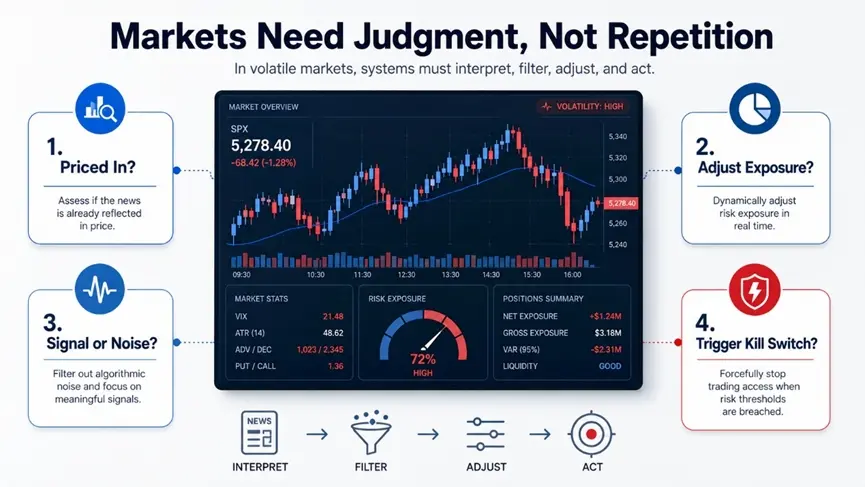
The same goes for financial systems. In the face of volatility, reiterating news is meaningless. The system needs to judge: Has this news already been reflected in the price? Should the risk exposure be adjusted in real time? Which fluctuations are just noise generated by algorithms? When should trading interfaces be forcibly stopped?
The same applies to internal enterprise systems. Models can generate perfect business emails, but they do not understand internal permission controls and process connections. If an AI tool does not know who has the authority to approve budgets or which actions will trigger subsequent financial processes, it cannot enter core business. In industrial manufacturing, if the model's actions are unstable, the rhythm is disrupted, or equipment is collided with, the system fails.
The bottleneck of industry AI lies in the lack of an "execution structure" rather than simply lacking intelligence. Many failed AI projects treat large models as universal interfaces, hoping to solve everything through prompts. This approach quickly exposes its fragility when dealing with long tasks and high-risk scenarios: lengthening the task chain can lead to uncontrolled costs, increasing steps can cause delays, and due to the lack of feedback mechanisms, the system cannot self-heal from execution failures.
3. Sereact Sample: Shortening the Chain from Perception to Action
In April 2026, this German robotics AI company completed a $110 million Series B financing round, led by Headline, with follow-on investments from Bullhound Capital, Felix Capital, and others. Sereact disclosed that this funding will be used for the development of its next-generation robotic brain Cortex 2.0 and expansion into the North American market. Currently, Sereact has over 200 systems operating in Europe, having completed more than 1 billion real production grabs, with only one remote human intervention needed for every 53,000 grabs.
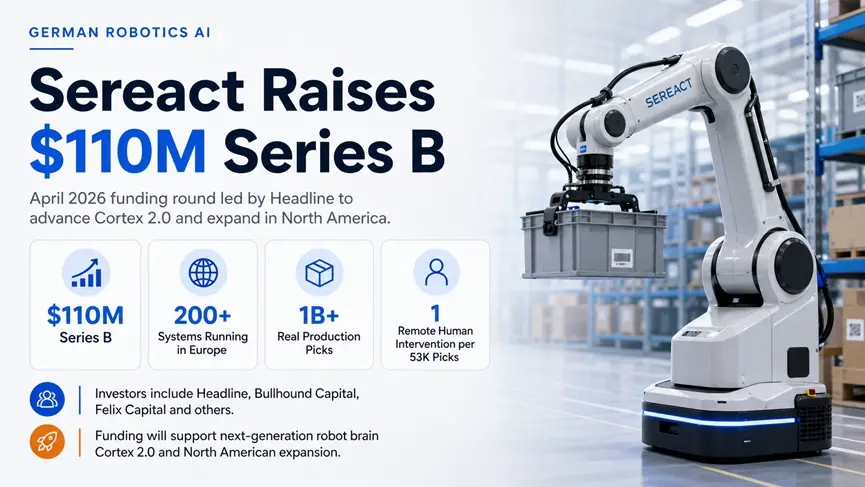
This is not just a monetary competition. Sereact has avoided the path of chatbots and directly entered physical execution: enabling robotic arms to achieve stable grabs in dimly lit, deformed packaging, and severely obstructed industrial environments.
Its core technology VLA (Vision-Language-Action) compresses visual input, language instructions, and robot states into the same execution structure, significantly shortening the chain from perception to action.
Traditional robotic systems typically work in a modular fashion: first recognizing objects, then understanding tasks, and finally planning paths. In this chain structure, even a slight deviation in visual recognition—such as a depth judgment being off by 1 centimeter—can lead to subsequent planning failures. In complex warehouse environments, each step relies on independent modules to relay results, making it easy for the chain to break.
Sereact's approach is to train the scene images, instructions, and robot states within the same framework. The model output is no longer a textual explanation but directly conveys action decisions to the control stack:
- Coordinates for the robotic arm's movement;
- Angles of the gripper's rotation and closure moments;
- How to remedy failures in real time.
When a robot faces a shoebox, it does not label "this is a shoebox," but rather makes decisions about the task: Is the packaging paper blocking the path? Is lateral grabbing steadier than grabbing from above? This short-path architecture reduces information loss during the transmission process.
However, actions have physical consequences, so a World Model is also needed. But this does not mean that a complete physical simulation is conducted at every step; rather, it involves a Look-ahead Layer for key actions at a low-cost rehearsal level. The system will predict: Will this grab slip? Will lateral entry cause a collision? Will pushing aside the packaging paper increase the success rate?
This structure only cares about the variable changes relevant to the task, thus determining "when it is worth spending more computing power to think":
- Low-level controllers: Handle high-frequency, stable fine-tuning actions;
- Mid-level models: Handle grabbing strategies;
- High-level planning: Only at nodes with high risks and high action costs, invoke predictive models to calculate a few more steps.
When general AI enters an industry, it must be reorganized into this layered execution structure.
4. The Five-Layer Structure of Deployable AI
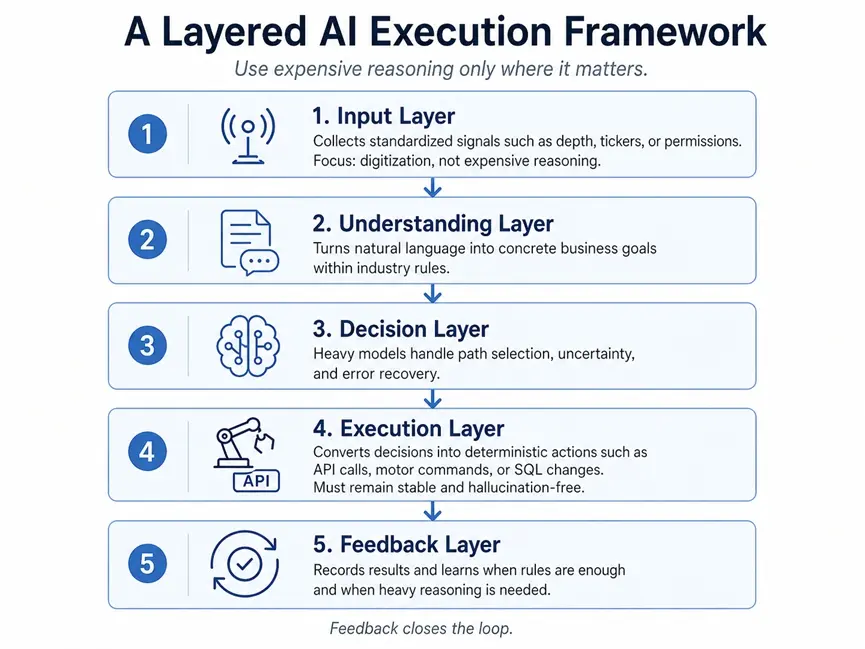
Real business includes input, understanding, decision-making, execution, and feedback. Handing all steps to a large model will quickly make the system heavy. Deployable AI will ultimately be broken down into five layers:
- Input Layer: Responsible for receiving external information. Robots look at images and positions, financial AI monitors order books and on-chain data, and enterprise AI examines document permissions. This layer does not engage in deep thinking; it is solely responsible for standardizing information collection.
- Understanding Layer: Responsible for intent parsing and task alignment. When a user says "process the order," the system must translate it into specific business objectives: Is it checking inventory, verifying invoices, or updating approval status? This layer needs to be constrained by hard industry rules.
- Decision Layer: Handles uncertainty and path planning. This is where strong models are most needed. What should be done first when information is incomplete? Which tool should be invoked? The decision layer needs to handle conflicting objectives and execution risks.
- Execution Layer: Turns judgments into deterministic actions. Robotic arm movements, API calls, approval submissions, and inventory adjustments. The most important aspect of the execution layer is stability. Many actions are better handled by rules, controllers, or fixed workflows to ensure there are no "hallucinations."
- Feedback Layer: Records execution results and writes them back to the system. Was the action successful? Did the prediction hit? Was there a human takeover? The role of the feedback layer is to feed data back into the system. Without feedback, AI is just a tool; with feedback, the system knows which scenarios need upgraded reasoning and which processes can be solidified.
Expensive strong reasoning is only used at true decision nodes. Ordinary actions are executed directly, high-risk tasks are validated, and successful processes are solidified into rules.
5. Industry Cases: The Boundaries of Task Reconstruction
Various industries are using structured design to hedge against computing power costs.
- Warehousing and Logistics: Reconstructing from "Recognition" to "Action Success Rate" In logistics settings, competition is no longer just about who can recognize more types of goods. The goal of this architecture is to allow the same computing power to cover more effective actions, rather than handing every grab to a strong model. The system embeds AI into the driving layer, with large models only intervening when encountering unseen new packaging or complex obstructions.
- Financial Trading: Reconstructing from "Market Prediction" to "Layered Risk Control" Financial AI no longer predicts trends every second through large models. The restructured system is divided into three layers: small models handle signal filtering, rule engines execute stop-loss, and only activate large-scale parameter models for global risk assessment when facing complex fluctuations like cross-market linkages.
- Enterprise Agent: Reconstructing from "Copy Generation" to "Permission Transfer" The focus of enterprise AI is to ensure the integrity of transactions. Large models are responsible for analyzing needs and breaking down tasks, but every write operation (such as modifying a database or sending a transfer instruction) must undergo hard validation by a state machine. This ensures that AI behavior is auditable, reversible, and traceable.
- Software Development: Reconstructing from "Code Generation" to "Automated Engineering" Although GPT can write complex code snippets, the real efficiency bottleneck lies in debugging and deployment. The new generation of development tools integrates AI into the CI/CD process, where the model not only generates code but also analyzes runtime logs and automatically rewrites, reducing the frequency of manual debugging.
6. Next Stage: Architectural Efficiency Determines Victory or Defeat
AI will continue to grow stronger, and computing power will continue to be invested. However, the focus of competition at the application layer has changed: in the past, companies blindly pursued access to the strongest models; now, they emphasize achieving stable business results with limited computing power.
Accessing strong models only provides capabilities; turning those capabilities into business results is what matters. From Sereact's example, we can draw inspiration: expensive reasoning is reserved for key decisions, high-frequency actions are assigned to fast modules, low-value tasks are given to cheaper systems, and real results continuously accumulate as feedback.
As computing power continues to rise in price, the space for loosely calling models will shrink. Competition at the application layer will return to architectural efficiency:
- Calling a strong model one less time means incurring one less cost.
- Writing failure results back to the system provides one more opportunity for improvement.
- Better integrating rules and models leads to a more stable system.
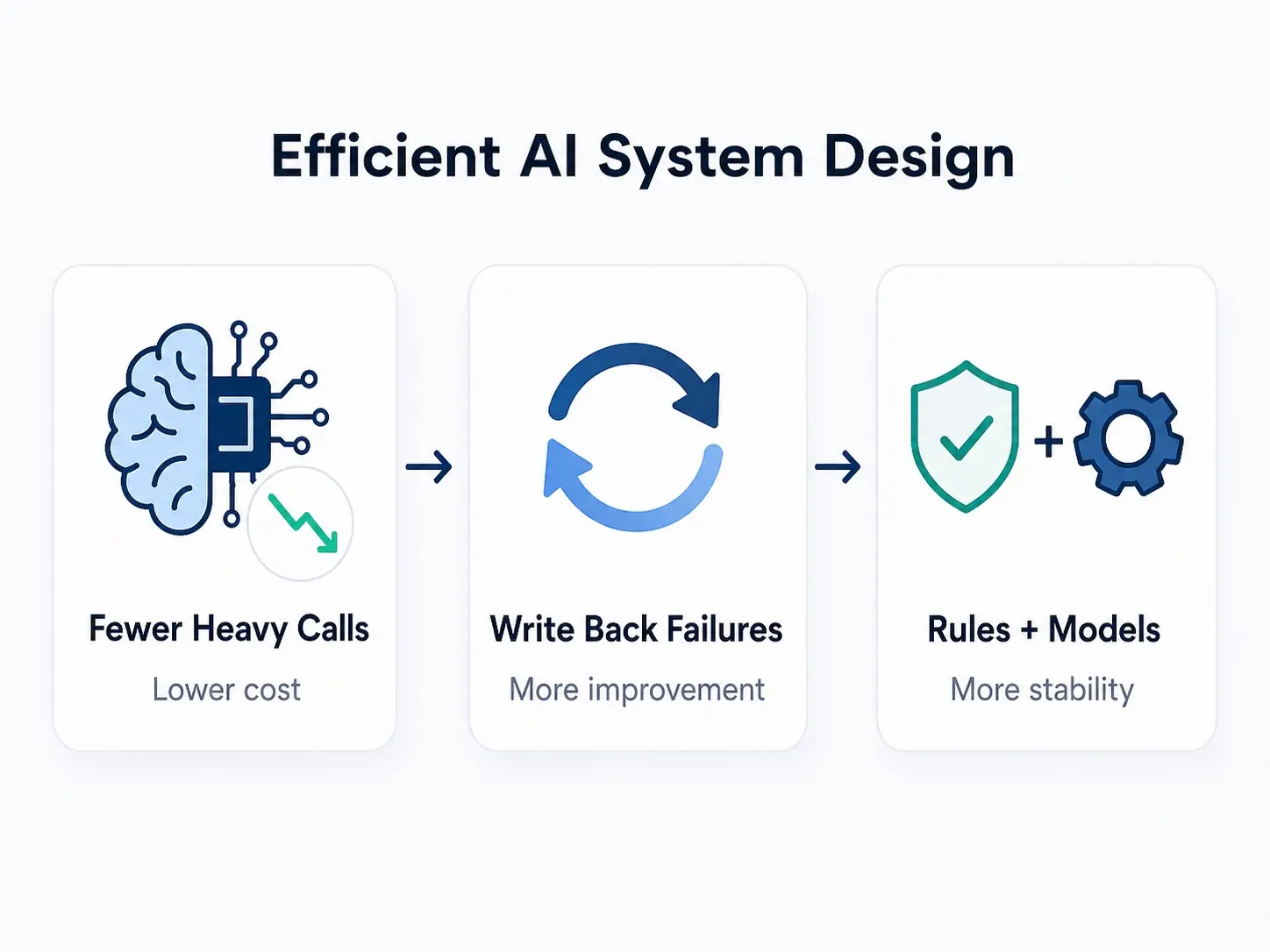
The bottleneck of industry AI does not lie in a lack of intelligence but in a lack of execution structure. Large models provide the upper limit of capability, while the layered design of application systems, feedback loops, and risk control determine how many real business results can be generated per unit of computing power. Future models need to be organized more intelligently.
 Risk warning