"Everyone is scrambling for storage chips, like a war."
 Core Viewpoint
 A person may have 10 different AI agents in the future to assist them, and these agents will require more storage, which expands our market.
Author: Xie Ruirui, Tencent Technology
Editor: Xu Qingyang, Tencent Technology
"It’s like a war," said Choi Tae-won, chairman of SK Group, "Everyone wants to buy memory chips."
In the past, memory chips were the most typical cyclical products in the semiconductor industry: when demand rose, the entire industry expanded production, and after oversupply, prices plummeted, leading manufacturers to "weather the winter" together.
Today, AI has rewritten the new cycle of memory, with SK Hynix becoming the most direct beneficiary of this change. By 2025, SK Hynix, leveraging its leading advantage in HBM, will control nearly half of the global market share and has become one of the key suppliers for AI chip giants like Nvidia.
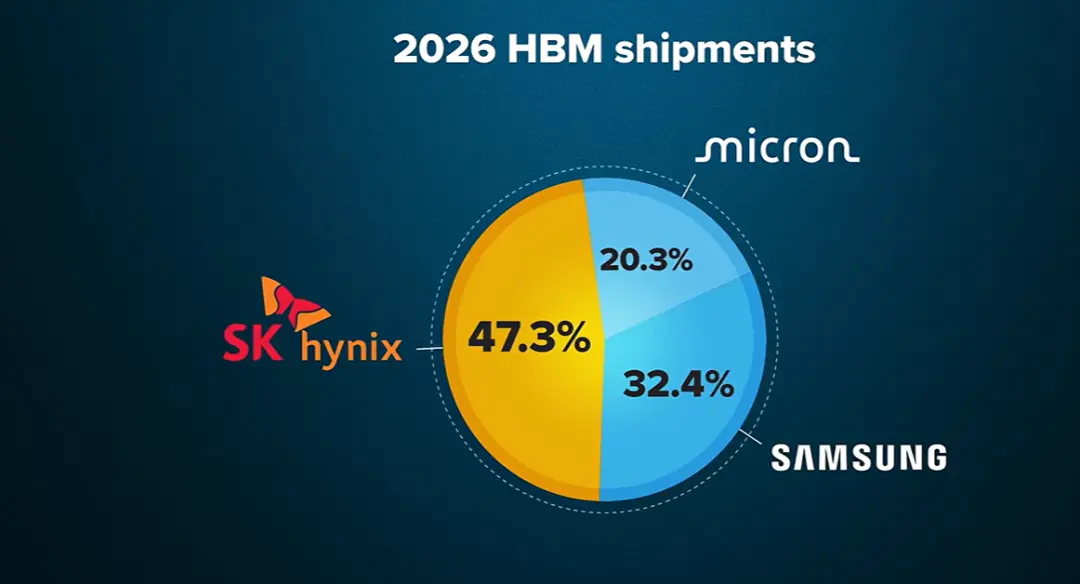
SK Hynix controls nearly half of the global HBM market share. Source: CNBC
To bet on the next round of demand, SK Hynix is undertaking the largest memory wafer fab expansion globally, investing $72 billion, with plans to triple its production capacity by 2034.
Choi Tae-won’s reasoning is simple: AI requires more and more memory.
He believes that the number of AI agents could grow about tenfold in the next five years. Within ten years, total memory demand could reach nearly five times the current capacity. Meanwhile, HBM is being co-designed with AI processors, and memory is no longer just a standardized commodity as it was in the past.
But the risks are also clear; the memory industry has never lacked lessons on "overbuilding." Expanding production takes 4 to 5 years, while customer demand is already approaching double; long-term agreements, joint venture fabs, and "memory as a service" have all become new ways for companies to try to share risks.
In Choi Tae-won’s view, AI is ushering the memory industry into a new phase. In the past, memory demand mainly depended on population and the number of hardware devices; one person wouldn’t use dozens of smartphones at the same time. AI is different; a person may have multiple AI agents in the future, each requiring memory.
He does not believe the memory industry's cycle will disappear but thinks it may become longer. This is also the main basis for SK Hynix's bold decision to expand production on a large scale.
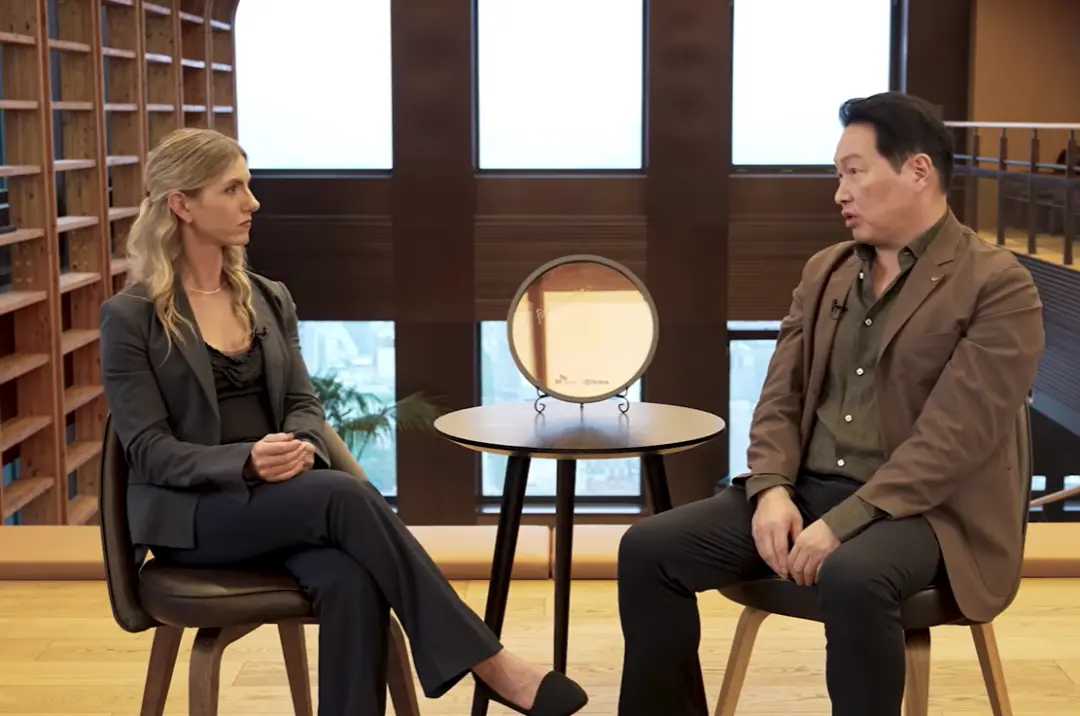
Choi Tae-won during an exclusive interview with CNBC. Source: CNBC
The following is a transcript of the interview (with edits):
01 "It’s like a war"
Q: SK Group has over 100 subsidiaries; how important is the memory business to the entire group?
Choi Tae-won: We are now in the AI era, and people need a lot of memory, especially for AI. I think of AI as a four-year-old child; it’s still very small, but as it grows, it will need more functions, more experiences, and more knowledge, all of which must be stored somewhere.
Humans are the same; a child's brain doesn’t have much memory, but as we grow older and gain experience, we have more memories and wisdom. The same applies to AI, so AI needs a lot of memory chips. Currently, SK Hynix is already the largest subsidiary under SK Group.
At the same time, AI also needs energy and network support. SK Group also has energy and telecommunications businesses that are participating in the construction of future AI data centers. From this perspective, we have a relatively complete business portfolio. However, for now, SK Hynix is indeed the most important part of the group’s business.
Q: When you decided to enter the semiconductor industry in 2012, did you foresee the AI opportunities of today?
Choi Tae-won: At that time, I did not foresee the explosion of AI. In 2012, we already had energy, chemicals, and telecommunications businesses, but I wanted to add more globalized businesses.
We were in the digital age, and I believed that a digital society would require a lot of memory because a vast amount of knowledge and data needed to be stored. So I thought memory chips might represent the future, and I made that decision. It was a very risky bet, but looking back now, it’s one of the biggest and most successful bets of my life.
Q: You are now betting $72 billion to expand production capacity. Why do you believe long-term demand can support such a large-scale investment?
Choi Tae-won: If you look at future demand, you will find that people may use more and more AI agents. I believe the future is the era of AI agents, and by 2025, the number of AI agents could grow about tenfold in the next five years.
Once they are spread across the world, they will also require a lot of memory. Therefore, I see that in the next ten years, total memory demand could reach nearly five times the current capacity. The demand is enormous, and to meet global needs, we must quickly expand supply capacity, which is why I decided to expand production.
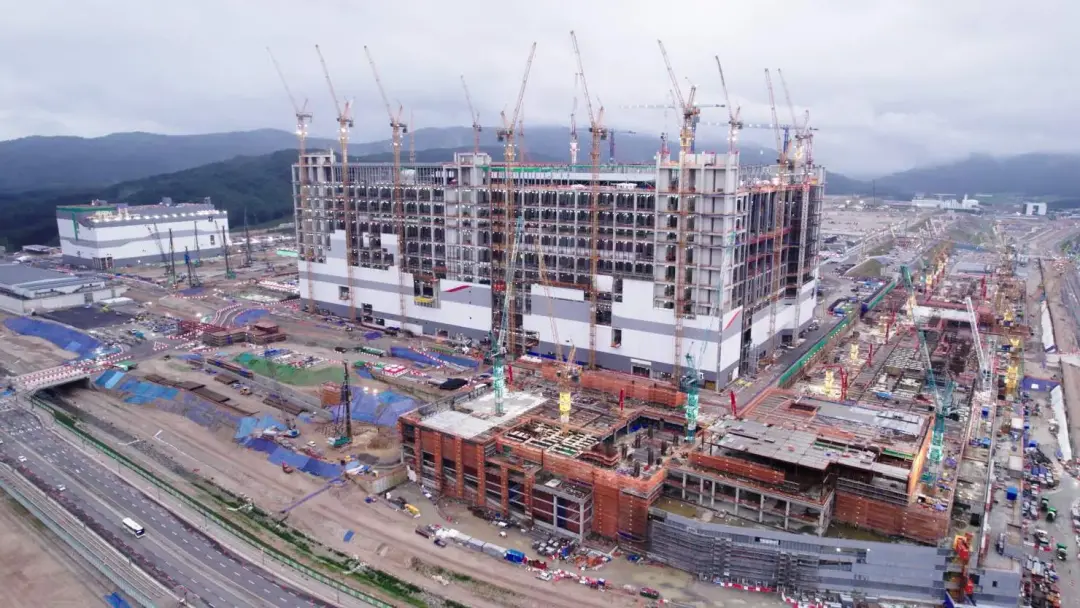
The first of four fabs being built by SK Hynix in the Yongin cluster in South Korea is taking shape. Source: CNBC
Q: Who are your friends in the AI field?
Choi Tae-won: My friends in the AI field are mainly leaders of large-scale enterprises, including Jensen Huang from Nvidia, Satya Nadella from Microsoft, Sundar Pichai from Google, and Mark Zuckerberg from Meta. These people are basically customers of SK Hynix, and I occasionally meet with them.
Q: What about TSMC?
Choi Tae-won: Of course, including C.C. Wei. About a month ago, I met him in Taiwan, and we had dinner together, exchanging a lot of information and predictions about the future. He also believes that AI is a real technology. No matter how many memory chips there are, if TSMC’s capacity is limited, there won’t be enough GPUs; conversely, even if TSMC has ample capacity, it won’t help without sufficient HBM. So we must establish partnerships and collaborate. That’s the nature of our relationship with TSMC.
Q: How do you secure enough capacity on TSMC's manufacturing lines? Everyone is queuing up for that capacity.
Choi Tae-won: He knows which parts are critical because without them, there is no AI production, especially in GPUs. So no matter how much capacity they have, the demand is overwhelming. But I believe he will manufacture base chips for us.
Q: Nvidia CEO Jensen Huang once wrote "Please produce more" on a wafer you showcased. How important is Nvidia to SK Hynix?
Choi Tae-won: Nvidia is currently the most important customer. They are developing new products and technologies every year, and I greatly admire their speed. We are also working with Nvidia to push new chips and new technologies.
Nvidia is one of the most outstanding companies in the world today, and I believe it will continue to dominate in the future. They possess not only GPU technology; Jensen Huang is also collaborating with other companies to build an AI ecosystem. He is not only developing his own company but also establishing different types of partnerships to build the entire ecosystem, which is very important.
Q: Is there a risk in concentrating so much business on one customer like Nvidia?
Choi Tae-won: Without Nvidia, the AI ecosystem wouldn’t exist. Nvidia provides many solutions for AI infrastructure, so we must do our best to support them.
However, Nvidia is not our only customer; Google, Microsoft, and other large-scale enterprises are also our customers, some of which are also manufacturing chips themselves. Currently, the largest is Nvidia, so we hope to provide solutions for this largest customer, but that does not mean we rely solely on one customer.
Q: Among these customers, is there anyone helping you with this capacity expansion? What can they do to help you quickly increase capacity?
Choi Tae-won: They always ask for more chips, and I am working hard to provide some solutions, but currently, demand is very strong. Expanding capacity requires a long lead time, at least 4 to 5 years. Therefore, next year may be the most challenging year because all memory companies are not yet ready to expand capacity, but demand continues to grow.
We believe that this year’s demand will double, and almost all customers are asking us to provide nearly double the amount of chips. It’s a bit like a war; everyone wants more memory chips. Without them, they cannot produce AI computing devices and AI chips.
Another downside is that prices are rising too quickly. PC manufacturers, smartphone manufacturers, consumer electronics, and even automotive manufacturers are struggling to find chips, and some chip prices are too high. One of my jobs is to protect the entire memory market as much as possible, expand capacity, and do it quickly.
02 "Chip Inflation"
Q: Memory chip prices have risen by 40% to 50%. Do you expect this situation to continue?
Choi Tae-won: This is what we call "chip inflation." Chip prices are too high, and even Apple has had to raise the prices of flagship products, which has effectively pushed up prices across society. I don’t want this to happen, but it has. I don’t have a solution in the short term, which is why I am investing heavily in expanding fabs.
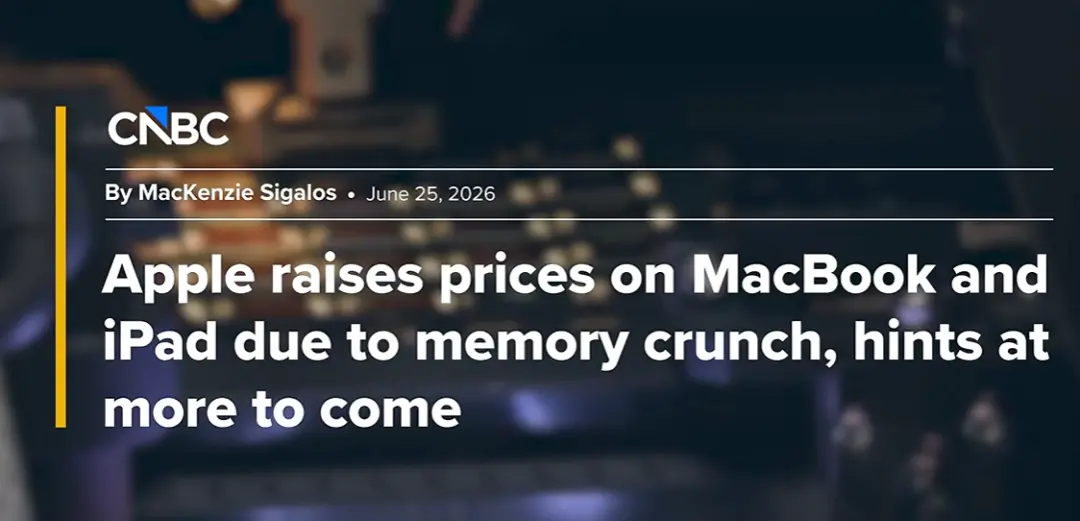
Due to the shortage of memory chips, Apple has raised the prices of MacBook and iPad. Source: CNBC
We have announced that we will double our capacity within five years, but for most customers, this is still not enough; they need more. The problem is that some things are physically impossible, which is what we now refer to as the AI bottleneck.
Q: HBM and DRAM account for about three-quarters of SK Hynix's revenue. If AI chips start adopting other technologies in the future, does that pose a risk to you?
Choi Tae-won: Technology is always evolving. DRAM is just the foundation; we stack on top of DRAM to form HBM, and in the future, there may also be CXL (Compute Express Link) and other technologies to support AI data centers.
There will be various options in the future, but our goal is clear: to expand memory capacity in various ways. Ultimately, we want to reduce the Token cost for AI. Right now, I think the Token price is still too high and must be further reduced; otherwise, people will have to spend too much on Tokens.
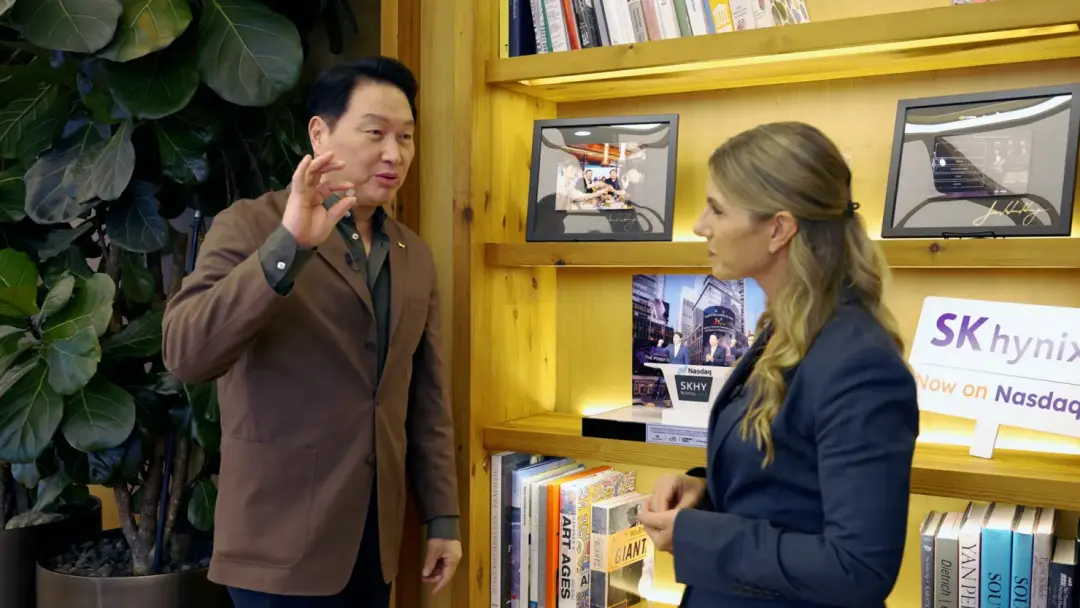
Choi Tae-won showcases HBM4 chips to Trelasov at SK Group headquarters in Seoul, South Korea. Source: CNBC
Q: The memory industry has often faced overbuilding due to large-scale capital expenditures in the past. How do you avoid this situation?
Choi Tae-won: We have always been very cautious. Although we just announced a large-scale expansion plan, this plan is based on the existence of demand. Before each expansion, we check whether the demand is real. Customers have already signed some long-term agreements with us, and we also have different ways to share risks, such as establishing joint venture fabs or offering "memory as a service." This is not just about selling chips; it can also be about sharing risks in other ways.
We do not want oversupply or undersupply, so we are always checking demand. Another important issue now is HBM. People need a lot of AI accelerators, and every country and market may want to have these devices. To meet the demand, we produce a lot of HBM, but there is a problem with HBM expansion; it consumes more wafer space than ordinary DRAM, taking up a lot of wafer capacity.
Therefore, we must expand overall wafer capacity. I believe there are indeed risks on the supply side, but we are already aware of this and are carefully confirming whether future demand exists.
Q: What changes are there in the long-term contracts requested by customers now?
Choi Tae-won: This is not something we proposed unilaterally; in fact, customers want to sign long-term agreements because they must ensure a supply of memory.
If customers only want to pursue short-term profits, it does not help alleviate the current supply shortage. These agreements are indeed long-term agreements, but we want to give customers more certainty. We will check demand year by year and extend long-term agreements. This way, both parties can work together to continuously confirm demand, avoiding over-investment and under-investment.
Q: I heard that hotels across South Korea are packed with tech companies coming to sign long-term contracts. Is that true?
Choi Tae-won: Yes. However, as I said, next year may be the most severe year for chip shortages. Many people want to buy chips now, but our supply capacity is limited. Every time I meet with customers, I feel sorry because if everyone wants all the chips, I cannot provide them all; I can only do my best.
03 2026, Hynix "Breaks into America"
Q: 2023 has been a tough time for you; the company almost went bankrupt in 1997. What will be different this time?
Choi Tae-won: I don’t really believe this time will be different. But one thing is different; we must deal with new things, the new "baby" (AI). AI has changed our society. It consumes a lot of energy, electricity, materials, silicon, and even water. It also creates intelligence. In the past, we only produced products, but people can use them to gain intelligence. We can become smarter and happier. Of course, there are dangers, but we must be vigilant.
Overall, AI can help humans reduce the burden of labor, lessen the differences between people, and relieve the overall tension in society. We don’t have to work so hard; there may be more opportunities to create a happier society.
Q: You mentioned that when choosing a location, power and water are more important than geography. Does the U.S. have enough resources to support HBM production facilities?
Choi Tae-won: Building a large memory fab requires nearly 600 to 700 different companies to support materials, chemicals, and services; otherwise, it cannot truly survive. This is one of the biggest problems. Every country wants to build memory fabs on its own territory.

SK Hynix receives government subsidies for its fab in Indiana. Source: U.S. Department of Commerce
If there is water, electricity, and land, the issue lies in the ecosystem. If I can bring that ecosystem over, I will build factories anywhere, including in the U.S. and anywhere in the world. Our research team is studying where the real opportunities are, how quickly new fabs can be built, and how to alleviate the memory shortage.
Q: U.S. customers want SK Hynix to build complete memory fabs in the U.S. What are your current plans?
Choi Tae-won: We have been studying this, and we cannot directly announce where to build the factory yet because we still need to decide on specific locations, timing, methods, and more details, as well as sign many contracts. We are working hard. Not just in the U.S., I am also looking for expansion opportunities globally; I am willing to do so, but first, we must find the right location. To be honest, we have been researching for over a month.
Q: Has the U.S. government or customers directly asked you to build a factory in the U.S.?
Choi Tae-won: U.S. customers want to build factories on U.S. soil. As for the U.S. government, I have not yet spoken directly with them. This is a business matter; if customers want to do this, I am willing to look for opportunities with them.
Q: What advantages does SK Hynix have compared to Samsung Electronics and Micron?
Choi Tae-won: SK Hynix was once a company under bankruptcy protection for over ten years, so we were really "hungry" at that time. We have a fighting spirit that can be called "determination." Our teamwork is very good. Technically, we are almost at the same level as our competitors. In terms of resources, while some companies may have larger scales, we have sufficient resources, funding, and engineering strength; the gap is not significant. I believe it is our teamwork and spirit that can be the key to changing the landscape.
Q: One of the ways you gain more funding is through revenue from the U.S. market. How did you feel on the first day of listing? And how do you feel about the performance since listing in the U.S. market?
Choi Tae-won: Listing in the U.S. is a significant move; it is the first step for SK Hynix to enter the global financial market. With new shareholders and new financial supporters, this is a huge opportunity for us. We can increase many different types of financial and market options and have the opportunity to provide better incentives for potential engineering talent in the U.S.
To this end, we decided to open a new R&D center in the U.S. and also the Indiana fab. We have been considering many other investments, especially in AI.
Q: Why establish a $10 billion AI company in the U.S.?
Choi Tae-won: We want to acquire technology from the U.S. We can bring our own memory technology, but we also need system simulation and other AI technologies. In the future, we may provide better solutions for AI data centers, AI infrastructure, and AI software because software must connect with hardware.
The U.S. has excellent software engineers and a strong software industry, while Korea, Taiwan, and Japan have strong manufacturing capabilities; these two aspects can complement each other. That’s why we established this AI investment company.
Q: The memory industry has always experienced cycles of boom and bust. Why can this large-scale investment be sustained?
Choi Tae-won: In the past, the memory business mainly depended on population because population determines the number of hardware devices. Without hardware devices, people can only consume one smartphone at a time; one person wouldn’t buy dozens of smartphones in a day. The population is limited, so the entire market is also constrained.
But the AI era is different. A person may have ten different AI agents to assist them in the future, and these agents all require more memory, which expands our market.
So I don’t want to say that the memory industry no longer has cycles, but I believe the cycles will change and may become longer. Of course, I am not sure; no one can truly see the complete future. But I feel that this is no longer the way the memory business used to operate. For us, this is a turning point, and I see it as a structural change.
Now, customers tell us they have a large demand for products, and my responsibility is to deliver those products. This situation may continue. As for when and how the market will enter the next boom or downturn, I cannot judge precisely, but at least in the near future, there is strong momentum on the demand side, which is certain.

 Risk warning