








HPC Report: Perpetual contracts are a supplement to futures contracts rather than a replacement, achieving risk transfer at a lower cost
The latest research report from the Hyperliquid Policy Center (HPC) states that perpetual contracts expand hedging options and improve price discovery, with no evidence found of statistically significant harm to the benchmark futures market. The report argues that perpetual contracts are complementary to traditional futures with expiration dates, rather than zero-sum substitutes.
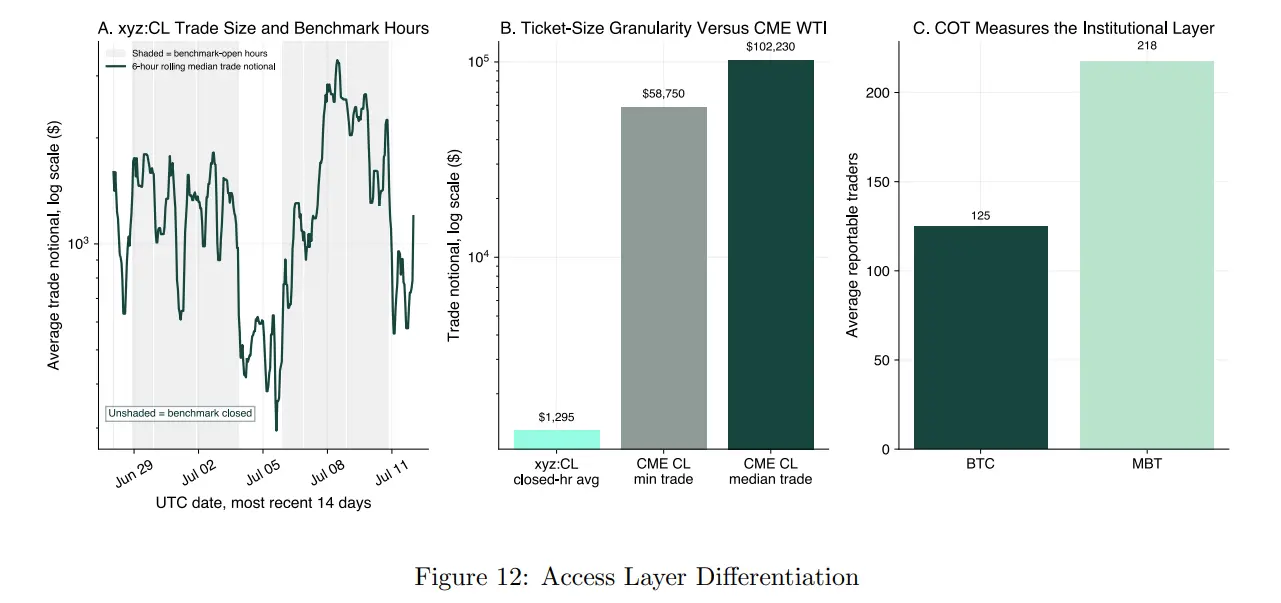
The study utilizes the natural experiment of traditional markets being closed on weekends while perpetual markets continue trading, comparing 205 weekends of Bitcoin trading and 19 weekends of on-chain crude oil perpetual (xyz:CL) samples. The report states that expiring futures require calendar-based forced rollovers, with the cost of rolling a $10 million exposure on the Monday of April 2026 being about $950,000, while on Friday it is about $110,000; perpetual positions do not have this forced cost. The median transaction price for on-chain crude oil perpetual during non-trading hours is about $1,300, approximately one percent of the benchmark WTI median transaction price.
HPC also provides an example where the crude oil weekend repricing on the week of March 6, 2026, was 15.8%, with the benchmark market completely closed; if hedged through on-chain crude oil perpetual, a $10 million position loss could be reduced from about $1.58 million to approximately $62,000 (after accounting for all costs).

 Risk warning Risk warning


