After GPT-6, does the story of skyrocketing computing power make sense again?
 Core Viewpoint

 GPT-6 Astra reignites expectations for AI computing power growth, Computer Use allows Agents to expand from programmers to a broader range of knowledge work, enabling multiple Agents to run simultaneously behind a single user. The higher the model efficiency and task success rate, the more willing people are to delegate more, longer, and more complex tasks to AI, ultimately driving continuous growth in AI usage and total computing power consumption.
After the release of GPT-6 Astra on September 3, semiconductor and memory stocks rebounded first. On September 4, SOXX rose 3.5% in a single day, Micron increased by 6.1%, and SanDisk surged by 11.9%; on September 7, South Korea's KOSPI climbed 4.61%, Samsung Electronics rose 5.7%, and SK hynix increased by about 8%.
Prior to this, concerns about overheated AI capital expenditure and peak computing demand had caused related sectors to fluctuate for quite some time. MarketWatch even described this rise as Astra "reigniting the memory-chip trade."
Tae Kim, author of "The Nvidia Way" and former technology reporter for Barron's, provided a more radical explanation: AI may be entering the fourth round of exponential computing demand growth in the past four years.
The first three rounds came from Chatbot, Reasoning, and Coding Agent, while the fourth round could be the Computer Use highlighted by Astra this time. Kim's logic is that Chatbot has led hundreds of millions to consume reasoning computing power, Reasoning has made each answer require more computation, and Coding Agent has transformed the model from "answering once" to continuously working for dozens of minutes or even hours. Now, Computer Use expands the continuously running agents from programmers to ordinary knowledge workers in Excel, Blender, CAD, Power BI, and browsers.
Kim has long focused on Nvidia and semiconductor investments, and his newsletter Key Context is centered on technology investment judgments, with recent articles leaning positively towards AI infrastructure.
Therefore, "the fourth round of exponential growth" is primarily an investment hypothesis proposed by AI computing bulls, not an already validated industry rule. However, its timing is quite subtle.
Before the release of Astra, the agent paradigm had just undergone a round of skepticism regarding "capability hitting a wall": short tasks were becoming stronger, but once entering long-term, multi-step, and real software environments, reliability noticeably declined, which also led to doubts about peak computing demand mentioned at the beginning. If the capability ceiling of agents cannot be broken, the story of continued growth in computing power becomes untenable.
Can Astra really break through this ceiling?
Every 1 Human Workday Corresponds to 3.1 Agent Workdays
The first three rounds of "exponential growth" in AI computing power refer to the significant increase in the amount of computation a user can consume each time the usage paradigm changes over the past few years.
ChatGPT brought reasoning into the mainstream market for the first time; Reasoning models began to be willing to conduct longer internal calculations for a single question; by the time of Coding Agent, a simple instruction could trigger a continuous loop of reading code, modifying, testing, checking errors, and modifying again.
At the same time, agents have begun to break through the physical limitation of "one person can only work 8 hours a day."
On September 6, OpenAI just disclosed a set of internal data. By mid-August this year, among the company's researchers, those at the 50th percentile were using the reasoning amount corresponding to Coding Agent, which, when converted at public API prices, had exceeded $600 per person per day; researchers at the 90th percentile were exceeding $7,000 per day. According to Business Insider's compilation of OpenAI data, the median value in July was only about $162, representing an increase of nearly 3.7 times in just over a month. 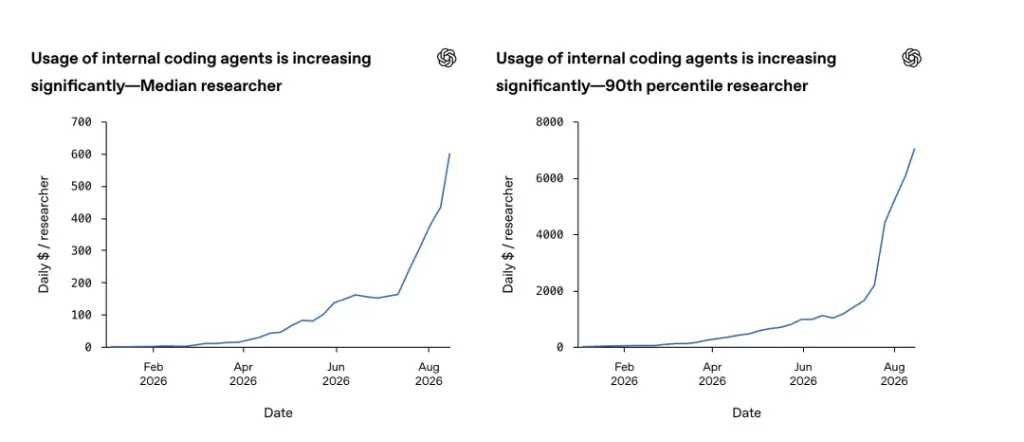 Figure: As of mid-August, every 1 human workday in OpenAI's research department corresponds to 3.1 agent workdays; the reasoning amount used by the median researcher per day is over $600 when converted at API prices.
This is the internal usage amount converted at API prices, which is closer to "single-user reasoning intensity."
Before June, the total running time of all agents in OpenAI's research department had not exceeded the researchers' own working hours; by mid-August, every 1 human workday corresponded to 3.1 agent workdays. More and more researchers are also running multiple agents simultaneously.
This means that after the agent paradigm, multiple "digital processes" capable of working in parallel are beginning to appear behind a single user, no longer constrained by the physical limitation of "human input speed." Now one person can keep three or four agents working continuously, even allowing agents to create sub-agents.
The measurement unit for computing demand may thus change to: how many agents are running simultaneously behind a user, and how many hours these agents work each day.
Computer Use Expands the Workspace
Although Coding Agent is growing rapidly, it still has a clear boundary; most tasks running multiple agents are still performed by programmers, who are just a small part of the global knowledge worker population.
Computer Use has expanded the space even further. After the release of Astra, Kim conducted a test himself. He previously did not know how to use Blender, so he let Astra research the space shuttle on a Mac, open Blender, and complete 3D modeling. About 10 minutes later, a model that could be rotated and viewed was created.
The ordinary dialogue is roughly "input---reasoning---output"; Coding Agent becomes "read code---reasoning---modify---test---re-reason"; Computer Use further evolves into "look at the screen---understand the interface---decide on actions---execute---wait for results---re-observe---validate---correct errors."
A task that a human completes in ten minutes may involve dozens of rounds of visual understanding, reasoning, and tool invocation behind the AI.
Once this set of capabilities enters Excel, Salesforce, SAP, Power BI, Photoshop, CAD, and various enterprise internal systems, the potential user base expands to almost all knowledge workers sitting in front of computers.
This is the core of what Kim calls "the fourth round of demand":
Coding Agent wants to consume programmers' computer time, while Computer Use aims to consume all white-collar workers' computer time.
But so far, this is still just a possibility.
OpenAI has not disclosed the task volume for Computer Use after the release of Astra, nor has it published daily curves for single-user token usage, GPU utilization, or reasoning throughput. Therefore, it cannot be definitively proven that "Astra has brought about the fourth round of computing power growth."
Has Computing Power Really Started to Tighten?
After the release of Astra, Tencent Technology noticed that some developer communities reported a difficult-to-quantify but noteworthy feedback: the usage experience seemed to begin to differ across regions and accounts.
Some developers in the Asia-Pacific region reported that recently ChatGPT and Codex were responding more slowly, and the stability of complex tasks was not as good as that of U.S. accounts. The community has taken to directly calling this experience "dumbing down."
At least part of this is not entirely a subjective feeling.
On September 4, OpenAI's official status page reported a performance decline in services in the Asia-Pacific region, affecting multiple products including ChatGPT, Work, and Codex Cloud. Four days later, OpenAI announced a multi-year agreement with Nvidia-supported data center operator Firmus to obtain dedicated computing capacity from two data centers in Malaysia. 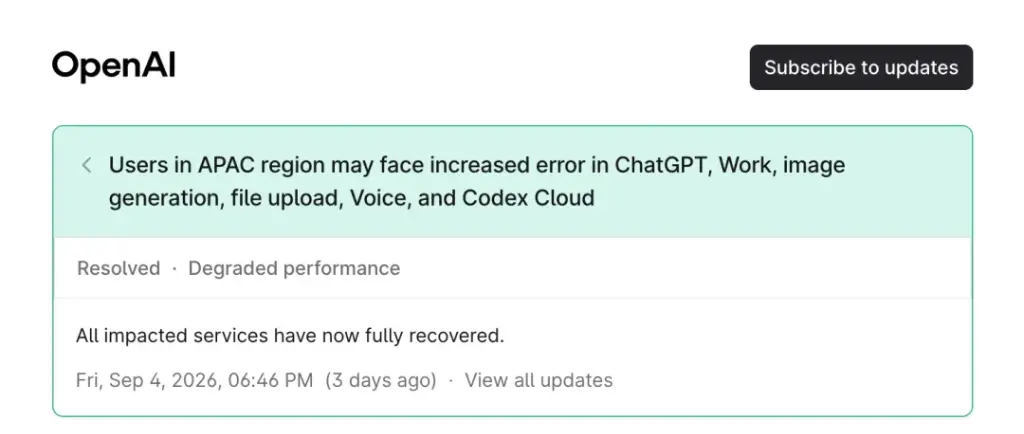
Similarly, there is currently no evidence that OpenAI has reduced model reasoning budgets for Asia-Pacific users or switched to weaker models due to the increased load from Astra.
The so-called "dumbing down in the Asia-Pacific" may still be mixed with three different factors: regional infrastructure and routing issues, account-level risk control and rate limits, and dynamic resource scheduling during peak periods. These may manifest to users as slower performance, higher failure rates, interrupted tool calls, and even poorer final answers for complex tasks.
However, this feedback still provides another way to observe the pressure on AI computing power.
As models become increasingly capable of continuously consuming computation, supply tightness may first manifest as fluctuations in latency, failure rates, and service quality between different regions and accounts.
The problem is that this judgment currently lacks a set of the most critical data:
Whether there are stable differences in the first token latency, total reasoning time, tool success rate, and final task completion rate for the same model, same package, and same task across different regions.
Until this data is obtained, "dumbing down" can only be a clue, not evidence of tight computing power.
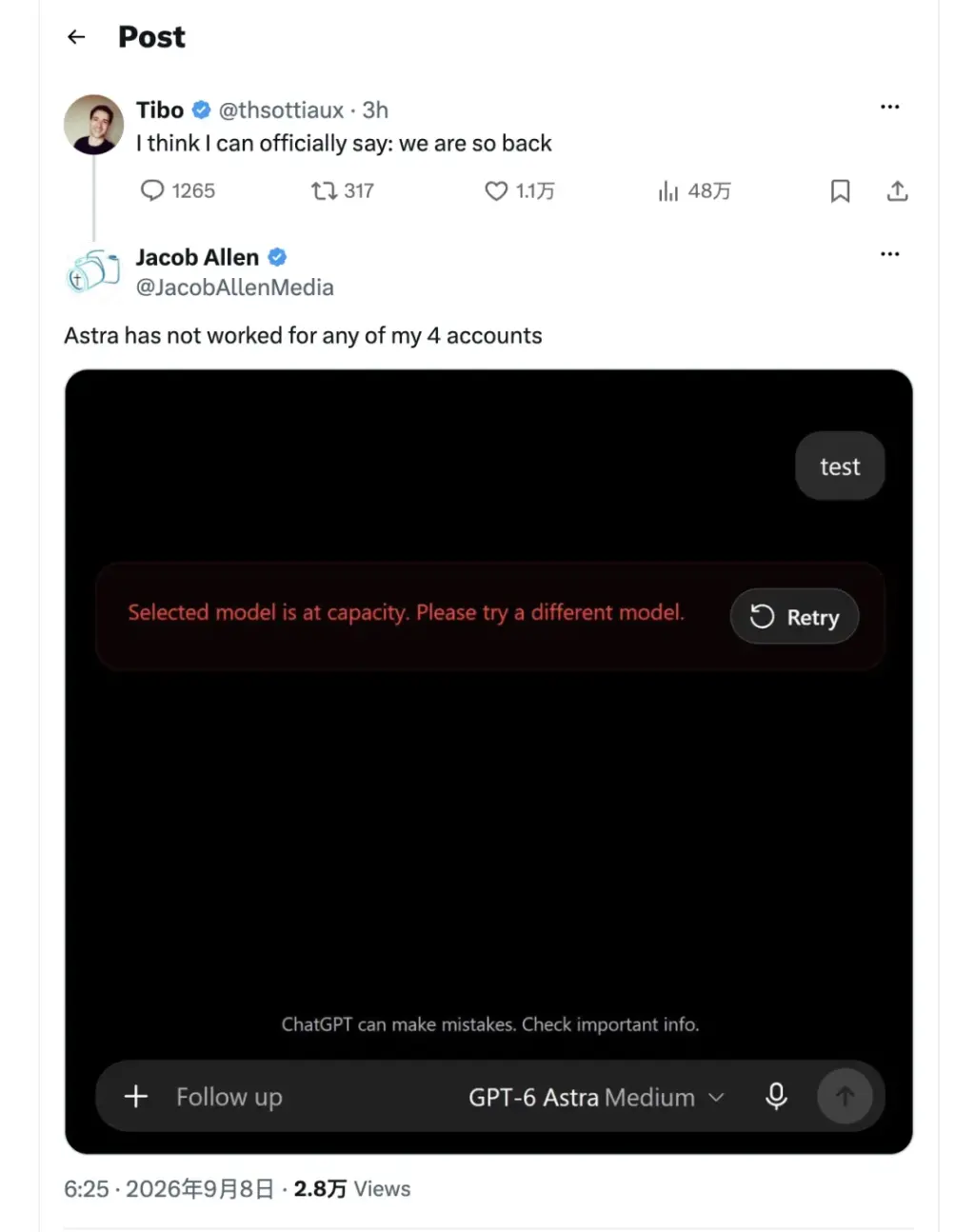
Figure: On September 8, a user shared a prompt indicating that GPT-6 Astra's "capacity is full," stating that all four of their accounts were unable to function normally, and the system suggested switching to other models. Tibo jokingly retweeted, saying "we are so back," viewing "model saturation" as a signal of renewed AI demand.
The Capital Market Has Started to Bet Again
Although the actual computing power usage curve after the release of Astra has not been made public, the capital market has already traded on the story that "AI demand has not peaked yet."
MarketWatch reported that after the release of Astra, the iShares Semiconductor ETF rose about 3.5%, with memory-related companies like Samsung, SK hynix, and Kioxia performing even stronger. Foreign media even directly described this round of market activity as Astra "reigniting the memory-chip trade."
Notably, the most striking aspect of this rise is not Nvidia, but memory.
If Computer Use truly becomes a sustained workload for running agents, the increase needed will not only be in GPU computing. Longer contexts, KV Cache, concurrent agents, virtual machines, browsers, and software environments may continue to drive up demand for HBM, DRAM, CPU, networking, and storage.
Thus, what the capital market has been trading recently is not entirely "GPT-6 is more powerful," but the main logic remains: will a smarter model make users willing to purchase more computing?
This is also the biggest difference between this round of AI infrastructure story and traditional software.
The more traditional software is optimized, the less server resources a single user may need.
Conversely, generative AI may exhibit the opposite "Jevons Paradox": the more efficient the model and the higher the task success rate, the more willing people are to delegate more, longer, and more complex work to AI, ultimately leading to an increase in total computing power consumption.
However, it is important to be cautious, as the capital market also has its own "butt."
AI infrastructure has already experienced a round of significant growth and adjustment before this, and semiconductor stocks have also seen a noticeable pullback this year due to overheated capital expenditures and declining free cash flow from cloud vendors. Therefore, the few days of rebound brought by Astra can only indicate that investors are starting to bet again, but it is not enough to prove that the fourth round of computing power demand has truly emerged.
An Economic Calculation
Kim's judgment ultimately depends on three more practical questions.
The first is still reliability.
Real business operations are not a one-time demo. Whether an agent can operate ERP, financial models, or engineering software continuously for several hours, while still maintaining accuracy amidst pop-ups, permission changes, and data updates, is a completely different issue.
The second is cost.
In the future, how much will it actually cost to complete the equivalent work of one hour of human computer use before Computer Use?
If AI can complete a $50 task for an employee at $10, demand can easily explode; if it costs $100, the market potential is entirely different.
The $600/day figure from OpenAI indicates that agents can create huge demand, but it also suggests that this way of working may still be very expensive today.
The third question: Will Computer Use eventually eliminate part of its own demand?
Currently, models need to look at screens and find buttons because existing software is designed for humans. Once Salesforce, Microsoft, Adobe, or internal enterprise systems start to directly open APIs, MCPs, and agent interfaces, many tasks will no longer need to simulate mouse and keyboard actions.
The more likely outcome is a fusion of Computer Use and Tool Use: where there are structured interfaces, they will be called directly; for old systems without interfaces or those difficult to modify, and open web pages, visual operations will continue.
Thus, the market that Computer Use truly opens up may not be "making AI click on computers like humans forever," but rather through the approach of "my human master authorized me to click your software, so you have no say," allowing agents to break through the existing application ecosystem. Agents can finally enter the last large work environments that automation previously could not cover.
This is also the part that Kim refers to as the "fourth round of exponential growth" that is truly worth verifying: "Is Computer Use a stepping stone, or is it really another paradigm shift?"
After GPT-6, is the computing power story that had become increasingly difficult to articulate due to agents hitting walls once again coherent?
The capital market has begun to bet again.
After the explosion of generative AI, the market continues to slap the face of the "computing power growth" bears; will this time be different?
 Risk warning