Venice surged 40% in a single day, OpenAI's trust crisis ignites the privacy AI market
 Core Viewpoint

 OpenAI's "Rashomon," a catalyst for privacy AI
Author: Deep Tide TechFlow
Today, there has been a significant movement in the AI sector of the cryptocurrency market:
Venice ($VVV), which focuses on privacy inference, surged nearly 40% in a single day, with its price briefly breaking $25 to set a new historical high.
This also led to the person who "defected" and liquidated Ethereum at the end of May this year ultimately making a substantial profit. David Hoffman, co-founder of Bankless, previously sold off his ETH holdings after six years and turned around to buy LIT, ZEC, NEAR, HYPE, and VVV.
Reference reading: The Bankless founder who liquidated ETH made a fortune in three months.
In this portfolio, the only one that had not performed well before was $VVV. Thus, this big player's new investment portfolio completed the puzzle of "everyone surging."
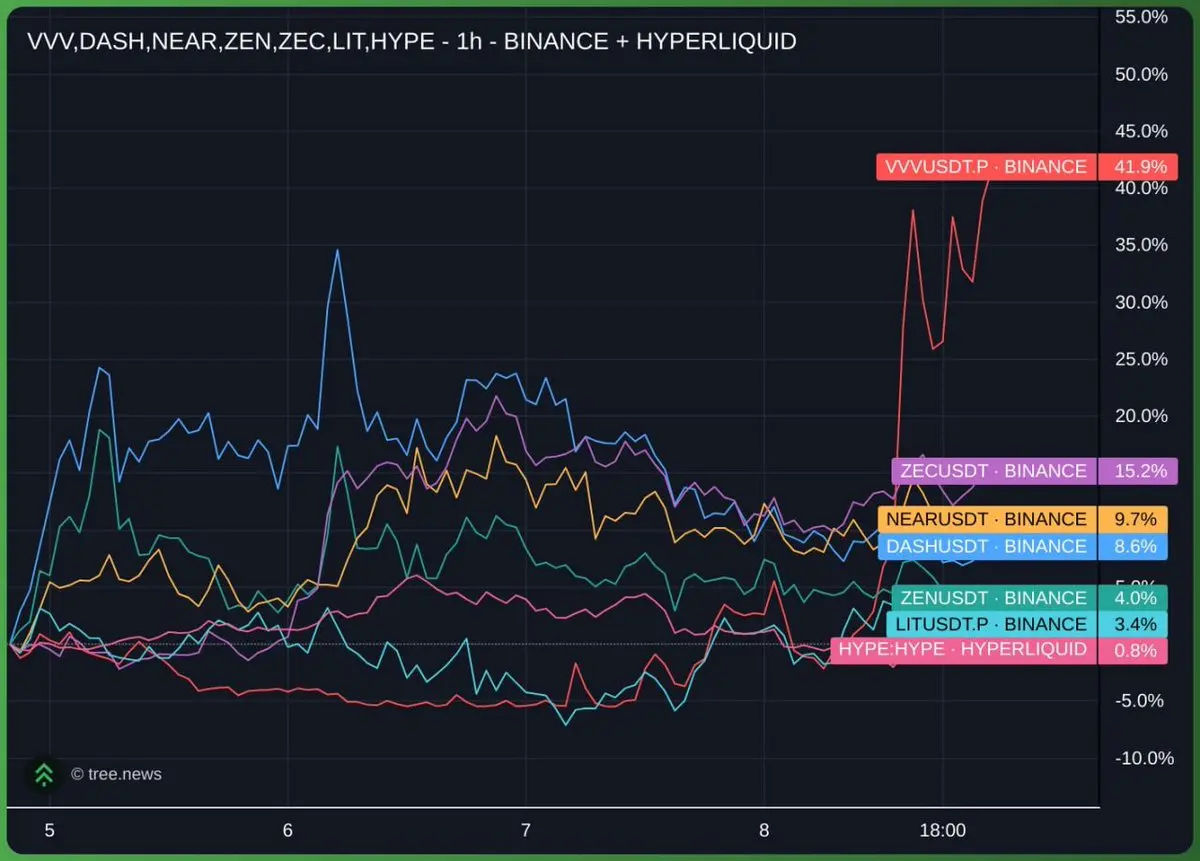
Many players focusing on on-chain data may attribute this breakthrough to its strong fundamentals:
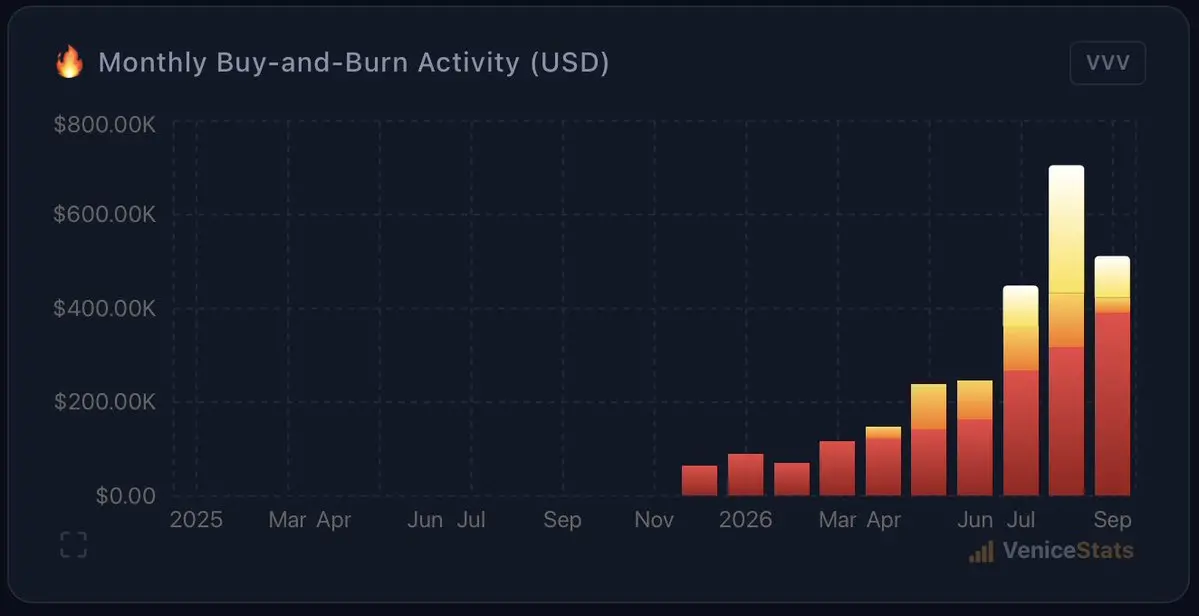
Venice just set a new record of $390,000 in token buybacks and burns in September. While the fundamentals are indeed solid, what truly ignited this violent surge must have involved narrative hype and sentiment.
There is a voice on social media suggesting that the rise of VVV is a conspiracy driven by outsiders; excluding the sarcasm and conspiracy theories, they are indeed promoting the old "Private AI" narrative, but the direct catalyst may be that the English crypto Twitter leveraged a sudden AI scandal to push the "Private AI" narrative back onto the main stage of short-term hype.
The catalyst for this old wine in a new bottle is the "academic espionage scandal" that broke out over the weekend involving OpenAI.
An Academic "Rashomon" Awakens the Old Narrative of Privacy AI
Privacy AI is not a groundbreaking new concept, but generally, it is often viewed by the market as a lukewarm geek slogan due to a "lack of real pain points."
However, once a negative event occurs, everyone starts to emphasize the importance of privacy, and attention and liquidity will concentrate and flow in, becoming the reason for the hype around tokens.
The core figures in this event are two mathematicians (Tristan Buckmaster and Levent Alpöge).
Over the past year, the two have been advancing an extremely hardcore mathematical proof of fluid equations, during which they fed a large number of unpublished draft derivations to OpenAI's coding tool Codex.
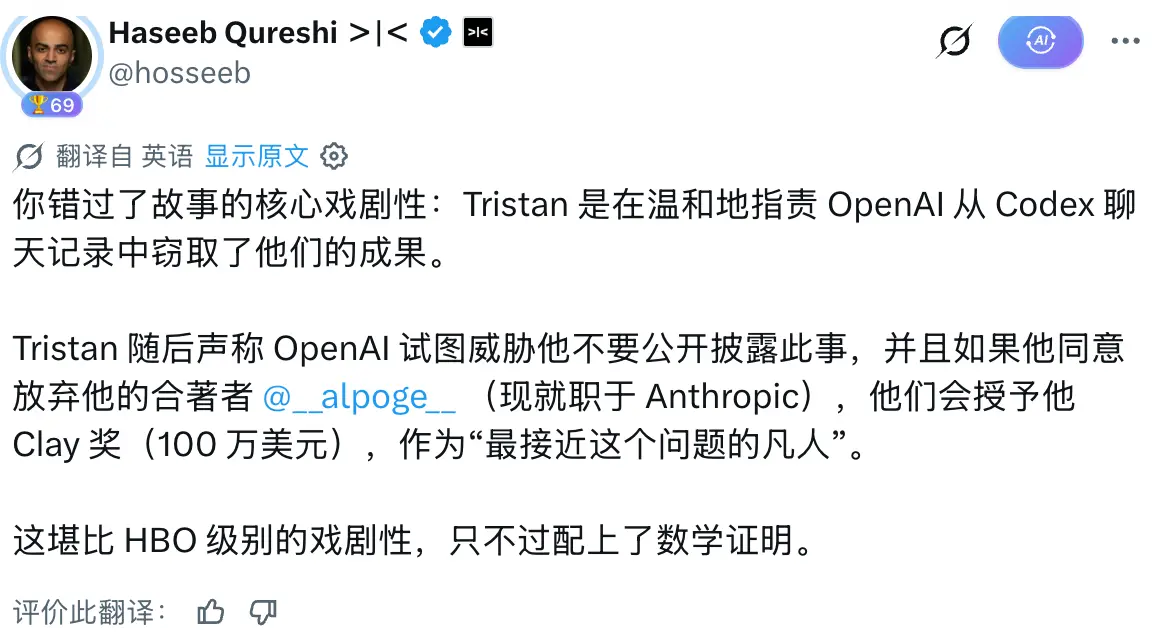
A dramatic scene unfolded in early September. When Tristan privately clarified the research to OpenAI, the researchers claimed in a call a few days later that:
Their internal model also used the same extremely obscure technical route to produce hundreds of pages of proof.
When questioned whether they had viewed the user drafts in Codex, OpenAI was vague and avoided answering whether they had used training data.
According to reports, OpenAI even proposed an extremely domineering release plan during negotiations and allegedly attempted to bribe the mathematicians into silence with a $1 million "Clay Mathematics Institute Prize," bluntly asking, "Why would you ruin your career?"
Although OpenAI later rushed to deny the allegations, this Rashomon-like incident detonated a trust crisis in both the tech and crypto circles.
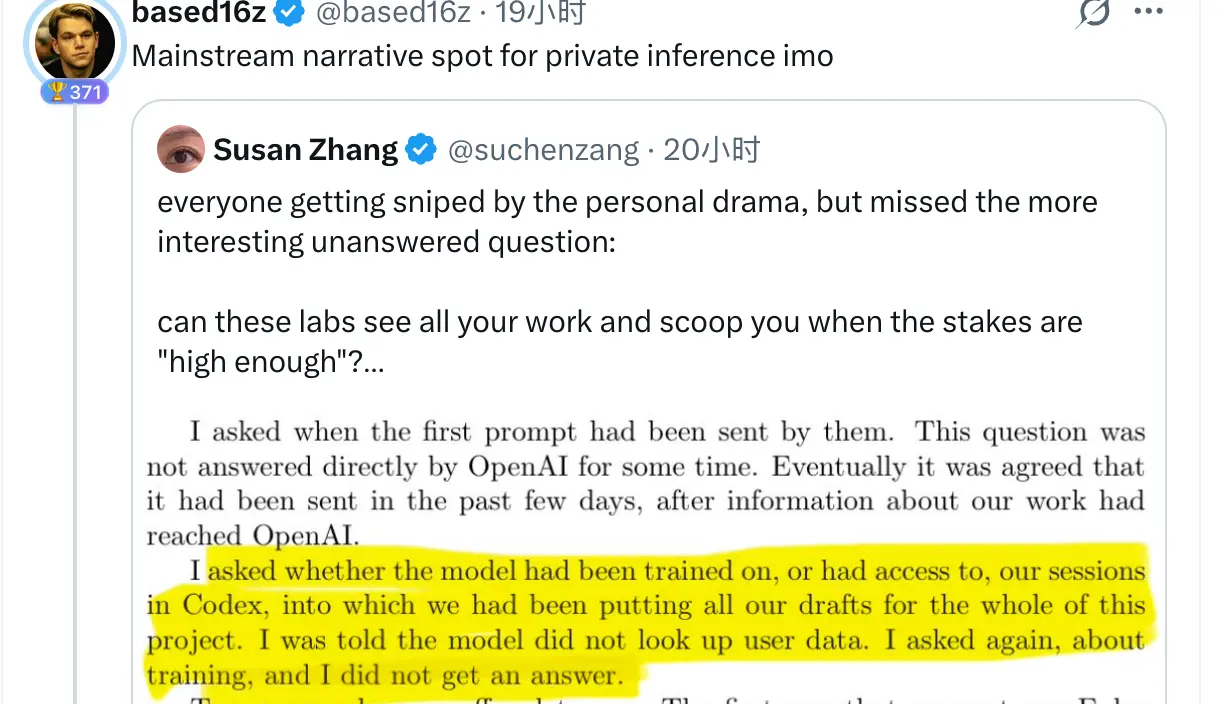
As former OpenAI and Meta engineer Susan Zhang pointedly noted, while everyone is busy watching personal feuds, they overlook the most critical question:
When the stakes are high enough, can these top AI labs really see your private work, or even preempt it?
In the Privacy AI Boom, Who is Selling the Shovels?
David Hoffman asserted on Twitter: "Frontier AI labs will systematically steal user data to gain an advantage in competition. This is an arms race."
Of course, this statement comes from his holding of VVV, interpreting it as a narrative of privacy AI resisting closed-source AI labs.
Whether or not there are vested interests, the collective panic over the data hegemony of closed-source giants has indeed become a mainstream sentiment today, and combined with the rise of $VVV, a narrative of short-term attention and hype has formed.
The VVV project focuses on end-to-end encryption, does not collect user data, and is extremely rare among VC coins to have real Web2 business revenue, achieving deflationary burns for seven consecutive months.
All these have become reasons for bullish sentiment after the emotional overflow.
However, after the explosive rise, VVV has already peaked, and the risk of FOMOing in has significantly increased. In this renewed hype around privacy AI, what other beneficiaries have not yet been fully priced in?
Following Venice's business logic to dig deeper, the crypto community is currently optimistic about an underlying infrastructure dark line.
To achieve its touted "end-to-end encrypted privacy inference service," Venice requires extremely hardcore decentralized computing power and confidential computing infrastructure support.
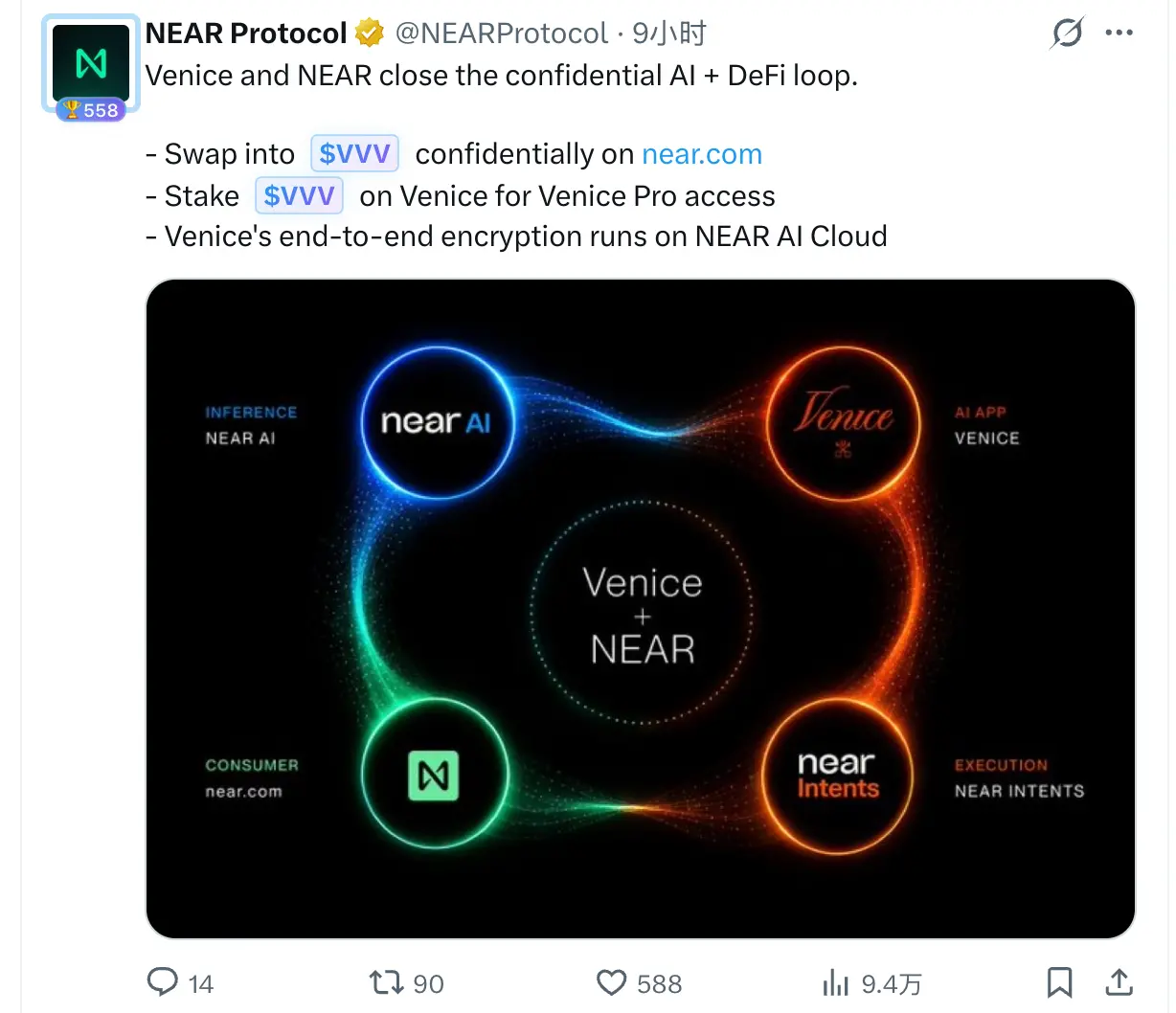
Analysts point out that the underlying service provider for Venice is NEAR Protocol's AI Cloud. Benefiting from the hype around VVV's rise, NEAR's official channels have also openly highlighted this deep binding relationship:
Venice's end-to-end encryption runs on NEAR AI Cloud, allowing users to anonymously exchange $VVV on NEAR and obtain premium services through staking. The entire "confidential AI + DeFi" closed loop relies on NEAR's infrastructure.
Of course, the above is merely an emotional resonance within the narrative hype; whether real funds have indeed flowed into NEAR, this old token still requires further on-chain analysis for verification or falsification. However, the idea of seeking related targets whenever a leading token rises is applicable in every round of localized upswings.
For instance, previously, Robinhood's Pons generated revenue due to the token issuance boom, leading to a surge in the token, prompting many to consider positioning in Uniswap, which launched tokens on the Robinhood chain, and Arbitrum, which provided technical licensing for this chain; even after UNI confirmed its rise, some more Degen players considered Sushiswap.
Upon closer examination, it becomes clear that this logic is not 100% sound, but effectively riding the narrative wave is indeed a viable strategy.
Note: The above information is a comprehensive compilation from crypto social media and is not investment advice. Cryptocurrency tokens are highly volatile and carry significant risks; please DYOR.
 Risk warning