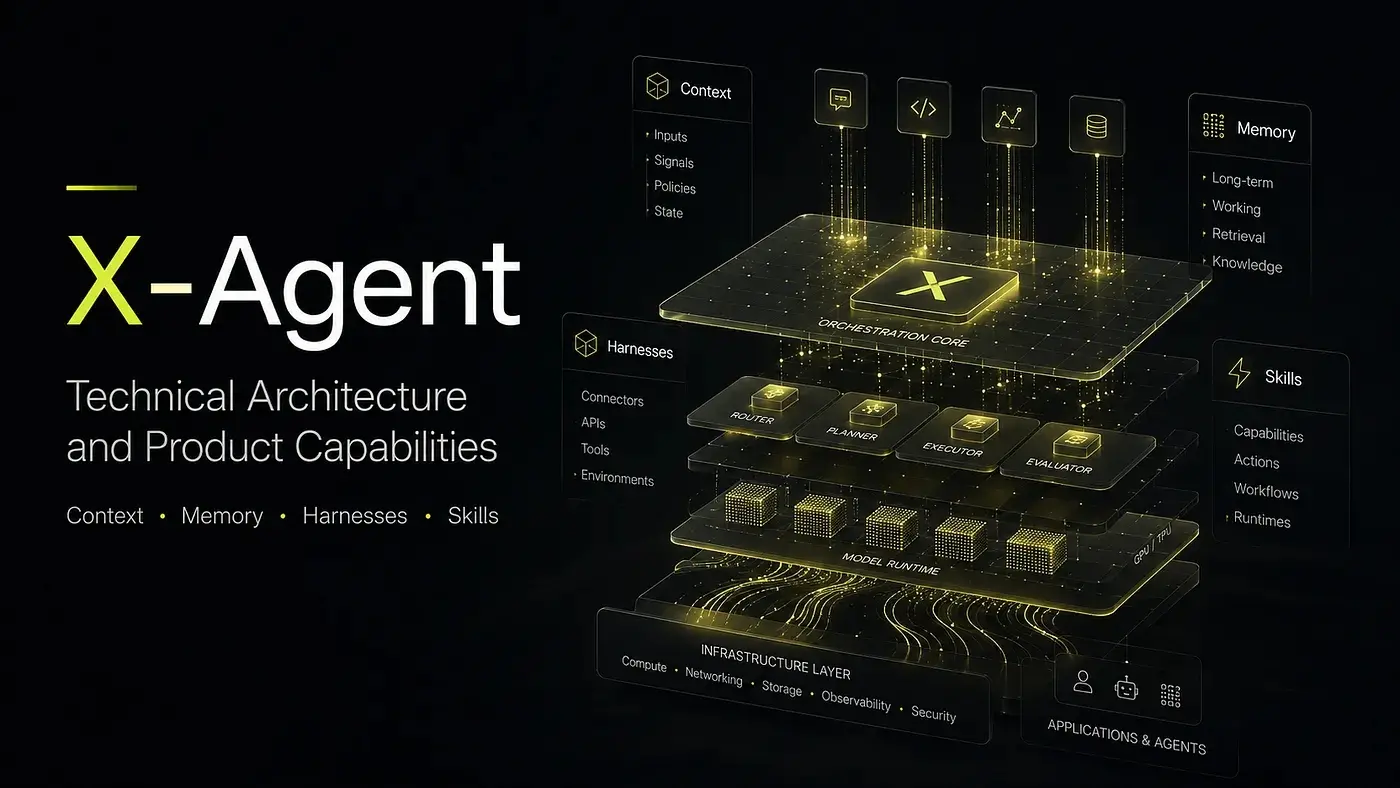
The Agentic Economy: Why Cryptocurrency Will Become the Default Payment Channel for Artificial Intelligence

 Artificial intelligence provides intelligence, blockchain provides the economic foundation.
Artificial intelligence is rapidly evolving from a tool for providing information into a system capable of taking action.
At the same time, blockchain technology is transitioning from speculation to a programmable financial infrastructure that can support entirely new forms of economic activity.
The combination of these two technologies is creating unprecedented things: an economic system composed of autonomous AI agents, in which AI agents can negotiate, transact, and settle value without human intervention.
Artificial intelligence provides intelligence, while blockchain provides the economic foundation.
The future may no longer involve humans clicking the "pay" button, but rather software agents trading in real-time with other software agents.
The Rise of Agent Economy
Today's AI systems are already capable of performing tasks once thought to be unique to humans. The next step is achieving autonomous operation.
Modern AI agents are increasingly capable of:
Booking travel
Contract negotiation and pricing
Data procurement
Hiring professional agents
Paying for computational resources
Settling micro-payments
Managing ongoing workflows
As these systems become more automated, requiring human approval for every transaction has become a significant bottleneck.
Software operates at machine speed, while human approval processes do not.
The result is a growing demand for economic infrastructure specifically designed for autonomous agents.
Why Traditional Payment Methods Fail
Global payment systems are designed for humans, not for software.
Credit cards, bank transfers, ACH networks, and traditional payment processing methods rely on human involvement at every step. While they work effectively for consumer transactions, they fall short when applied to machine-to-machine transactions.
Traditional payment systems typically have the following characteristics:
Too slow, with settlement times ranging from seconds to days.
Too costly for high-frequency, low-value transactions.
Dependent on account creation, identity verification, and human approval processes.
Optimized for human-machine interaction rather than autonomous execution.
Imagine an AI agent making hundreds of API calls, data purchases, or service requests every minute.
Under traditional payment systems, transaction fees could quickly exceed transaction value, while settlement delays would undermine the agent's ability to operate in real-time.
This economic model simply does not work.
Enter Agentic Payments
Agent payments represent a new model in which AI agents can initiate and execute transactions within predefined rules set by humans or organizations.
These may include:
Spending limits
Budget allocations
Approval thresholds
Usage restrictions
Compliance requirements
Within these boundaries, agents can operate independently.
Each agent is assigned a wallet, enabling it to discover services, negotiate prices, complete payments, and continue executing tasks without waiting for human approval at every step.
This transforms the payment process from manual operation to programmable operation.
Why Cryptocurrencies Fit Naturally
Blockchain-based payment systems address many challenges faced by autonomous agents.
Programmable Money
Smart contracts allow payments to be directly tied to outcomes and conditions.
Agents can:
Pay only after goods are confirmed delivered.
Continuously pay stream payments based on resource consumption.
Automatically execute escrow agreements.
Execute contract terms without intermediaries.
Money itself becomes part of software logic.
Internet-Scale Micropayments
Modern blockchains and layer-two networks offer:
Near-instant settlement.
Extremely low transaction costs.
Payment capabilities below a cent.
This enables entirely new business models.
Agents can pay fractions of a cent for an API call, a piece of data, or a moment of computational power—something that is economically impractical in traditional payment systems.
Global Permissionless Access
Autonomous agents are not limited by geography.
Blockchain networks enable cross-border transactions without local banking relationships or complex payment integrations.
An AI agent in one country can seamlessly transact with service providers anywhere in the world.
Stablecoins Make Consumption Easier
Volatility has long been seen as a challenge for cryptocurrency payments.
Stablecoins (such as USDC) help address this issue by providing predictable value while retaining the advantages of blockchain infrastructure.
For agents, stablecoins offer a practical medium of exchange that behaves more like digital cash rather than a speculative asset.
Infrastructure is Taking Shape
While the vision of an economy of autonomous agents sounds like future technology, its infrastructure is already under construction.
Several key advancements are accelerating this transition:
Coinbase's x402 standard is reviving HTTP 402 ("Payment Required") for native internet payments.
AI agents can increasingly pay directly for API access, content, and digital services.
AWS Bedrock integration is supporting transactional AI workflows.
Embedded wallets on Base simplify agent ownership and spending.
Protocols like Circle Nanopayments and Nevermined are creating a business framework for machine-to-machine interactions.
Major fintech and payment companies are actively exploring AI-native wallet experiences.
Once experimental infrastructure is steadily moving towards production deployment.
Economic Opportunities
The emergence of autonomous agents could create entirely new markets and business models.
Usage-Based Everything
Beyond fixed subscription models, services can also monetize through:
Pay-per-query
Pay-per-inference
Pay-per-API request
Pay-per-data retrieval
Every interaction can be measured with economic metrics.
Agent-to-Agent Market
Professional AI agents may start purchasing services from each other.
Research agents can hire another agent for data collection. Customer service representatives can purchase translation services from language agent agencies.
These interactions create a self-organizing digital market that can operate continuously without human intervention.
Massive Economic Scalability
Unlike human employees, autonomous agents can operate 24/7.
Millions (and eventually billions) of traders can transact simultaneously, creating entirely new layers of economic activity.
Composable Financial Workflows
Blockchain infrastructure allows agents to combine various financial foundational technologies into an automated workflow.
Agents can seamlessly integrate:
Payments
Escrow systems
Loan agreements
Governance mechanisms
Financial management
Decentralized organizations
In this model, blockchain becomes a trustless execution layer for AI-driven decision-making.
Challenges Remain
Despite strong momentum, several significant challenges must be addressed before agent commerce can be widely adopted.
Key areas include:
Security and spending controls
Agent identity and accountability
Regulatory clarity and accountability frameworks
Fiat to cryptocurrency deposit and withdrawal
Cross-chain interoperability
Encouragingly, some solutions have already emerged through:
Permissioned and phased wallet architectures
Programmatic compliance systems
Hybrid fiat-cryptocurrency payment rails
Cross-chain infrastructure and standards
This technology is still in its early stages, but the direction of development is becoming increasingly clear.
The Big Picture
The agent economy requires a form of currency that circulates at machine speed.
As AI agents become independent economic entities, the financial infrastructure supporting them must possess the following characteristics:
Instant
Programmable
Global
Autonomous
This is precisely where the unique advantages of blockchain and stablecoins lie.
Cryptocurrencies may not only become part of the rise of artificial intelligence but could also serve as the settlement layer for an autonomous machine economy.
Artificial intelligence provides intelligence.
Blockchain provides the economic foundation.
The future may not involve humans clicking the "pay" button.
It may involve autonomous agents negotiating, transacting, and settling value directly on the chain.
The remaining question is simple:
Will the number of AI agents surpass the number of online human users first, or will the number of AI agent wallets surpass human wallets first?
 Risk warning Risk warning