Circle Why Build Its Own Chain? A Complete Breakdown Before the Arc Mainnet Launch

 The market's judgment of it has always been polarized: on one hand, it is seen as a watershed moment for traditional capital entering the blockchain, while on the other hand, it is criticized for deviating from decentralization and becoming a private alliance chain of traditional finance.
Author: SoSoValue Research
Circle's self-developed Layer 1 network Arc is set to launch its public mainnet on September 16, 2026. From the project initiation in August 2025, the public testnet launch on October 28, 2025, to the completion of a $222 million institutional pre-sale at a $3 billion valuation in May 2026, market opinions about it have been polarized: some view it as a watershed moment for traditional capital entering the blockchain space, while others criticize it for deviating from decentralization and becoming a private consortium chain of traditional finance.
Both viewpoints can find support. Let’s set aside the official promotional language and analyze from four perspectives: why Circle wants to build its own chain, its consensus mechanism, how this chain differs from others, and what ordinary users can participate in.
1. Why Circle Builds Its Own Public Chain
USDC has long been issued on Ethereum, Solana, and various major Layer 2 networks. As a user rather than an operator of these networks, Circle faces three structural constraints.
Financial friction from dual currencies. Enterprises executing cross-border settlements or large transfers must additionally purchase and hold ETH or SOL to pay transaction fees. This creates an extra exposure on the enterprise's balance sheet, an additional currency exchange, and an extra tax matter.
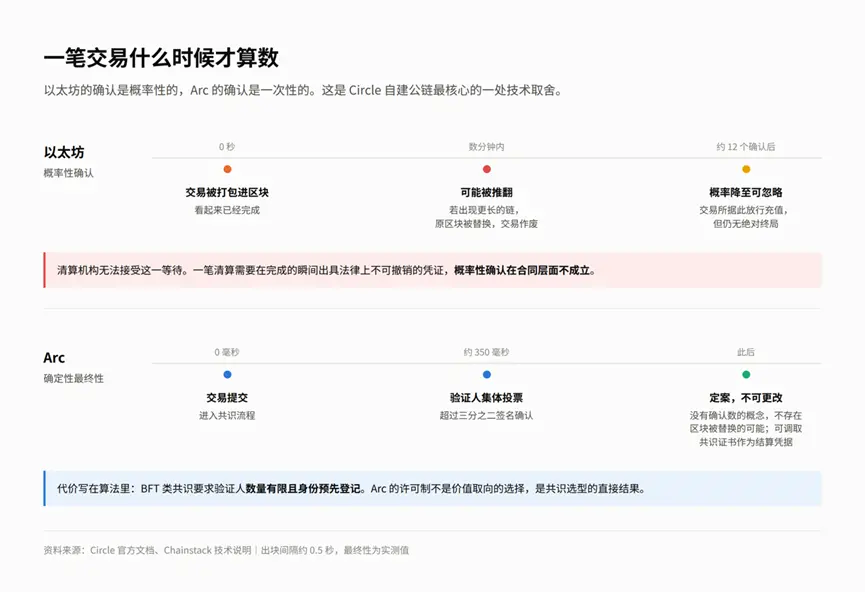
Transaction confirmations may be overturned. In networks like Ethereum, being included in a block does not equate to final confirmation. If a longer chain emerges, the original block will be replaced, and the transactions within it will be voided. This phenomenon is known as block reorganization, and its probability decreases rapidly as subsequent blocks accumulate. Exchanges require deposits to wait for several confirmations, which is to wait for this probability to drop to a negligible level.
Crypto users have become accustomed to this waiting process, but clearing institutions cannot accept it. Clearing operations require an irrevocable legal certificate at the moment a transaction is completed; probabilistic confirmations do not hold at the contractual level.
Lack of protocol control. Hard forks of the underlying public chain, MEV congestion, gas price fluctuations, and sequencer failures are all beyond Circle's risk control.
Arc is not positioned as a general public chain competing for DeFi liquidity, but rather as a settlement network specifically for stablecoins, tokenized real-world assets (RWA), and foreign exchange clearing.
2. Regulatory Framework: One in Effect, One Pending Vote
The architectural choices of Arc, aside from commercial motivations, are also influenced by regulatory constraints. Clarifying this layer allows us to distinguish which designs stem from Circle's preferences and which arise from legal obligations.
The effective GENIUS Act
On July 18, 2025, the GENIUS Act came into effect, establishing the federal regulatory framework for payment-type stablecoins in the United States.
The Act sets four core obligations for issuers: reserves must consist of highly liquid quality assets, monthly reserve reports must be disclosed, and quarterly audits by third-party institutions are required; issuers with outstanding liabilities exceeding $10 billion must obtain federal permission to become "Approved Payment Stablecoin Issuers" (PPSI); PPSIs are classified as financial institutions under the Bank Secrecy Act, with anti-money laundering and customer identification being mandatory requirements; issuers are prohibited from paying interest or returns to holders, which legally distinguishes payment-type stablecoins from bank deposits.
The Federal Deposit Insurance Corporation (FDIC) has clarified that the reserve assets backing stablecoins are not covered by federal deposit insurance.
In light of the above provisions, several designs of Arc can be directly traced back. The built-in blacklist mechanism at the protocol layer corresponds to the issuer's obligations under the Bank Secrecy Act; USDC, as the native gas, does not set interest-bearing assets on-chain, which is a result of the prohibition on returns; the audit trail mandated by EIP-7708 serves the evidentiary requirements for monthly disclosures and quarterly audits.
In other words, Arc's level of centralization has a legal minimum set by law. As a PPSI, even if Circle intends to build a censorship-resistant network, it cannot be realized.
The pending CLARITY Act
The Senate will conduct a procedural vote on the CLARITY Act on September 15, with the Arc mainnet launching the following day. The two timelines are adjacent but not dependent; the voting outcome does not affect the launch schedule of Arc. The impact of this Act on Arc is focused on the medium term.
First, jurisdictional division. The Act assigns the digital commodity spot market to the Commodity Futures Trading Commission (CFTC), while the securities portion remains with the Securities and Exchange Commission (SEC). Sixteen tokens identified as commodities are clearly under CFTC regulation, accounting for approximately 78% of the total market value of crypto assets.
Second, the legal basis for tokenized securities. One of the highest-weighted narratives in Arc is that the DTCC plans to migrate DTC custodial assets on-chain in the second half of 2027, achieving atomic settlement with stablecoins. What is lacking in this plan is not technical conditions but the legal certainty provided by market structure legislation. If the Act does not pass, this foundation will be absent, significantly increasing the difficulty of implementing the aforementioned integration.
Third, the qualitative nature of the ARC token itself. The Act sets a path for tokens to be exempt from securities classification: a four-step "maturity chain test," with a hard cap of 20% on holdings.
There is an inference here that needs to be verified: Circle retains 25% in the initial allocation of ARC, which is above this cap, while the ecological portion accounts for 60%, and the actual control rights have not been disclosed. If the TGE is delayed indefinitely, this inference can be disproven—observing how Circle ultimately handles this 25% will suffice. It should be noted that the white paper does not position the securities attributes of ARC.
The Act also contains two provisions indirectly related to Arc. The stablecoin yield provision prohibits returns that have the nature of bank deposit interest but allows rewards linked to trading, payments, market making, liquidity provision, governance, validation, and staking; 78 banking industry groups have expressed that this boundary is easily circumvented in engineering; Section 604 exempts non-custodial software developers from registering as money transmitters and obligations under the Bank Secrecy Act, with law enforcement opposing this, arguing that it opens a pathway to avoid compliance.
The voting outlook is not optimistic. The procedural vote only determines whether the Act can enter the debate process, not its final passage. The Republican Party holds 53 seats in the Senate, with Rand Paul and Josh Hawley clearly opposing, and Thom Tillis supporting it conditionally on strengthening ethical provisions; on the Democratic side, only two voted in favor during the committee stage, while seven issued a joint statement citing deficiencies in ethical provisions, consumer protection, and illegal finance. The odds of the Act passing on Polymarket have dropped from 82% in February to 16% by the end of August.
If the vote fails, the outcome will not be a status quo but a return to a path where regulations are set by various agencies independently—SEC's "Project Crypto," CFTC, Office of the Comptroller of the Currency (OCC), and the Treasury Department acting separately, with comprehensive legislation possibly delayed until 2029.
3. Consensus Mechanism: Transactions Cannot Be Changed Once Confirmed
Arc's consensus engine is Malachite, developed by Informal Systems—a team engaged in formal verification of Tendermint, which was incorporated into Circle in 2025. The execution layer uses Reth, fully compatible with the Solidity toolchain. The block interval is approximately 0.5 seconds, and the mainnet Chain ID is 5042.
This mechanism provides deterministic finality: once a transaction is submitted, validators collectively vote, and if more than two-thirds sign, it is finalized and cannot be changed, taking about 350 milliseconds in practice. There is no concept of confirmation numbers, nor is there a possibility of blocks being replaced; the aforementioned reorganization risk is excluded at the mechanism level.
The cost is inherent in the algorithm itself. BFT-type consensus relies on validators voting to reach consensus, requiring a limited number of participants with pre-registered identities; otherwise, votes cannot be counted. Arc's permissioned model is not a value-oriented choice but a direct result of consensus selection. This point will be revisited when discussing the validator structure.
4. Main Differences from General Public Chains
To meet compliance requirements, Arc has made the following changes at the underlying level.
|-----------------------|------------------------------------------------------|--------------------------------------------------------------------------------------| | Changes | Mechanism | Actual Impact | | USDC as Native Gas | USDC directly serves as on-chain fuel and is used for pricing, with a target fee rate of 1 cent per second. | The situation where stablecoin holders cannot transfer due to lack of gas tokens will no longer occur; it also means that the fuel for this network is Circle's liability. | | Dual Interface Precision Difference | USDC as a native asset has 18 decimal places, while the exposed ERC-20 interface has 6 decimal places, both operating on the same balance. | The primary source of integration failure identified in the official documentation. The same balance called through different interfaces can differ by 10¹² times, and alignment errors can lead to miscalculated funds. | | Close Public Transaction Waiting Area | The public queue area (mempool) for transactions before entering the block is not open to the public, and pending transaction filtering interface returns -32001. | In other networks, this waiting area is publicly visible, allowing bots to preemptively execute trades or sandwich others' trades for arbitrage. After Arc closed this layer, front-running and sandwiching are no longer valid; the cost is that conventional arbitrage bots and on-chain monitoring tools simultaneously lose their data source. | | Compliance Interception Down to Protocol Layer | The blacklist mechanism is placed at the consensus execution layer. | Transactions initiated by sanctioned addresses fail and roll back directly at the underlying level, regardless of whether the balance is sufficient. The freezing authority of USDC is moved from smart contracts to the network itself. | | Transfer Log Generation Mandatory | EIP-7708: All movements of native USDC automatically trigger standard Transfer events from system addresses. | The protocol layer mandates the retention of a complete audit trail, bringing reconciliation costs close to zero; privacy designs must circumvent this default path. | | Built-in Foreign Exchange Settlement | The on-chain institution inquiry system synchronizes with foreign exchange settlement (PvP). | The two payments involved in currency exchange are completed simultaneously within the same contract, either both succeed or both fail, avoiding situations where one party has paid while the other has not. This module points to the traditional foreign exchange clearing CLS system. | | Reversible Transactions | A reverse payment layer is overlaid on an immutable ledger, generating reverse transactions with mutual consent. | Aligns with banks' fiduciary responsibilities and error correction needs; the difference from credit card chargebacks is that reversals require bilateral consent. The anti-censorship attribute thus gives way. |
There are two additional details that need to be confirmed before integration.
The first is query costs. Ordinary nodes only retain the complete state for a recent period, while older data must be retrieved from archived nodes that store all history, which incurs higher costs. Arc defines this boundary as being 127 blocks behind the chain head, about 1 minute; Ethereum is about 25 minutes. This means that a transaction record from an hour ago is considered historical data that requires payment to retrieve on Arc. The operational costs for wallets, market data sites, and data service applications will thus be significantly higher than Ethereum.
The second is the consensus certificate. Arc provides the arcgetCertificate interface, which can retrieve the credentials of which validators signed off on a particular transaction; arcgetVersion is used to query node versions. The former is significant for institutions as it serves as an archivable proof of settlement completion, and it is the technical embodiment of the "legally irrevocable certificate" mentioned in the first section.
In terms of privacy, Arc offers optional confidential transfers, where the amount is obscured while the address remains visible, relying on TEE—an isolated area within the chip that cannot be read externally. The security of this layer of privacy is built on hardware manufacturers rather than cryptographic assumptions. The anti-quantum route progresses in four phases, with the genesis phase supporting anti-quantum signature wallets that users can create directly without needing to migrate afterward.
In terms of cross-chain, native integration of CCTP and Gateway. CCTP's approach is to destroy the corresponding USDC on the original chain while minting an equivalent amount of new USDC on Arc, without involving a third-party bridge contract to hold funds, thus avoiding risks such as cross-chain bridge attacks. Users receive USDC issued by Circle itself, rather than a token certificate issued by a cross-chain bridge. The Gateway consolidates users' balances across multiple chains to the same address. This advantage comes from the identity of the issuer rather than the technology.
Five, Validator Structure
Arc's validator set is currently completely closed. Circle has announced that the founding validators consist of 11 entities, plus Circle itself, totaling 12 nodes:
- Financial Infrastructure and Exchanges: DTCC (Depository Trust & Clearing Corporation), ICE (Intercontinental Exchange)
- Payment Clearing Networks: Visa, Mastercard, MoneyGram, Global Payments
- Asset Management and Multinational Banks: BlackRock, Standard Chartered, SBI Group, Sumitomo Corporation
- Crypto and Comprehensive Institutions: Galaxy, Circle
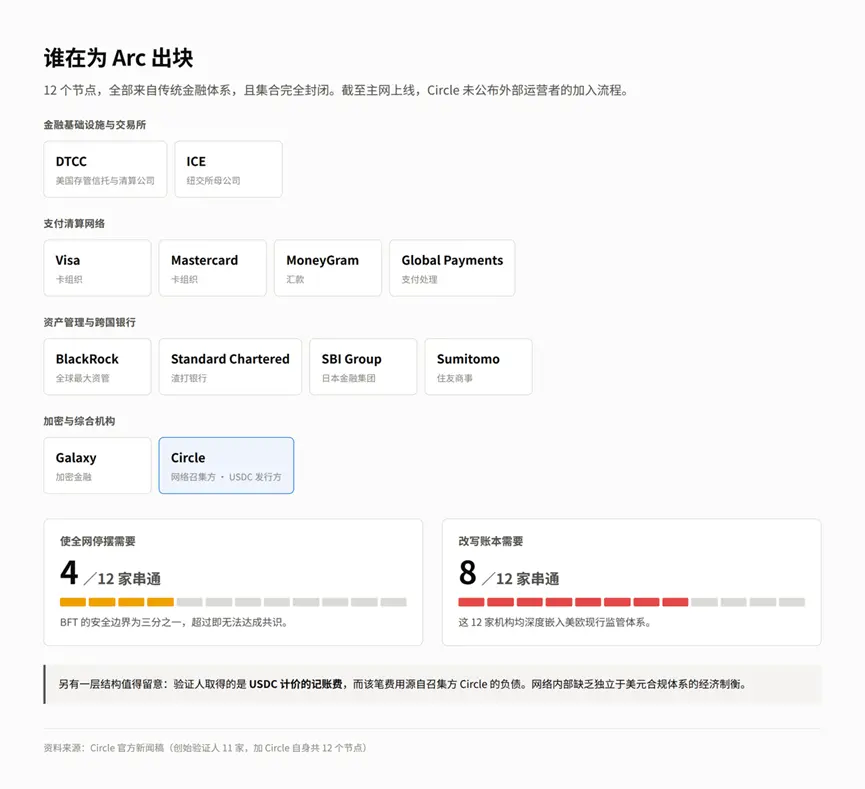
The security boundary of BFT is one-third: 4 out of 12 nodes can collude to halt the entire network, and 8 can collude to rewrite the ledger. All 12 institutions are deeply embedded in the current regulatory systems of the US and Europe. As of the mainnet launch, Circle has not disclosed the process for external operators to join the validator set.
Another structural layer worth noting: validators receive accounting fees priced in USDC, and this fee comes from the liabilities of the convening party, Circle. The network lacks an economic balance independent of the US dollar compliance system.
Adam Cochran's criticism points to the same issue: "This is not L1; calling it L1 is an offense. This is a private, pre-approved validator consortium chain." His argument path is that using USDC as gas eliminates the economic incentives for validators to remain independent, thus centralization becomes inevitable.
The defense's response is that Arc is not built for DeFi; institutions are willing to bear the cost of centralization for predictable costs and smooth access.
The dispute is over definitions. The more practically significant question is whether the trust model is disclosed truthfully: understood as "an institutional clearing network realized through blockchain technology," Arc's design is self-consistent; measured against public chain standards for anti-censorship, it fails.
Six, Current Status of ARC Token
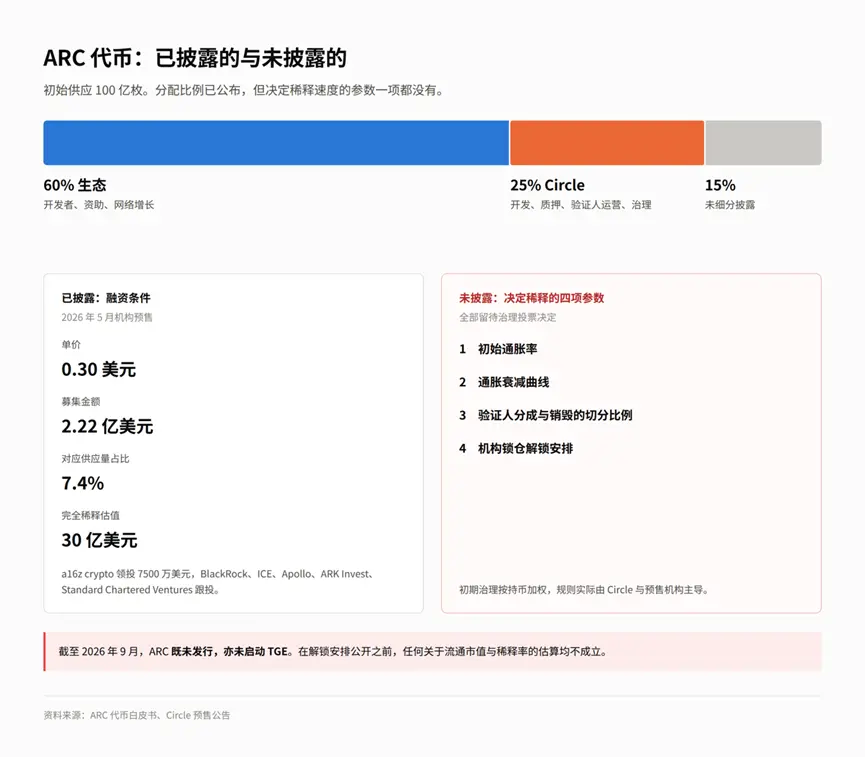
ARC and the mainnet launch on September 16 are two independent matters, currently neither issued nor has TGE been initiated.
Disclosed Parameters. Initial supply is 10 billion tokens, with 60% allocated for the ecosystem, 25% reserved by Circle, and approximately 15% not detailed.
Financing Situation. A pre-sale of $222 million was completed in May 2026, with a unit price of $0.30, corresponding to 7.4% of the supply and a fully diluted valuation of $30 billion. a16z crypto led with $75 million, with follow-on investments from BlackRock, ICE, Apollo, ARK Invest, and Standard Chartered Ventures.
Token Functionality. Supports the network's transition from PoA to PoS (the former has designated institutions taking turns to produce blocks, while the latter has nodes staking tokens to produce blocks); governance economic parameters; converts stablecoin transaction fees into ARC at settlement, distributed to validators and stakers. The stability of user-side fees and the value capture on the token side are split into two layers.
Undisclosed Parameters. Initial inflation rate, inflation decay curve, validator sharing and burn ratio, institutional lock-up and unlock arrangements. These parameters will be decided by governance voting, while initial governance is weighted by token holdings, with rules effectively led by Circle and pre-sale institutions.
Before the unlocking arrangements are made public, any estimates regarding circulating market value and dilution rates are invalid.
Seven, Boundaries of Participation for Ordinary Users
Current Stage (Testnet)
Operations Available. Claim test USDC and EURC, complete basic interactions on Uniswap and Curve, deploy contracts through Remix, or participate in the Architects points system of Arc House—five tiers with thresholds of 500, 3,500, 15,000, 40,000, and 90,000 points, corresponding to benefits including badges, priority registration for events, quarterly briefings with the Circle team, and merchandise, with the highest tier including travel subsidies.
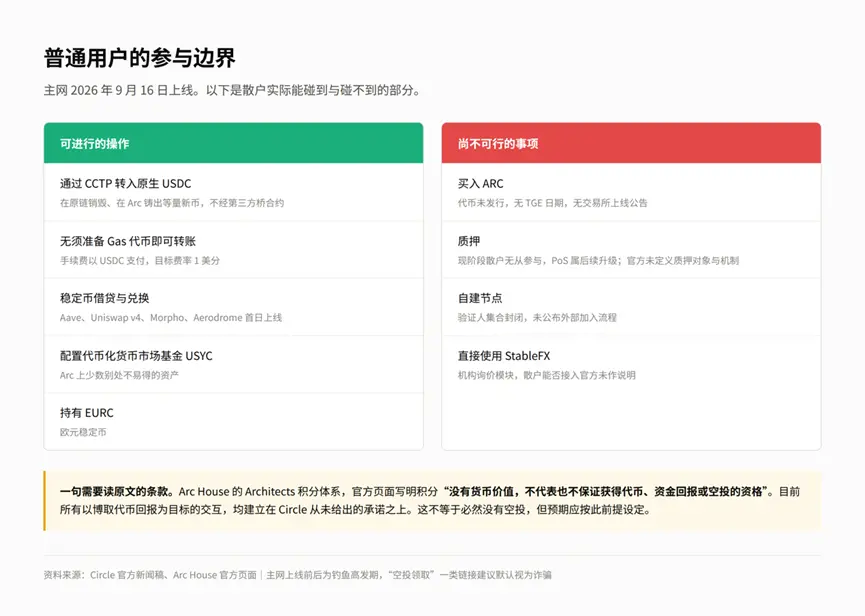
A clause that needs to be read in the original text. The official page states that Architect points "have no monetary value and do not represent or guarantee eligibility for tokens, financial returns, or airdrops." Currently, all interactions aimed at obtaining token rewards are based on promises that Circle has never made. This does not mean there will definitely be no airdrops, but expectations should be set according to this premise.
After the Mainnet Launch
Operations that can be performed. Transfer native USDC via CCTP; complete transfers without preparing additional Gas tokens; engage in stablecoin lending and exchange on Aave, Uniswap v4, Morpho, and Aerodrome; configure tokenized money market fund USYC; hold EURC.
Operations that are not yet possible. Purchase ARC (not yet issued); staking (currently retail investors cannot participate, PoS is a subsequent upgrade; there are second-hand sources claiming staking will be available on the first day of the mainnet, but the official has not defined the staking objects and mechanisms); self-built nodes. StableFX is an institutional inquiry module, and it is unclear whether retail investors can directly access it, as the official has not clarified.
8. Can the meme craze of Robinhood be replicated?
Before the launch of Arc, Robinhood experienced a wave of meme craze, which drew user attention to the launch of Arc, questioning whether it could continue to replicate Robinhood's meme craze.
Design goals and actual direction of Robinhood Chain
Robinhood Chain launched on July 1, 2026, positioned as a regulated venue for tokenized real-world assets to access DeFi, with the anchor product being Stock Tokens—on-chain versions of stocks like Nvidia and Apple. This design was widely seen as a paradigm for traditional brokerages entering the blockchain.
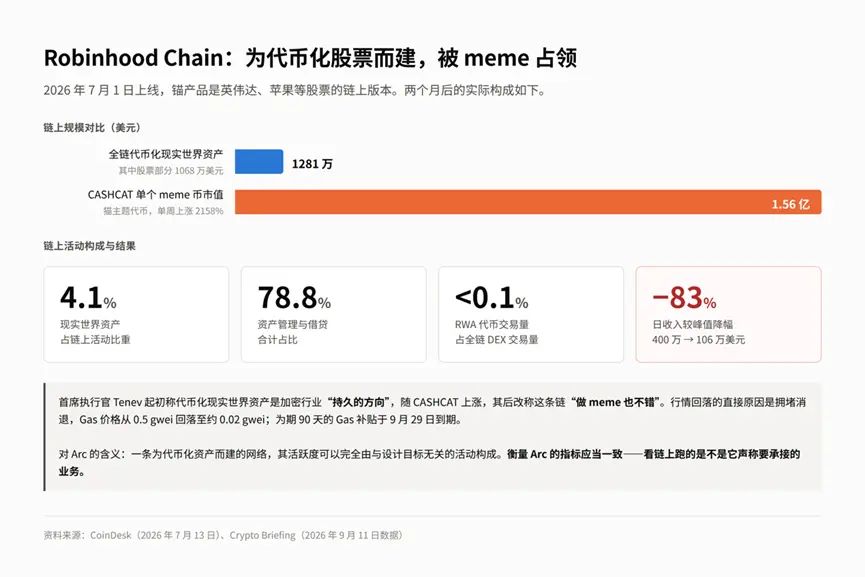
The actual direction deviated from the design goals. After launch, the dominant on-chain activity was memes: a cat-themed token CASHCAT surged 2158% in a single week, reaching a market cap of $156 million, while the total scale of tokenized real-world assets across the chain was $12.81 million, with the stock portion at $10.68 million. In terms of proportion, real-world assets accounted for 4.1% of on-chain activity, while asset management and lending totaled 78.8%. CEO Tenev initially stated that tokenized real-world assets were the "sustainable direction" of the crypto industry, but as CASHCAT surged, he later remarked that "doing memes is also good" for the chain.
Within two months, the DEX trading volume on the network exceeded $34.6 billion, and stablecoin supply surpassed $1 billion. During the same period, the actual trading volume of tokenized real-world assets was below $30 million, less than 0.1% of the total DEX trading volume.
Current results
The market has already retreated. Daily revenue dropped from a peak of $4 million to $1.06 million on September 11, a decline of 83% from the peak and a week-on-week decrease of 76%. The direct reason was the decline in meme congestion, with Gas prices falling from 0.5 gwei to about 0.02 gwei, eliminating the fee premium that had previously boosted revenue. The 90-day Gas subsidy will expire on September 29, at which point users will need to pay according to market rates. The parent company Robinhood Markets reported a 38% year-on-year decline in crypto trading revenue to $100 million in the second quarter.
Two additional issues exposed structural problems with this model. On September 4, block production on the network was interrupted for at least 14 minutes, with the reason not publicly disclosed. During the same period, AMC Entertainment CEO Adam Aron publicly opposed the existence of AMC stock tokens on the chain, stating they were not registered under U.S. securities law, demanding a halt to trading and threatening legal action; Robinhood's Chief Legal Officer Dan Gallagher rejected this request. Previously, OpenAI also denied any partnership with Robinhood.
The issue lies in the legal structure of Stock Tokens: they are debt securities issued by Robinhood Assets Limited, providing price exposure without granting holders ownership or claims against the underlying companies, thus allowing issuance without the consent of the underlying companies. This design supported rapid expansion but also led to ongoing friction with the tokenized companies.
In contrast, Arc is taking the opposite approach on the same issue: not issuing price mapping certificates itself, but waiting for DTCC to move DTC custodial assets on-chain in the second half of 2027. This route is much slower but avoids problems like those with AMC.
Four supporting conditions for the meme craze
The launch platform Pons had approximately $5.95 million in fees over 24 hours on September 3, ranking fourth globally, higher than Pump's $4.64 million and also higher than the $4 million collected by Robinhood Chain during the same period. On September 2, nearly 25,000 tokens were issued through Pons in a single day, with a trading volume of $544 million; since July, approximately 646,000 tokens have been issued from over 167,000 creator addresses. The PONS token surged 300% in a week, driven by the protocol's buyback and burn mechanism, which has canceled about 29% of the original supply. The network has collected approximately $20 million in fees since its launch in July, of which about $18 million has been retained. Robinhood charges several basis points per transaction and shares revenue with Arbitrum. CEO Tenev stated that developers are using this network in "ways we did not anticipate."
Breaking it down, there are four conditions supporting this round of market activity.
First, the network operator directly benefits. Robinhood earns revenue from meme trading, so its position is tacit approval.
Second, there is an existing retail entry point. Robinhood's app and user base itself serve as a traffic channel.
Third, there are on-chain assets available for speculation. PONS's buyback and burn mechanism converts fees into token prices.
Fourth, a self-reinforcing cycle. On-chain activity generates fees, which are used to buy back tokens to drive up prices, and rising prices attract new participants.
Corresponding situations for these four conditions on Arc
None of the four are met.
The first condition is the opposite. Arc's validators include Visa, Mastercard, BlackRock, and DTCC, and Circle itself is a publicly traded company on the NYSE. A network planned to take on DTC custodial assets for settlement in 2027, if a meme investment field emerges, poses a reputational risk rather than revenue, and Circle holds a blacklist at the protocol level. The issue is not whether it can be technically achieved, but whether the operator is willing—this distinction is far more important on Arc than on other networks.
The second condition does not exist. Arc's distribution channels are card organizations and asset management institutions, not speculators. Support from MetaMask and Binance Wallet serves as access points but does not constitute a traffic channel.
The third condition is absent. ARC has not yet been issued, fees are denominated in USDC, and there are no on-chain native tokens available for buyback, burn, or speculation, resulting in a complete absence of the wealth effect from rising token prices.
The fourth condition's supporting infrastructure has been removed. Arc has closed the public trading waiting area, making it impossible to prioritize buying new tokens at launch or to bundle and sort buy orders at the protocol level. A significant portion of the profits from launch platforms like pump.fun and Pons comes from this. With this layer missing, the economic model of launch platforms needs to be rewritten.
On the other hand, the space has not completely closed off. Arc is EVM-compatible, allowing anyone to deploy ERC-20 tokens and establish trading pools; Uniswap v4 and Aerodrome launched on the same day, with the latter's incentive mechanism originally aimed at long-tail assets; USDC, being low-cost and predictable for Gas, is actually friendly to high-frequency speculation; narratives like "the first meme on the blockchain from BlackRock" have inherent virality.
Existing projects are already laying the groundwork for this. ARCLaunch claims it will launch around the mainnet, providing token creation, trading, cross-chain, Uniswap launches, creator revenue sharing, and referral programs. This project is unrelated to Circle, and its promotion is distributed through paid press release channels, marked as sponsored content. This signal itself is worth noting.
Another easily misinterpreted point: the expectation of airdrops before TGE itself will bring a batch of interactions, with data patterns resembling market activity, but the driving mechanisms are entirely different.
The conclusion is that the market is difficult to form, and even if it does form, it is hard to sustain. If it truly emerges, its structure will be even more fragile than that of Robinhood Chain—lacking support from native token buybacks, lacking binding interests from operators, and liquidity will completely depend on external inflows of USDC, with withdrawal speeds likely to be even faster. Meanwhile, Robinhood Chain saw its daily on-chain revenue drop by 83% within two weeks after retreating from its peak in early September, despite meeting all four conditions.
More importantly, another lesson from Robinhood Chain is that a network built for tokenized assets can have its activity entirely composed of activities unrelated to its design goals, and this activity can quickly dissipate after subsidies decline and speculation cools. Arc may not necessarily repeat this process, but the metrics for assessing it should be consistent—whether the on-chain activities align with the business it claims to undertake.
9. Follow-up Observations
Disclosures on September 16. The TGE roadmap, validator admission standards, and initial economic parameters, if still pending, indicate that the network's economic model remains open-ended for the foreseeable future. The procedural voting results of the CLARITY Act on September 15 will be announced first, and regulatory narratives and product narratives should be evaluated separately.
Capital flow and integration readiness. It is necessary to distinguish between "planned access" and "actual deployment" in announcements; BlackRock's BUIDL fund, approximately $2.87 billion, is described as expected rather than completed. Reports on testnet trading volumes vary, with one stating 166 million transactions in February 2026, while another claims a cumulative total of 671.5 million transactions, with the proportion of airdrop farmers being indeterminate.
DTCC integration in the second half of 2027. This plan aims to tokenize DTC custodial assets on Arc and achieve atomic settlement with stablecoins. If realized as scheduled, this would be the first time a traditional securities settlement system connects to a public chain; prior to this, it was merely an intention.
Competitive landscape of similar networks. Arc competes with Tempo, supported by Stripe and Paradigm, for institutional clearing, while Tether's Stable and Plasma primarily target retail and offshore payments. The results of the diversion among the four networks will become apparent within a year.
10. Conclusion
Within the boundaries of the protocol layer blacklist, revocable mechanisms, and 12 regulated validators, the assets on Arc are legally and technically closer to a crypto form of a bank certificate rather than censorship-resistant self-custodied assets. The distinction is that this certificate does not have deposit insurance, and the FDIC has clearly stated that stablecoin reserves are not covered. This point should determine the scale of capital investment more than any performance parameters.
Arc has never intended to cater to the crypto-native ideology; its clients are Wall Street and multinational settlement channels. If the goal is low-friction cross-border circulation of US dollars, corporate payments, and RWA yields, it is a well-experienced settlement product; if the goal is to seek uncertain issuance profits, the time cost is certain, but the profit probability is unknown.
The measure of Arc's success or failure is whether it can undertake traditional financial clearing business, rather than the on-chain activity of retail investors. The answer does not lie in September 16, but in whether the DTCC integration can be realized in 2027, and before that, whether what operates on this network is real settlement or just volume manipulation.
 Risk warning

Popular articles