Mastercard Sixty Years: How a Group of Banks Built a Global Payment Network
 Core Viewpoint

 Mastercard and Visa have different starting points; it grew from an association established by a group of banks into a global company with its own brand.
Author: Stablehunter, Yokiiiya
A friend who works at Mastercard recommended a book to me titled "Payments Systems in the U.S.: A Guide for the Payments Professional." He said, Visa and Mastercard, more than business.
What we are most familiar with are the two logos on bank cards: the blue lettering of Visa and the red-yellow circles of Mastercard. They appear in similar consumer scenarios and compete for the same banks and customers, but if we only understand their relationship as a business competition between two companies, we will miss many stories.
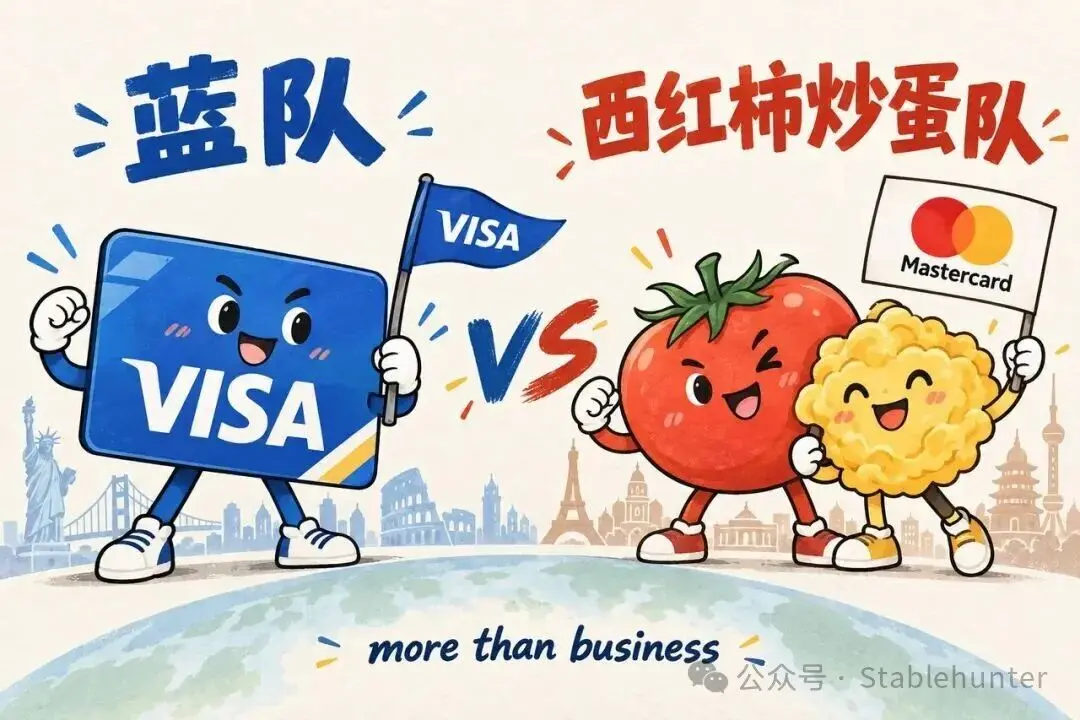
The two networks once had common member banks and participated in establishing common technical standards. Banks needed them and negotiated terms with them; they competed with each other while having common interests in security and interoperability. Mastercard and Visa started from different points; Mastercard grew from an association established by a group of banks into a global company with its own brand.
1966---1978: Banks Unite, Networks Begin to Go Overseas
The story of Visa begins with a product from a single bank, while the story of Mastercard begins with several banks deciding to unite. In 1958, Bank of America launched BankAmericard in California. By 1966, it began authorizing other banks in the U.S. and abroad, allowing more banks to join this system.
In the same year, another group of banks established the Interbank Card Association, abbreviated as ICA, which is the predecessor of Mastercard. From its inception, it adopted a governance model where member banks collectively managed it, without any single bank taking the lead.
At that time, other banks could choose to join the BankAmericard system, which later developed into Visa, or they could unite to create another network. Mastercard was the result of the latter choice.
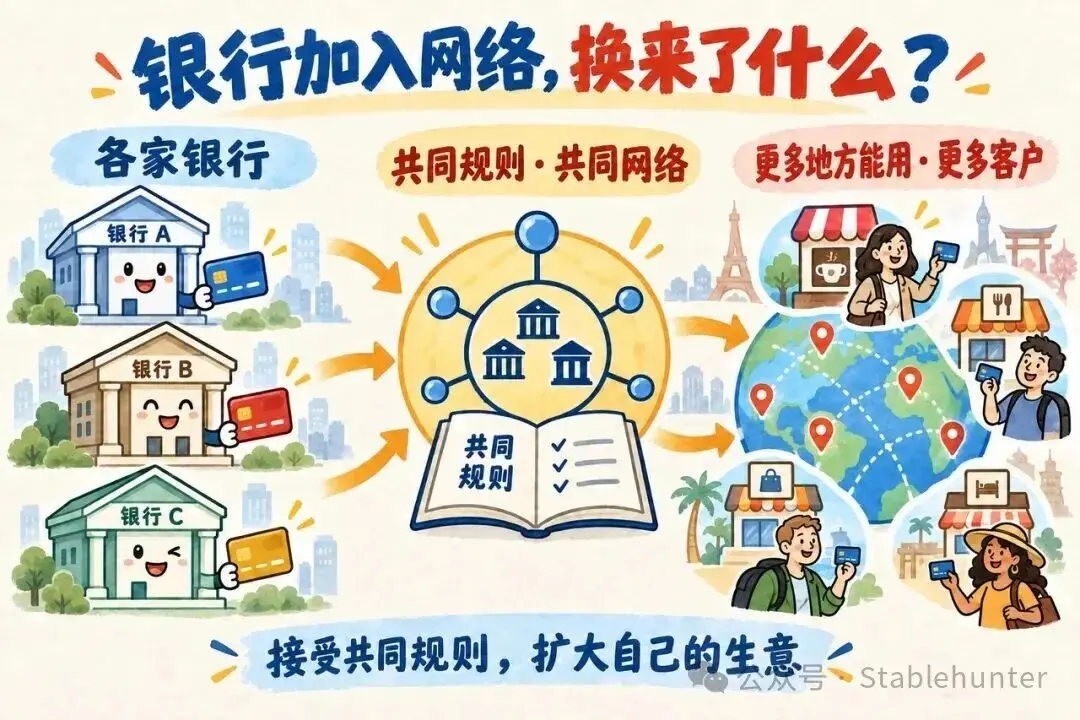
For ICA, the first cooperation challenge was how a card could cross the boundaries between banks. For a single bank, issuing a card and ensuring that card could be used everywhere are two completely different challenges.
Banks know their customers, can assess their credit, and decide how much to lend them. However, customers travel to other cities and enter stores served by other banks. Are merchants willing to accept this card? How do they know the transaction was approved? After selling goods, how do they receive payment? In case of disputes, who handles them?
If every two banks negotiate separately, the relationships would quickly become too complex to maintain. The value of a common network thus emerged: participants accepted a set of rules, transmitted transaction information through a common system, and completed settlement arrangements between institutions. In Mastercard's sixtieth anniversary review, this shared system was also regarded as the core mission at the company's founding.
Banks relinquished some independence in deciding how products operate in exchange for a broader usage of the card, and there was a direct revenue incentive behind this exchange. Credit cards allowed banks to offer loans to consumers outside their original geographical operating range; banks could establish customer relationships through a credit card without waiting for the customer to open a deposit account. An expanded acceptance range meant banks had the opportunity to reach more borrowers and expand their consumer credit business.
This also influenced who had more say within the association. In the era when both networks were still jointly owned and managed by member banks, issuing cards was more profitable than acquiring them, and issuing institutions often dominated the voices in important committees and boards.
This was the earliest exchange in the payment network: banks were willing to accept common rules because these rules helped them expand their business. Participants in the joint network did not inherently possess the same influence.
Two years after ICA was established, it began seeking cooperation outside the U.S. In 1968, it established connections with Banco Nacional in Mexico, allied with Eurocard in Europe, and the first members from Japan joined in the same year.
When entering Europe, ICA found cooperation with the existing card organization Eurocard. European banks already had their own customers and partner merchants; connecting the networks allowed each other's cards to be used in more places. For ICA, this also meant it could leverage existing banking relationships to expand its business.
By 1970, BankAmericard transitioned into an independent company and subsequently adopted the Visa brand in 1976. At this time, Mastercard's predecessor was still using the name Master Charge.
For Mastercard, the system initially established by several American banks began connecting more banks and merchants in other countries through overseas partners.
1979---1990: Renamed Mastercard, Expanding the Network
In 1979, Master Charge was officially renamed Mastercard, and as the business entered more countries, this unified brand appeared on an increasing number of cards issued by banks.
Entering the 1980s, the company continued to expand its product range. The Gold Mastercard launched in 1983 targeted customers with higher spending power, allowing banks to offer different card products to different customers on the same network.
During the same period, Mastercard was also expanding what bank cards could do. In the late 1980s, it acquired the Cirrus ATM network, incorporating interbank cash withdrawal into its business scope.
Buying goods and withdrawing cash are two different needs for cardholders. After connecting to the ATM network, the uses of bank cards further extended: when out and about, in addition to paying in stores, they could also withdraw cash through ATMs connected to the network.
During this phase, Mastercard was expanding two types of connections: connecting more banks in different countries and connecting more card usage scenarios. Next, when banks wanted customers to pay directly using the money in their deposit accounts, debit cards became a new growth opportunity.
1991---2001: Entering Everyday Consumption, Competing and Cooperating with Visa
In 1991, Maestro was launched.
Entering the 1990s, the network began to expand into more everyday payment scenarios. Credit cards were just one entry point, the ATM network connected cash withdrawal needs, and debit cards connected bank deposit accounts. The launch of Maestro in 1991 was an important step for Mastercard in expanding debit payments.
However, banks that were already network members did not necessarily adopt its new products seamlessly. Visa and Mastercard wanted banks to issue their debit cards, so they approached the credit card managers they had previously worked with. They soon discovered that the credit card department managed credit cards, while savings accounts, ATMs, and bank branches were managed by another department. Familiar faces could not make decisions for this matter.
The department managing savings accounts was already promoting its own PIN-based debit card and had to consider how much money its business could earn and what costs it would incur. Now, switching to a new product meant renegotiating who would be responsible and how revenue would be calculated. It took banks several years to sort out these relationships and gradually realize that, in the U.S. market at that time, Visa and Mastercard's debit card products could bring more attractive returns to banks.
This also indicated that for Mastercard to grow its business, it first needed to get banks to adopt its products and find the departments within banks that could truly make decisions.
In 1997, Priceless began reaching consumers.
Getting banks to issue Mastercard cards was just the first step. Once the card was in the hands of consumers, whether it would be used for payments was another question.
A person might have several cards in their wallet. Some offer more rewards, some have better discounts, and some are just habitual choices. For Mastercard, securing card issuance partnerships with banks did not equate to securing every future transaction from cardholders.
In 1997, Mastercard launched the Priceless advertising campaign. The earliest ad featured a father taking his child to a baseball game: buying tickets and food costs money, but the time spent together cannot be measured by price. Mastercard placed its brand into a relatable life scenario that ordinary people could understand.

The first Priceless ad in 1997: having a good conversation with your child, priceless.
The connection this campaign aimed to establish was: when you spend money on the people and things you care about, Mastercard can be there with you. It gave the red-yellow circles on the bank card an easily memorable story.
From a business perspective, Mastercard needed to appeal to both sides. Banks decided what cards to issue, and cardholders decided which card to use; brand advertising was one way it could directly influence cardholders.
On a card, the bank's name and Mastercard's logo are placed together, but behind them lie their respective business objectives. Banks hope customers continue to use their products, while Mastercard wants consumers to recognize and choose its brand among cards issued by different banks. Both sides need to cooperate while hoping to establish a deeper connection with consumers.
From 1998 to 2001, competition, cooperation, and legal entanglements with Visa unfolded simultaneously.
Visa and Mastercard were not two distinctly separate camps. During the years they operated in the form of bank associations, there were common member banks and overlapping economic interests and governance relationships. A single bank could benefit from both networks.
The operational rules of the two networks have historically been very similar, partly because many banks simultaneously belonged to both associations and issued cards under both brands; these banks hoped the rules would be as consistent as possible to reduce the complexity of managing two sets of products.
This added another layer to the relationship between the two companies: the customers they sought were once common owners. While the networks needed to compete, banks hoped that the two systems would not impose too many different requirements on them.
In 1998, the U.S. Department of Justice sued Visa and Mastercard, challenging this dual governance arrangement and the exclusive rules that restricted member banks from cooperating with other card networks.
On safety and compatibility, both networks have common needs. Cards and terminals from different countries need to be compatible, and security technologies also require a common foundation. Europay, Mastercard, and Visa participated in the development of the initial EMV specifications, and EMVCo was established in 1999 to manage related specifications and interoperability work.
From a business perspective, this cooperation makes sense. Banks can choose between card organizations, but merchants find it difficult to bear the burden of each brand requiring a completely different set of acceptance devices.
Common standards reduce the difficulty of access; thereafter, who banks hand the projects to, which card consumers use, and which services customers purchase remain competitive, with each transaction network operating independently.
In 2001, the court ruled that the exclusive rules restricting member banks from issuing cards from other networks were illegal. This ruling targeted the exclusive restrictions and did not categorically deem overlapping memberships or all collaborations between the two companies as illegal.
Over the years, the two companies have advanced technical standards while facing legal challenges posed by exclusive rules. How to achieve technical compatibility and who is allowed to participate commercially are two matters that need to be handled separately.
2002---2008: From Banking Associations to Public Companies
In 2002, Mastercard merged with Europay International and transitioned from a member association to a private stock company. In 2006, it was listed on the New York Stock Exchange under the ticker MA.
The merger with Europay brought Mastercard's collaboration with European banks more closely under one company. Previously, Mastercard was an association jointly established and managed by banks, primarily serving member banks. After going public, it had public shareholders. These shareholders are concerned with how much money the company makes, whether profits can be increased, and where the next business opportunities lie.
Original member banks could convert their holdings into cash through the IPO. The board was no longer primarily managed by representatives of member banks. Banks remained important clients, but when Mastercard made decisions, it also had to consider the interests of the company and other shareholders. This restructuring also involved how potential litigation and antitrust liabilities would be handled, not just for financing purposes.
Visa subsequently went public in 2008, and both companies began to pursue their growth more clearly, adjusting their products, fees, and rules. For merchants accepting both cards, this meant that the requirements for the two sets could become increasingly different and needed to be adapted separately.
In my view, this marks a key turning point in Mastercard's history, as it began to decide how to develop itself and needed to reconsider how to keep banks willing to cooperate while also making more money for the company.
To understand this business, one must also look at where the swipe fees ultimately go. After a customer swipes a card, the merchant typically has to pay a fee. This money is divided among several participants, with a portion called "interchange fees," usually paid by the institution that helps the merchant collect payments to the bank that issued the card to the customer. Mastercard processes this money through the settlement process, but it does not count this money as its own revenue. What it earns primarily comes from fees for providing payment networks, transaction processing, and other services.
Although interchange fees do not belong to Mastercard, issuing banks care about this revenue. When banks can choose between different card organizations, they consider which card is more cost-effective to issue. If one card can bring better returns, banks may be more willing to issue and promote it, and Mastercard may also seek to win over large banks' card issuance partnerships through fee discounts and service support.
Thus, the rules set by Mastercard not only affect how much it earns but also influence how much banks earn and which cards they are willing to promote. However, these fees also factor into the merchant's cost of acceptance, and arrangements that banks find attractive may be seen as too expensive by merchants.
A single rule, or even one clause, can change who earns a little more and who pays a little more in a business transaction. Mastercard needs to coordinate these different interests to ensure banks are willing to issue cards and merchants are willing to continue accepting them.
2009---2016: From Card Swipes to Mobile Payments
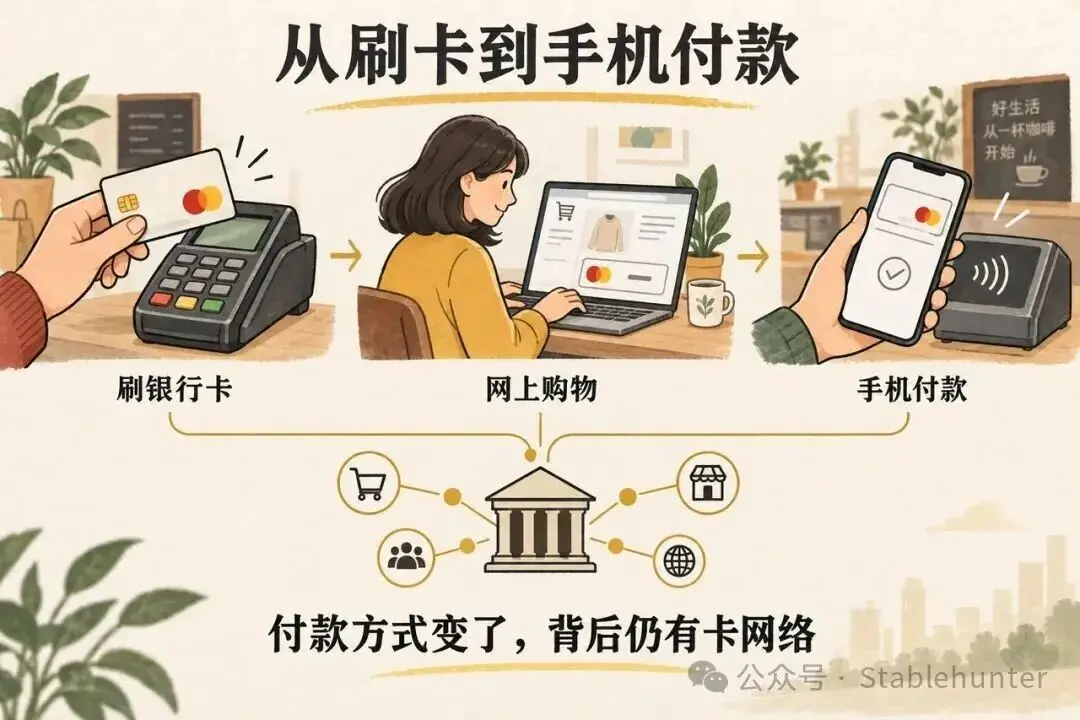
Consumer shopping habits began to change. In physical stores, merchants could see customers and cards; online and on mobile, how to reduce the hassle of filling out information, confirm the payer's identity, and protect card numbers became new issues.
In 2010, Mastercard acquired DataCash to expand its e-commerce payment services. It aimed to help merchants connect to online payments and provide more processing capabilities before and after transactions enter the network.
In 2013, Mastercard launched Masterpass. Consumers could save payment and delivery information and check out on websites or apps that support this service, reducing the steps of repeatedly entering information. Mastercard began to participate more directly in the online checkout experience.
In 2014, Apple Pay was launched, and Mastercard, along with Visa and American Express, became one of the first supported card networks. Mastercard's digital service MDES was also involved, allowing bank cards to be securely integrated into mobile payment scenarios.
A key technology among these is payment tokens. Simply put, a digital identifier can be used as a substitute for the real card number during payment, with restrictions on its usage. Consumers see the card in their mobile, but verification and transaction processing still require collaboration between banks, card networks, and mobile wallets.
Users may carry plastic cards less frequently, or even stop noticing the logos on their bank cards, but payments may still go through the original card networks. Mastercard needs to adapt to new payment entry points and has the opportunity to provide security and connectivity services for these points.
By 2016, Mastercard had already partnered with wallets like Apple Pay, Android Pay, and Samsung Pay, while continuing to develop Masterpass. It was both creating its own products and supporting other companies' wallets.
New participants also prompted networks to adjust their rules. The two networks established rules to clarify how PayPal and similar companies could use bank cards for business. With more payment entry points, networks needed to decide how to integrate these companies and what rules to follow for collaboration.
During this phase, Mastercard needed to keep up with the changes from cards to websites, apps, and mobile. It had new platforms to engage with consumers and increasingly important partnerships beyond banks.
2017---2022: From Bank Cards to Account Payments and Financial Data
After going public, Mastercard continued to seek new business opportunities, one direction being to expand its service scope beyond bank cards.
In 2017, it acquired a majority stake in Vocalink, expanding its account payment infrastructure business. Beyond card consumption, the systems required for transfers between bank accounts also became part of its business.
In 2020, it completed the acquisition of Finicity, enhancing its financial data connectivity and open banking capabilities, this time expanding into services that help clients connect and use financial data.
In 2021, Mastercard completed the acquisition of most of Nets' Corporate Services business, increasing capabilities in inter-account payments, real-time payment infrastructure, bill payments, and electronic invoicing.
Looking at these transactions together, Mastercard's business began to cover more payment methods that do not rely on card swipes and extended into financial data services. When banks, businesses, and other payment institutions need to transfer funds, connect accounts, or use data, it hopes to participate as well.
By this stage, "card network" was no longer sufficient to encompass its entire business scope. However, whether acquisitions can translate into long-term revenue still depends on whether customers are willing to continue using these products.
2023---2025: Establishing Clearing Operations in China and Continuing to Expand Services
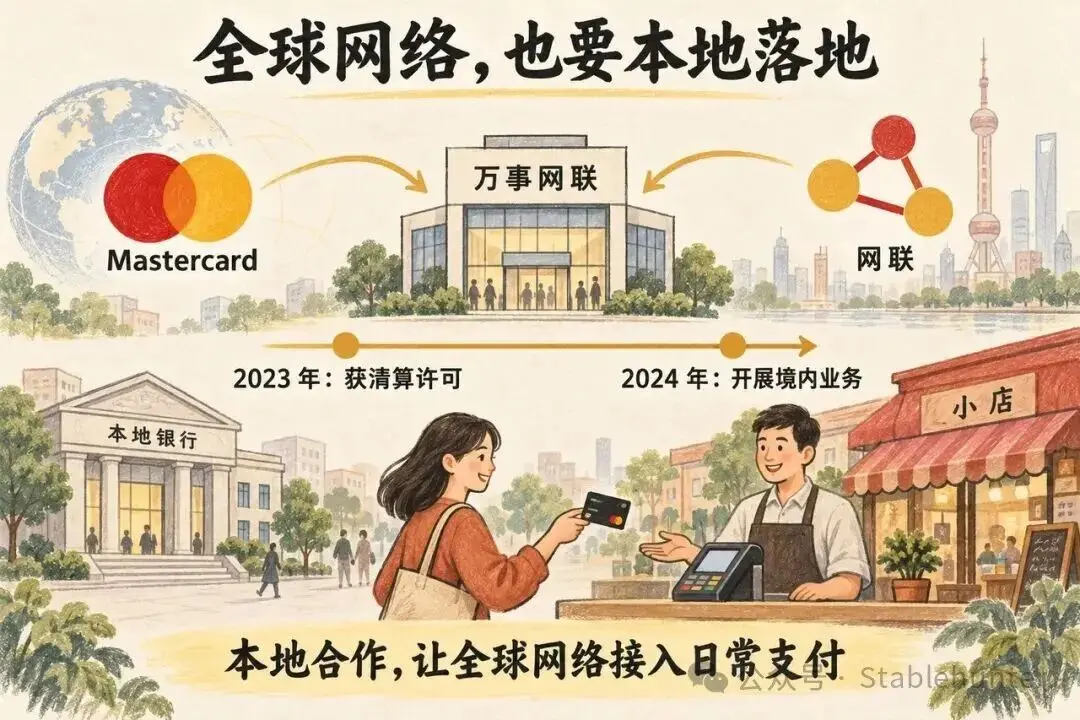
An international brand card being used for cross-border consumption is different from an institution being authorized to conduct domestic bank card clearing in China. Mastercard, in partnership with the National Network, established a joint venture called Wan Shi Wang Lian, which obtained a bank card clearing business license in 2023 and began domestic operations in May 2024.
This marks an important milestone in its development history. For a global network to enter a market, it still requires local institutional permissions, bank cooperation, and actual access. The logos on bank cards may be the same, but the implementation process must be completed one country and one institution at a time.
The significance of this milestone lies in the fact that an international network operating for decades still needs local cooperation to enter a new type of business. The brand and technology it has accumulated in other markets do not automatically replace this process.
During the same period, Mastercard was also expanding another type of capability. By the end of 2024, it completed the acquisition of Recorded Future, enhancing its threat intelligence and cybersecurity services.
From account payments and financial data connectivity to threat intelligence, these transactions expanded the services the company could offer. They point to a common business intent: when clients need to connect accounts, use financial data, assess risks, and protect systems, Mastercard hopes to provide services as well.
It is attempting to broaden the answer to "why customers need me." Transactions going through card networks is one answer; solving issues surrounding payments for customers is another set of answers.
While expanding these new businesses, Mastercard also needs to continue managing its original bank card business. When banks launch new cards or replace old ones, whether they continue to choose its network is crucial for retaining existing customers and transactions.
In 2025, a round of card replacements in the Netherlands will illustrate how this cooperation continues.
Local banks are replacing Mastercard's Maestro debit cards with Debit Mastercard, which belongs to the same system. By the end of 2025, Mastercard and local banks jointly announced the progress of the card replacement. For cardholders, it means the bank sent a new card; for Mastercard, it signifies that banks continue to use its network while updating products.
This also highlights the role of banks in this business. Most people choose a bank first when applying for a card and then select from the cards offered by that bank. When banks decide which network a particular card will use, Mastercard has the opportunity to enter customers' wallets alongside that card. A bank can offer both Visa and Mastercard, but which network a specific product adopts is usually arranged by the bank.
For example, a bank with many customers chooses to issue a certain debit card using Mastercard's network. When customers open accounts, receive cards, and make daily payments, Mastercard has the opportunity to enter their lives through that bank. It does not need to persuade each individual to choose it first.
This is why the choices made by banks in the past have influenced the later development of Mastercard. Over time, as the partnership grew, banks had already integrated their systems, accumulated experience in card issuance and transaction processing, and customers had already received a batch of cards. Changing networks would involve system adjustments, card replacements, and customer notifications, which are costs that banks need to consider. Of course, if another network offers more suitable conditions, banks may also switch partners.
Go global, but first Go local
Mastercard spent decades connecting banks and merchants from different countries into the same network. However, global network coverage does not mean that business can be easily conducted in every country.
In China, it needs to collaborate with the National Internet Finance Association and obtain domestic clearing licenses to launch new businesses. In the Netherlands, its existing bank partnerships continue with the transition from Maestro to Debit Mastercard. One is about entering the market, while the other is about retaining the market, both of which rely on local institutions' choices.
Consumers see the red and yellow circles on their bank cards, but Mastercard faces different issues in each market: Why are banks willing to issue its cards? Why are merchants willing to accept them? What businesses are regulators allowing it to conduct? These questions cannot be easily resolved with a globally unified brand and technology.
This also explains why Visa and Mastercard have different standings in various countries. Who established partnerships with local banks earlier, whose products better meet local needs, and who can maintain ongoing collaborations all influence today's market landscape. Local card organizations and consumer payment habits also affect the development space for both companies.
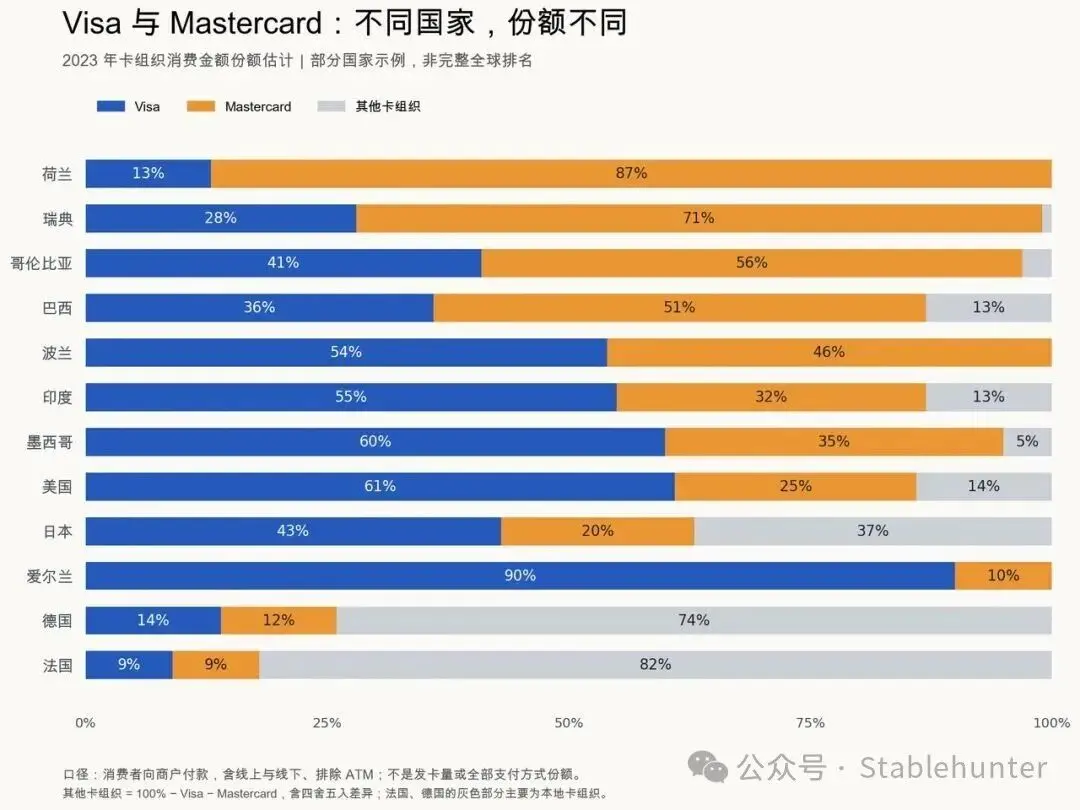
Figure: The data represents the estimated share of spending by card organizations in 2023, including online and offline consumer payments to merchants, excluding ATMs; it does not represent card issuance volume or the share of all payment methods. The gray area represents other card organizations, including rounding differences. Examples from some countries, not a complete global ranking.
For Mastercard, the value of a global network is that a card can be used in more places; the value of local partnerships is that local banks are willing to issue that card and merchants are willing to accept it. Each time it enters a market, it needs to reconnect these two aspects.
Mastercard's sixty years began with a group of banks deciding to build a network together. Later, it developed its own brand, became a publicly traded company, and expanded its business into mobile payments, account transfers, and security services. But no matter where it goes, it always needs to answer the same question: Why are local banks, merchants, and partners willing to choose it?
Its relationship with Visa is also intertwined. Both companies compete for the same customers, hoping that more transactions go through their networks; however, for a card to be used across banks and borders, everyone needs to adhere to common technical and security standards. They compete for business, but together they maintain the foundation that allows business to occur.
Looking back at what my friend said, "Visa and Mastercard, more than business," adds another layer of meaning. What we are familiar with are the blue letters and the red and yellow circles, but behind them is a decades-long evolution of competition, cooperation, and interests. The development history of both companies is also a story of how a bank card connects the world.
 Risk warning



Popular articles