Singapore CARF Implementation: Cryptocurrency Tax Transparency Enters Execution Phase
 Core Viewpoint


 The article outlines the Crypto Asset Reporting Framework (CARF) that Singapore will implement in 2027. Exchanges and some payment service providers will face requirements for user tax self-certification, transaction data aggregation, and annual reporting, while some crypto funds and family offices may also be affected by the revised CRS.
Author: FinTax
Introduction
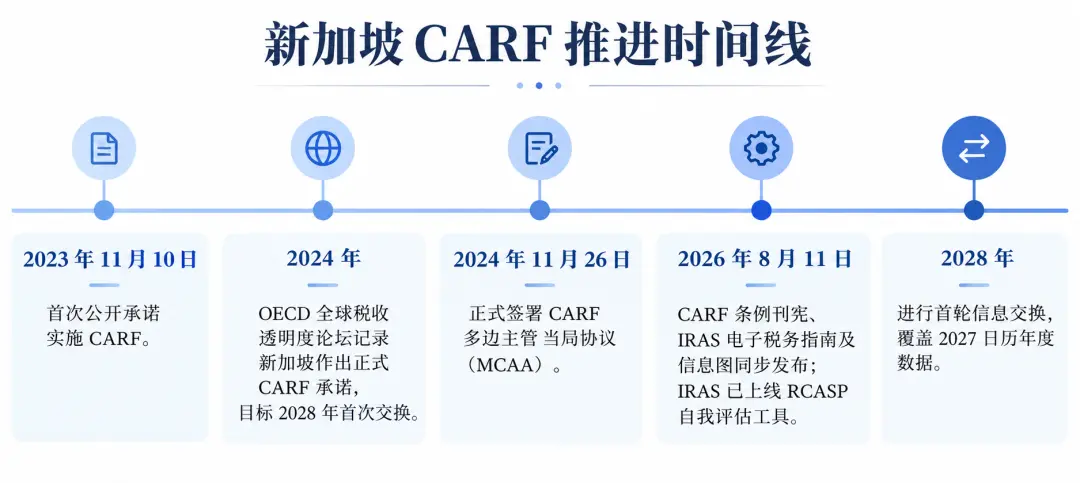
On August 11, 2026, the Singapore Government Gazette published the Income Tax (International Tax Compliance Agreement) (Crypto Asset Reporting Framework) Regulations 2026. The Inland Revenue Authority of Singapore (IRAS) also released the first version of the CARF electronic tax guide on the same day. The regulations will take effect on January 1, 2027, with the first round of information exchange covering 2027 data expected to occur in 2028.
As of June 2026, 76 jurisdictions worldwide have committed to implementing CARF, with the first 48 jurisdictions requiring local crypto service providers to start collecting CARF data from January 1, 2026. Singapore is not the first jurisdiction in Asia to advance CARF domestically; Japan has established a CARF domestic reporting system through its 2024 tax reform and has initiated related user self-certification requirements starting January 1, 2026, with plans to begin information exchange in 2027. However, Singapore has quickly formed a relatively complete CARF implementation framework by simultaneously launching the implementation regulations, supporting guidelines, and practical tools in a short period. Singapore's decision to advance CARF from an international commitment to executable domestic rules at this time is a key point for observing changes in the competitive landscape of Asian financial centers, as the effectiveness of these rules in generating compliance dividends will be crucial.
1 Why Singapore Must Align with CARF
CARF stands for Crypto-Asset Reporting Framework, designed by the OECD in 2022 and subsequently incorporated into the international tax information automatic exchange standard system published in 2023. To some extent, CARF redefines what constitutes a good business environment: in the past, when mentioning crypto-friendly regions, the first reaction was "regulatory leniency." After the implementation of CARF, the clarity and certainty of rules are becoming new evaluation labels.
Singapore's positioning as a leading global international financial center and digital asset hub makes participation in CARF seem like a necessary question to answer. The Monetary Authority of Singapore (MAS) has established a licensing system for digital payment token (DPT) service providers. As a hub economy that heavily relies on international capital flows and institutional trust, not participating in CARF would mean falling behind in the global wave of tax transparency. Conversely, joining and rapidly promoting the implementation of CARF provides a first-mover advantage for Singapore, which centers its competitiveness on clear rules and credible institutions.
Throughout the participation timeline, Singapore's actions are clear and coherent:
2 CARF Identification Standards in Singapore
2.1 Identification of Reporting Entities (Reporting SGCASP)
Before submitting information, it is necessary to determine whether the entity itself qualifies as a Reporting Singaporean Crypto-Asset Service Provider (Reporting SGCASP).
This determination involves two steps. The first step is to assess whether the entity facilitates crypto asset exchange transactions (Exchange Transactions) for clients or on behalf of clients as a business, based on the substance of the business rather than merely relying on licensing records.
Meeting the above criteria constitutes a Reporting Crypto-Asset Service Provider (RCASP). On this basis, it is necessary to further discuss whether the entity is subject to CARF reporting obligations in Singapore. Therefore, the second step is to determine whether the entity has a statutory connection to Singapore, thus constituting a Reporting SGCASP. The connection points include:
(1) Individuals or entities residing in Singapore for tax purposes;
(2) Entities established or registered under Singapore law;
(3) Entities managed in Singapore (i.e., their senior management typically makes decisions in Singapore);
(4) Entities with a permanent establishment in Singapore;
(5) Entities operating through a branch in Singapore.
Regarding the exemption rules for duplicate reporting. If an RCASP has connections to multiple CARF jurisdictions and has a higher association standard in another cooperating jurisdiction (such as being a tax resident of that jurisdiction) and has notified IRAS that it has fulfilled CARF requirements according to that jurisdiction's rules, it is not required to duplicate reporting and due diligence in Singapore.
IRAS has launched an RCASP self-assessment tool, allowing relevant entities to preliminarily understand whether they fall within the RCASP scope and whether they have CARF obligations in Singapore by filling out a structured questionnaire.
2.2 Reportable Users
Reportable users need to be determined based on tax residency status and entity nature.
(1) For individual users, the tax residency jurisdiction is primarily confirmed based on self-certification and other information, and it is determined whether they are reportable persons.
(2) For entity users, in addition to determining whether the entity itself is a reportable user, it is also necessary to further confirm its entity classification. If the entity is neither an excluded person nor an active entity, the Reporting SGCASP must identify its controlling persons and determine whether the relevant controlling persons are reportable persons.
2.3 Core Obligations
The core obligations that Reporting SGCASP must fulfill are as follows:
(1) IRAS Registration: Singapore reporting crypto-asset service providers that fall under regulatory scope in 2027 must complete registration with IRAS by March 31, 2028. Service providers that enter the scope after 2027 generally must complete registration by March 31 of the year following the calendar year in which they become reporting service providers.
(2) Due Diligence and Self-Certification: Reporting service providers must obtain and verify valid tax self-certification when opening accounts for new users. For existing users as of December 31, 2026, valid self-certification must be obtained and verified by December 31, 2027. For existing users who have not obtained and confirmed valid self-certification by December 31, 2027, reporting service providers are prohibited from executing related transactions for them starting January 1, 2028, until self-certification and reasonableness confirmation are completed.
(3) Annual Reporting: CARF declarations must be submitted by May 31 each year. The first reporting year is 2027, with a deadline of May 31, 2028. Service providers with no relevant reportable transactions generally still need to submit a zero declaration.
The reportable information includes two categories: first, the identity information of reportable users and some entity controllers, including names or entity names, addresses, dates of birth (for individuals), tax residency jurisdictions, and tax identification numbers (TIN); second, transaction information summarized by relevant crypto asset types, including the amounts, unit quantities, and transaction counts for acquiring and disposing of crypto assets in fiat currency, the fair market value, unit quantities, and transaction counts for crypto-to-crypto transactions, reportable retail payment transactions, and other relevant information for transfers in and out. Transactions involving the purchase of goods or services with crypto assets valued over $50,000 are classified as reportable retail payment transactions.
For assets transferred to external wallets that cannot be confirmed to be associated with virtual asset service providers (VASP) or financial institutions, the total fair market value and total unit quantity must be reported separately. Wallet addresses themselves do not need to be submitted with the annual declaration but should be retained for reference.
(4) Record Keeping: User identification and business relationship data should generally be retained for five years after the business relationship ends; transaction data and some due diligence records should be retained for five years from the corresponding reporting year; records related to external wallet addresses should also be retained for at least five years.
Reporting SGCASP may delegate third parties to assist in completing CARF compliance work (such as data collection, XML file generation, and submission), but the ultimate reporting responsibility still rests with them, including ensuring the accuracy, completeness, and timeliness of the data.
3 Comparison between Hong Kong and Singapore: Targeting 2028 Exchange, but Rules Are Not Synchronized
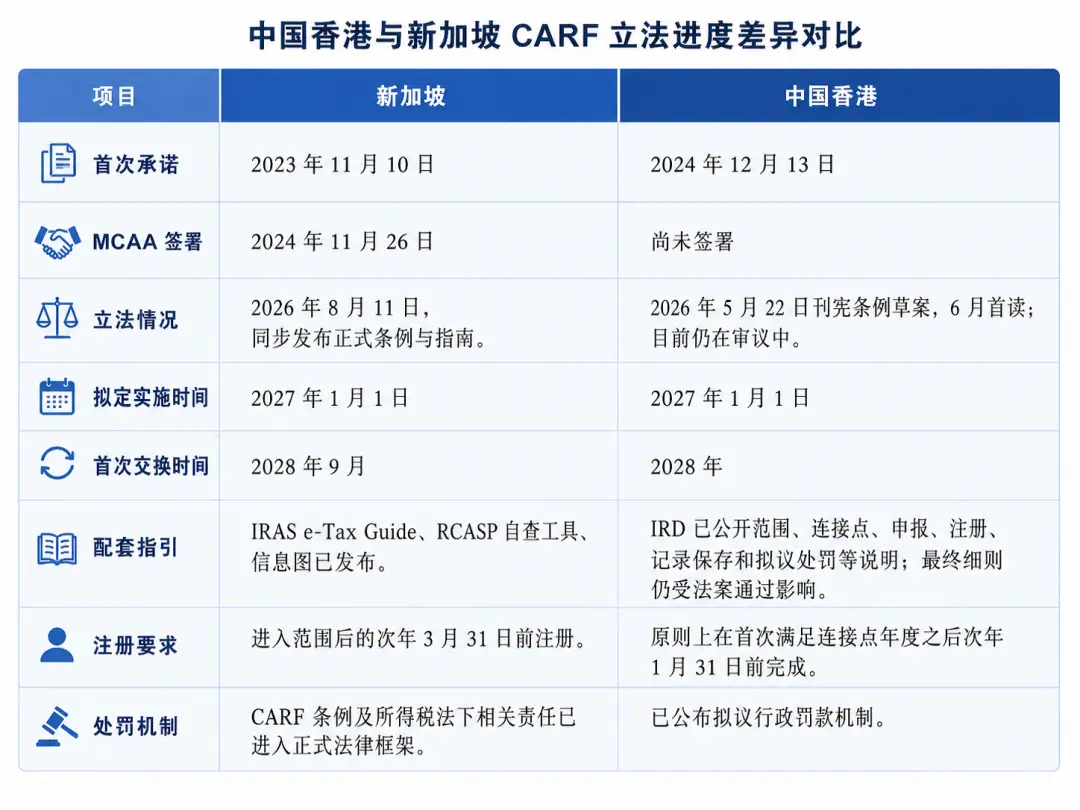
Both Singapore and Hong Kong are important cross-border financial and crypto business centers in Asia, both planning to initiate the first CARF information exchange in 2028, but the progress and certainty of the rules in the two places are not the same.
3.1 Differences in Legislative Progress
In terms of CARF implementation timelines, Singapore and Hong Kong are relatively close, both planning to conduct the first information exchange in 2028. However, the two places show different progress in domestic legislation, implementation guidelines, and supporting execution mechanisms.
3.2 Differences in Corporate Location Implementation Preparations
When businesses and capital choose financial centers, they typically focus on tax burden levels, regulatory environments, and market connectivity. Hong Kong benefits from the mainland market, has a common law system, and lower tax rates; Singapore is known for its political stability, transparent rule of law, and regional hub status. Tax rates, capital market depth, licensing thresholds, talent reserves, and regulatory environments are always important components of financial center competitiveness.
With the implementation of CARF, the importance of compliance certainty and institutional transparency has further increased. For cross-border crypto platforms, whether the rules are timely clarified and whether the implementation path is clear directly affects the ability to plan customer due diligence, system transformation, data governance, and reporting arrangements in advance. The earlier the rules are finalized, the more timely businesses can adjust their processes and technical architectures, reducing additional costs and execution risks arising from repeated corrections.
Singapore's promotion of CARF continues its long-standing policy orientation of participating in international tax transparency cooperation and aligning with global standards. IRAS emphasizes that international tax standards can only maintain a fair competitive environment and strengthen the trust foundation of international financial centers when implemented consistently and effectively across different jurisdictions. Singapore has provided a sufficient preparation period for reporting service providers to facilitate system and process transformations while improving domestic legislation and IT infrastructure, referencing the implementation experiences of pioneering jurisdictions to enhance the stability and enforceability of CARF rules.
Hong Kong's advancement of CARF needs to consider its dual positioning as an international financial center and an important window for China's financial opening. On one hand, Hong Kong needs to continuously align with international tax transparency standards to respond to the demands of cross-border financial institutions and market participants for consistency and predictability of rules; on the other hand, its institutional design must fully consider the current crypto asset regulatory policies in the mainland and the financial connections between the two regions. In the context where mainland China has not yet committed to implementing CARF, the implementation of CARF in Hong Kong emphasizes coordination between international rule alignment, market openness, and the local institutional environment.
4 The Impact of CARF Implementation on Singapore's Pillar Businesses
The comparison between Hong Kong and Singapore illustrates the differences in policy certainty across different jurisdictions. However, for cryptocurrency businesses already operating in Singapore, the more immediate question is which business and operational aspects these rules will affect. Different business models are impacted to varying degrees by CARF, with the focus on whether the entity is actually providing or facilitating relevant cryptocurrency asset transactions for clients, and whether the related business falls under the revised version of CARF or CRS.
4.1 Trading and Payment Service Providers: CARF Requires Integration into Daily Operations
Exchanges and payment institutions are the business entities directly affected by CARF. The essence of the business serves as the basis for determining whether it constitutes RCASP; as long as the business facilitates cryptocurrency asset exchange transactions for clients or on behalf of clients, it may fall within the reporting scope of CARF.
The compliance requirements faced by cryptocurrency exchanges will become part of their daily operations. When new users open accounts, the platform needs to obtain and verify valid tax self-certifications, including information such as tax residency jurisdiction and taxpayer identification number (TIN); for eligible entity users, further determination is needed to identify their controlling persons. A larger workload may come from existing clients. Users who are already in existence as of December 31, 2026, need to complete the corresponding self-certification and reasonableness verification by December 31, 2027. For existing users who have not completed valid certification by that time, the platform shall not continue to facilitate relevant cryptocurrency asset transactions for them starting January 1, 2028, until the certification requirements are met. Therefore, the platform needs to modify account opening fields and backend rules, proactively clean up existing accounts, identify information gaps, and establish certification reminders, exception handling, and transaction restriction mechanisms, which can be a challenging project for large platforms with a significant number of existing accounts.
The transformation of trading data may be even more complex. CARF requires RCASP to summarize different categories of transaction information by relevant cryptocurrency asset types, including fiat currency buying and selling, cryptocurrency-to-cryptocurrency exchanges, and specific transfers. For assets transferred to certain external wallets, separate summaries are also required. This requires exchanges to further convert the data originally used for matching, settlement, and risk control into tax data that complies with CARF standards and to establish stable correspondences between user identity, asset types, and transaction records.
Whether cryptocurrency payment, remittance, and merchant settlement institutions fall within the CARF scope cannot be determined solely by the business name; the key point is to assess whether such institutions facilitate relevant cryptocurrency asset exchange transactions for clients or on behalf of clients in a business manner. Service providers that only offer technical interfaces and do not participate in the exchange of cryptocurrency assets with fiat currency or between different cryptocurrency assets may not constitute RCASP. If they actually undertake exchange or matching functions in their business processes, they may fall within the CARF reporting scope.
It is important to note that the CARF framework has set a threshold of $50,000 for reporting retail payment transactions. However, this threshold applies to transactions where goods or services are paid for with relevant cryptocurrency assets and the value exceeds this amount; not all on-chain transfers exceeding $50,000 fall within the reporting scope.
The CARF rules are particularly important for service providers handling corporate procurement, cross-border commercial payments, or large merchant settlements. Service providers need to correlate clients' tax residency status, exchange functions, and payment purposes to determine which transactions need to be included in the annual report.
4.2 Cryptocurrency Funds: Not Directly Affected by CARF, but Facing CRS 2.0 Pressure
Cryptocurrency funds typically do not constitute RCASP. The buying and selling of funds is for asset management of their own investment portfolios and does not directly provide cryptocurrency asset exchange services to fund investors, but they may fall within the reporting scope of the revised CRS.
While promoting CARF, Singapore is also implementing the revised CRS simultaneously, and together they form a network for the transparency of cryptocurrency assets. CARF covers transactions conducted directly with cryptocurrency service providers, while CRS 2.0 covers cryptocurrency exposures held through financial institutions. Institutions operating both traditional finance and cryptocurrency businesses need to pay attention to the due diligence standards, reporting criteria, and timelines of both frameworks, which imposes dual pressure on fund managers at the operational level.
4.3 Family Offices
Singapore has long supported the development of fund management and family wealth management businesses through tax incentive systems such as 13O and 13U. In recent years, the Monetary Authority of Singapore (MAS) has continued to improve the economic substance, governance, and anti-money laundering requirements related to single-family offices, promoting family office operations under a more defined regulatory framework.
The implementation of CARF itself does not change the applicable conditions for tax exemptions under 13O or 13U, but it will increase compliance requirements regarding client identification, tax residency confirmation, and information reporting for family funds, family offices, and related holding vehicles involved in cryptocurrency asset transactions. At the same time, family funds and their underlying holding entities may also involve classification issues under the revised CRS. Some entities managed by professional management institutions, primarily engaged in financial asset investment activities, may be classified as investment entities and accordingly bear registration, due diligence, and reporting obligations under CRS.
Conclusion
Singapore has advanced CARF from international commitment to specific implementation stages, gradually forming an implementation framework that encompasses entity identification, client due diligence, data collection, and annual reporting. As relevant requirements come into effect, the impact of CARF on market entities will further enter daily business and system processes.
For relevant institutions, it is currently more important to clarify whether they fall within the reporting scope as soon as possible and further sort out entity classification, client identification, controlling person determination, transaction data aggregation, and the applicable boundaries between CARF and the revised CRS. For platforms with a large client base, complex business models, or involving multiple types of financial products, the extent of preparedness in the early stages will directly affect subsequent implementation costs and compliance efficiency.
Singapore's practice also provides an important sample for observing the implementation of CARF in Asian financial markets. As more jurisdictions enter the implementation phase, it will be worth continuing to monitor how different markets integrate CARF into local regulatory systems and how the resulting rule differences will affect corporate operations, cross-border compliance, and regional business layouts.
 Risk warning





Popular articles