Morgan Stanley Wilson: The stock market adjustment is nearing its end, and it's time to prepare for positioning
 Core Viewpoint


 Michael Wilson, Chief U.S. Equity Strategist at Morgan Stanley, believes that the internal adjustment of the U.S. stock market, which has lasted for several months, is nearing its end, and investors should prepare to increase their risk exposure. The quality factor has reached a new high, and the divergence in earnings revisions is widening, combined with the compression of cyclical stock valuations, which is signaling a mid-cycle transition. The earnings outlook for the S&P 500 remains strong, and Wilson recommends prioritizing investments in high-quality stocks while paying attention to the capital goods sector, where earnings are improving and valuations are more attractive.
Author: Bu Shuqing, Wall Street Journal
Morgan Stanley's Chief Equity Strategist Michael Wilson has sent a clear signal: The internal adjustment of the stock market that has lasted for several months is nearing its end, and investors should be prepared to increase their risk exposure. This judgment is based on three signals: the quality factor breaking new highs, the divergence in earnings revisions intensifying, and valuations having undergone significant digestion, providing a rare window for market positioning.
According to Wind Trading Desk, Wilson pointed out in the latest client report that although the S&P 500 index is only about 2% away from its historical high, the market breadth within the index has significantly deteriorated, with the equal-weight version down nearly 4% since its peak on August 14. Cyclical sectors such as financials, industrials, and consumer discretionary have borne the brunt of valuation compression. This divergence pattern is a typical feature of the market transitioning from an early cycle to a mid-cycle.
Wilson stated, "We advise investors to be prepared for either a rapid recovery or a slower downward pressure extending into November, as we believe that will be the time to increase risk (positions) rather than avoid risk." Meanwhile, Goldman Sachs strategists noted that investor positioning is becoming more defensive, while JPMorgan believes that stabilizing bond yields will provide "important support" for the stock market.
Quality Factor Breakthrough, Clear Signals of Mid-Cycle Transition
Morgan Stanley's quality factor composite index has risen to a 52-week high, having increased by about 6% since mid-August, while the equal-weight S&P 500 index has fallen nearly 4% during the same period. Wilson believes this divergence is a clear indication of the market's shift from early-cycle low-quality stocks leading to mid-cycle high-quality stocks dominating.
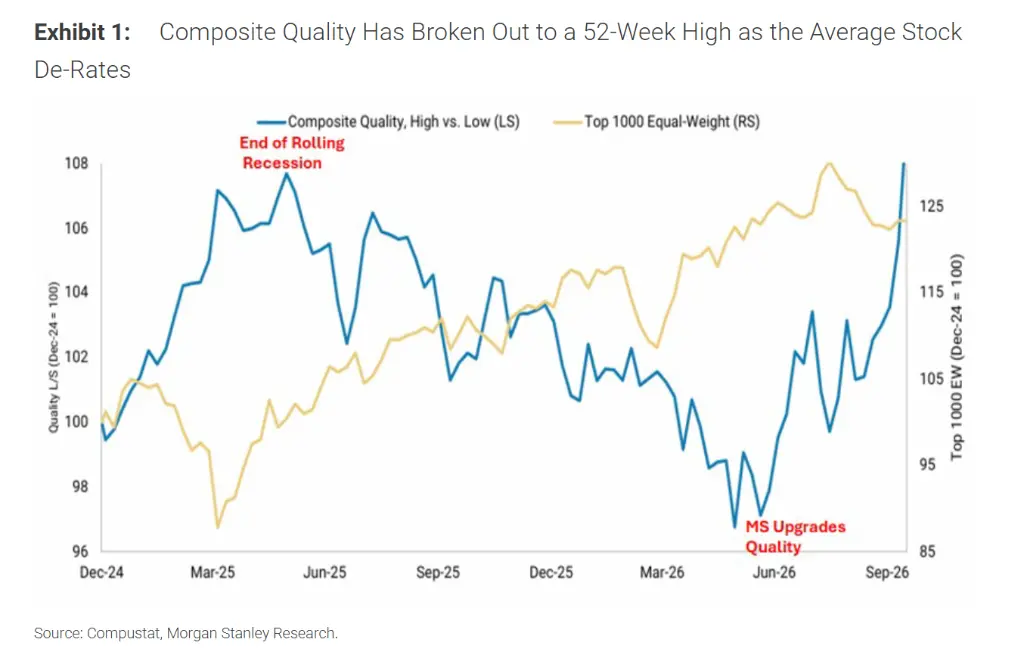
Earnings revision data further reinforces this judgment.
The breadth of earnings revisions between high-quality and low-quality stocks has widened to about 10%, the second highest level since 2010. Historical data shows that when this gap is at the highest quintile historically, high-quality stocks tend to outperform low-quality stocks by about 8% on average over the subsequent 12 months, while the average excess return across all periods is only about 1%. Notably, the current relative forward price-to-earnings ratio of high-quality stocks is still close to the historical median, meaning investors do not need to pay a premium for this earnings advantage.
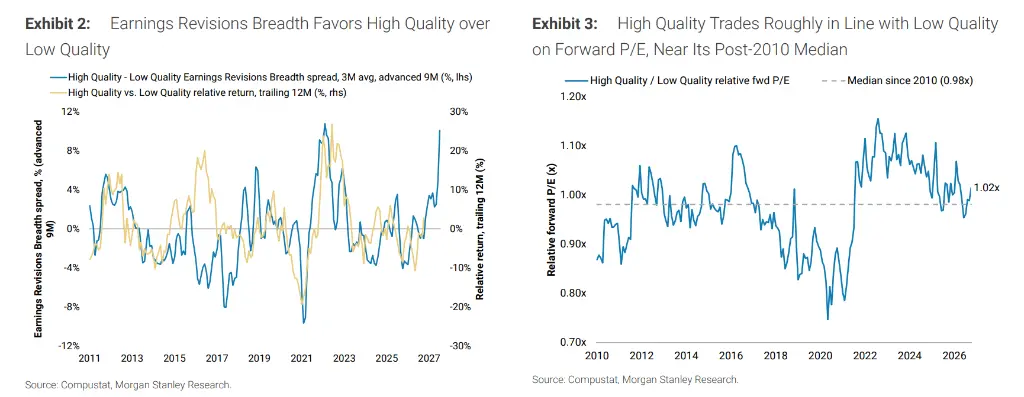
Wilson traces the starting point of this cycle transition back to "Liberation Day" in April 2025, which marked the end of a rolling recession and the beginning of a new economic cycle. He identified in June that the rate of change in earnings revisions for low-quality early-cycle leading stocks (semiconductors, consumer discretionary, financials) had peaked, combined with the more hawkish policy orientation brought by the new Federal Reserve Chair, confirming the arrival of the mid-cycle transition.
Financial Conditions Tightening, Cyclical Stock Valuations Fully Digested
Morgan Stanley's financial conditions index, constructed from interest rates, the dollar, and energy prices, has tightened to its highest level since 2022, with a particularly noticeable impact on economically sensitive stocks—since mid-August, the equal-weighted financials, materials, consumer discretionary, and industrial sectors have significantly underperformed the market.
Wilson pointed out that the key variable currently is how Federal Reserve Chair Warsh characterizes this tightening of financial conditions. Warsh previously attributed the rise in long-term yields mainly to strong economic growth, capital competition, and geopolitical factors. If Warsh acknowledges that the market has, to some extent, replaced the Federal Reserve in completing the tightening work, the pressure on interest rate-sensitive assets may ease; conversely, if he continues to focus on inflation risks while ignoring the tightening effects that have already occurred, long-term yields and cyclical stocks may continue to be under pressure.
Warsh did not provide new monetary policy guidance at the IMF meeting, which the market interpreted as being consistent with previous pricing. Morgan Stanley economists expect the Federal Reserve to maintain interest rates in October.
Strong Earnings Fundamentals Provide Confidence for Positioning
A strong earnings outlook is the core support for current market confidence.
According to estimates compiled by Bloomberg Intelligence, S&P 500 constituent earnings are expected to grow by about 24.6% year-on-year in the third quarter. Morgan Stanley's data shows that third-quarter EPS expectations are projected to grow by 27% year-on-year, with full-year EPS growth expectations for 2026 and 2027 at 33% and 16%, respectively.
AI-related stocks are the main drivers of earnings growth. Morgan Stanley estimates that by 2027, the total AI capital expenditure of hyperscale cloud providers and emerging cloud service providers will reach $1.58 trillion, of which about 65% will flow into S&P 500 companies, directly contributing about 5% of S&P 500 revenues and about 25% of revenue growth. AI-related companies are expected to see earnings growth of 25% by 2027, while non-AI companies are only expected to grow by 4%.
From the current earnings report season, among the approximately 10% of companies that have reported, the median next-day stock price reaction is -0.4%, with only 41% of companies recording a positive reaction, indicating a decline in the market's tolerance for performance. Morgan Stanley analysts' forward preview shows a net positive expectation for KPIs of +18% and a net positive expectation for NTM EPS of +15%, both below last quarter's levels, but overall still maintaining positive values.
Positioning Direction: Quality First, Focus on High-Quality Cyclical Stocks like Capital Goods
Wilson maintains a preference for quality stocks while noting that valuation digestion has created more attractive entry opportunities in some cyclical sectors. He specifically highlighted the capital goods sector, believing that the breadth of earnings revisions in this sector is improving, aligning with broader trends in manufacturing order backlogs.
Morgan Stanley's selected "high quality + upward earnings revision" stock pool covers multiple industries, including Apple, Broadcom, Micron, etc., in the information technology sector, all meeting the screening criteria of being in the top 1000 by market capitalization, in the top quartile for quality composite scores, having recent upward revisions in NTM EPS, and receiving upgrades from Morgan Stanley.
Wilson stated that under the baseline scenario, stabilizing long-term yields will make earnings the main driver of returns again; even in a risk scenario where financial conditions continue to tighten, quality stocks have historically provided relative protection. He listed whether the relative performance of the financial sector can stabilize during the earnings season, whether bond volatility can continue to decline, and Warsh's statements on the tightening of financial conditions as the three key observation indicators to determine whether this round of adjustment has truly ended.

 Risk warning