Dialogue with Folius founder Jason Kam: Crypto VC will disappear, don't look for 100x new stories in the next round, just buy the winners directly
 Core Viewpoint


 The future winners may no longer come from "finding the next unheard-of new coin," but rather from identifying true Winners that can occupy a long-term share in already validated massive markets.
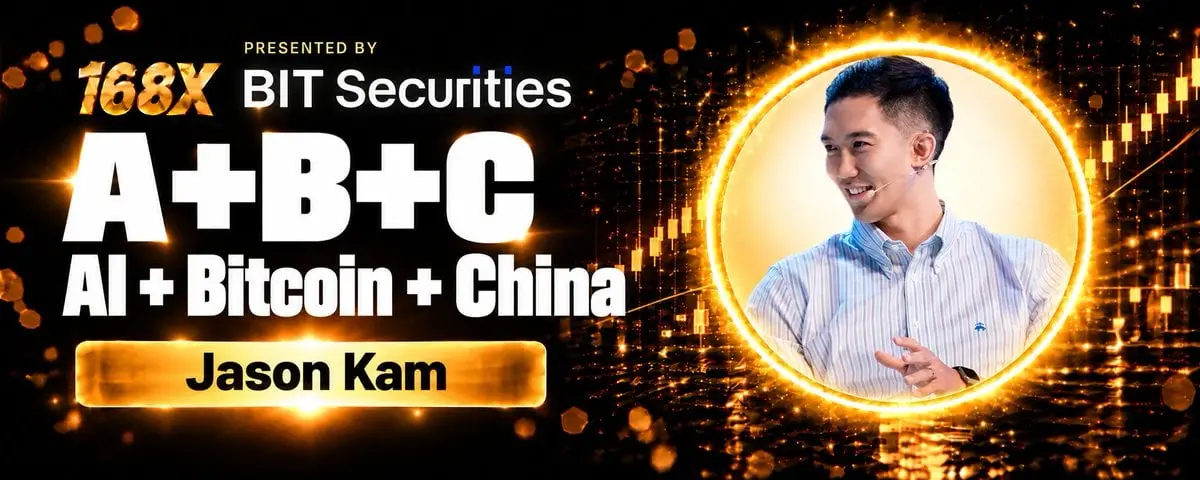
Author: 168X (Host Mr. Z) × Jason Kam (Founder of Folius Ventures)
Crypto has not disappeared, but has transitioned from the Wild West to the Fintech era: the real big opportunities are converging on "everything on-chain" and "dollars entering everything."
On October 21, 2026, 168X invited Jason Kam, Founder of Folius Ventures, for a conversation spanning Crypto VC, Bitcoin, AI, semiconductors, and Chinese tech stocks.
Jason's transformation itself is one of the most noteworthy signals in this market cycle. Folius has essentially stopped new primary investments in Crypto since September 2024, and Jason himself has shifted about 80%–90% of his focus to AI and the secondary market since January and February of this year. Meanwhile, he is more willing than ever to gradually buy into Crypto during downturns, especially BTC.
The reason is not that "Crypto has a new narrative," but rather the opposite. Jason's judgment is that the stories that could be told in the past few cycles have mostly been exhausted, and the truly promising paths are rapidly converging. Future winners may no longer come from "finding the next unheard-of new coin," but from identifying true long-term winners in already validated massive markets.
1. Folius has not invested in primary Crypto for two years: this cycle has moved from "sowing" to "harvesting"
Mr. Z: Folius was established in a completely different Crypto environment during the last cycle. As we stand today, where has your investment framework changed the most?
Jason: Folius can now actually be divided into two entities. One is the past fund, and the other is more like my own holding company, a small family office, which also has some external funds and can invest in stocks, Crypto, and anything else.
Jason: Since January and February of this year, I have devoted about 80%–90% of my energy to AI, especially in the secondary market. In Crypto, I am more focused on managing existing positions.
Jason: Moreover, since September 2024, we have basically stopped making primary investments in Crypto. One reason is that the lifecycle of the previous Token Factory model has come to an end. A few people forming a project, raising funds, TGE, low circulation high FDV, and then waiting for unlocks—this model is increasingly nonsensical.
Jason: Another reason is that our fund structure allows LPs to redeem quarterly. This structure is inherently unsuitable for early-stage projects that take 5 or 8 years to exit.
Jason: So now it feels more like a harvesting phase. The focus is on how to realize and manage liquidity for what has already been invested, rather than proving oneself as a VC by forcibly seeking out a bunch of new private deals.
2. There will be no Crypto VCs by 2030: only Fintech VCs, Liquid Funds, and Multi-sector Funds will remain
Mr. Z: Looking ahead to 2030, do you think the category of "Crypto VC" will still exist?
Jason: I believe there will definitely be no Crypto VCs in the future.
Jason: Liquid Funds and Prop Funds will certainly still exist because Crypto has its own market structure, on-chain data, chip analysis, and historical experience, all of which can constitute an edge. But if you are talking about traditional VC specifically focused on primary Crypto, I think it will become increasingly difficult.
Jason: The reason is simple. After Crypto becomes formalized, your real competitors become institutions like Sequoia, Founders Fund, and USV. Why would a good founder want to take money from a boutique Crypto fund?
Jason: In the future, Crypto Funds will either join Liquid, OTC, and become more like public market investors; or they will transform into Fintech VCs, investing in stablecoins, payments, and neobanks; or they will completely open their mandate to invest in AI, robotics, and biotech.
Jason: Institutions like Paradigm and Framework are already moving in this direction. If an investor previously only had the capability of "I understand Crypto," that will no longer be enough in the future.
3. Crypto ultimately has only two super mainlines left: everything on-chain, and dollars entering everything
Mr. Z: If the stories of past infrastructure, Layer 2, and new public chains are gradually losing effectiveness, what is left in Crypto?
Jason: I think it has been very well defined, essentially two things.
Jason: The first is everything on-chain, and all financial products gaining more equitable and accessible trading markets. Ultimately, this corresponds to Everything Exchange, trading, speculation, and various assets entering the on-chain market.
Jason: The second is the dollar as a value carrier, entering every corner of life around the world. What emerges from this are stablecoins, payments, payment processors, and neobanks.
Jason: In the past, everyone talked about sharding, ZK, and various application layers, but most of them ultimately failed. A core reason is that users simply do not care about the technology itself. Many technologies are like using a hammer to find nails.
Jason: But trading and money are not. The global financial asset market is a massive total addressable market (TAM), and global payments are also a huge market. The penetration rate of Crypto in these two markets is still very low.
Jason: So it's not that Crypto has no opportunities; rather, the opportunities have converged from 100 vague paths into 2 very large paths.
4. Stop looking for the next 100x: true alpha is buying winners directly when undervalued
Mr. Z: As an investor, since the paths are so clear, how should one allocate?
Jason: My thinking is becoming increasingly simple: just buy the winners.
Jason: In areas like stablecoins, exchanges, and payments, who is leading is becoming increasingly obvious. You can research new startups, but why assume that a newly formed team will perform better than those leaders who already have distribution, liquidity, engineering capabilities, and users?
Jason: What is truly worth doing is to look at the market cap of winners relative to their adoption and see if it is expensive or not.
Jason: For example, Robinhood can be evaluated by its market cap relative to assets under custody; Hyperliquid can be assessed by its valuation relative to TVL and volume; similar payments companies should be evaluated based on their actual transaction volume and user penetration.
Jason: The market capitalization of these companies will fluctuate cyclically around adoption. During bubbles, they can be absurdly expensive, and during troughs, the market may feel they will never grow again.
Jason: True alpha may not be about discovering winners, but about having the courage to buy when the market temporarily dislikes the winners.
5. Entrepreneurs should not directly compete with the first place: the biggest lesson from HIP-3 is that capital has inertia
Mr. Z: If investors should directly buy winners, is there still an opportunity for entrepreneurs?
Jason: Yes, but do not create something that is exactly the same as the first place.
Mr. Z: For example, with HIP-3, I initially thought this design was very clever, allowing different teams to establish their own markets on Hyperliquid. But in the end, you see TradeXYZ capturing the majority of the trading volume. This is not just about whether the mechanism is good; it also involves founder relationships, early ecosystem positioning, and liquidity.
Mr. Z: Capital itself has inertia and stickiness. Once a positive cycle is formed, it is very difficult for later entrants to win just by saying, "I also make the same product."
Jason: Therefore, entrepreneurs must find a completely different edge. For example, if others are doing traditional trading, can you do AI + intent trading? If others are doing pure trading, can you turn social into a new trading interface?
Jason: Finding new entry points in already validated large paths is much more important than reinventing a new path that no one needs.
6. BTC and Crypto have already separated: one is digital gold, the other is Fintech
Mr. Z: If there is to be a new bull market this cycle, what story should Bitcoin and other Cryptos tell?
Jason: I believe BTC and everything else must be completely separated.
Jason: BTC represents digital gold, while other Cryptos represent Fintech.
Jason: In the past, Bitcoin was like the sun, with the entire industry revolving around it. But now, if you look at assets like Hyperliquid, their correlation with BTC is no longer as high as it used to be; instead, they are increasingly resembling movements in U.S. stocks and Fintech adoption.
Jason: BTC itself has also increasingly detached from the past four-year halving cycle. The annual new supply is now very small, and in relation to ETFs and global dollar liquidity, the impact of halving on marginal supply and demand is becoming weaker.
Jason: In the future, BTC will resemble gold, slowly rising with the dollar cycle and global asset allocation. Other tokens, if they have real cash flow, value accrual, credible management, and growth, are essentially becoming more like stocks that can be traded 24/7.
Jason: So do not use the same framework to evaluate both BTC and hype. They are now two completely different assets.
7. What to Do with BTC in the Next 12-18 Months: Buy on Dips, But Remember These 3 Major Scary Stories
Mr. Z: So are you currently Bullish or Cautious about BTC?
Jason: Since June of this year, my basic judgment has been to buy on dips in the next 12-18 months. When the market drops, buy slowly; when it rises, hold it; if it rises too much, maybe sell a little Call.
Jason: After experiencing several cycles, everyone knows what a Cycle Bottom looks like. Long-term holders at this position really have no strong reason to sell, unless forced.
Jason: There are 3 scary stories that could lead to a significant drop in BTC.
Jason: The first is extremely strong AI Productivity. If AI truly allows productivity to grow almost infinitely, then why would I hold an asset that doesn’t generate cash flow? Capital might all go after Productivity Assets.
Jason: The second is Q Day. If quantum computing suddenly makes breakthroughs, it would create huge FUD regarding the security of existing Cryptography. In the end, there may be technical solutions or forks, but the market will definitely trade on panic first.
Jason: The third is a real Financial Crisis and Forced Liquidation. If the AI Cycle collapses and triggers a liquidity crisis, BTC will definitely drop along with Risk Assets.
Jason: But aside from these 3 stories, my thinking remains the same: buy slowly on dips.
8. The Next Major Source of Liquidity for Crypto May Be AI: Employee Cash-Outs Could Bring $10-60 Billion
Mr. Z: Why do you say that the future Crypto Cycle will increasingly be determined by the AI Cycle?
Jason: Because the Wealth Effect generated by AI is simply too large.
Jason: You can do a rough calculation by adding up the potential IPOs and cash-outs of all AI companies in Silicon Valley over the next 2-3 years, and then assume these employees eventually allocate 2%-15% of their assets into Crypto.
Jason: I estimate that this potential inflow could be $10-60 billion.
Jason: This number can even be compared to the cumulative net inflow brought by BTC ETFs since their launch.
Jason: Moreover, this is just from employee cash-outs, not accounting for the Wealth Effect created by the rise in AI stocks for the entire market.
Jason: So just because AI is particularly good doesn’t mean Crypto is the best right now, because funds are chasing AI; but once AI wealth starts to be realized, some of that money will eventually flow into Crypto.
Jason: Conversely, if AI suddenly collapses, Risk Assets cannot remain unaffected in the first phase.
Jason: The biggest Macro Variable for the next round of Crypto may not even be within Crypto itself.
9. The Toughest Turning Point for AI Hardware: What to Focus on Is Not Token Price, But Revenue per GPU
Mr. Z: You’ve spent a lot of time studying AI and semiconductors. What do you think is the hardest part to judge in the AI Cycle?
Jason: At the beginning of the year, it was relatively simple. At that time, the market didn’t understand Coding Agents, so you could buy a basket. Later, the market didn’t understand GPU Demand, which was also easy to navigate. But now the questions that need to be answered have become very difficult.
Jason: The core issue is not whether "Token Price has decreased," but whether Revenue per GPU has actually decreased.
Jason: It’s true that Token prices have been falling, but the cost of generating Tokens per GPU is also rapidly decreasing. Model Efficiency, Software Optimization, and chip utilization are all improving.
Jason: Therefore, a drop in Token Price does not necessarily equate to a deterioration in GPU Economics.
Jason: Another variable is the increase in demand brought by Open Source + Post-training versus the decrease in demand due to the slowdown of Frontier Lab Growth; which one is greater?
Jason: The real danger is that by the time you clearly see GPU Rental Yield dropping, Smart Money may have already traded 1-2 quarters ahead.
Jason: So, identifying the top of AI won’t be as simple as looking at a moving average. The real turning point is hidden in Revenue per GPU, Channel Checks, and Hyperscaler Earnings.
10. The Next Shift in AI May Move from Chips to Hyperscalers: The Odds for MSFT, AMZN, and GOOG Are Clearer
Mr. Z: If Semiconductor is becoming increasingly difficult, what AI investments do you dare to make now?
Jason: Right now, I’m more willing to invest in Hyperscalers.
Mr. Z: Because the capabilities of Open Source Models are getting stronger, companies don’t need to use the most expensive Frontier Models for every task. CSPs can integrate various Open Source Models into their Cloud and then provide deployment for enterprises.
Jason: The ones that truly have the opportunity to benefit are Cloud Distributors like Microsoft, Amazon, and Google.
Jason: So if I have to buy AI now, I might look at MSFT, AMZN, GOOG, or even some Cloud ETFs. Semiconductor investments are more challenging because market expectations are already very high, and I can’t be sure where Revenue per GPU will ultimately go.
Jason: This trade isn’t something you can just hold for 10 years without looking. The speed of Open Source advancements, the Closed Source Frontier Lead, Token Price, and GPU Economics are all still changing.
Jason: But at least at this stage, the logic of rotating from Hardware to CSP is clearer than continuing to mindlessly buy all chips.
11. China AI Only Wants to Bet on 3 Companies: DeepSeek, Tencent, ByteDance
Mr. Z: Looking ahead to the next few years in China AI, who do you want to bet on the most?
Jason: Right now, I want to bet on 3 companies: DeepSeek, Tencent, and ByteDance.
Jason: What attracts me most about DeepSeek is its very clear strategy. It aims to make models as open as possible, with the lowest costs and the strongest performance, and then push Cost/Performance to the extreme.
Jason: Tencent doesn’t necessarily need to create the world’s strongest Frontier Model. Its real assets are WeChat, gaming, and advertising distribution. AI can significantly enhance advertising efficiency and greatly reduce game development costs, while the Monetization Channel remains firmly in Tencent's hands.
Jason: ByteDance represents a different approach. It has very strong Consumer Distribution and is one of the most aggressive companies in China in terms of computing power investment.
Jason: Therefore, China doesn’t necessarily have to completely surpass the U.S. in Frontier Models to create huge AI Equity Value.
Jason: Models represent capability, but Distribution is the machine that turns capability into money.
12. ByteDance's Biggest Hidden Alpha: Not Doubao, But Video Generation + App Factory
Mr. Z: Why do you find ByteDance particularly interesting now?
Jason: I think the most underestimated aspect of ByteDance is not simply Doubao.
Jason: The first is Video Generation. If its video generation model continues to iterate, the gap between AI Video and traditional film production will become smaller over the next year or two.
Jason: If in the past a piece of content required actors, photography, lighting, post-production, and a production team, in the future, a few people plus a bunch of computing power could create long and short films, fundamentally changing the entire Entertainment Cost Curve.
Jason: The second and more important point is that ByteDance itself is an App Factory.
Jason: It excels at product development, growth, and distribution, and has already proven through TikTok that it can rapidly push products to a global audience.
Jason: As AI continues to lower the cost of app development, companies that can continuously produce apps and push them to hundreds of millions of users will become increasingly valuable.
Jason: So ByteDance's edge is not just "it has a model," but rather Model + Data + Distribution + Growth Engine.
13. Don’t Force the Narrative of AI + Crypto: Real AI Researchers Don’t Care About Crypto
Mr. Z: So where is the real AI + Crypto?
Jason: To be honest, nobody knows.
Jason: Many serious AI researchers don’t care about Crypto at all. Instead, it’s the Crypto natives who are constantly thinking about how to combine AI with Tokens.
Jason: This doesn’t mean there are no opportunities at all. For example, directions like Privacy, Private Inference, and Venice have real demand; Payments, Stablecoins, and financial markets may also see more machine-to-machine transactions due to the emergence of Agents.
Jason: But I won’t assume a project has value just because it has "AI + Crypto" in its title.
Jason: The biggest problem with AI + Crypto has always been that the narrative is too easy to tell, while finding real Product-Market Fit is too difficult.
Jason: If Crypto really makes AI products better, then it deserves to exist, rather than forcing an AI just to issue tokens.
Fourteen, If the U.S. Enters a K-shaped Downturn: PDD + Agent May Become Defensive Assets
Mr. Z: The valuation of Chinese internet stocks is already very low. If the U.S. or the global economy really enters a K-shaped Economy, where is the next opportunity?
Jason: I will look at A-shares, Hong Kong stocks, and Chinese concept stocks separately, as they all have their own funding issues. But some individual companies are indeed cheap to an exaggerated extent.
Jason: For example, PDD, I have a position in it. I like it not just because it's cheap, but because it may have a natural advantage in a K-shaped Downturn.
Jason: If consumers increasingly pursue low prices, combined with Agents helping users find the lowest prices and highest efficiency products across the internet, then platforms like PDD, which have already optimized their low-cost supply chains, may actually be strengthened.
Jason: You can look back at the U.S. Financial Crisis from 2007 to 2009; extreme low-price retailers like Dollar Stores did not collapse like high-end consumption.
Jason: So if AI ultimately triggers a divergence in employment, income, and consumption structure, Low-cost Distribution + Agent may be a very interesting Downside Protection.
Fifteen, Three Things to Really Study in the Next 12 Months: Cheap Intelligence, Post-Cycle AI, Robotics
Mr. Z: Finally, if you could only give investors three directions worth studying in the next 12 months, what would you choose?
Jason: First, I particularly want to clarify who will turn the declining cost of increasingly cheap Intelligence into their own profits.
Jason: As tokens become cheaper and AI capabilities resemble commodities, someone will definitely buy this cheap intelligence and then convert it into huge Enterprise Value. It could be a PE firm, a software company, or a completely different business model.
Jason: Second, if AI weakens in the medium term due to a decline in Revenue per GPU, what should we buy at that time? Now everyone knows how to go long on AI, but not many have seriously considered who will become the winner in the post-cycle of AI.
Jason: Third, I have a strong conviction that AI will unlock Robotics and the Physical World.
Jason: The next round of the market will definitely start trading Robotics more seriously. The question is not whether Robotics will become a narrative, but which company can truly turn AI Intelligence into Physical Productivity.
Jason: So in the next 12 months, I really want to study three things: who captures Cheap Intelligence, who wins in the post-cycle of AI, and who will dominate Robotics.
Mr. Z: At the end of this episode, I will condense Jason's framework into five judgments. First, traditional Crypto VCs are losing their necessity to exist; in the future, those that remain will be Fintech VCs, Liquid Funds, or investment platforms that can cross AI, Robotics, and Public Markets; second, the big opportunities in Crypto have converged into two paths: everything on-chain and the dollar entering everything; rather than continuing to find 100 new stories, it’s better to directly buy proven winners at the trough of the cycle; third, BTC is gradually separating from the entire Crypto Fintech ecosystem, becoming an independent Digital Gold Trade; in the next 12 to 18 months, the most important factors are not Halving, but the AI Wealth Effect, Q Day, and liquidity crises; fourth, the biggest impact of AI on Crypto may not be AI Agents issuing tokens, but how much wealth AI creates and how much of that wealth eventually flows into Crypto; fifth, the real next stage of Alpha has begun to shift from "Will AI continue to rise?" to "Who will monetize Cheap Intelligence, who to buy in the post-cycle of AI, and who will win in Robotics." Thanks to Jason Kam for coming to 168X!
 Risk warning

Popular articles