How to choose a cryptocurrency exchange that supports stock trading pairs: a comprehensive comparison of security, fees, and market coverage

 Stock mapping products, tokenized stocks, and perpetual contracts for stocks are becoming new areas of competition among cryptocurrency exchanges. This article compares the product forms, security, fees, and market coverage of four platforms: SuperEx, Kraken, Bitget, and Gate, and provides selection considerations.
This article compiles data based on publicly available information from various platforms as of October 22, 2026.
Before Comparison, Distinguish Four Types of "Stock Trading"
This is the most important step when choosing a platform.
1. Stock Price Mapping Products
Price mapping products track the prices of related stocks, allowing users to buy and sell within the platform, but typically:
Do not represent actual ownership of company shares;
Do not provide shareholder voting rights;
Do not necessarily offer traditional cash dividends;
Cannot be transferred to traditional brokers;
Do not necessarily support on-chain deposits and withdrawals.
SuperEx stock spot trading pairs belong to this category. Its official FAQ clearly states that the products are based on the price changes of related U.S. stocks, and users trade using USDT within the platform, but it does not represent actual stock ownership.
2. Tokenized Stocks
Tokenized stocks are usually issued by organizations that issue on-chain tokens and claim to be backed by underlying stocks, ETFs, or related assets.
These products may support:
Fractional shares;
On-chain withdrawals;
Self-custody wallets;
DeFi usage;
Economic dividend adjustments.
However, what users hold are still tokens and do not necessarily have direct shareholder rights in the underlying companies. Risks also include issuer, custodian, smart contract, and redemption mechanism risks.
Kraken xStocks, Bitget rTokens, and Gate gStocks all belong to this broad category, but the issuers, custody methods, and specific rights differ.
3. Stock Perpetual Contracts
Stock perpetual contracts only provide long and short exposure to stock prices and do not represent stock ownership.
Main features include:
Ability to go long or short;
Use of margin;
Support for leverage;
Existence of funding rates;
Existence of forced liquidation risks;
Some platforms offer 24/7 trading.
Both SuperEx and Bitget offer stock perpetual contracts. Users should not interpret these as "leveraged stocks," but rather as derivatives based on stock price indices.
4. Traditional Securities or Brokerage Services
A few crypto platforms also provide traditional stock account services through licensed brokerage partnerships. These services may involve real securities, dividends, corporate actions, and transfers between brokers, but usually require stricter identity verification and are subject to regional regulatory restrictions.
Users must distinguish between "Stocks," "Stock Tokens," "Stock Perpetuals," and "CFDs" on the platform. Similar names may represent entirely different legal and risk structures.
Core Comparison Results
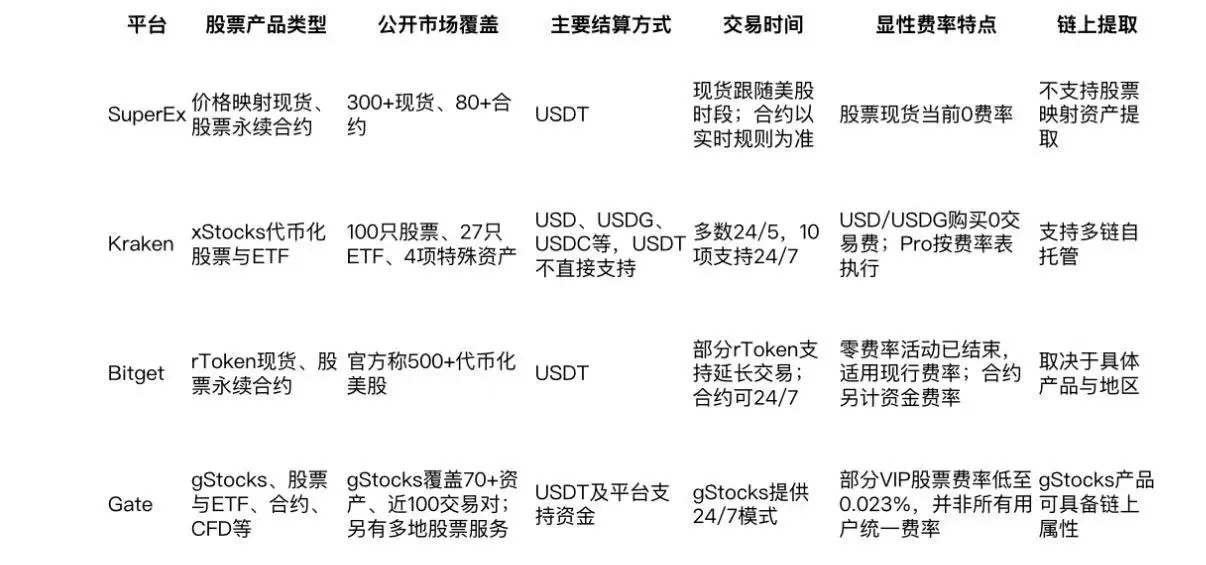 The quantities, fees, and functions in the table may change, and the final reference should be the real-time page.
Kraken: Greater Transparency of Underlying Assets and On-Chain Self-Custody
Kraken's xStocks belong to on-chain tokenized stock products.
According to Kraken's official FAQ, as of this verification, xStocks cover a total of 131 assets:
100 stocks;
27 ETFs;
4 special assets.
Most products support 24/5 trading on Kraken Pro, with 10 major products supporting 24/7 trading; after withdrawal to compatible wallets, users can also trade through on-chain protocols.
Security and Underlying Asset Structure
Information disclosed by Kraken includes:
xStocks are backed 1:1 by underlying stocks;
Underlying shares are custodied by Alpaca Securities;
InCore Bank serves as a secondary custodian;
Weekly on-chain reserve proofs are published;
Quarterly ISAE 3000 assurance is conducted;
Designed through special purpose entities to reduce issuer bankruptcy risks.
From the perspective of "asset support and audit disclosure of the stock products themselves," Kraken is the platform with the most complete information in this comparison.
However, this does not mean there are no risks. Users still bear:
Issuer risks;
Custodian risks;
Smart contract risks;
On-chain network risks;
Market liquidity risks;
Legal and regional policy change risks.
Fees and Funding Pathways
Kraken's official information shows:
No trading fees when purchasing xStocks using USD or USDG;
Corresponding fees apply when using other assets through the instant buy feature;
Kraken Pro executes according to the trading fee schedule, with public starting rates related to order types and trading volumes;
USDT cannot be directly used for purchases and must first be converted to USDC, USD, or other supported assets;
Minimum investment can be as low as 1 dollar;
Supports fractional shares.
Therefore, Kraken's "0 fee rate" has clear conditions for payment assets. Users holding USDT also need to calculate conversion costs and price differences.
Product Features
Kraken xStocks support:
Multi-chain withdrawals;
Self-custody;
DeFi collateral;
Lending;
Liquidity provision;
Economic dividend rights reflected through balance adjustment mechanisms.
It is important to note that xStocks do not equate to actual company shares. Users do not have traditional shareholder voting rights and cannot transfer them to traditional brokerage accounts.
Who is it suitable for?
Users who value product-level reserve disclosures;
Users who wish to self-custody stock tokens on-chain;
Users needing fractional shares and lower minimum investment amounts;
Users who want to use stock tokens in DeFi;
Users who can accept the USDT conversion step.
Major Limitations
USDT cannot be purchased directly;
Not available in regions such as the United States, United Kingdom, Canada, Australia, etc.;
Does not represent traditional stock ownership;
After-hours and weekend prices may use model valuations, and price differences may widen;
The number of products is less than the stock spot coverage publicly disclosed by SuperEx and Bitget.
SuperEx: Lower Fees and a More Direct Combination of "Stock Spot + Stock Perpetual Contracts"
Overall, the SuperEx Stock section is the most comprehensive for newcomers; this does not mean it is the highest, but rather that it is suitable in all aspects, making it the most comprehensive.
As of data released in September 2026, the SuperEx Stock section has expanded from the initial 90+ stock mapping trading pairs to:
300+ stock spot trading pairs;
80+ stock perpetual contract trading pairs.
Market coverage includes large technology, AI, semiconductors, new energy, finance, consumer, healthcare, and popular growth companies. Users can trade directly using USDT without needing to exchange for USD first or repeatedly transfer between crypto accounts and traditional brokers.
Fees and Trading Rules
According to SuperEx's official stock FAQ:
The current trading fee rate for stock spots is 0%;
Buy and sell quantities follow whole share rules;
Stock mapping assets do not support deposits and withdrawals;
Stock spots are not traded 24/7;
Trading hours follow the U.S. market and adjust according to daylight saving time, standard time, and holidays;
Mapping trades do not provide shareholder voting rights or traditional shareholder rights.
The 0% fee rate is a clear advantage of SuperEx, especially suitable for users with high trading frequency who do not want fees to continuously erode their profits.
However, a 0% fee does not mean zero cost. Users still need to consider:
Buy-sell price differences;
Slippage;
Order book depth;
Stock perpetual contract funding rates;
Opening gaps;
The price of USDT itself and custody risks.
Market Coverage Advantages
SuperEx's characteristic is not having the most stock spot quantity, but rather a relatively balanced coverage of spots and contracts:
Spots are used to establish medium to long-term price exposure;
Contracts are used for going long, going short, and risk hedging;
USDT serves as a unified settlement unit;
Stocks and crypto assets can be managed within the same account system.
Compared to platforms with only tokenized stock spots, the 80+ stock perpetual contracts provide active traders with a more complete strategic space.
How should security and transparency be viewed?
SuperEx stock spots belong to price mapping products, allowing for on-chain redemption. Therefore, when assessing security, users should focus on:
USDT fund custody;
Price index and abnormal price handling;
Order book liquidity;
Extreme market handling rules;
Platform operation and counterparty risks.
In the publicly available information reviewed this time, no weekly reserve proofs or independent assurance pages similar to Kraken xStocks were found. For large users, this should be included in due diligence and should not be replaced by "0 fees" or the number of trading pairs.
Who is SuperEx suitable for?
Users who want to trade stock prices directly using USDT;
Users who value 0 trading fees for stock spots;
Users who wish to use both spot and stock perpetual contracts;
Users familiar with crypto trading interfaces who do not need to extract stock products on-chain;
Active traders needing more stock perpetual contract options.
Major Limitations
Stock mapping products do not represent real shares;
Do not support deposits and withdrawals of stock mapping assets;
Whole share trading is less flexible than fractional shares on some tokenized platforms;
Stock spot trading is subject to U.S. market hours;
Disclosure of underlying assets and independent audits for stock products can still be further enhanced.
Bitget: The Broadest Spot Coverage, More Complex Derivatives and Ecosystem Functions
Bitget currently offers:
rToken stock spots issued by Reality;
Stock perpetual contracts;
Stock copy trading;
Unified trading account collateral;
Grid and automation tools;
Some stock token-related financial or structured products.
Its official information states that the stock spot section has launched 500+ tokenized U.S. stocks and uses a 1:1 real stock support mechanism.
In terms of the sheer number of publicly available stock spots, Bitget is the platform with the broadest coverage in this comparison.
Fees
Bitget previously offered limited-time zero fees for stock tokens, but this promotion ended on July 13, 2026. Thereafter, real-time stock trading fees will apply.
Bitget's publicly disclosed basic fee information includes:
The standard spot base fee rate is usually 0.1% maker and 0.1% taker;
Using BGB may provide discounts;
Contract base fees are calculated separately;
Stock perpetual contracts also involve funding rates;
rToken may be subject to a separate stock spot fee group.
Therefore, users cannot continue to reference the now-ended "zero fees for stocks" promotion, nor can they assume that all stock products use the same fee rate.
Stock Perpetual Contracts
Bitget stock perpetual contracts:
Use USDT for margin and settlement;
Support long and short trading;
Some products support up to 100x leverage;
Not all trading pairs offer the same leverage;
Provide 24/7 trading;
Involve funding rates and liquidation risks.
Higher leverage is not purely an advantage. It reduces margin usage while shortening the distance to liquidation. Ordinary users should calculate risks based on nominal positions and maximum losses, rather than just looking at the margin amount.
Platform-Level Security Disclosure
Bitget releases reserve proofs monthly. Its snapshot on September 29, 2026, shows an overall reserve ratio of 131% and maintains an independent protection fund.
However, platform-level reserve proofs should not be confused with the 1:1 support mechanism of the underlying stocks of rToken. Users should verify separately:
- The issuance and custody arrangements of Reality;
- The redemption rules for rToken;
- The handling of dividends and corporate actions;
- The conditions for on-chain withdrawals;
- The regional availability of products.
Suitable Users
- Users who wish to have the most stock spot options;
- Users who need stock spot, contracts, copy trading, and automation tools;
- Users familiar with unified accounts and advanced derivatives;
- Users who wish to use fractional shares and tokenized products;
- Users who can distinguish different stock product rates and rules.
Main Limitations
- A wide range of products can confuse beginners regarding rToken, Stock+, perpetual contracts, and other products;
- 500+ products do not mean every trading pair has the same depth;
- The zero-fee promotion has ended;
- High leverage significantly increases the risk of liquidation;
- Support status during weekends and extended hours may change; real-time announcements should be checked;
- Regional restrictions and product qualifications vary by jurisdiction.
Gate: Global Market Coverage is Broad, but Product Entry Points Need Clarification
Gate's stock ecosystem does not consist of just one product but includes:
- Gate Stocks;
- gStocks tokenized stocks;
- U.S. stocks and ETFs;
- Hong Kong stocks;
- South Korean stocks;
- Perpetual contracts for stocks;
- CFDs;
- Pre-IPO and IPO Access.
This product structure is suitable for users who wish to access more traditional financial markets on one platform, but it can also lead to confusion: users may not know whether they are buying traditional stocks, tokenized stocks, or derivatives.
gStocks Coverage and Fees
Gate's public information shows:
- gStocks covers 70+ tokenized stock assets;
- Nearly 100 related trading pairs are online;
- Supports USDT trading;
- Provides a 24/7 trading model;
- Covers technology, semiconductors, aerospace, consumer goods, healthcare, and major ETFs;
- The minimum participation amount can be relatively low.
Gate advertises that stock trading fees can be as low as 0.023%, but this is the minimum rate under specific VIP levels or account conditions and should not be understood as a uniform rate for all users and all stock products.
Ordinary users need to confirm separately before placing orders:
- Ordinary stock rates;
- gStocks rates;
- Contract maker and taker rates;
- CFD spreads and overnight costs;
- Withdrawal or cross-chain fees;
- Costs for handling corporate actions.
Security and Reserves
Gate's latest snapshot released on October 18, 2026, shows:
- Total reserves of approximately $8.688 billion;
- Overall reserve ratio of 118.49%.
Its reserve proof uses technologies such as Merkle Tree and zk-SNARK.
Similar to Bitget, this belongs to platform-level reserve information and does not mean that every gStock is automatically included in the same audit scope. Users also need to check the token issuer, underlying stock custody, and redemption documents.
Suitable Users
- Users who wish to access multiple stock markets such as the U.S., Hong Kong, and South Korea;
- Users who want to use stocks, ETFs, tokenized stocks, CFDs, and contracts simultaneously;
- Users with cross-market allocation experience;
- Users needing a unified account experience for traditional finance and crypto products;
- Users who can understand the legal attributes and fee structures of different products.
Main Limitations
- The product structure is complex;
- Ownership, dividends, trading times, and fees differ across different entry points;
- "Minimum 0.023%" is not a uniform fee for all users;
- 24/7 mainly applies to specific tokenized products, not all traditional stocks;
- New users must carefully confirm whether they are entering stocks, gStocks, CFDs, or contracts.
How to Compare Security: Reserve Ratio is Not the Only Answer
Many platforms display reserve ratios, protection funds, or custodians in their security introductions, but these indicators address different issues.
Platform Reserve Proof
Platform reserve proofs primarily answer:
Are the crypto assets publicly controlled by the exchange sufficient to cover the user balances included in the proof?
It cannot independently prove:
- The platform has no liabilities;
- All stock products are included in the audit scope;
- Stock token issuers will not default;
- Smart contracts have no vulnerabilities;
- There will definitely be sufficient liquidity in extreme market conditions.
Proof of Underlying Stock Assets
The product-level proof of stock tokens primarily answers:
Do the issued tokens correspond to underlying stocks or custodial assets?
Kraken provides relatively complete information in this regard, including custodians, weekly reserve proofs, and quarterly assurances. Bitget and Gate have also disclosed 1:1 support statements, but users still need to check specific issuers and product documents.
SuperEx uses an internal stock price mapping model, so the focus of evaluation is not on the on-chain stock token reserves but on counterparty risk, pricing mechanisms, trading rules, and the safety of USDT funds.
User Account Security
Regardless of which platform is chosen, users should check:
- Whether a separate and complex password is enabled;
- Whether two-factor authentication is turned on;
- Whether a phishing code is set;
- Whether a withdrawal address whitelist is enabled;
- Whether there are unfamiliar login devices;
- Whether the API restricts withdrawal permissions;
- Whether the official domain is correct;
- Whether order and deposit records are saved;
- Whether all funds are kept long-term on a single platform.
A truly secure comparison must cover all three levels: platform, product, and user account.
How to Compare Fees: Don't Just Look at "Zero Fees"
The complete cost of a stock trade may include:
- Maker or taker fees;
- Bid-ask spreads;
- Market order slippage;
- Conversion costs between USDT, USDC, and USD;
- Deposit and withdrawal fees;
- On-chain gas;
- Contract funding rates;
- CFD overnight fees;
- After-hours trading spreads;
- Corporate action handling methods.
For example:
SuperEx currently has a 0 fee for stock spots, but there are still spreads and slippage; Kraken offers 0 trading fees when purchasing with USD or USDG, but USDT users need to convert first; Bitget's zero-fee stock promotion has ended; Gate's 0.023% is the minimum rate under specific conditions; Even if the maker rate for perpetual contracts is low, long-term holdings may still incur funding rates.
The best way to compare is to calculate the total round-trip trading cost based on your trading habits:
Total Cost = Buying Cost + Holding Cost + Selling Cost + Funding Conversion Cost
For high-frequency users, fees are important; for long-term users, spreads, custody structures, and corporate action handling may be more important; for contract users, funding rates and liquidation risks may far exceed fees.
Final Choice: Which One is More Suitable for You?
Choose SuperEx if you value:
- Direct use of USDT;
- 300+ stock spots and 80+ perpetual contracts;
- Current 0 trading fee for stock spots;
- A simple, familiar crypto trading interface;
- Using stock spots and perpetual contracts on the same platform;
- Not needing to withdraw stock products to an on-chain wallet.
Choose Kraken if you value:
- 1:1 underlying asset support;
- Product-level reserves and audit disclosures;
- On-chain withdrawals and self-custody;
- Fractional shares and low minimum investment amounts;
- DeFi usability;
- Willingness to use USD, USDG, or USDC instead of directly using USDT.
Choose Bitget if you value:
- 500+ stock spot products;
- Perpetual contracts with higher leverage;
- Copy trading, grid, and automated trading;
- Unified accounts and multiple collateral uses;
- Ability to understand complex product systems and different rates.
Choose Gate if you value:
- Multiple markets such as the U.S., Hong Kong, and South Korea;
- Stocks, ETFs, gStocks, CFDs, and IPO services;
- 24/7 trading of tokenized stocks;
- A more complete ecosystem of traditional financial products;
- Ability to manage different entry points and fee structures separately.
Use traditional brokers if you truly need:
- Legal ownership of company shares;
- Shareholder voting rights;
- Traditional cash dividends;
- Investor protection systems;
- Transfer of stocks between different brokers;
- Standard securities tax documents.
This is very important: If a user's core goal is to become a long-term shareholder in a company, then the mapped products, tokenized stocks, and perpetual contracts in crypto exchanges cannot be automatically regarded as a complete substitute for traditional broker accounts.
Conclusion
When choosing a crypto exchange that supports stock trading pairs, one should not only compare who has more trading pairs or who advertises zero fees.
Users should at least compare simultaneously:
- What the products actually are;
- Whether they are supported by underlying stocks;
- Whether on-chain withdrawals are possible;
- Whether they receive dividend economic rights;
- Coverage of spots and contracts;
- Complete trading costs;
- Platform reserves and product-level audits;
- Order book depth;
- Trading hours;
- Regional and identity restrictions.
Among the four platforms, SuperEx, with 300+ stock spots, 80+ perpetual contracts, direct settlement in USDT, and current 0 fee for spots, forms a relatively clear "low-cost spot allocation + contract strategy" combination, especially suitable for users who are already familiar with crypto trading and wish to expand stock price exposure in the same account.
Kraken is stronger in asset support and self-custody transparency; Bitget is richer in the number of stock spots and advanced trading tools; Gate offers a broader entry into global traditional financial products.
A truly professional choice is not about finding a platform that ranks first in all indicators but about finding the platform whose product structure best matches one's needs.
Disclaimer
This article is compiled based on publicly available information from each platform as of October 22, 2026, and is intended for information comparison and product education only. It does not constitute a security guarantee, rating, investment advice, or trading recommendation for any platform. Platforms may adjust trading pairs, fees, leverage, reserve disclosures, trading times, identity requirements, and regional availability at any time.
Tokenized stocks, stock mapping products, CFDs, and perpetual contracts do not equal traditional stock ownership and may involve issuer, platform, custody, smart contract, liquidity, leverage, and regulatory risks. Users should read real-time product rules, fee schedules, risk disclosures, and service agreements before trading and make independent judgments based on their circumstances.

 Risk warning

Popular articles