True or False Cryptocurrency Market Makers: What Kind of Market Making Has Legitimacy?
 Core Viewpoint


 Understand the regulatory gaps behind cryptocurrency market makers. The author starts from the primary responsibilities of market makers (providing two-way quotes and liquidity), distinguishing between genuine market making and volume manipulation under the guise of market making. The article outlines the differences between cryptocurrency market makers and traditional market makers in terms of access, contracting parties, and trading scenarios, and points out five major shortcomings in the industry and the shift in regulation.
Author: Ekko An, Ryan Yoon
Compiled by: Chopper, Foresight News
Anyone who has traded in the cryptocurrency market will recognize a familiar pattern: after a token is launched, its price quickly rises, followed by a rapid decline, with trading volume evaporating almost overnight. Crypto investors often attribute this extreme volatility to market makers.
This negative perception has been created by a group of institutions that engage in price manipulation under the guise of being market makers. Influenced by such institutions, in the crypto industry, "market makers" have slowly become synonymous with manipulation teams, and investors worldwide have suffered losses due to these operations. The FBI has prosecuted several institutions providing "manipulation services"; in South Korea, some teams have inflated trading volumes under the pretense of providing liquidity, and the responsible individuals have been sentenced. However, these belong to illegal operators who charge fees and dump tokens, not true market makers fulfilling the function of providing liquidity.
Due to the lack of clear qualification requirements, anyone can claim to be a market maker, which has dragged down the credibility of the entire industry. Such manipulative behavior destroys market trust and has nothing to do with the original role of market makers in providing liquidity.
Why the Market Needs Market Makers
Market makers are core market participants who continuously provide buy and sell quotes, ensuring liquidity and facilitating normal trading. To understand the value of market makers, one must first understand their work. In South Korea, the terms "liquidity provider (LP)" and "market maker" are often used interchangeably.
Broadly speaking, liquidity provision is not limited to specific qualified institutions. Any order that does not execute immediately and waits on the order book for a counterparty is called a passive order, which essentially provides a trading counterpart to other traders. Therefore, as long as passive orders are placed, it can be broadly considered as providing liquidity. High-frequency trading firms like Jump Trading, which fill the order book with their own capital, fall into this category.
Just like currency exchange counters at airports ensure that travelers can exchange money at any time, markets with market makers allow buyers and sellers to transact without waiting for each other. Both investors and token issuers can benefit from this.
What Investors Gain: Lower Trading Costs
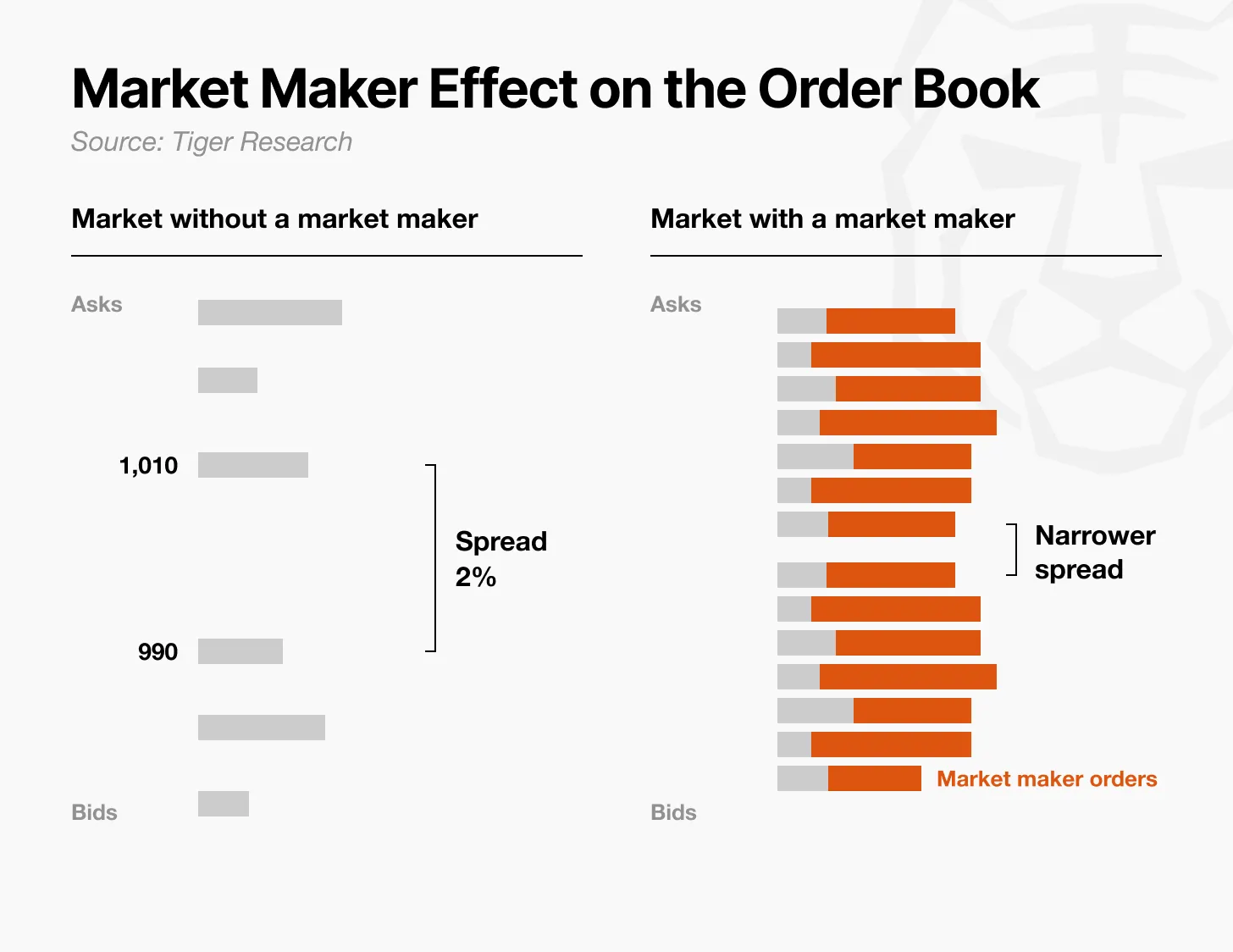
Impact of Market Makers on the Order Book
Transaction fees are not the only factor determining an investor's actual profit and loss; hidden costs have a greater impact: whether orders can be executed immediately at the expected price, whether large orders cause price fluctuations, and whether there are significant price differences between different centralized exchanges. The work of market makers is to solve these three problems: placing dense orders on both the buy and sell sides, acting as a counterparty when there are no counterparties, and smoothing out price differences between different exchanges. As a result, investors can trade as needed, with lower trading costs, and obtain similar prices across platforms.
- Lower trading costs: narrower bid-ask spreads, reduced slippage from large orders
- Ability to trade anytime: there is always a counterparty available
- Reduced cross-exchange price differences: quoting on multiple exchanges simultaneously, relying on arbitrage to smooth out price differences
First, trading costs will decrease. The spread between the buy and sell prices is itself a cost. For example, if your current buy price is 1010 Korean Won and the sell price is 990 Korean Won, if you buy and immediately sell, you incur a direct loss of 2%. The larger the order size, the greater the loss. Once the optimal liquidity is consumed, orders will continue to consume the next price level, continuously raising the buying cost. After market makers place dense orders, the spread narrows, and the order volume at each price level increases, reducing slippage losses for each trade.
Second, investors can buy and sell at any time. In trading, the ability to open and close positions at desired times is crucial. For tokens with poor liquidity, sellers must wait for buyers to appear, during which time prices may continue to move unfavorably. Under normal market conditions, market makers will continuously place orders and act as counterparties. Even in a quiet market, sellers can transact immediately, and buyers do not have to wait long.
What Token Issuers Gain
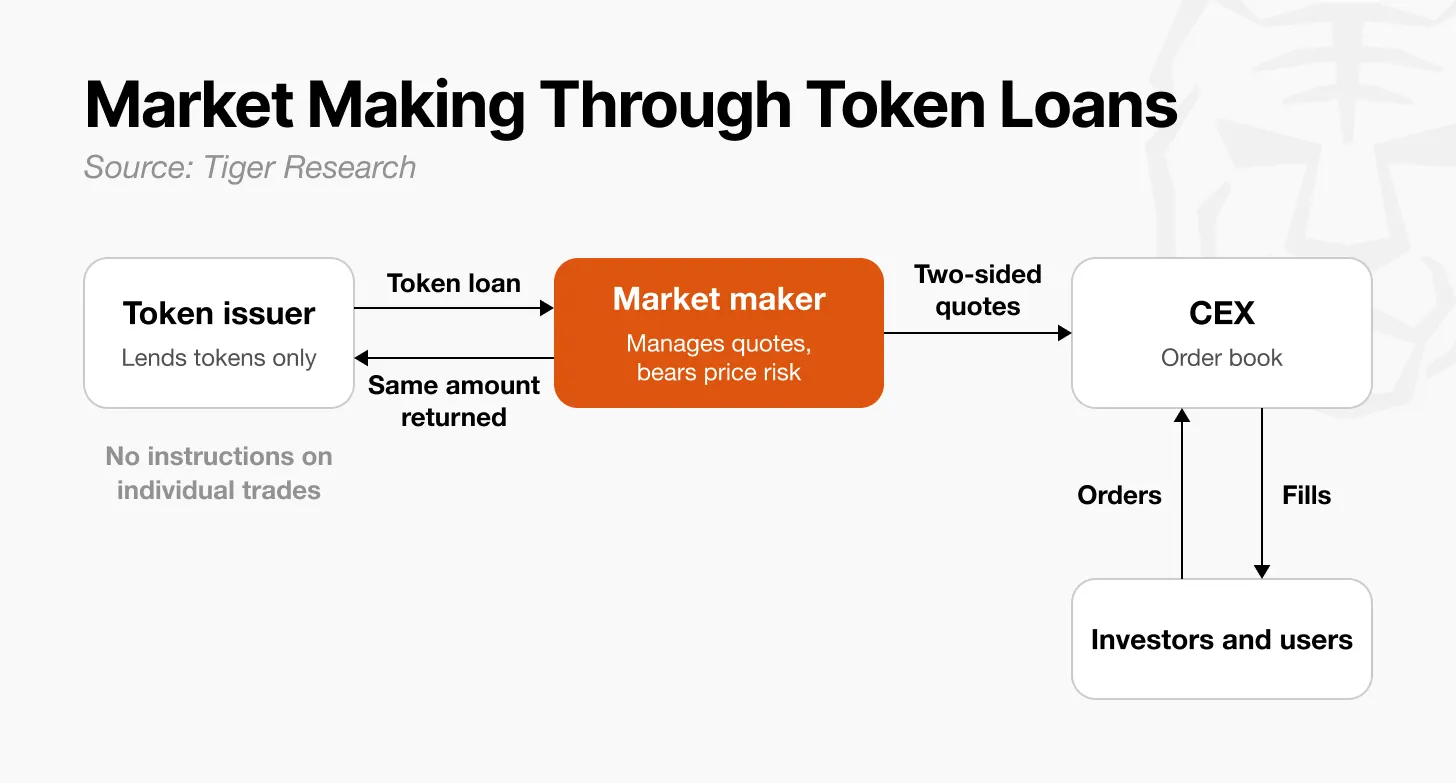
Conducting Market Making through Token Lending
The launch of a token is not the end but the beginning. After a token is launched, it needs to trade continuously so that users and investors can enter and exit freely, allowing for fair pricing of the token. Market makers maintain the trading landscape for issuers, who can reap two benefits:
- Smoother trading: small orders are less likely to trigger extreme market fluctuations
- Avoiding price manipulation suspicions: independent third-party market makers are responsible for quoting, while issuers only lend tokens
First, issuers have a market with stable trading. After a token is launched, it is re-priced daily by the market: users buy tokens to use products, and investors buy and sell tokens based on project prospects. Only when participants can enter and exit smoothly can the token price be fair. For tokens with thin liquidity, even a small order can cause significant price swings. Such high volatility amplifies uncertainty, damaging the reputation of the project regardless of its fundamentals.
Second, it avoids suspicion of price manipulation. If a token issuer directly buys and sells its own tokens, it can easily be suspected of manipulating the market. Therefore, related transactions are entrusted to independent market makers, and the issuer only lends tokens. A compliant delegation contract typically includes clauses prohibiting price manipulation.
In simple terms, investors can trade as needed with lower trading costs; token issuers can create a trading environment where tokens circulate smoothly. The spread earned by market makers is essentially a service fee paid by traders for immediate execution. As industry competition compresses this profit, the liquidity dividend will ultimately benefit all market participants.
Differences Between Crypto Market Makers and Traditional Financial Market Makers
The business of crypto market makers is fundamentally no different from that of traditional financial market makers; the difference lies in the market environment and applicable regulatory rules. Market makers in the stock market sign formal contracts with exchanges and operate under a mature regulatory framework. In contrast, the crypto market currently lacks a set of rules governing the delegation contracts between market makers, centralized exchanges, and token issuers.
Access Entities: Licensed Institutions and Institutions Without Contract Requirements
In traditional finance, market making is a legally defined business. Financial institutions sign formal contracts with exchanges after passing audits and continuously quote prices as agreed to receive fee reductions. Exchanges publicly disclose which institutions are responsible for market making for which stocks, and long-established laws and precedents clearly define what constitutes compliant market making.
The crypto market is entirely different. Market makers perform the same functions but operate with almost no institutional regulations governing how market makers sign formal contracts with centralized exchanges, what obligations both parties have, and what compensation they can receive. There are two core differences: First, the absence of contract rules. There is no standard definition of what constitutes compliant market making, which institutions can undertake delegated market making from exchanges, and how corresponding obligations and benefits are set. Second, the unique structural risks of the crypto market. Centralized exchanges engage in market making themselves, and market makers sign undisclosed private contracts with issuers; such distorted arrangements are very common. Regulatory agencies currently prioritize addressing explicit risks rather than building a complete framework, such as prohibiting exchanges from self-market making and requiring the disclosure of undisclosed contracts.
The South Korean market faces the same issue; regulations strictly prohibit centralized exchanges from self-market making, but there is still no unified standard or formal process to determine whether a market making operation is compliant.
It is important to clarify a misconception: the regulatory gap pertains to formal delegation contracts signed with exchanges/brokerages, and such contracts require licenses. Simply using one's own funds to place orders for trading, regardless of whether a license is held, is a legal activity. The EU MiCA rules are similar: market making with one's own funds at an exchange does not require a license; only when providing market making services to clients does it require qualifications.
Contracting Parties: Exchanges, Centralized Exchanges, and Token Issuers
The most intuitive difference between crypto market making and traditional finance is that contracts for market making by token issuers are very common. Among them, the "no-contract self-trading model" is different in nature: market makers do not sign contracts with anyone, do not charge service fees, and only trade using their own funds according to their strategies, with liquidity being a byproduct of trading. This is what was previously referred to as broad liquidity provision, which is a legal business and does not involve licensing requirements. The token lending model is similar: as long as market makers independently decide to trade and bear price risks, and issuers do not directly intervene in trading, it is essentially consistent with self-trading.
Risks are concentrated in a type of delegated contract from issuers that uses trading volume as a performance metric. Industry practitioners indicate that these contracts differ from those initiated by exchanges in terms of funding sources and risk-bearing entities, with terms varying widely, from spread settings to trading strategies for listing and unlocking windows. However, contracts that focus on volume as the core performance target easily lead to wash trading and false transactions; moreover, the content of the contracts is not disclosed externally, which is a major pain point in the industry.
Trading Scenarios: Single Market vs. Distributed Market
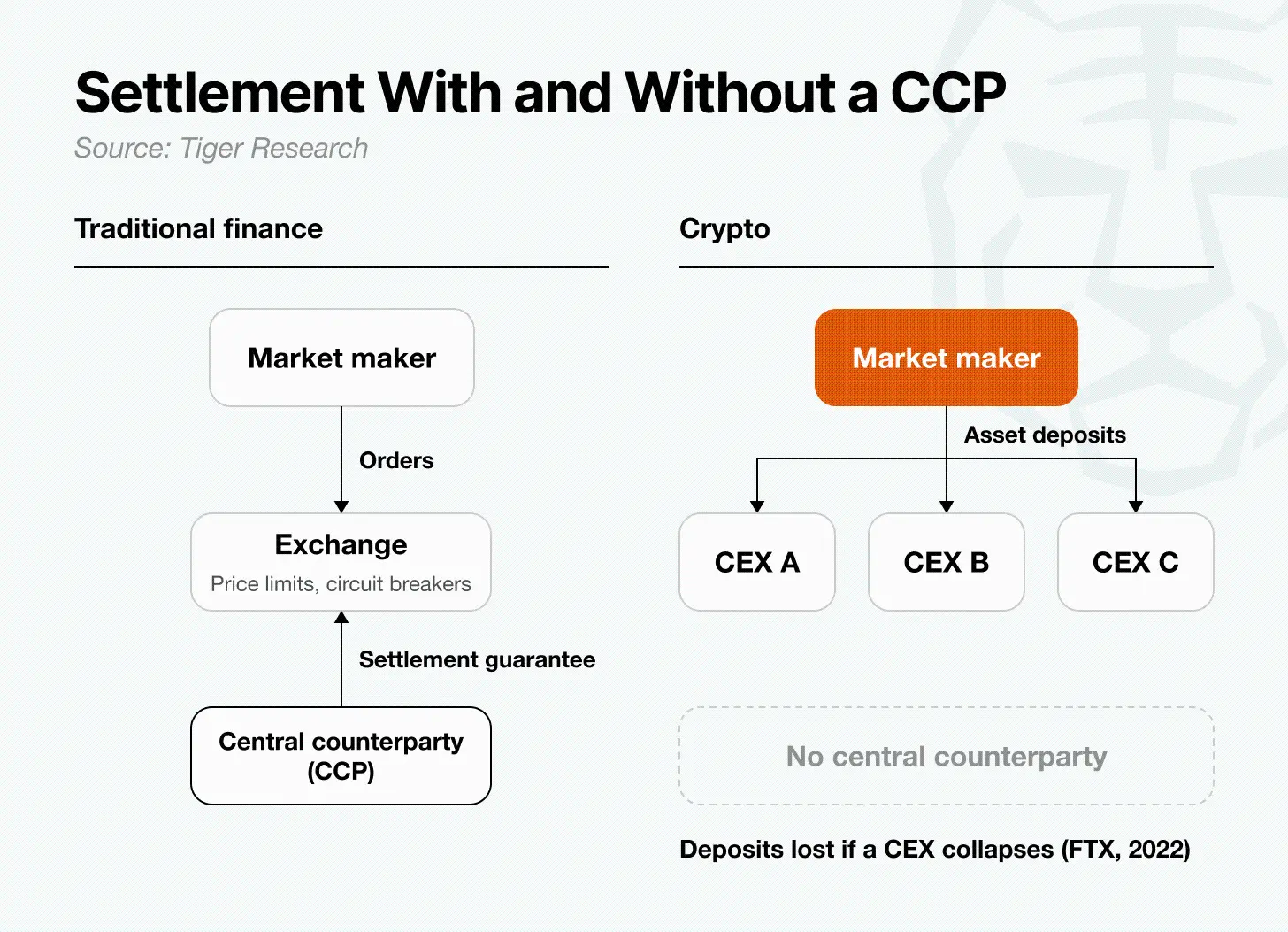
Comparison of Settlement Mechanisms with and without a Central Counterparty
Stocks are traded within a single exchange and fixed time periods, where exchanges and clearing institutions prevent anomalies and manage settlement risks. The crypto market operates 24/7 across multiple centralized exchanges globally, lacking this protective mechanism, which brings many risks to market makers.
First, the crypto market operates 24/7 and is distributed across multiple exchanges, making it easy to have cross-platform price differences. Market makers need to spread their assets across various exchanges to smooth out these differences; if network issues such as deposit and withdrawal suspensions occur, this arbitrage mechanism will come to a halt. Second, there are limited risk hedging tools. The market lacks protective mechanisms like circuit breakers, and high-leverage futures trading is prevalent, forcing market makers to rely on futures positions to hedge spot position risks. The October 2025 incident involving approximately $19 billion in liquidations is a typical case: when an exchange's automatic liquidation mechanism is triggered, even compliant hedged positions of market makers can be forcibly liquidated. Without hedging protection, market makers can only urgently cancel orders, leading to further market instability.
The fundamental issue is the lack of a central counterparty settlement mechanism. In the traditional financial system, trading and settlement are guaranteed; crypto market makers must directly deposit assets into various exchanges to trade. Once an exchange collapses, as seen in the 2022 FTX incident, assets held by market makers on the platform may face total loss, making recovery difficult.
Current Shortcomings in the Market Maker Industry
The market making mechanism is the foundation of smooth trading. However, without constraints, rampant pseudo-market making activities can severely disrupt market stability. We need to accurately identify the structural issues in the crypto market and seek feasible solutions. Below are five major shortcomings, which do not indicate flaws in market making itself, but rather a lack of clear standards and monitoring systems that cannot distinguish between compliant liquidity provision and illegal price manipulation. The crypto market making industry urgently needs a set of clear standards.
Normal risk control operations can easily be misjudged as market manipulation.
To outsiders, routine risk control operations by market makers can easily be seen as disrupting the market or manipulating prices. Industry practitioners have summarized four types of risk control behaviors that are most likely to be misunderstood. Even in mature regulatory markets, if compliance boundaries are not predefined, such misunderstandings will still occur.
The South Korean stock market is a typical case. In 2021, the Financial Supervisory Service of South Korea determined that the frequent withdrawal and modification of quotes by nine brokerage firms constituted market disruption, issuing fines totaling 48.7 billion won (approximately 35 million USD), leading to a direct halt in market-making activities. A year later, in July 2022, the Securities and Futures Commission of South Korea overturned this conclusion: frequent price modifications and withdrawals are necessary operations for fulfilling obligations and managing risks; the withdrawal ratio of these institutions (95.68%--99.55%) is close to that of the New York Stock Exchange (about 94.6%), and there were no clear pre-established criteria, thus the related operations were not illegal. However, during the investigation period, the market lacked market makers for a whole year.
The cryptocurrency market lacks clear standards; for the same trading behavior, the prosecution may claim manipulation, while the defense may argue it provides liquidity. Even compliant market makers cannot predict whether their trades will be deemed illegal, leading some institutions to exit the market directly.
The solution is to predefine compliance standards. The core judgment should be the trading intent, rather than merely looking at the frequency of withdrawals. This aligns with the regulatory approach in the United States: only extreme quotes are prohibited. Industry practitioners generally adopt the following judgment criteria:
- Whether operations are within the pre-agreed contracts and internal risk control rules
- Whether the operations genuinely reduce the market maker's own price risk
- Whether there are bid and ask quotes simultaneously, with no one-sided price pushing goal
For example, during significant market fluctuations, a market maker may sell spot and simultaneously buy an equivalent amount of futures, which may appear as a reckless sell-off to outsiders, but essentially serves to hedge overall position risk and is considered normal risk control. Conversely, spreading negative news while simultaneously selling large amounts of spot without hedging does not constitute risk control.
Regulatory agencies and exchanges should publicly announce this set of standards, allowing compliant liquidity service providers to operate with peace of mind, while illegal manipulation becomes easier to identify. The troubles caused by the lack of standards extend beyond this: compliant institutions are suspected, while it also facilitates ill-intentioned institutions to impersonate market makers.
Volume Manipulation Institutions Impersonating Market Makers
The previous section discussed the misjudgment of compliant market makers, but the reverse issue also exists: many institutions that are not market makers claim to be market makers. Most "market maker scandals" in the market are caused by these third-party institutions masquerading as market makers.
Gotbit is a representative case. Information from U.S. prosecutors shows that between 2018 and 2024, Gotbit sold volume manipulation services, using multiple accounts to create false trading volumes through wash trading, aiming to inflate project token market value rankings and help projects list on top exchanges. The founder of the institution pleaded guilty and was sentenced to 8 months in prison, with the company fined and forfeited approximately 23 million USD worth of cryptocurrency assets.
Some market makers have noticed that the business model of such institutions is to create false trading volumes, without bearing any price risk themselves. In a volume-centric evaluation system, their data may even appear very attractive.
Therefore, the metrics for evaluating market makers need to shift from "trading volume" to real executable depth; trading volume can be easily fabricated through wash trading. True market makers only consider trading volume as a byproduct, focusing instead on:
- How deep the order book is within a 1%--2% range of the current price
- How much price slippage a fixed-size order would cause
- The proportion of time that both buy and sell quotes are online simultaneously
Even with high trading volumes, if the order book is thin and small orders can significantly move prices, there is no real liquidity. The core judgment standard is whether external traders can execute their desired scale at a fair price. Exchanges and project parties use this set of metrics to filter out institutions that aim solely for manipulation.
For institutions that undertake market-making services on behalf of exchanges or issuers, registration or licensing can be required. Setting thresholds during the contracting phase can filter out institutions like Gotbit that charge service fees for manipulation. Participants engaging in self-proprietary trading with their own funds do not need to be included in licensing management. Consistent with previous discussions, the EU MiCA also follows this logic: proprietary trading at exchanges does not require a license, while providing services to clients does require qualifications.
Hidden Contract Parties and Conflict of Interest Arrangements
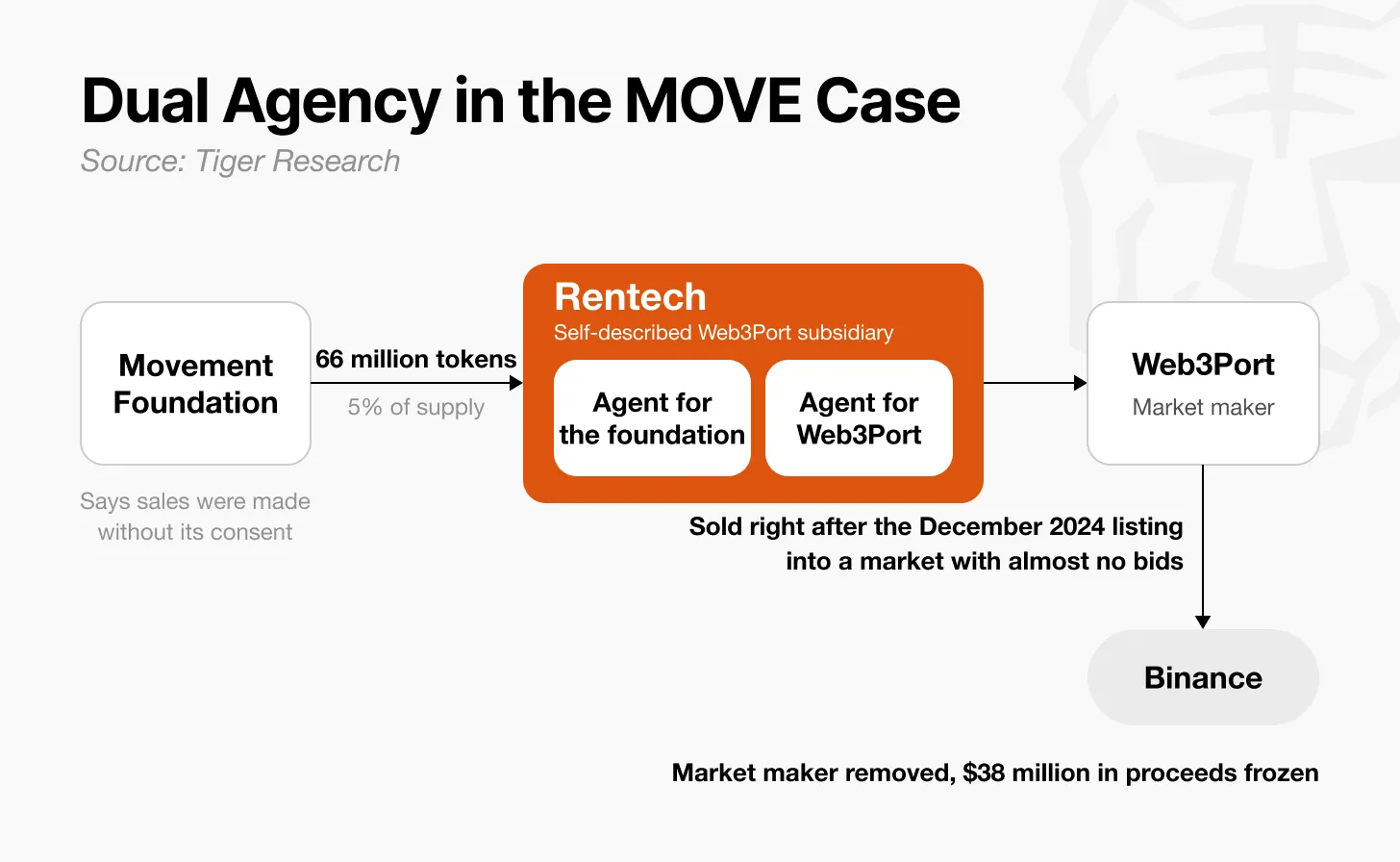
Dual Agency in the MOVE Case
Even if a reliable institution is selected, if the contractual relationships are not transparent, serious problems can still arise. In the cryptocurrency market, the contracts between token issuers and market makers are often not disclosed to the public. When the counterparty is hidden, it is easy for the same institution to simultaneously act as agents for both sides of a transaction, creating a distorted structure.
The MOVE incident is a typical example. The Movement Foundation entrusted 66 million tokens (5% of total supply) to the intermediary Rentech (self-identified as a subsidiary of Web3Port) to provide liquidity. It was later revealed that Rentech, in the same contract, acted as both the foundation's agent and the Web3Port agent, effectively representing both sides of the transaction.
This batch of tokens was directly sold into the market when it launched in December 2024, with almost no buy orders. Binance delisted this market maker and froze 38 million USD of related profits, and Coinbase subsequently suspended MOVE trading. The foundation stated that this sale was not conducted with its consent. The contract was nominally a liquidity service agreement, but in reality, there were no bid and ask quotes; it was merely a unilateral sale of the issuer's tokens.
Therefore, the premise of compliant market making is fair contract terms and transparent signing relationships. In terms of the substance of the contract, compliant market-making agreements have two core principles: market makers bear real price risks themselves, and token issuers do not interfere with price direction.
In a token lending model, market makers place bid and ask orders using borrowed tokens along with their own funds. After the contract expires, they only need to return an equivalent amount of tokens, without receiving instructions to influence prices in any direction. A standardized contract must specify:
- Prohibition of wash trading
- Prohibition of one-sided price pushing
- Maximum bid-ask spread
- Minimum order size
The same applies to options models; as long as market makers independently decide daily quotes, and issuers only stipulate option terms without interfering in individual transactions, it complies with the principles.
The second requirement is contract transparency. At a minimum, exchanges and regulatory agencies should be able to verify which institutions are making markets, the scale of tokens, contract terms, and whether intermediaries are simultaneously representing both parties. Since March 2026, Binance has required project parties to submit this type of information. Furthermore, just as stock exchanges publicly disclose stock market makers, investors should also have the right to know which market-making institutions correspond to a particular token.
Exchanges and Market Makers as Related Entities
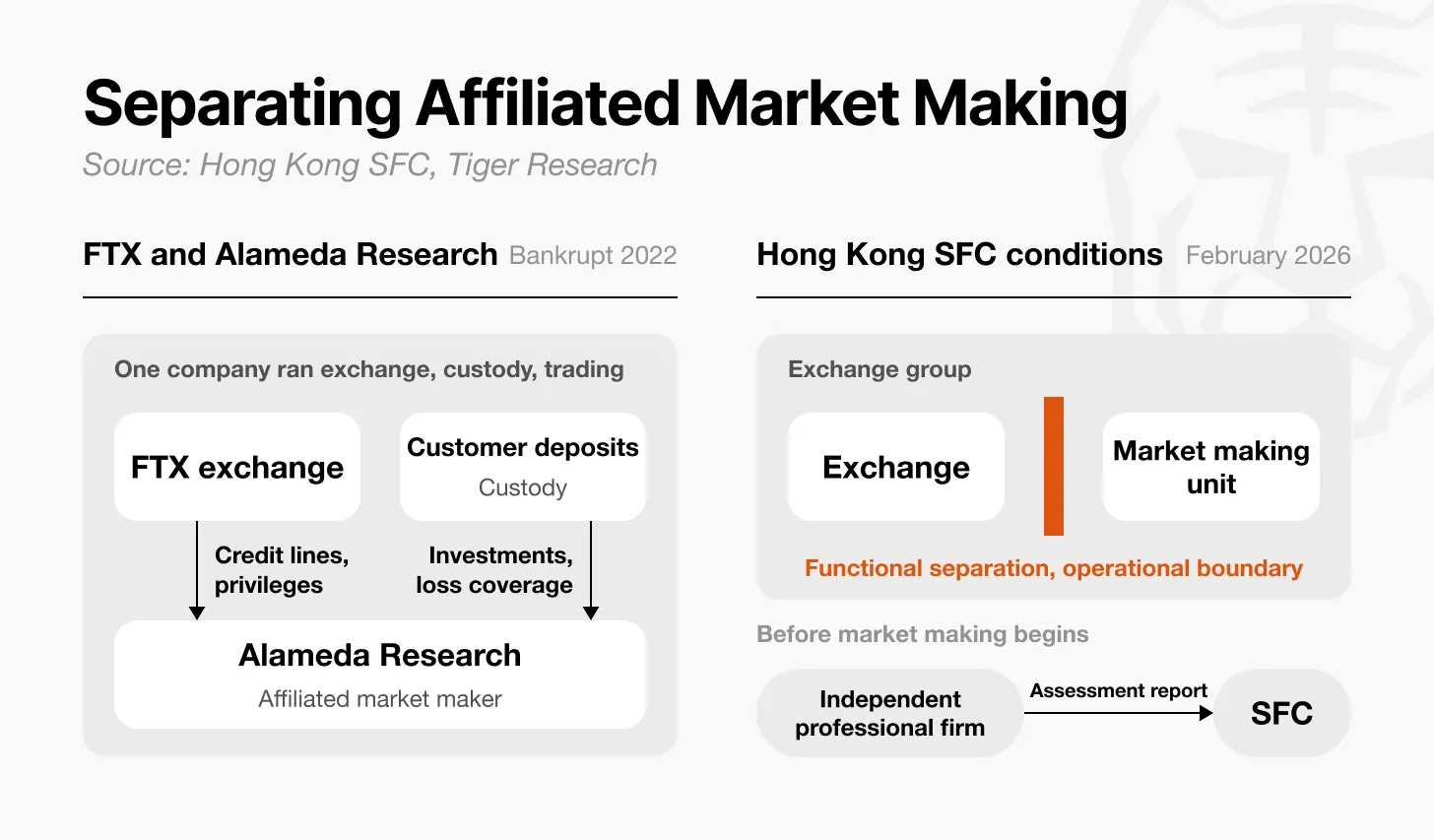
Isolating Related Market-Making Activities
If market makers are related entities of centralized exchanges, the risk of conflicts of interest significantly increases. A single company operating an exchange, custody, and proprietary trading can easily grant related market makers privileges that other users do not have.
FTX and Alameda Research are classic examples. Alameda was the core market maker for the FTX platform, receiving credit and privileges unavailable to other users. U.S. regulatory investigations determined that FTX user funds were diverted to Alameda for investments and to cover losses. Both institutions went bankrupt in 2022.
The issue lies not in the identity of market making itself, but in the lack of oversight over the granting of credit privileges and operational space, ultimately leading to the misappropriation of user assets. The solution is not to outright ban related market making, but to implement business isolation and continuous monitoring. The International Organization of Securities Commissions (IOSCO) identified such conflicts of interest as a key risk in its 2023 report, and Hong Kong subsequently implemented relevant regulatory rules. In February 2026, the Hong Kong Securities and Futures Commission (SFC) allowed related entities of exchanges to engage in market-making activities but set three hard conditions:
- Isolation of market-making business units from exchange functions
- Establishment of clear business boundaries between the two
- Submission of an evaluation report from an independent third-party professional institution to the regulatory agency before commencing market-making activities
This set of rules delineates boundaries and ensures continuous monitoring to avoid preferential treatment and insider information sharing. If South Korean centralized exchanges engage in market making through related companies in the future, they should also adhere to these principles from the outset.
No Mandatory Obligations During Crises, Market Makers Withdraw First
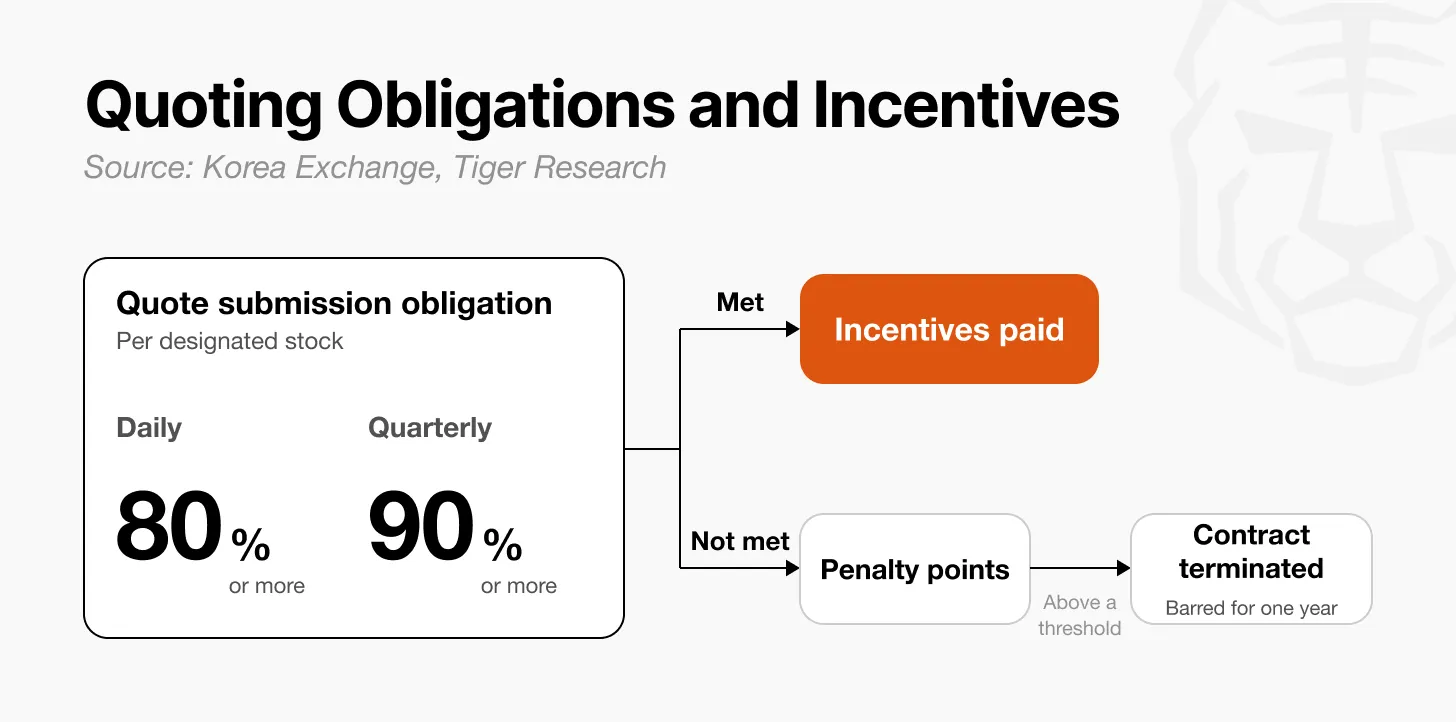
Quote Obligations and Incentive Mechanisms
The first four points are shortcomings under normal circumstances, while the last point is an issue that only arises during market crashes. The vast majority of cryptocurrency market makers have no mandatory performance obligations during downturns. When losses continue to expand, the rational choice is to withdraw quotes, leading to significant gaps in the order book and accelerating market collapse. The market situation mentioned on October 10, 2025, is typical: a large number of cryptocurrency assets fell by 40%--70% in a single day, and industry practitioners generally believe that the concentrated withdrawal of market makers was a key driver of the market's loss of control.
To avoid collective withdrawals during crises, it is necessary to establish clear performance obligations and accompanying incentive mechanisms. Institutions bound by enforceable contracts will behave very differently during a crisis. According to interviews with practitioners, there was a cryptocurrency that plummeted due to macroeconomic negative news; its market maker only widened the spread but did not withdraw quotes, thus maintaining uninterrupted trading. The difference comes from contractual obligations and risk control guidelines.
Traditional stock markets have already incorporated this mechanism into regulation. The Korea Exchange (KRX) requires market makers to maintain a quoting duration of no less than 80% for each individual security daily and no less than 90% quarterly; only those who meet the standards can receive incentives, while failing to meet the standards will result in point deductions, and reaching a threshold will directly terminate the mandate and prohibit market-making activities for one year.
There also needs to be a set of metrics to measure performance effectiveness. Industry practitioners assess the recovery situation after a shock not by looking at price rebounds, but by examining whether trading functionality has been restored:
- Whether the widened spread has narrowed again
- Whether the withdrawn orders have been replenished
- Whether the price differences between different exchanges have converged
- How long it takes to return to normal status
Using these metrics as performance assessment standards, along with accompanying incentives, market makers will be more motivated to maintain quotes during crises rather than exiting the market directly.
Shifting from Post-Hoc Punishment to Normalized Regulation
The market's distrust of market makers is not unfounded. However, as seen in the previous section, the root of the problem is not the act of market making itself, but rather that anyone can claim to be a market maker, and the industry lacks a definition of what constitutes "normal business."
Current South Korean laws still maintain this ambiguous state, and we need to clarify where the regulatory gaps truly lie: using proprietary funds to place orders, including trading with borrowed tokens, is legal in itself. Like other trades, if the behavior constitutes price manipulation, it will be punished; purely proprietary trading is not illegal. The gray area is concentrated in the business of entrusted contracts.
Current regulatory gaps in South Korea include:
- Lack of a compliant channel for signing formal entrusted market-making contracts with exchanges; the current "Virtual Asset User Protection Act" only prohibits price manipulation and does not provide exemptions for compliant market making. Contracts signed between exchanges and market makers with quoting obligations carry the risk of being deemed manipulative.
- Entrusted market makers lack a registration and licensing system.
- Corporate entities find it difficult to open accounts and participate in trading on won exchanges.
In other words, the regulatory framework in South Korea does not prohibit the provision of liquidity itself, but lacks a set of channels for delegated market-making activities to be formally commissioned and regulated. Contract-based market makers do not have a compliant regulatory path, and regulation can only punish after an incident occurs.
Major jurisdictions around the world are advancing similar rules: aligning unfair trading practices with traditional finance while formally recognizing compliant liquidity service providers in regulations.
European Union: MiCA will come into full effect on December 30, 2024, prohibiting price manipulation of crypto assets; market making with proprietary funds on exchanges does not require a license, but providing services to clients does require qualifications. Leading market makers like Keyrock and Flowdesk will obtain the corresponding licenses in June 2026 to undertake client business.
Hong Kong: The regulator determined that there was insufficient liquidity on exchanges, and in February 2026, the Securities and Futures Commission allowed related entities of exchanges to engage in market making, provided that business operations are isolated.
Japan: In July 2026, a bill was passed to amend the Financial Instruments and Exchange Act to include crypto assets, adding a ban on insider trading.
Different regions have different starting paths, but the direction is consistent. There is a strong crackdown on manipulation while providing compliant market makers with a legitimate position within the regulatory framework. The South Korean market also needs to find this balance; outright denial of market makers or unconditional beautification is not advisable. Regarding the structural shortcomings mentioned earlier, the necessary regulatory reforms can be summarized as follows:
- Legislation should distinguish between compliant business and violations. Adopt industry-standard judgment criteria: whether market makers bear price risk themselves, whether there are no one-sided price control objectives, and whether external investors can trade normally. Clearly define standards in advance to avoid misjudging normal risk control as manipulation.
- Clarify the qualification requirements for delegated market makers. Licenses and registration obligations only apply to institutions that undertake commissions from exchanges or issuers with performance obligations; proprietary liquidity provision should maintain the status quo without requiring qualifications. Filter out volume-faking institutions at the contracting stage.
- Contract transparency. At a minimum, exchanges and regulatory agencies should be able to verify the market-making entities, token scales, and contract terms; investors should also have the right to inquire about the market-making institutions for corresponding tokens.
- Manage conflicts of interest. Market-making activities within exchange groups must be business-isolated and subject to external evaluations, referencing the Hong Kong model.
- Bind obligations and incentives. Referencing the market-making mechanism of South Korean exchanges, set maintenance obligations for quotes, along with corresponding incentives, to encourage market makers to stay in the market during price crises.
Now is the right time to build this regulatory framework. The draft of the Basic Law on Digital Assets, submitted for review in June 2025, has already stated: market-making activities commissioned by exchanges are not included in the scope of price manipulation determination. In September 2026, a senior official from the Financial Services Commission (FSC) publicly stated that they would assess the necessity of building a market-making regulatory framework. At the October National Assembly audit meeting, the chairman of the Financial Services Commission stated that the bill text has been drafted and is entering the final consultation stage, with the government aiming to complete the legislation within the year.
The core controversy now is not whether to allow market making, but under what standards to allow it. However, the currently public version of the draft focuses on market making commissioned by exchanges, benchmarking against the stock market model. Much of the chaos discussed in this article arises precisely from the commission contracts of token issuers. If the bill does not make provisions for market making commissioned by issuers, the largest regulatory blind spot will still exist.
The opening of corporate access is also tied to this legislation. In February 2025, the Financial Services Commission of South Korea announced plans to pilot allowing about 3,500 listed companies and professional investors to trade crypto assets. Relevant guidelines have not yet been finalized and are being considered for simultaneous publication with the Basic Law on Digital Assets.
If, during the phase of establishing rules for institutional capital entry, market makers are not included in the regulation, once corporate funds enter, the liquidity provision business will still be outside the framework. For the South Korean crypto market to safely accommodate institutional funds, it must first change its inherent perception of market makers. Relying solely on post-event penalties will neither retain compliant market makers nor filter out fraudulent market-making institutions. The Basic Law on Digital Assets is a key opportunity: transforming market makers from targets of crackdown to subjects of normalized regulation.
 Risk warning Risk warning