Why does BNB Chain want to create another L1 without issuing new tokens and focusing on low latency?
 Core Viewpoint


 High-frequency trading, on-chain order books, and AI Agents require stable and predictable execution. These issues are difficult to resolve by upgrading BSC; it is more reasonable to rebuild from the ground up.
Author: Zhou, ChainCatcher
New Chain Focuses on Low Latency, BNB Remains Economic Center
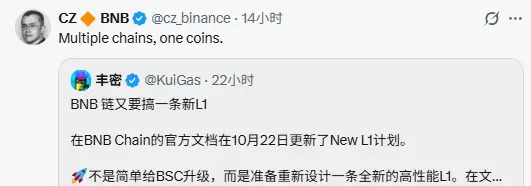
Recently, news about BNB Chain planning to create a new L1 chain has been circulating in the community, with CZ tweeting "Multiple chains, one coin."
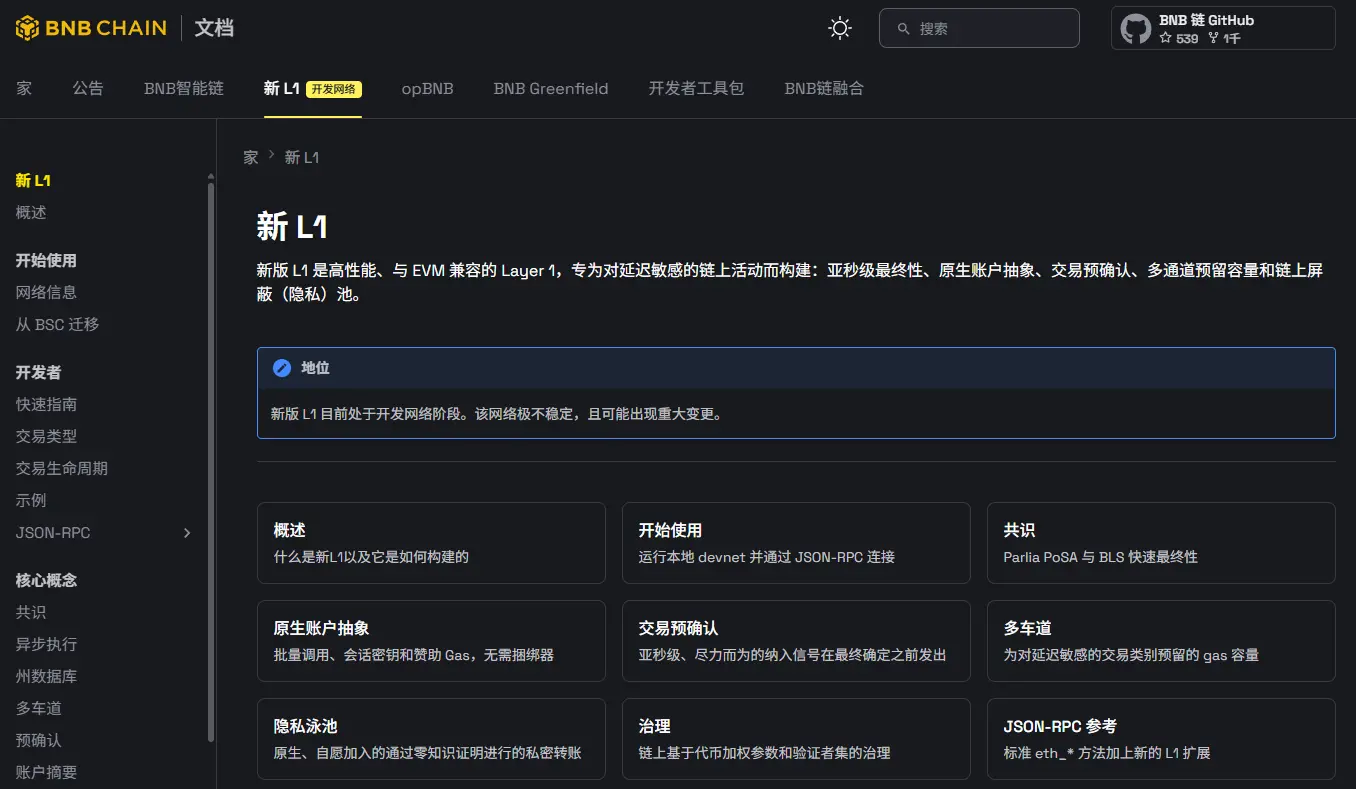
According to the official document, New L1 is a high-performance EVM-compatible L1 aimed at latency-sensitive on-chain activities, with official scenarios including high-frequency trading, real-time payments, confidential finance, and AI agent-driven trading.
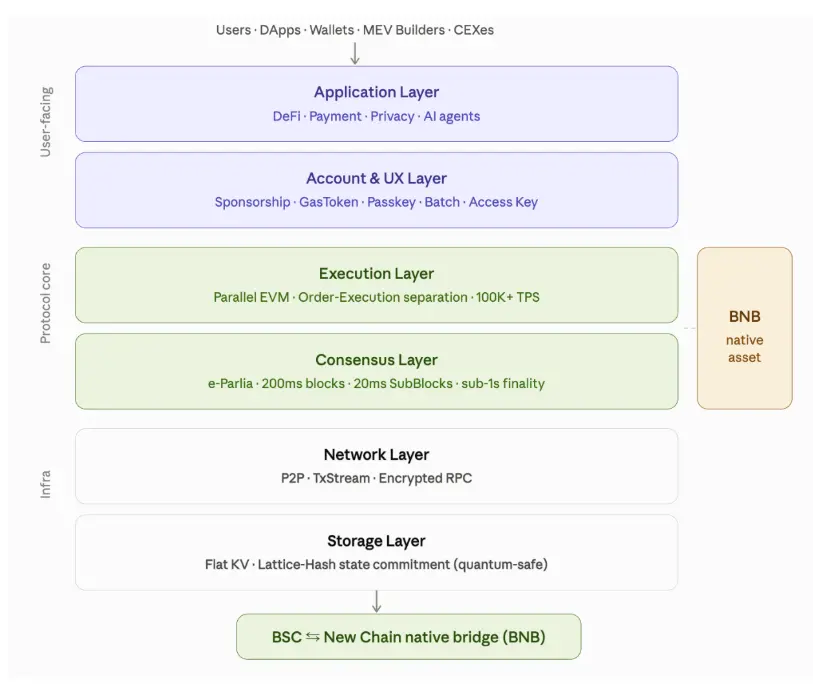
The official design goal is a block time of 200 milliseconds, approximately 20 milliseconds for transaction pre-confirmation, and transaction finality achieved within 1 second.
Compared to BSC, both chains belong to the Parlia PoSA consensus family, with New L1 achieving faster block times, decoupled transaction ordering and execution, and eliminating the global mempool, allowing transactions to be sent directly to the current and next block producers.
The new chain also introduces native account abstraction, transaction pre-confirmation, Multi-Lane reserved block capacity, and optional privacy pools at the protocol level, features that BSC does not provide. The execution layer is built using reth and revm, allowing existing Solidity contracts to run without modification.
In terms of token arrangements, New L1 will not issue new coins. BNB will be transferred from BSC through a native cross-chain bridge for Gas payments, staking, and governance.
The official document lists the new chain as the next chain in the BNB ecosystem following Beacon Chain, BSC, opBNB, and Greenfield, with Beacon Chain having ceased operations in 2024.
At the same time, the document outlines several limitations. Pre-confirmation is a best-effort signal, and transactions may still be revoked before block finality, with irreversible operations requiring final confirmation.
The privacy pool's circuit has not yet been audited, and the trusted setup used is imported, making it unsuitable for holding real funds at this time. The native cross-chain bridge connecting the two chains is also still under development.
In fact, this new chain is not making its debut. BNB Chain proposed developing the next-generation L1 architecture in the H2 technical roadmap released on July 8, extending the use of BNB to trading, payments, privacy, and AI scenarios.
Currently, the new chain is running on an internal multi-validator development network, with plans to launch a testnet by the end of 2026 and a mainnet in early 2027.
On-chain Derivatives Moving Towards Verticalization, Trading Platforms Compete to Build Their Own Chains
According to the BNB Chain roadmap, BSC will reduce block intervals to 450 milliseconds in the first half of 2026, shorten memory finality to 650 milliseconds, and increase baseline throughput to approximately 5,200 TPS. As positioned, BSC will continue to serve as a broad base for the existing ecosystem, while New L1 will handle workloads that BSC cannot accommodate.
Among these workloads, the most concentrated demand is for perpetual contract trading. Research institution Castle Labs reported that, as of September 12, derivatives accounted for 82.58% of the total trading volume in cryptocurrency over the past 30 days. During the same period, centralized exchanges had a perpetual contract trading volume of approximately $4.56 trillion, while on-chain it was about $614.5 billion, roughly 13% of the former.
On a daily basis, the gap between the two is smaller. On October 25, on-chain perpetual DEX trading was approximately $11.96 billion, about 30% of Binance's contract trading volume of $38.08 billion on the same day.
The importance of latency is related to the order book model. Castle Labs believes that order book execution is faster and spreads are narrower, attracting professional market makers and facilitating high-frequency trading through APIs, which in turn brings in more institutional funds.
High Gas fees and latency in the past made on-chain order books difficult to implement, but platforms like Hyperliquid and Lighter have changed this situation by building dedicated settlement environments.
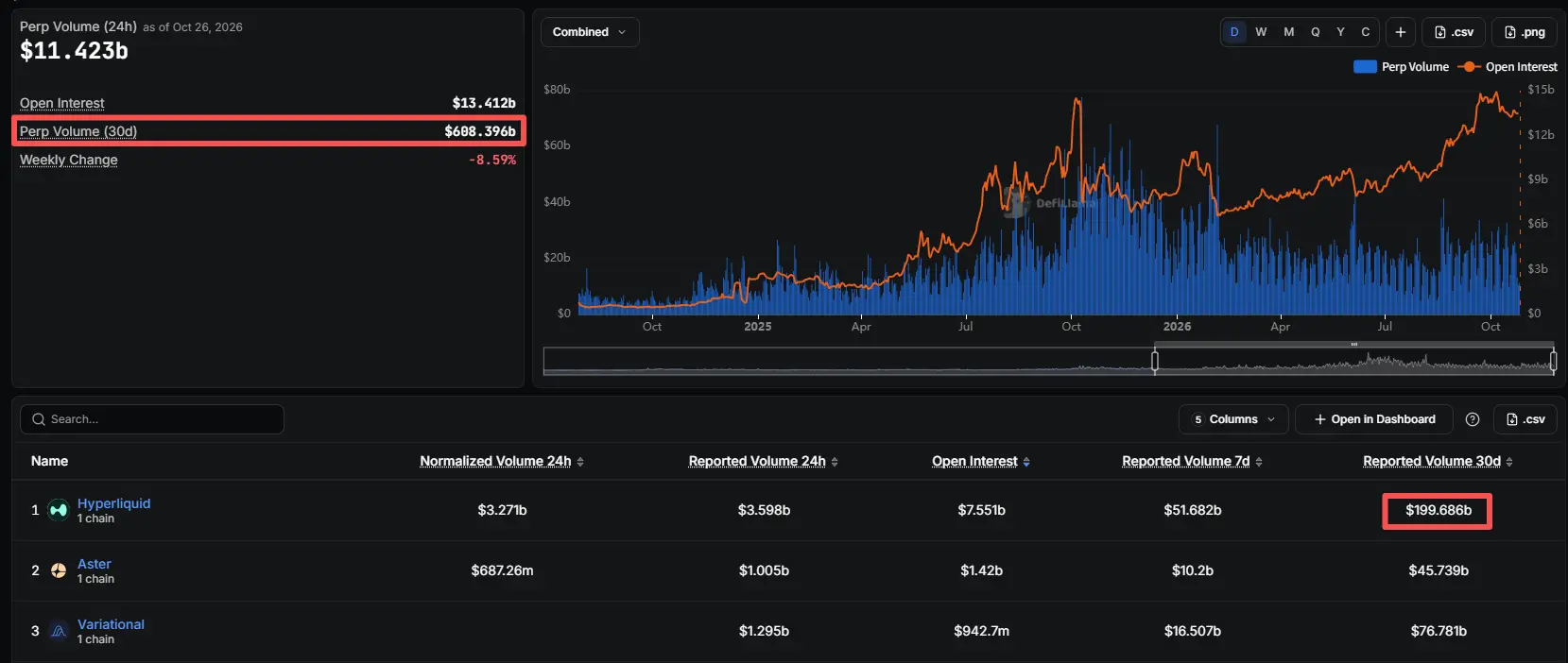
Data from DefiLlama shows that as of October 26, on-chain perpetual contracts had a trading volume of approximately $608.4 billion over the past 30 days, with Hyperliquid accounting for about one-third.
In terms of on-chain perpetual open contracts, Hyperliquid holds 57%, with approximately $687 million in revenue over the past 12 months, ranking fifth among crypto protocols, almost entirely from perpetual trading.
Perpetual exchanges are becoming increasingly verticalized. An earlier example is dYdX, which migrated from StarkEx to its own Cosmos application chain.
There are also precedents within the BNB Chain ecosystem. The Perp DEX Aster, supported by YZi Labs, started on BNB Chain, and data from DefiLlama shows its trading volume peaked around October 2025, after which it significantly declined.
This trend is relatively common among second-tier platforms, with data showing that Lighter's monthly trading volume dropped from $292.5 billion in November 2025 to $50.8 billion in September this year, while edgeX fell from $168 billion to $35.7 billion during the same period.
In March this year, Aster announced the launch of the genesis block of its own L1 Aster Chain, claiming a block time of 50 milliseconds and zero Gas fees for transactions. As of October 26, Aster had approximately $45.7 billion in perpetual trading volume over the past 30 days, with open contracts of about $1.42 billion, ranking second on-chain.
Market Recognizes Replacement Direction, BNB Narrative Still Divided
From the official document, the changes in New L1 focus on the underlying aspects that BSC cannot easily modify. State storage has been changed from Merkle-Patricia trees to cumulative hashes, the execution client has shifted from the go-ethereum branch to reth, and the global mempool has also been eliminated.
On a chain carrying a large number of existing assets and applications, these changes are difficult to achieve through upgrades, so the new chain is positioned as a fresh design from scratch.
Unlike Hyperliquid, which writes the order book into the protocol, New L1 remains a general-purpose EVM chain, offering another answer: transaction ordering is left to the block producers, and reserved block capacity is allocated through voting by govBNB holders.
The scale and admission rules of the validator set have not yet been disclosed, which will determine how the new chain balances speed and decentralization.
Currently, the majority of market voices believe that the new chain is BNB Chain's response to high-performance trading scenarios. Crypto KOL Feng Mi believes that BNB Chain is no longer satisfied with being a general-purpose public chain, and the pressure brought by Perp DEX is the main reason driving the new chain.
Indeed, high-frequency trading, on-chain order books, and AI agents require stable and predictable execution, issues that are difficult to resolve by upgrading BSC, making a bottom-up rebuild more reasonable.
Some industry insiders also point out that this is a strategic-level infrastructure narrative, but there is still a considerable amount of time before launch, with the chain name, Chain ID, public RPC, and native cross-chain bridge yet to be determined. It is highly likely that the new chain will focus on supporting a completely new Perp DEX, and Aster has already launched its own public chain, making it difficult to migrate from scratch.
Regarding BNB itself, Feng Mi believes that the new chain not issuing new coins and continuing to use BNB as Gas effectively brings incremental demand for BNB. Official materials also indicate that the new chain supports Gas payment on behalf of users, meaning that transaction senders do not need to hold BNB.
Crypto Brave believes that the concept of one coin across multiple chains has already been established in the BNB ecosystem, with opBNB and Greenfield showing average performance, while BSC remains the main force on-chain. Binance excels at internal and external competition, and this time the bet is on a new L1 aimed at the AI era.
 Risk warning
 Risk warning