Ethereum After the Mumbai Conference: Post-Quantum 2028 Race, Glamsterdam Delay and Hard Fork Delivery Dilemma
 Core Viewpoint


 Devcon 8 will advance Ethereum's anti-quantum evolution to 2028, but the pace of delivering three hard forks in 24 months is facing real obstacles; a comprehensive breakdown of the Gas reservoir crisis, EIP-8288, and second-level determinism.
Author: YQ
Compiled by: Deep Tide TechFlow
Deep Tide Overview: At the recently concluded Devcon 8 conference in Mumbai, Ethereum Foundation researcher Justin Drake made a startling statement, proposing to fully complete quantum-resistant and AI-resistant upgrades by the end of 2028. This is a full year ahead of the official roadmap, meaning the underlying network must deliver three major hard forks at high frequency within the next 24 months.
Cryptographic algorithms are ready, but the reality of delivery capability has raised red flags. The Glamsterdam testnet has been forced to postpone until 2027 due to the Gas Reservoir mechanism disrupting multiple contract invariants. Ethereum stands at the crossroads of technical ideals and the complexities of systems engineering, and how to smoothly transition without disrupting the existing ecosystem has become the industry's most severe test.

Key Points Extracted
On the first day of Devcon 8, Ethereum Foundation researcher Justin Drake set the target for Ethereum to achieve a "fully post-quantum and post-AI era" by December 2028. This is a full year ahead of the Foundation's previously planned deadline of December 2029.
To achieve this vision by the end of 2028, Ethereum must deliver three large hard forks continuously at high frequency within the next 24 months. However, looking back at Ethereum's version history over the past few years, the actual delivery intervals for single hard forks have generally been 7 to 14 months.
The next core upgrade, Glamsterdam, has stalled after its launch on the Sepolia testnet. A brand-new "Gas Reservoir" repricing rule unexpectedly disrupted eight core invariants relied upon by existing smart contracts, making the mainnet upgrade almost certain to be delayed until 2027.
At the underlying cryptographic level, the defense puzzle for post-quantum has been largely prepared: signature algorithms based on hash functions, lightweight virtual machine leanVM aggregation verification, and sub-second real-time zero-knowledge proofs have all achieved engineering feasibility. Currently, the biggest bottleneck in the system is no longer theoretical algorithms, but how to smoothly complete industrial-grade engineering delivery without disrupting trillions of dollars in existing DeFi contracts.
Overview of Mumbai Conference Data: More Restraint in Scale and Focused Values
The eighth Ethereum Developer Conference (Devcon 8) was held from November 3 to 6, 2026, at the Jio World Centre in Mumbai, India, marking the first time Devcon has entered the South Asian subcontinent.
In terms of overall scale, the four-day conference included 370 keynote speeches and 399 speakers, with the agenda reduced by about 43% compared to Devcon 7 held in Bangkok. This contraction in scale was a deliberate choice by the Ethereum Foundation, which had just streamlined 54 positions, accounting for about one-fifth of the total team.

Image: Overview of core data and topic distribution at Devcon 8 Mumbai
The agenda for this conference was entirely built around the core values of the Foundation. Two-thirds of the topics in the main venue were clearly labeled with the Ethereum Foundation's mission program CROPS: Censorship Resistance, Open Source, Privacy, and Security.
Among all the labels, underlying security (70 sessions) and privacy protection (65 sessions) topped the discussion heat chart, followed closely by topics related to artificial intelligence (57 sessions). Ethereum co-founder Vitalik Buterin pointed out in his opening speech that modern digital technology generally requires users to give excessive blind trust while providing too little public verification capability; Ethereum must establish a verifiable trust foundation across operating systems, chip architectures, communications, and artificial intelligence.
The next developer conference (Devcon IX) has been officially scheduled for October 11 to 13, 2027, in Lisbon, Portugal.
Heading Towards 2028: The Radical Schedule of Post-Quantum Transformation
According to the Strawmap roadmap drafted by the Ethereum Foundation's architecture team, the hard forks following Glamsterdam will progress in alphabetical order: H* corresponds to Hegotá, followed by I, J, K, and L versions.
On this radical evolutionary path, the construction plan for post-quantum Ethereum has been broken down into four key milestones:
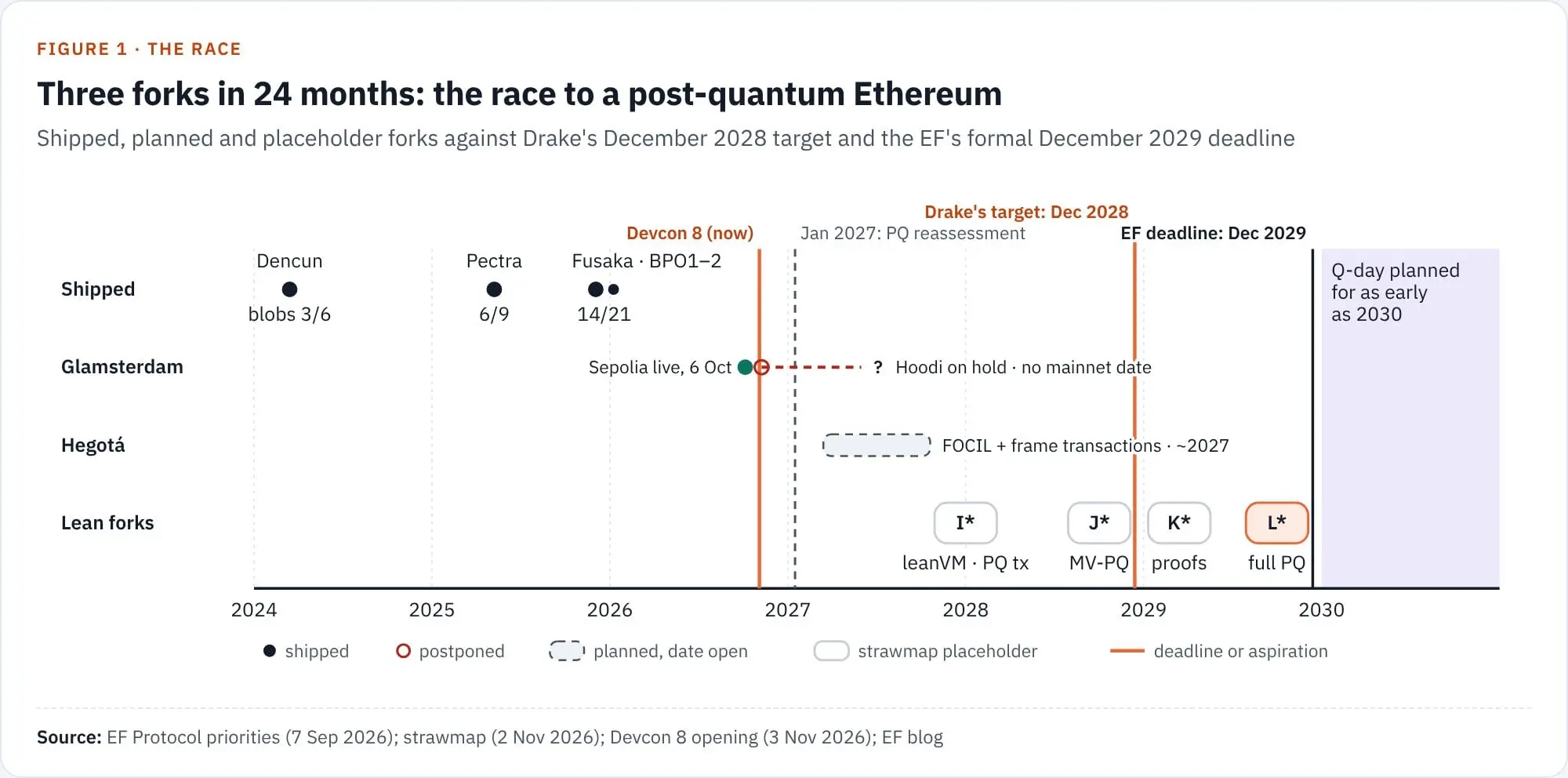
Image: Ethereum post-quantum evolution roadmap and hard fork delivery cycle estimation
The first step is Hegotá, set to launch in 2027. Although it is not purely a post-quantum fork, it will officially introduce the "Frame Transactions" architecture, allowing each on-chain account to freely bind independent signature schemes, laying the groundwork for a complete departure from the ECDSA elliptic curve algorithm in the future.
The second step is the I* fork, which introduces a super-lightweight virtual machine leanVM optimized for zero-knowledge proofs and natively supports post-quantum lightweight transactions. The third step is the J* fork, which fully launches hash function-based validator signatures and post-quantum data sampling, defined by the Foundation as the "Minimum Viable Post-Quantum" defense line. Finally, in the K* and L* forks, state execution proofs will be enforced, completing the final loop of the Lean architecture.
Delivering three large hard forks within 24 months means an average of one successful launch every 8 months. However, the actual delivery intervals for Ethereum's last three upgrades were 11 months, 14 months, and 7 months, and the current Glamsterdam has been 11 months since the last upgrade. Given the current engineering delivery pace, achieving all goals by the end of 2028 faces significant real-world resistance.
The urgency prompting core researchers to accelerate comes from two major external threats:
First is the accelerating drop in the threshold for quantum attacks. A recent joint paper from Google Quantum AI, the University of California, Berkeley, the Ethereum Foundation, and Stanford University indicates that breaking Ethereum's current elliptic curve signatures may require less than 1200 logical qubits (equivalent to less than 500,000 physical qubits). This attack can be computed in minutes, sufficient to directly hijack high-value transactions waiting to be packed in the memory pool (Mempool).
Second is the unexpected breakthrough in AI-assisted cryptographic cracking. In July of this year, Anthropic reported that its cutting-edge large model discovered a new attack vector, reducing the complexity of recovering HAWK-256 signature keys based on lattice cryptography from 2 to the power of 64 to 2 to the power of 38. Researcher Justin Drake stated that the industry must proactively enter a "bomb shelter defense state" to prevent AI-assisted mathematical cracking from breaching traditional cryptographic systems before physical quantum computers do.
Glamsterdam Fault Analysis: What Did the Gas Reservoir Rule Disrupt?
As a key transitional node, the Glamsterdam hard fork has been online on the Sepolia testnet since October 6. Its core vision is to introduce EIP-8037 and EIP-8038, attempting to recycle the execution Gas that was previously burned back into the so-called "Gas Reservoir" to reduce state storage costs.
However, on October 22, the core development team had to urgently withdraw this version from the second testnet. The security audit team found that this seemingly clever repricing rule disrupted eight core invariants that existing smart contracts on the chain had long relied upon.

Image: Analysis of the Gas Reservoir mechanism and disrupted contract invariants in the Glamsterdam hard fork
In the current Ethereum architecture, developers generally follow a series of ironclad rules: for example, the Gas consumption of external calls in sub-contexts will never exceed the limit set by the parent transaction; or transactions that revert (Revert) cannot have persistent resource impacts on subsequent operations.
However, the new Gas Reservoir mechanism breaks this determinism: even a malicious sub-transaction that completely rolls back can accumulate unsettled refund amounts in the reservoir, leading to abnormal Gas increments during subsequent legitimate code execution. This anomaly not only allows attackers to violently collide with CREATE2 contract address salts at nearly zero cost but also directly breaches the security verification logic of the Paymaster payment contract in the ERC-4337 account abstraction system.
The main testnet Hoodi, originally scheduled to launch on November 5, has been fully postponed. Core developers are currently weighing whether to patch the reservoir algorithm or start completely from scratch. As a result, the Glamsterdam mainnet upgrade is likely to be postponed until the first quarter of 2027.
The Real Cost of Post-Quantum Consensus: From Hash Signatures to LeanVM Aggregation
If Ethereum's abandonment of elliptic curves in favor of hash signatures is an irreversible historical fate, then the underlying network must pay a high cost in bandwidth and storage.
Currently, the BLS aggregated signature used by Ethereum validators is only 96 bytes. In contrast, hash function-based signatures with quantum-resistant properties (such as SPHINCS+ or its lightweight variant leanSPHINCS) typically exceed 4 KB in size, expanding by more than 40 times.

Image: Comparison of aggregation costs based on hash signatures and LeanVM in the post-quantum consensus layer
Currently, there are over 1.1 million active staking validators across the network. If millions of 4 KB signatures are indiscriminately broadcast in each 12-second block slot, each slot will generate over 4.4 GB of terrifying data flow, which would instantly suffocate and paralyze any decentralized network.
The core killer feature to solve this dilemma is the introduction of the state proof virtual machine, leanVM. By utilizing the STARK proof system for recursive compression of massive hash signatures at the verification node level, the discrete validation of thousands of nodes can be packed and compressed into a single short proof, reducing broadcast bandwidth back to a secure scale of tens of kilobytes. Meanwhile, the EIP-8450 proposal is establishing a unified post-quantum validator public key registry to ensure a smooth transition of verification power during cross-fork upgrades.
EIP-8288 Proposal: Let the Transaction Memory Pool Handle Complex Cryptography
To achieve post-quantum protection at the transaction execution layer without overwhelming Ethereum's block space, core researchers have introduced the ambitious and cleverly conceived EIP-8288 proposal.
The core design philosophy of EIP-8288 is very clear: to keep heavy complex cryptographic proofs outside the underlying blockchain, allowing the distributed transaction memory pool and specialized builders to bear the computational burden.

Image: EIP-8288 Transaction Memory Pool Encryption and Block Recursive Proof Workflow
Under this mechanism, post-quantum transactions initiated by ordinary users carry complete post-quantum cryptographic credentials when entering the memory pool. However, at the moment the block-producing node packages the transaction on-chain, the block builder will run an aggregation prover off-chain, compressing hundreds or thousands of heterogeneous signatures into a minimal recursive STARK proof, ultimately writing only a proof summary in the block header.
This mechanism brings three disruptive advantages: first, the actual gas consumption of post-quantum signatures drops dramatically from 150,000 to 200,000 gas for direct on-chain verification to about 33,000 gas; second, the on-chain verification cost of privacy transaction proofs plummets from several million gas to around 60,000 gas; finally, the underlying network does not need to deploy dedicated precompiled contracts for each emerging algorithm, allowing any future breakthroughs in cryptography to seamlessly integrate into Ethereum in proof form.
Finality Determination: Shortened from Over Ten Minutes to Seconds
In addition to post-quantum defenses, another core breakthrough established at the Mumbai conference for Ethereum's consensus layer is Single Slot Finality (SSF).
Currently, on the Ethereum mainnet, a transaction takes about 16 minutes on average to achieve irreversible finality from being packed into a block. This greatly limits the clearing efficiency of cross-chain bridges, decentralized exchanges, and centralized institutional channels.
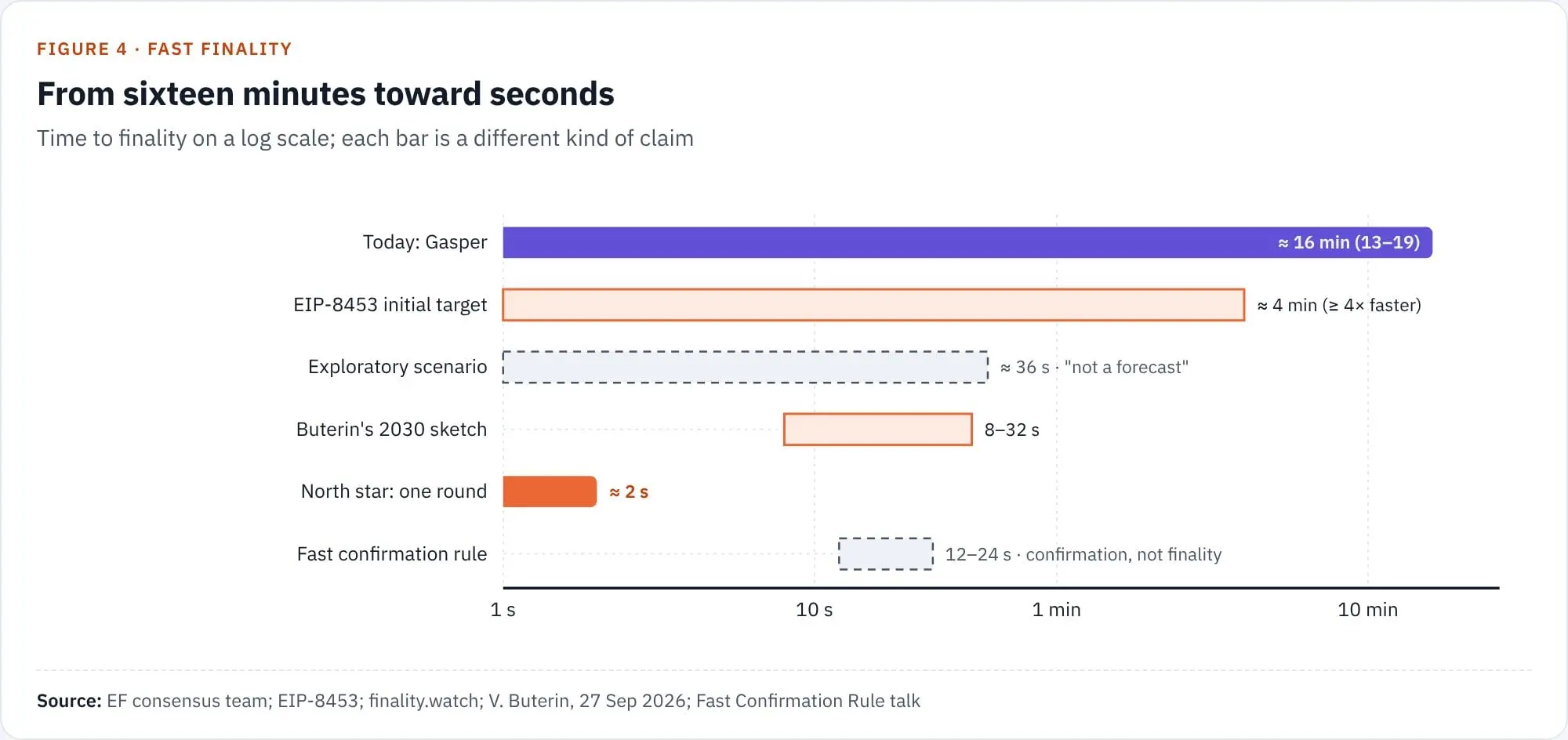
Image: EIP-8453 Decoupled Consensus Mechanism and Second-Level Finality Confirmation Architecture
The draft EIP-8453 "Decoupled Consensus" proposal completely splits the traditional consensus responsibilities into two: a rotating fast committee of 512 validators is responsible for immediate block production and availability voting; while a post-confirmation engine composed of all validator nodes is specifically responsible for providing immutable finality locks.
This mechanism can initially compress the final confirmation time by more than four times. In the long-term plan, Ethereum's finality is expected to be shortened to 36 seconds, ultimately moving towards a "North Star goal" of 1-second blocks and 2-second finality confirmation, making the settlement experience of decentralized networks truly comparable to centralized high-performance cloud platforms.
Zero-Knowledge Proof Implementation: Replacing Full Node Re-execution with Real-time Validity Proofs
In the dimension of execution layer scalability, Ethereum is firmly transitioning from "global full node re-execution" to "real-time zero-knowledge proof verification."
For a long time, the biggest concern in the industry regarding zkEVM has been the computational power consumption and time delay of proof generation. However, in the benchmark tests conducted on November 8, three independent prover teams successfully achieved sub-second real-time proof standards in environments with 4 to 16 consumer-grade GPUs, with the proof cost for a single block astonishingly reduced to between $0.003 and $0.007.
With the computational power and cost bottlenecks broken, formal security verification has become the new institutional barrier. The Ethereum Foundation plans to achieve a technical standard for 128-bit provable security by early December, ensuring that the complex recursive verifier code absolutely contains no logical vulnerabilities. As the future K* fork establishes state proofs as a mandatory requirement, Ethereum will officially enter an era of super throughput, evolving towards hundreds of thousands of transactions per second (Gigagas).
Other Key Ecological Dynamics During Mumbai Week
During the week-long Mumbai Tech Week, other key tracks in the Ethereum ecosystem also showed vibrant evolutionary trends:
Blob Data Availability: Since the adjustment in January this year, the target capacity for blobs has been increased to 14 (maximum 21). The actual average usage per block over the past few months has been about 4.4, with a unit price far below 1 cent, and the infrastructure's data throughput capacity has significantly outpaced current ecological demands.
Layer 2 Ecological Landscape: The long-term tracking of Layer 2 networks, L2BEAT, has officially been renamed ETHBEAT, with the vast majority of mainstream Rollup networks now operating stably in Stage 1 (Base locked value approximately $14 billion, Arbitrum approximately $9 billion).
Cross-Chain Interoperability: The Ethereum Economic Zone successfully demonstrated atomic-level cross-chain calls between L1 and L2 on the development network, with Gnosis Chain clearly announcing its intention to officially adopt this standard in the spring of 2027.
Security and Self-Custody Reflection: In response to the recent serious security incident where Binance's hot wallet suffered targeted infiltration, resulting in $6.36 billion in assets being stolen, the on-chain evidence collection team TRM Labs pointed out that hackers used pre-signed EIP-7702 authorizations to bulk empty funds. While account abstraction has amplified the execution radius of a single operation, the root cause remains the mismanagement of internal signing credentials, rather than a flaw in the protocol design itself.
Future Observation Windows and Thoughts
Looking at the entire Mumbai conference, Ethereum demonstrated an extremely clear technical determination. From cryptographic foundations, consensus mechanism reconstruction to execution layer proofs, Ethereum has completely clarified its technological blueprint for its third decade.
The key windows to watch in the coming months include: the core developer conference ACDC and ACDE scheduled for mid-November, where the patching path for the Glamsterdam vulnerability and the new testnet timeline will be officially finalized; the Foundation's formal review of the post-quantum timeline in January next year; and the delivery of the 128-bit zkEVM security milestone by the end of the year.
Ethereum knows how to build an ultimate distributed world computer capable of withstanding quantum attacks and technological upheavals for decades to come. The only and deepest suspense left by Mumbai for the entire industry is whether the core team can truly shoulder the engineering miracle of delivering a hard fork every eight months while maintaining industrial-grade security atop this increasingly complex behemoth.
 Risk warning
 Risk warning



Popular articles