SoftBank reports its first quarterly loss in two years, with a sharp decline in AI severely impacting the Vision Fund, and significant impairment on its data center projects in the United States
 Core Viewpoint


 SoftBank Group's net loss for the second fiscal quarter reached 1.12 trillion yen, marking the first quarterly loss in nearly two years. The main reason was the company's adjustment of power supply equipment procurement for its AI data center in Ohio, leading to a write-off of nearly 3.7 billion dollars in advance payments, while the Vision Fund turned from profit to loss, and high debt financing costs rose. SoftBank's stock price has fallen more than 50% since its peak in June.
Author: Zhang Yaqi, Wallstreetcn
SoftBank Group recorded a quarterly net loss for the first time in nearly two years, primarily due to significant impairments in its U.S. data center projects, compounded by a broad decline in technology stock valuations affecting its investment portfolio. Concerns about the sustainability of the AI boom are manifesting in tangible financial costs.
On Tuesday, SoftBank announced that the net loss for the second quarter of the fiscal year ending September 30 amounted to 1.12 trillion yen (approximately $7.1 billion), a stark contrast to the market expectation of a profit of 129 billion yen, while the same period last year recorded a net profit of 2.5 trillion yen. The loss was mainly due to a write-off of approximately $3.7 billion (59.725 billion yen) related to the cancellation of non-refundable advance payments made for the procurement plan of power supply equipment for its data center campus in Ohio, USA.
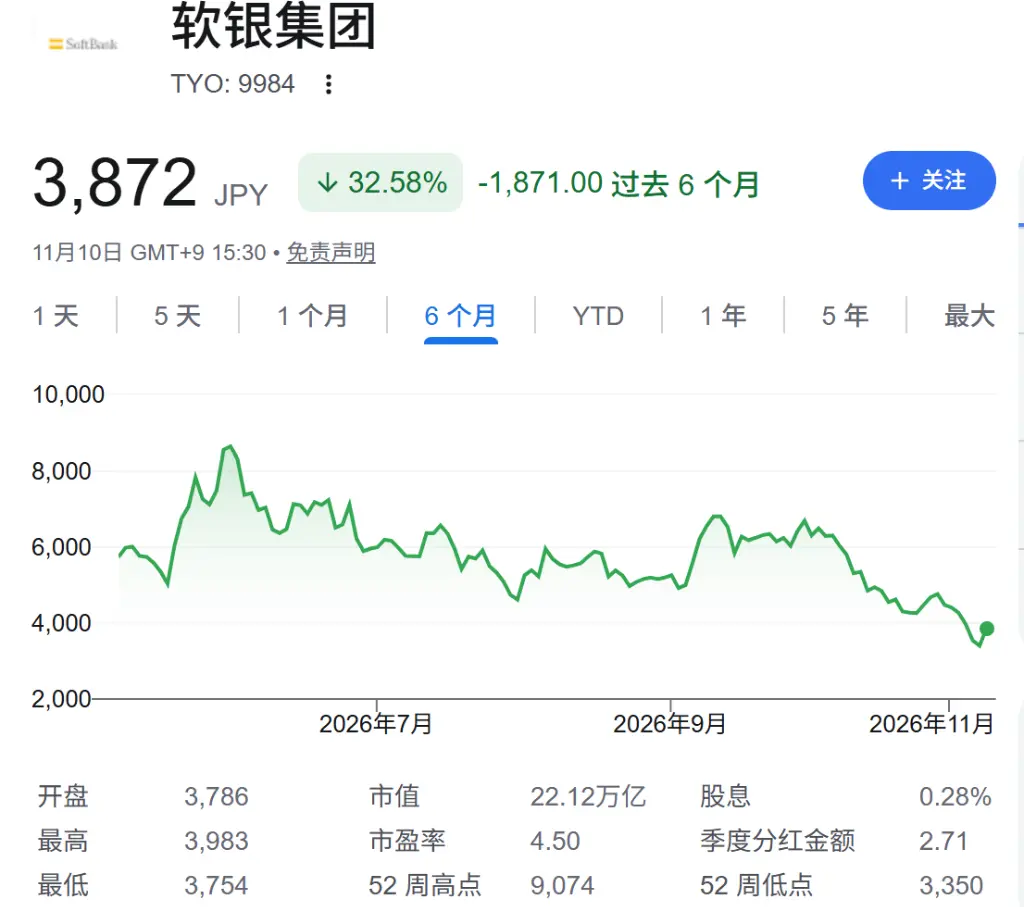
This performance shock has heightened market vigilance regarding the risks of SoftBank's AI strategy. SoftBank's stock price has fallen over 50% since its peak in June, with concerns about regulatory tightening following the Democratic Party's significant victory in the U.S. midterm elections, as well as the financial pressure accumulated by founder Masayoshi Son's heavy debt bets on AI, all contributing to ongoing suppression.
Despite the release of worse-than-expected loss data, SoftBank's stock price rose 13.9% on Tuesday, mainly due to a rebound in the Asian technology sector following the recovery of U.S. stocks.
Data Center Impairments Become the Biggest "Black Hole"
The core of this loss lies in significant changes to SoftBank's procurement arrangements for its U.S. AI data center projects. During the first half of the fiscal year ending September 30, the company confirmed losses totaling 59.725 billion yen due to the "re-adjustment" of the procurement plan for power supply equipment for its U.S. AI data center projects, which included non-refundable advance payments made to secure equipment and capacity.
SoftBank positions itself as a core participant in large-scale AI infrastructure construction, with the Ohio data center campus being a concrete manifestation of its ambitions. However, there remains considerable uncertainty between the advanced investment in AI infrastructure and its actual implementation, and this uncertainty has directly translated into financial losses.
Vision Fund Performance Deteriorates Sharply
SoftBank's flagship Vision Fund also faced significant pressure this quarter. The Vision Fund segment recorded a loss of 81.6 billion yen this quarter, compared to a profit of 2.38 trillion yen in the same period last year, while the market had originally expected the segment to remain profitable.
Structurally, Vision Fund 1 incurred an investment loss of 3.86 billion yen due to the decline in stock prices of listed holdings such as Coupang and Grab, although its holdings in ByteDance contributed approximately $1.3 billion in unrealized gains. Vision Fund 2 recorded investment income of 89.26 billion yen, but the total investment income for the entire Vision Fund segment was only 85.45 billion yen, a significant decrease from 2.81 trillion yen in the same period last year.
The decline in stock prices of chip giant Arm Holdings and Intel, as well as the valuation drop of the South Korean e-commerce platform Coupang, further eroded SoftBank's overall earnings.
OpenAI Holdings Under Dual Pressure from Valuation and Financing Costs
OpenAI is the core target of SoftBank's AI strategy. As of the end of September, SoftBank's cumulative investment in OpenAI reached $54.6 billion, corresponding to a fair value of $99.6 billion, with cumulative investment gains of approximately $45 billion. The company stated that the fair value of its OpenAI holdings has remained unchanged since March of this year.
However, the overall valuation of AI unicorns is undergoing a repricing. According to Bloomberg, OpenAI ultimately completed a financing round of approximately $11 billion at a valuation of $1.25 trillion, lower than the previously sought valuation of $1.4 trillion and the target fundraising amount of $30 billion. Meanwhile, Anthropic's valuation was once lowered to $1.1 trillion, far below the previously circulated market figure of $2 trillion.
The pressure on the financing side cannot be ignored either. SoftBank's overall financing costs surged to 461.9 billion yen this quarter, sourced from margin loans secured by its Arm holdings, large-scale bond issuances, and rising overall financing rates. Masayoshi Son's strategy of relying on the debt market to provide ammunition for AI investments has made SoftBank's bonds extremely sensitive to market sentiment, with its credit default swap (CDS) spreads rising to multi-year highs.
External Adverse Factors Compound
In addition to internal financial pressures, SoftBank also faced multiple external headwinds this quarter.
The Democratic Party's overwhelming victory in the U.S. midterm elections raised widespread concerns that the new Congress would strengthen regulatory scrutiny over AI data center construction, an expectation that triggered a deep adjustment in global tech stocks last week, directly impacting SoftBank.
Notably, on the eve of its earnings release, SoftBank announced that it would jointly invest at least $1.85 billion in initial capital with Grab and Malaysia's national oil and gas company PETROS to develop AI infrastructure in Malaysia, with a long-term goal of establishing at least 5 gigawatts of AI computing capacity, demonstrating its continued active push in the Asian AI market. In terms of revenue, this quarter's revenue was 2.22 trillion yen, exceeding the market expectation of 2.02 trillion yen, supported by growth in telecommunications and AI computing businesses.
 Risk warning
 Risk warning





Popular articles