How much is NVIDIA worth without Jensen Huang?
 Core Viewpoint


 It is estimated that losing the founder could reduce Nvidia's valuation by 20% to 30%.
TL;DR
·Stifel has set the leadership transition as the baseline scenario, lowering NVIDIA's target price from $315 to $205 while maintaining a buy rating. ·This adjustment mainly falls on the valuation multiple, with Stifel reducing the expected price-to-earnings ratio for fiscal year 2028 from 20 times to 13 times, while still expecting recent performance to slightly exceed expectations. ·Dan Ives and Gene Munster previously estimated that Jensen Huang's departure could lead to a 20% to 30% decline in NVIDIA's valuation, but at that time, the probability of departure was only estimated at 10% to 15%. ·With reports of the replacement and successor search emerging, the early judgment that "departure risk has been priced in" needs to be reassessed. ·According to TIKR, if earnings expectations remain unchanged, a 20% to 30% discount would push NVIDIA's forward price-to-earnings ratio down to about 10 to 12 times. ·If subsequent export restrictions impact the forecasted sales, the market will also need to lower earnings expectations, putting pressure on both valuation multiples and earnings.
Jensen Huang's iconic leather jacket is becoming a metaphor for Wall Street's discussion of NVIDIA's valuation.
On November 10, Scott Galloway described on the "Pivot" podcast that the AI industry seemed to be "held up by a leather jacket" that night. As NVIDIA's board launched an independent investigation into Jensen Huang, investors began to price a scenario that had rarely been seriously discussed in the past—how much is NVIDIA worth if the founder leaves?
Some analysts provided initial judgments that the valuation could decline by 20% to 30%. Subsequently, brokerages began adjusting target prices. On November 12, according to Investing.com, Stifel lowered NVIDIA's target price from $315 to $205, a decrease of about 35%, while maintaining a buy rating.
As of the time of the report, NVIDIA had not announced any leadership changes. However, in Stifel's valuation framework, the management transition has already become the baseline scenario.
Jensen Huang's Value Begins to Reflect as a Price-to-Earnings Discount
Stifel's adjustment provides a set of specific numbers for "how much Jensen Huang is worth."
The institution's expected earnings per share for fiscal year 2028 is $15.65, which will be used to calculate the target price's price-to-earnings ratio, reduced from 20 times to 13 times. According to this metric, a 13 times price-to-earnings ratio corresponds to about $203, which is close to the new target price of $205.
The price-to-earnings ratio reflects how much investors are willing to pay for each dollar of earnings. When earnings forecasts remain at similar levels, a decline in the multiple indicates a weakening of investor confidence in future growth, leading to a lower price they are willing to pay.
Stifel's judgment on NVIDIA's recent operational performance remains relatively positive. The institution expects that the company's third-quarter results for fiscal year 2027, to be announced on November 17, will likely slightly exceed expectations, with supply still being the main constraint on growth, and there is room for upward adjustments in the fiscal year 2028 earnings forecast. Meanwhile, the selection of a successor, the timing of the transition, whether core executives can remain, and how sales channels and export compliance arrangements are adjusted all increase the uncertainty of future growth.
Other institutions are also reassessing this risk. According to Investing.com, Bernstein downgraded NVIDIA's rating from "outperform" to "market perform," lowering the target price to $200. Morgan Stanley removed it from its preferred stock list but retained a buy rating and a target price of $300. The balance of earnings and valuation among various institutions has shown significant divergence.
Jensen Huang's importance is primarily reflected in NVIDIA's organizational structure. Robert Cyran, a columnist for Reuters Breakingviews, pointed out that more than 60 people report directly to Jensen Huang, with four senior executives holding equivalent positions. This structure, centered around the founder, means that the successor must simultaneously take on multiple responsibilities, including technical judgment, internal coordination, and customer communication, which also increases the difficulty of an urgent transition.
External business relationships also test the successor. Large clients like Microsoft, Amazon, and Google continue to purchase NVIDIA chips while also motivated to develop lower-cost in-house products. Jensen Huang has increased the cost for customers to switch suppliers by expanding supporting hardware and software, while also establishing financing collaborations with institutions like Apollo and Blackstone to help clients fund chip purchases. Cyran believes that investments and financing support for smaller clients also help expand the buyer base and limit the bargaining power of a few large clients.
This arrangement links product competitiveness, customer financing, and order growth. Whether the successor can maintain these collaborations will affect investors' judgments on future revenue and profit margins, as well as determine how much valuation premium NVIDIA can retain.
The 20% to 30% Impact Depends on Departure Probability
Before Stifel adjusted its target price, Dan Ives and Gene Munster had already attempted to quantify the impact of Jensen Huang's departure.
Dan Ives of Yorkville Ives & Co. stated on November 10 that if Jensen Huang were to be removed from the CEO position, NVIDIA's company and stock value could decline by 25% to 30%. At that time, he estimated the probability of such an event occurring to be about 15%.
Gene Munster of Deepwater Asset Management estimated the impact to be around 20%. He believed that the stock price at that time might have already reflected about a 25% probability of departure, while his own judgment was 10% to 15%.
TIKR conducted a simple probability-weighted calculation based on this. According to Ives' judgment, a 25% to 30% valuation loss multiplied by a 15% probability of occurrence corresponds to an overall valuation impact of about 3.75% to 4.5%. According to Munster's judgment, the impact is about 2% to 3%.
Based on these assumptions, TIKR's article on November 11 suggested that the consecutive two-day decline may have already priced in most of the departure risk.
However, this conclusion is highly dependent on the timing of the news release.
Subsequently, The Wall Street Journal reported that the board was preparing to replace Jensen Huang, while Bloomberg reported that the company had hired a headhunting firm and was considering appointing an interim CEO. By the time Stifel released its latest judgment, the leadership transition had already entered its baseline scenario. The previous assumption of a 10% to 15% probability also needed to be reassessed.
If investors believe that departure is becoming increasingly likely, even if the judgment on the magnitude of valuation loss after departure remains unchanged, the risk discount that the current stock price needs to reflect will also widen. Determining whether the risk has been fully priced into the stock requires estimating both the probability of departure and the actual impact of management changes on the company's value.
Earnings Expectations Unchanged, NVIDIA Could Drop to 10 to 12 Times Price-to-Earnings Ratio
TIKR believes that NVIDIA's valuation still has support, based on the market's expectations for its earnings growth.
According to the consensus expectations cited by TIKR, NVIDIA's adjusted earnings per share will rise from $9.32 for the fiscal year ending January 2027 to $21.41 for the fiscal year ending January 2029, more than doubling over two years.
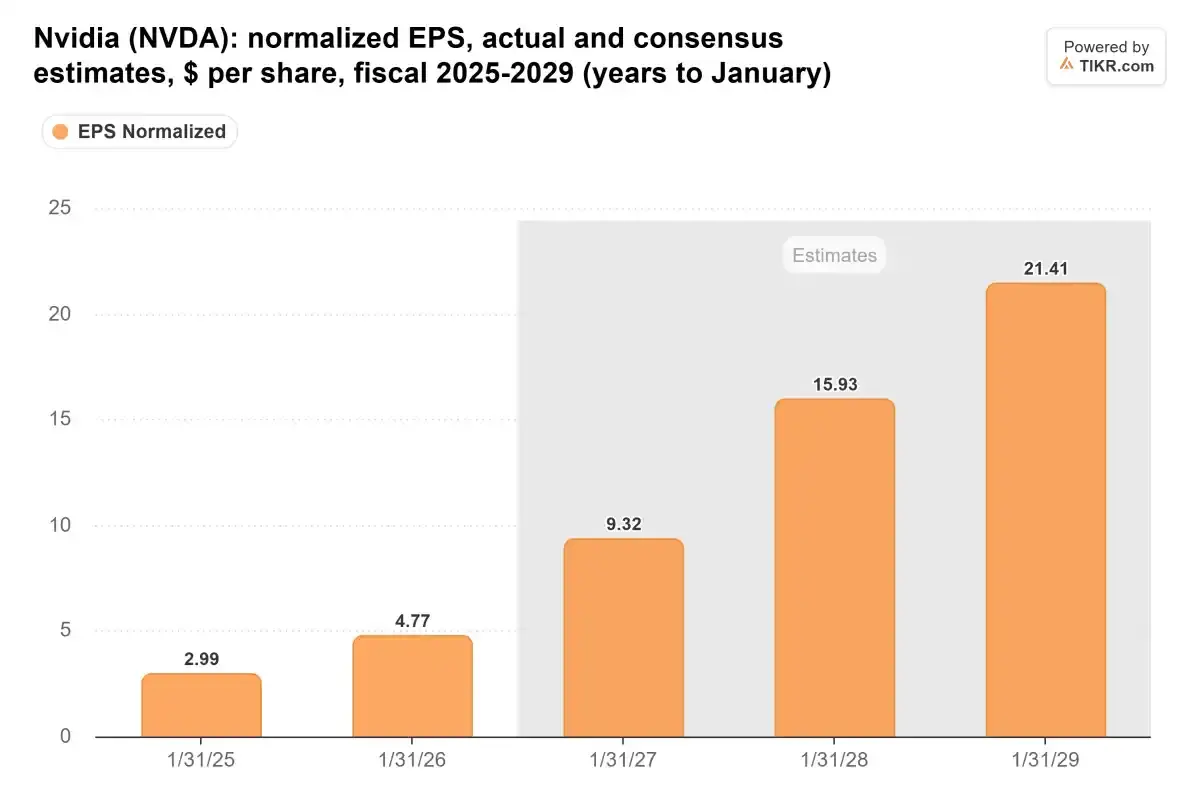
NVIDIA's adjusted earnings per share for fiscal years 2025-2029, in dollars. The gray area represents the market consensus expectations.
TIKR data shows that on November 9, NVIDIA's expected price-to-earnings ratio for the next 12 months was about 14.8 times, at a low point over the past three years, below the average level of about 30.1 times during the same period.
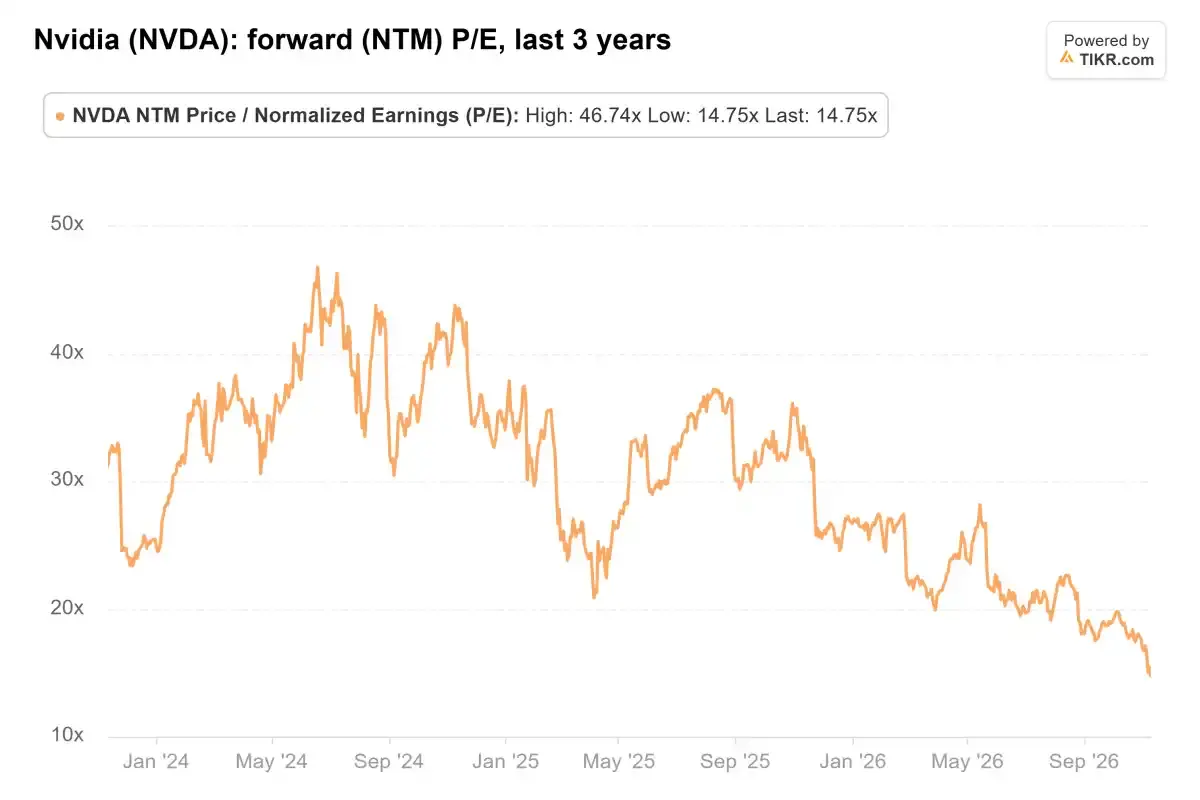
NVIDIA's expected price-to-earnings ratio for the next 12 months over the past three years, with the latest value at 14.75 times.
If earnings forecasts remain unchanged, a 20% to 30% discount on the stock price based on this would correspond to a price-to-earnings ratio of about 10.4 to 11.8 times. This is what TIKR refers to as "without Jensen Huang, NVIDIA could become a stock with a price-to-earnings ratio of 10 to 12 times."
This calculation uses the stock price and earnings expectations at that time. As prices and market judgments change, the corresponding multiples will also change. Additionally, TIKR uses expected earnings for the next 12 months, while Stifel uses expected earnings for fiscal year 2028, leading to differences in valuation metrics.
Both calculations reflect that the market still expects NVIDIA's profits to continue growing but is reconsidering how much price it should pay for those profits. The uncertainty regarding the successor, management stability, and strategic continuity could all become factors that depress valuation multiples.
How much of this discount will ultimately remain depends on NVIDIA's ability to provide a credible transition plan and whether the successor can maintain product execution, customer relationships, and financing collaborations.
If Earnings Forecasts are Also Downgraded, Revaluation Will Deepen Further
The above calculations share a common premise—the profits expected by analysts can be realized.
TIKR points out that if subsequent reviews lead to tighter export regulations that impact the forecasted sales, analysts will need to lower their earnings per share expectations. At that time, the target price may simultaneously face pressure from declining earnings and contracting valuation multiples.
NVIDIA's previous performance outlook has already assumed no revenue from data center computing business in China. Therefore, the impact of subsequent policies needs to be implemented at specific customers, regions, and sales channels, observing whether new restrictions affect existing revenue forecasts.
The financial report on November 17 will provide a test. The company previously provided a quarterly revenue guidance of $10.8 billion, with a fluctuation of 2%. Stifel expects the actual performance to slightly exceed expectations, and investors will also pay attention to subsequent growth guidance, as well as management's explanations regarding supply, customer demand, and leadership arrangements.
"How much is NVIDIA worth without Jensen Huang?" currently depends on two sets of variables. If the company continues to deliver earnings growth, the main adjustment the market will make is to the price-to-earnings ratio it is willing to pay; if management changes further impact business execution and order expectations, earnings forecasts may also face downward revisions.
Whether the transition plan can stabilize the core team, whether product plans can be advanced on schedule, and whether customers can continue to secure funding for computing power will determine whether the discount currently given by Wall Street is a risk compensation during the transition period or a more lasting valuation adjustment.
 Risk warning
 Risk warning



Popular articles