Pantera Shenzhen Inspection Notes: Hardware is leading in China, software is leading in the United States, and "data farms" cannot produce modeling capabilities
 Core Viewpoint


 Pantera partner Cosmo Jiang believes after conducting on-site research on the Shenzhen robotics industry chain: China is absolutely leading in hardware and supply chains, while software algorithms lag behind the top companies in the United States by 1-2 years; the "data farms" created by local subsidies produce a large amount of homogeneous data, and the real barrier is the ability to extract high-value training signals from raw data.
Author: Cosmo Jiang, Erik Hopyan (Pantera Capital)
Compiled by: Deep Tide TechFlow
Introduction: In the current tightening of liquidity in the primary cryptocurrency market, leading crypto VCs have clearly extended their reach into the AI and robotics sectors.
Pantera Capital is one of the earliest and most well-known institutional-level cryptocurrency/blockchain investment firms in the United States. Founded in 2003, it launched the first institutional Bitcoin fund in the U.S. in 2013, focusing on digital assets and blockchain for a long time, and later gradually expanding into broader technological frontiers such as AI and robotics.
Recently, partners of the fund Cosmo Jiang and investor Cody Poh specifically flew to Shenzhen to conduct on-site research on China's robotics industry chain, observing various aspects from humanoid robot manufacturers, modeling teams to dexterous hand and data collection equipment suppliers, and published a lengthy article summarizing their findings.
Their core findings can be summarized very directly: hardware is leading in China, software is leading in the U.S., and in the intermediate data segment, quality is far more important than quantity.
What is even more interesting in the article is their insights and comparisons of the capital ecosystems between China and the U.S. from a VC perspective:
Chinese venture capital generally requires projects to see revenue within 2-3 years or even push for an IPO, coupled with relatively weak intellectual property protection, forcing entrepreneurs to prioritize hardware sales and data outsourcing for "quick money" businesses, and not daring to heavily invest in long-cycle foundational software development.
In addition, the low labor costs in China mean that humanoid robots are currently more often used for showroom reception or performances (dancing, martial arts); while the high labor costs and blue-collar shortages in the U.S. have driven real commercial orders for industrial and logistics automation.
We have compiled the full text as follows.

At 2 AM, after a six-hour delay in Singapore, our Cathay Pacific flight finally landed in Hong Kong. Having slept for less than three hours, we hopped into a car heading straight for Shenzhen. This is China's hardware capital and the headquarters of tech giants like Huawei, BYD, and DJI.
"Genchi Genbutsu": Go see for yourself, see with your own eyes. We had previously visited many robotics companies in the U.S. and selectively invested in a few of them. Based on these experiences, we are well aware that China is a crucial link in the global robotics industry chain; but can we really see the truth if we only observe from afar?
For the past two years, the robotics sector has been our research focus. Breakthroughs in the field of embodied intelligence have brought a step function change to the development potential of this industry. Today, models can perform visual perception, logical planning, and take action in the physical world, and the hardware required to drive these models has become increasingly powerful and affordable.
In the most optimistic scenario, robots will disrupt the broader global manual labor market. Currently, there are 2.2 billion manual laborers worldwide, with a total annual wage pool exceeding $20 trillion. Even if robots only penetrate 1% of this market, the revenue generated would be enough to rival today's top global tech giants.
China is an indispensable presence for the embodied intelligence industry. Global equipment manufacturers heavily rely on China's supply chain, with Chinese manufacturers accounting for over 90% of the global humanoid robot output by 2025. Meanwhile, recent restrictions imposed by the U.S. Federal Communications Commission (FCC) on advanced robot equipment manufactured abroad highlight how geopolitics is increasingly reshaping the robotics industry.
As fundamental-focused investors, we must understand and navigate this rapidly changing macro landscape. The best way to achieve this goal is to go deep into the front lines and witness the most authentic state of the industry.
Thus, our Shenzhen trip officially began. Here, we observed firsthand the rapidly evolving robotics industry ecosystem in China. We visited numerous companies covering the entire robotics industry chain, from vertically integrated humanoid robot manufacturers and cutting-edge model developers to data collection equipment suppliers and experts focused on dexterous hand research.
During this period, we engaged in in-depth conversations with founders of startups, executives responsible for sales, manufacturing, and research, and candidly exchanged ideas with recent university graduates entering the workforce. Our investigation goal was very clear: to understand China's real position in the global robotics race, its core competitive advantages, and more importantly, what investment-worthy gaps and opportunities still exist in the current market.
Hardware: China Leads the Manufacturing Race
Throughout the investigation, one thing is indisputable: China is in an absolute leading position in the robotics hardware race, supported by unparalleled manufacturing scale and supply chain integration capabilities. This advantage is particularly evident in Shenzhen, which can be considered the heart of China's manufacturing engine.
Decades of accumulation as a core hub of global manufacturing have established a deeply entrenched foundational ecosystem here: readily available raw materials, highly cost-effective logistics networks, mature mass production lines, and a large and skilled workforce proficient in precision manufacturing. This forms a structural moat that is extremely difficult for other emerging manufacturing centers to replicate.
This supply chain advantage not only directly translates into extreme cost competitiveness but also brings about astonishing innovation iteration speeds. In Shenzhen, a humanoid robot startup can come up with a new idea in the morning, immediately notify upstream suppliers, and by noon, the newly customized components can be delivered directly to their office.
This extreme responsiveness allows Chinese manufacturers to supply higher quality cutting-edge hardware at lower prices. The stereotype that China can only produce low-quality imitations or generic goods is severely outdated.
As leading model laboratories continue to expand their training scales, their demand for customized data collection equipment has surged, and China has a unique advantage in low-cost scalable manufacturing of such equipment.
Some top robotics companies in the U.S. often boast that all core components are independently developed and manufactured; however, when communicating with local suppliers in Shenzhen, they will explicitly tell you which of the Magnificent Seven (Mag 7) or billion-dollar Silicon Valley unicorns they are supplying steadily. This applies to core components such as dexterous hands and actuators, as well as wide-angle cameras and head-mounted devices used for data collection.
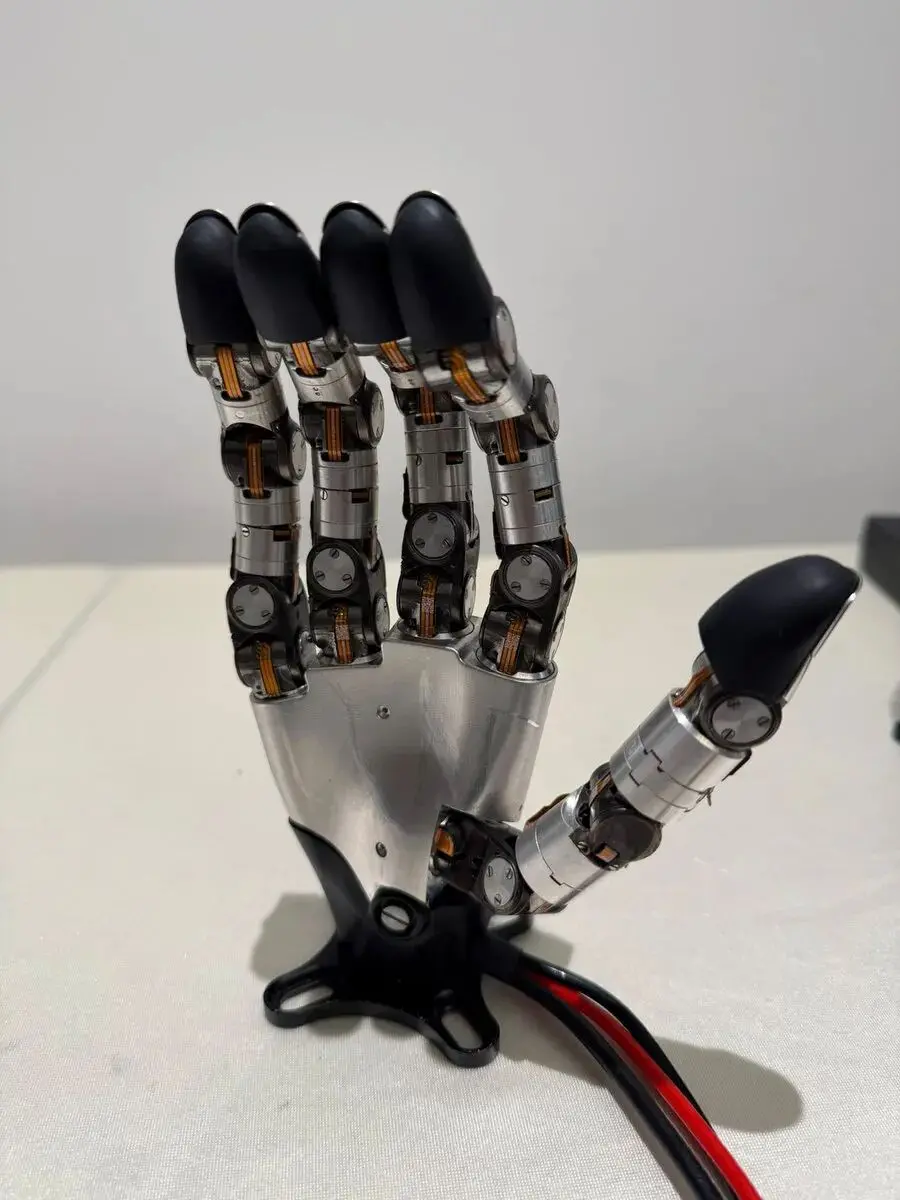
Take the dexterous hand manufactured by Wuji Tech as an example; this product integrates over 1,800 components within a compact size close to that of a human palm, outperforming any robotic hand we have seen in the U.S. Unsurprisingly, they are the silent core suppliers behind many American tech giants.
Each finger supports reverse bending, significantly enhancing durability (a key battleground in the field of robotic hands) and impact resistance against accidental collisions. On-site, we observed the robotic hand (via remote operation) precisely extracting a single card from a complete deck of playing cards. This task seems easy for humans but poses a significant challenge for robotic hand operation, as it requires micron-level precision in controlling force and friction.
Another shocking yet slightly uncanny moment was seeing a humanoid robot from UBTECH with lifelike human skin, evoking a sense of the Cylons from "Battlestar Galactica."

Another notable feature of the Chinese market is the extremely fierce internal competition, which continually drives down product prices and compresses industry profit margins to near zero.
One startup spent a full hour introducing us to the various technological breakthroughs achieved by their next-generation actuators. However, when we asked them how they planned to break through in market competition, they immediately replied, "Of course, price is the most important." Companies holding this view are by no means isolated cases.
During lunch, a chain retail store owner lamented that it is very difficult to make a profit in domestic business because there are always competitors willing to sacrifice this year's profits to seize market share, hoping to make money next year; only to find that new disruptors emerge the following year to engage in cutthroat competition at even lower prices.
Chinese culture has a deeply rooted "hard work" spirit. This resilience, willing to endure hardships for the long term, certainly suppresses individual companies' ability to achieve excessive commercial profits, making survival exceptionally difficult for each company. However, from a macro perspective, it has endowed the entire country's supply chain industry cluster with astonishing overall competitiveness.
In addition to cost and scale advantages, China's position at the top of the robotics industry chain also grants it another often underestimated natural advantage: the ability to gain close insights into the evolution trends of global cutting-edge technologies.
Leading robotics laboratories have been continuously experimenting with new data collection methods, from tactile and force feedback sensing gloves to visual collection headsets equipped with eight high-definition cameras for wider angle recording.
As almost the only supplier in the world capable of quickly and cost-effectively delivering such cutting-edge hardware, Chinese manufacturers can capture subtle changes in technology demands from the world's top laboratories very early, even predicting the next generation of technological evolution trends 3 to 6 months ahead of the overall market.

However, can Chinese companies truly transform this manufacturing dominance and the market insights gained ahead of time into their own core proprietary technology advantages? This is a completely different proposition. As our journey deepened, our doubts grew stronger.
Data: Collection is the Industry Bottleneck, Not a Competitive Barrier
Almost every robotics company told us that China is implementing a large-scale data collection project and widely exporting this data to global clients.
On the surface, this seems reasonable: companies arrange for workers to wear collection headsets to capture first-person perception data, thereby earning some extra income. However, as we communicated with more startups within the Chinese ecosystem, it became evident that the operational mechanisms behind this are far more complex than they appear and often accompanied by clear guidance from local policies.
Several industry insiders revealed to us that local governments at all levels in China are actually the core driving force behind this wave of data collection. After the central government introduced incentive policies to support the development of the robotics industry and promote employment, local governments quickly realized that providing financial subsidies for the data collection segment was a shortcut to creating new jobs related to robotics in the short term.
Driven by quantifiable assessment indicators, local officials often tend to pursue easily measurable short-term results, which sometimes comes at the expense of higher-dimensional long-term industrial strategies.
Millions of dollars are continuously being poured into questionable training data. Across China, many so-called "data farms" have emerged, where workers mechanically repeat the same actions day after day, accumulating thousands of hours of "robot training data."
However, these highly repetitive and homogeneous datasets provide almost no substantial incremental value for improving the generalization ability of models after the initial few datasets.
Despite concerns about data quality, this data continues to be sold to overseas clients. This highlights a deeper, more severe reality in the industry: the scarcity of data remains the biggest bottleneck facing the current development of robotic models. Unlike large language models that can directly scrape vast amounts of ready-made text from the internet, the robotics field lacks a corresponding pool of ready-made data.
Moreover, truly valuable robotic training data comes in various forms, and the types of data needed to unlock the next generation of model performance leaps have not yet reached a scale that can be effectively utilized in the real world.
Therefore, the real core barrier has never been the data collection itself, but the ability to transform raw data into high-value training signals.
Encouragingly, an increasing number of cutting-edge signs indicate that scaling laws also apply to robotic models, meaning that as the scale of training data increases, model performance will show deterministic enhancement. This suggests that the market will maintain a strong and ongoing demand for high-quality, diverse, heterogeneous robotic training data, which must be able to precisely match the evolving standards of cross-modal, different collection methods, and new training architectures.
In an industry environment where the definition of "high-quality data" is constantly changing, the most defensible competitive barrier lies in whether one can become an irreplaceable and trusted research partner for the world's top cutting-edge laboratories.
Winning this industry reputation hinges on having a high level of professional taste in data labeling, cleaning, selection, and model evaluation, rather than simply relying on the collection capacity of a large workforce.
The future winners are likely not those teams that collect the largest total amount of data, but those with a deep background in embodied intelligence research who can collaborate with cutting-edge robotic companies to evolve technology at the fastest pace. Just as Scale AI and Mercor have deeply bound themselves to the world's top large model laboratories through their top-notch research understanding, this logic also holds true in the field of embodied intelligence.
Software: The Elephant in the Room
Robotic automation technology has actually existed in the industrial sector for decades. For example, since Amazon acquired Kiva in 2012, it has massively introduced automated robots into its warehousing and logistics system, surpassing a deployment scale of one million units by 2025, continuously launching new forms and functions. Therefore, creating increasingly advanced hardware is merely a natural extension of industrial evolution.
The real paradigm revolution in the robotics field lies in embodied intelligence. It completely breaks the limitation that robots can only be pre-programmed for specific tasks, fundamentally expanding the cognitive and execution boundaries of robots.
Throughout all our visits in Shenzhen, AI software has always been the "elephant in the room" that no one wants to address. Most humanoid robots and devices we saw on-site have extremely limited autonomous decision-making and generalization capabilities, with the vast majority heavily relying on manual teleoperation or pre-set fixed program actions.
Several executives candidly admitted that their robots currently lack advanced AI capabilities, with underlying software algorithms lagging at least 1 to 2 years behind leading overseas competitors. Among younger employees, one often hears a reality that is less about official pleasantries and more about harsh truths. They jokingly acknowledge that their software systems currently cannot operate normally in complex scenarios, and many previous attempts cannot be described as fully committed.
Part of this is due to our visit focusing on hardware-heavy Shenzhen, rather than software algorithm-centric Hangzhou or Shanghai. However, this indeed reflects a more general underlying fact in the industry.
China's dominance in hardware manufacturing and data collection has not naturally translated into a leading position in software algorithms. Many Chinese humanoid robot manufacturers have not developed their foundational models from the ground up but continue to use open-source models released by leading American laboratories as the cornerstone of their software capabilities, particularly the open-source ecosystems from organizations like OpenAI, Nvidia, and Physical Intelligence.
Our discussions with industry researchers indicate that many Chinese robotics companies seem more inclined to avoid investing heavily in foundational model development and instead focus their efforts on post-training fine-tuning of existing open-source models.
For leading model laboratories in the U.S., this presents a strategic opportunity: open-source can evolve into an extremely powerful market distribution strategy, driving global developers to adopt and build ecological networks around their models. As the general performance of these foundational models becomes increasingly strong, the motivation for Chinese manufacturers to independently develop alternative foundational models may be further weakened.
Model distillation has long been an open secret in Chinese enterprises, and it is clear that some teams are betting on replicating this path in the robotics sector. However, unlike large language models that can achieve efficient model distillation through synthetic text, robotic models face more complex engineering challenges.
Distilling robotic models not only requires foundational algorithms but also vast amounts of real physical interaction data, hardware collaborative infrastructure, and rigorous real-world empirical validation. This means that even companies with strong hardware manufacturing capabilities will find it geometrically more difficult to replicate the capabilities of the most advanced overseas models solely through distillation.
Deep Divides in Business Rules
In a country that has completely escaped poverty within the lifetime of contemporary executives, the deep imprint left by material memory is clearly visible. Chinese society is permeated with a strong culture of striving and catching up, which is very common in regions where new wealth is rapidly rising: people are eager to earn certain business profits quickly, fearing a return to the poverty of their recent past.
This may sound reasonable, but what truly shocks us is the profound impact this mentality has on the entire entrepreneurial and venture capital ecosystem.
During our visits to Chinese startups, we repeatedly heard a remark filled with envy: "American startups don't have to worry about making money in the short term." This directly points to the harsh commercialization pressure that Chinese teams face from investors.
This divergence stems from the generally short investment return cycle expectations prevalent in China's venture capital ecosystem. Many startups are required to generate substantial business revenue within 2 to 3 years of establishment; once there is a slight improvement, investors will impatiently push for a sprint to go public.
We speculate that the reason Chinese venture capital institutions lack patience for long-term investment cycles is due to several factors: on one hand, there is a lack of alternative assets with high returns (the stock market has seen narrow fluctuations over the past decade, with residential rental yields in first-tier cities around 1%, coupled with capital control restrictions); on the other hand, there is a lack of long-term institutional investors (LPs) capable of enduring ultra-long cycles, similar to overseas university endowment funds.
This forces entrepreneurial teams to heavily tilt their focus toward hardware outsourcing and data collection services, as these businesses have faster payment cycles and shorter capital turnover periods; while they tend to shy away from the long and uncertain commercialization paths of foundational software development.
Additionally, the attitudes toward intellectual property protection are also starkly different between the two regions. Although we saw many companies proudly displaying patent certificates on the walls of their corridors during our visits, the reality is that substantial intellectual property protection is relatively weak in the industry.
This compels companies to monetize every small innovation as quickly as possible, or they risk being imitated and outpaced by peers at lower costs.
Ultimately, this leads to a structural mismatch in incentive mechanisms: China has built extremely strong barriers at the physical level of robotics, but the existing capital environment and assessment orientation objectively suppress the long-term patient capital investment needed to elevate these physical advantages to a software leadership position.
Pantera's Core Assessment of the Robotics Industry
Leaving Shenzhen, we gained a much clearer and more nuanced understanding of the development stage of the global robotics industry and the key gaps and breakthroughs it entails for future evolution.
1. The robotics industry is still in its early stages, with China playing an irreplaceable key role
Our on-site investigations in Shenzhen and conversations with Chinese robotics executives reaffirmed our judgment: the embodied intelligence industry is currently still in its infancy. Hardware performance is continuously optimizing, but at least in the consensus among Chinese teams, software algorithms are still far from truly mature commercialization.
China's weight in the global robotics industry chain is more significant than ever. Chinese manufacturing companies are not only the core manufacturers of data collection equipment but also the main suppliers of key components for robots.
Data remains the core bottleneck for unleashing model generalization capabilities; as long as scaling laws continue to hold, collecting more diverse and high-quality data is the necessary path to enhancing performance. China's manufacturing ecosystem has a unique industrial position in the large-scale production of data collection hardware and the stable output of core components like dexterous hands and actuators to the global market.
How China deeply participates in the global robotics industry ecosystem will directly determine the iteration speed of global industrial development. China's dominant position at the hardware level is likely to be maintained for the long term and will continue to serve as a core supplier for global robotics companies (even if there are potential bans from the FCC on complete machines, these restrictions do not cover components).
If Chinese teams catch up at the algorithm model level in the future, Chinese companies may leverage increased prices for core components or restrict hardware supply to create significant leverage over the global supply chain. Although this currently seems a low-probability scenario, it is also a key potential risk that we must consider when conducting investment risk assessments for U.S. robotics companies.
2. The economic demand for using robots in China has not yet fully manifested
Currently, while the shipment volume of humanoid robots in the Chinese market is impressive, they have been deployed in almost no production scenarios with substantial economic output. Currently, humanoid robots in China are mainly deployed in low commercial value display and entertainment scenarios, such as providing simple guidance to visitors in exhibition halls or performing dance and martial arts shows. Most quadrupedal and even bipedal robots are still primarily sold to university research laboratories or geek enthusiasts.
This stands in stark contrast to the U.S. market. In the U.S., robots are rapidly penetrating high-value industrial manufacturing and logistics warehousing scenarios, with some companies already locking in long-term commercial procurement contracts worth tens of millions of dollars.
The key to this fundamental divergence lies in the significant gap in labor costs and supply structures between the two regions: the high labor costs in the West, combined with the younger generation's aversion to blue-collar physical labor, create a strong economic drive for automation to reduce costs.
Even so, technological advancements often occur long before widespread commercial adoption. A Chinese entrepreneur shared a vivid analogy with us: today's humanoid robots are like early automobiles in the era of horse-drawn carriages, when people generally questioned the practical value of cars because horse-drawn carriages could fully meet daily travel needs; but at that time, people could not foresee that cars would completely revolutionize the entire transportation landscape and give rise to a new massive industry.
We firmly believe that this disruptive evolutionary pattern also applies to humanoid robots. Today's public and enterprises find it hard to understand why general-purpose humanoid robots are needed, simply because they have not truly witnessed the full potential that general embodied intelligence can ultimately unleash. Furthermore, due to the lack of urgent economic demands for cost reduction through labor substitution in China, the intrinsic motivation to explore unprecedented commercial application scenarios is relatively insufficient, which also makes the local entrepreneurial ecosystem appear more conservative.
3. General-purpose Humanoid Robots Will Ultimately Become the Lowest Cost Form of Labor in the Future
The industry has been intensely discussing a core question: Since specialized robots are more efficient and stable in handling specific tasks, why does the world still need general-purpose humanoid robots?
Our field research in China has also confirmed this reality: At the current stage, the actual operational capabilities of specialized robots far exceed those of general-purpose robots. By focusing on clearly defined and quantifiable sub-tasks, specialized robots can achieve a faster commercial closure.
However, in terms of horizontal scaling, specialized robots have a natural limit. A company cannot possibly purchase a dedicated robot for every different process in its daily operations; similarly, an ordinary household cannot simultaneously buy a dishwashing robot, a table-cleaning robot, a laundry robot, and a folding robot.
While specialized robots perform better in single tasks, once multiple machines are required to complete a series of daily tasks, the overall economic efficiency of procurement and maintenance will significantly decline.
We believe that general-purpose humanoid robots will ultimately become the most cost-effective form of labor. Their core advantage does not lie in their ability to complete a specific task with 99.9% precision, but in their capability to competently handle hundreds of completely different daily tasks with 99% acceptable precision.
Humanoid robots do not need to excel in every single aspect of dishwashing, folding clothes, or laundry; they only need to perform adequately in these and more household chores. As the model's generalization ability improves, the same general hardware chassis can unlock an infinitely expandable skill set without the need for companies or households to purchase additional specialized equipment.
Ultimately, the economic barrier of general-purpose humanoid robots does not lie in the extreme optimization of single-point operational capabilities, but in maximizing the number of task types that a single device can cover. This generalization capability, coupled with improved operational stability and continuously decreasing hardware manufacturing costs, will fundamentally disrupt the economic model of physical labor.
4. The Data Collection Market is Huge, with Core Value Concentrating on "Data Intelligence"
With more concrete evidence that the expansion law has successfully extended into the physical world of AI, robot data collection is bound to grow into an extremely large market. The Helix 2.5 model recently released by Figure AI provides exciting empirical proof: As the volume of training data increases exponentially, the enhancement of robot model capabilities shows a high degree of predictability.
Just as larger scales of data and computing power have driven leaps in the capabilities of large language models, the robotics field is replicating the same evolutionary trajectory. This means that as cutting-edge laboratories accelerate their competition for general embodied intelligence, the rigid demand for robot training data will continue to explode.
However, simply increasing the scale of data does not equate to obtaining higher quality data. Our field investigations in China have further solidified this understanding. Although large data farms can churn out thousands of hours of operational footage in bulk, this highly homogenized data has minimal marginal incremental value for enhancing model generalization performance.
As the industry enters deeper waters, the bottleneck will quickly shift from "collecting more hours of data" to "precisely filtering out truly valuable core data segments."
Therefore, the real blue ocean opportunity lies not in extensive data collection, but in how to convert raw training hours into quantifiable improvements in model capabilities. This requires more refined data annotation, filtering, cleaning, and evaluation systems to extract valuable effective training signals from a large volume of redundant, low-quality pipeline data.
As robot models rapidly iterate and continuously reconstruct their data standards, the sustained ability to mine and deliver high-value quality datasets will form a much deeper competitive barrier than merely staffing data collection.
5. The Model Layer Will Gradually Become Homogenized, but the U.S. Will Continue to Maintain Algorithmic Leadership Over China
We believe that competition at the foundational model layer of robotics is rapidly intensifying, facing long-term risks of commoditization.
In the past few months, several top American teams, including Physical Intelligence, Generalist, Dyna Robotics, and Figure AI, have independently announced significant breakthroughs in model capabilities and generalization. The fact that multiple teams have achieved substantial breakthroughs in a very short time suggests that cutting-edge embodied intelligence is unlikely to be monopolized by giants like OpenAI and Anthropic, as seen in the large model field.
Most blue-collar physical labor does not require a super IQ of 200; it only needs moderate environmental understanding combined with excellent post-training fine-tuning to be competent. As training methodologies mature and data scales expand, the competitive focus of the entire industry will shift from developing general foundational models to deploying them in specific scenarios and targeted post-training. In this landscape, any company that solely bets on foundational models will find it increasingly difficult to maintain a differentiated competitive moat.
In the foreseeable future, we believe the U.S. will continue to maintain its lead over China in software algorithms. This is largely because Chinese robotics companies tend to pursue immediate cash flow from hardware sales and data outsourcing, lacking the patience for long-term capital investment in R&D. Continuous breakthroughs in foundational algorithms by leading American laboratories will likely deepen Chinese manufacturers' reliance on overseas open-source ecosystems.
Unlike large language models, which can be relatively easily reproduced through text distillation, the threshold for distilling embodied intelligence models is much higher. Model cognition must be deeply closed-looped with real interaction data across diverse physical environments and different mechanical bodies. Simply relying on single-point advantages in hardware manufacturing cannot easily overcome this comprehensive barrier. We speculate that the generational gap between China and the U.S. in embodied software may be more enduring than the gap we observe in large language models.
6. The Robotics Track Has Significant "Latecomer Advantages"
Currently, vast amounts of capital are being invested to address major underlying controversies in the robotics field (such as model architecture routes, mechanical configuration design, vertical integration vs. horizontal division, etc.), and many early-stage startups are destined to hit dead ends in this exploration.
Today's new entrepreneurial teams can completely stand on the shoulders of pioneers to draw lessons, avoiding the massive capital consumption of trial and error, and directly build the most cutting-edge new architectures based on the latest industry paradigms (Meta).
Conclusion
On the last night of our trip, at eight o'clock, we got into the same car, heading to Hong Kong International Airport and flying back to New York. After conducting a comprehensive in-depth investigation of Shenzhen's core robotics industry, we gained a refreshed understanding of the global robotics industry's development panorama.
"On-site and in-person." This field investigation reaffirmed our belief: In this age of information overload, being on the front lines and seeing with our own eyes remains the most solid foundation for investors focused on fundamentals to build independent thinking and deep judgment.
China will undoubtedly play a crucial role in reshaping the future landscape of global robotics, and we will closely monitor the evolution processes of hardware, software, and all links between the two.
Decades of manufacturing accumulation have given China an extremely large, even insurmountable barrier in hardware manufacturing. However, the short-term quantitative target-driven data collection drawbacks are becoming apparent, and the capital market's shortsightedness regarding immediate returns has constrained local companies more than American firms when facing the need for long-cycle foundational innovation.
One thing is clearer than ever: When we left Shenzhen, we were filled with more confident optimism about the future prospects of the robotics track and firmly believed that now is an excellent time to invest heavily in this industry.
Before foundational software truly possesses sufficient generalization capabilities to give humanoid robots substantial productivity, there remains a significant structural gap in data collection, high-dimensional annotation, and data intelligence within the industry. We are always looking for outstanding entrepreneurs who are building breakthrough solutions in the fields of robot data and embodied intelligence. If you are deeply engaged in this area, our investment team looks forward to communicating with you.
 Risk warning Risk warning




Popular articles