BeginVC Partner Paul Klay: Why is it becoming increasingly difficult to make money in the cryptocurrency industry?
 Core Viewpoint


 Paul Klay believes that the easy money from the past in cryptocurrency came from a gambler's cycle of funding, but insider trading, controlling token prices combined with contract liquidations, inflated valuations for token issuance, and large-scale rug pulls have allowed a few operators to continuously siphon off liquidity. The market is shifting towards institutions and real use cases; the industry will still grow, but it will not return to its early form.
Author: Paul Klay, BeginVC Venture Partner
Compiled by: Gu Yu, ChainCatcher
In recent years, we have repeatedly seen various different tactics used in the crypto market. I believe they play a key role in "why there are almost no easy ways to make money in the crypto space anymore." And I don't think these opportunities will come back.
I won't talk about BTC prices or trading volumes, and I'm not a crypto analyst, so please take everything I say next as my personal opinion.
Easy money can only happen when others are willing to spend. The vast majority of participants in the crypto market are gamblers. Of course, there are indeed real technologies and practical use cases, but those who participate in everything and treat crypto as a full-time job are, more or less, gamblers.
So, if you are smarter than others, get information earlier, and then sell to later investors, who eventually sell to retail investors, you can make money. Even if you are not the earliest entrant, you still have quite a good chance to make money.
And when these people make money, most of them will immediately reinvest that money back into the crypto market. Just like in a casino, they move their money to other opportunities they believe can earn more.
But all of this happens relatively naturally. Everyone has made money, and everyone has lost money. There is no specific group that continuously takes all the profits.
And we know that in traditional casinos, it is the casino owners who make money.
Thus, several groups decided to become such casino owners. They figured out how to profit from all the volatility and take that money out of the market.
The best part for them is that in the casino they created, they have almost no chance of losing. They are simply exploiting people's greed.
I will explain the four biggest and most common tactics that, in my opinion, play a decisive role.
1. Trump and Insider Trading
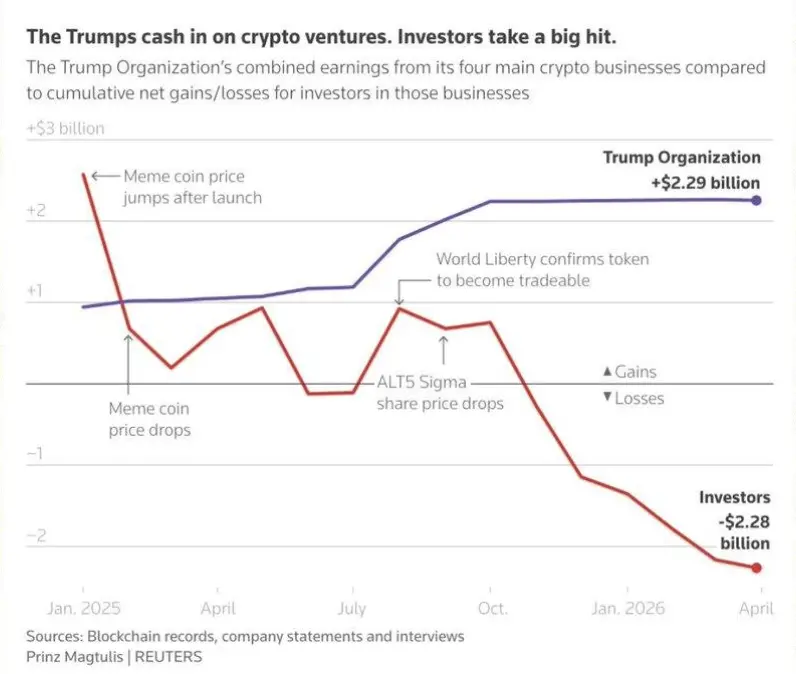
Trump realized that he had a great opportunity to influence both the crypto market and the stock market, and he actively took advantage of it. We focus on crypto here because it is much smaller, more volatile, and easier to manipulate.
When you are the one deciding the market direction, you and those around you have a huge information advantage.
The alleged tactic is simple: determine which market direction is more profitable, establish a position, and then make as much money as possible within the limits of market liquidity.
And keep repeating until people no longer believe you, no longer react to your statements, or until there is no liquidity left to extract.
The problem is that the market is not infinite. The number of gamblers is limited, and their money is limited.
When insiders exploit their ability to influence the market, they can extract huge amounts of money, concentrating wealth in a small group of people, who may not necessarily reinvest that money back into the crypto market.
In addition, Trump and his family issued several tokens, but that is another topic.
Thus, what the crypto community celebrated as a victory during the election period may ultimately turn into its worst nightmare.
2. Crypto Crime
This is essentially the same idea, except you are influencing prices not because you are the President of the United States. You can do this because you control a large portion of a token's supply, and your token has futures trading on a major exchange.
Here is a step-by-step guide:
Create a project, raise funds from well-known investors, use that money to inflate trading volume and fan base, showcase non-existent revenue, raise another round, and negotiate a listing on a major exchange. If you can get futures trading immediately, that's great. If not, keep inflating trading volume until you get it.
Now, you have a machine that looks like it can print money indefinitely.
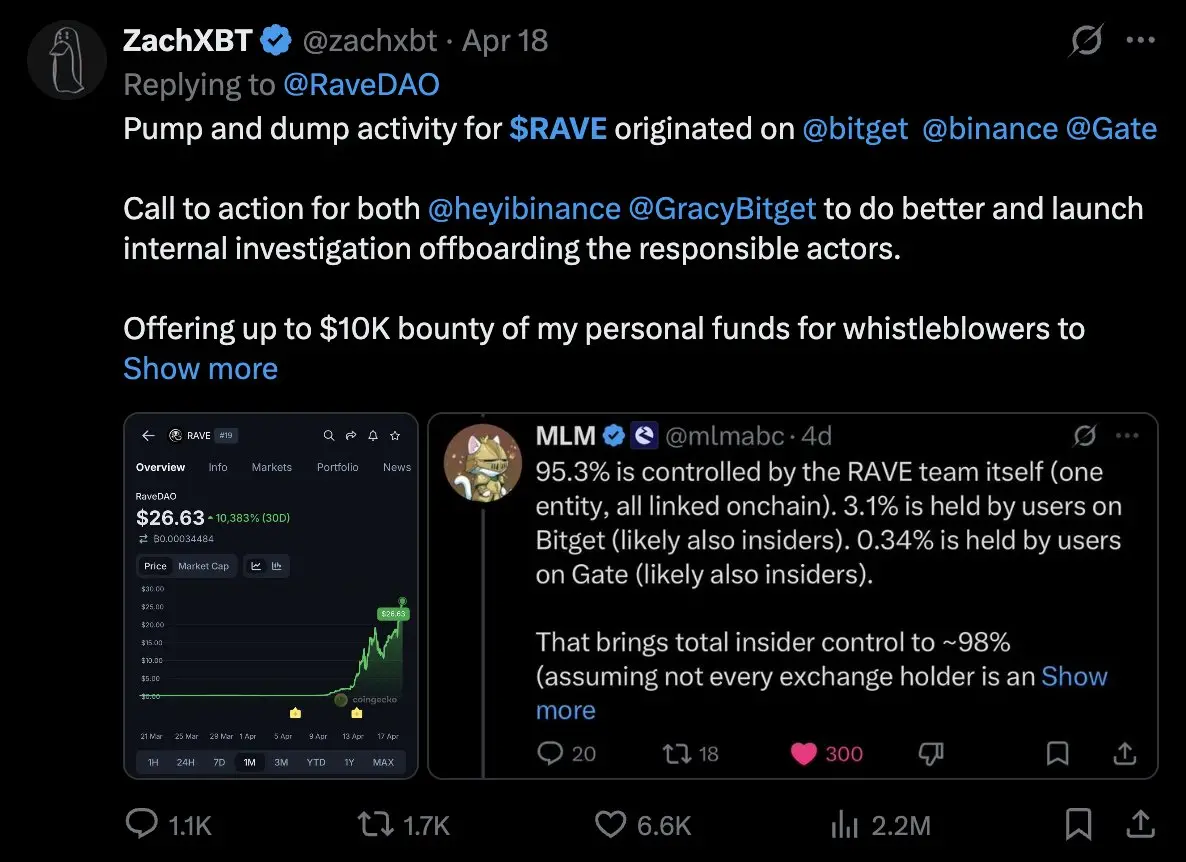
When futures trading is available, and you control a large portion of the supply, you can monitor how many people are shorting and how many are going long. You choose the direction that benefits you, buy or sell enough quantity to trigger a liquidation on the other side, and then take the profit.
Repeat as many times as possible until your token is delisted, or until this tactic no longer works.
To make this method work on a large scale, you need to obtain futures trading on a major exchange because the trading volume comes from there. No matter how good your project actually is, as long as your token has futures on Binance, it can attract hundreds of millions in trading volume.
3. Projects with Severely Overstated Valuations, Whose Revenues Cannot Justify Their Valuations
Crypto is still a relatively emerging industry, so projects often achieve very high valuation multiples. Many people do not really understand what others are telling them. There are countless technologies, grand visions, and so on. This is completely normal.
Like all other industries, most projects that do not meet their assumptions will eventually shut down, while a small portion of projects will drive the market forward.
But crypto has two key differences:
- How revenue is generated
Due to the nature of this market—most people come here looking for easy money opportunities—and the way many founders and marketers position their projects, we end up in a situation where almost everyone's real motivation is to make money, rather than to solve problems.
Founders promise potential rewards to users through airdrops, encouraging them to use their technology. People do use it, but not because this technology solves their problems. They use it because they expect to make money.
Founders then take these metrics to investors, raise huge rounds, and eventually issue their tokens.
They distribute rewards to users, and activity can sometimes drop by hundreds or even thousands of times because people use the product only in anticipation of financial returns.
- Token Issuance
In other industries, if a project fails, it shuts down. Investors lose money, and founders lose time.
But in crypto, even if your idea completely fails, weak regulation and oversight may allow you to continue claiming everything is going well, build a compelling narrative, and issue tokens at a valuation that is grossly inflated and bears no relation to the actual value of the project.
And people will buy it.
Founders make money, investors either recoup part of their investment or sometimes even make a profit, even though the project should have shut down.
This is essentially an IPO without an equivalent level of regulation and meaningful due diligence. You can issue at any time, pay to get listed on exchanges, and then you're off. The level of scrutiny can be surprisingly low.
One of my colleagues even created a product I really like called Valueverse. It compares actual revenue to valuations to find undervalued projects.
This helps explain why so many crypto tokens trend downward after issuance, while a few become exceptions, sometimes due to manipulation rather than real demand. Meanwhile, many projects that actually generate real revenue do not even issue tokens.

If we return to the basic principles of the market, as long as more and more people keep coming in, this model can operate. But theoretically, if no real value is created, it cannot operate in the long term.
Everyone wants to make money, but someone has to lose money. So founders start mass-producing projects and treat token issuance as an exit liquidity.
I know many teams that used to issue projects and still issue multiple projects every week. Imagine that. Several projects every week. They just package the projects, fabricate attractive metrics, pay influencers for promotion, and then the profits come.
4. Rug Pull
In the previous examples, we talked about severely overstated valuations. By every metric, a project should be worth $10 million, but its valuation is $1 billion.
Here, it is just a massive issuance of memecoins. Many teams are doing exactly the same thing.
Their probability of losing money can be extremely low because they control the supply and can sell their holdings. Even if only 1 out of 100 tokens takes off, they can make a fortune.
That's it.
Again, no real value is created here. You are just given an opportunity that satisfies the gambling instinct, just like in a casino.
However, traditional casinos sometimes lose money in the short term. Here, the operators can arrange things so that they have almost no downside risk. And your odds may even be worse than in a casino.
The result is that the market is increasingly shifting towards institutional participants and products with real use cases. Simply having a compelling story no longer works as it used to, and most of the easy money opportunities that followed have also ceased to work.
You could say that the industry has matured, and I agree. But at the same time, a relatively small group of people has extracted huge amounts of money, and the market feels nothing like it did in the early days. This is inevitable because this model has been fundamentally unsustainable from the beginning.
At the same time, I believe this industry has tremendous potential, and I am confident it will continue to grow in the long term, just not in the same form as before.
This industry was once filled with extremely incompetent people who built ecosystems without any understanding of how to run a business, but everyone was throwing money at them. Then, they would hire some of the most unqualified experts I have ever seen and pay some of the highest salaries I have encountered.
Most of those people have now left, which is a good thing. Money is no longer handed out to everyone for no reason.
This creates an incentive to build real businesses that solve real problems. And this should ultimately have a very positive impact on the industry.
ChainCatcher reminds readers to view blockchain rationally, enhance risk awareness, and be cautious of various virtual token issuances and speculations. All content on this site is solely market information or related party opinions, and does not constitute any form of investment advice. If you find sensitive information in the content, please click , and we will handle it promptly.





Popular articles