NVIDIA offers free open models, why does the world modeling company charge?
 Core Viewpoint


 What exactly is a world model, why are there almost no companies publicly disclosing the most important progress in 2026, and how can we assess the investment value of this track?
Author: Sid, IOSG
What exactly is a world model, why have almost no companies publicly shared the most important advancements for 2026, and how to assess the investment value of this track.
Generating a world that is indistinguishable from reality is a problem that has been solved. Keeping the model usable after changes occur in the world is a problem that has not yet been solved.
TL;DR
There are three different products under the name "world model": world generators, predictive world models, and world-action models. Their buyers, economic models, and competitors are all different. The judgment method boils down to one question: can it model a specific real warehouse.
Benchmark scores do not adequately explain the issues. A model scoring about 95% on LIBERO dropped below 30% in the perturbation test LIBERO-Plus. A comparative study in 2026 shows that world models are more robust against appearance perturbations like lighting and background, but worse in terms of camera angles, with inference speeds 7.6 to 83 times slower; a sufficiently diverse ordinary VLA (π0.5) can level the playing field or even outperform.
The diversity of the training environment is more important than the amount of data. The value of a simulation environment lies in its interactivity (geometry, physical parameters, kinematics, simulator compatibility), rather than visual realism. Joint training with real data can improve performance on real tasks by about 1.6 times.
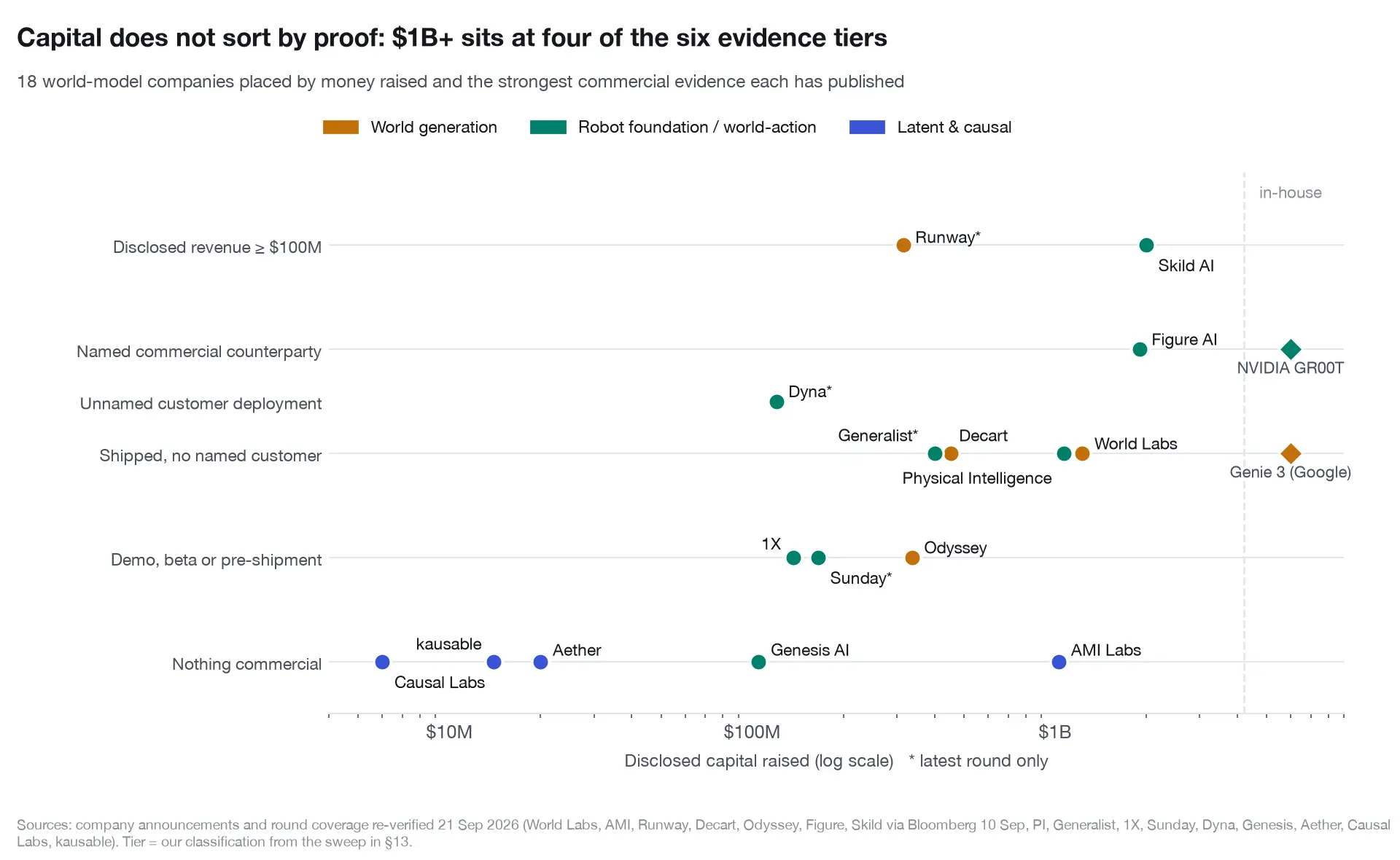
Over $3B flowed into world models in the first half of 2026. NVIDIA controls pricing power through open-source GR00T and equity swaps for GPUs. Only 4 out of 18 companies have named clients.
By software revenue, the market size in 2033 is estimated to be around $11-17B, with world model vendors potentially earning $2-6B. Greater value accrues to those who control deployment. Companies with paid deployments and the ability to feed failure data back into the model should be favored.
1 What is a World Model
In simple terms
You are about to walk through a door. You push the door open, and before your foot even lands, you already have a rough idea of what the next room looks like: the floor can support you, and the door will swing in a certain direction.
You have been doing a rough simulation of the world in your mind and acting based on the results of that simulation.
A world model is about enabling machines to have the same thought process: to build an internal model of how the environment evolves and to be able to ask it: What will happen next? and more importantly, What will happen if I do this?
This is important because while language models have read about gravity, they have never dropped anything. A robotic arm trained through thousands of human demonstrations learns a kind of conditioned reflex—if the scene looks like this, move like this—rather than understanding, like mimicking without comprehension. Move the camera by 4 degrees, and this reflex fails because no part of the system knows why this action is effective.
The entire track can be summarized in one sentence: What the model learns is what things tend to occur together, rather than the underlying rules that govern them. Each technical route below aims to solve this problem, but each route trades one capability for another.
Why is it worth paying attention to?
The environments in games and films can be generated directly without manual construction, which will change the cost structure of production across the entire industry. Autonomous driving and warehouse automation can rehearse rare and dangerous scenarios millions of times without needing actual accidents to occur. As for robots—the real, physical ones that come into your home to help you fold clothes—whether they can be realized also depends on this, because a robot that can only work in a training room is merely a demonstration, not a product.
Categorical issue: Three products, one name
This is the first thing to clarify, as much of the confusion in this track stems from naming, and most erroneous comparisons start here. Three completely different products share the label "world model." Their buyers, economic models, and competitors are all different.
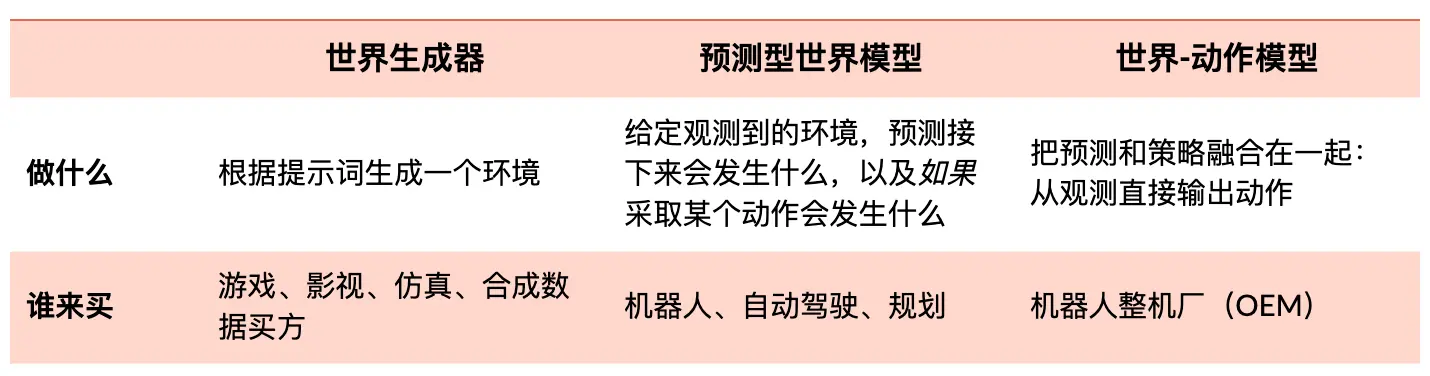
A practical judgment method requires just one question. Aim it at a real warehouse and ask it to model this warehouse. Generators cannot do this—they can generate a warehouse that looks reasonable, but not this one. The size of the reachable market is determined by this point.
Where is the structure of the world placed?
All methods in this field originate from the same starting point: predicting the next state. The divergence of each route lies in where the structure of the world is placed. This architectural choice determines persistence, editability, coverage, cost, and moat.
Here is the distribution of various companies.
Persistence and realism are inversely related; coverage and generality are inversely related; explainability and scale are inversely related. No route is without bottlenecks—the only question is which bottleneck you would prefer to be stuck at three years from now.
The difference between the latent-predictive route and the causal-latent route is just one technical concept: identifiability. It is a formal guarantee that ensures the variables recovered by the model correspond to the real underlying factors in the world, rather than statistically useful "shadows." A model that predicts accurately learns correlations, possibly for the wrong reasons; a model with identifiable causal latent variables can, in principle, answer What would happen if I intervened?
2 Measurement Issues
Why benchmark scores in this field do not explain much
LIBERO is a standard manipulation benchmark consisting of desktop tasks that a set of robotic arms must complete. The current state-of-the-art (SOTA) is about 97.2%, with several models clustered around 93-96%. So when a company advertises "about 99% on LIBERO," it is actually announcing that it has improved by about 1.8 percentage points in a narrow range at the top of an already saturated benchmark. This is more like a difference due to rounding, not a breakthrough.
Then, at the end of 2025, a team built LIBERO-Plus (arXiv 2510.13626) and posed an obvious yet previously unasked question: What if the room is slightly altered? They perturbed seven variables—camera angle, robot initial state, language instructions, lighting, background texture, sensor noise, object layout—and retested ten SOTA models.
The result is the most important number in this track: models scoring about 95% dropped below 30%.
What is a perturbation test? Answer: it’s like a driving test after learning to drive. A student who has only practiced during the day, on the same route, and in the same car may fail if it rains, the road signs are moved, or the car is changed. The testing method for robotic models is similar: changing the camera angle, lighting, and starting position of actions.
In 1904, a horse named Hans solved arithmetic problems by tapping its hoof. Psychologist Oskar Pfungst proved that it was actually reading the questioner's unconscious subtle head movements. The answer was correct, but the reason was wrong, and it failed when conditions changed: when Hans could see the questioner, the accuracy was 89% (50 correct out of 56 questions); when it could not see, it was only 6% (2 correct out of 35 questions). This illustrates the difference between a clean test set and a perturbation test set.
The performance loss caused by perturbations is shown in the figure below:
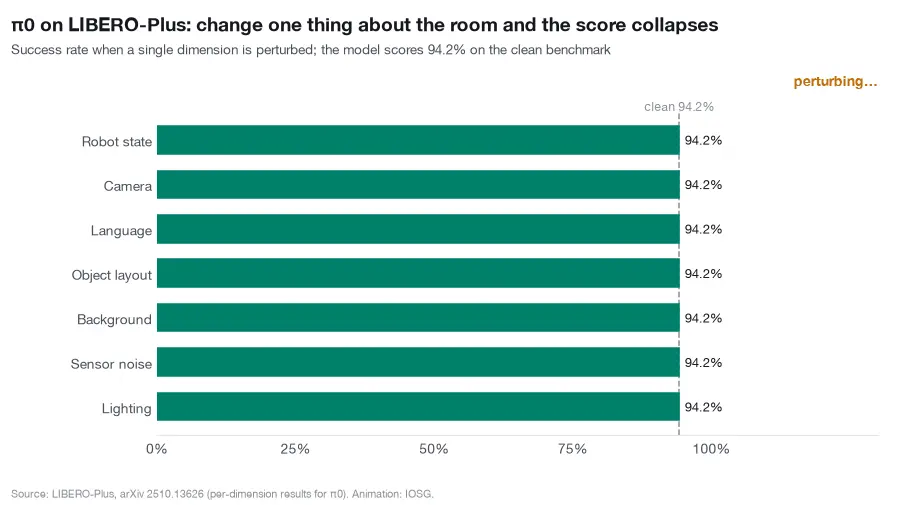 π0 scored 94.2% in the clean test, but when the robot's starting position was changed, the score dropped by 87.6 percentage points. This model did not learn the task; it merely memorized the trajectory.
Conclusion from 2026: Do world models generalize better?
This is an ongoing debate in the field. The viewpoint from the world model camp is that strategies with internal dynamic models should degrade more smoothly than strategies that map directly from pixels to motor commands, because what they learn is closer to how the world operates. This claim is appealing, but until March 2026, it was basically just a proposition.
"Do World Action Models Generalize Better than VLAs? A Robustness Study" (arXiv 2603.22078) conducted a formal comparison: testing world-action models (LingBot-VA, Cosmos-Policy, GE-Act), classic VLAs (π0.5, X-VLA, π0, OpenVLA-OFT, UniVLA, RIPT-VLA), and hybrid models (MOTUS, VLA-JEPA) on LIBERO-Plus and RoboTwin 2.0-Plus.
The answer is more interesting than either side hoped.
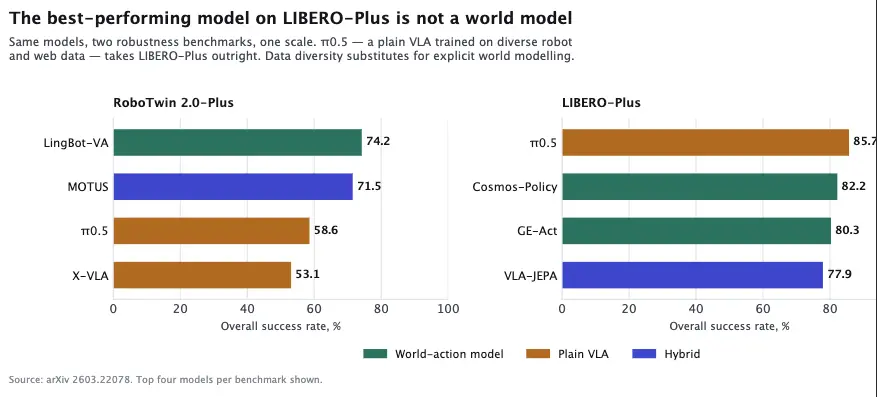
Three findings, each of which will change the way you view project pitches:
1.
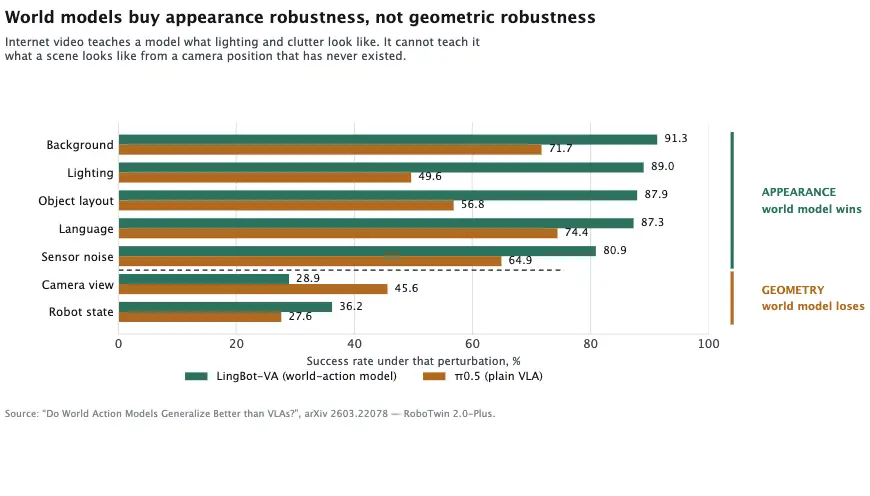
World models provide robustness in appearance, not in geometry. In the dimensional results of RoboTwin 2.0-Plus, LingBot-VA scored 89.0% on lighting, 91.3% on background, and 87.9% on layout, significantly ahead of π0.5's 49.6 / 71.7 / 56.8. However, in terms of camera angles, it dropped to 28.9%, worse than π0.5's 45.6%.
The reason is clear, and the paper explicitly states: world-action models inherit spatiotemporal priors from video-generating backbone networks, which are trained on internet-scale videos. Internet videos can teach models what lighting and clutter look like, but cannot teach models what a scene looks like from a camera position that has never appeared before.
2.
Well-trained general VLA can flatten or even surpass world models. π0.5 ranks first on LIBERO-Plus with 85.7%. The explanation given in the paper is not about architecture, but about data: π0.5 used a diverse set of robot data and network data during training. Data diversity can replace explicit world modeling. This is the most cautionary finding for investors betting on a certain architecture.
3.
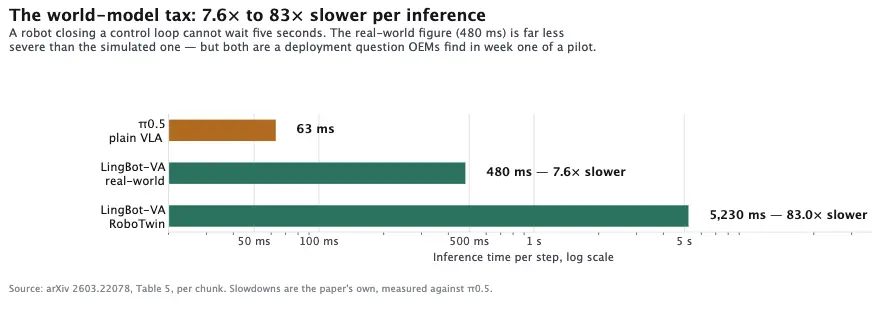
The "performance tax" of world models is real and heavy. π0.5 takes 63 ms per action chunk, while LingBot-VA requires 480 ms in real environments (7.6 times slower) and 5,230 ms on RoboTwin (83.0 times slower) ------ data from Table 5 of the paper. The numbers in real environments are far less severe than in simulations, and can be said to meet deployment conditions; the numbers in simulations do not. In either case, for robots requiring closed-loop control, this is a question of deployability, not a minor detail in a footnote.
What this means for causal pathways. If the causal latent variable pathway is correct, its advantage must manifest as less degradation under perturbations ------ this is a prediction of the argument itself. Scores on clean test sets cannot distinguish this hypothesis from the null hypothesis. As of September 2026, there is no public evidence that causal latent variable models outperform world-action models on perturbation tests. This does not mean that this pathway is wrong, but rather that the evidence does not yet exist. Distinguishing which situation you are facing is at the core of investment judgment.
3 What Kind of Learning Environment is a Good Environment
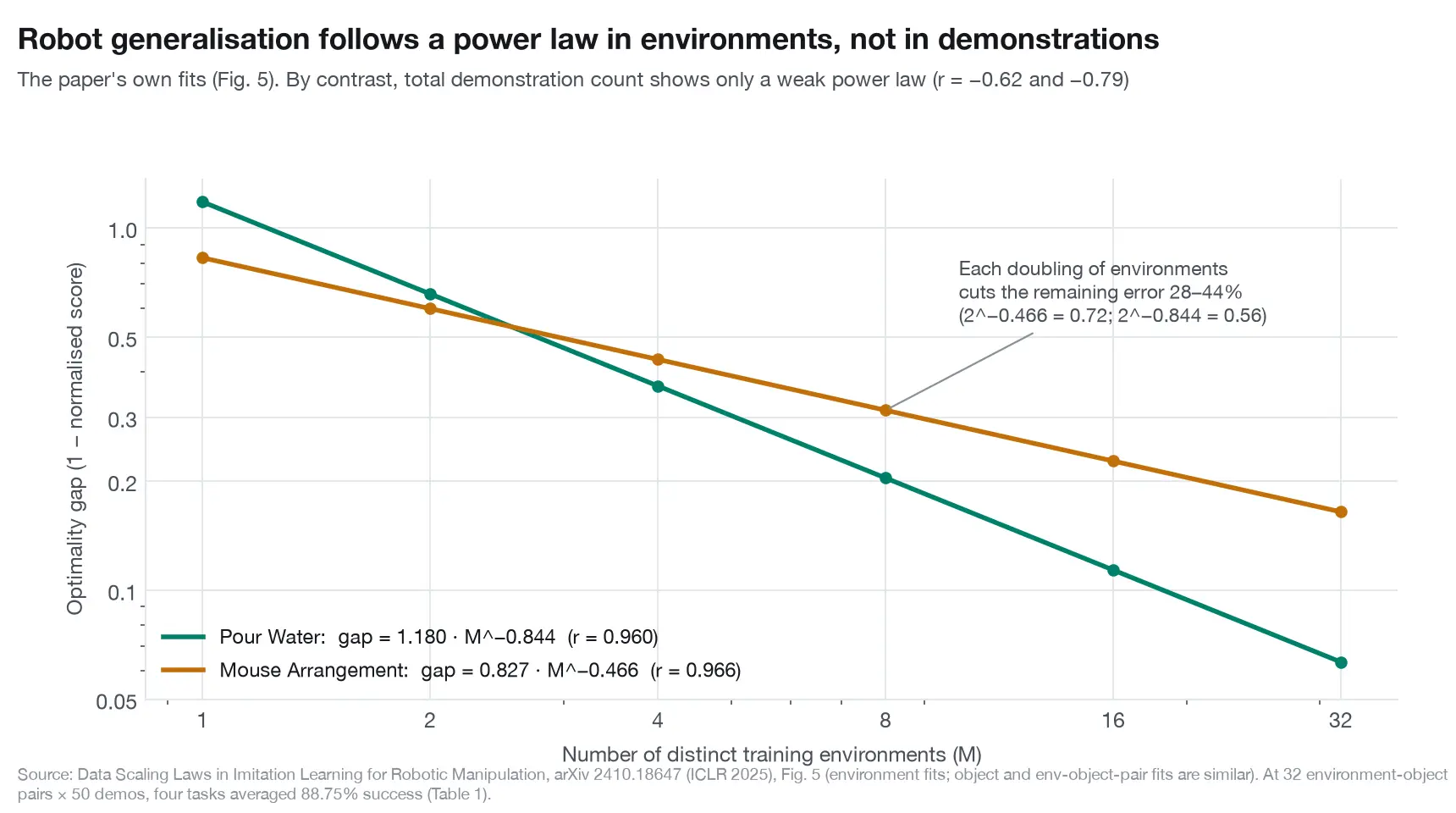
Diversity outweighs quantity The most useful empirical result in robot learning, and also the most unassuming one. "Data Scaling Laws in Imitation Learning for Robotic Manipulation" (arXiv 2410.18647, ICLR 2025) collected over 40,000 demonstrations, performed over 15,000 real robot tests (rollouts), just to answer one question: if the data budget is fixed, where should it be spent?
Three findings:
Generalization ability is roughly power-law related to the number of training environments and objects.
The diversity of environments and objects is far more important than the raw number of demonstrations.
Once the number of demonstrations in a single environment exceeds a certain threshold, continuing to increase demonstrations in the same environment has almost no effect.
The practical method given in the paper states: "Collect data in as many different environments as possible, using only one unique object per environment," and collect 50 demonstrations (K=50) for each environment-object combination. "When the environment-object combinations reach 32, it is usually sufficient to train a strategy that can operate in new environments and interact with unseen objects."
To collect enough data for two of the tasks, the paper describes: "Four data collectors worked for an afternoon."
One company has 1 million demonstrations in one warehouse, while another has 50,000 in 30 warehouses, with the latter having more useful data for generalization.
 What "good environment" technically means: Four requirements
The 2026 review "3D Generation for Embodied AI and Robotic Simulation" (arXiv 2604.26509) does a very useful job: defining simulation readiness, which is the attributes an environment must have before a robot can learn from it. "Aesthetics" is not on the list.
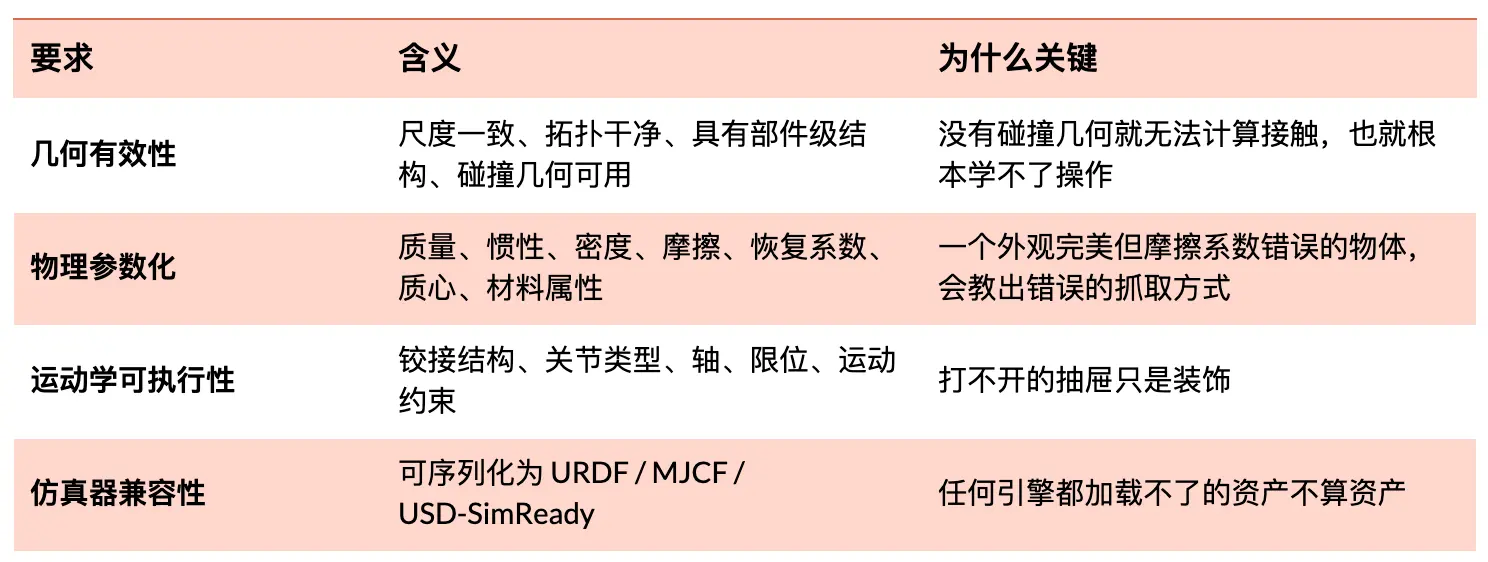 A one-sentence summary of the review's view on the direction of the field best illustrates this shift:
"The field is shifting from visual realism to interactive readiness."
Photorealism is a rendering problem that has essentially been solved and is becoming increasingly commercialized. Interactive readiness, on the other hand, is a problem of physical annotation and asset engineering, which is costly, unassuming, but will continue to accumulate. Some engines excel at rapid contact dynamics, while others excel at navigation, leading to fragmentation in the field.
Domain Randomization: A Truly Rewarding Dimension
Domain randomization refers to deliberately changing the environment during training to force the model to become robust. It is the main means currently addressing the vulnerabilities discussed in §4. RoboTwin 2.0 (arXiv 2506.18088) is the most well-documented implementation:
Five randomization dimensions: clutter, lighting, background, table height, and language
RoboTwin-OD: 731 object instances across 147 categories, with operation-related annotations
50 dual-arm tasks on 5 robot bodies (Aloha-AgileX, ARX-X5, Piper, Franka, UR5)
Reward: VLA models pre-trained on this synthetic data achieved a 367% relative improvement in few-shot real environment transfer and a 228% improvement in zero-shot generalization.
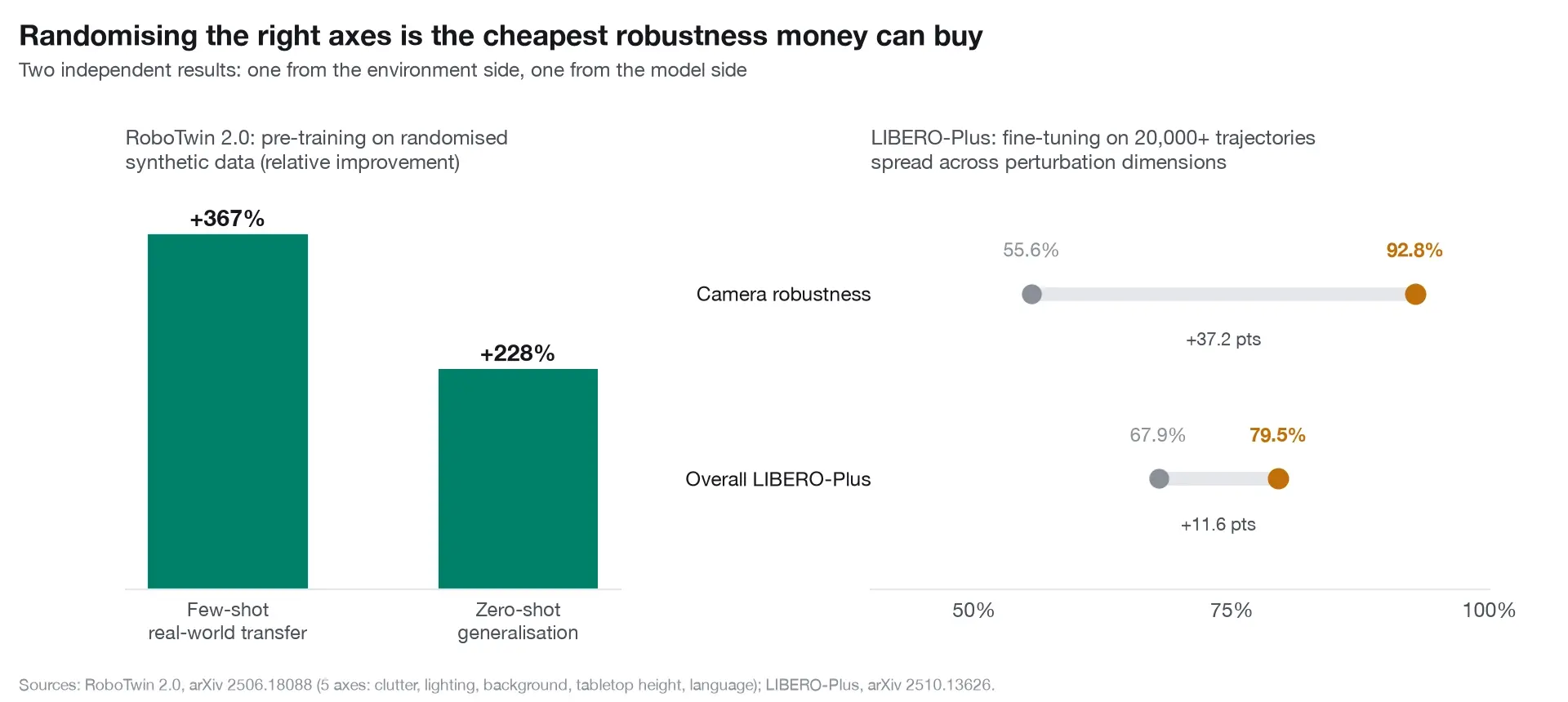 The authors of LIBERO-Plus independently reached the same conclusion from the model side. They analyzed the sources of model robustness and identified three driving factors, none of which are particularly technical:
Wrist camera. Models using first-person wrist camera input have far better generalization ability under viewpoint changes than versions using only third-person perspectives, as the wrist perspective provides geometric cues unaffected by lighting. This is a hardware and data collection decision made years before model training, and is one of the highest-leverage choices in the entire tech stack.
Training diversity and co-training. Emphasizing diversity and mixed distribution co-training strategies consistently produces more robust models.
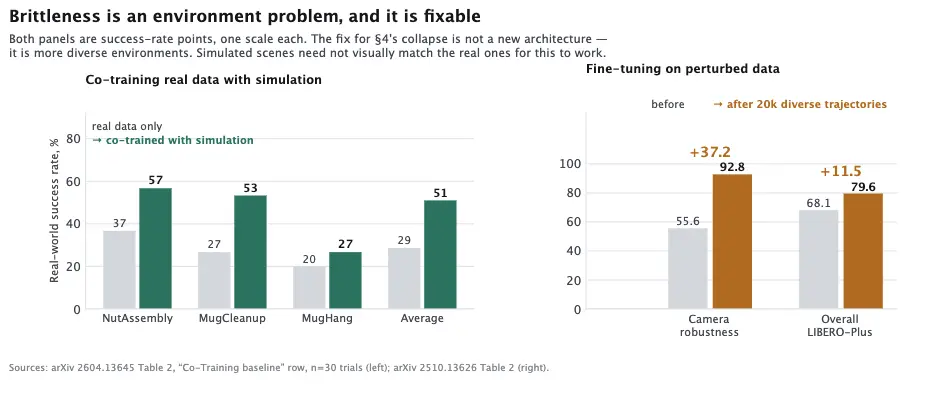
Scale of diversified trajectories. Fine-tuning on 20,000+ diversified trajectories covering various perturbation dimensions improved camera robustness by 37.2 percentage points, with LIBERO-Plus's overall performance rising from 67.9% to 79.5%.
Scalable data is now available. RoboCasa365 (arXiv 2603.04356, ICLR 2026) offers **365 tasks covering 60 types of kitchen activities, modeled after 2,500 unique kitchens based on real American kitchens, including *612 hours of human demonstrations and 1,615 hours of synthetic demonstrations*, totaling over 2,000 hours.
In the words of the paper proposing this method, the trick is to make the simulator vary enough that the real world just looks like another variant. Mixed Simulation and Real Data If simulation is cheap and real data is expensive, then the practical problem is the mixing ratio. Two papers from the past two years provide an answer that is not as intuitive as it seems.
"Sim-and-Real Co-Training" (arXiv 2503.24361) found that simulated data averaged a 38% improvement in real task performance— even when there are significant differences between the simulated and real environments. Simulated scenes do not need to visually match real scenes for transfer to be effective.
"A Mechanistic Analysis of Sim-and-Real Co-Training" (arXiv 2604.13645) explains the reasons, and this explanation is the useful part.
Co-training is determined by two effects:
Structured representation alignment ------ "Changes in structured representation alignment explain about 50% of the loss variance, while the importance reweighting effect brought by mixing ratios accounts for only 20%." The model needs to align representations across different domains for transfer while retaining enough domain-specific information to act adaptively in the real world. The authors refer to this as an optimal range: representations should be "close but not collapsed."
Importance reweighting ------ that is, mixing ratios and dataset sizes ------ only explains about 20%.
Their results come from Table 2 (n=30 trials for each task, "Co-Training baseline" row): NutAssembly 17/30, MugCleanup 16/30, MugHang 8/30, averaging 13.7/30 (45.6%), while the baseline using only real data was 8.6/30 (28.7%). Co-training improved real environment performance by about 1.6 times. Effective mixing ratios fall within the (0.016, 0.3) range: "The best performance always occurs within the (0.016, 0.3) range."
Note → Blind alignment can be harmful. When domain gaps arise solely from physical characteristics, stronger representation alignment is negatively correlated with performance. Making the simulator look more like the real world does not automatically equate to progress. Cases with only physical differences are the hardest to handle: a simulator that looks correct but behaves incorrectly physically is more dangerous than one that is obviously fake.
→ The aviation industry learned this lesson in the 2010s: a stall model's incorrect full-motion simulator could teach pilots the wrong recovery methods. This is why the FAA re-certifies the physical characteristics of simulators, not the visuals.
4 Market
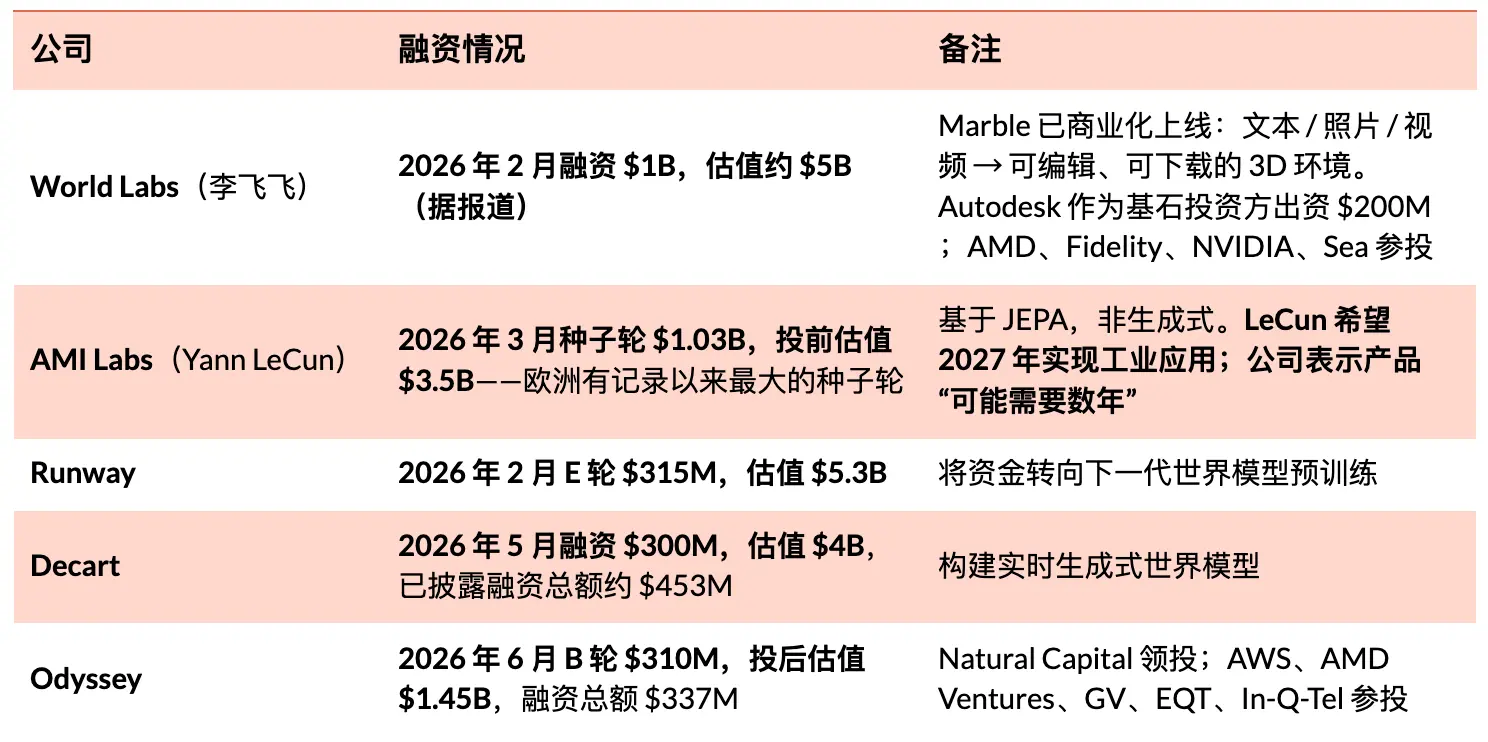
Funding Landscape
Robot Foundation Models / Physical AI
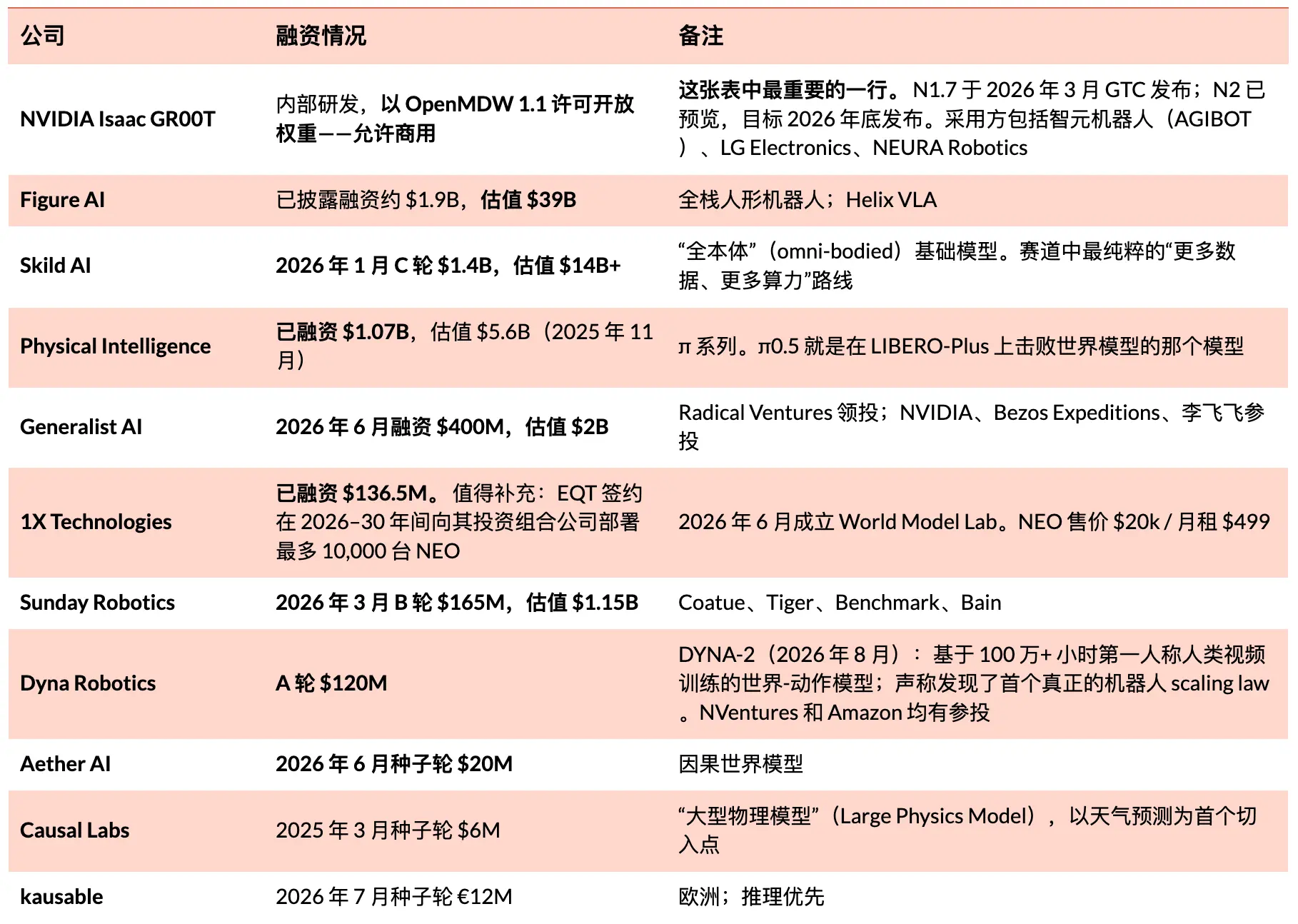 A fact that everyone overlooks: Amazon operates over 1 million warehouse robots. Covariant's general "Covariant Brain" has been absorbed by Amazon. Dexterity, Nimble, Mytra, Ambi, RightHand, Exotec, Locus, GreyOrange, and Dexory have collectively raised over $2.5B. Any project that focuses on logistics should first check against this list------these companies often do not appear in startup competitive analysis charts because including them would make it seem like the market is already occupied.
Total: In the first half of 2026, over $3B flowed into global models; as of mid-June 2026, funding for robotics startups reached $18.8B (Crunchbase), surpassing any previous full year.
Who decides how much a trained model is worth? A structural observation that helps understand possible trends in the coming years.
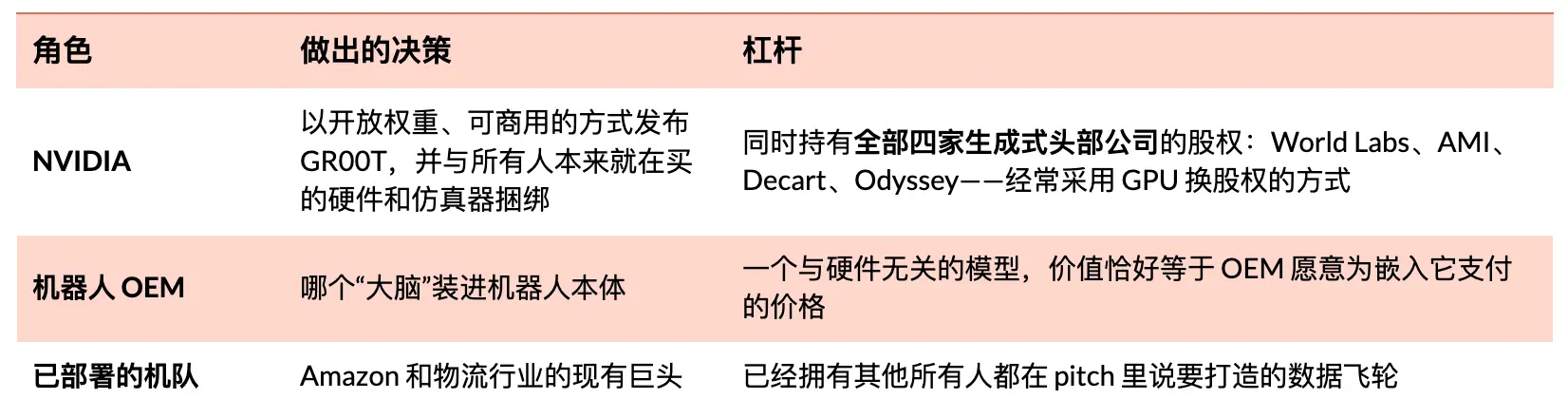 They do not train cutting-edge world models, but they all determine how much a trained world model is worth.
NVIDIA is open-sourcing what other companies are raising billions to build. This is not generosity, but the clearest signal: profits do not lie at the model level. In the summer of 2026, NVIDIA placed Cosmos, Isaac GR00T, and Nemotron under the Linux Foundation's OpenMDW 1.1 license------a license that clearly allows for commercial use------turning this signal into a systemic arrangement.
NVIDIA is commercializing the layer above its products. When a company wants to turn the layer below into a toll booth, it will do so. Its agreement to acquire Hugging Face for $12.9B (announced in September 2026, expected to close in 2027) points in the same direction.
GPU for equity: A mechanism more important than valuation As of July 2026, NVIDIA's equity investments reached $99B, up from about $7B a year earlier. In just the first four months of 2026, it committed over $40B in investments, with $30B directed towards OpenAI; in the first eight months, it participated in 53 rounds of financing of $100M or more (Dealroom). It often exchanges long-term GPU procurement commitments for equity.
Why this is more important than any valuation number: GPU for equity transforms capital advantages into structural advantages in unit computing power (per FLOP) costs, accumulating continuously with each training. A company purchasing computing power at retail prices is not only smaller in scale than competitors supported by NVIDIA, but also pays a higher unit price for the most significant inputs. Over a three-year training cycle, this gap will not narrow; it will only widen.
Market Scan
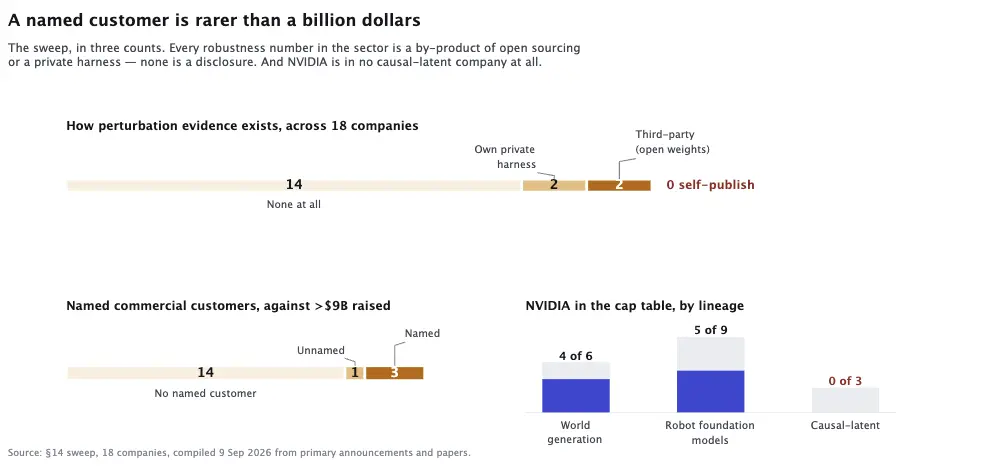
Assumption 1------Few companies publicly disclose true disturbance test results. Among 18 companies, none have independently published comparisons of clean tests and disturbance tests. Every robustness number currently available in the market comes from one of two situations: the company open-sourced model weights, tested by external teams (Physical Intelligence, NVIDIA); or the company built its own testing framework, without external baselines (Skild, Dyna). The most rigorous evidence in this field is the byproduct of open-sourcing, rather than results voluntarily disclosed by companies.
Assumption 2------NVIDIA concentrates investments in leading generative companies. Confirmed, but clearer differentiation is elsewhere. NVIDIA holds equity in all four world generative companies (World Labs, AMI, Decart, Odyssey), as well as five of the eight robotics foundation model companies (Skild, Figure, 1X, Generalist, Dyna). But the clearest pattern is at the bottom of the table: NVIDIA has not invested in any of the three causal latent variable companies.
Also note the one leading company not on NVIDIA's list: Physical Intelligence, whose model currently has the best independent robustness score in the field. NVIDIA's investment direction is unrelated to empirical performance but is tied to computing power consumption.
Assumption 3------7 out of 18 companies have no customer evidence. In this field, deployment is a multi-year process, and finding paying customers is harder than raising a billion dollars; this also indicates a high market ceiling.
 Now let's look at the biggest visible giant here: Tesla.
Tesla has built a neural world simulator: a trained model that inputs the current state and the next action, outputting future sensor data, generating all eight camera views at once, all synthetic data. It is not a video generator that creates reasonable-looking road scenes, but a model conditioned on actions with causality, allowing driving strategies to operate within it and see the results of their actions. Tesla AI Vice President Ashok Elluswamy introduced it as "building the robotics foundation model at Tesla" (ICCV 2025, followed by a keynote at CVPR 2026). Tesla claims this allows strategies to gain the equivalent of hundreds of years of driving experience in a single day, and the same architecture can be transferred to Optimus, using action-conditioned videos for navigation.
The other companies mentioned in this article only occupy one or two links, while Tesla occupies all five. Thus, the same team can have the simulator generate a scenario that the fleet has only encountered twice, train on it, release it, and then observe changes in failure rates.
Conclusion: Tesla believes the advantage lies in the closed loop, not in the model.
flowchart LR
F["The fleet in the real world\
today is cars, the next step is Optimus"] -->|sensor data, takeover records, failure cases| D["data"]
D -->|training| W["world simulator\
action-conditioned, covering all cameras"]
W -->|rehearse rare and dangerous scenarios| P["strategy"]
P -->|OTA push| H["proprietary hardware"]
H --> F
W -.->|pre-deployment evaluation| P

World models inherit robustness in appearance from videos, but will fail on unseen geometries. Driving is primarily about appearance and traffic participants, while geometric structures are repetitive. Operations are about contact issues, and no amount of camera video can teach contact. Tesla's own team also states that hands are the hardest part; public information aligns with this: training data for Optimus now comes from people wearing camera devices, and Tesla claims to have achieved dexterous manipulation with "almost no data coming from teleoperation."
5 Conclusion
One-page investment decision Where to invest. Invest in layers where there are already paying buyers, and no platform offers similar products for free: models plus deployment (models running in a named business), and vertical data and evaluations that every model lab must purchase.
What to bet on. Bet on companies with paid deployments, failure data that can flow back to the model, and partners that own robots or venues. Do not look at benchmark scores, funding scales, research backgrounds, or whether there is NVIDIA endorsement------in our scan of 18 companies, none of these four factors can predict whether a company has customers.
How big can the market be? There are three sub-markets where vendors can charge for software today. The scale of synthetic data generation in 2026 is $0.78--0.79B (projecting 2025 data from a certain source to 2026). Robotics simulation software is $2.25--3.22B, and outsourced game art is $0.65B. The total of the three is $3.7--4.7B. Based on the growth rates provided by various sources------synthetic data grows 31--34% annually, robotics simulation 11.6--16.3%, and game art about 9%------the three will reach $6.7--9.4B by 2030, and $11.2--16.6B by 2033 [our calculations]. This total is an upper limit for two reasons: the synthetic data purchased for robot training overlaps with simulation spending; autonomous driving simulation is completely unaccounted for, as robotics simulation reports typically already include this portion. Moreover, not all of this is revenue from world models: NVIDIA provides its simulation technology stack for free, and existing vendors control most of the toolchain.
Therefore, we assume that world model manufacturers can capture 30-50% of the synthetic data market, 10-25% of the robotic simulation market, and 20-40% of the game art market. Based on these assumptions, the revenue truly accessible to them by 2033 is $2.3-5.9B. The only path to a larger number—AI replacing 10-20% of AAA game internal art budgets, adding an extra $2-6B—relies on an input without sources, thus not included in the baseline scenario.
Compare this figure with the $18.8B that has flowed into robotic startups as of mid-June 2026. The real goal has never been licensing revenue, but rather to become the environmental layer upon which robots and autonomous systems rely, with the value of these platforms far exceeding their underlying software. This is why NVIDIA offers its robotic models for commercial licensing for free and agreed to acquire the open-source model download center Hugging Face for $12.9B. This is also why the evidence in this article leans towards the operators' side. Among the 18 companies scanned, only 4 have named clients: Skild, Figure, 1X (EQT, up to 10,000 NEO), and Dyna (Din Tai Fung, a self-service laundromat in Sacramento). All four sell to actual operators. Meanwhile, the highest-scoring model in the field—the model from Physical Intelligence—has no named clients.
By software calculation, this is an $11-17B market by 2033, from which world model manufacturers may capture $2-6B. In terms of the value it unlocks, it serves as the operating system for physical AI, and this portion of value belongs to the party that masters deployment, rather than the party that masters the model.

ChainCatcher reminds readers to view blockchain rationally, enhance risk awareness, and be cautious of various virtual token issuances and speculations. All content on this site is solely market information or related party opinions, and does not constitute any form of investment advice. If you find sensitive information in the content, please click , and we will handle it promptly.





Popular articles