Four Pillars Latest Research Report: 2026 Digital Asset Market Development Status
 Core Viewpoint


 In 2026, although cryptocurrencies mostly remain low-key, their position within the system is becoming increasingly solid. What can be built on this foundation may determine the direction of the next cycle.
Author: Four Pillars Research Team
Compiled by: Gu Yu, ChainCatcher
Summary
The year 2026 is a paradoxical year for digital assets. Prices are struggling, market attention has shifted to AI, yet the crypto industry is more deeply integrated into the financial system than ever before. Institutions are entering the on-chain market, regulators are creating clearer pathways for digital assets, and stablecoins, tokenized securities, and crypto-native market infrastructure are increasingly connecting with traditional finance. Crypto may have lost the spotlight, but it has gained something more enduring: a place within the system.
This shift has also made the market more selective. Growth is concentrated in areas with clear demand, whether speculative markets like perpetual contracts and prediction markets, or financial infrastructure such as stablecoins, real-world assets (RWA), payments, and institutional on-chain products. Meanwhile, weaker protocols are shutting down, venture capital activity is slowing, token valuations are becoming more sensitive to revenue and value capture, and companies within the industry are converging on fewer, more validated opportunities. The market no longer simply rewards participation but increasingly questions: what truly works, who is using it, and where does value ultimately flow?
It is through this lens that "State of Digital Assets 2026" looks ahead to 2027. The next phase will no longer be about putting more assets, products, and users on-chain for the sake of being on-chain, but rather transforming the infrastructure built over the past few years into real utility, sustainable economic models, and broader distribution. From institutional finance and tokenized assets to new trading markets and agent payments, the core question is becoming consistent: since the crypto industry is entering the system, what value can it prove once inside?
Market Overview
Interpreting the overall crypto market in 2026 through market capitalization, trading volume, and active wallets.
Difficult Start for 2026, Clear Winners and Losers
DefiLlama, CoinGecko, CoinMarketCap, RWA.xyz · As of October 30, 2026
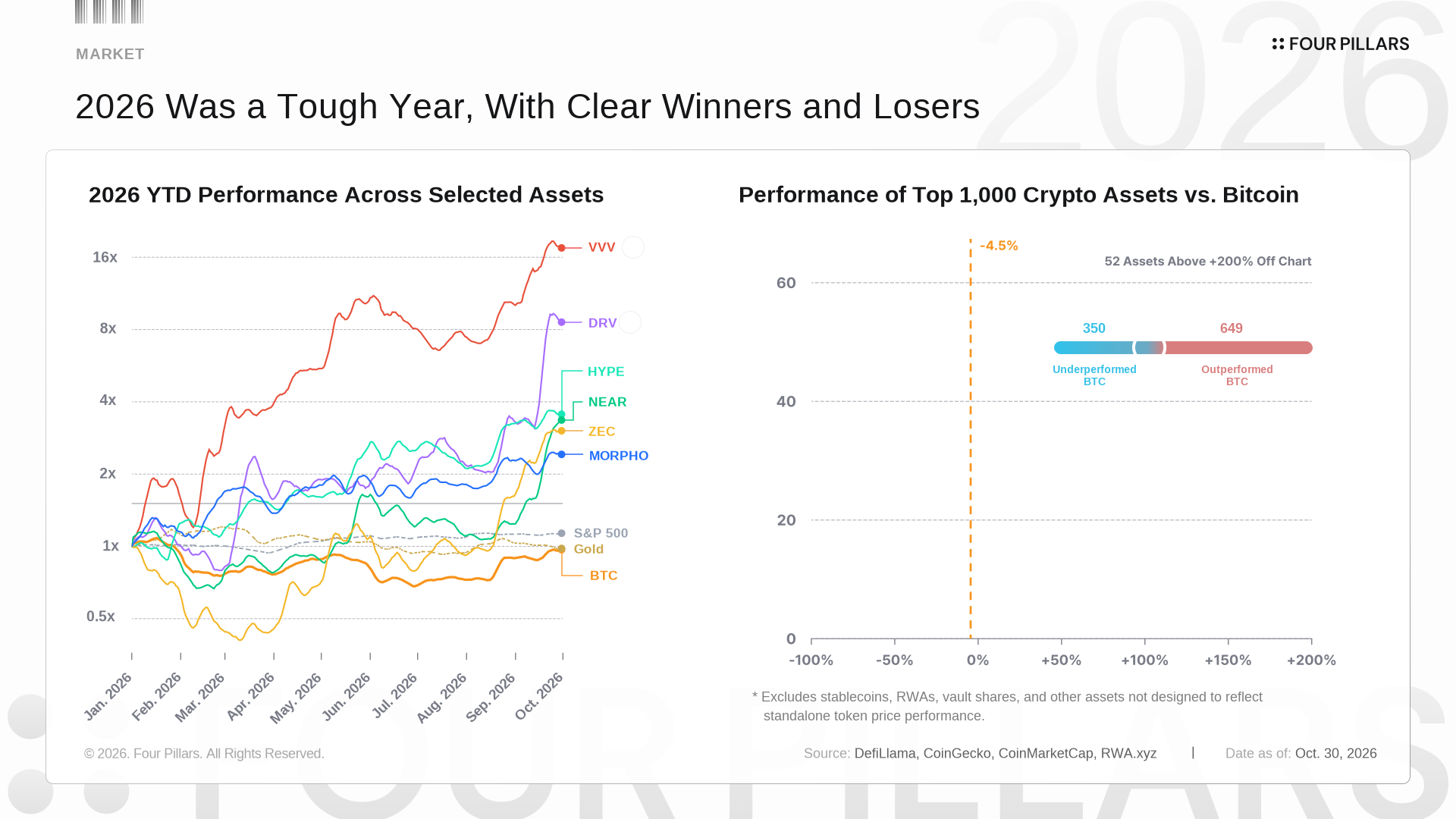
2026 has been a tough year for the overall crypto industry. The market experienced a prolonged pullback in the first half of the year, and even after a strong rebound in the third quarter, the total crypto market capitalization remains below the beginning of the year. By late October, Bitcoin is still in negative return territory. More importantly, this weakness is widespread. Among the top 1000 crypto assets shown in the chart, 649 underperformed Bitcoin, while only 350 outperformed it. Meanwhile, a few tokens such as HYPE, NEAR, MORPHO, and ZEC achieved excess returns. As a result, the scenario of widespread market gains is rare, with returns concentrated among a relatively small number of winners.
Crypto ETF Fund Flows in 2026 Essentially Flat
Farside Investors, CoinGecko · As of October 15, 2026
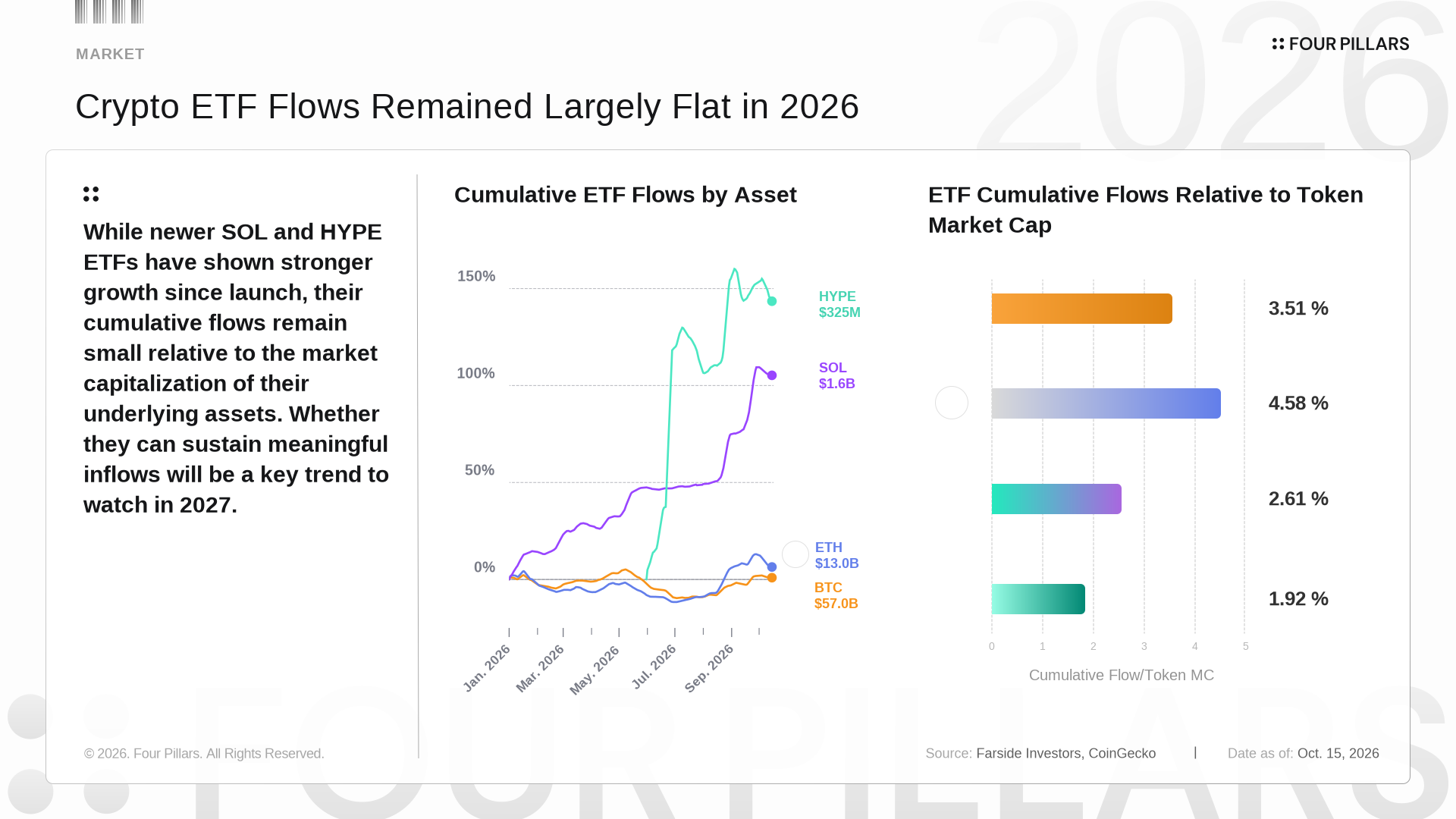
The fund inflows for crypto ETFs in 2026 have essentially stagnated. By the end of this period, the cumulative inflows for BTC and ETH were approximately $57 billion and $13 billion, respectively, with both remaining largely flat for most of the year rather than continuing the strong inflow trend seen after their launch.
DAT Trading at a Discount, Momentum Weakens
Coingecko, mNAV.com, DefiLlama · As of October 9, 2026
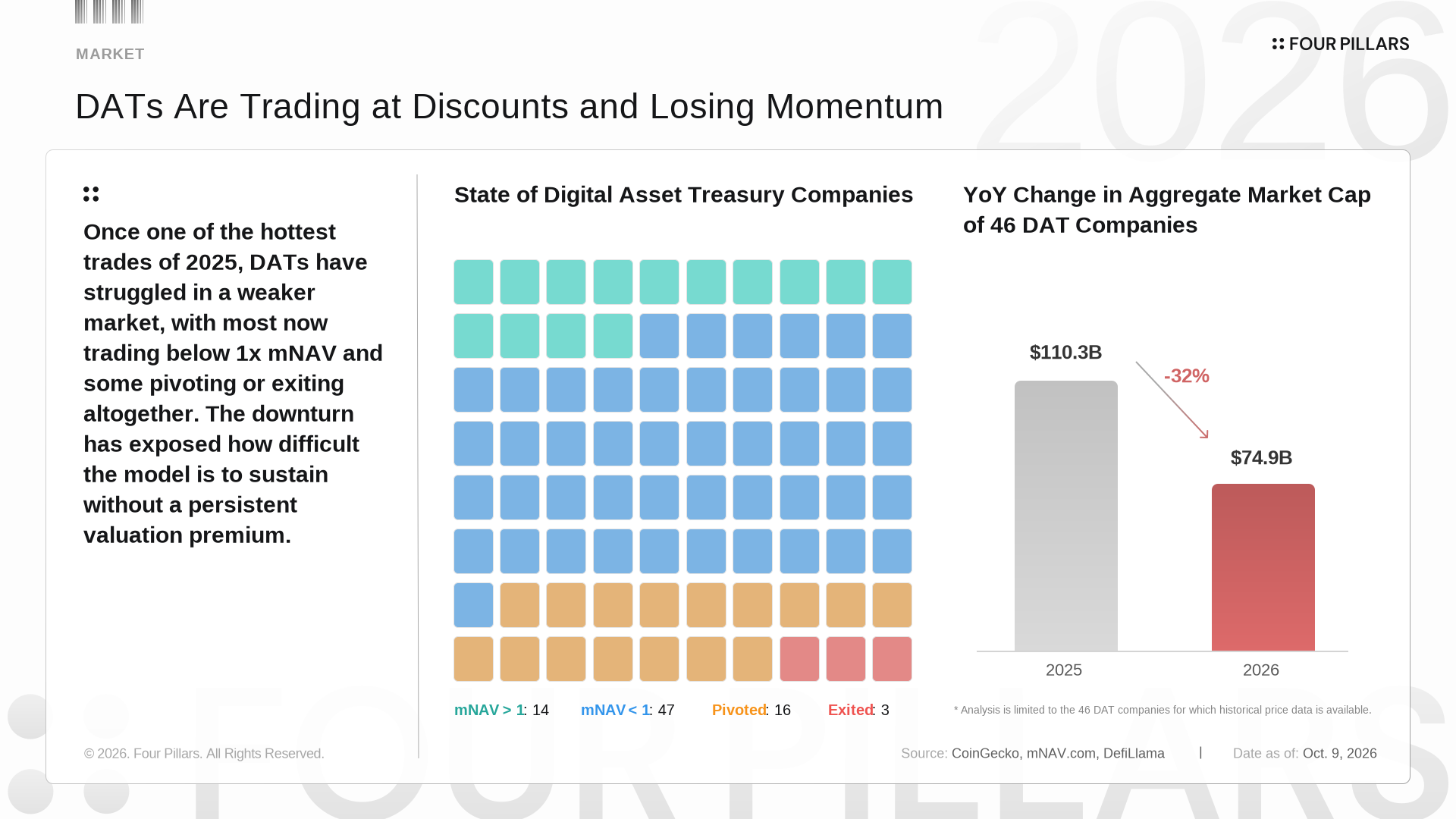
DAT (Digital Asset Treasury Company) was one of the hottest trading themes in 2025, but as the crypto market weakened in 2026, this model came under significant pressure. Among the companies shown in the chart, only 14 are still trading at prices above 1x mNAV, while 47 are below 1x. The total market capitalization of the 46 DAT companies with historical price data also decreased by 32%, from $110.3 billion in 2025 to $74.9 billion in 2026. The issue lies at a structural level. When DAT trades at a price above net asset value (NAV), it can issue shares at a premium, using the proceeds to buy more crypto assets, thereby reinforcing the flywheel effect. Once mNAV falls below 1x, new share issuance dilutes existing shareholders, and this mechanism begins to fail. This is precisely why the general shift to discount trading raises questions about the sustainability of this model. For companies that can no longer maintain the flywheel, the outcomes are increasingly polarized. The chart shows that 16 companies adjusted their strategies, while 3 companies completely exited. In other words, 2026 turned DAT trading from a broad market narrative into a test of which companies can truly navigate a weak cycle based on their capital structure.
Bitcoin May Be Approaching a Cyclical Bottom
As of November 9, 2026
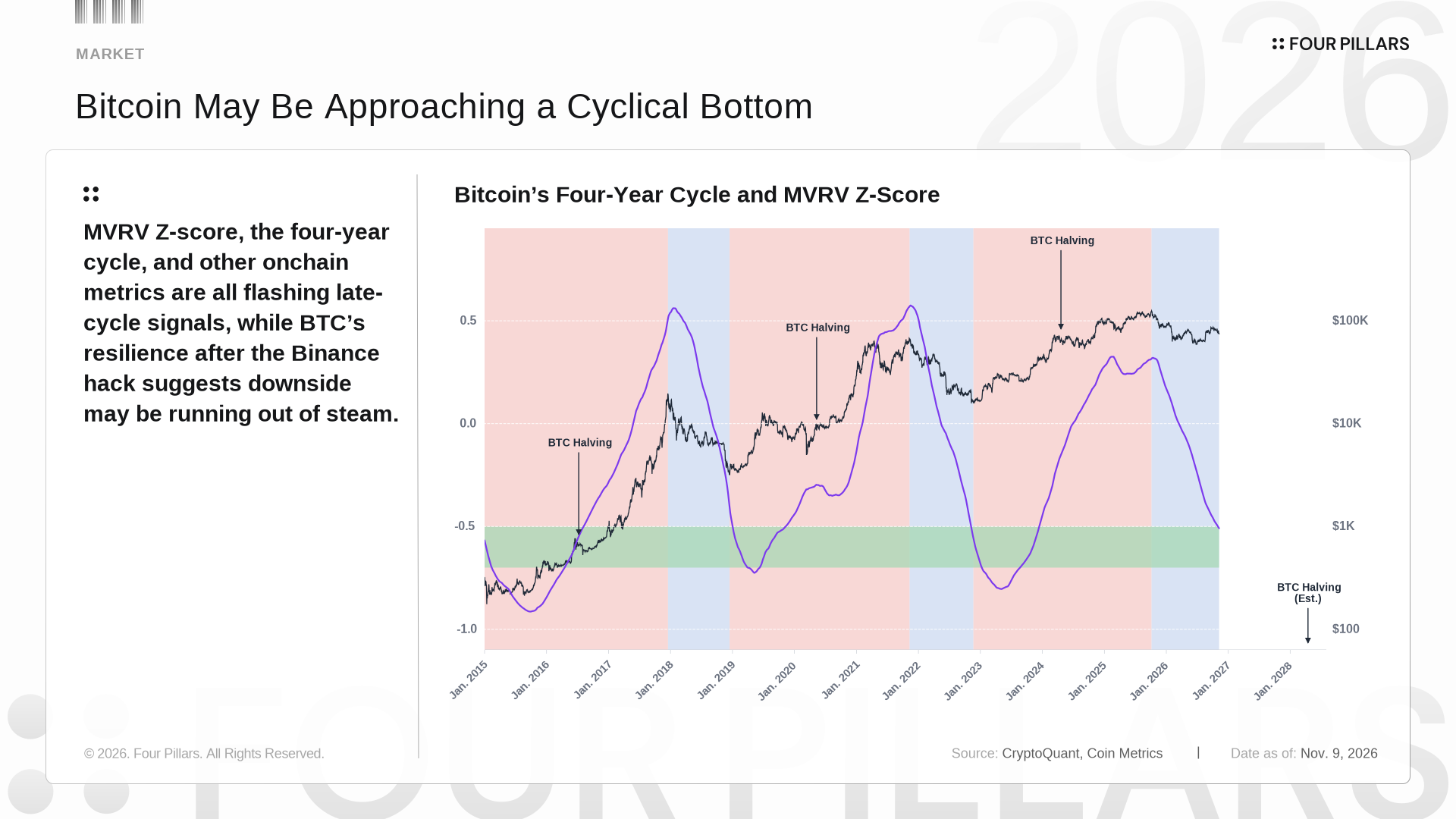
Bitcoin's four-year cycle has historically corresponded quite accurately to significant market turning points. If this framework still holds, the current landscape suggests that Bitcoin may be approaching the later stages of its downward cycle and gradually nearing a cyclical bottom. The MVRV Z-score also points in a similar direction. This metric compares Bitcoin's market capitalization to its realized value (i.e., the aggregate cost basis of holders on-chain) and standardizes the gap between the two using historical volatility. Historically, lower readings typically correspond to undervalued, late-stage bear market conditions, while higher readings often coincide with market overheating. Therefore, the current decline in the MVRV Z-score suggests that a significant reset of Bitcoin's valuation may have already occurred. If the four-year cycle theory continues to hold, Bitcoin may be nearing the bottom region. The question now is simple: can it start to rise from here?
On-Chain Ecosystem Exhibiting a Barbell Structure
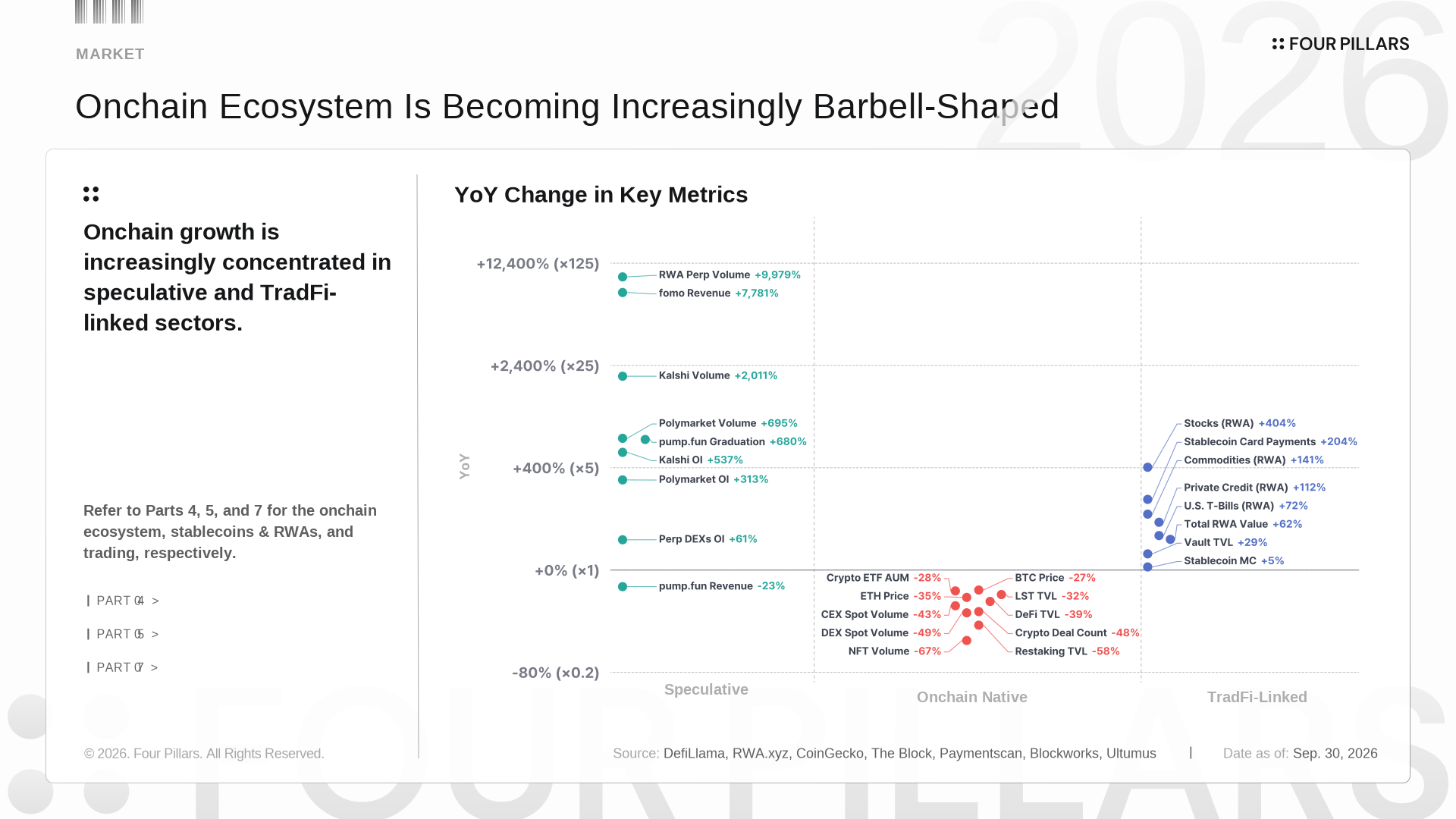
DefiLlama, RWA.xyz, CoinGecko, The Block, Paymentscan, Blockworks, Ultumus · As of September 30, 2026
In 2026, the on-chain market is increasingly exhibiting a barbell structure. Despite the broader crypto market being weak, growth at both ends of the ecosystem remains exceptionally strong. On the speculative end, Kalshi's trading volume increased by 2011% year-on-year, Polymarket's trading volume grew by 695%, and the open interest in perpetual contract DEXs rose by 61%. On the end associated with traditional finance, tokenized stocks grew by 404%, stablecoin card payments increased by 204%, private credit rose by 112%, and U.S. Treasury RWA grew by 72%. For in-depth analyses of the on-chain ecosystem, stablecoins and RWA, and trading, please refer to Sections 4, 5, and 7, respectively.
Crypto Industry Losing Venture Capital Attention
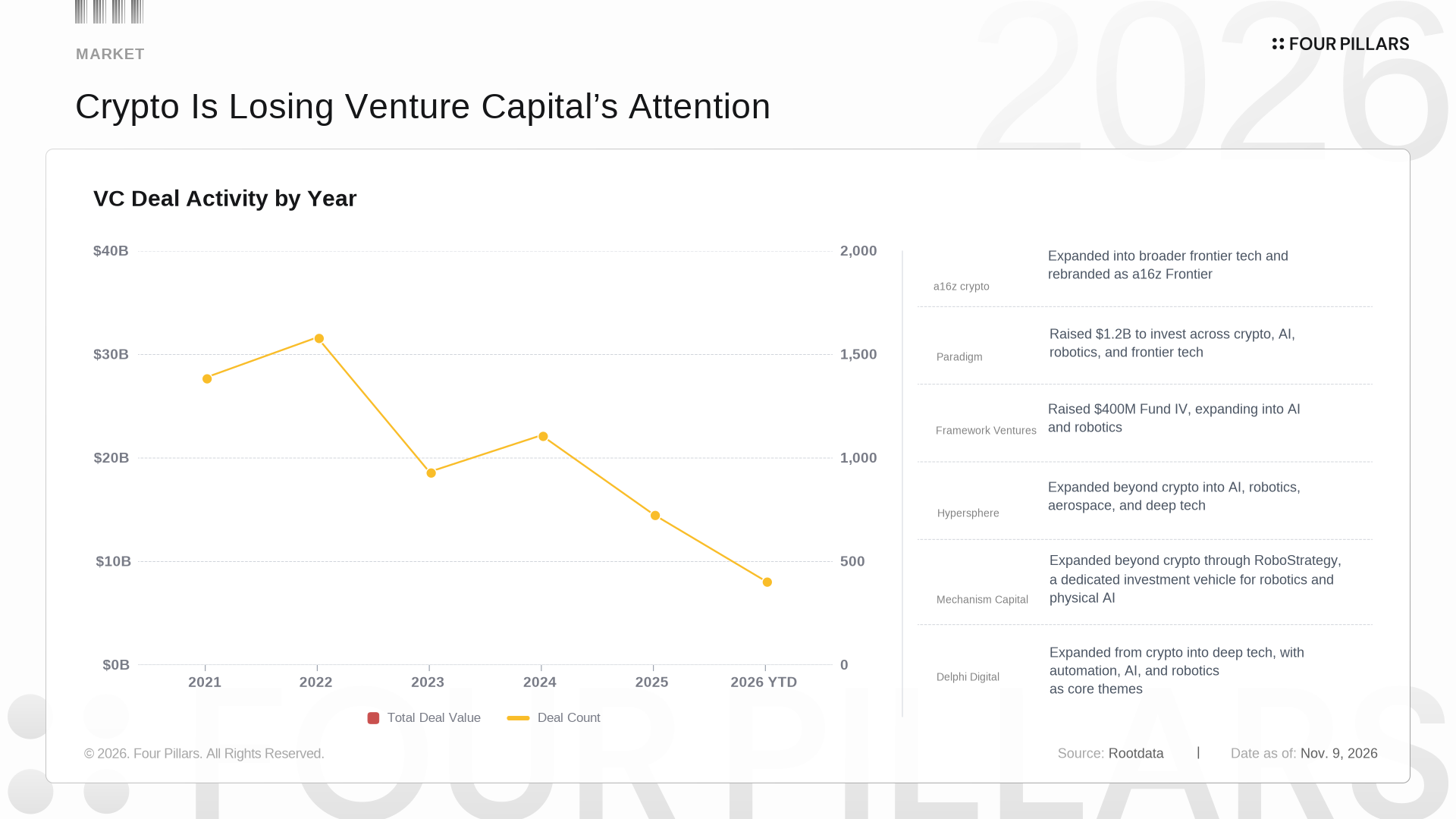
As of November 9, 2026
Venture capital activity in the crypto space has significantly declined from the peak of the previous cycle. The chart shows that the number of deals dropped from over 1500 in 2022 to less than 500 so far in 2026, with the total deal amount also far below the peaks of 2021 to 2022. This shift is also evident among crypto-native VCs themselves. Those companies that were once primarily associated with crypto are increasingly expanding into AI, robotics, physical AI, aerospace, and other cutting-edge technology fields. a16z crypto has expanded into the broader a16z Frontier platform, while Paradigm, Framework, Hypersphere, Mechanism Capital, and Delphi have also extended their investment mandates beyond crypto. The signal being sent is increasingly clear: the crypto industry is no longer just competing for capital within its own sector but is also vying for attention with some of the fastest-growing technology fields.
Mergers and Acquisitions Remain Active as Industry Matures
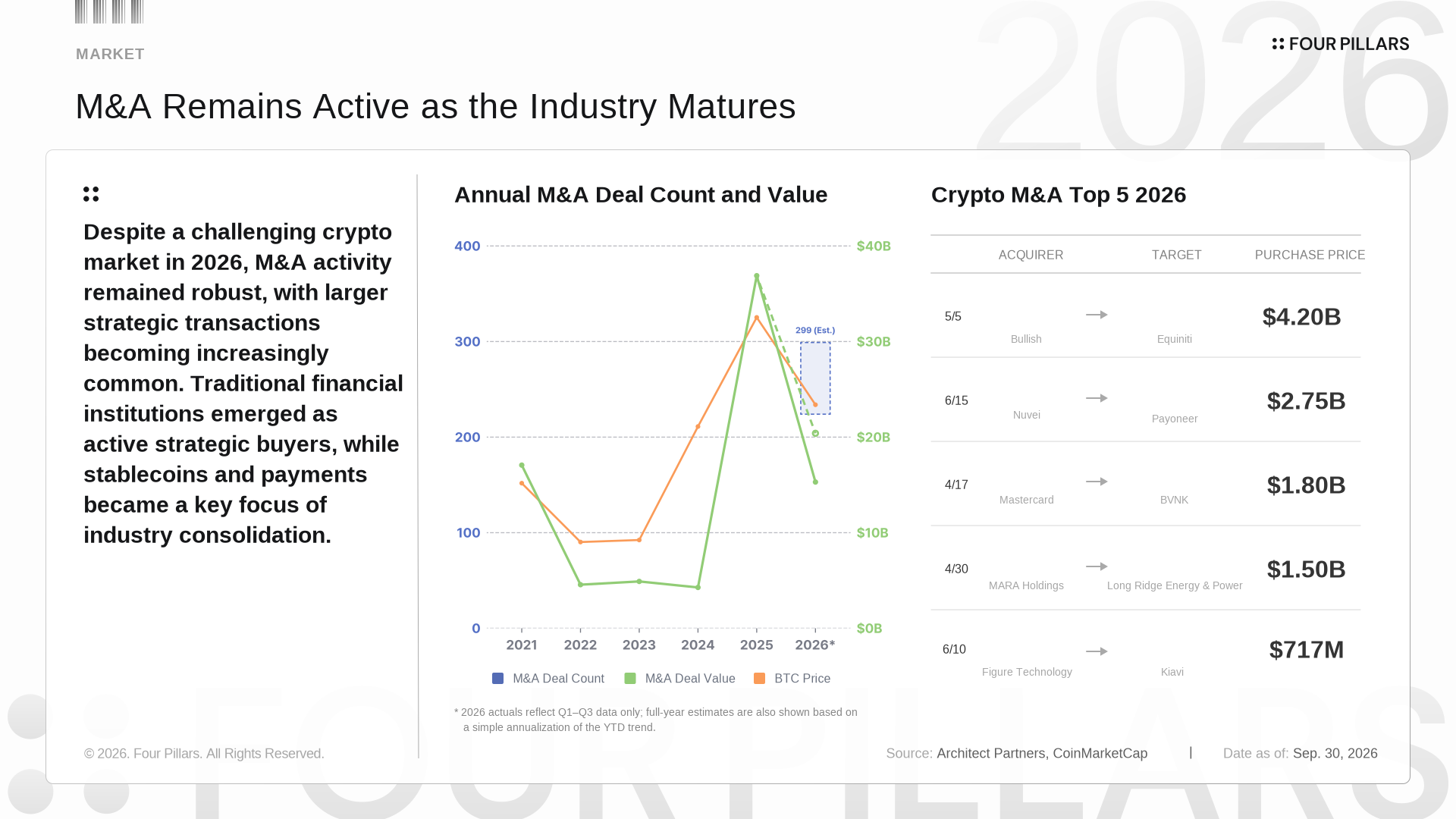
Architect Partners, CoinMarketCap · As of September 30, 2026
While crypto venture capital weakened in 2026, mergers and acquisitions have gone against the trend. The chart shows that the number of deals in 2026 is expected to be around 300, with estimated annual deal amounts still exceeding $20 billion. More importantly, the largest deals have become significantly larger, including Bullish's acquisition of Equiniti for $4.2 billion, Nuvei's acquisition of Payoneer for $2.75 billion, and Mastercard's acquisition of BVNK for $1.8 billion.
Fundamentals Starting to Matter
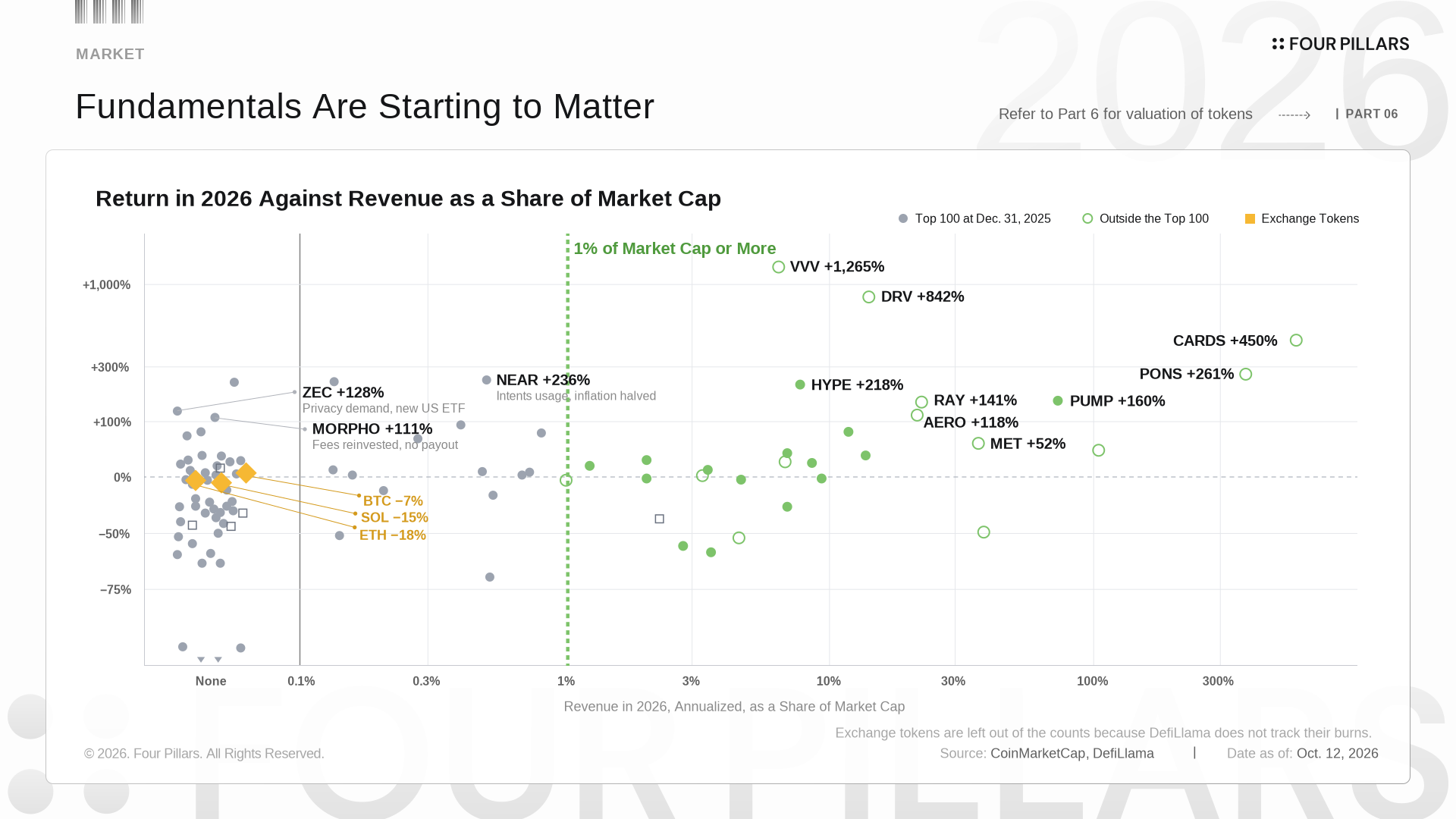
CoinMarketCap, DefiLlama · As of October 12, 2026
Unlike previous cycles, the connection between token performance and fundamentals is clearer in 2026. The chart indicates that protocols generating substantial revenue relative to their market capitalization tend to perform better, while many tokens with little to no revenue remain concentrated in negative return territory. The strongest performing tokens, including VVV, DRV, HYPE, RAY, and PUMP, are also far above the 1% revenue-to-market-cap threshold shown in the chart. This suggests that the market is becoming more selective about what it rewards. Revenue itself does not determine token performance, but the increasingly strong correlation between operational economic conditions, value capture, and price indicates that the crypto industry is beginning to take fundamental pricing more seriously.
Tokenized Stocks Achieve Breakthrough in 2026
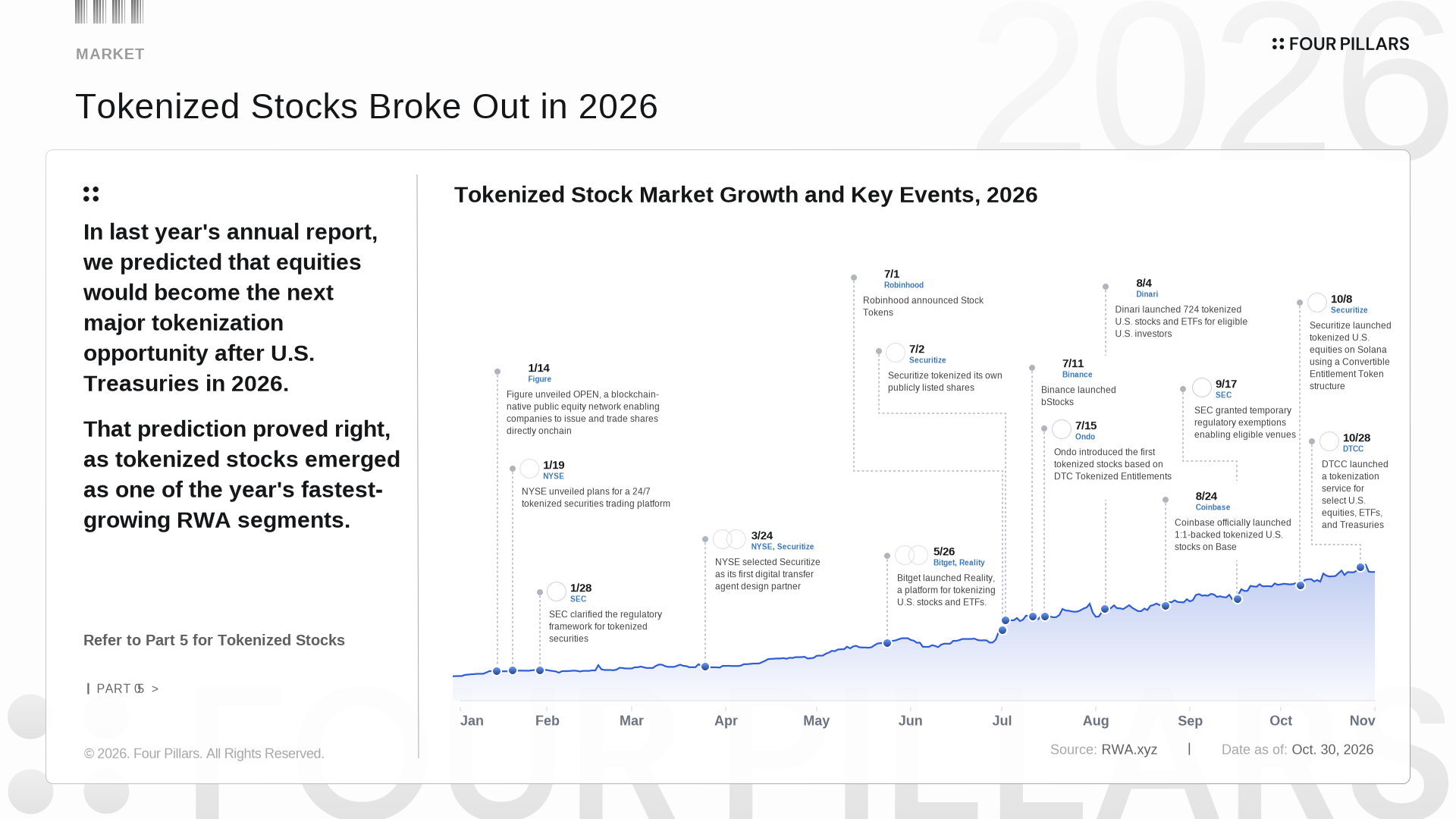
As of October 30, 2026
2026 is the year when tokenized stocks began to establish their position as an important market. Market capitalization steadily climbed throughout the year and accelerated significantly in the second half. In last year's annual report, we pointed out that stocks are the next major tokenization opportunity after U.S. Treasury bonds, and 2026 began to validate this view on a large scale. This shift transcends the market size itself. Robinhood, Dinari, Binance, Ondo, Coinbase, Securitize, and DTCC have all entered or expanded their presence in the tokenized stock space, while the regulatory framework has also become clearer. In September, the SEC granted a temporary conditional exemption for on-chain trading of certain tokenized NMS stocks, paving a clearer path for regulated secondary markets. With platforms, traditional financial institutions, and regulators all moving in the same direction, tokenized stocks are likely to continue being a significant theme for RWA in 2027.
Institutional Adoption and Stablecoins Defined Asia's 2026
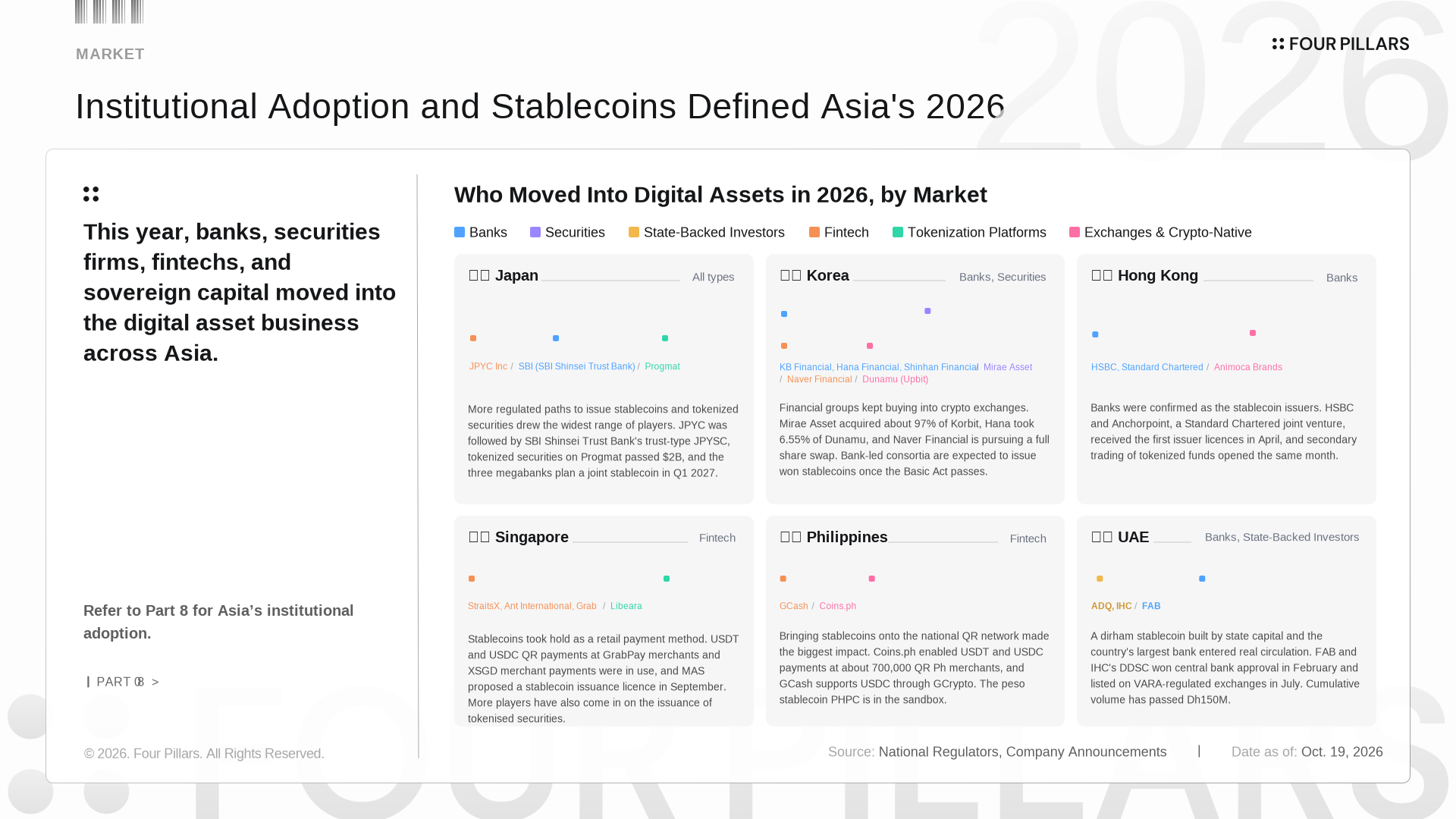
National Regulators, Company Announcements · As of October 19, 2026
Institutional adoption is one of the clearest themes in Asia for 2026. Banks, securities firms, fintech companies, exchanges, and sovereign-backed institutions are delving deeper into the digital asset space, but the forms of adoption vary by market. Japan is advancing regulated stablecoins and tokenized securities, South Korean financial groups are increasing exposure to crypto exchanges, Hong Kong is allowing banks to participate in stablecoin issuance, while Singapore and the Philippines continue to push for payment and fintech-led adoption. The common thread is that digital assets are increasingly entering existing financial institutions rather than developing as an independent industry. Meanwhile, Asia remains highly fragmented, with each jurisdiction following its own regulatory and business path. For an in-depth analysis of institutional adoption in Asia, see Section 8.
Agentic Payments Still Have a Long Way to Go for Mainstream Adoption
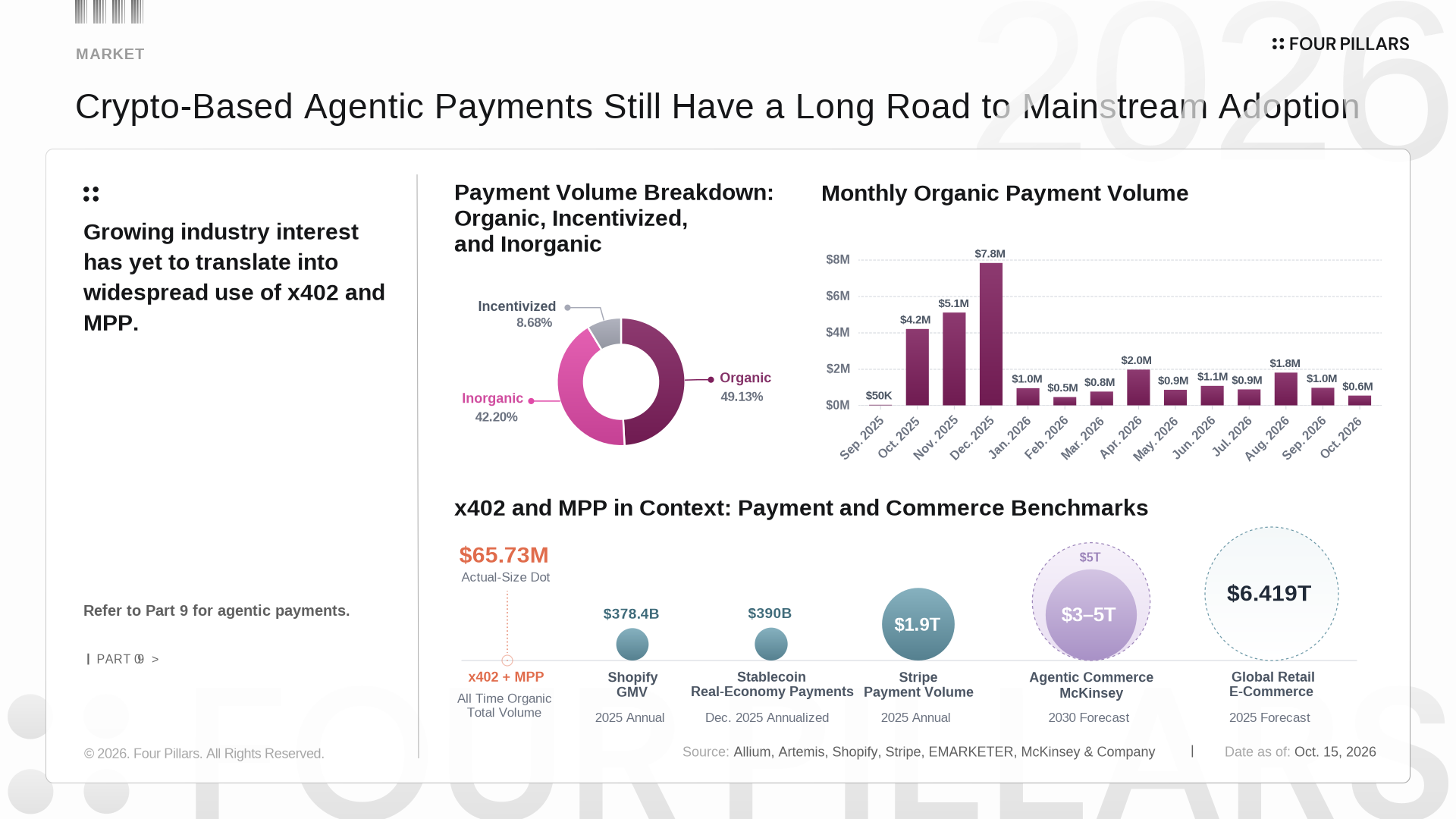
Allium, Artemis, Shopify, Stripe, EMARKETER, McKinsey & Company · As of October 15, 2026
Agentic payments have become one of the most discussed new use cases for crypto in 2026, but actual adoption is still in its very early stages. On x402 and MPP, the total historical natural payment volume is only $65.7 million, with nearly half of the observed activities classified as non-natural, and another 8.7% classified as incentive-driven. Monthly natural payment volume peaked at $7.8 million at the end of 2025, while for most of 2026, it has remained between approximately $500,000 and $2 million per month. This gap is even more pronounced compared to existing payment and commerce markets. Compared to Shopify's $378 billion gross merchandise volume (GMV), $390 billion in stablecoin real economy payments, and Stripe's annual payment volume of $1.9 trillion, agentic payment volume remains negligible, not to mention the projected trillions of dollars in the agentic commerce market by 2030. The infrastructure and concepts are beginning to take shape, but meaningful mainstream usage has yet to arrive. For an in-depth analysis of agentic payments, see Section 9.
Bitcoin at a Crossroads
Focusing on Bitcoin itself: spot ETPs, corporate holdings, and mining economics.
Has Bitcoin Found Its Cycle Bottom?
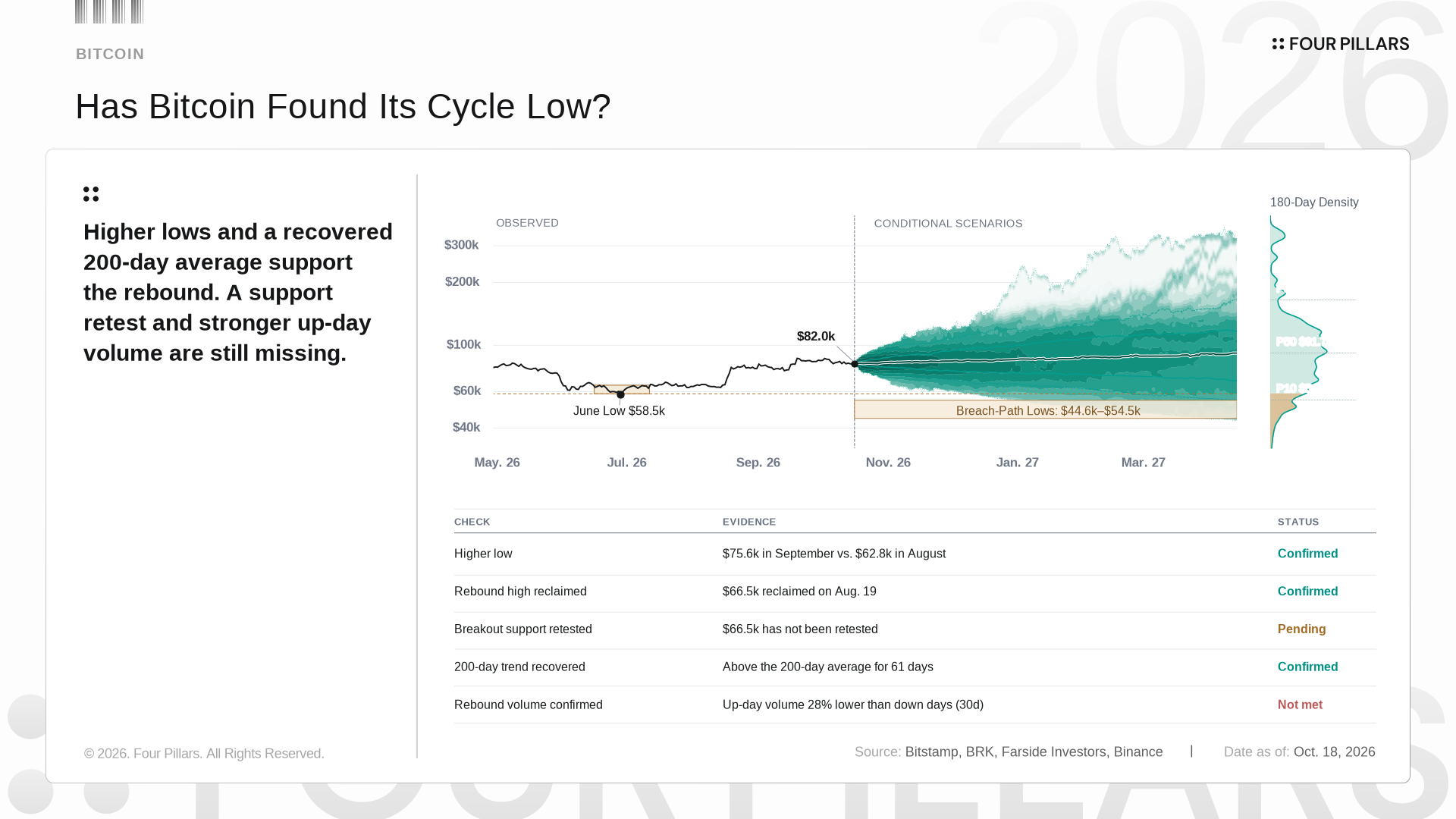
Bitstamp, BRK, Farside Investors, Binance · As of October 18, 2026
As of October 18, 2026, Bitcoin has rebounded to around $82,000, approximately 40% higher than the low of $58,526 in June. The price has reclaimed the 200-day moving average and the cost basis for short-term holders. However, the 30-day short-term holder SOPR is only 1.003, indicating that realized profits are just slightly above breakeven. These indicators support the recovery since the June low, but recent buyers seem to lack a substantial profit buffer to withstand further declines.
Increased Price Correlation Between Bitcoin and S&P 500
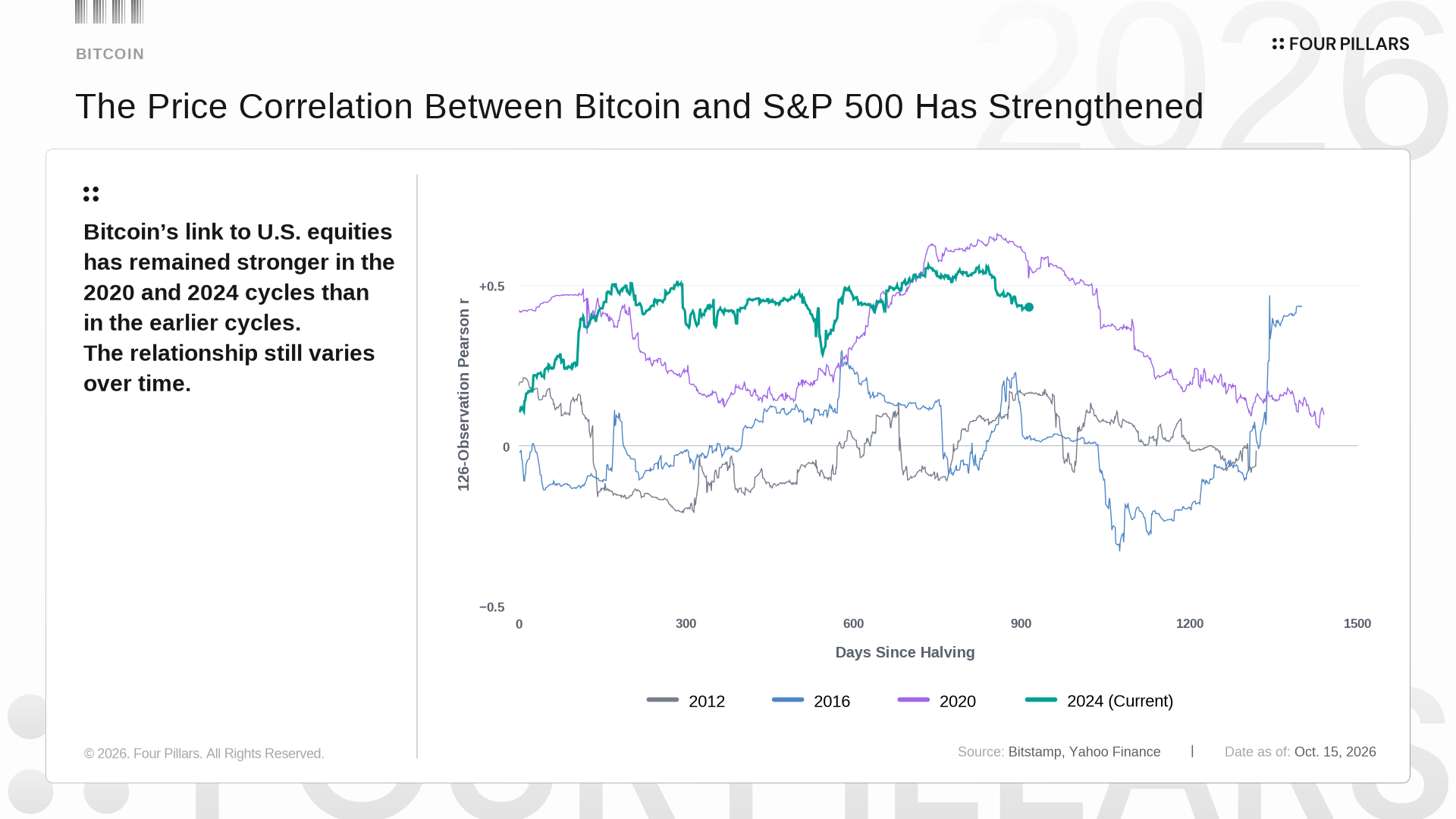
Bitstamp, Yahoo Finance · As of October 15, 2026
Comparing returns over the first 908 days after each halving, the correlation between Bitcoin and the S&P 500 index was -0.06 in the 2012 cycle, 0.07 in 2016, 0.39 in 2020, and 0.43 in the current cycle. The stock market's linkage was weaker in the first two corresponding cycles, but the tendency for both assets to move in the same direction became more pronounced in the 2020 cycle. This relationship has continued into the current cycle. From the beginning of 2026 to October 15, the correlation was 0.494, showing a significant positive correlation with the stock market. The relationship with interest rates is less stable. In the first 908 days of each cycle, the correlation between changes in U.S. Treasury yields and Bitcoin returns was close to zero. However, in the most recent 126 common observations from April 16 to October 15, 2026, the correlations with changes in 2-year and 10-year U.S. Treasury yields were -0.22 and -0.20, respectively, indicating a weak negative correlation. Over the entire available range in 2026, these correlations are closer to zero, at -0.079 and -0.087, respectively.
Quote: Ki Young Ju, CEO of CryptoQuant
Interview: Ki Young Ju
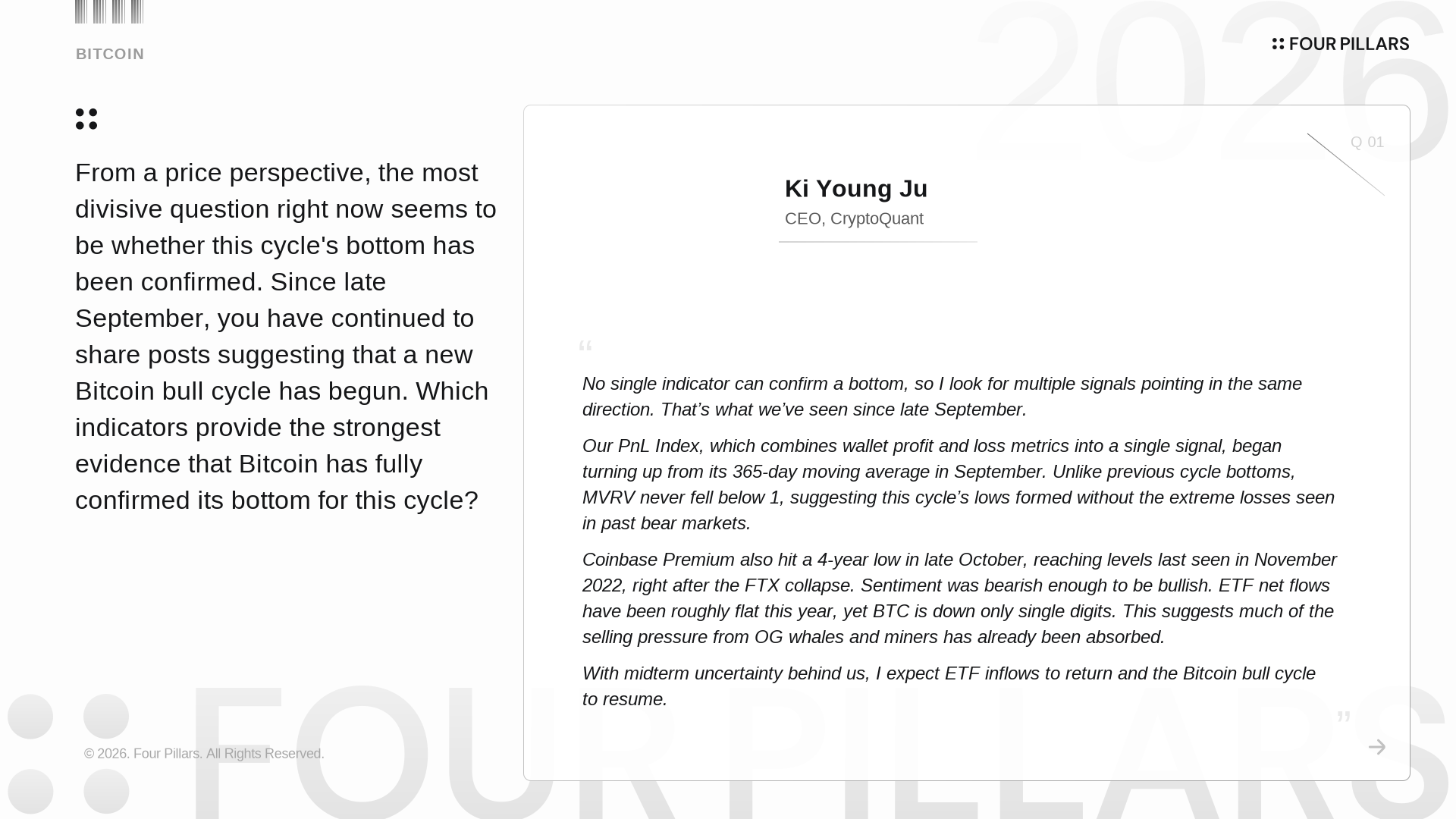
From a price perspective, the most controversial question right now seems to be whether the bottom of this cycle has been confirmed. Since late September, you have consistently hinted that a new Bitcoin bull market has begun. What indicators most strongly prove that Bitcoin has fully confirmed the bottom of this cycle? No single indicator can confirm the bottom, so I look for multiple signals pointing in the same direction. That is exactly what we have seen since late September. Our PnL Index integrates the profit and loss indicators of wallets into a single signal, which began to turn upward from its 365-day moving average in September. Unlike previous cycle bottoms, MVRV has never dropped below 1, indicating that the formation of this cycle's low did not accompany extreme losses seen in past bear markets. The Coinbase Premium also hit a four-year low in late October, reaching levels seen after the FTX collapse in November 2022. Market sentiment is pessimistic enough to become a bullish signal. This year, ETF net inflows have been roughly flat, but BTC has only dropped by single digits. This suggests that much of the selling pressure from established whales and miners has been absorbed. As mid-term uncertainties settle, I expect ETF inflows to return, and the Bitcoin bull market cycle to resume. ------ Ki Young Ju, CEO of CryptoQuant
IBIT Leads Bitcoin ETF Net Inflows
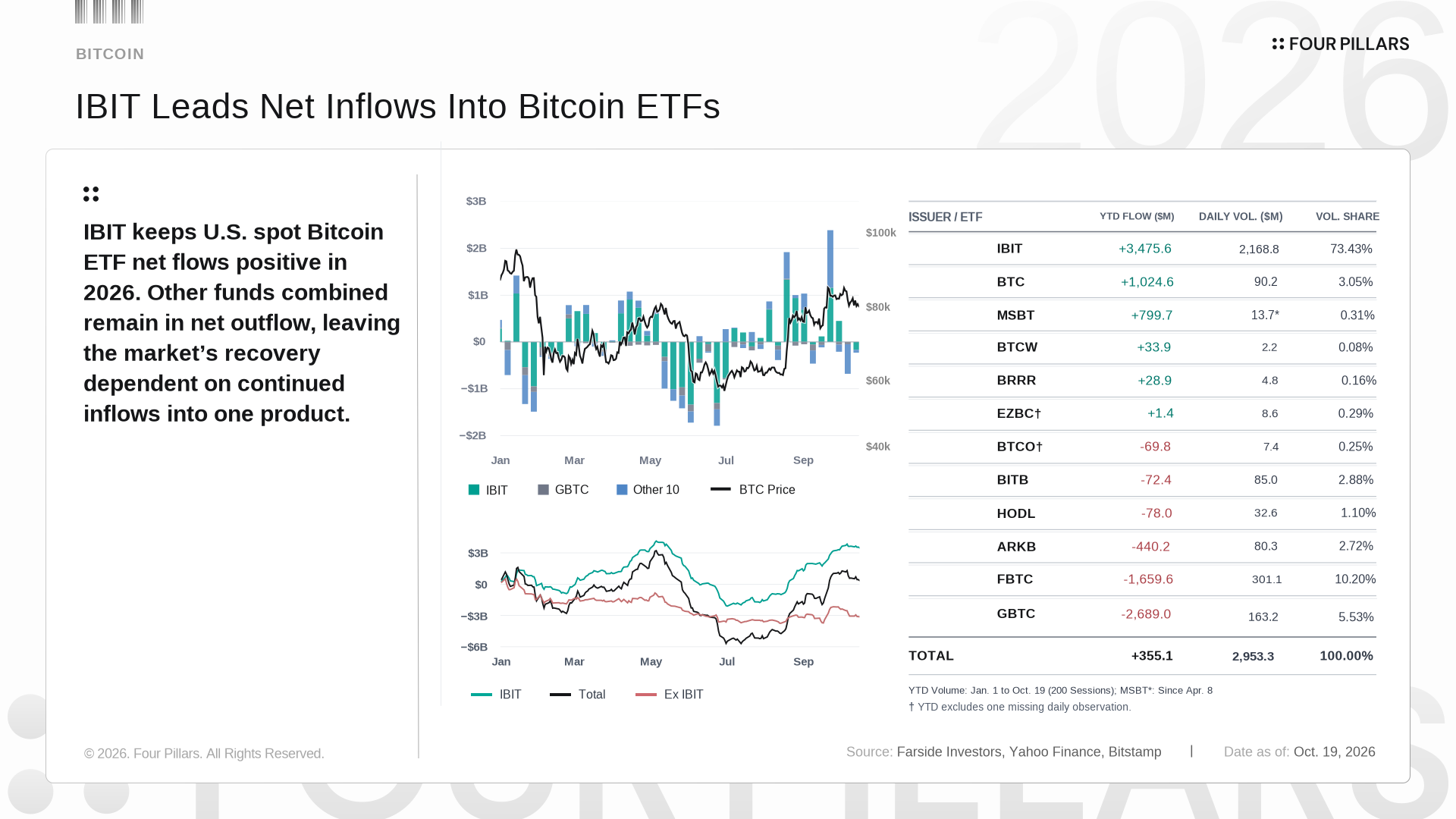
Farside Investors, Yahoo Finance, Bitstamp · As of October 19, 2026
In 2026, BlackRock's IBIT continues to attract net inflows for the U.S. spot Bitcoin ETF. As of October 16, IBIT attracted approximately $3.48 billion, while other funds recorded a total net outflow of about $3.12 billion. GBTC and FBTC faced significant redemptions of approximately $2.69 billion and $1.66 billion, respectively. Despite the inflows into IBIT, the total net inflow year-to-date is still only about $355 million. Therefore, a significant portion of ETF demand this year has been offset by withdrawals from existing investors.
Weak Association Between ETF Inflows and Subsequent BTC Returns
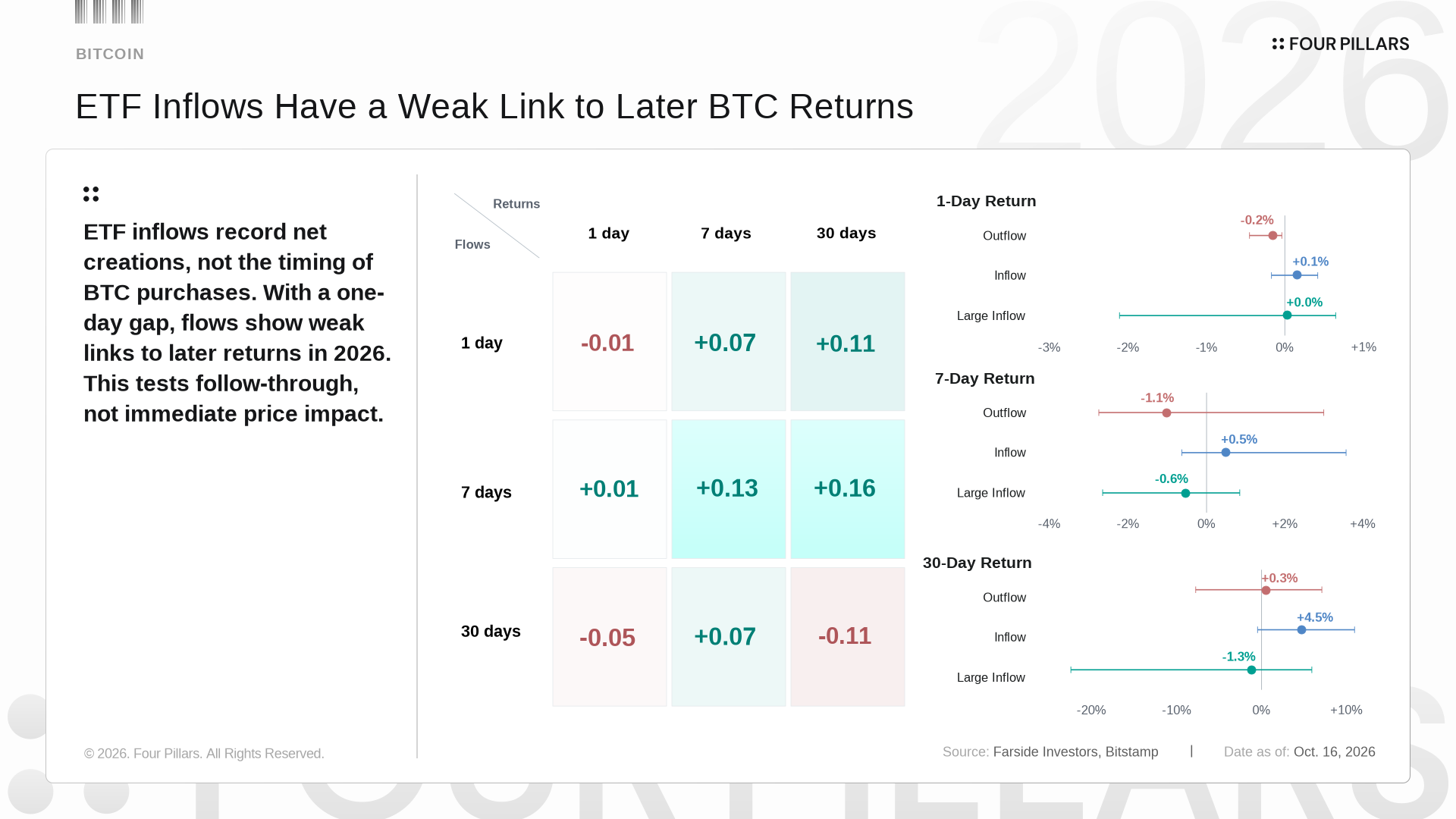
Farside Investors, Bitstamp · As of October 16, 2026
During the 2026 sample period, the relationship between ETF fund flows and subsequent Bitcoin returns is weak across daily, weekly, and monthly windows. Daily net inflows have correlations of -0.01, 0.07, and 0.11 with subsequent 1-day, 7-day, and 30-day returns, respectively. For rolling 7-day net inflows, the corresponding correlations are 0.01, 0.13, and 0.16, while the correlation between rolling 30-day fund flows and subsequent 30-day returns is -0.11. To separate the measurement of fund flows from the return window, returns are calculated starting from the closing price on the day after the ETF fund flow date. The 95% confidence intervals for the nine combinations all include zero, providing almost no evidence of a consistent leading relationship.
Quote: Corbin Fraser, CEO of Bitcoin.com
Interview: Corbin Fraser
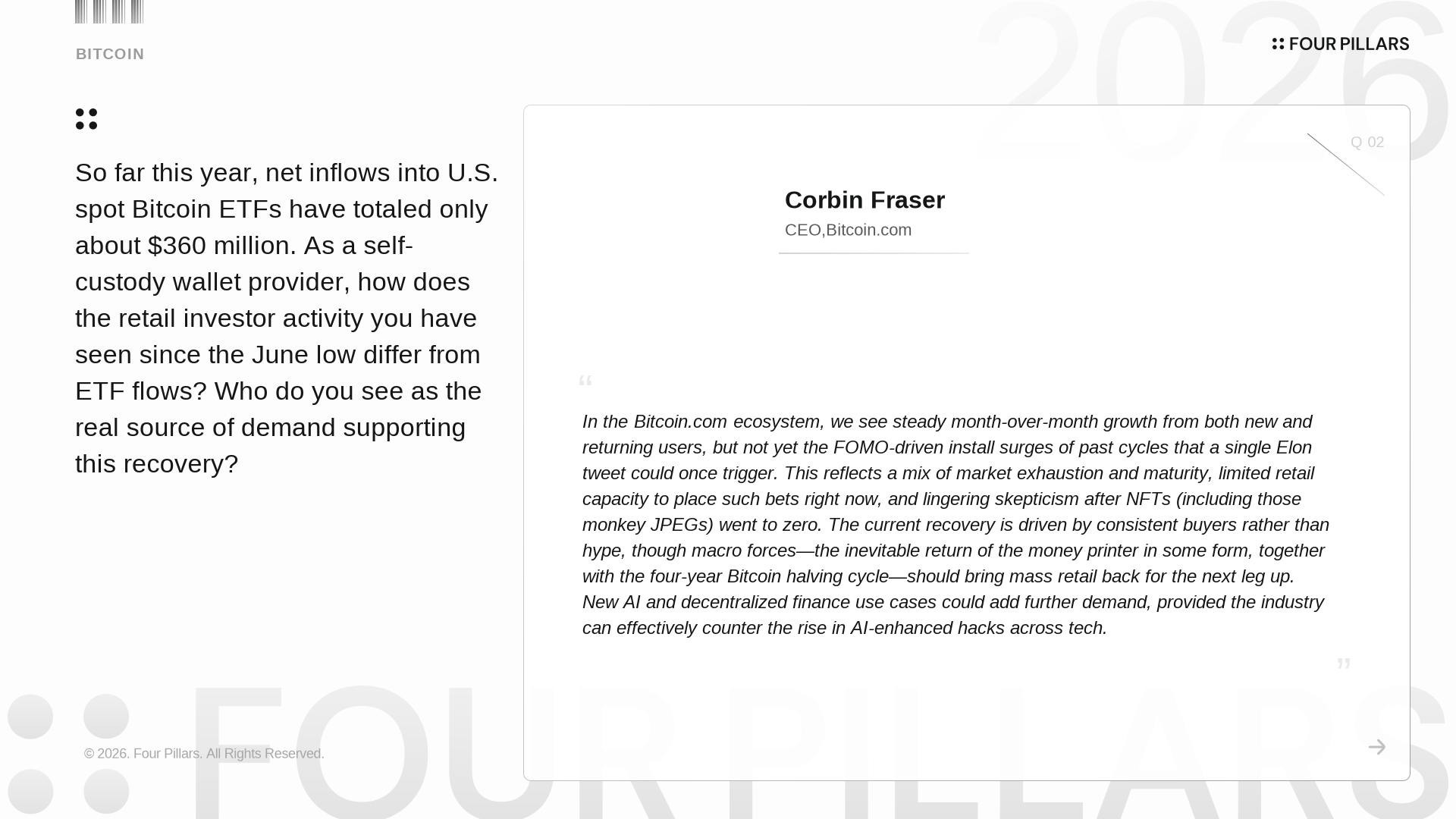
So far this year, the total net inflow of the U.S. spot Bitcoin ETF is only about $360 million. As a self-custody wallet provider, how does the retail investor activity you have seen since the low in June differ from the ETF fund flows? Who do you think are the true sources of demand supporting this round of recovery? In the ecosystem, we see a steady month-on-month growth of new and old users, but there has not yet been a surge in installations driven by FOMO triggered by a single Elon tweet as seen in past cycles. This reflects a mix of market fatigue and maturity, limited ability for current retail investors to make such bets, and lingering skepticism after NFTs (including those monkey JPEGs) went to zero. The current recovery is driven by sustained buyers rather than speculation, although macro forces—such as the inevitable return of the money printer in some form, combined with Bitcoin's four-year halving cycle—should bring back retail investors to drive the next round of increases. New AI and decentralized finance use cases may bring further demand, provided the industry can effectively respond to the increasing number of AI-enhanced attacks in the tech space. ------ Corbin Fraser, CEO of Bitcoin.com
MSTR's larger treasury actually dilutes per-share value
Strategy Filings, Bitstamp, Yahoo Finance · As of October 18, 2026
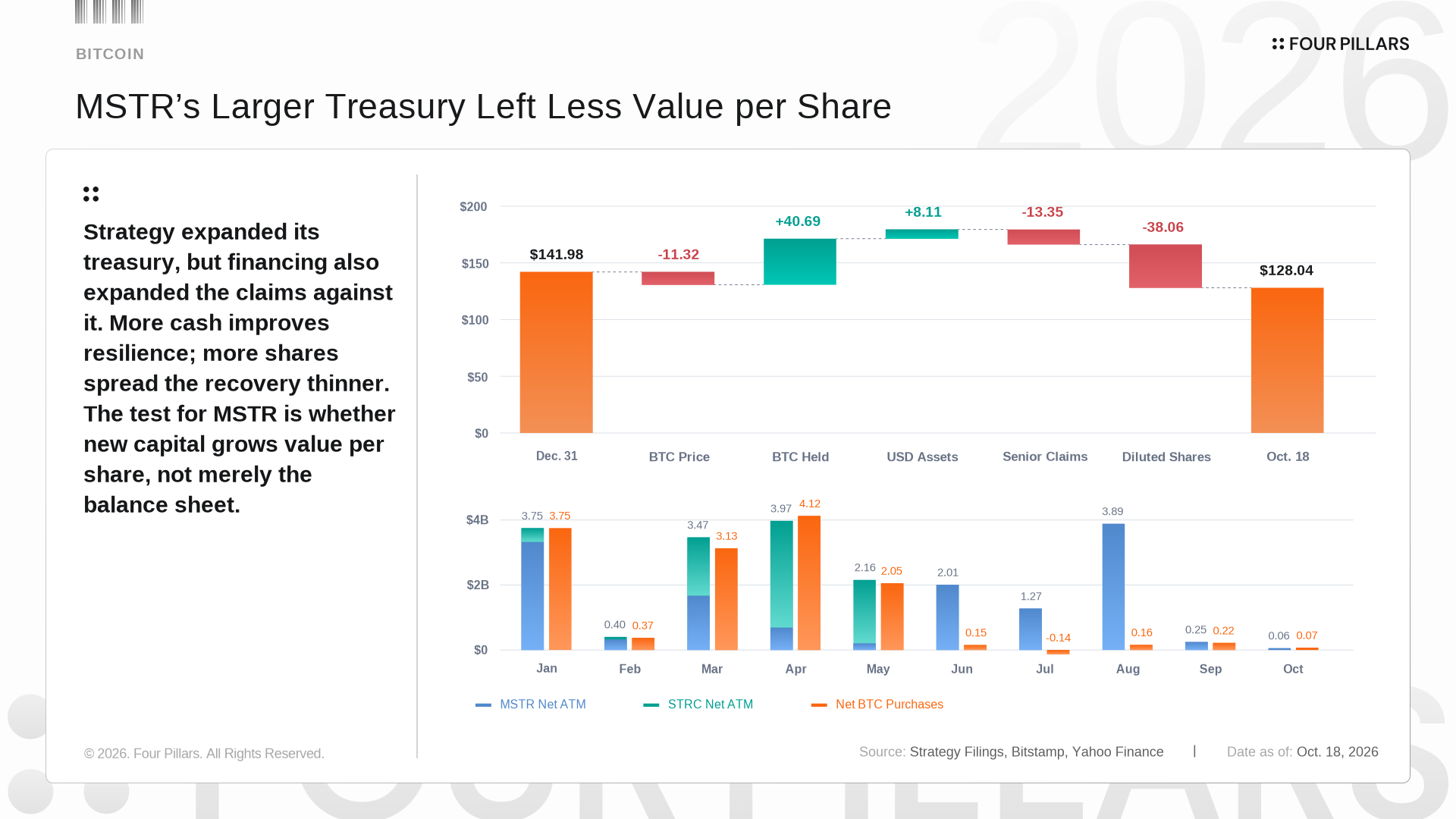
In 2026, Strategy's Bitcoin holdings grew by 26.2%, but when measured accounting for all convertible securities, the per-share Bitcoin value actually declined by 4.6%. The number of shares entitled to share in these holdings grew faster than the company's accumulation of Bitcoin.
Strategy places confidence in BTC accumulation over STRC
Strategy, Yahoo Finance · As of October 19, 2026
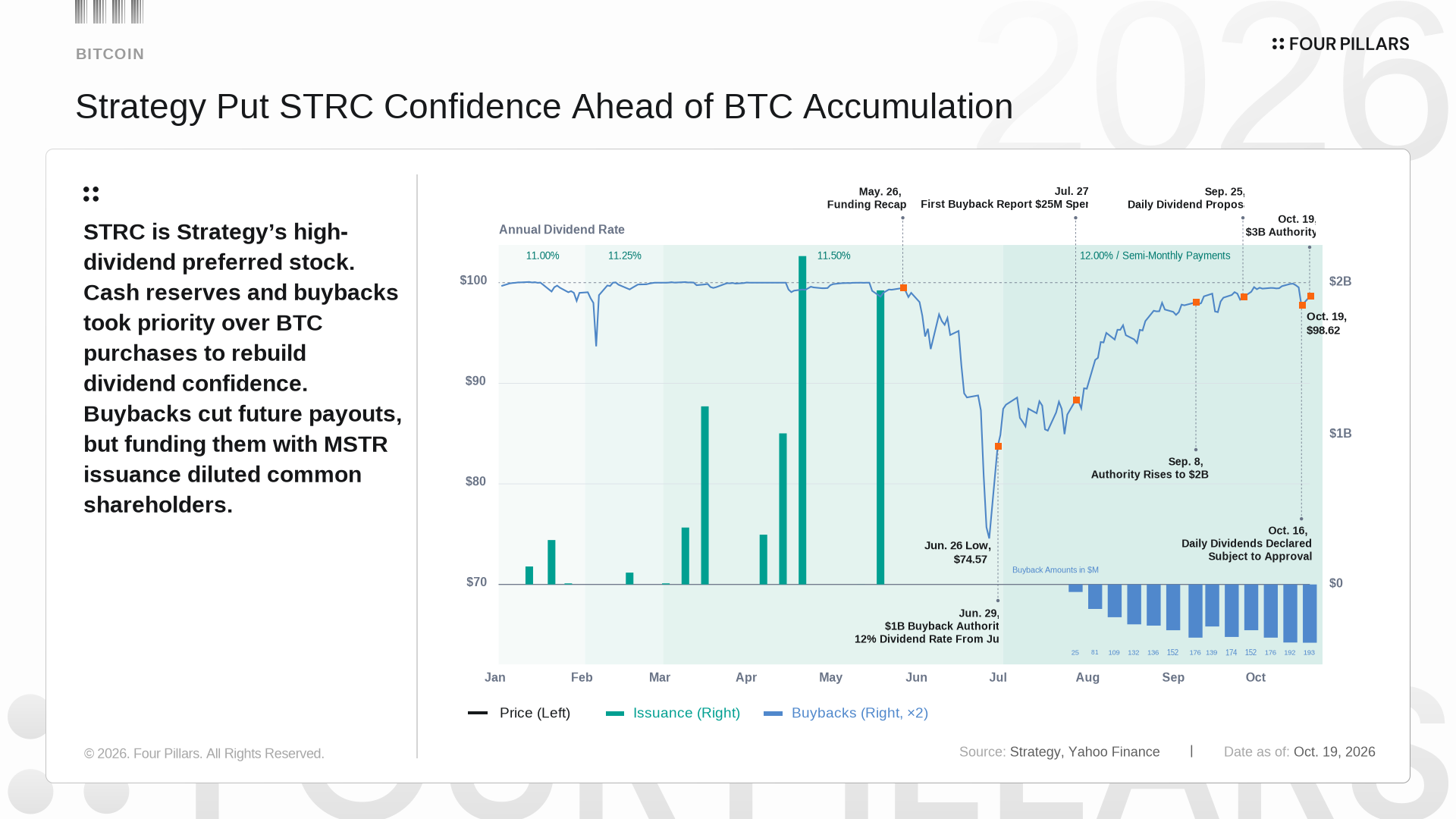
STRC is the preferred stock issued by Strategy to raise funds for purchasing BTC. Investors do not directly participate in the rise of BTC prices but receive high cash dividends. At the beginning of the year, the dividend yield was 11% per year based on a reference amount of $100, raised to 12% in July. Strategy guides STRC to trade around $100 through adjustments in the dividend yield and other measures, but this product does not allow investors to redeem $100 at any time, nor does it have a maturity date. Therefore, the value of STRC depends not only on the high dividend itself but also on how long the company can maintain the payments.
Bitcoin still drives revenue, while miners are turning to AI
Company Financial Filings, Calendar H1 2026 · As of June 30, 2026
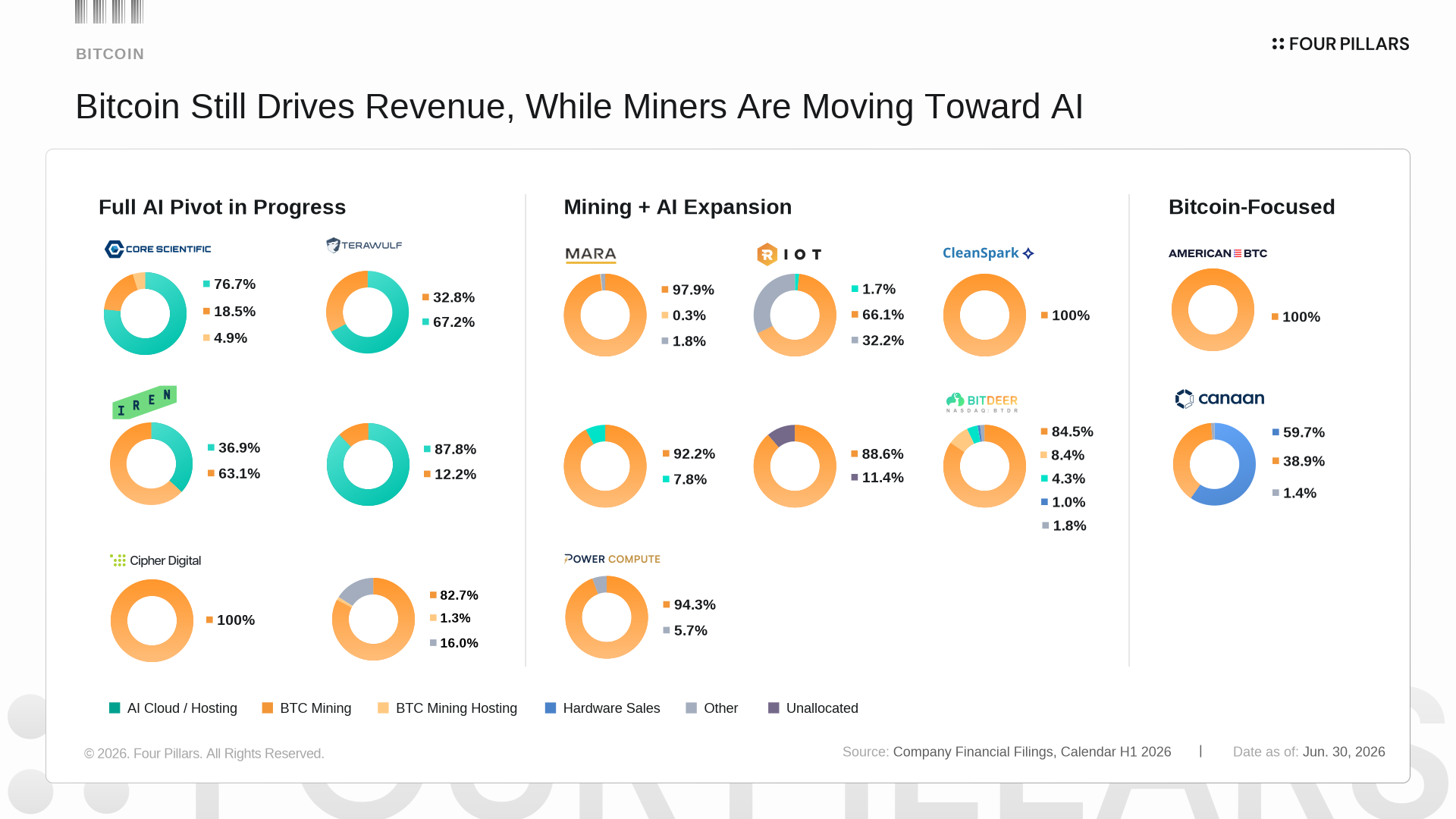
Bitcoin miners are expanding into AI, but their revenue is transforming at distinctly different rates. In the first half of 2026, Ionic Digital, Core Scientific, and TeraWulf derived over half of their revenue from AI and computing infrastructure. Meanwhile, Cipher Digital and Keel Infrastructure still generated revenue from mining during the same period, although they are advancing towards AI-centered transformations/power sales. These companies may share the same strategic direction but are at different stages: some are already earning revenue in new businesses, while others are still in the construction phase.
Miner sell-offs decrease, but fail to prevent Bitcoin's decline in Q2
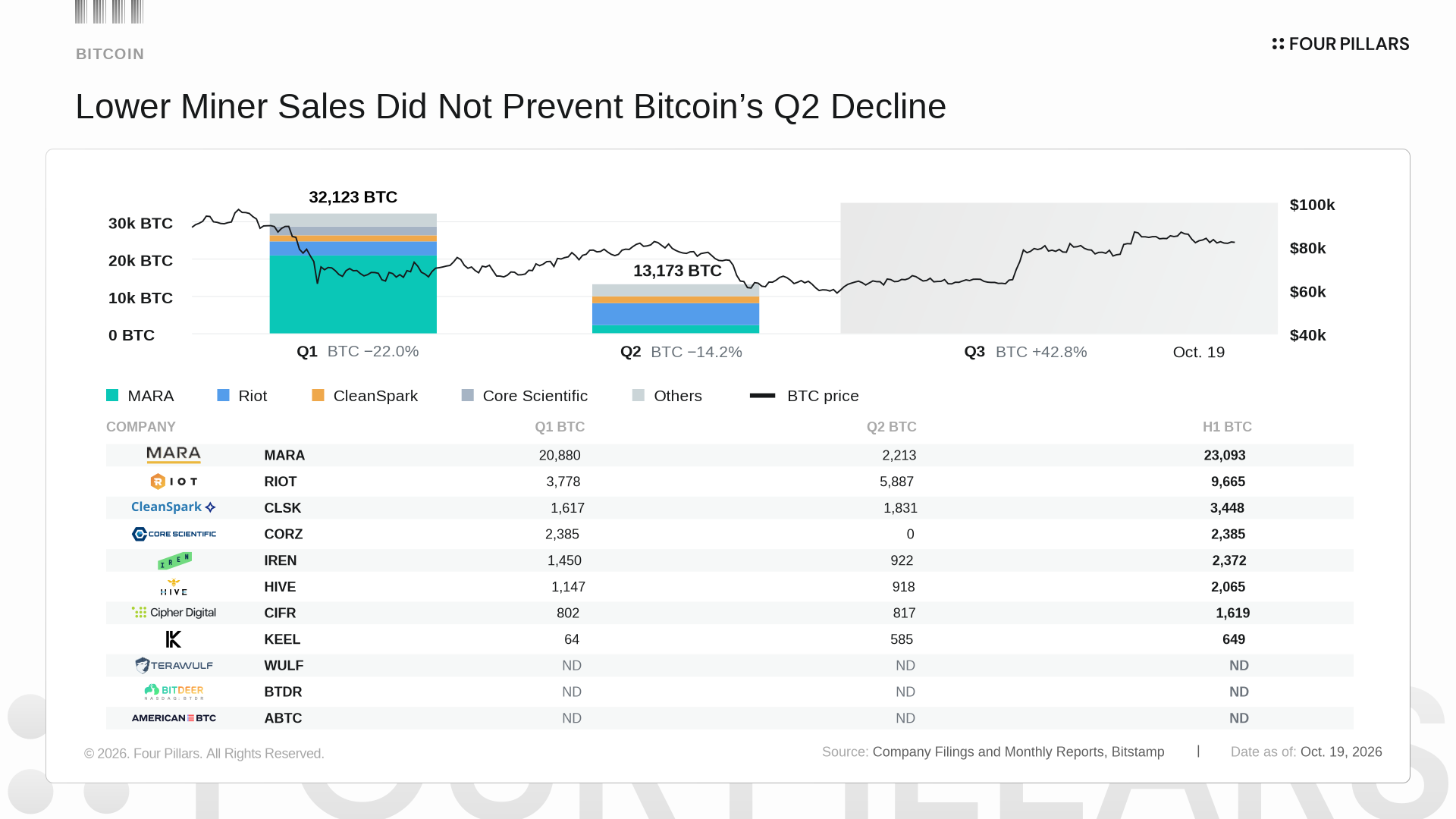
Company Filings and Monthly Reports, Bitstamp · As of October 19, 2026
The Bitcoin sell-off volume from eight major publicly listed miners decreased by 59%, from about 32,123 BTC in the first quarter of 2026 to 13,173 BTC in the second quarter, with MARA accounting for most of the decline. Meanwhile, Riot increased its sell-off volume from 3,778 BTC to 5,887 BTC.
Transaction counts rise, but miner revenue declines with prices
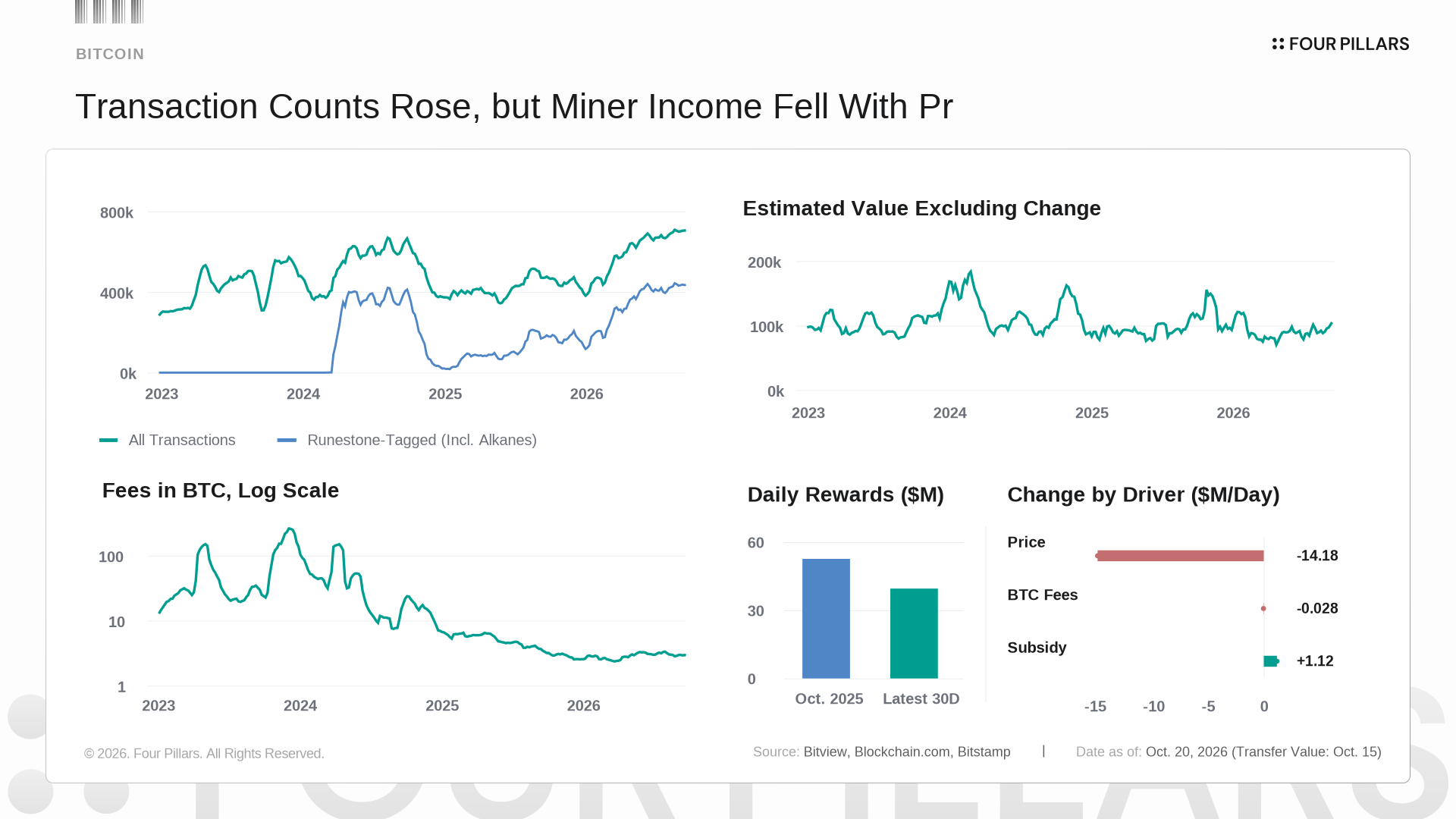
Bitview, Blockchain.com, Bitstamp · As of October 20, 2026 (Transfer value: October 15)
Unlike Bitcoin prices, on-chain activity measured by transaction counts has steadily increased since 2025. In the 30 days ending October 20, the average daily transaction volume was about 706,000, a 50% increase from October 2025, approaching the cycle's peak. This growth is driven by token-related activities using the Runestone format, including Runes, Alkanes, and DIESEL.
Quote: Muneeb Ali, CEO of Stacks Labs and Founder of Stacks
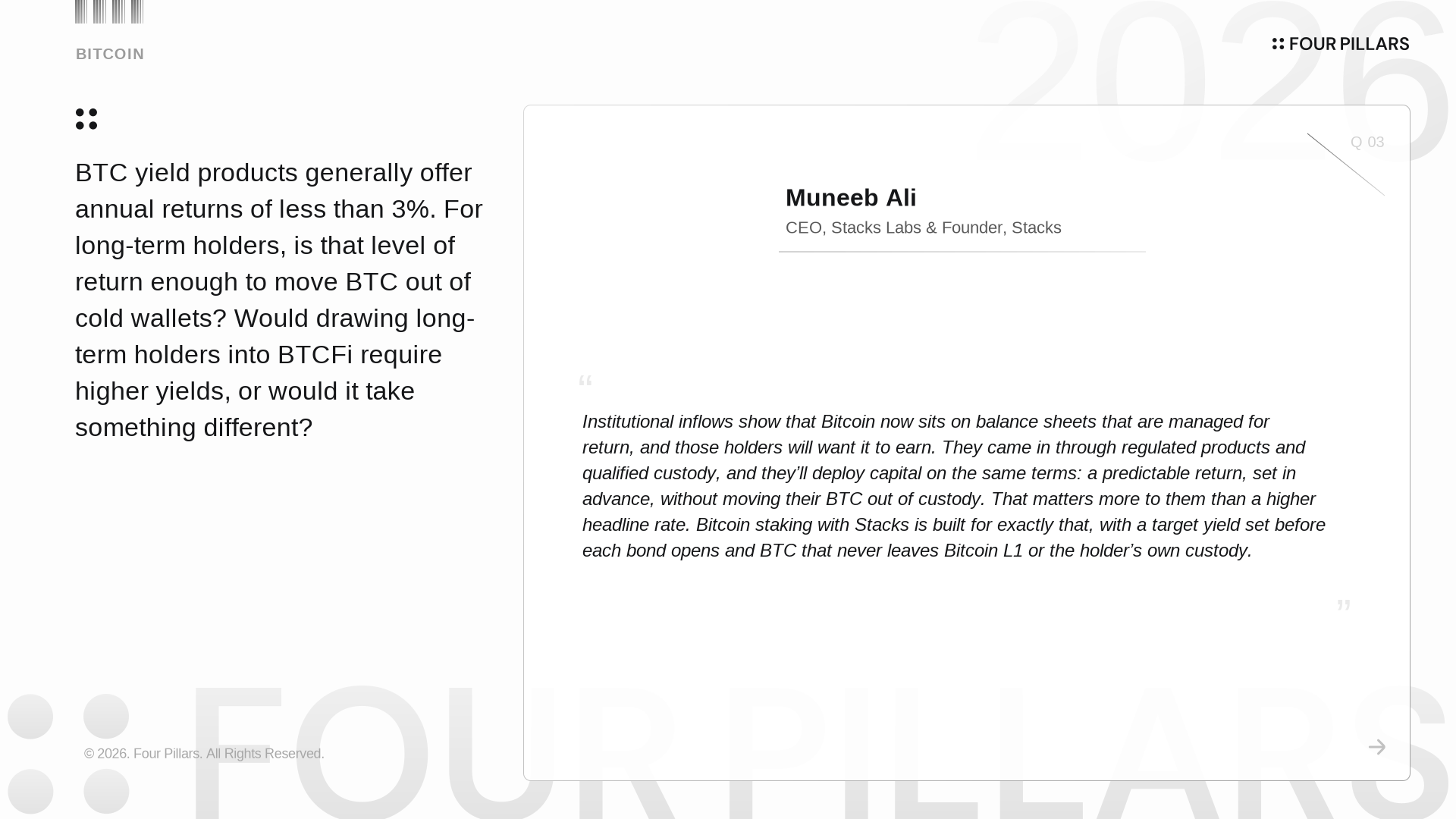
Interview: Muneeb Ali
BTC yield products typically offer annualized returns of less than 3%. Is this level of return sufficient to draw BTC out of cold wallets for long-term holders? To attract long-term holders into BTCFi, is a higher yield needed, or is something else required? The inflow of institutional funds indicates that Bitcoin is now appearing on balance sheets managed for returns, and these holders will want it to generate yield. They enter the market through regulated products and qualified custodians, deploying funds under the same conditions: pre-set predictable returns without needing to move BTC out of custody. This is more important to them than higher nominal interest rates. Stacks' Bitcoin staking is built for this purpose, setting target yields before each bond issuance, with BTC never leaving Bitcoin L1 or the holders' own custody. ------ Muneeb Ali, CEO of Stacks Labs and Founder of Stacks
Active developers decrease, but core development participation widens
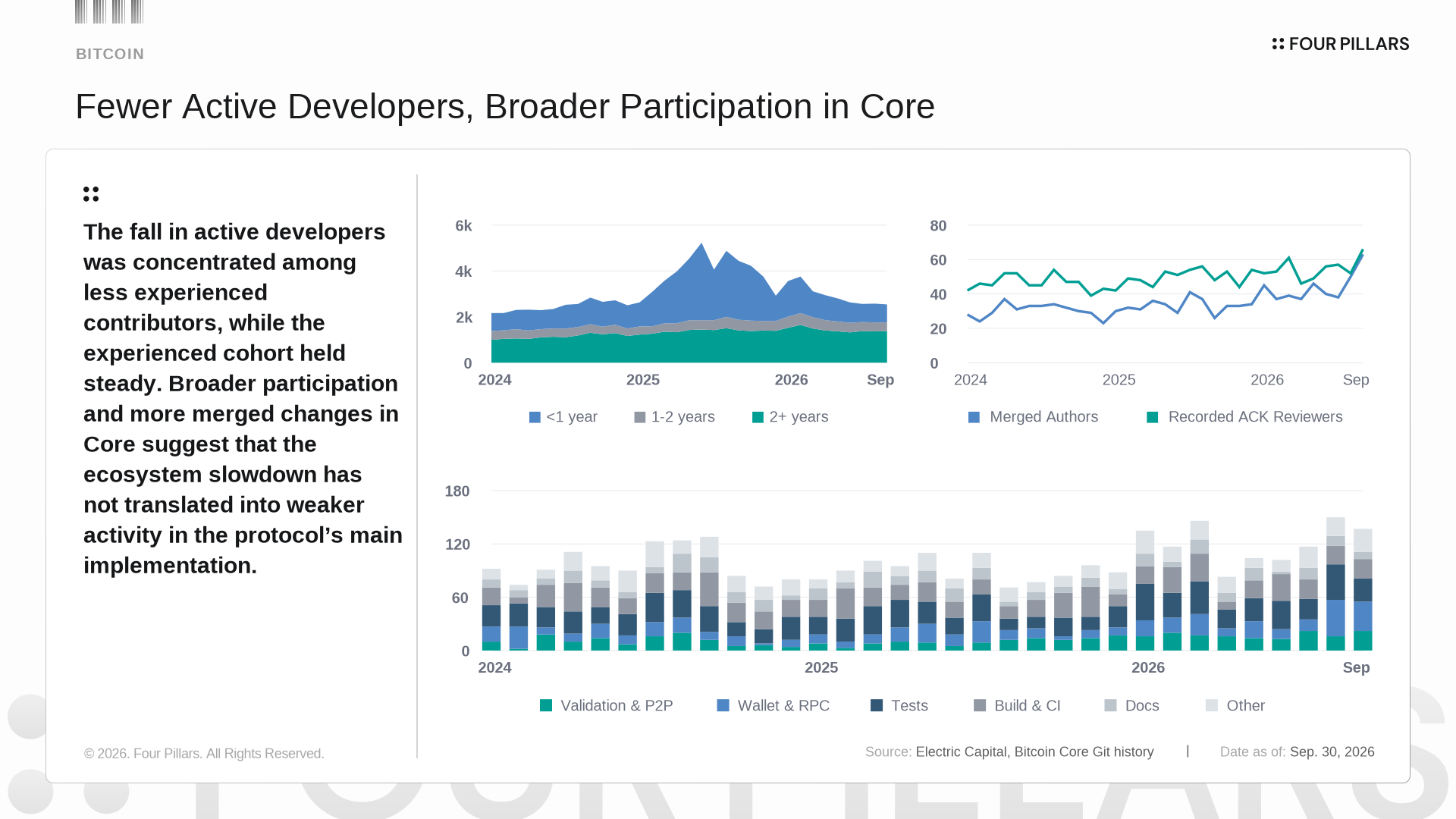
Electric Capital, Bitcoin Core Git history · As of September 30, 2026
In the past year, the number of active developers in the Bitcoin ecosystem has decreased, but this has not translated into a widespread weakening of the development base. In September 2026, the number of monthly active developers decreased by about 43% compared to the same month last year, while the group with more than two years of crypto development experience only decreased by about 3%. The decline is concentrated among developers with shorter resumes, indicating that while some gains from the participation expansion in 2025 have been reversed, the group of experienced developers has remained largely stable.
BIP-110 fails to gain widespread mining support
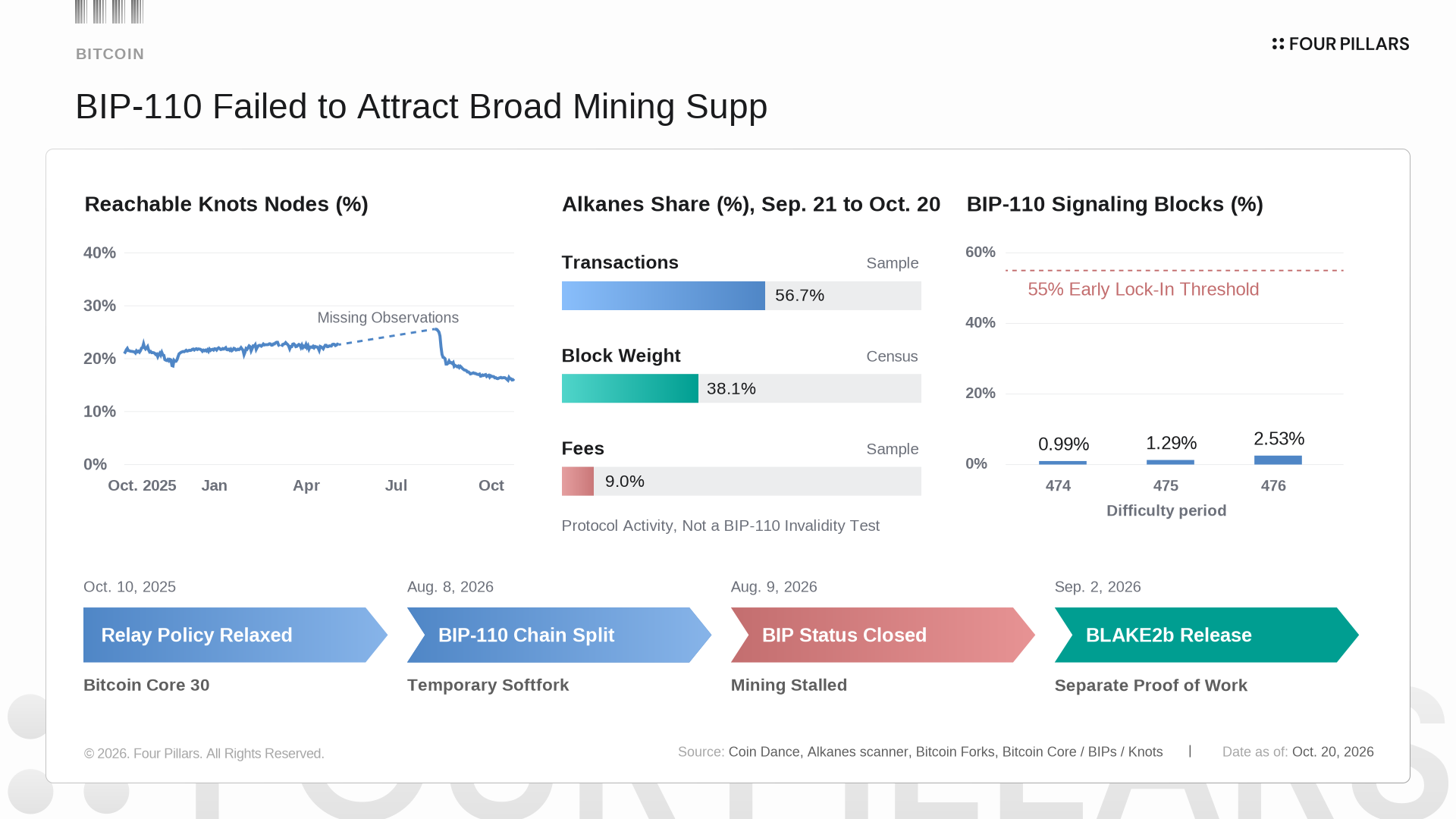
Coin Dance, Alkanes scanner, Bitcoin Forks, Bitcoin Core / BIPs / Knots · As of October 20, 2026
One of the biggest debates in the Bitcoin community this year involves the extent to which Bitcoin should be allowed to record data unrelated to payments, and whether this issue should be left to the relay strategies of individual nodes or restricted through network-shared rules. This debate gained substantial momentum in October 2025 when the OP_RETURN changes introduced by Bitcoin Core 30 relaxed data relay restrictions. In response, BIP-110 was proposed, aiming to temporarily cap the size and format of data that transactions can carry as a consensus rule through a soft fork. Some node operators supported the proposal and adopted the Knots client to implement these strategies.
Quantum risk exposure concentrated in large balances
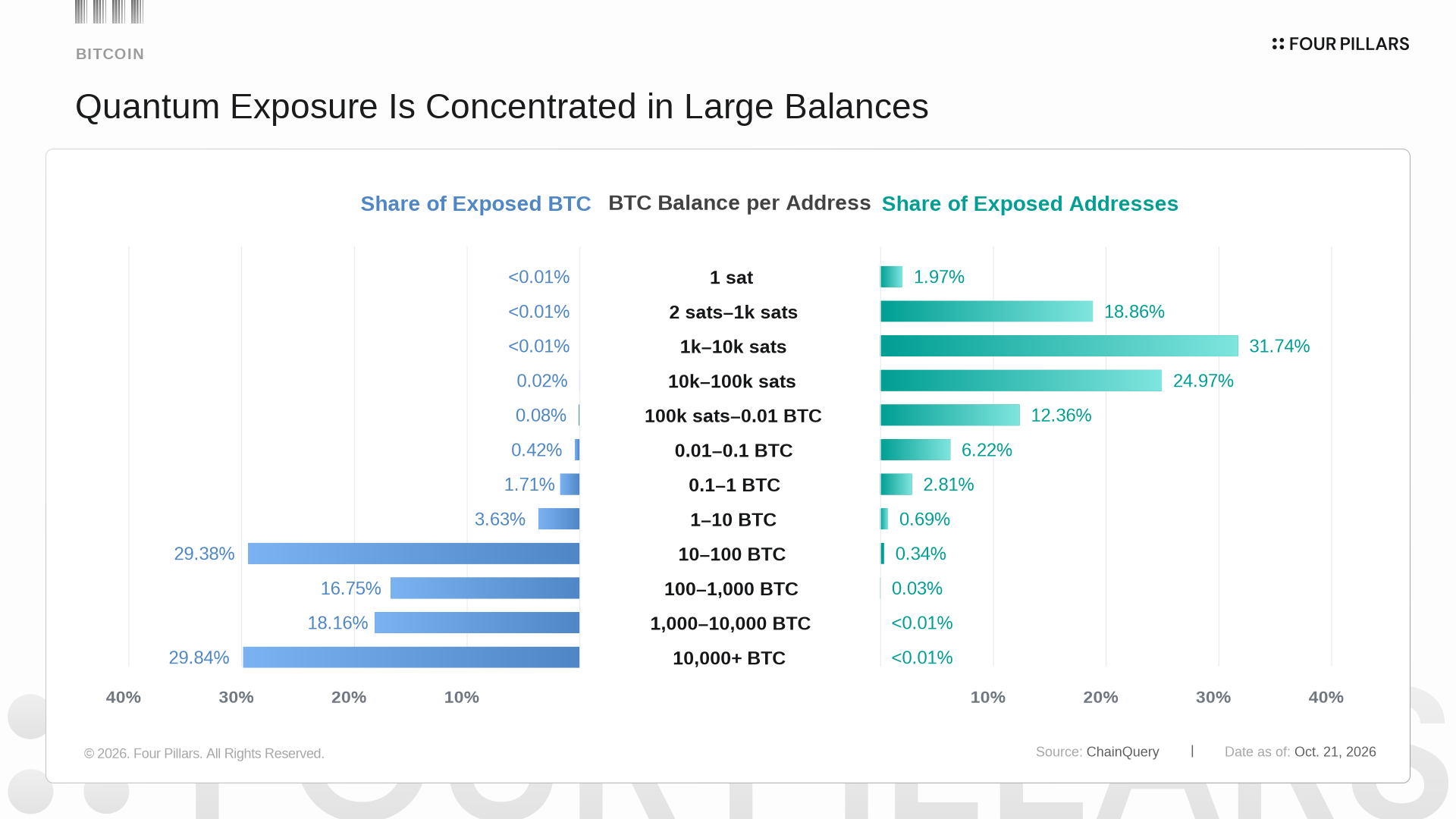
ChainQuery · As of October 21, 2026
Whether Bitcoin can adequately respond to the threats posed by quantum computers has been an ongoing topic of debate. A sufficiently powerful quantum computer could derive private keys from public keys and spend tokens without the owner's consent. The weak link here is the digital signature that authorizes transactions. Certain Bitcoin address formats keep the public key hidden until the token is spent, but reusing the address after spending can leave or accumulate balances protected by already public keys. In contrast, the P2PK format used in Bitcoin's early days and the current Taproot format are designed to expose the public key. Once a quantum computer capable of breaking existing signatures is built, these holdings could become targets for attacks.
Ethereum outperforms $ETH
A year in Ethereum from the perspectives of fees, staking, and L2 settlements.
ETH experiences the shallowest historical pullback, yet is most tightly bound to BTC
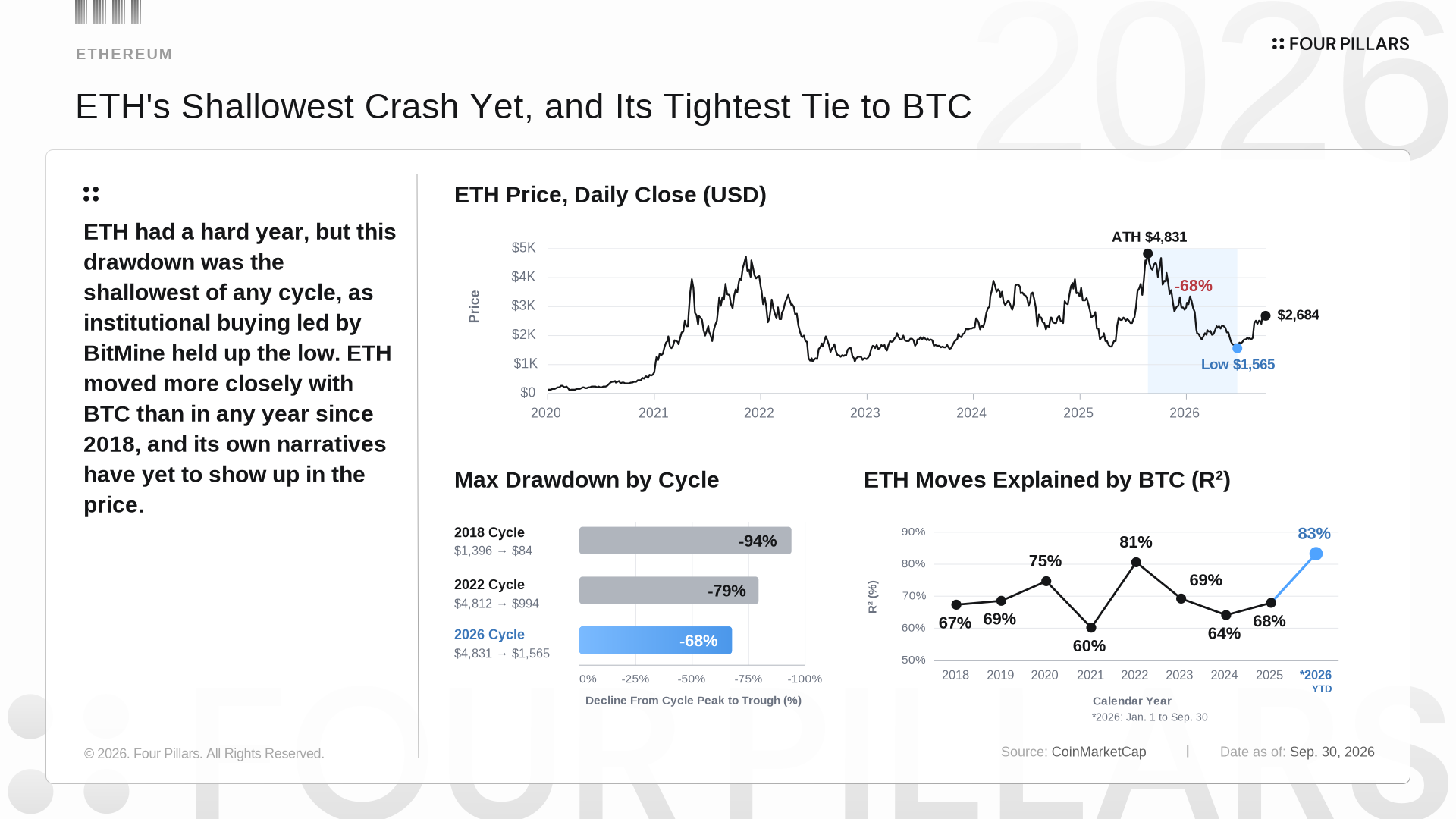
CoinMarketCap · As of September 30, 2026
ETH has dropped 68% from its peak in August 2025. It has been a tough year, but the magnitude of the pullback is shrinking with each cycle. The cycle in 2018 saw a 94% drop from its peak, while the cycle in 2022 was 79%. During this downturn, institutions absorbed the selling pressure. BitMine, a digital asset treasury company, purchased approximately 1.89 million ETH between January and September. Most of the ETH sold by the Ethereum Foundation also flowed to BitMine through OTC (over-the-counter) transactions. While the crypto industry struggles, other assets like Nasdaq and the Korea Composite Stock Price Index (KOSPI) have surged significantly. Only the crypto industry remains in a bear market. ETH's performance this year relative to BTC has also resembled that of a high beta asset. In 2026, 83% of ETH's intraday volatility can be explained by BTC, marking the closest correlation between the two since 2018. This indicates that ETH is following the overall trend of the crypto market led by BTC, rather than having an independent market. The narrative of Ethereum itself has yet to be reflected in the price of ETH.
As prices fall, network usage hits all-time high
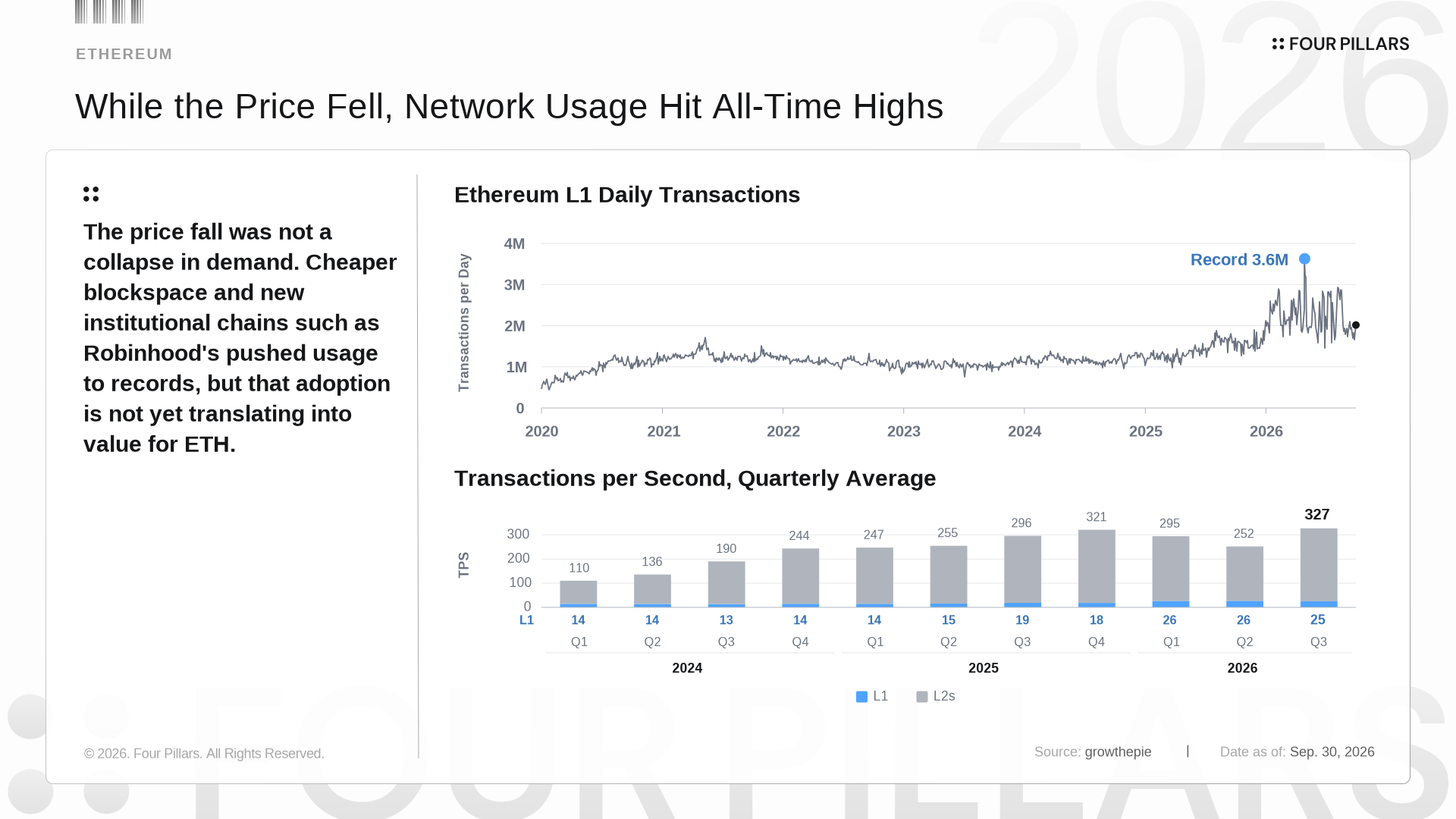
growthepie · As of September 30, 2026
Despite the drop in ETH prices, network usage has reached an all-time high. On April 28, the daily transaction volume on Ethereum L1 hit 3.63 million, the highest since its launch. The peak in 2025 was 2.23 million transactions on December 29, so the daily record grew by over 60% in four months. When accounting for L2, the average throughput in the third quarter was 327 transactions per second, the highest ever, which is 13 times the volume handled by L1 alone. Lower fees are the reason for the increase in usage. In late November 2025, before the Fusaka upgrade, the gas limit was raised to 60 million, significantly reducing L1 fees. Payments for data publication and settlement on L1 from L2 dropped from 228 ETH in the third quarter of 2025 to 79 ETH in the third quarter of 2026, a decrease of 65%. The Blob (dedicated space for L2 data) now has such ample idle capacity that its fees are nearly zero. There is no basis to interpret the drop in ETH prices as a collapse in demand. The remaining challenge is how to convert the new demand into the value of ETH.
BitMine continues to buy ETH, while smaller treasury companies are selling
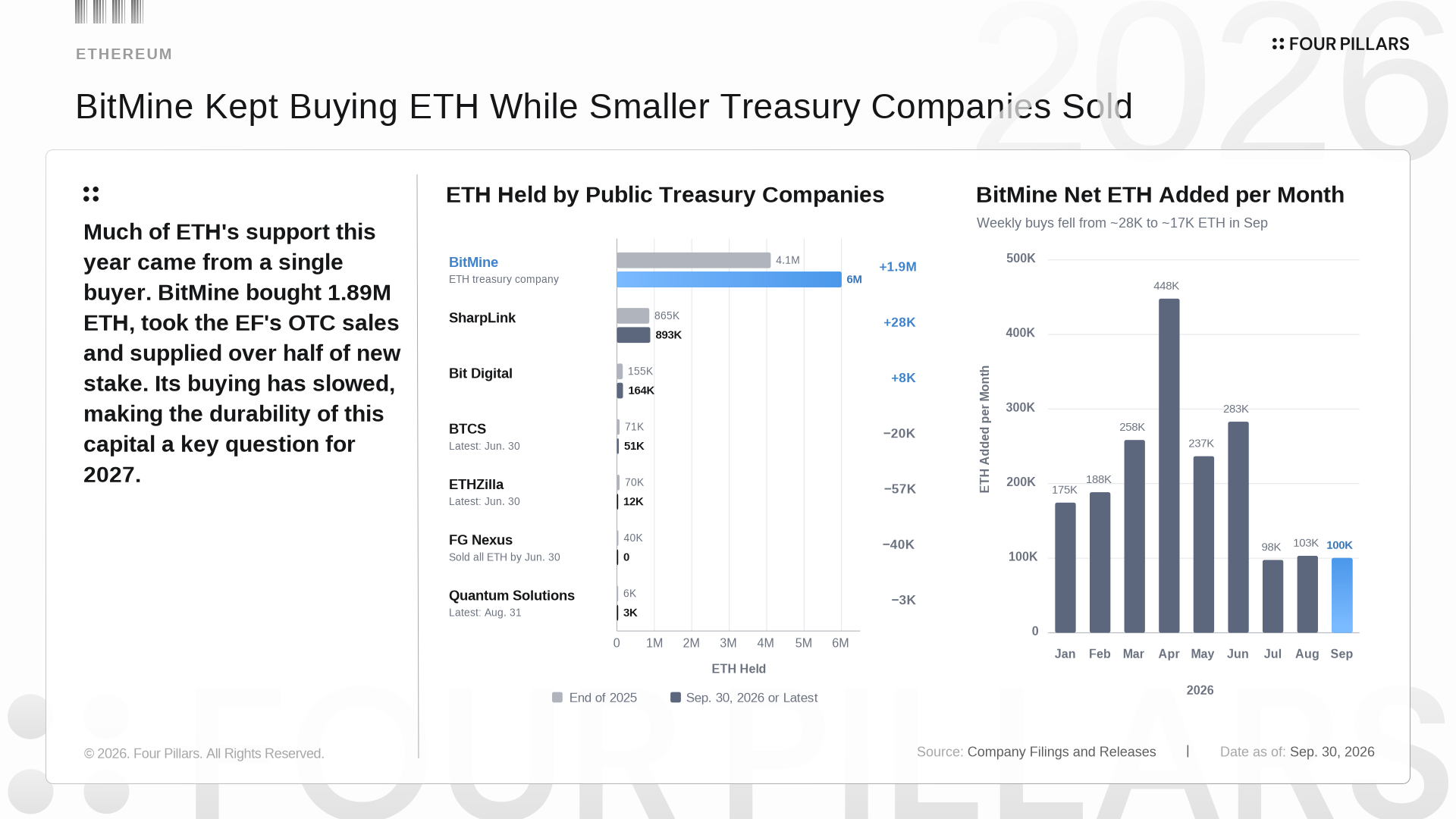
Company filings and announcements · As of September 30, 2026
BitMine increased its ETH holdings from 4.11 million at the end of 2025 to 6 million by the end of September. In just this year, it has purchased 1.89 million ETH, currently holding about 4.9% of the total supply. On the other hand, SharpLink and Bit Digital only slightly increased their ETH holdings in 2026. BTCS and ETHZilla reduced their positions. FG Nexus completely liquidated all its ETH. As a result, BitMine's share of ETH held by seven listed DAT companies rose from 77% to 84%. The company is close to its target of holding 5% of the total supply. The largest buyer supporting ETH this year has already slowed down, so the core question of ETH supply and demand is: who will fill this role in 2027?
Staking hits record high, with BitMine providing over half of new staking
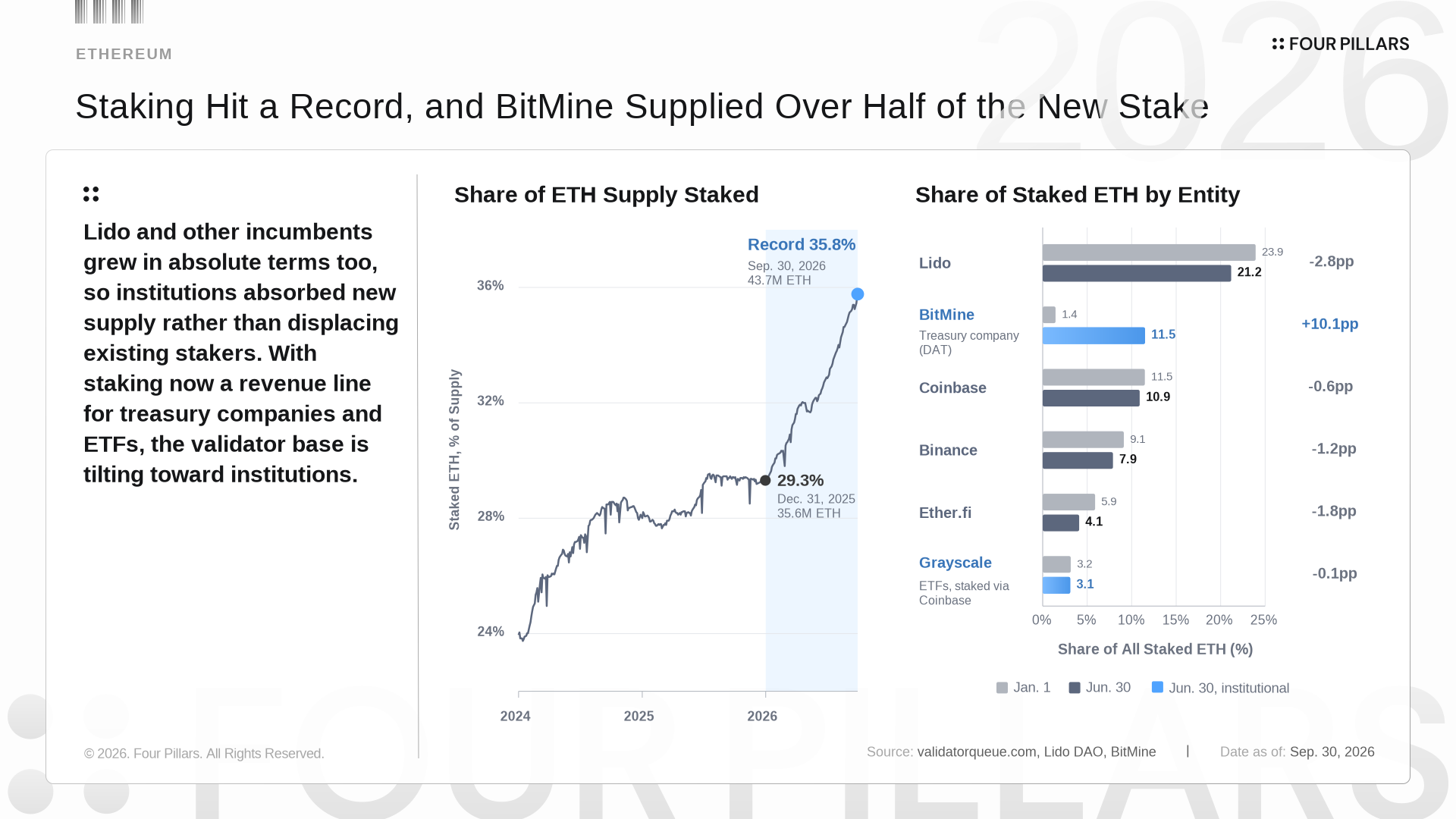
validatorqueue.com, Lido DAO, BitMine · As of September 30, 2026
In 2026, Ethereum staking continued to set records. As of September 30, a total of 43.66 million ETH has been staked, accounting for 35.8% of the total supply. This number was 35.57 million (29.3%) at the end of 2025, thus increasing by 8.1 million ETH in nine months. The staking supply ratio hovered around 28% to 29% throughout 2025 but has surged sharply this year. Currently, over one-third of ETH has been staked.
Quote: Samuel Chong, Director of Asia-Pacific Institutional Relations at Lido Ecosystem Foundation
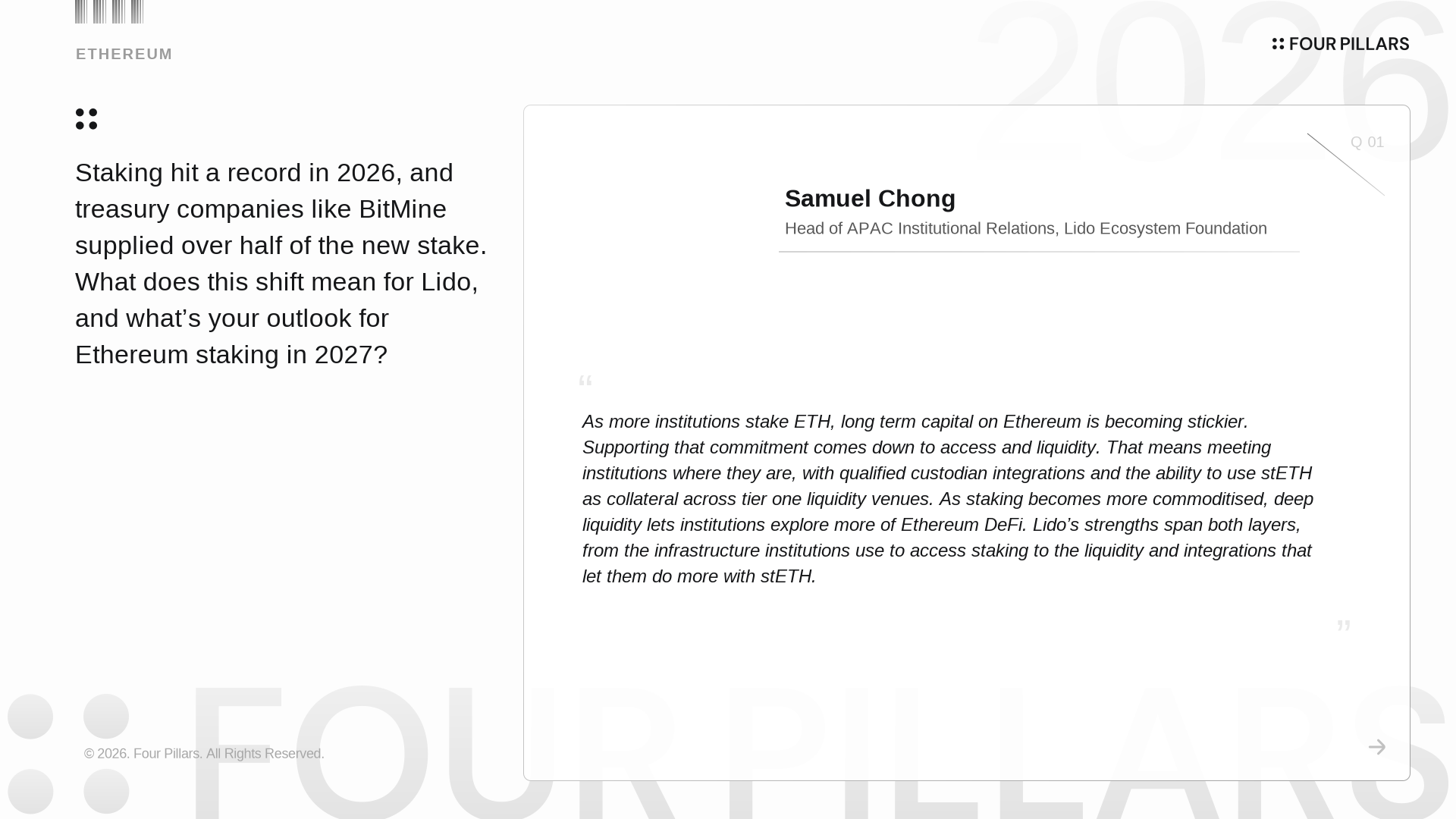
Interview: Samuel Chong
In 2026, staking set a record, with treasury companies like BitMine providing over half of the new staking. What does this shift mean for Lido? What are your expectations for Ethereum staking in 2027? As more institutions stake ETH, long-term capital on Ethereum is becoming stickier. The key to supporting this commitment lies in access and liquidity. This means meeting their needs where institutions are located, providing qualified custodial integration, and the ability to use stETH as collateral in primary liquidity venues. As staking becomes increasingly commoditized, deep liquidity allows institutions to explore more Ethereum DeFi. Lido's advantages span two levels, from the infrastructure used by institutions to access staking, to the liquidity and integration that enable them to do more with stETH. ------ Samuel Chong, Director of Asia-Pacific Institutional Relations at Lido Ecosystem Foundation
As Ethereum scales, L1 fees shrink to about 1% of application fees
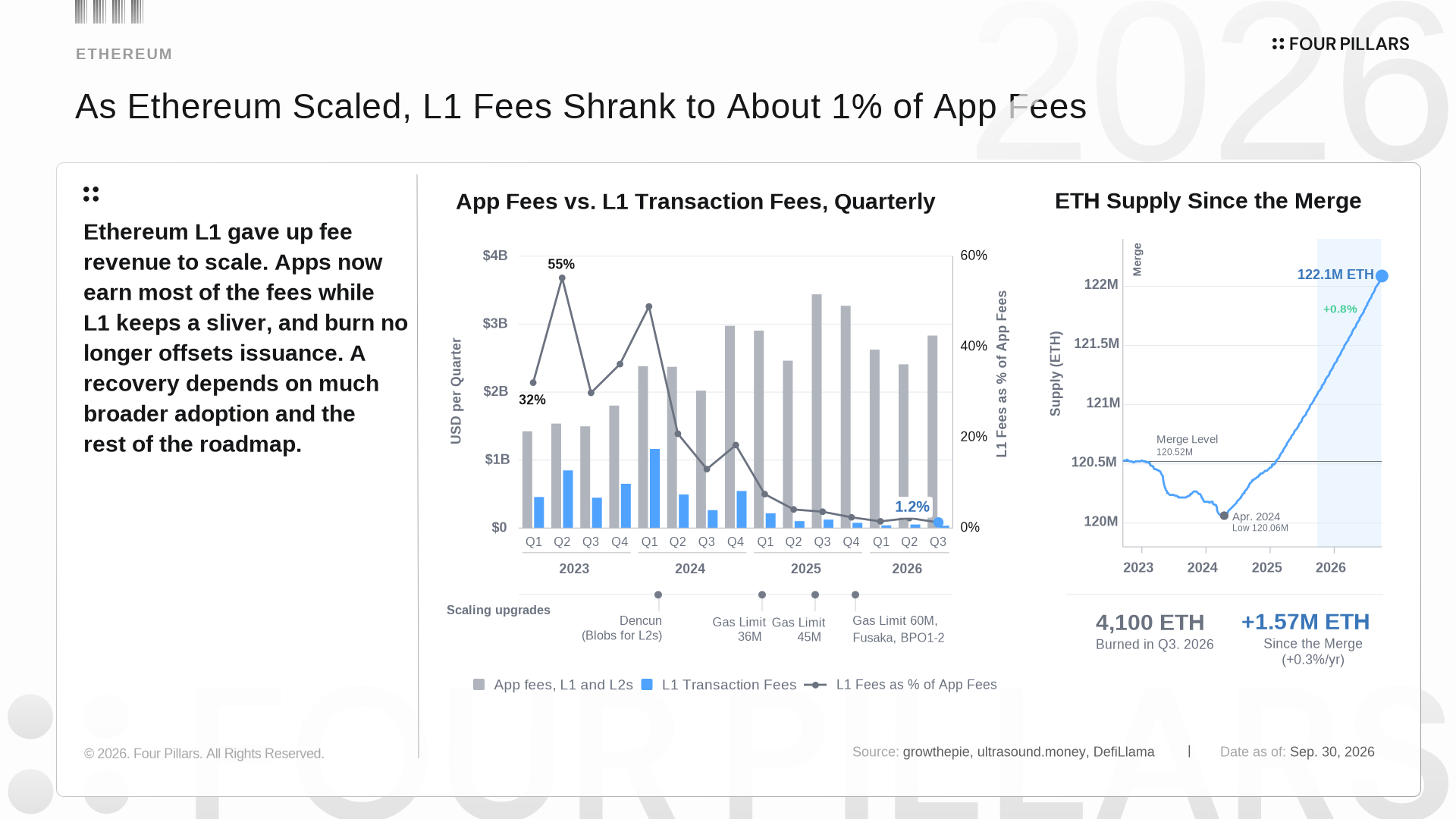
growthepie, ultrasound.money, DefiLlama · As of September 30, 2026
Usage continues to grow, but L1 revenue has declined. In the third quarter, applications on Ethereum earned $2.83 billion in fees, while Ethereum only collected $35.1 million in transaction fees, just 1.2% of application fees. This ratio was 38% in 2023. This decline stems from choice rather than failure. In March 2024, the Dencun upgrade added blobs (independent space for L2 data). Subsequently, the gas limit doubled from 30 million to 60 million in 2025. The Fusaka upgrade in December 2025 and two subsequent BPOs (which only adjusted Blob parameters) further increased blob capacity. Ethereum chose to lower network usage costs and increase throughput. Consequently, the amount of ETH burned correspondingly decreased. In the third quarter, the burn amount was only about 4,100 ETH, while the total supply of ETH increased by 990,000 over the past year, or 0.8%. Since the merge, the net increase in supply has been 1.57 million ETH. The roadmap will further enhance Ethereum's throughput. To convert this additional throughput into the value of ETH, adoption must far exceed current levels.
Quote: Artem Sinyakin, CEO of OAK Research
Interview: Artem Sinyakin
In the third quarter of 2026, Ethereum earned L1 fees that accounted for only about 1.2% of application fees. Do you think Ethereum L1 revenue can improve from here? What conditions are needed? Ethereum finds itself in a delicate position. Like most blockchains, the fees for transactions on ETH are variable, but the chain's revenue depends solely on the number of transactions on the network. This means Ethereum has two options: either tax the applications/tokens issued on its chain, which is not a viable option; or become more scalable while remaining competitive with other chains to increase transaction volume. L2 has not succeeded as hoped, so we are back to square one: scaling the core chain through future network upgrades. While Ethereum's revenue is important, I believe the more critical question is: what are the economic incentives for holding ETH? With the split of the Ethereum Foundation and the introduction of new initiatives, I hope to see truly meaningful use cases in the future that justify holding ETH. ------ Artem Sinyakin, CEO of OAK Research
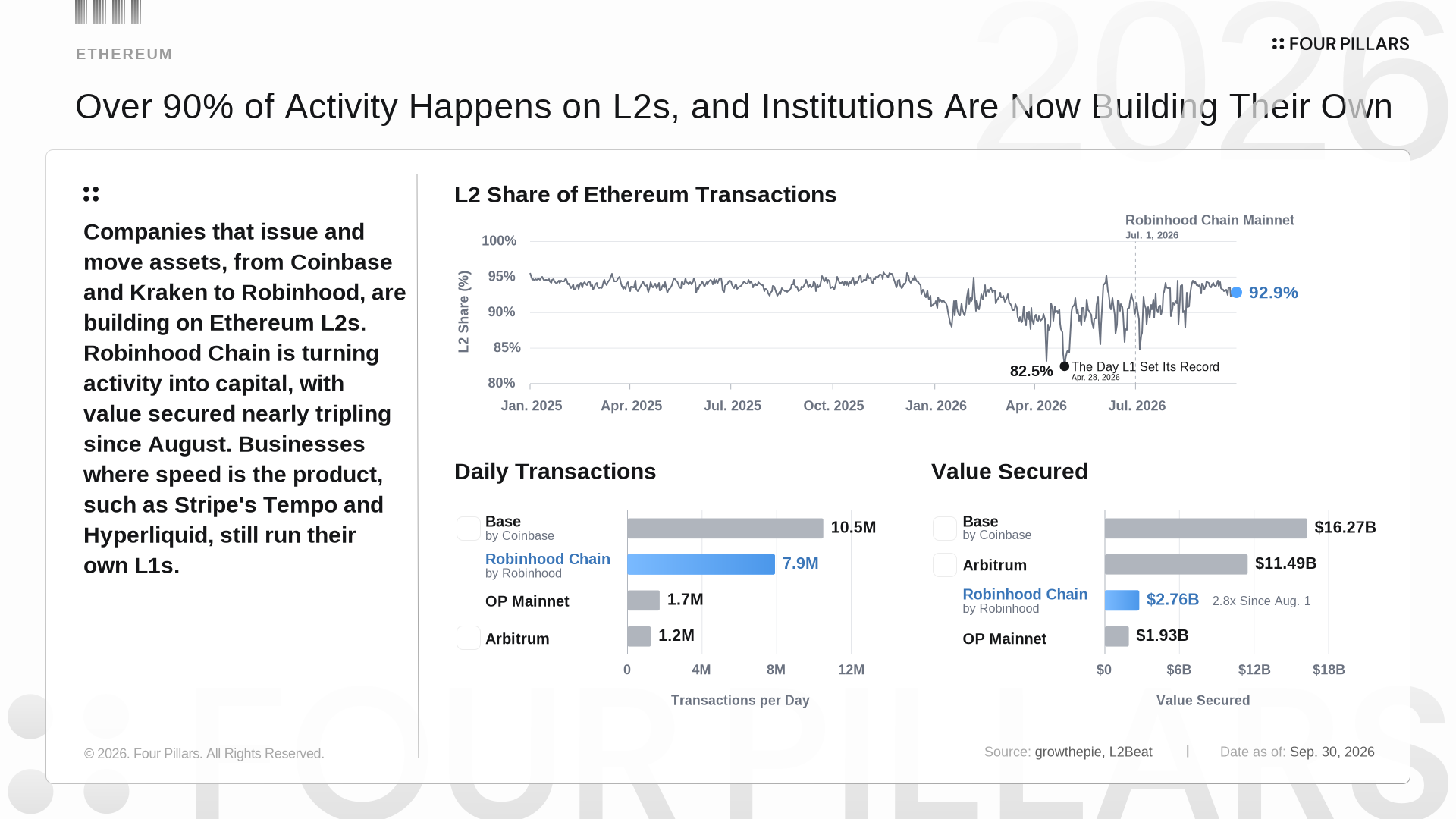
Over 90% of activity occurs on L2, and institutions are now building their own L2
growthepie, L2Beat · As of September 30, 2026
Most Ethereum activity occurs on L2. As of September 30, L2 accounted for 92.9% of all Ethereum transactions. Companies building these L2s are performing outstandingly. On that day, Coinbase's Base led with 10.5 million transactions, followed by Robinhood Chain with 7.91 million transactions. Together with Kraken's Ink, they demonstrate a clear trend: companies that issue and transfer assets are launching their own L2 chains on Ethereum. Some companies have chosen their own L1, such as Tempo, supported by Stripe and Paradigm. However, where trust in assets and liquidity is crucial, companies are opting for Ethereum L2.
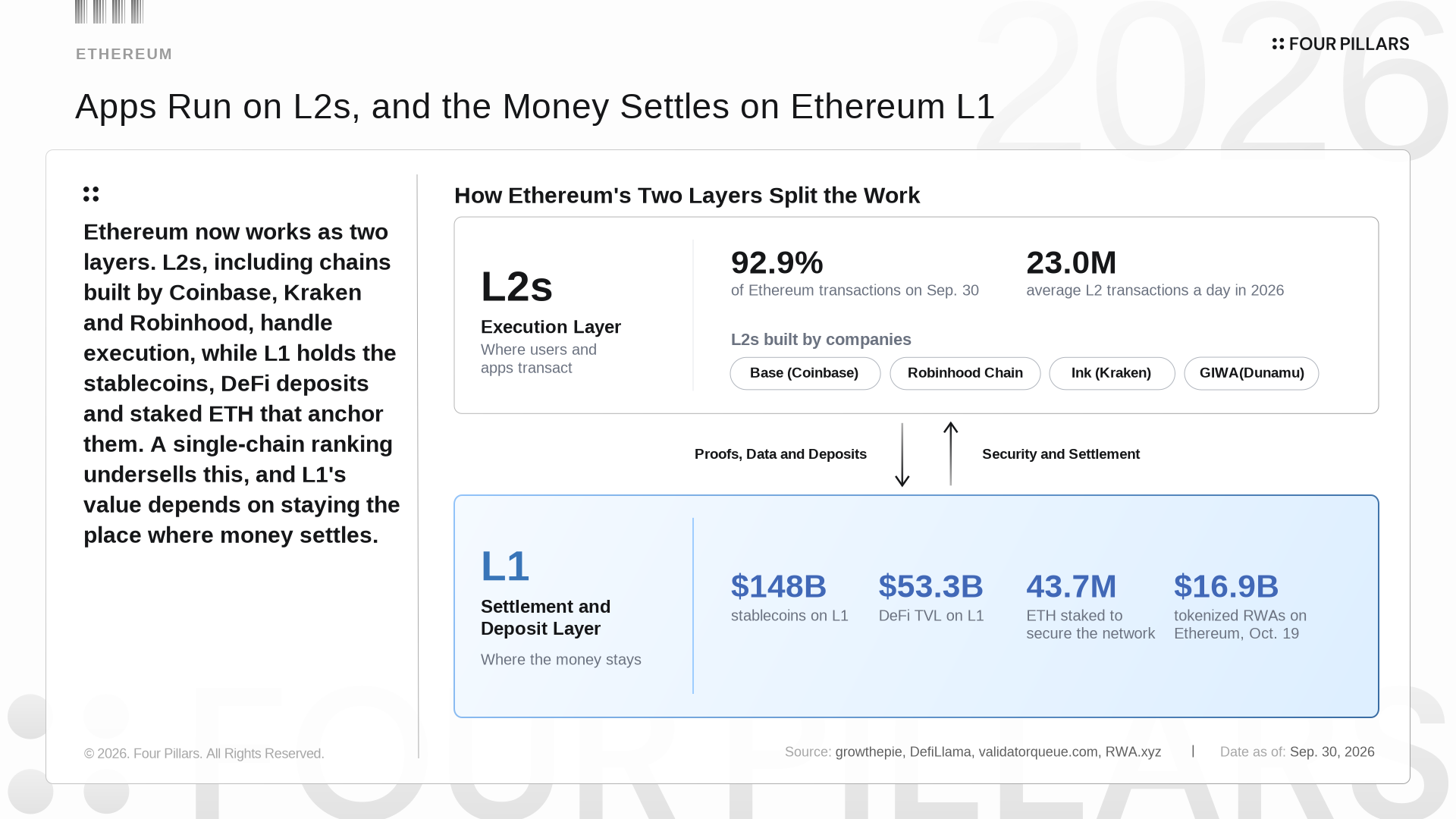
Applications run on L2, while funds settle on Ethereum L1
growthepie, DefiLlama, validatorqueue.com, RWA.xyz · As of September 30, 2026
Ethereum operates as a two-layer system. Users and applications primarily transact on L2. As of September 30, L2 handled 92.9% of Ethereum transactions, processing an average of 23 million transactions per day in 2026. Assets are settled on L1. As of September 30, stablecoins worth $148 billion and DeFi deposits worth $53.3 billion remained on Ethereum L1. L2 sends proofs, data, and deposits to L1, which in return provides security and final settlement. Due to this division of roles, simple on-chain data can easily underestimate Ethereum. L1 alone lags behind other chains in certain metrics (such as DEX trading volume), but when accounting for L2, the Ethereum ecosystem remains the center of crypto finance.
Quote: Steven Goldfeder, Co-founder and CEO of Offchain Labs
Interview: Steven Goldfeder
Robinhood launched Robinhood Chain in July, which is its proprietary L2 built using the Arbitrum Platform. What can the company gain by building the chain as an Ethereum L2 rather than an independent chain? What else do you think is needed to encourage more companies to make the same choice? Companies building their chains as Arbitrum L2 on Ethereum have immediate access to security, liquidity, and a large user and developer base. Operating a proprietary chain on this foundation allows financial businesses to control what matters most: compliance, privacy, product functionality, and the economic benefits of each transaction. We expect more financial institutions to have infrastructure beneath their products while keeping the blockchain invisible to customers. Two things will accelerate this process: clearer rules for stablecoins and tokenized assets, and a path that does not require a big bet on day one. This means launching on a public chain first, validating demand, and then migrating to their own chain once trading volume proves reasonable. ------ Steven Goldfeder, Co-founder and CEO of Offchain Labs
Ethereum Ecosystem Leads in All Funding Metrics
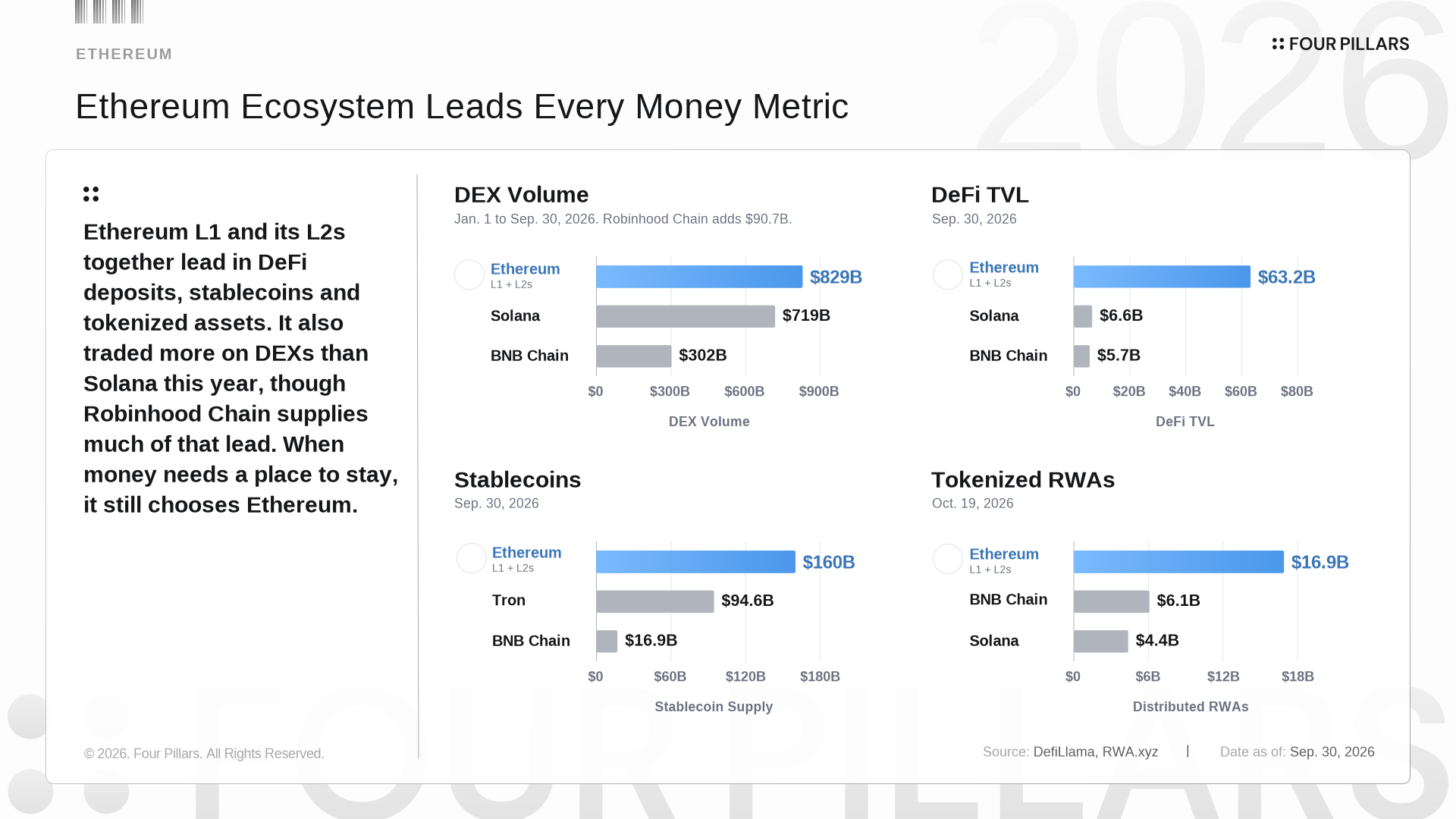
DefiLlama, RWA.xyz · As of September 30, 2026
When L1 and its L2 are counted as one ecosystem, Ethereum ranks first in every funding metric. As of September 30, DeFi deposits (TVL) reached $63.2 billion, more than nine times the $6.6 billion of second-place Solana. The total amount of stablecoins reached $160.1 billion, far exceeding Tron’s $94.6 billion. As of October 19, tokenized RWA (real-world assets) reached $16.9 billion, nearly three times BNB Chain’s $6.1 billion. From January to September, the DEX trading volume of the Ethereum ecosystem reached $829 billion, leading Solana’s $719 billion. However, Robinhood Chain accounted for $90.7 billion of that. Without it, Ethereum's lead would shrink to 2.7%. Ethereum L1 is where funds stay long-term. Transactions can be transferred between fast, cheap chains. Trust-based funds, such as deposits, stablecoins, and tokenized assets, accumulate on Ethereum.
EF Chooses to Shrink, Those Leaving Still Stay on Ethereum
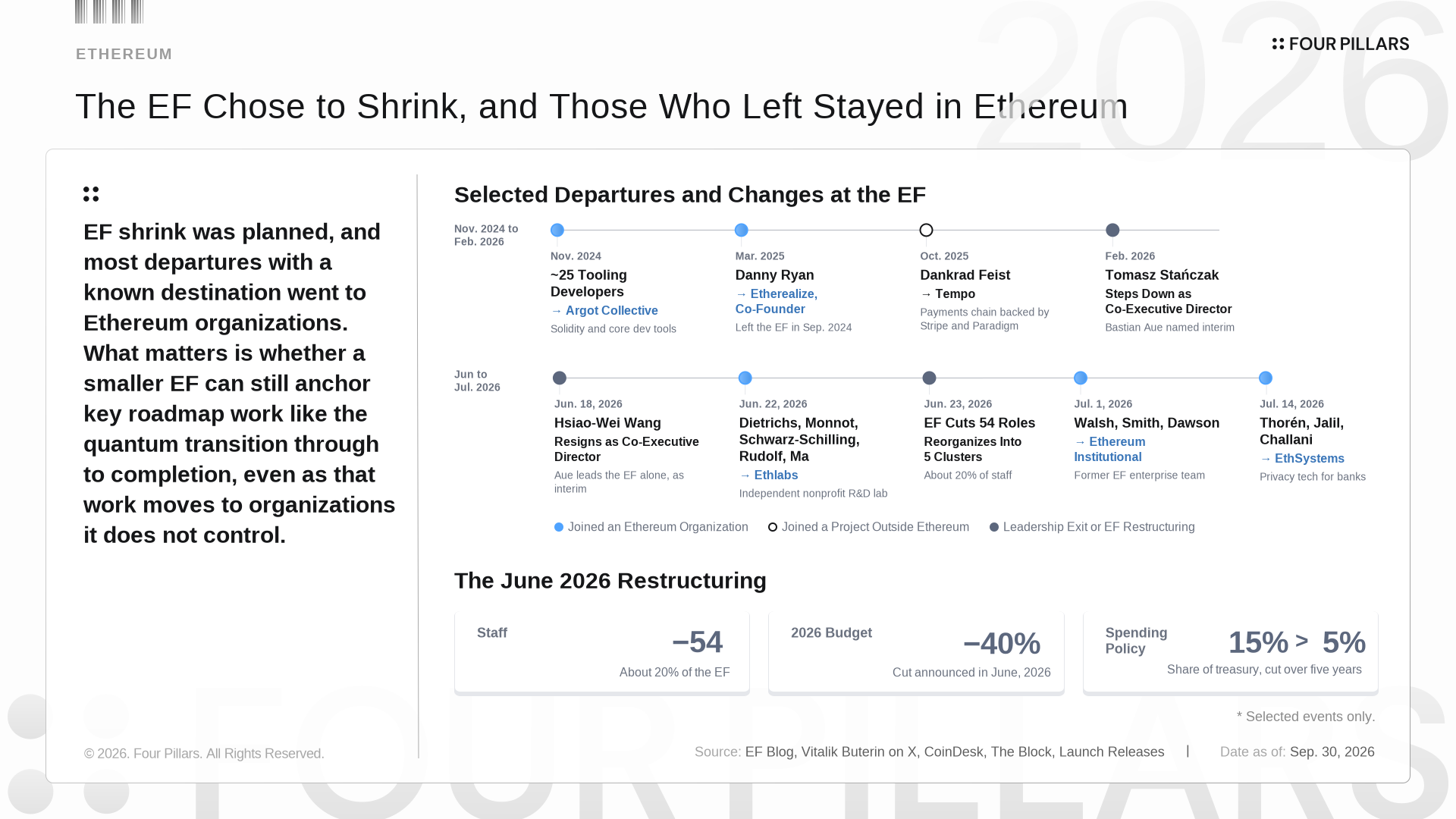
EF blog, Vitalik Buterin on X, CoinDesk, The Block, launch releases · As of September 30, 2026
The Ethereum Foundation (EF) is actively shrinking. On June 23, it cut 54 positions, about 20% of its total staff. According to Vitalik Buterin, it also reduced its 2026 budget by about 40%. These cuts were not hasty decisions. The long-term goal of EF has been to gradually offload its responsibilities so that Ethereum can ultimately operate without the foundation.
Key Organizations in Ethereum are Shifting from Non-Profit to Corporate Support
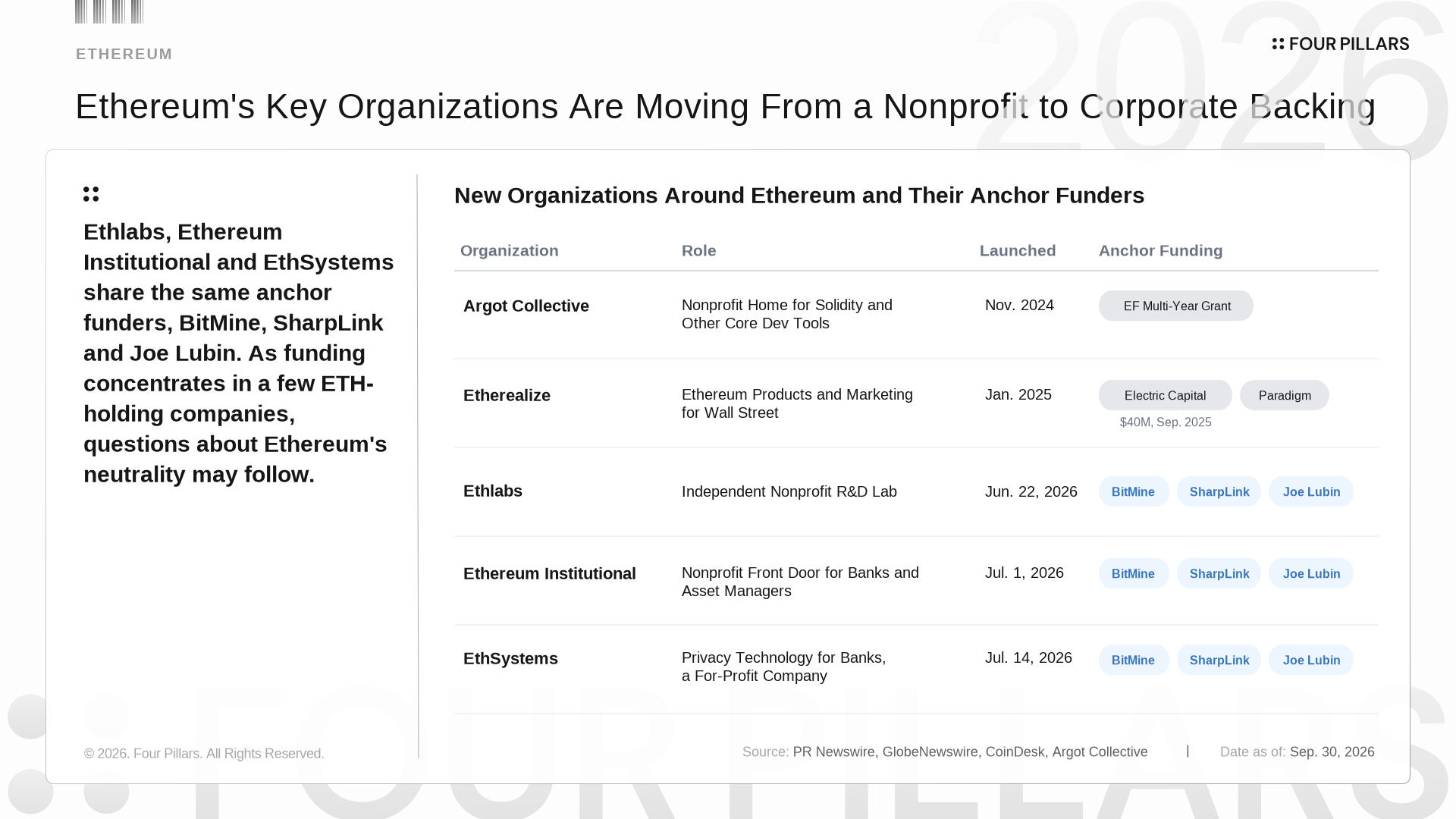
PR Newswire, GlobeNewswire, CoinDesk, Argot Collective · As of September 30, 2026
New organizations are taking on the work that EF has abandoned. In just June and July 2026, three were established in succession. Ethlabs is an independent research lab, Ethereum Institutional collaborates with banks and asset management companies, and EthSystems is a company building privacy technology for banks.
Quote: Julian Ma, Co-founder and Growth Lead of Ethlabs
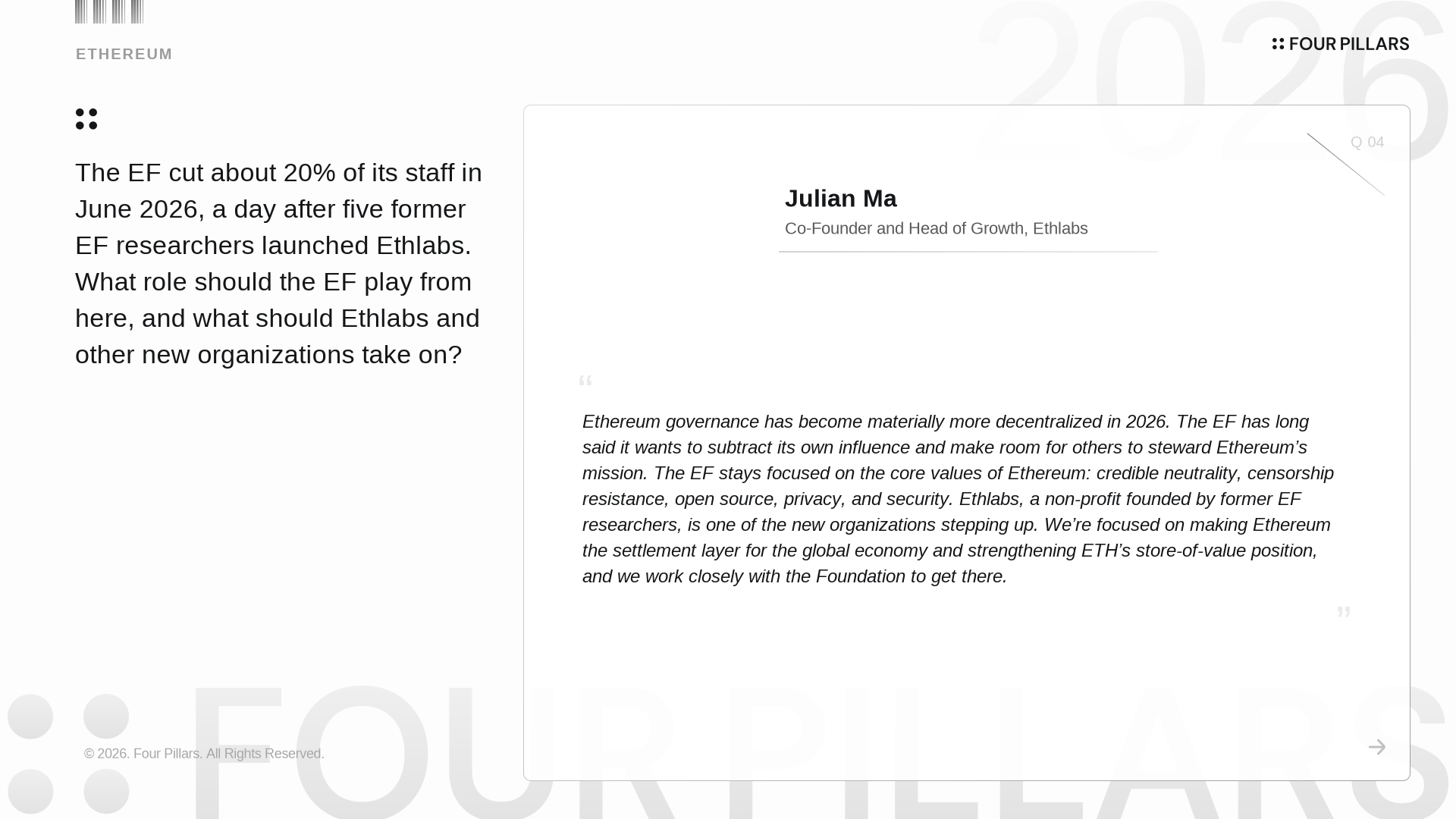
Interview: Julian Ma
EF cut about 20% of its staff in June 2026, and a day earlier, five former EF researchers founded Ethlabs. What role should EF play afterward? What responsibilities should Ethlabs and other new organizations take on? In 2026, Ethereum governance became substantially more decentralized. EF has long stated its desire to reduce its influence and make room for others to manage Ethereum's mission. EF continues to focus on Ethereum's core values: trustless neutrality, censorship resistance, open source, privacy, and security. Ethlabs, a non-profit organization founded by former EF researchers, is one of the new organizations on the rise. We focus on making Ethereum the settlement layer of the global economy and strengthening ETH's status as a store of value, working closely with the foundation to achieve this goal. ------ Julian Ma, Co-founder and Growth Lead of Ethlabs
Five Major Goals for 2029 Can Be Adjusted, Four Principles Remain Unchanged
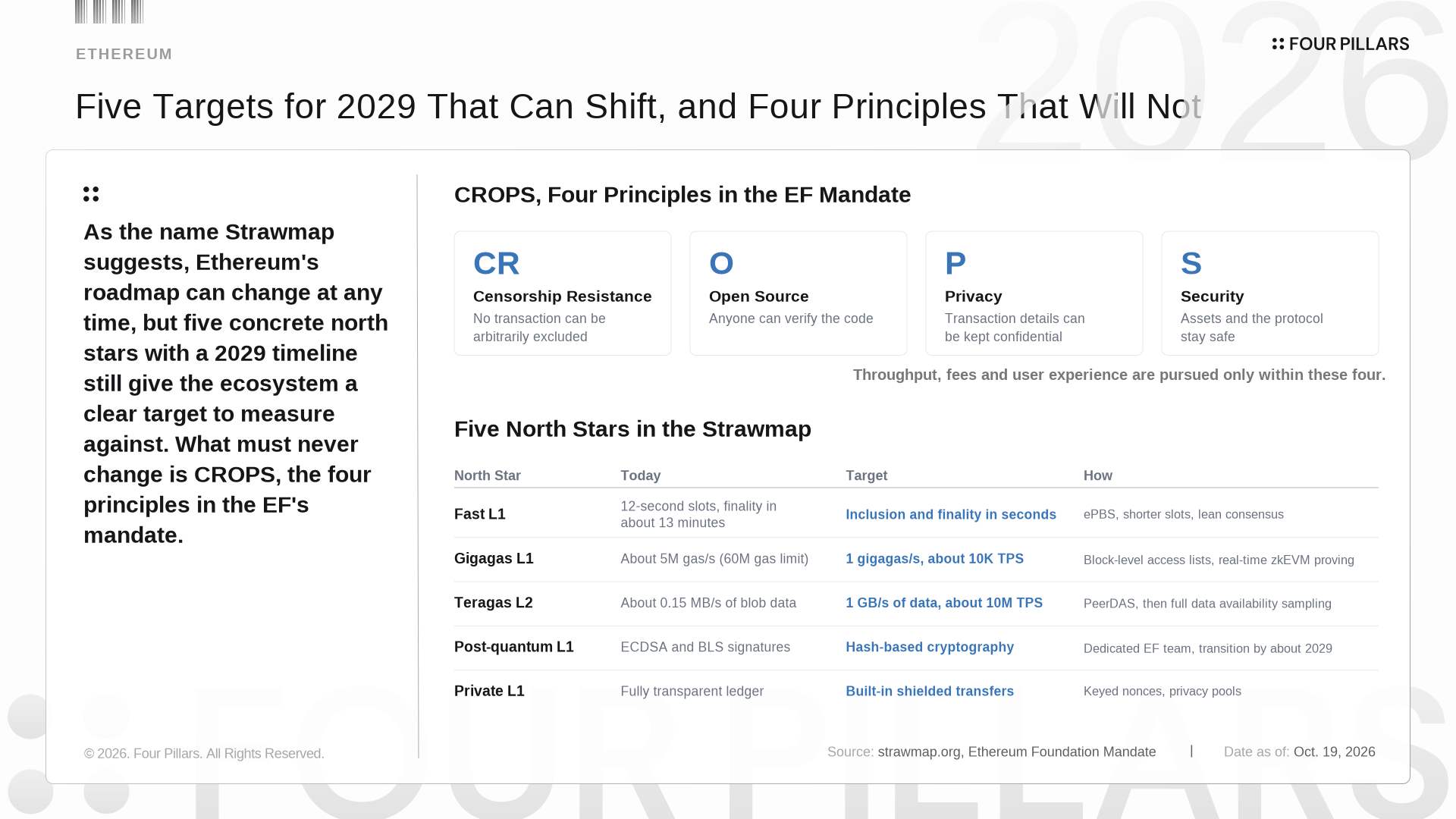
strawmap.org, Ethereum Foundation Mandate · As of October 19, 2026
In February 2026, EF's architecture team released Strawmap (draft roadmap). A month later, EF published its mandate document and clarified the series of unchanging principles known as CROPS. CROPS stands for censorship resistance, open source and freedom, privacy, and security. The name Strawmap combines "strawman" (a draft submitted for review) with "roadmap." It indicates that a complete official roadmap is impossible, and the plan can be modified at any time. Nevertheless, Strawmap still lists long-term goals with specific numbers, providing a standard for measuring progress in the ecosystem. In contrast, CROPS is a standard that cannot be replaced by any other goals. The goals of Strawmap must also be pursued without compromising CROPS. However, EF itself is not the owner of Ethereum but rather a steward building Ethereum alongside others. It remains unclear whether CROPS can continue to serve as a standard within the broader Ethereum ecosystem beyond EF.
Ethereum's Roadmap Now Prioritizes L1 Scaling, Privacy, and Quantum Resistance
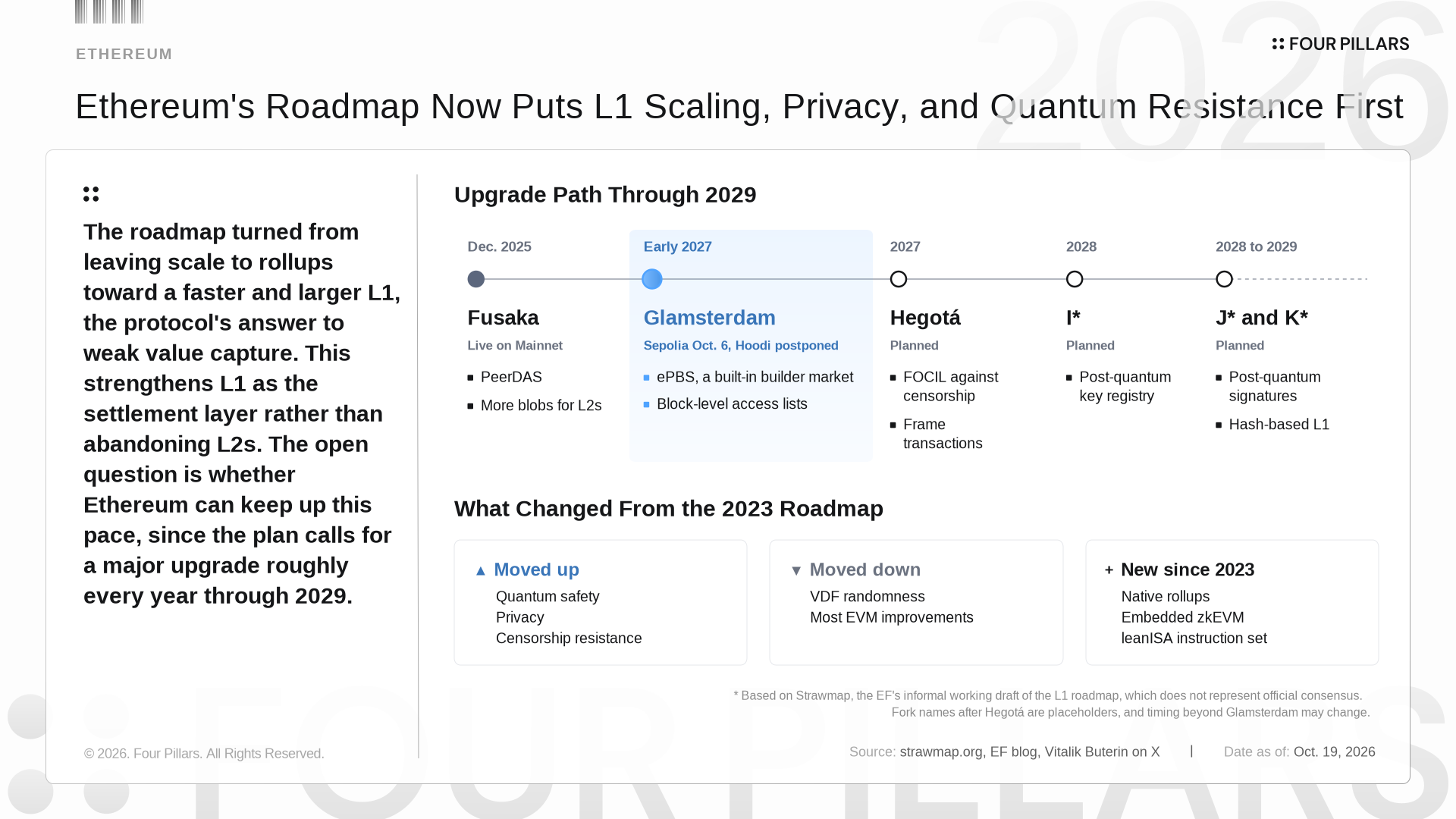
strawmap.org, EF blog, Vitalik Buterin on X · As of October 19, 2026
Since the rollup-centric roadmap in 2020, Ethereum has been developing around a minimized L1, delegating execution scaling to L2. Strawmap re-centers L1 and brings scaling and even privacy into L1 itself. The next fork, Glamsterdam, includes ePBS (separating block proposers from builders) and BALs for parallel execution. The Hegotá planned for 2027 will introduce frame transactions and FOCIL (a censorship resistance mechanism). Based on these changes, the forks in 2028 and 2029 aim to increase block size, shorten block times, and transition to quantum-resistant signatures. The question lies in the pace demanded by the roadmap. The plan requires a fork approximately every six months until around 2029. However, nearly a year after Fusaka goes live in December 2025, Glamsterdam still does not have a mainnet date. If Glamsterdam and Hegotá are delayed, everything scheduled afterward will also be postponed. For Strawmap to succeed, both forks need to launch on the mainnet by the end of 2027.
Quote: Felix Lange, Head of Geth at the Ethereum Foundation
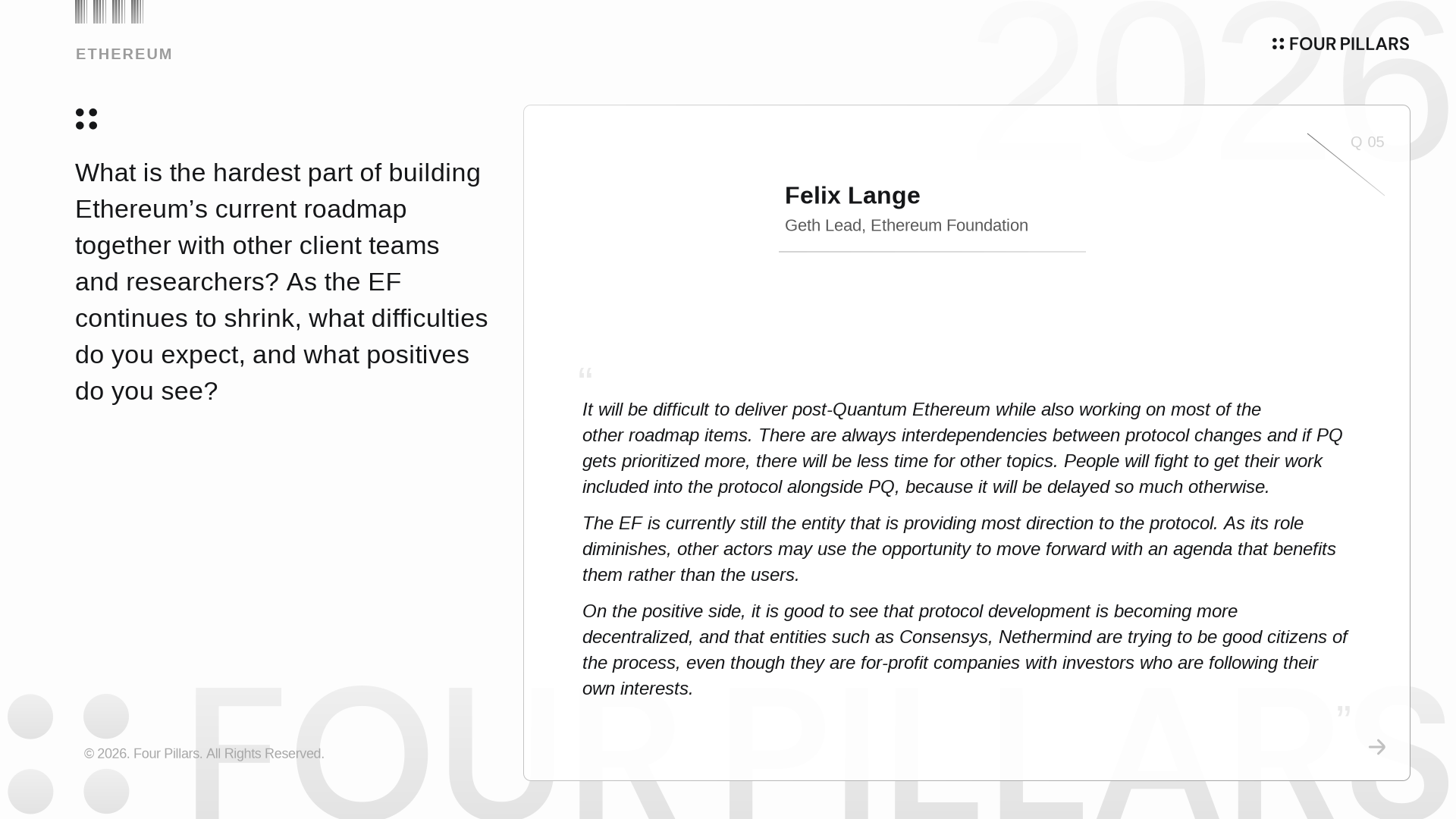
Interview: Felix Lange
Building the current roadmap for Ethereum together with other client teams and researchers, what is the most challenging part? As the Ethereum Foundation (EF) continues to shrink, what difficulties do you anticipate encountering, and what positives do you see? Delivering Ethereum for the post-quantum era while advancing most other roadmap projects will be very difficult. There are always interdependencies between protocol changes, and if post-quantum (PQ) is given higher priority, the timeline for other issues will be reduced. People will strive to include their work with PQ in the protocol, or it will be significantly delayed. Currently, the EF remains the entity providing most of the direction for the protocol. As its role diminishes, other actors may take the opportunity to advance agendas that benefit themselves rather than users. On the positive side, it is encouraging to see protocol development becoming more decentralized, with entities like Consensys and Nethermind striving to be good citizens in this process, even though they are for-profit companies with investors pursuing their own interests. ------ Felix Lange, Head of Geth at the Ethereum Foundation
Overall Trend of EIPs: Proposals Growing Steadily, Increased Focus on Protocol
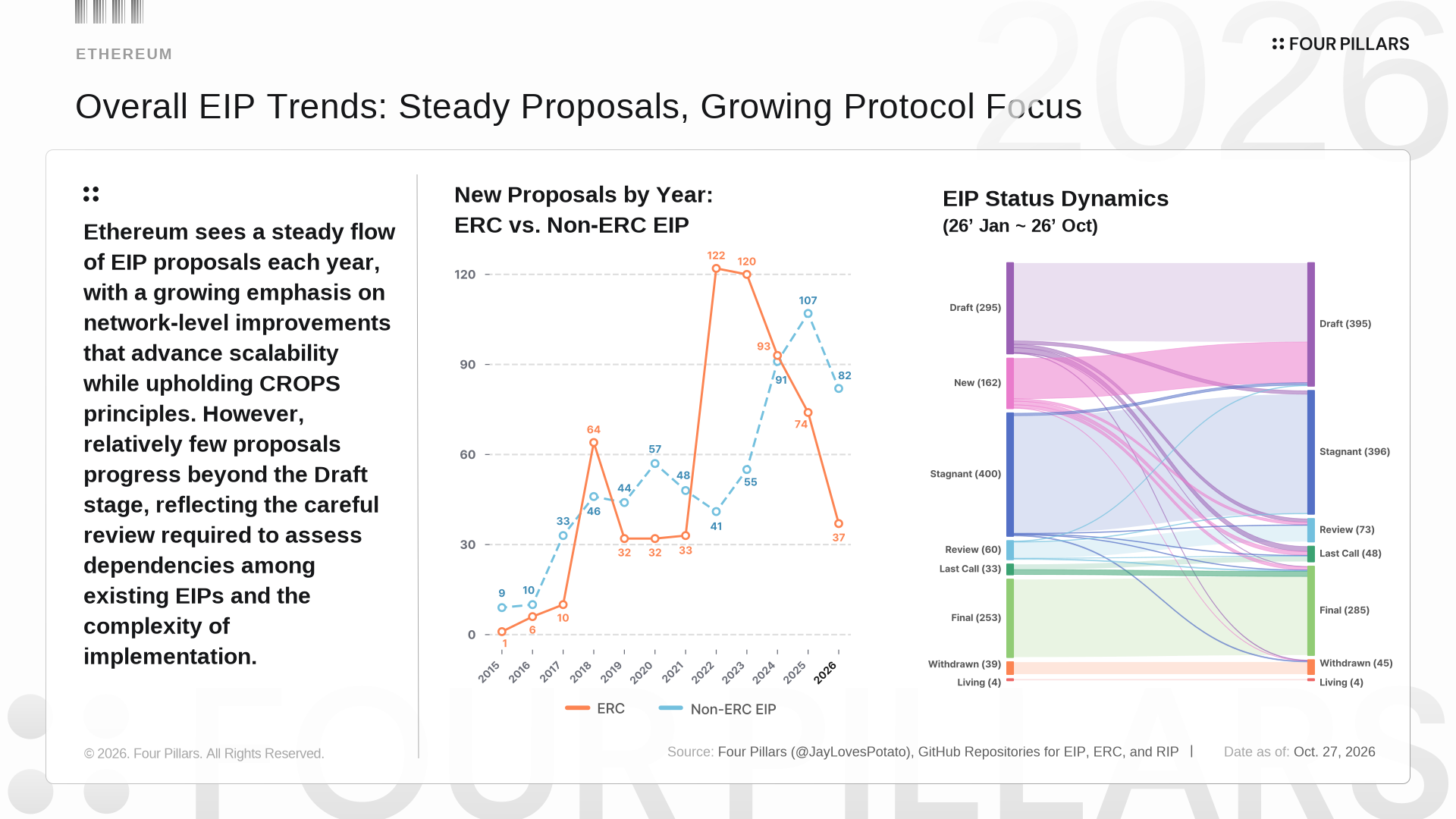
Four Pillars (@JayLovesPotato), GitHub Repositories for EIP, ERC, and RIP · As of October 27, 2026
From 2022 to 2026, as blockchain attracts widespread attention, approximately 160 to 180 new EIPs are proposed each year. These proposals align with Ethereum's goal of expanding while adhering to CROPS (Censorship Resistance, Open Source, Privacy, and Security). Performance improvements from Glamsterdam and the focus on censorship resistance from Hegotá are key examples. Relatively few proposals advance beyond Draft, reflecting the extensive discussions and testing required to assess the dependencies on existing EIPs and the complexity of implementation. (The right image includes EIPs written in earlier years but officially added to the repository in 2026, explaining why the number of new proposals exceeds the figure for 2026 in the left image.)
Is Ethereum Expanding Beyond the Foundation, Are New Contributors Joining?
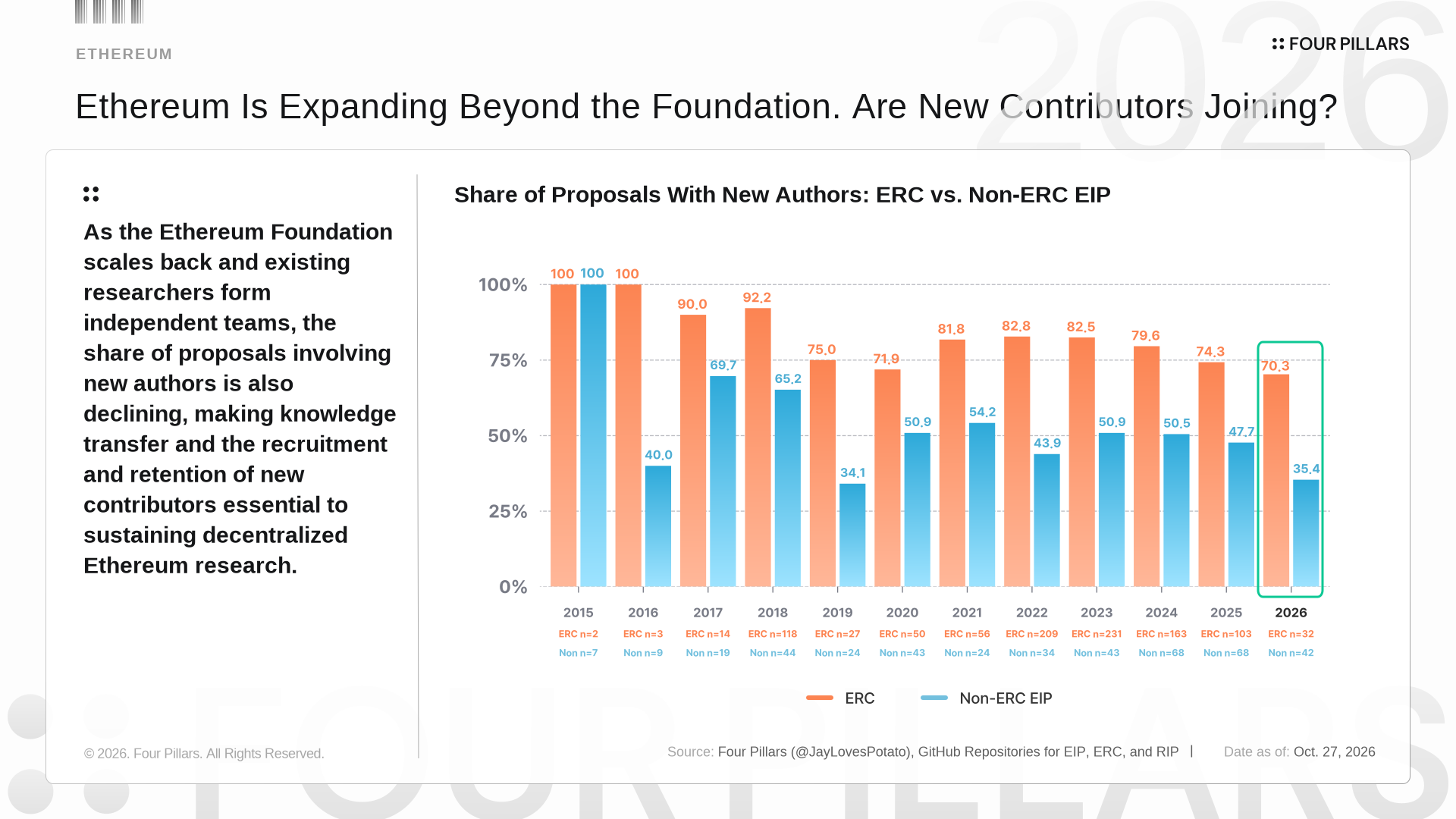
Four Pillars (@JayLovesPotato), GitHub Repositories for EIP, ERC, and RIP · As of October 27, 2026
In proposals involving at least one new author, the proportion of ERC is usually higher than that of non-ERC EIPs. However, in 2026, this ratio dropped to 70.3% and 35.4%, respectively, with non-ERC EIPs reaching their lowest level since 2019. As the Ethereum Foundation narrows its scope and reduces its size, and researchers form independent teams, these numbers raise a question: Is there enough new contributors joining while existing contributors continue to work outside the Foundation? The future largely depends on how the Foundation and its spin-off entities pass on accumulated knowledge and protocol design background to new researchers and help them become long-term contributors.
The Barbell Structure of On-Chain Markets
On-chain markets are increasingly exhibiting a barbell structure, with growth concentrated at both ends: speculative markets and institutional finance.
The year 2026 is a tough year for the overall crypto industry, but the impact on the on-chain economy is particularly severe. As of the end of September, the total market capitalization of crypto has decreased by 3.4% year-to-date, Bitcoin has dropped by 4.5%, and DeFi Total Value Locked (TVL) has decreased by 17.2%. The gap was more pronounced at the beginning of the year when DeFi TVL contracted significantly alongside the overall decline in on-chain activity. The poor performance of DeFi is particularly noteworthy because TVL is primarily composed of crypto assets and stablecoins. In principle, this should provide some buffer against the overall decline in the crypto market. However, the decline in DeFi TVL has exceeded that of the market itself, indicating that this weakness reflects more than just falling asset prices. It points to users actively withdrawing funds from DeFi or becoming unwilling to use on-chain protocols, a dynamic we will explore in the following slides.
A Wave of On-Chain Protocol Shutdowns in 2026
The challenging market environment of 2026 has exposed many on-chain business models as still fragile. Across the industry, protocols are struggling with insufficient product-market fit, meager revenues, depleted funding runway, and rising security costs, leading to an increasing number of teams shutting down operations. The wave of shutdowns indicates that the funds raised and impressive user data are no longer sufficient to sustain a protocol's survival. As financing becomes more difficult and users become more selective, protocols increasingly need persistent demand and credible paths to profitability to survive. Security incidents further raise this threshold, with several shutdowns in 2026 directly or indirectly related to significant vulnerabilities.
Quote: TN Lee, CEO of Pendle
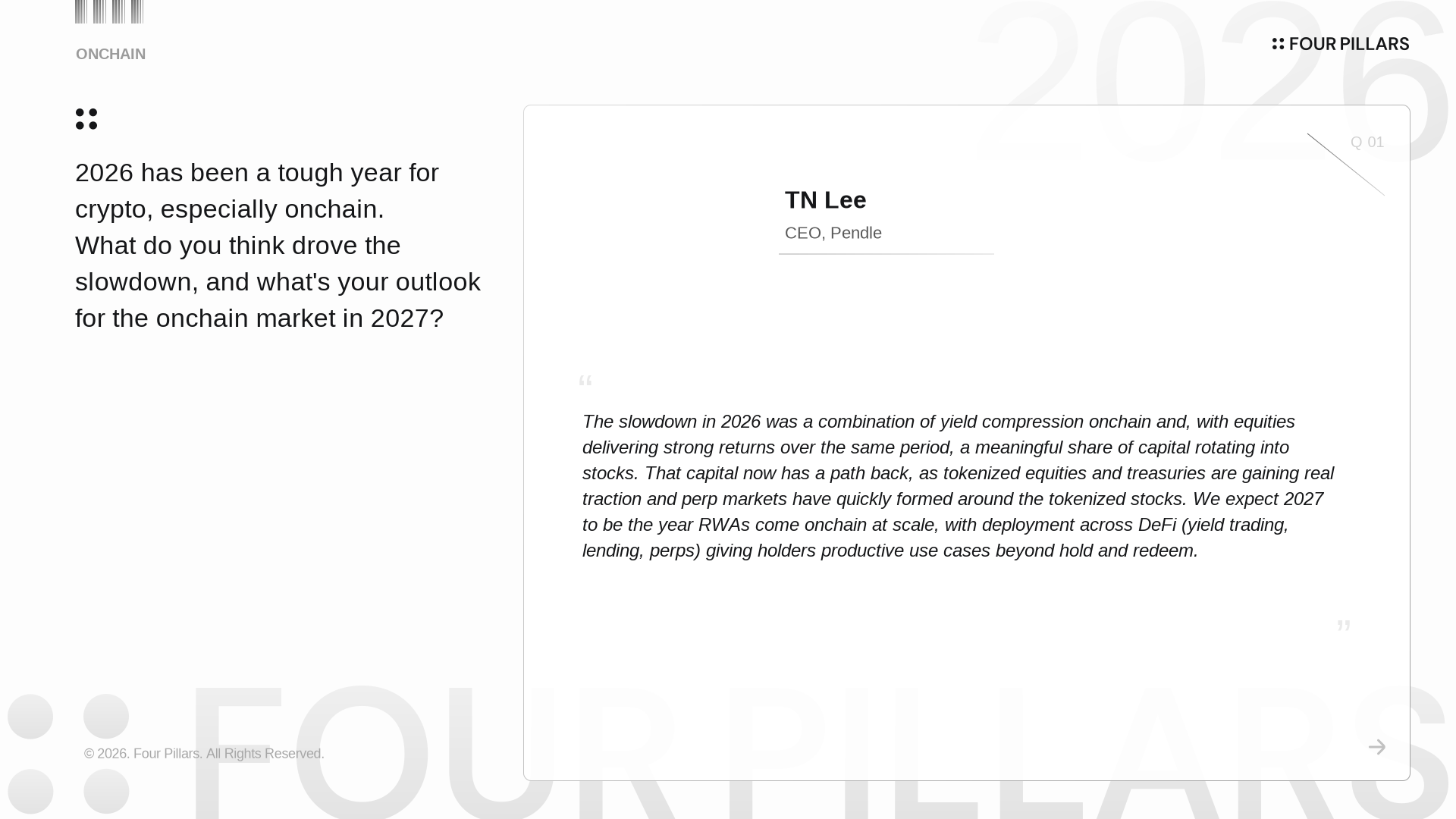
Interview: TN Lee, CEO, Pendle
2026 has been a tough year for the crypto industry, especially in the on-chain space. What do you think has led to the slowdown? What is your outlook for the on-chain market in 2027? The slowdown in 2026 is due to the compression of on-chain yields, combined with strong stock returns during the same period, leading a significant portion of funds to rotate into stocks. Now these funds have a path back, as tokenized stocks and government bonds are gaining real traction, and the perpetual contracts market is rapidly forming around tokenized stocks. We expect 2027 to be a year of large-scale on-chain deployment of Real World Assets (RWA), with their deployment in DeFi (yield trading, lending, perpetual contracts) providing holders with productive use cases beyond mere holding and redemption. ------ TN Lee, CEO of Pendle
Security Vulnerabilities are One of the Biggest Barriers to On-Chain Adoption
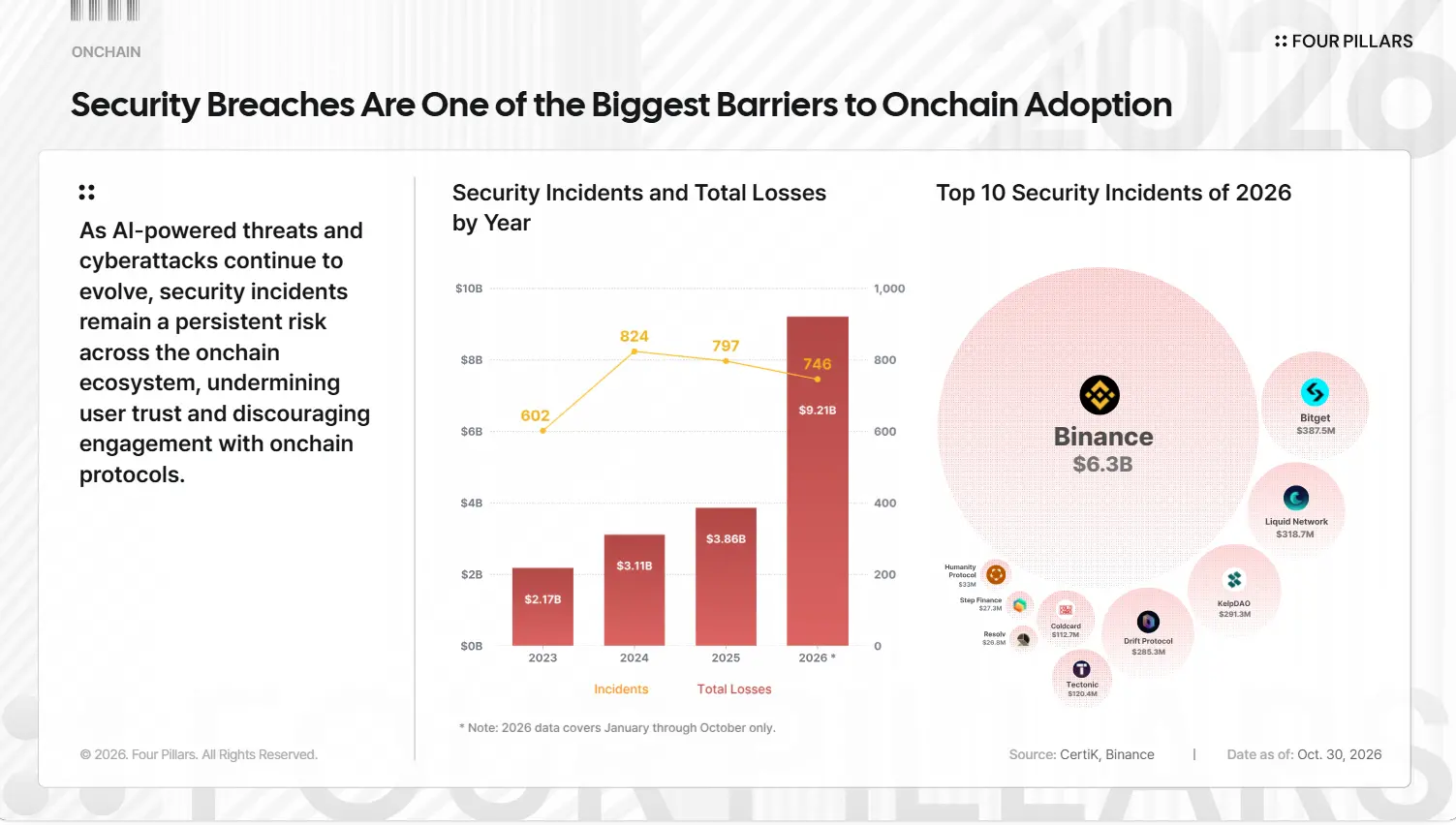
Security risks reached a new level in 2026. Over 750 security incidents resulted in approximately $9 billion in losses, largely driven by the $6.3 billion Binance incident, which is the largest crypto security incident to date. Despite the number of incidents remaining high, the scale of losses has surged dramatically. As AI makes cyberattacks increasingly complex and scalable, security is becoming a structural barrier to on-chain adoption. For users, the increased risk of large-scale losses adds a layer of uncertainty to using on-chain services, undermining trust and making the risk-reward trade-off of participating in crypto increasingly difficult to rationalize.
Quote: Jun Choi, Head of Growth at OtterSec

Interview: Jun Choi, Head of Growth, OtterSec
With the enhancement of AI capabilities, do you expect attacks on on-chain protocols to accelerate, or can AI-driven defenses and better security infrastructure keep up? AI helps security teams identify vulnerabilities for projects more efficiently, but black hats also benefit from many of the same capabilities. In response, we have seen a demand for customized security services that go beyond smart contract audits, as well as ecosystem coordination initiatives like STRIDE and SIRN. As AI expands what attackers can do, security teams are also adapting by taking a more holistic approach and prioritizing incident response when issues arise. ------ Jun Choi, Head of Growth at OtterSec
On-Chain Yields No Longer Offer Attractive Premiums
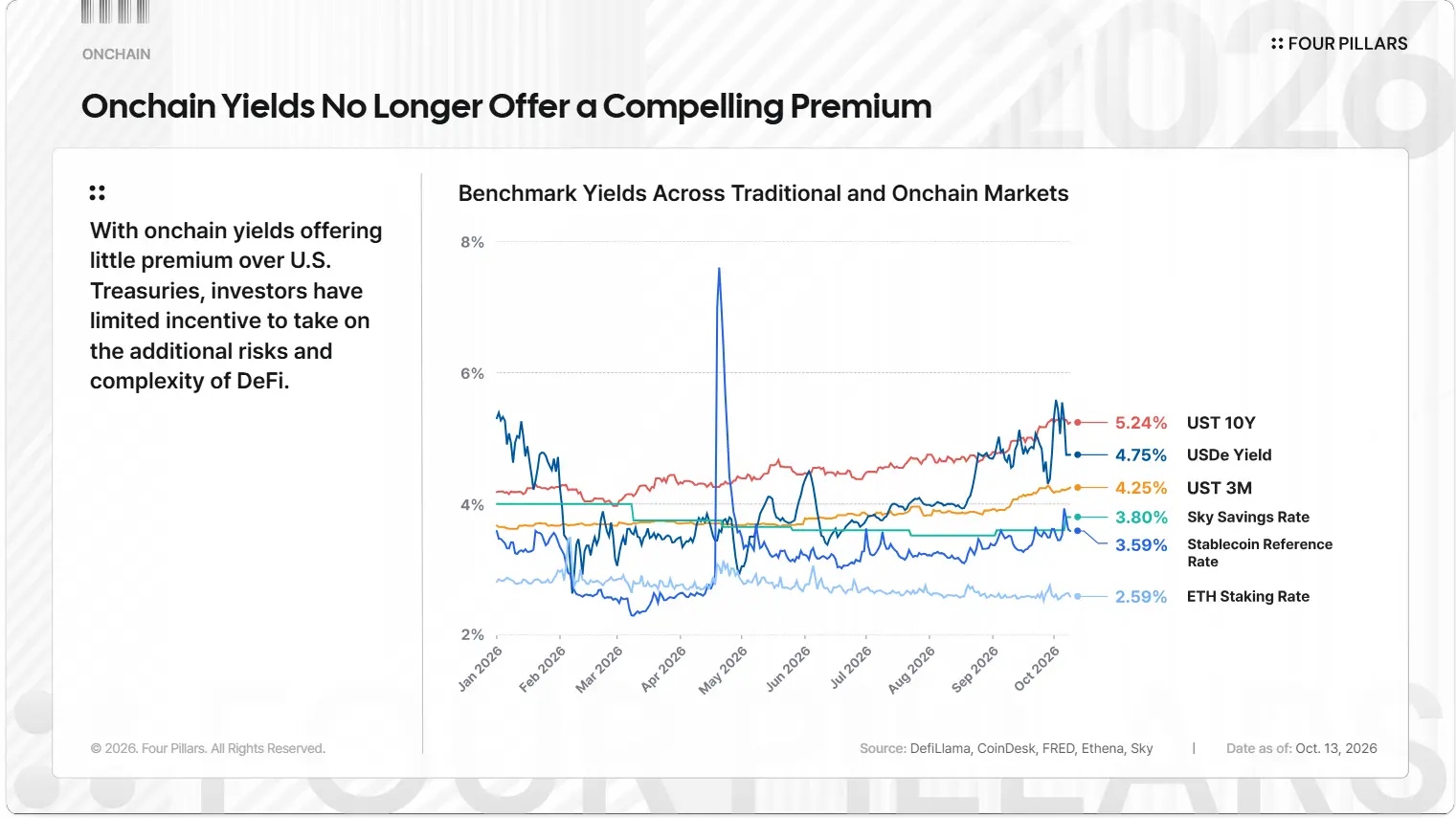
FRED, CoinDesk Indices, DefiLlama, Ethena, Sky · January 1 - September 30
On-chain yields no longer provide the premiums they once did. As of mid-October, the yield on 10-year U.S. Treasury bonds is 5.24%, 3-month is 4.25%, while USDe is 4.75%, Sky Savings Rate is 3.80%, and the stablecoin reference rate is 3.59%, with ETH staking at only 2.59%. In other words, investors can now achieve comparable or even higher yields in traditional markets without taking on the additional smart contract and liquidity risks of DeFi. With security risks also remaining high, the risk-reward trade-off of deploying funds on-chain has become less attractive, helping to explain why users may be increasingly reluctant to participate in DeFi.
Quote: Guy Young, Founder and CEO of Ethena
Interview: Guy Young, Founder and CEO, Ethena
Looking ahead to the next phase of crypto adoption, what do you think are the key factors in building a sustainable and resilient ecosystem? The next phase of crypto adoption will bring in funds that can hardly tolerate losses, and the protocols that will survive will be those that prioritize capital preservation. Ethena considers worst-case scenarios when designing systems, assuming the system has been compromised, and this approach has proven effective: during the Bybit and Binance hacking incidents, the 10/10 liquidation event, and the cross-chain bridge vulnerability affecting Aave, the redemption of USDe has always remained open and fully operational. The current greatest threat to resilience is the accumulating counterparty risk in DeFi, where one dollar lent may depend on one protocol, one cross-chain bridge, and dozens of collateral assets.
AI-assisted vulnerability attacks make this more urgent, so infrastructure needs to be built with protection at every layer, including rate limits for lending and cross-chain bridges, isolated blue-chip markets, and issuers capable of quickly freezing stolen assets. Protocols also have to forgo some returns in exchange for security and make this public. Ethena is doing this by urging partners to upgrade security and cutting exposure when upgrades are insufficient, as winning the next wave of users will be ecosystems that can prove every dollar is redeemable under pressure. ------ Guy Young, Founder and CEO of Ethena
The On-Chain Ecosystem is Increasingly Exhibiting a Barbell Structure
DefiLlama, Dune, rwa.xyz · As of September 30, 2026
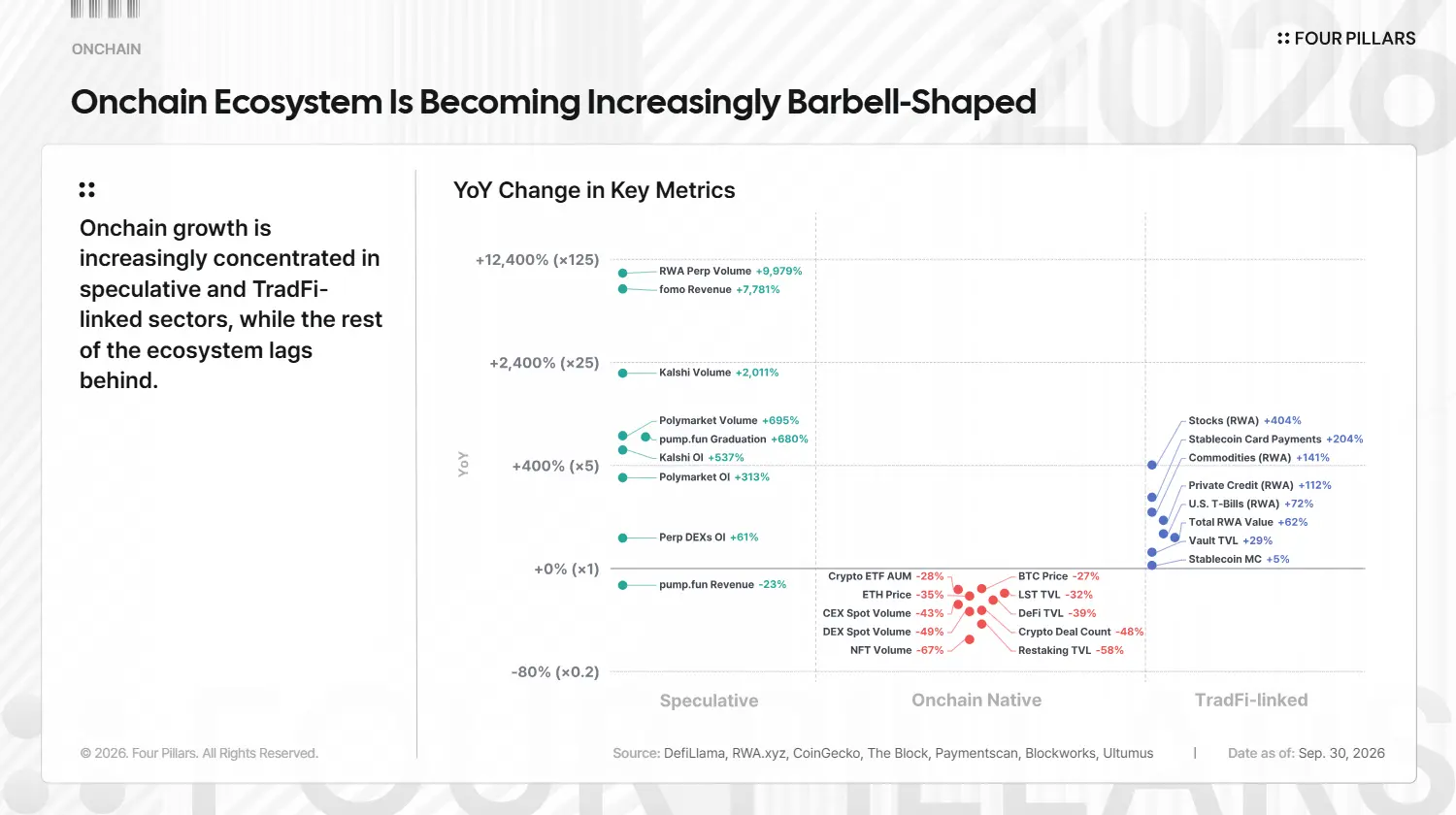
In 2026, the on-chain market is increasingly polarized. Growth is concentrated at both ends of the ecosystem: speculative markets and assets associated with traditional finance. Prediction markets are one of the most obvious winners, with Kalshi's trading volume increasing by 2011% year-on-year, Polymarket growing by 695%, and the open interest in perpetual contract DEX rising by 61%. Categories associated with traditional finance also expanded significantly, led by tokenized stocks at +404%, stablecoin card payments at +204%, and private credit at +112%. This aligns with the widespread rise of RWA perpetual contracts and tokenized stocks throughout 2026. In contrast, many traditional on-chain native ecosystems are experiencing contraction. DeFi TVL decreased by 39% year-on-year, DEX spot trading volume fell by 49%, NFT trading volume dropped by 67%, and re-staking TVL decreased by 58%. This gap indicates that on-chain demand is no longer expanding evenly across the crypto space but is increasingly concentrated around speculative products with clear user demand and financial products associated with traditional markets.
DeFi Protocols are Adjusting Product Design for Institutions
Project Announcement
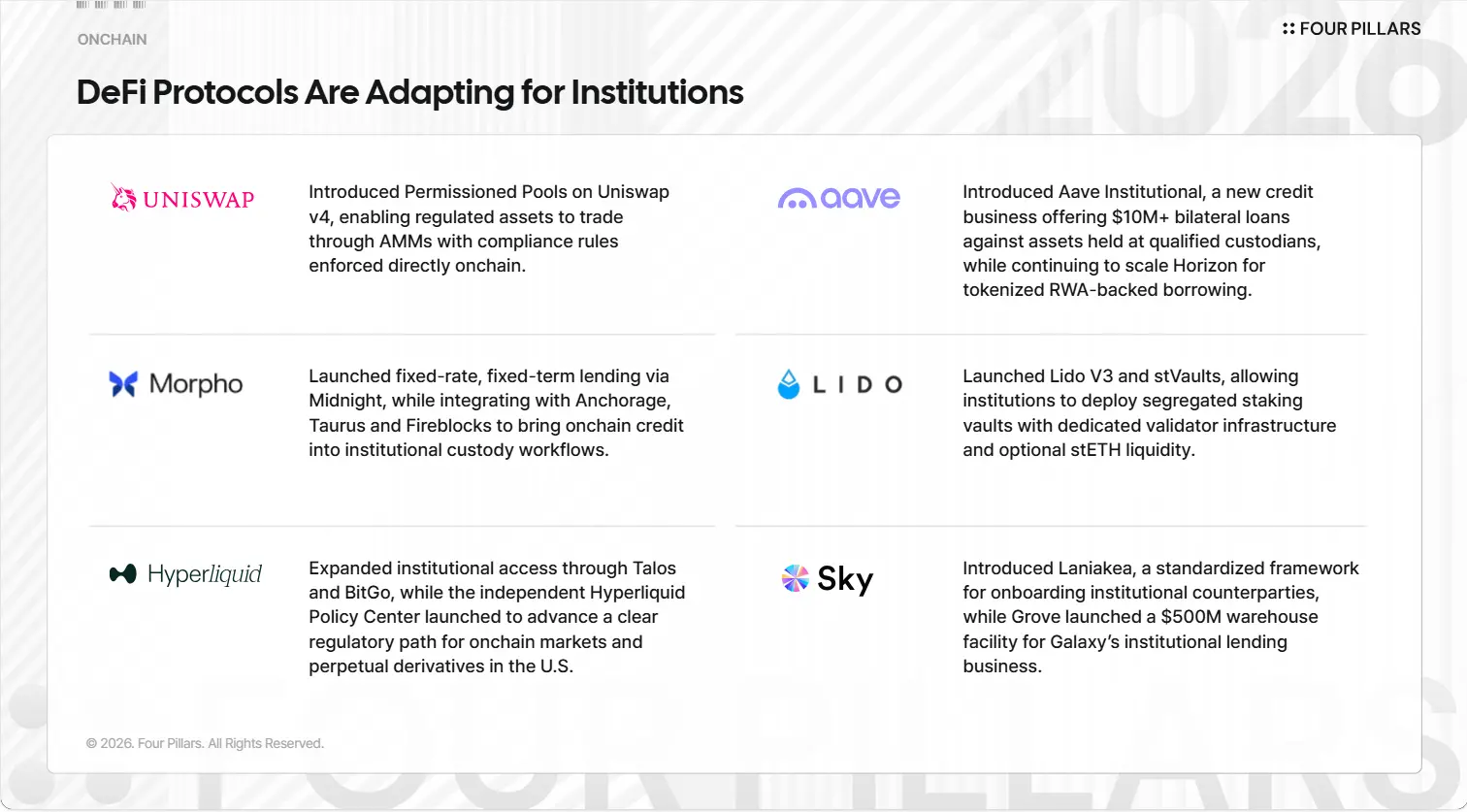
As institutional capital becomes an increasingly important source of growth, DeFi protocols are redesigning products around the needs of professional investors. This shift is evident across the entire tech stack, with protocols adding permissioned markets, predictable credit terms, qualified custody access, isolated staking, and institutional-grade compliance and risk control.
Quote: Merlin Egalite, Co-founder of Morpho
Interview: Merlin Egalite, Co-founder, Morpho
2026 is the year when major DeFi protocols begin to transcend the on-chain ecosystem and expand into institutional finance. Do you think this is an inevitable trend? If so, what key challenges need to be addressed in 2027 to attract more institutional capital? Institutional capital moving on-chain is an inevitable trend and will accelerate in 2027. The goal has never been to focus solely on the $60 billion crypto-backed lending market but to bring the $200 trillion global credit market on-chain. 2026 indicates that major financial institutions are ready to embrace on-chain infrastructure. The next step is to make this infrastructure serve the broader financial system. This means meeting their needs where institutions are, providing predictable loan terms through fixed rates, and seamlessly integrating with custody and compliance systems that institutions are already using. Institutions will not adopt DeFi just to use blockchain; they will adopt it because DeFi can deliver better, more efficient, and more competitive financial products. ------ Merlin Egalite, Co-founder of Morpho
Institutions are Moving On-Chain
Company Announcement
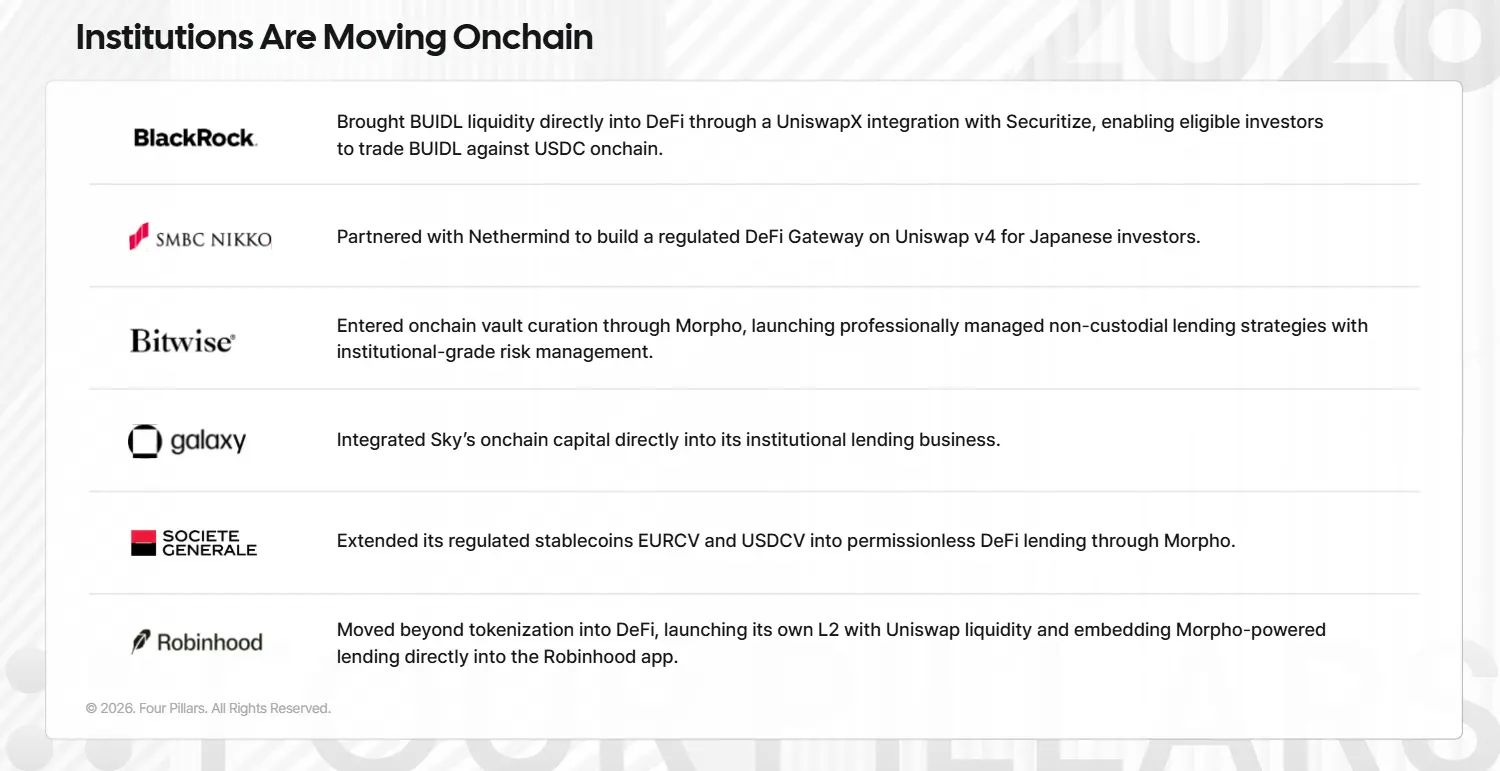
Institutional adoption is no longer a one-way story of DeFi adapting to traditional finance. Financial institutions themselves are increasingly moving on-chain, using DeFi protocols as infrastructure for trading, lending, liquidity, and asset distribution. BlackRock and Securitize are bringing BUIDL liquidity to UniswapX, SMBC Nikko is building a regulated DeFi gateway on Uniswap v4, and Bitwise is entering treasury management through Morpho. Galaxy is integrating Sky's capital into institutional lending, Société Générale-FORGE is deploying regulated stablecoins into the Morpho lending market, and Robinhood is embedding both Uniswap liquidity and Morpho-driven lending into its own on-chain ecosystem. In summary, these initiatives indicate that traditional financial institutions are increasingly viewing DeFi as available financial infrastructure rather than an experimental market.
Everyone is Focusing on the Same On-Chain Opportunities
Four Pillars · As of September 30, 2026
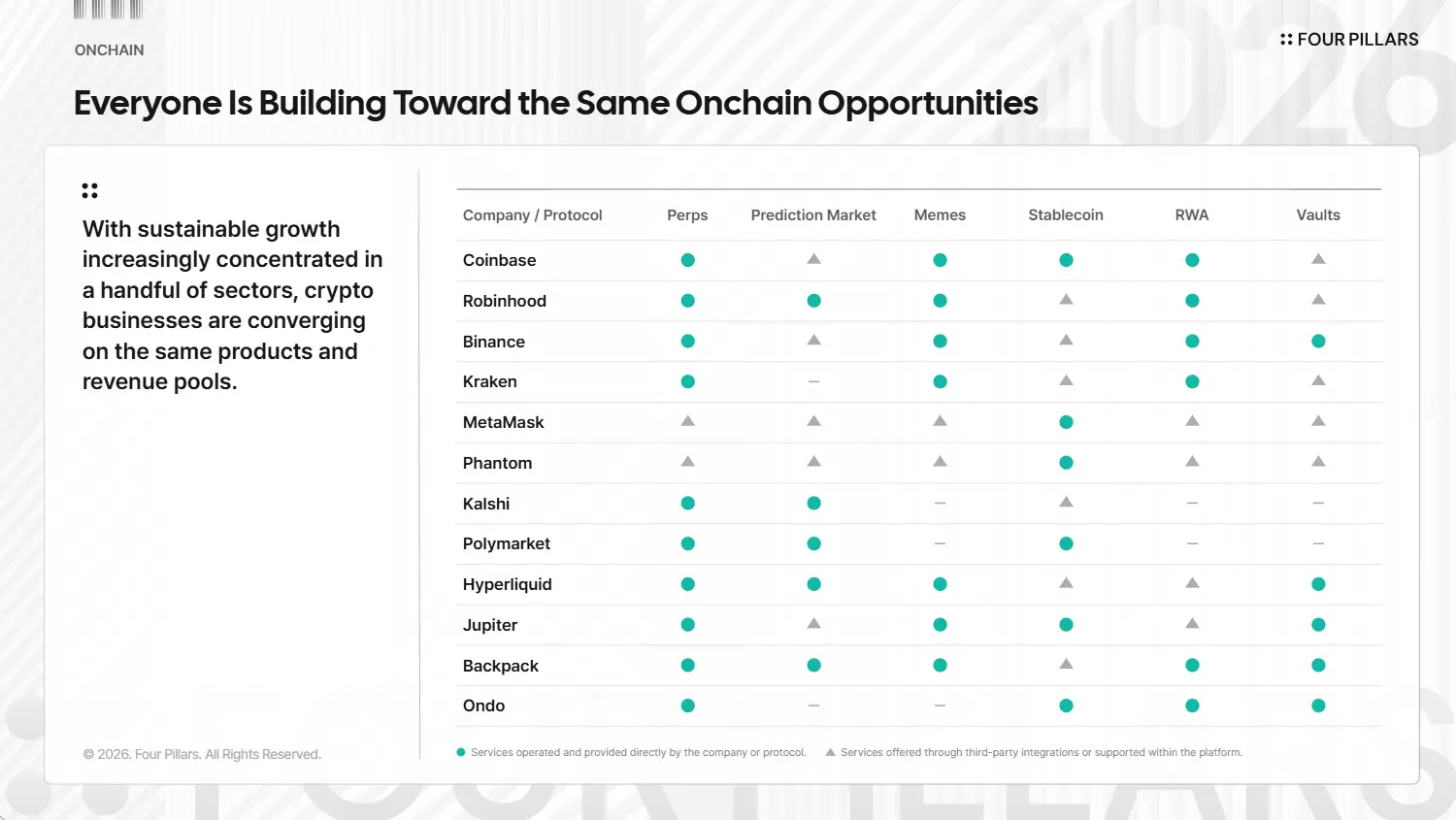
As on-chain growth increasingly concentrates on a few validated categories, businesses within the crypto ecosystem are converging on the same opportunities. Speculative products like perpetual contracts, prediction markets, and meme coins continue to attract strong user demand, while stablecoins, RWA, and treasuries have become the clearest areas of growth associated with traditional finance. Prediction markets alone set record trading volumes in 2026, and RWA perpetual contracts are rapidly expanding. Consequently, exchanges, wallets, trading venues, and protocols that initially had vastly different business models are increasingly offering the same products. Coinbase, Robinhood, Binance, Hyperliquid, and Jupiter are all expanding in these categories, either by directly entering or through integration. The result is a crypto industry with an increasingly converging product strategy, as everyone competes for the same limited demand and revenue.
Quote: Taisuke Isono, SMBC Nikko Securities
Interview: Taisuke Isono, General Manager, DeFi Technology Department, SMBC Nikko Securities
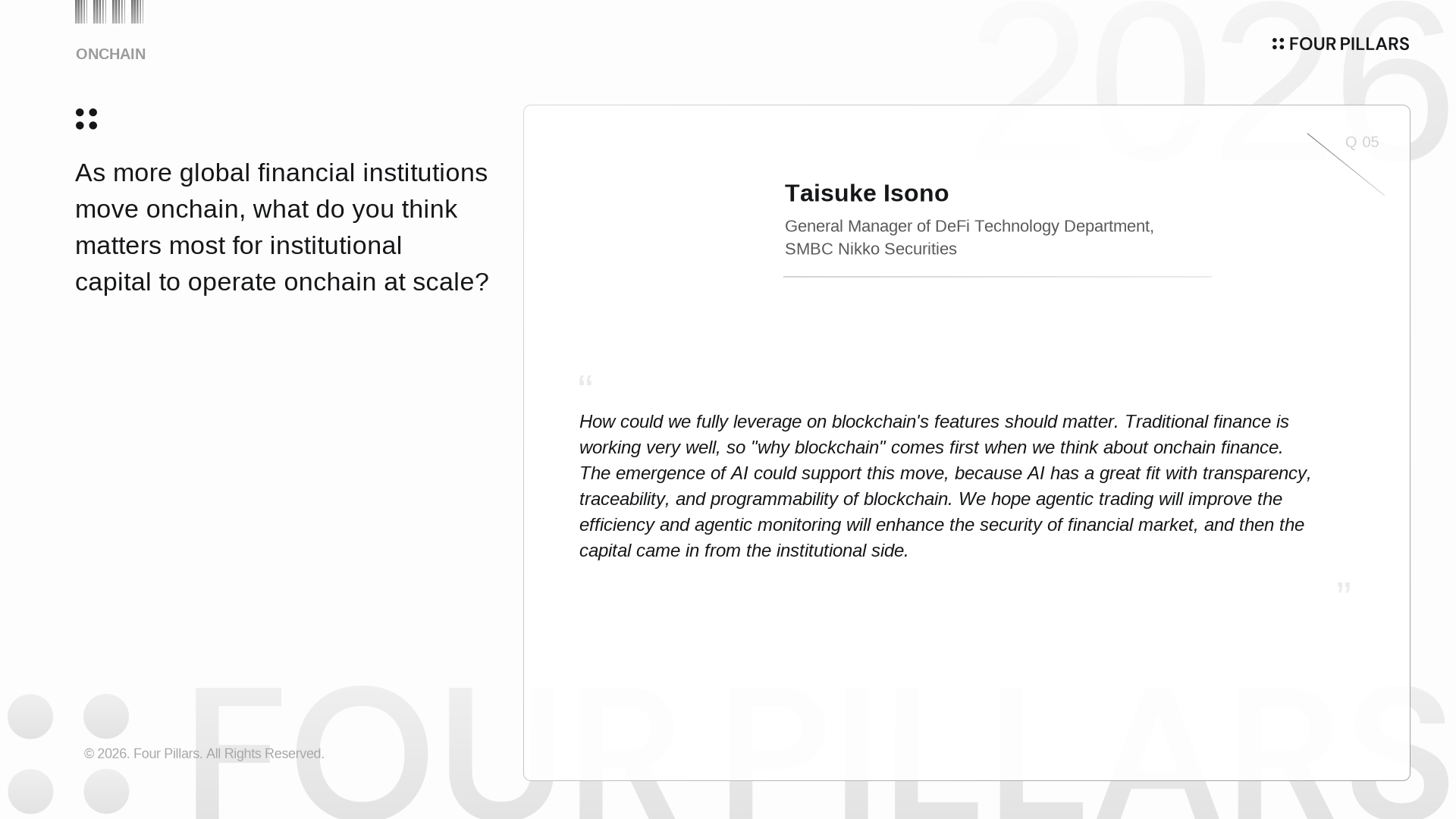
As more global financial institutions move on-chain, what do you think is most important for institutional capital to operate on-chain at scale? The key lies in how to fully leverage the characteristics of blockchain. Traditional finance operates well, so when we think about on-chain finance, the primary question is "why use blockchain?" The emergence of AI can support this transition, as AI aligns well with the transparency, traceability, and programmability of blockchain. We hope that agent trading can enhance the efficiency of financial markets, and agent monitoring can enhance the security of financial markets, after which capital from institutions will flow in. ------ Taisuke Isono, General Manager of DeFi Technology Department, SMBC Nikko Securities
Beyond Issuance to Utility
Stablecoins as payment rails, and the scale of tokenized assets surpasses $120 billion.
Stablecoins are Shifting from Issuance to Utility
Allium, FRED · As of October 30, 2026
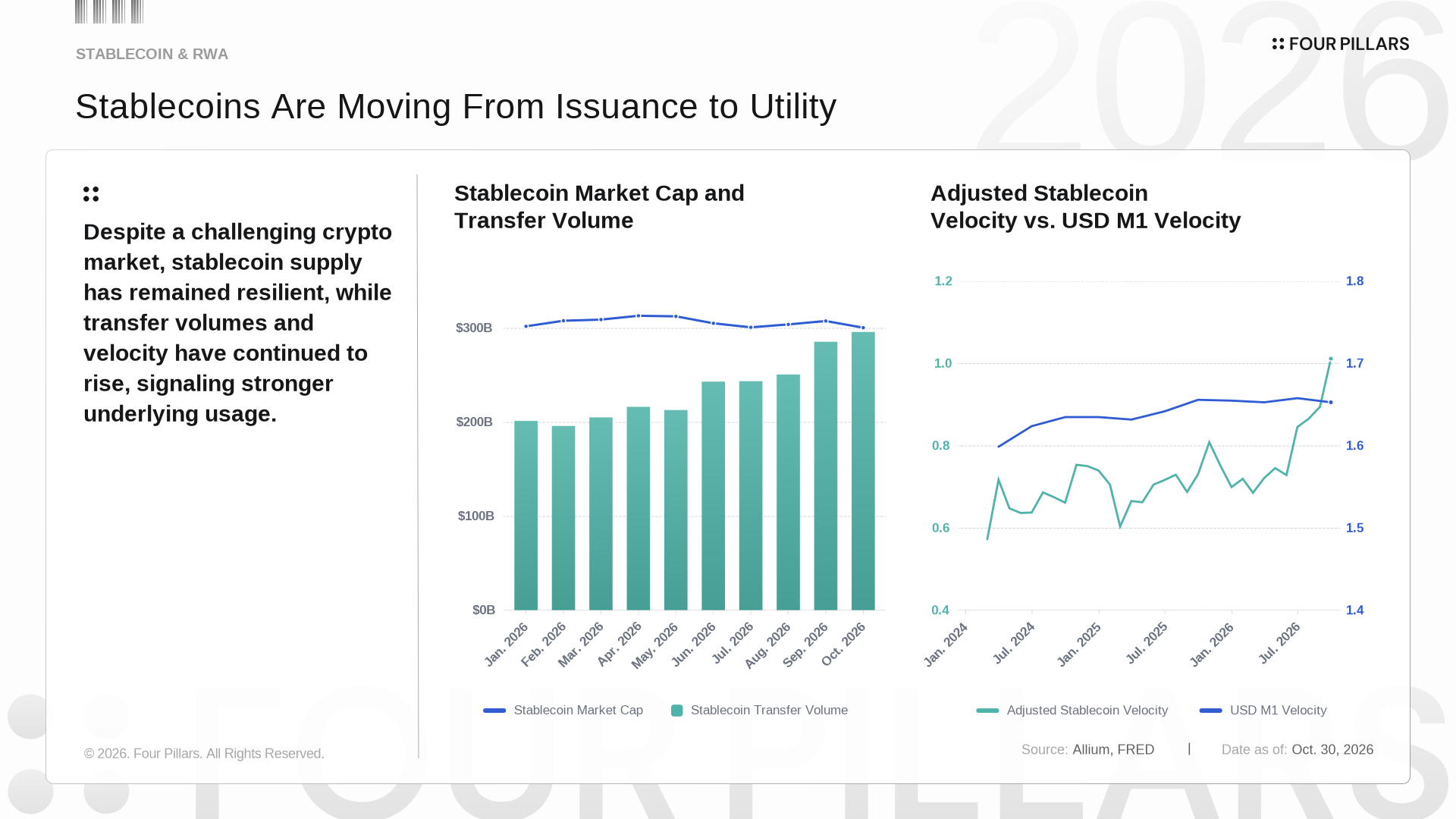
Despite the challenging crypto market in 2026, stablecoins have demonstrated extraordinary resilience. The supply has remained around $300 billion throughout the year, reaching approximately $305 billion by the end of the third quarter, even as the broader crypto market faced significant pressure. More importantly, usage continues to expand: as of September, stablecoin payments grew by 45% to $482 billion, and adjusted trading activity is also on the rise. This divergence, where supply remains relatively stable while activity increases, indicates that stablecoins are moving beyond the issuance-driven phase towards deeper usage. The adjusted velocity of stablecoin circulation continues to rise, surpassing the velocity of the U.S. M1 money supply in the latest range shown in the chart. In other words, the existing supply of stablecoins is circulating more actively, reinforcing the view that stablecoins are increasingly being used as financial and payment infrastructure rather than merely held on-chain.
Quote: Elton Shehdula, Head of Research at Allium
Interview: Elton Shehdula, Head of Research, Allium
In 2026, the supply of stablecoins remained relatively stagnant, even as trading volume continued to rise. What key catalysts do you think are needed to reignite stablecoin issuance growth in 2027? The growth of stablecoin supply in 2027 may be driven by two major developments: more institutions issuing stablecoins and broader distribution to new customers. The implementation of the GENIUS Act could accelerate issuance, especially among banks, with 21 financial institutions planning to jointly launch dollar-backed stablecoins in the first half of 2027. As issuance becomes easier and more issuers enter the market, distribution will become increasingly important, with revenue-sharing arrangements providing financial incentives for partners to promote stablecoins to their existing customers and create new demand. Early examples include Paxos's USDG, which increased its circulating supply by $1.6 billion in the first nine months of 2026, surpassing any other issuer; and Open USD, which reached $799 million within two weeks of launch, both sharing reserve income with partners, with Open USD also offering additional equity incentives. ------ Elton Shehdula, Head of Research at Allium
Stablecoin Payments Only Rise, Never Fall
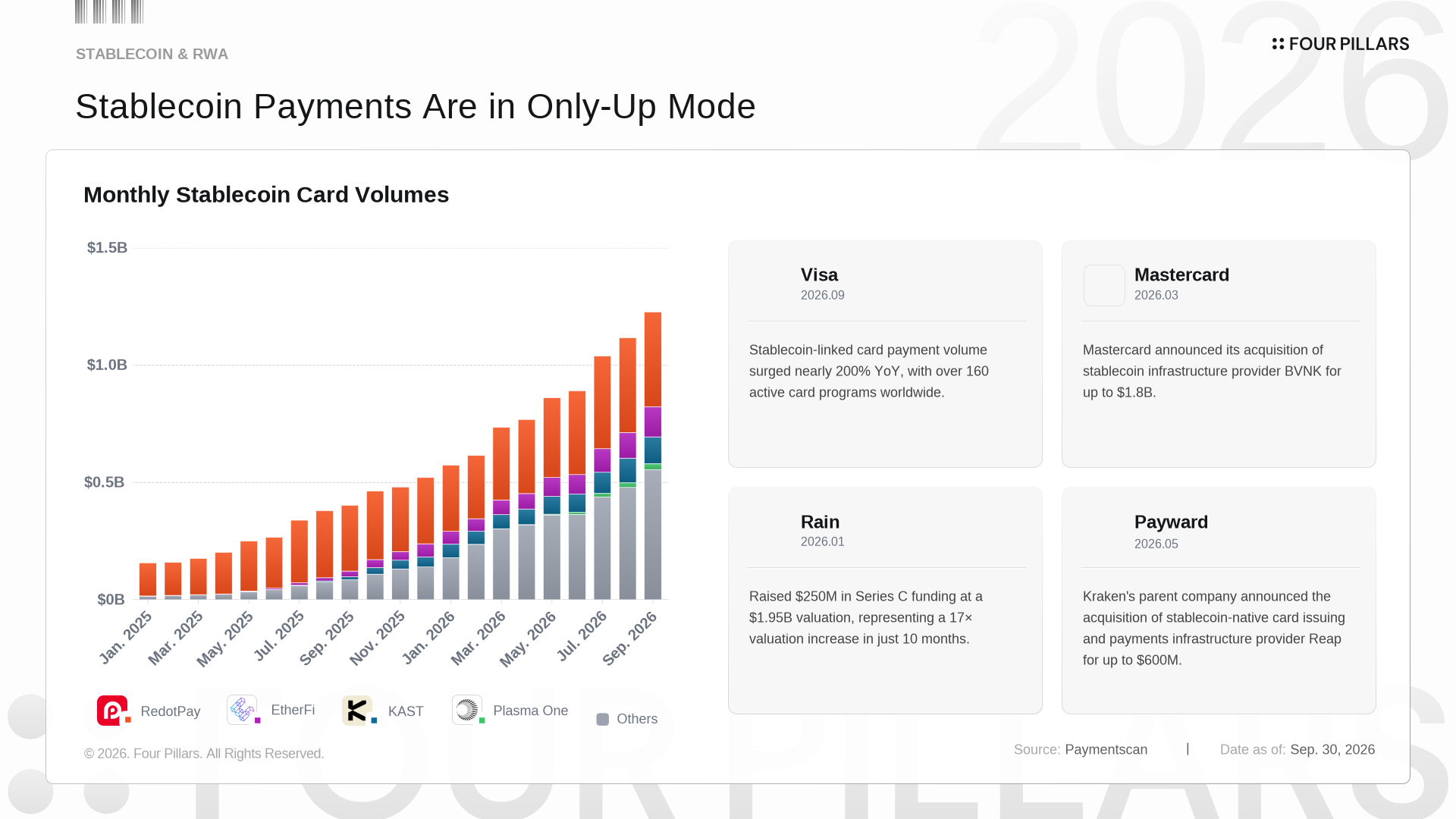
Paymentscan · As of September 30, 2026
Stablecoin payments are becoming one of the fastest-growing segments in the broader stablecoin ecosystem. Monthly card transaction volumes steadily increased throughout 2026, surpassing $1 billion in the third quarter, while Visa reported nearly 200% year-over-year growth across its global network of over 160 stablecoin-linked card programs. More importantly, this category is beginning to transcend its crypto-native niche market. Visa and Mastercard are expanding stablecoin payment infrastructure, and acquisitions such as Mastercard's purchase of BVNK and Payward's acquisition of Reap highlight the growing strategic interest from established financial and payment companies. Stablecoin cards are increasingly becoming a bridge connecting on-chain balances with everyday spending, laying the groundwork for broader mainstream adoption.
Open USD Quietly Gaining Momentum
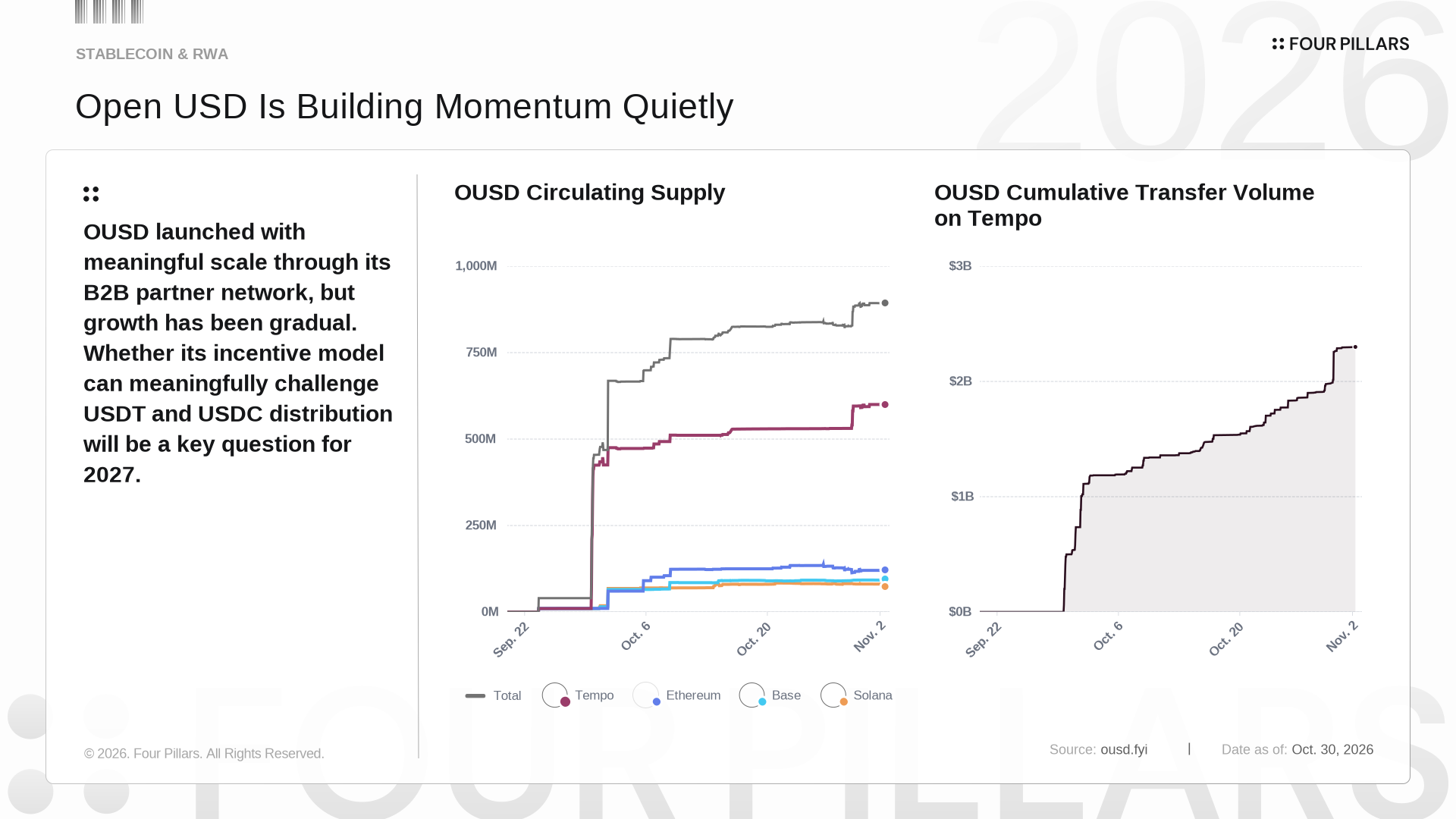
ousd.fyi · As of October 30, 2026
Open USD has taken a different path compared to retail-focused stablecoins. OUSD does not rely on natural consumer adoption but launched with a B2B distribution network composed of over 200 banks, fintech companies, payment companies, and crypto platforms, including Coinbase, Mastercard, Shopify, Stripe, and Visa. This partner-led model has helped OUSD quickly establish a substantial supply, securing over $1 billion in initial liquidity commitments during the illustrated period, with a circulating supply approaching $900 million.
Quote: Thomas Bush, Co-Founder of Paymentscan
Interview: Thomas Bush, Co-Founder, Paymentscan
The transaction volume of stablecoin cards has continued to grow throughout 2026 without any significant pullback. Do you expect this momentum to continue into 2027? What do you think are the key unlocking factors for stablecoin cards to achieve the next phase of growth? We expect the transaction volume of stablecoin cards to continue to grow significantly in 2027. We see leading neobanks expanding their products to include tokenized stocks, yields, credit, etc.—all of which will create sticky balances that ultimately drive more spending. Meanwhile, we are seeing more non-crypto businesses adopting stablecoin cards for speed, convenience, and efficiency, bringing transaction volume from an entirely new user base. — Thomas Bush, Co-Founder of Paymentscan
Tokenized Treasuries Transitioning from Growth to Maturity
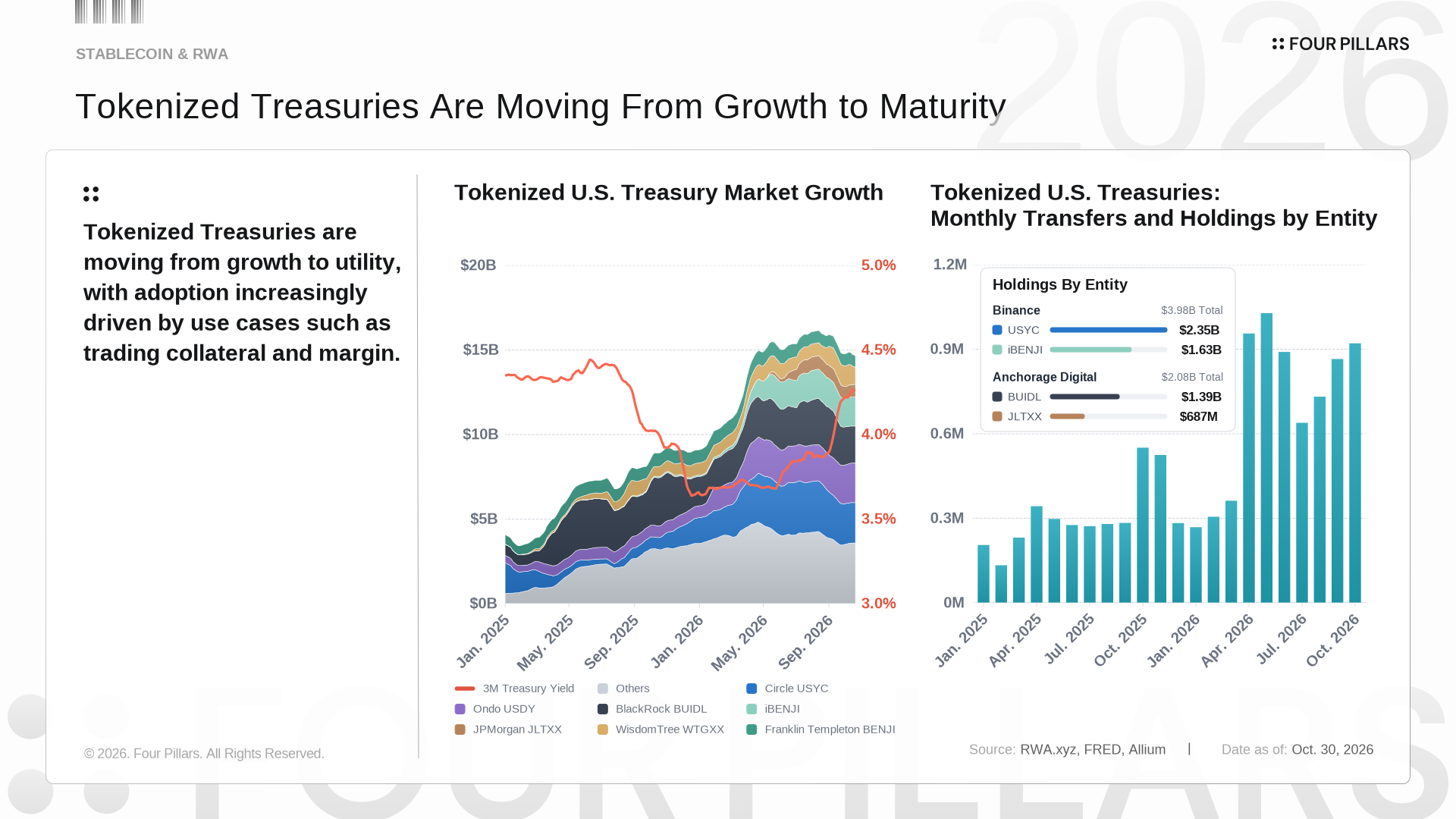
RWA.xyz, FRED, Allium · As of October 30, 2026
Tokenized U.S. Treasuries are entering a more mature phase. After growing from approximately $3 billion in early 2025 to nearly $16 billion at its peak in 2026, the market size has recently stabilized around $14 billion to $15 billion. However, activity continues to expand, with monthly transfers rising from about 200,000 in early 2025 to around 900,000 in October 2026. The next phase of growth is increasingly about utility rather than mere issuance. Major institutions hold billions of dollars in tokenized Treasuries, and these assets are being integrated into trading, collateral, custody, and margin processes. For example, Binance has allowed tokenized Treasury products like BUIDL to be used as institutional OTC collateral. Thus, the market is shifting from simply putting Treasuries on-chain to enabling them to play a role in a broader financial infrastructure.
Tokenized Treasuries Growing in Sync on Both Asset and Investor Sides
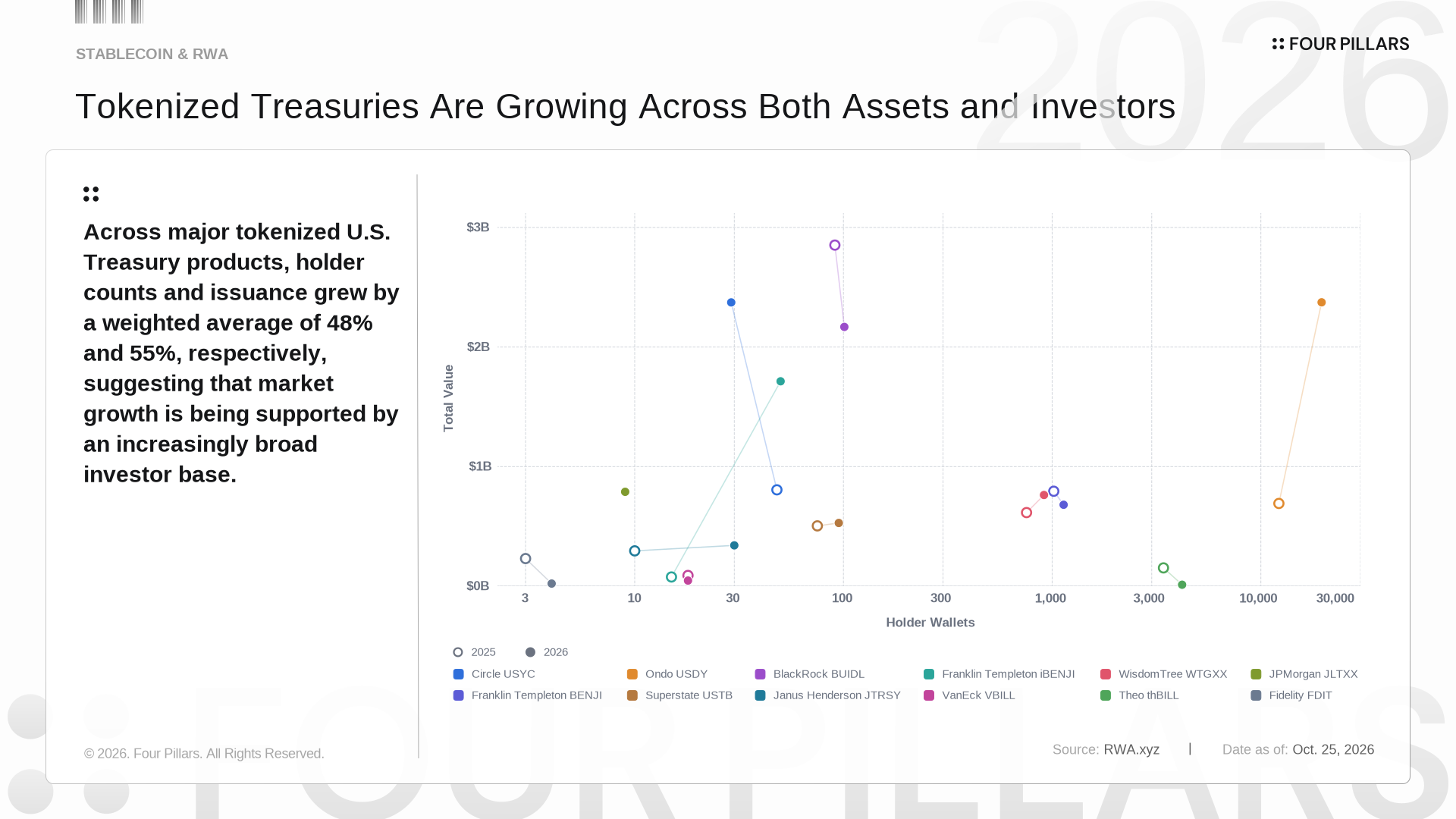
RWA.xyz · As of October 25, 2026
In 2026, tokenized U.S. Treasuries continued to expand, with both market size and investor participation showing an upward trend compared to the previous year. Among the major products illustrated, the issuance-weighted average grew by 55%, while the number of holders increased by 48%. An important conclusion is that growth is not solely driven by asset size. More products are simultaneously expanding their outstanding value and user wallet base, indicating that tokenized Treasuries are attracting a broader investor demographic rather than merely concentrating more capital among existing holders.
Quote: Chetan Karkhanis, Senior Vice President of Digital Assets Client Engagement at Franklin Templeton
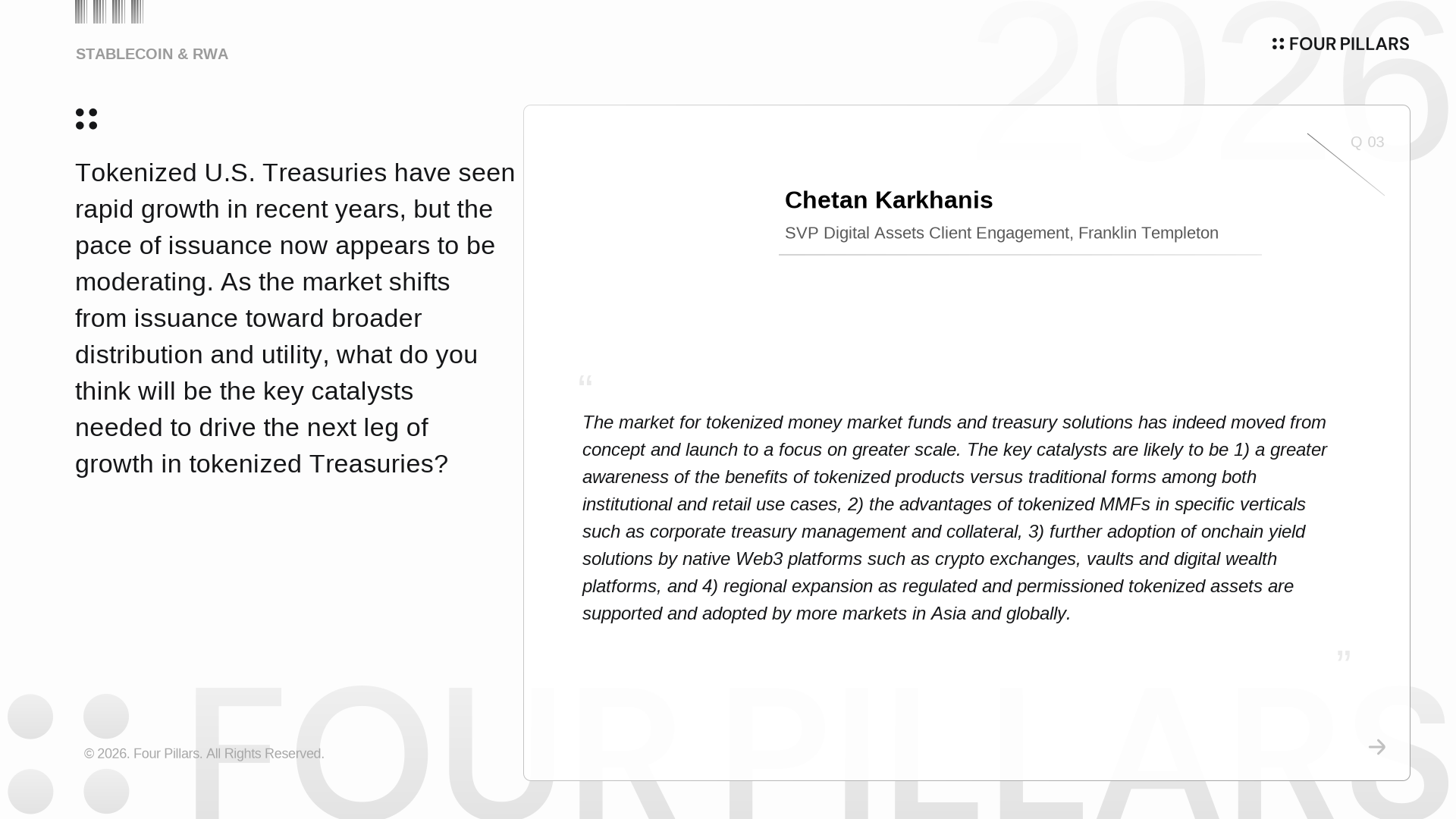
Interview: Chetan Karkhanis, SVP Digital Assets Client Engagement, Franklin Templeton
Tokenized U.S. Treasuries have grown rapidly in recent years, but the pace of issuance now seems to be slowing. As the market shifts from issuance to broader distribution and utility, what do you think are the key catalysts for the next round of growth in tokenized Treasuries? The market for tokenized money market funds and Treasury solutions has indeed shifted from concept and launch to a focus on larger scale. Key catalysts may include: 1) both institutional and retail use cases becoming more aware of the advantages of tokenized products compared to traditional forms; 2) the advantages of tokenized money market funds in specific verticals like corporate cash management and collateral; 3) further adoption of on-chain yield solutions by native Web3 platforms such as crypto exchanges, vaults, and digital wealth platforms; 4) regional expansion achieved as regulated and licensed tokenized assets gain support and adoption in more markets across Asia and globally. — Chetan Karkhanis, Senior Vice President of Digital Assets Client Engagement at Franklin Templeton
On-Chain Government Debt Remains U.S.-Centric
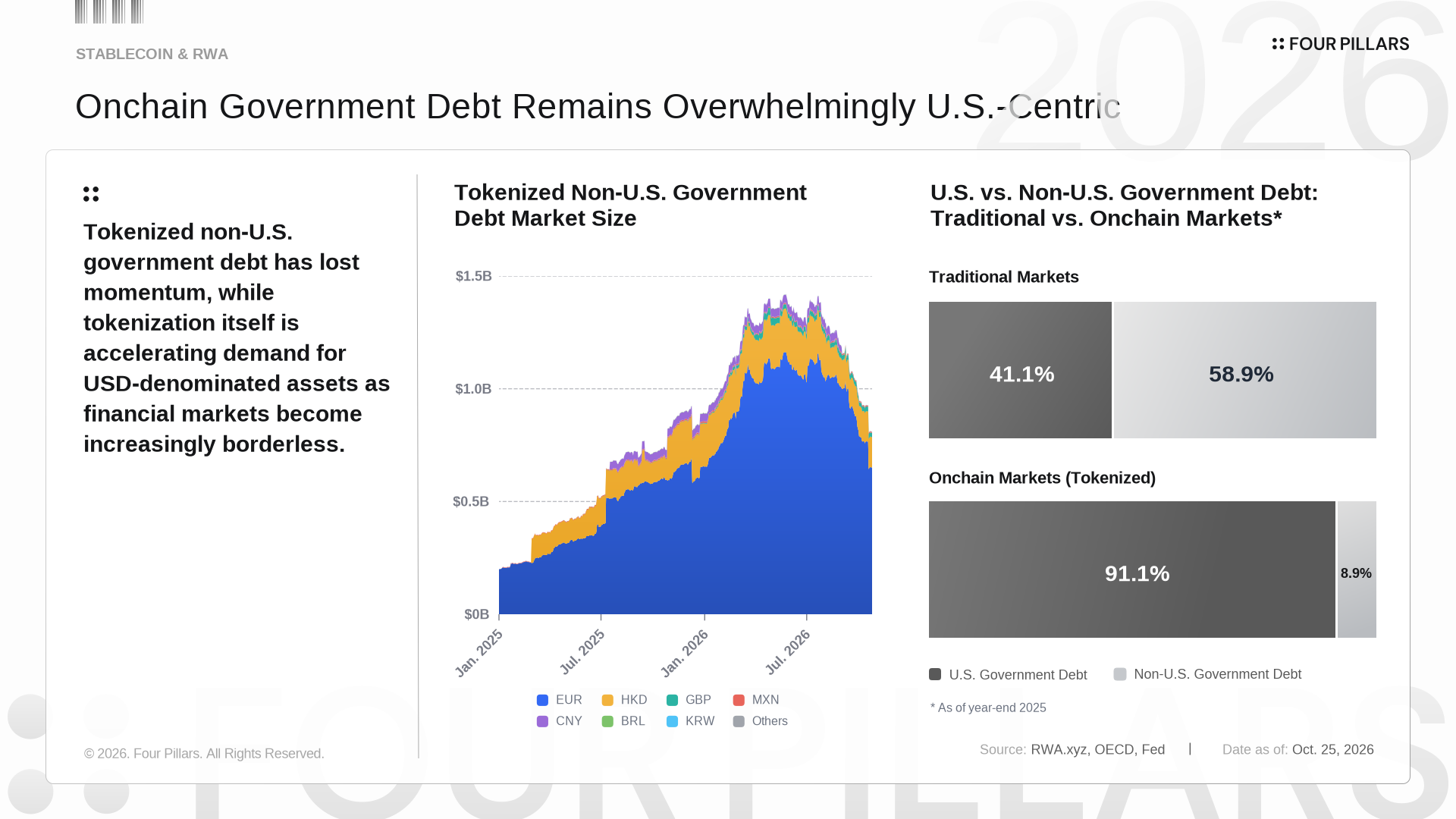
RWA.xyz, OECD, Fed · As of December 31, 2025
The composition of government debt looks starkly different on-chain compared to traditional markets. In traditional markets, non-U.S. government debt accounts for 58.9% of the total, while U.S. government debt makes up 41.1%. However, on-chain, the situation is almost entirely reversed: U.S. government debt constitutes 91.1% of tokenized government debt, while non-U.S. sovereign debt only accounts for 8.9%. This gap highlights both an opportunity and a structural reality. The limited presence of non-U.S. sovereign debt indicates significant expansion potential for government bond markets in Asia and other regions on-chain. Meanwhile, the dominance of U.S. Treasuries suggests that when geographic barriers are lowered, global demand often concentrates on the deepest and most liquid dollar-denominated assets. Therefore, tokenization may broaden access to financial assets while simultaneously reinforcing the global influence of the dollar.
Quote: Jeseok Hong, Associate in the Digital Asset Department at Shinhan Securities
Interview: Jeseok Hong, Associate, Shinhan Securities Digital Asset Dept.
Tokenized U.S. Treasuries are maturing, while the scale of non-U.S. sovereign bonds remains small. What are the key unlocking factors for tokenized non-U.S. government debt to achieve scale? The reason tokenized U.S. Treasuries have taken off is that the dollar itself is already on-chain. For investors holding dollar stablecoins, tokenized non-U.S. government bonds also mean taking on currency risk, so demand will fluctuate with interest rate spreads and foreign exchange outlooks. From a brokerage perspective, buying bonds in the market and settling them into custody is instantaneous, but converting stablecoin funds into local currency through banks takes time. For non-U.S. government debt to scale on-chain, local currencies must first be tokenized so that investors can purchase tokens with that currency and use them as collateral. — Jeseok Hong, Associate in the Digital Asset Department at Shinhan Securities
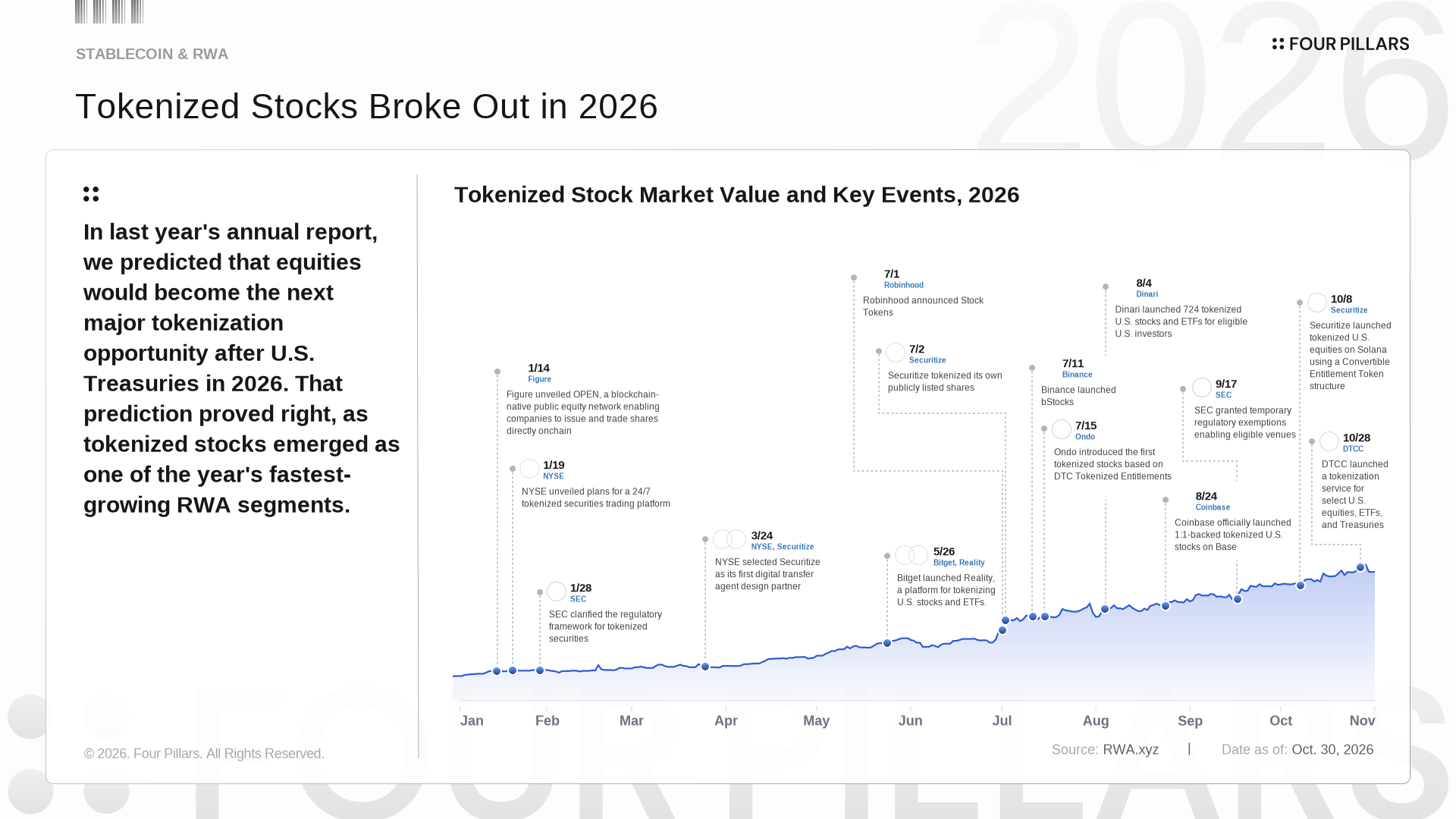
Tokenized Stocks Breakthrough in 2026
RWA.xyz · As of October 30, 2026
2026 is a breakthrough year for tokenized stocks, with the market rapidly expanding in both scale and depth. The chart shows that as new platforms and products enter the market and distribution channels widen, market capitalization accelerated throughout the year, especially from mid-2026 onward. This growth is also reflected in quality. Robinhood, Dinari, Binance, Ondo, Coinbase, Securitize, and DTCC have launched or expanded tokenized stock products, while U.S. regulators have begun to provide clearer frameworks for the issuance and trading of tokenized securities. In September, the SEC granted temporary exemptions for on-chain trading of certain tokenized NMS stocks, marking a significant step toward regulated adoption. Overall, the combination of platform expansion, institutional participation, and regulatory progress suggests that tokenized stocks are likely to continue being one of the fastest-growing RWA categories in 2027.
Quote: Armani Ferrante, CEO of Backpack
Interview: Armani Ferrante, CEO, Backpack
On-chain stock exposure is developing along two paths: perpetual contract futures and tokenized stocks. How do you expect these two models to evolve over time? Perpetual contracts and tokenized stocks address different issues, so I don't think one will replace the other. Perpetual contracts are the most efficient way to trade prices: available 24/7, capital-efficient, and without custodial overhead. Tokenized stocks, on the other hand, are about ownership; they are assets you can hold, transfer, and use as collateral anywhere on-chain. The real unlocking happens when both are offered side by side to anyone in the world under appropriate regulation. This is where on-chain stocks move from being just an experiment to becoming true market infrastructure. ------ Armani Ferrante, CEO of Backpack
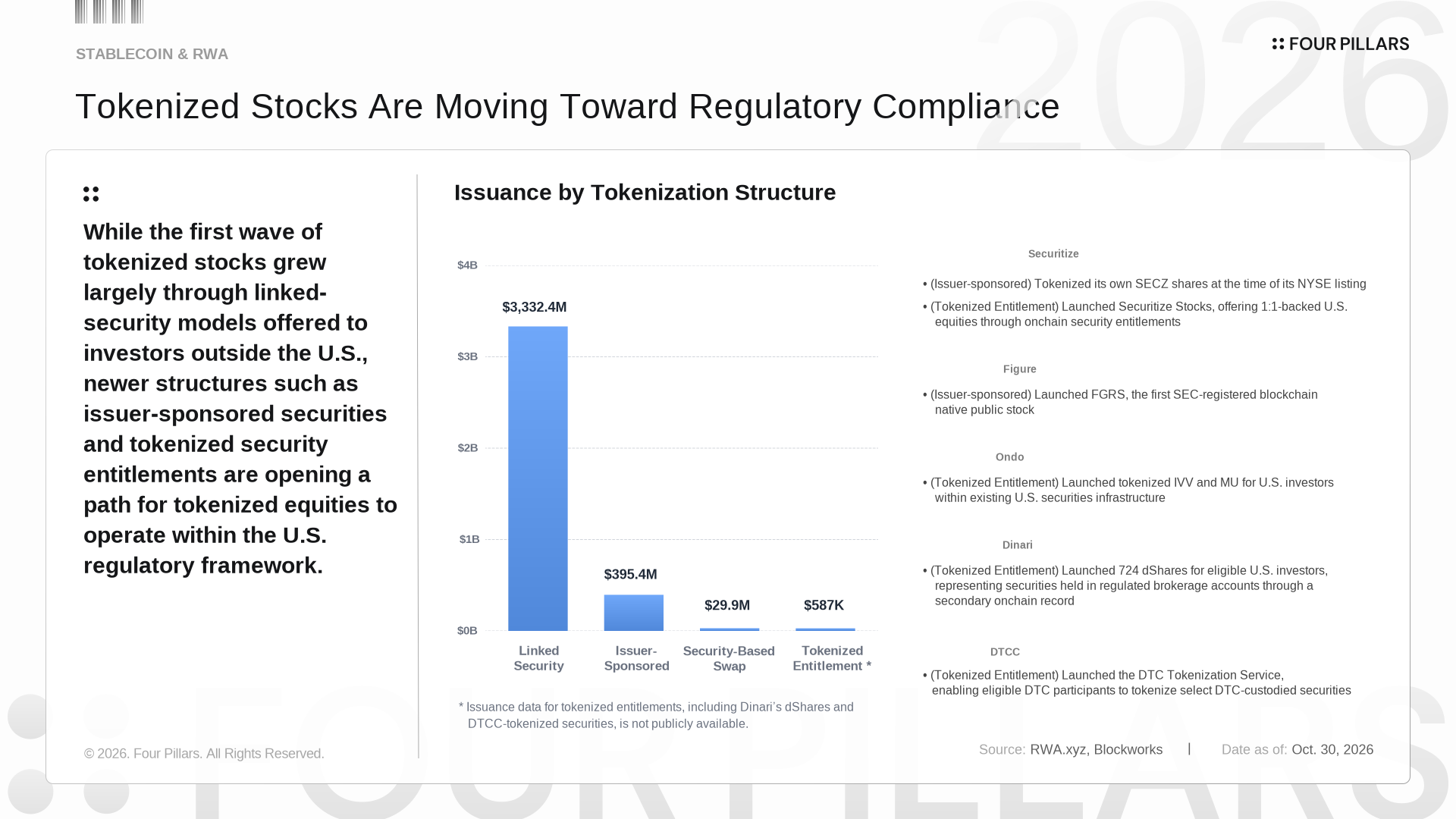
Tokenized Stocks are Moving Towards Regulatory Compliance
RWA.xyz, Blockworks · As of October 30, 2026
The first wave of tokenized stocks is primarily based on securities structures, providing global investors with easier access and greater on-chain flexibility. This model still accounts for the vast majority of issuances to date, with an outstanding size of approximately $3.3 billion, while the issuer-initiated securities amount to about $395 million. However, the direction of development is changing. By 2026, U.S. regulators provided clearer guidance on issuer-initiated securities and tokenized securities rights, while companies like Figure, Securitize, Dinari, Ondo, and DTCC launched products designed to operate within the existing U.S. securities law framework. Therefore, the next phase of tokenized stocks increasingly focuses not only on bringing stocks on-chain but also on doing so in a way that retains ownership, investor protection, and regulatory compliance.
Quote: Graham Ferguson, Head of Ecosystem at Securitize

Interview: Graham Ferguson, Head of Ecosystem, Securitize
What do you think is the biggest opportunity in bringing traditional stocks on-chain? Why is regulatory compliance so critical to realizing this opportunity? Depending on the specific day and what you count, the global stock market far exceeds $150 trillion—this is the scale of the opportunity in front of us. To enter this market, we must follow the rules. For a long time, our industry has been skirting the rules, but now we finally have the licenses and technology to bring these markets on-chain. ------ Graham Ferguson, Head of Ecosystem at Securitize
Asia: The Hidden Engine Behind Tokenized Stocks
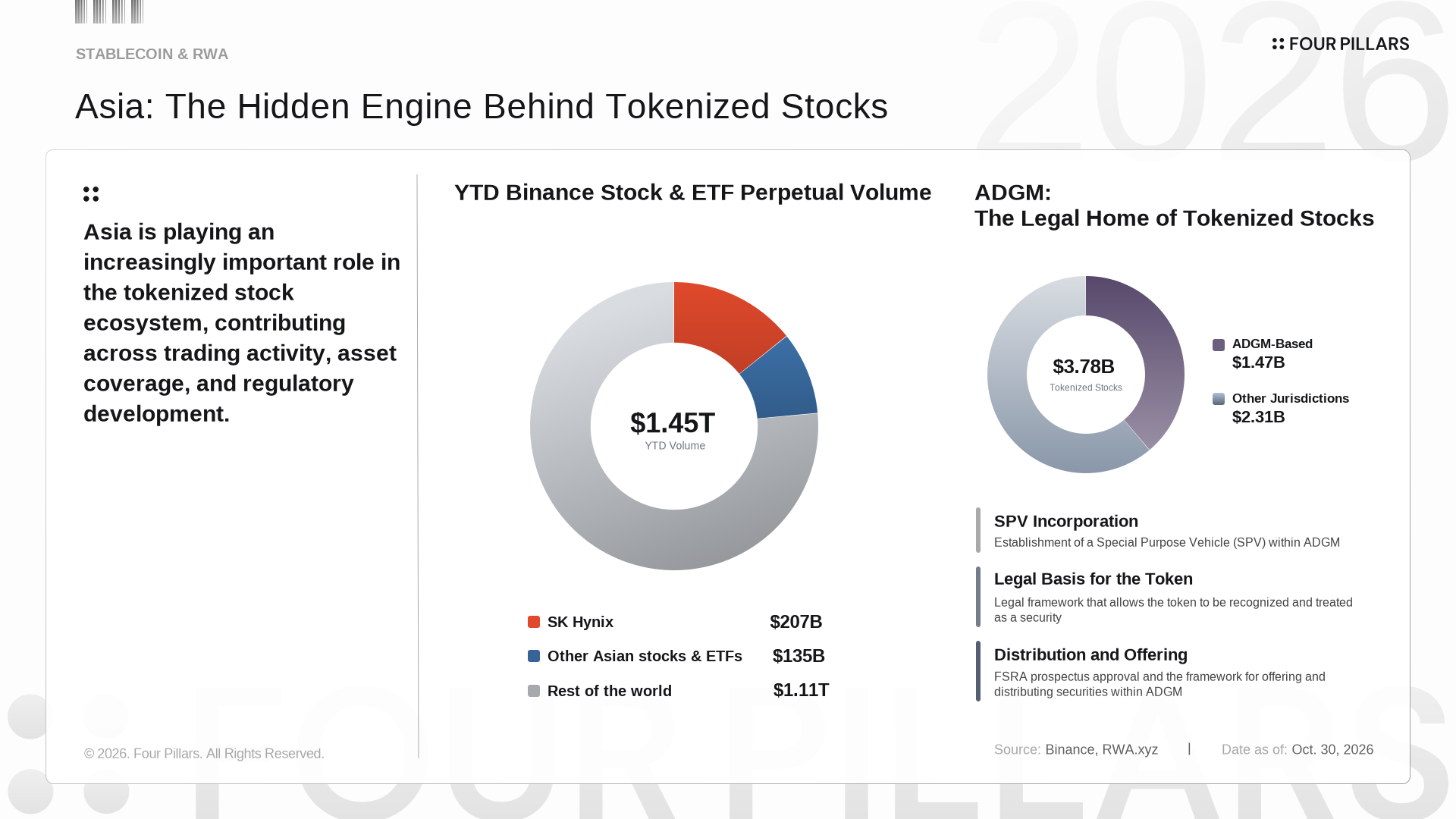
Binance, RWA.xyz · As of October 30, 2026
Asia plays a larger role in the tokenized stock ecosystem than what is shown by mere surface market share. On Binance, Asian stocks and ETFs account for approximately $342 billion in perpetual contract trading volume year-to-date, with SK Hynix alone contributing $207 billion, highlighting the strong demand for exposure to Asian stocks through crypto-native trading venues. Asia is also becoming an important regulatory hub for tokenized stocks. Of the $3.78 billion in tokenized stocks shown in the chart, $1.47 billion (about 39%) is issued based on the ADGM (Abu Dhabi Global Market) structure. ADGM provides a regulated framework for digital securities, while major platforms like Binance and Coinbase are increasingly using Abu Dhabi as a base for tokenized securities activities. Overall, the data indicates that Asia not only contributes demand and trading activity but also supports the regulatory infrastructure for the next phase of growth in tokenized stocks.
Quote: Alice, Head of Reality at Bitget
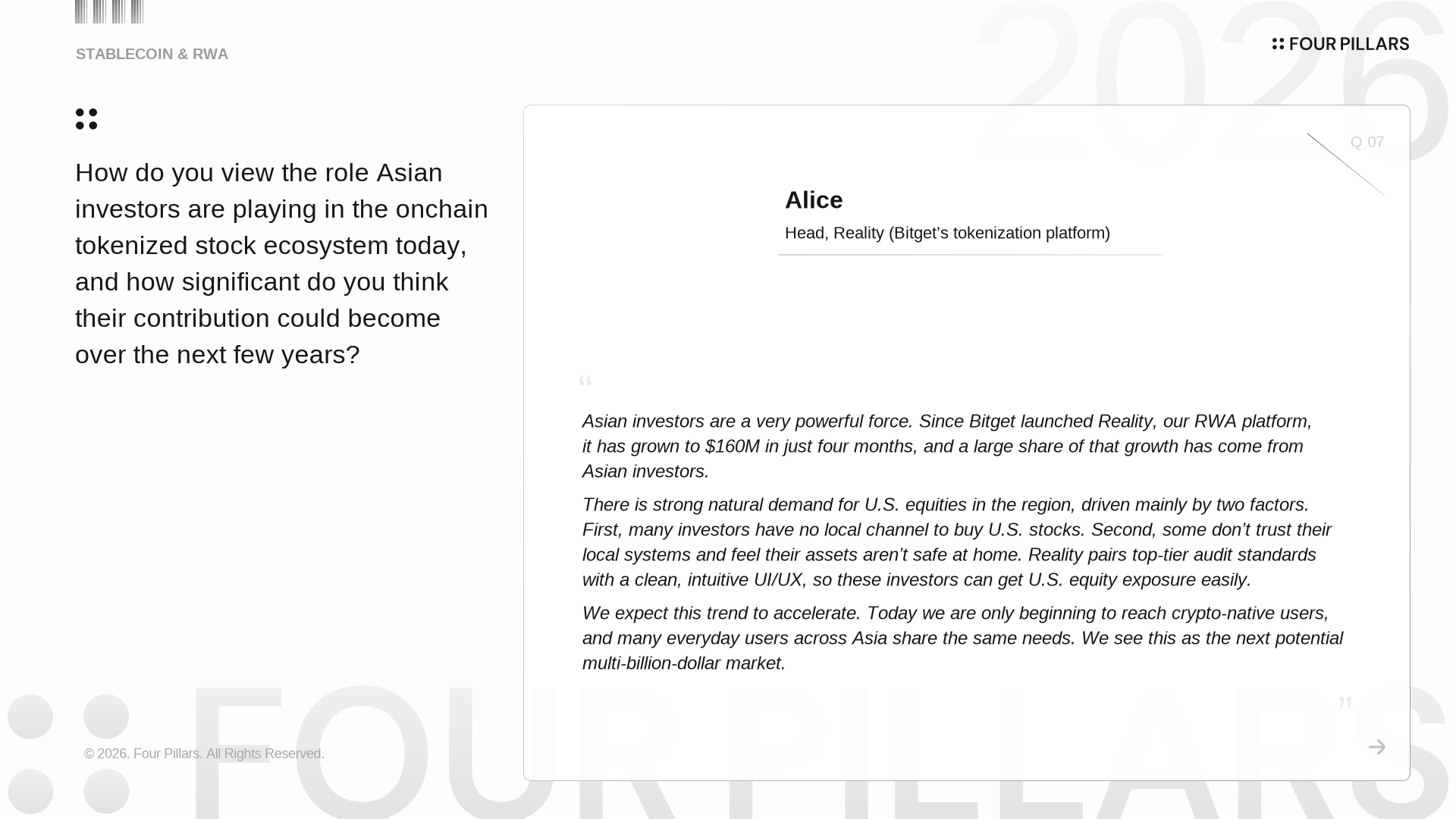
Interview: Alice, Head of Reality, Bitget
How do you view the role of Asian investors in the on-chain tokenized stock ecosystem currently? How significant do you think their contribution will be in the coming years? Asian investors are a very powerful force. Since Bitget launched our RWA platform Reality, it has grown to $160 million in just four months, with a significant portion of that growth coming from Asian investors. The region has a strong natural demand for U.S. stocks, driven by two main factors. First, many investors lack local channels to purchase U.S. stocks. Second, some do not trust the local system and feel their assets are not safe domestically. Reality combines top auditing standards with a simple and intuitive user interface/experience, allowing these investors to easily gain exposure to U.S. stocks. We expect this trend to accelerate. Today, we are just beginning to reach crypto-native users, and many ordinary users in Asia have the same demand. We see it as the next potential billion-dollar market. ------ Alice, Head of Reality (Bitget Tokenization Platform)
Tokenized Private Credit, Though Smaller Than Other Asset Classes, is the Most Widely Used Asset in DeFi
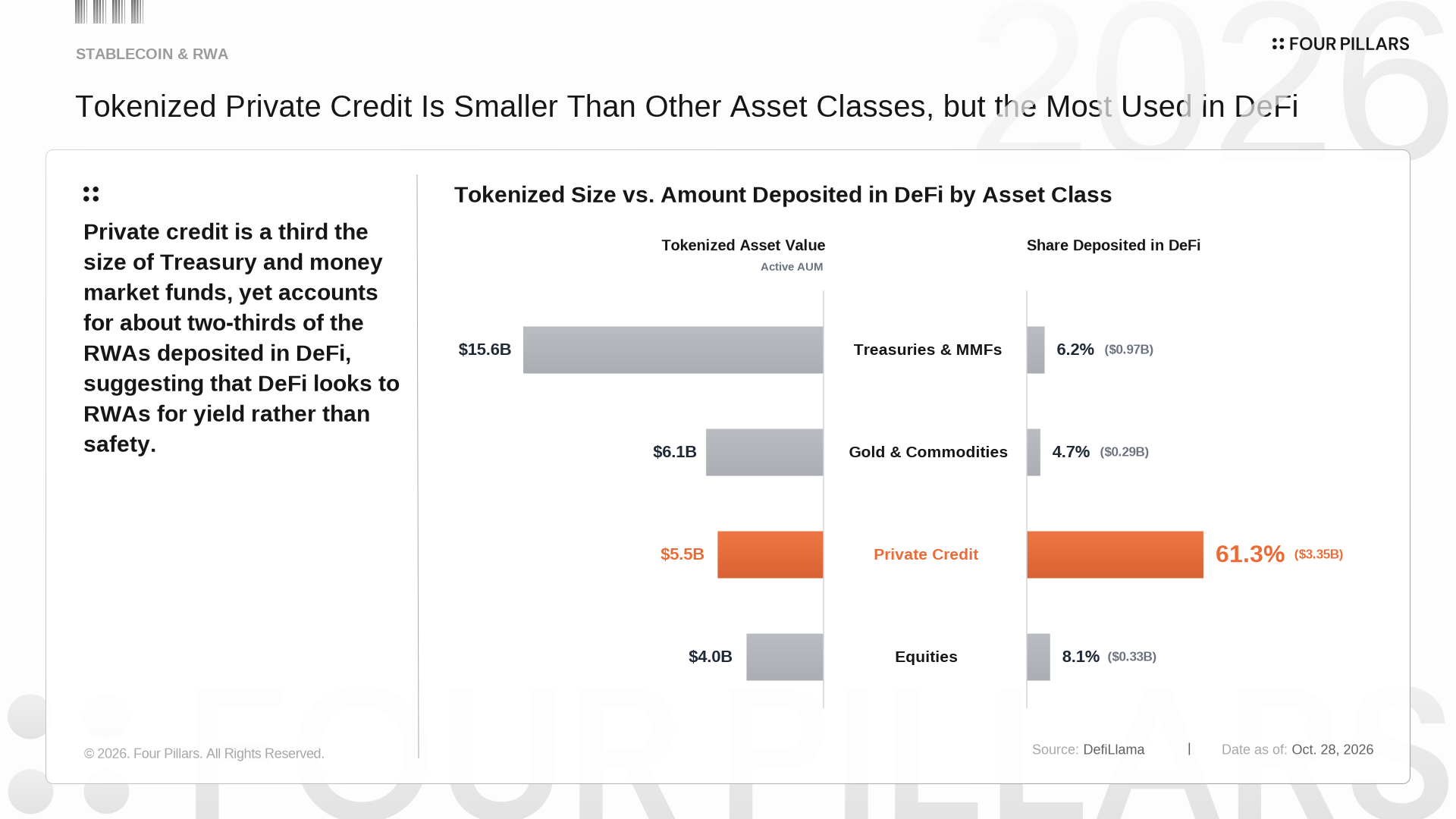
DefiLlama · As of October 28, 2026
As of October 2026, the size of tokenized private credit reached $5.5 billion. This is approximately one-third of the size of government bonds and money market funds ($15.6 billion), and smaller than gold and commodities ($6.1 billion). In terms of issuance volume, private credit ranks lower in the tokenized market.
Gold Prices Turn Down in 2026, While On-Chain Gold Holdings Continue to Grow
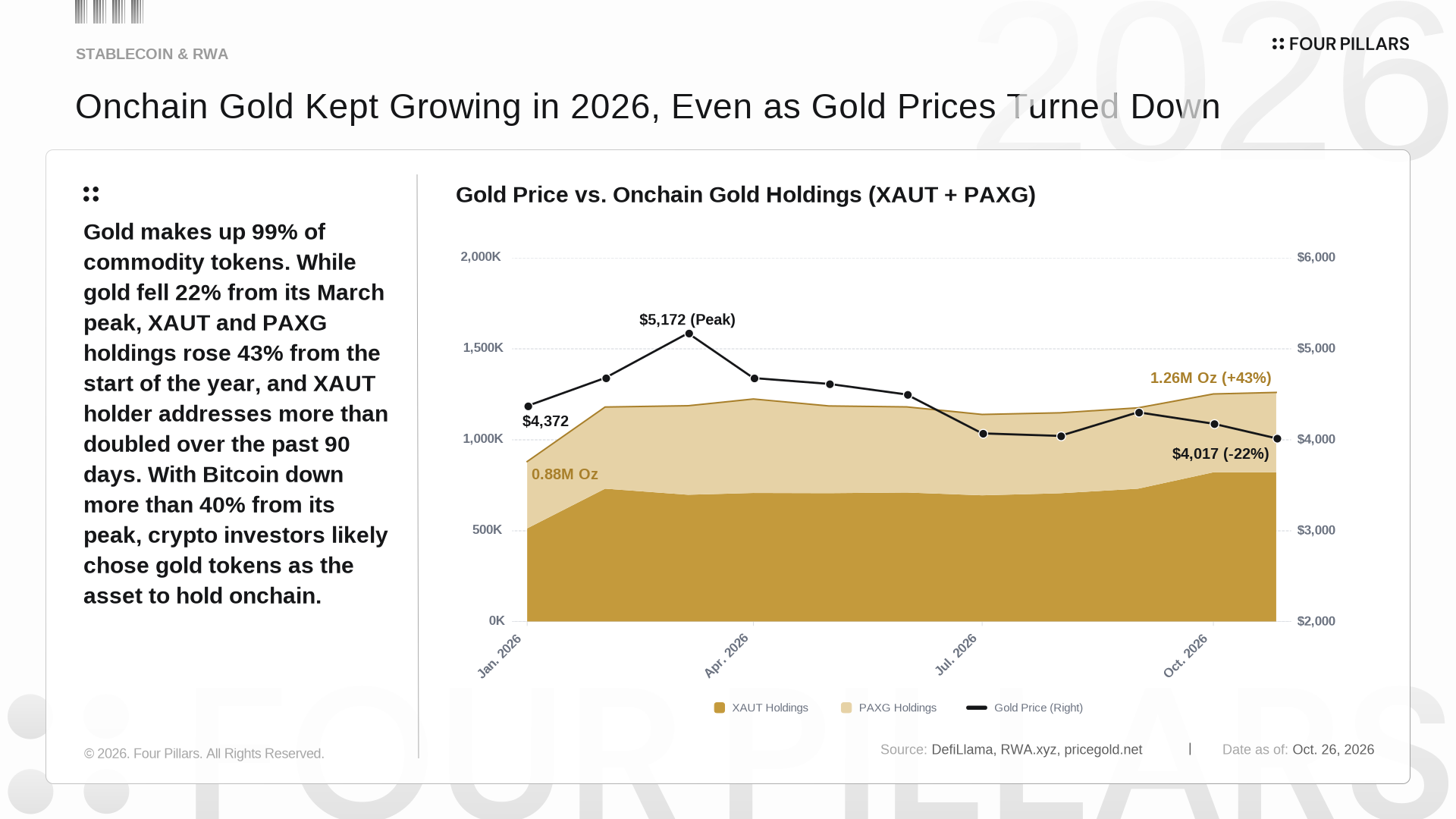
DefiLlama, RWA.xyz, pricegold.net · As of October 26, 2026
Gold accounts for 99% of tokenized commodities. This year, gold peaked at $5,172 per ounce in March, then fell 22% to $4,017 by October 26. On-chain gold holdings, however, have moved in the opposite direction. The combined holdings of Tether Gold (XAUT) and PAX Gold (PAXG) increased by 43%, from 880,700 ounces at the beginning of the year to 1,260,500 ounces. About 300,000 ounces were added in January and February before gold peaked, and holdings did not decrease after the price drop.
Figure's Home Equity Loans Drive Surge in Real Estate Tokenization This Year
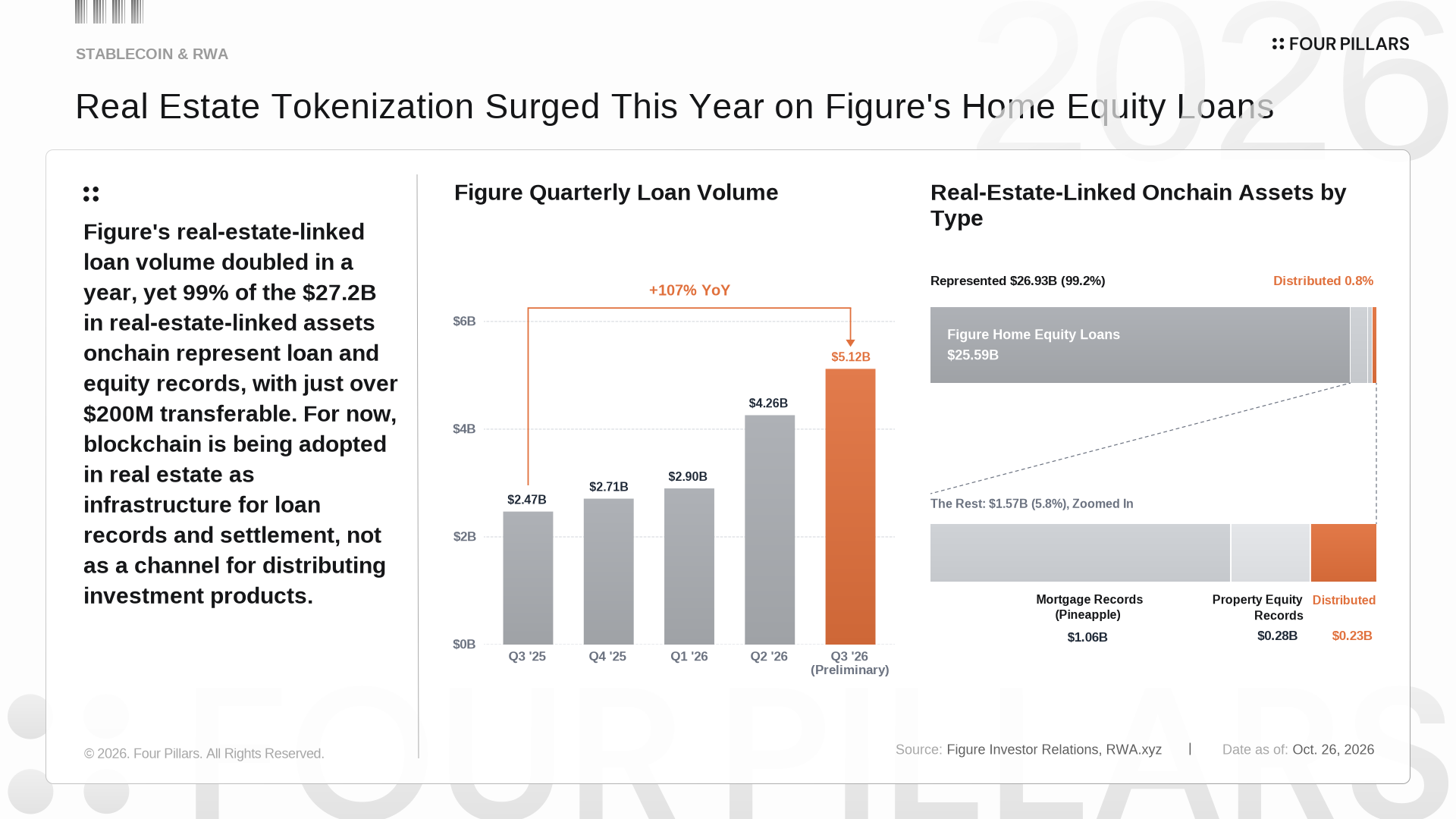
Figure Investor Relations, RWA.xyz · As of October 26, 2026
Figure's home equity loans have driven growth in the real estate tokenization market this year. According to Figure's investor disclosures, quarterly loan volumes more than doubled over the year, rising from $2.47 billion in Q3 2025 to $5.12 billion in Q3 2026 (preliminary data). In Q2 2026, transaction volume reached $4.26 billion, an increase of about 47% from the previous quarter, with growth continuing into Q3.
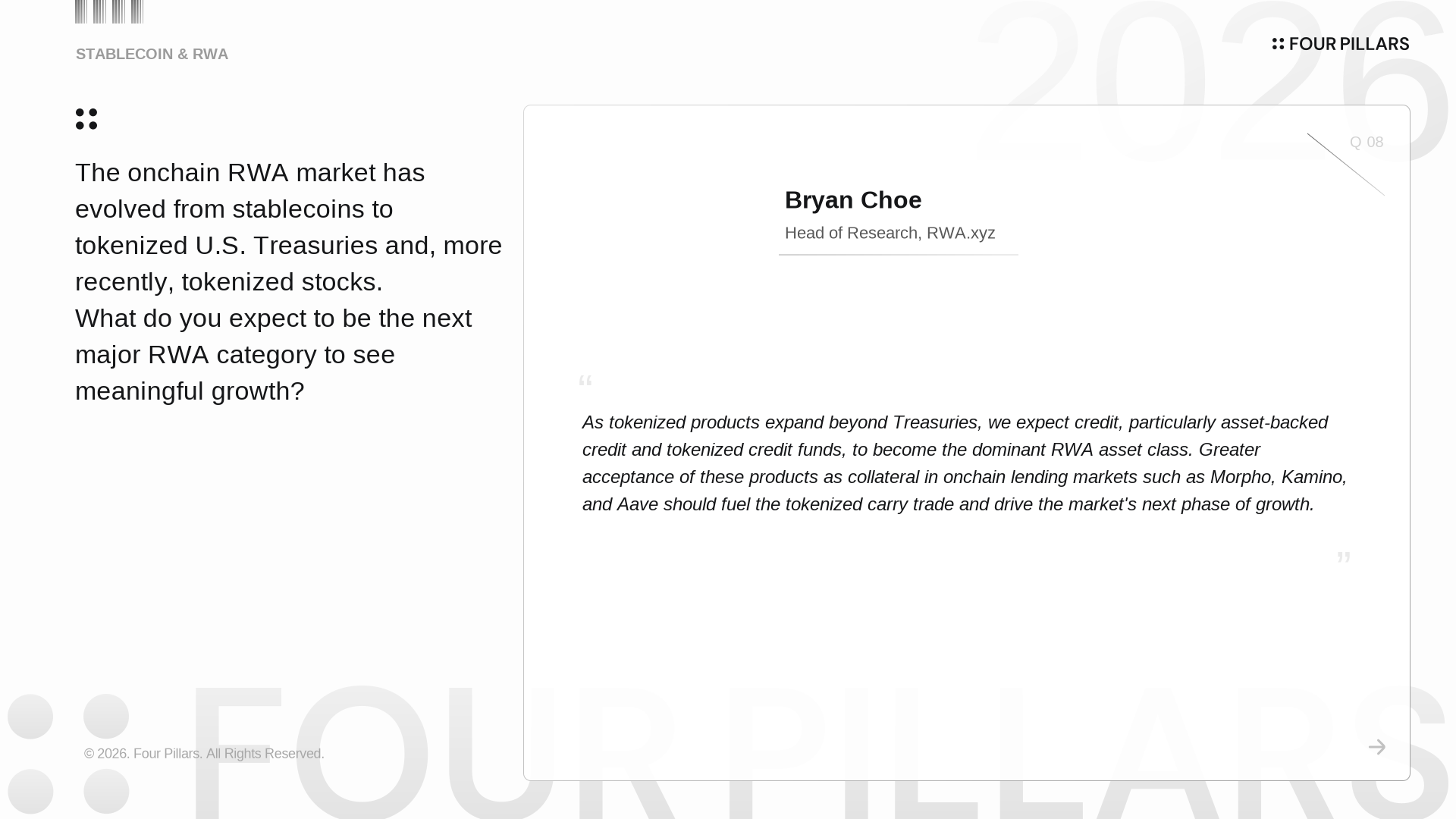
Quote: Bryan Choe, Head of Research at RWA.xyz
Interview: Bryan Choe, Head of Research, RWA.xyz
The on-chain RWA market has evolved from stablecoins to tokenized U.S. Treasuries, and recently to tokenized stocks. What do you expect to be the next significant RWA category to see meaningful growth? As tokenized products move beyond Treasuries, we expect credit, particularly asset-backed credit and tokenized credit funds, to become the dominant RWA asset class. These products are more widely accepted as collateral in on-chain lending markets like Morpho, Kamino, and Aave, which should drive tokenized arbitrage trading and propel the next phase of market growth. ------ Bryan Choe, Head of Research at RWA.xyz
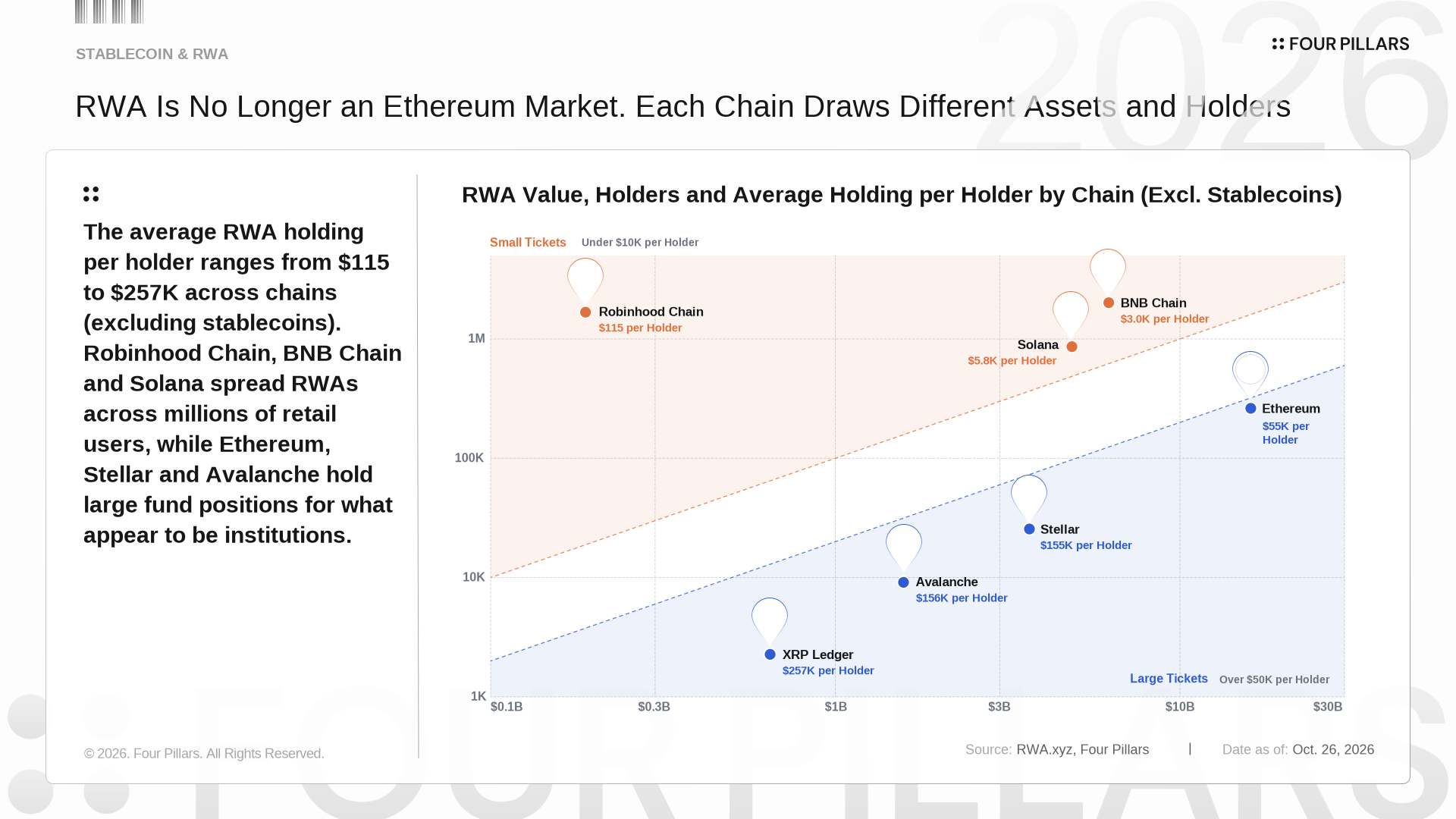
RWA is No Longer Dominated by Ethereum; Different Chains Attract Different Assets and Holders
RWA.xyz, Four Pillars · As of October 26, 2026
Aside from stablecoins, Ethereum remains the largest chain for RWA issuance, with a scale of $15.92 billion, followed by BNB Chain ($6.26 billion), Solana ($4.87 billion), and Stellar ($3.76 billion). Ethereum's issuance is 2.5 times that of the second-largest chain, but looking at the number of holders reveals a more layered market.
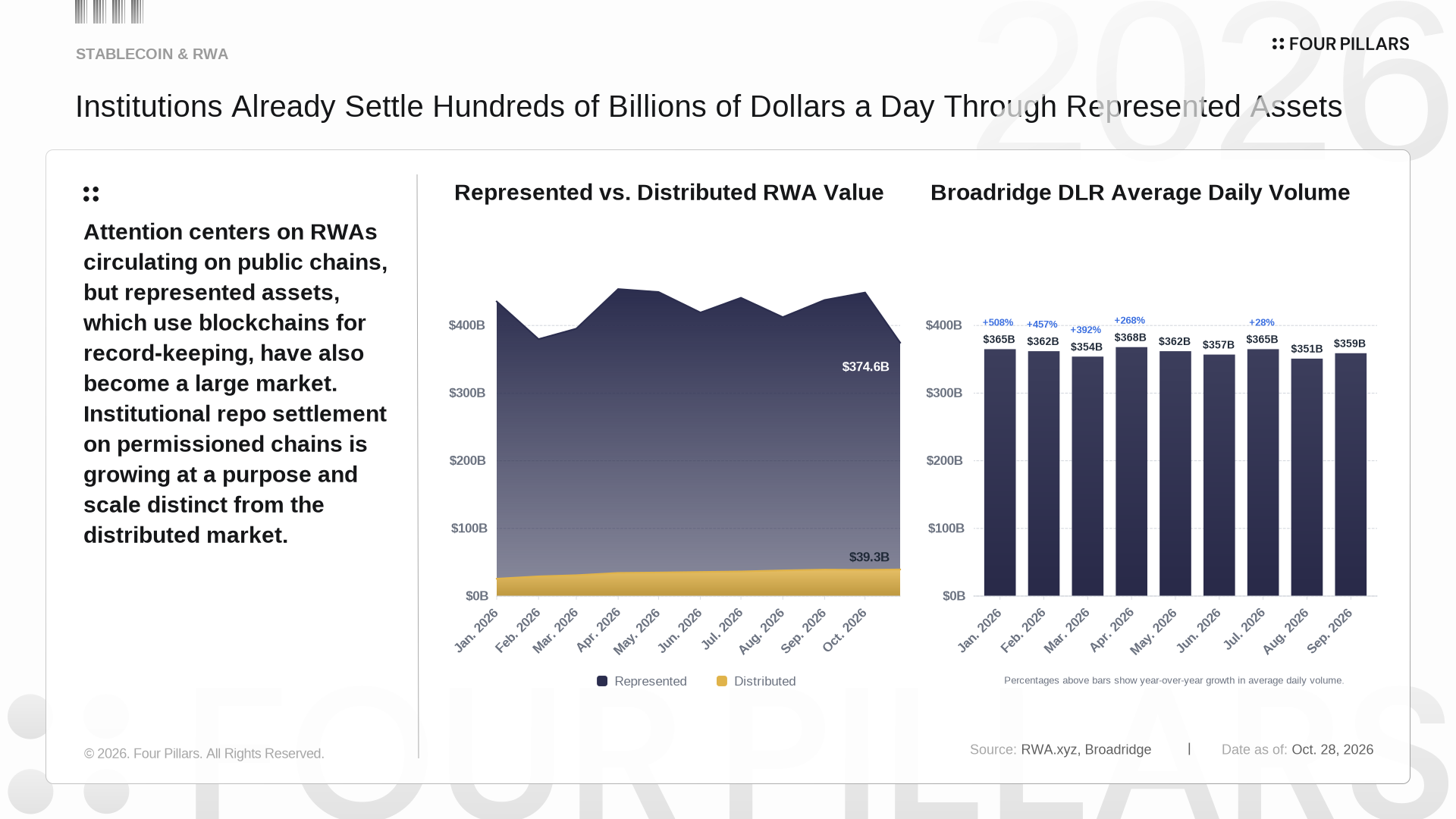
Institutions Settle Hundreds of Billions of Dollars Daily Through Representative Assets
RWA.xyz, Broadridge · As of October 28, 2026
Market attention is focused on the RWA circulating on public chains, but the scale of represented assets (assets recorded on the blockchain) is much larger. As of October, the total amount of represented assets reached $374.6 billion, approximately 9.5 times the $39.3 billion of distributed assets that can be transferred between wallets. Although distributed assets have steadily grown from $25.6 billion at the beginning of the year, represented assets have remained in the range of $370 billion to $450 billion throughout the year.
Robinhood Chain Has Not Perished
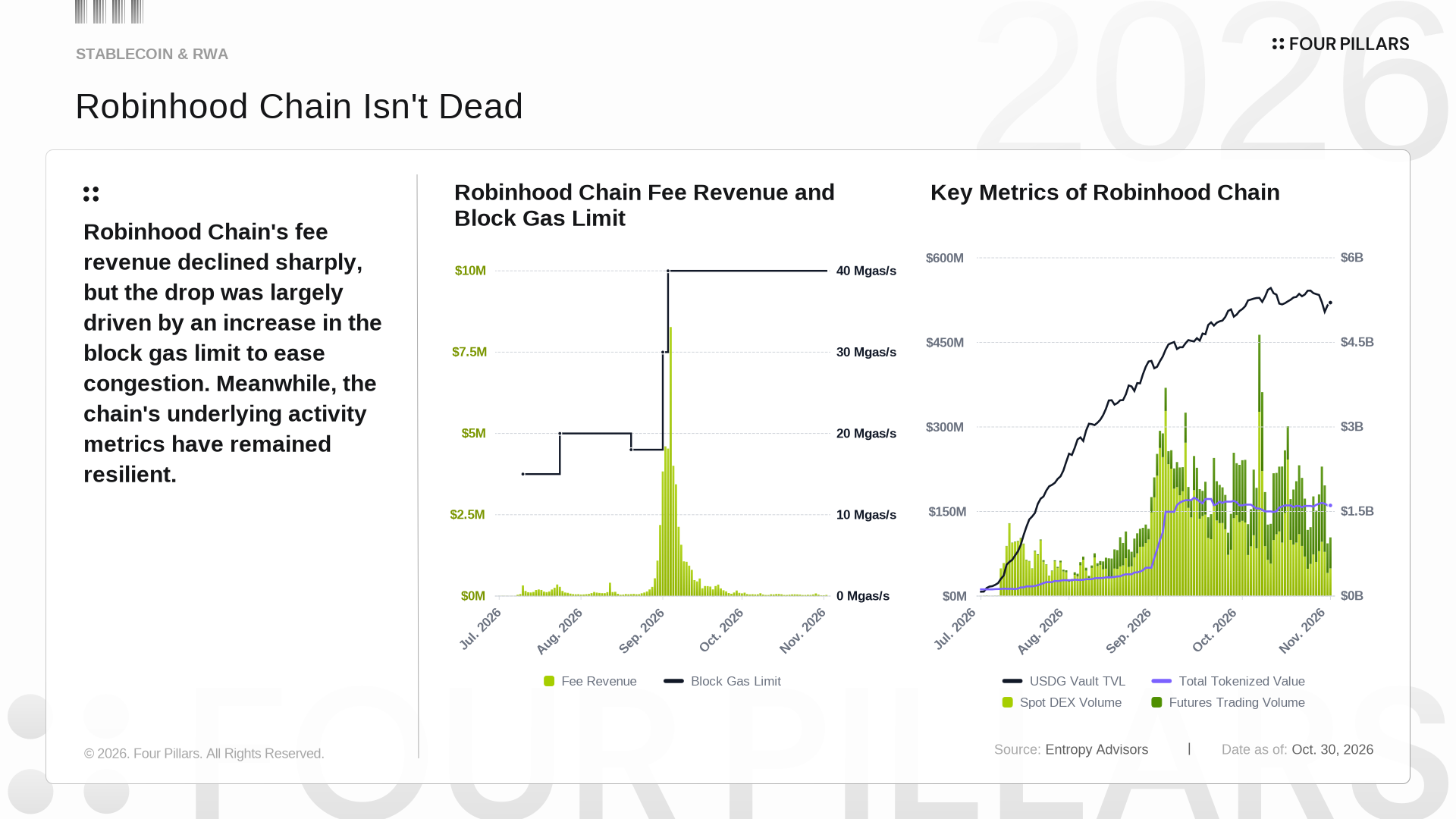
Entropy Advisors · As of October 30, 2026
The fee revenue of Robinhood Chain significantly declined after September, but this drop may not reflect a collapse in underlying network activity. This decline coincided with an increase in the block gas limit from about 20 Mgas/s to 40 Mgas/s, expanding block capacity and helping to alleviate congestion. Therefore, the reduction in fees is at least partially a result of decreased network usage costs, rather than a simple disappearance of users. The broader activity landscape remains relatively resilient. Robinhood reported that its DEX trading volume in the first quarter after the mainnet launch exceeded $80 billion, with chain fees exceeding $50 million, while charts show that tokenized value and USDG treasury TVL remained at meaningful levels as of October. Trading activity has returned to normal after the surge in September, but the chain still seems to retain considerable liquidity and usage.
Compliant and Liquid Secondary Markets Are the Next Frontier of Tokenization
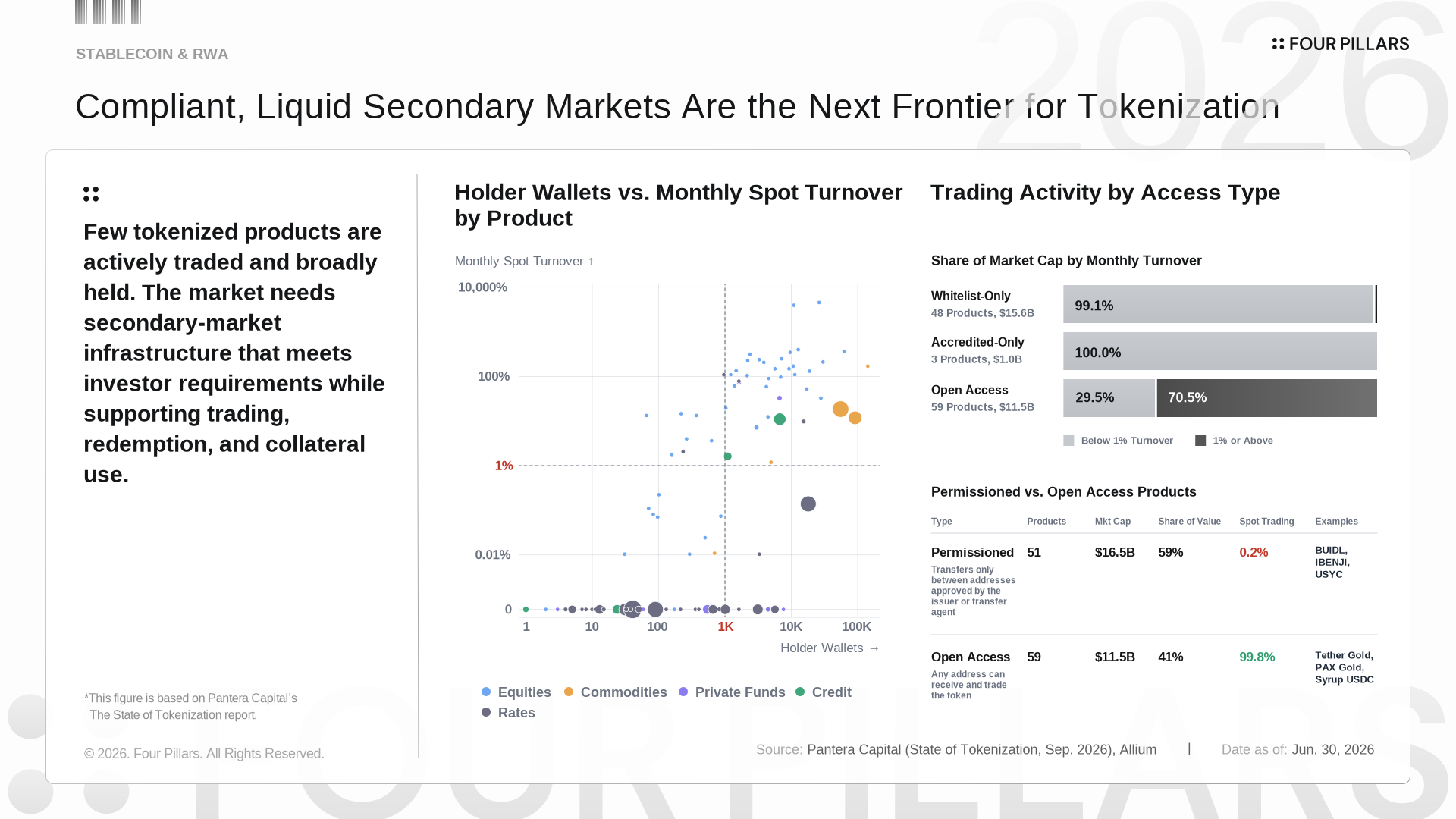
Pantera Capital (State of Tokenization, September 2026), Allium · As of June 30, 2026
This section is based on Pantera Capital's report on the "State of Tokenization."
Quote: Danning Sui, Research Director, Pantera Capital
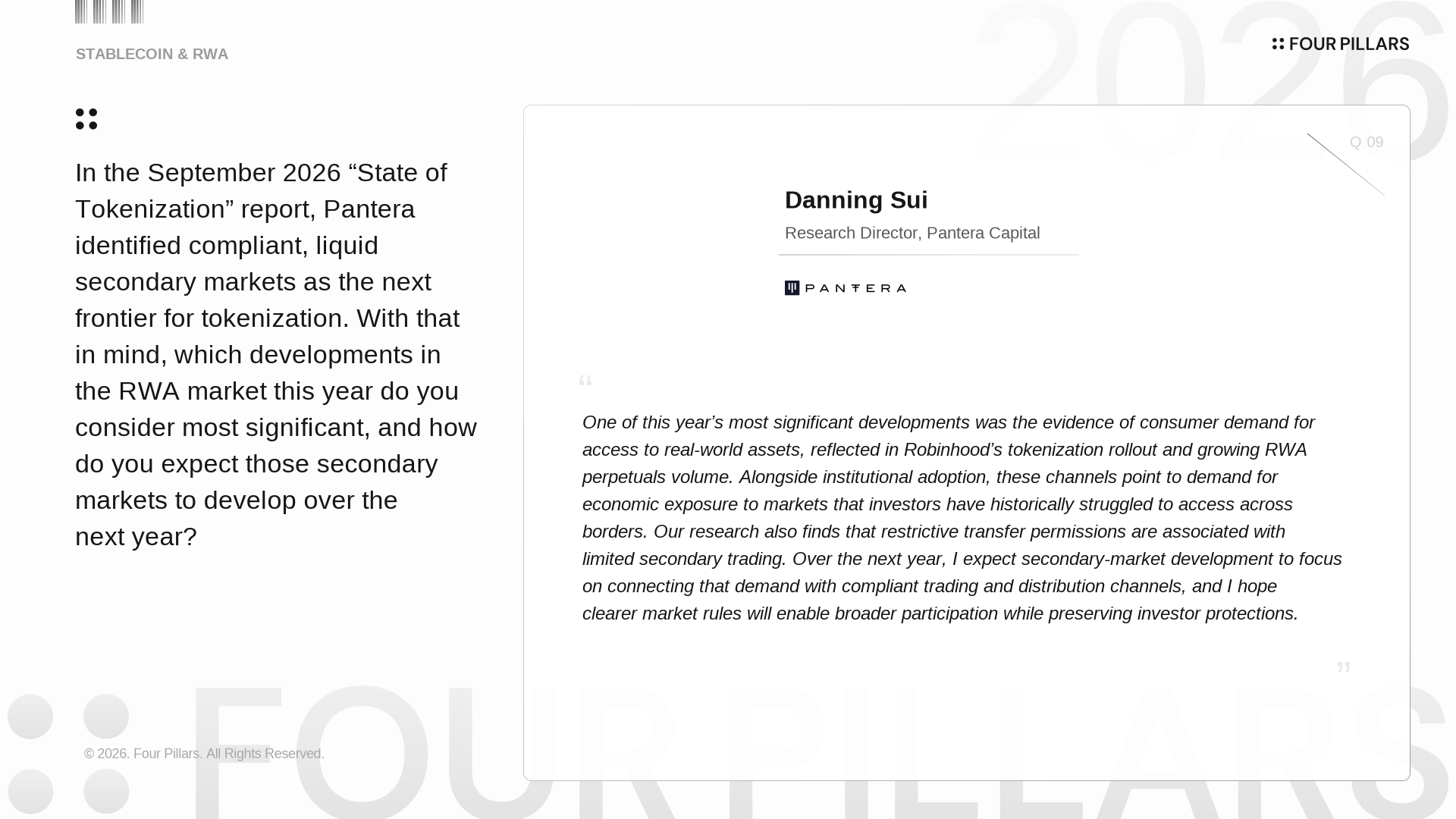
Interview: Danning Sui, Research Director, Pantera Capital
In the September 2026 report on the "State of Tokenization," Pantera views compliant and liquid secondary markets as the next frontier of tokenization. In light of this, what developments in the RWA market do you consider most important this year? How do you expect these secondary markets to evolve in the coming year? One of the most significant developments this year is evidence of consumer demand for access to real-world assets, reflected in Robinhood's tokenization launch and the growing trading volume of RWA perpetual contracts. Alongside institutional adoption, these channels point to a demand for economic exposure to markets that have historically been difficult for investors to access cross-border. Our research also found that restrictive transfer licenses are associated with limited secondary trading. In the coming year, I expect the development of secondary markets to focus on connecting this demand with compliant trading and distribution channels, and I hope clearer market rules can achieve broader participation while protecting investors. ------ Danning Sui, Research Director, Pantera Capital
Major Revaluation
Revenue, valuation multiples, and value capture interpreted through the lens of publicly traded company financial reports.
The Crypto Industry Is Competing for the Same Speculative Funds as AI Hardware
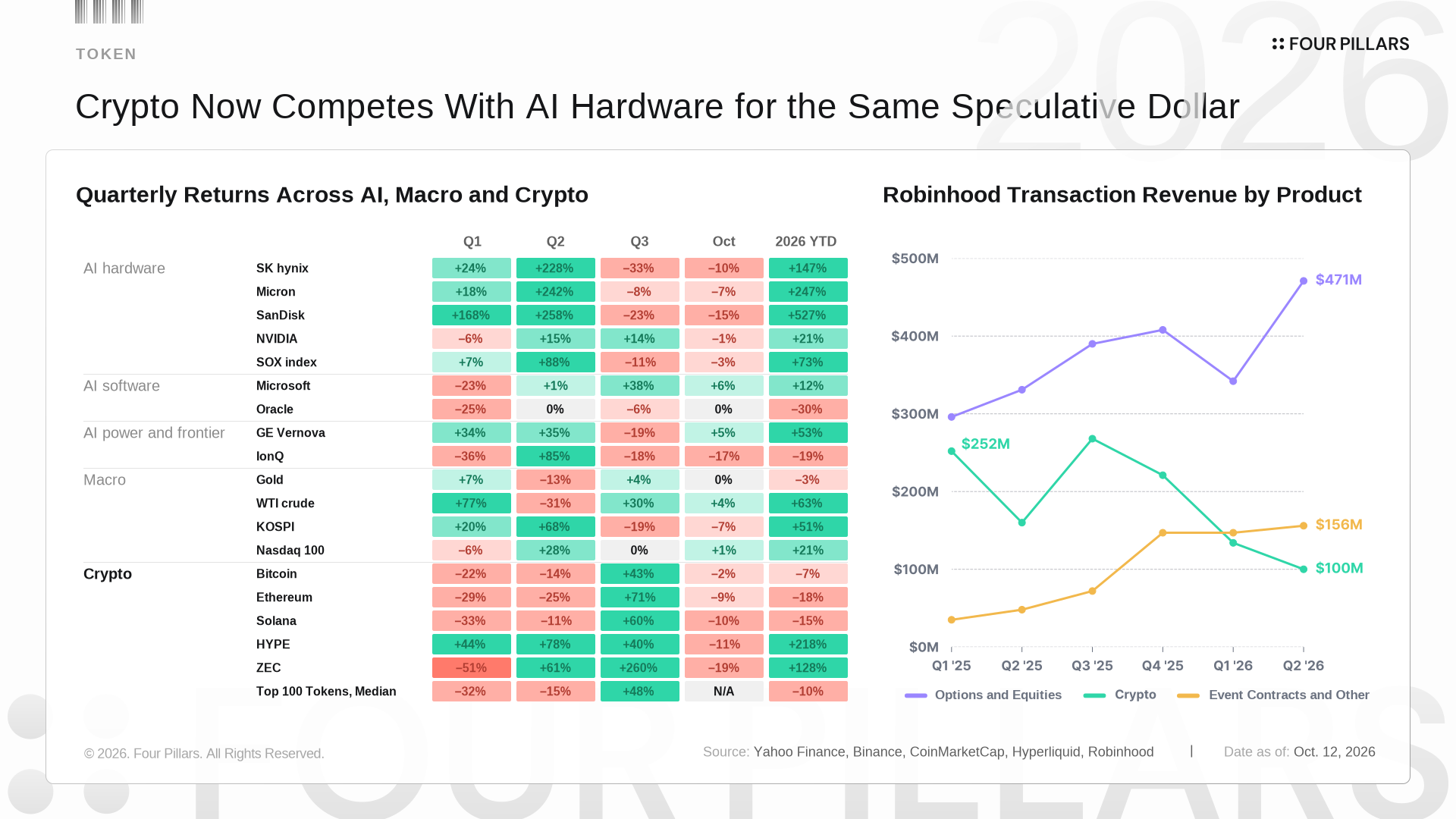
Yahoo Finance, Binance, CoinMarketCap, Hyperliquid, Robinhood · As of October 12, 2026
AI hardware dominated the flow of speculative funds in the first half of 2026, with SanDisk, SK Hynix, and Micron rising over 300%, while Bitcoin fell 33%, and the median of the top 100 tokens dropped 42%. Robinhood's crypto trading revenue declined by 60% over six quarters, despite a 59% increase in its options and stock revenue. The leading pattern reversed in the third quarter, with semiconductor stocks pulling back, and the median of the top 100 tokens rising 48%. However, AI hardware still maintained its lead for the year, with the semiconductor index rising 73%, while Bitcoin fell 7%, indicating a continued positive correlation as they compete for the same pool of venture capital. Within the crypto industry, only HYPE, MORPHO, and TRX rose in all three quarters, all supported by substantial protocol revenue.
ETF Access Expansion Leads to Product Growth Outpacing Demand
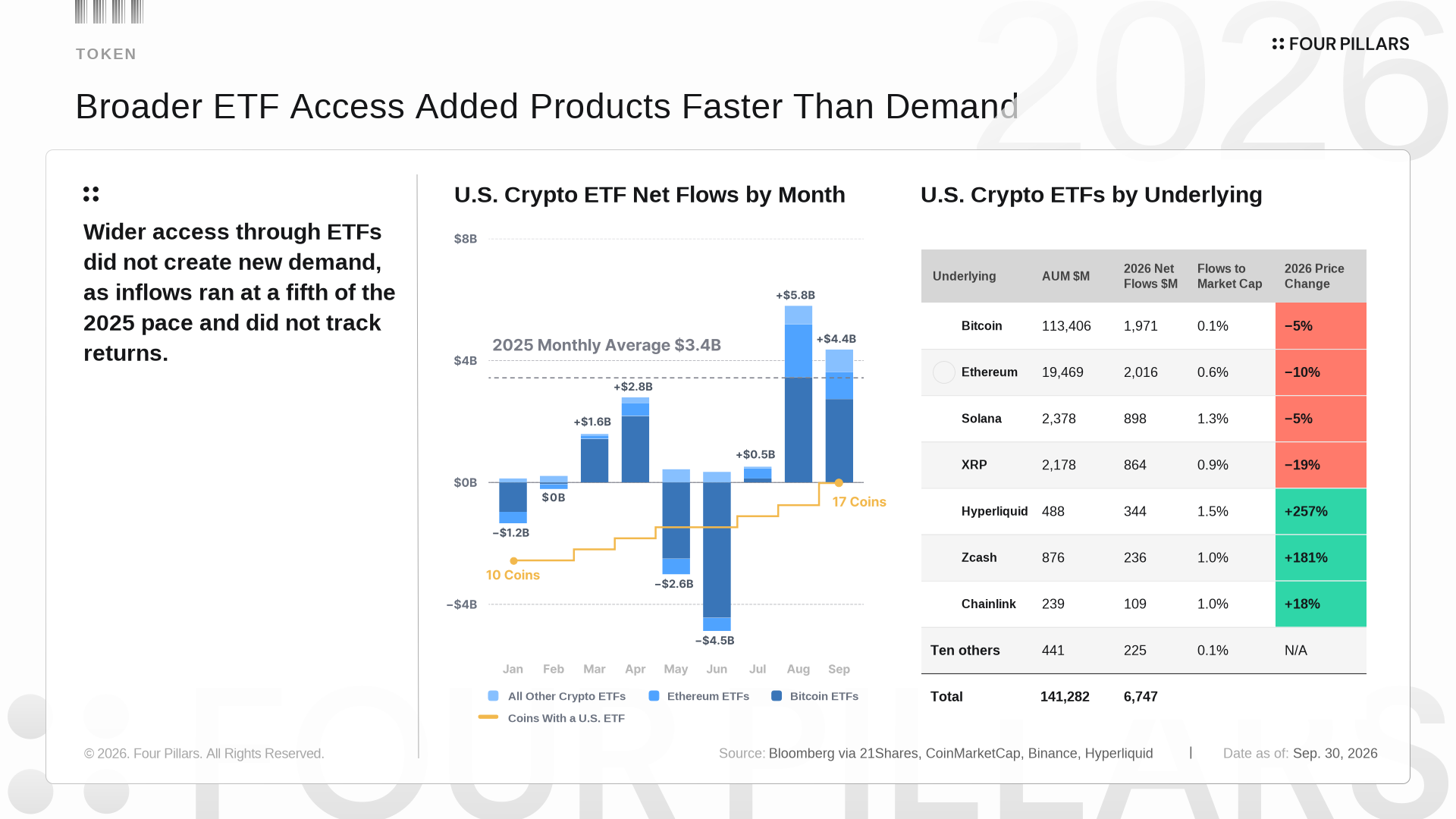
Bloomberg via 21Shares, CoinMarketCap, Binance, Hyperliquid · As of September 30, 2026
The number of assets available through U.S. crypto ETFs increased from 9 to 17 in 2026, but net inflows slowed from $41.2 billion in 2025 to $6.7 billion as of September. The average monthly inflow was $750 million, less than a quarter of the pace in 2025. Newer altcoin ETFs attracted $2.8 billion, although the amount is small relative to their underlying market size and has little correlation with returns. XRP, despite receiving $864 million in inflows, still fell 19%, while HYPE rose 257% on $344 million in inflows. ETFs improved market access, but the expansion of investable products has not led to a corresponding increase in demand.
After the October 10 Liquidation Event, Stock Picking Replaced Beta
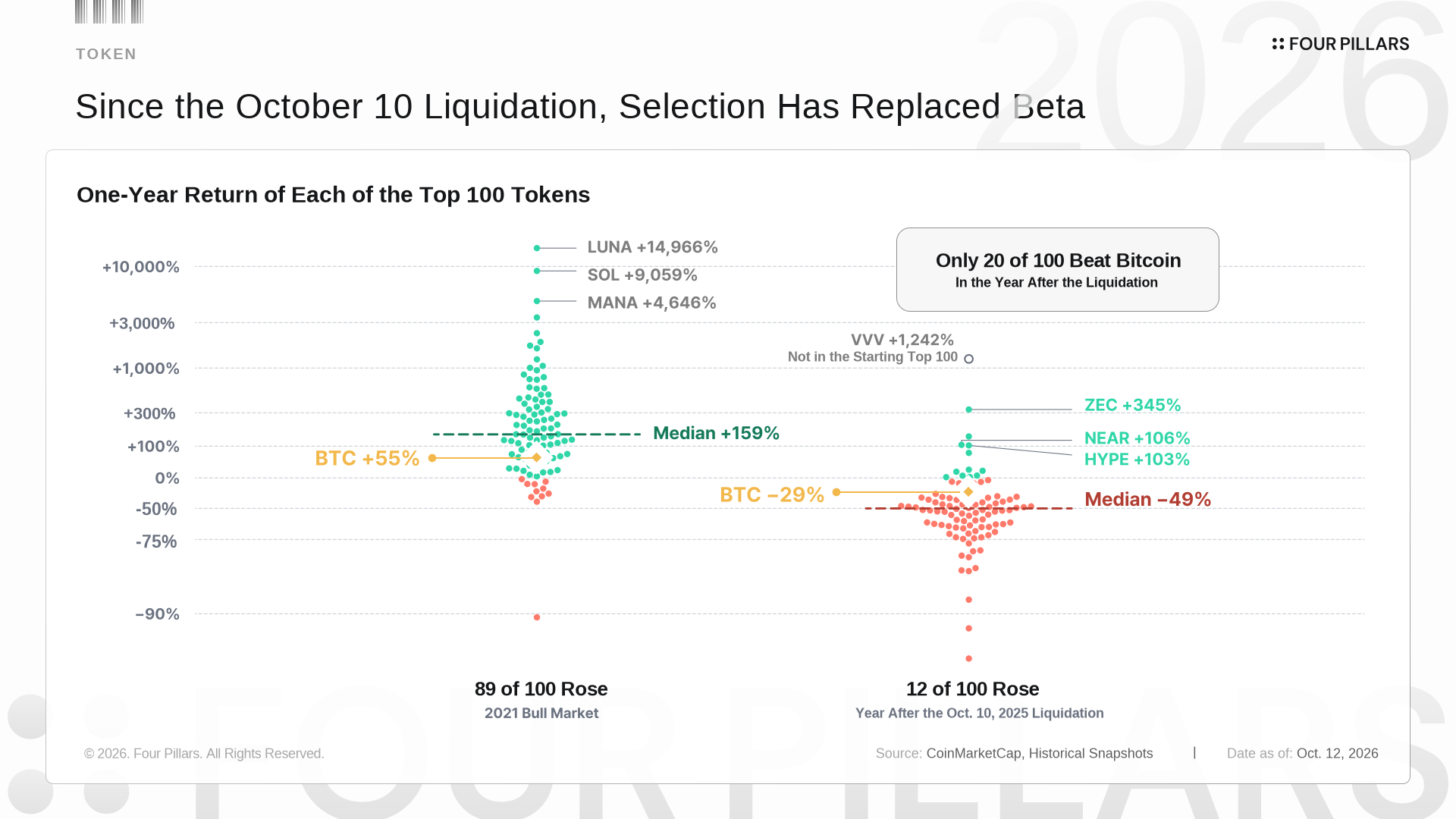
CoinMarketCap, Historical Snapshot · As of October 12, 2026
In the year following the liquidation event on October 10, 2025, only 12 of the top 100 tokens rose, with 20 outperforming Bitcoin. The median return was -49%, compared to -29% for Bitcoin, with ZEC, NEAR, and HYPE being among the few significant winners. This stands in stark contrast to 2021, when 89 of the top 100 tokens rose, with a median increase of 159%. Our analysis fixed the starting asset pool to avoid survivor bias; otherwise, including tokens that entered the top 100 only after rising would overestimate returns. Broad market exposure has become a poor substitute for individual token selection.
Unlimited Issuance and Limited Capital Make Filtering a Structural Norm
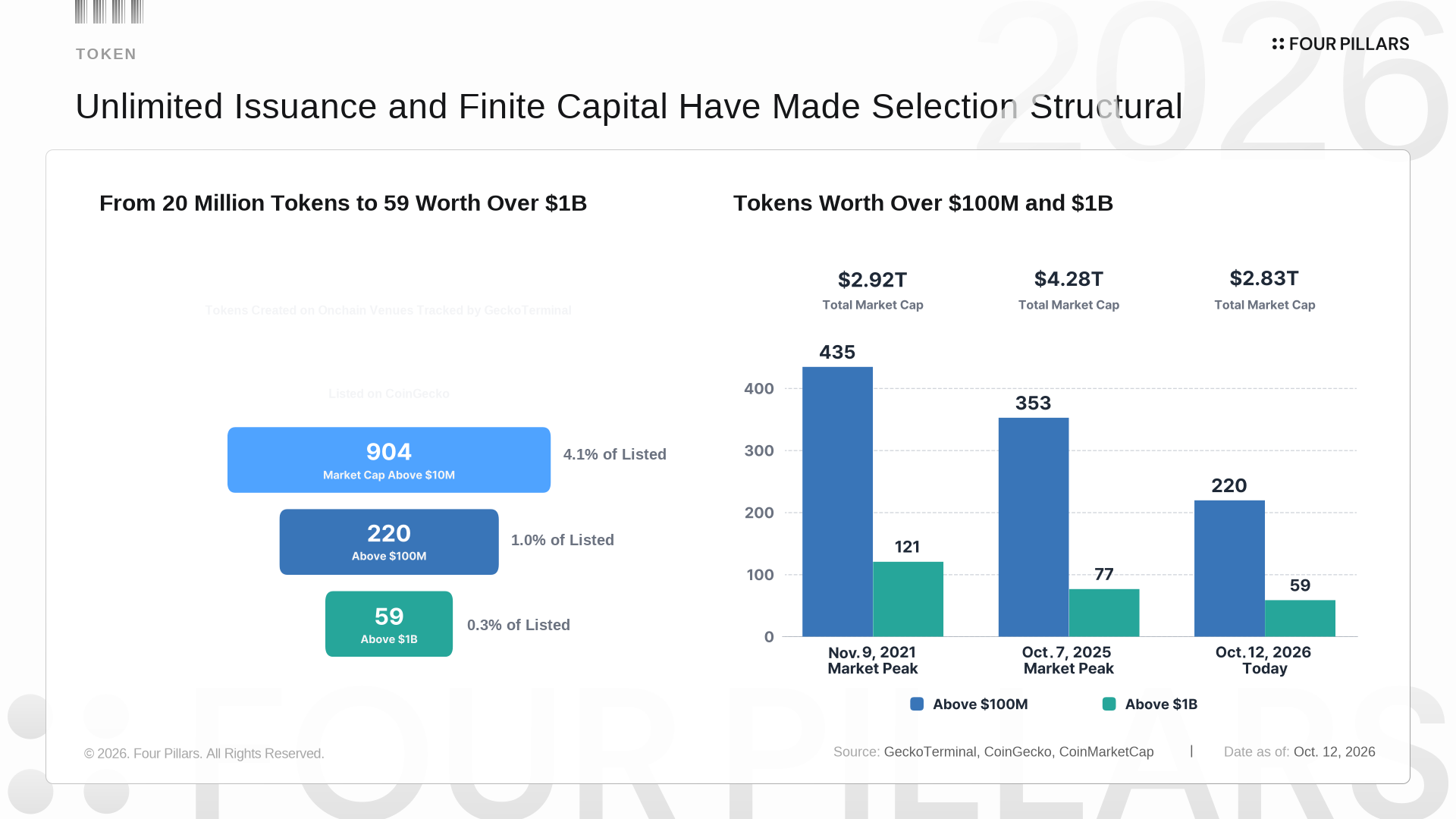
GeckoTerminal, CoinGecko, CoinMarketCap · As of October 12, 2026
GeckoTerminal recorded the creation of 20 million tokens, but only 22,181 are still listed on CoinGecko. Among these, 220 have a market cap exceeding $100 million, and only 59 exceed $1 billion, down from 435 and 121 at the market peak in November 2021. The market cap peak in October 2025 was 47% higher than in November 2021, but there are fewer large tokens supporting it. The performance of newly listed tokens has also been poor, with only 32% showing positive returns after 30 days and less than 10% after a year. Token issuance continues to expand, while the available funds to support meaningful valuations remain limited.
Tokens in 2021 Could Rise Without Revenue, But Most in 2026 Cannot
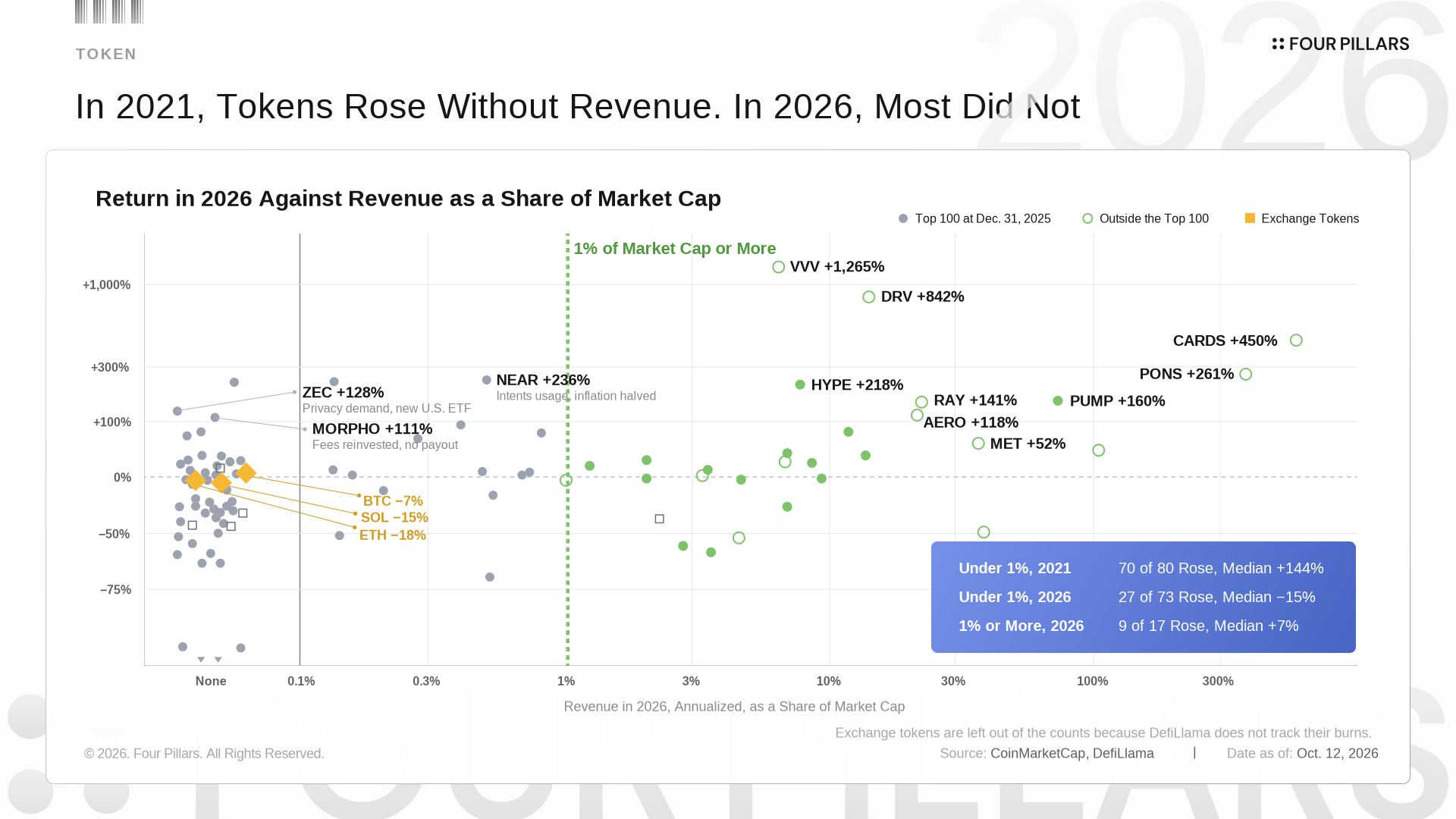
CoinMarketCap, DefiLlama · As of October 12, 2026
Revenue became a meaningful differentiator in 2026. Among the largest tokens, those generating annualized protocol revenue equivalent to at least 1% of their market cap had a median return of 7%, while those with lower revenue had -15%. In 2021, the latter group had a median increase of 144%. Distribution is also important; among the top ten revenue earners, seven that distributed most of their income achieved positive returns, while only two of the seven that retained most of their income did so. This relationship is not universally applicable, as Morpho and NEAR achieved strong returns without distribution, and revenue advantages vary significantly across different cycles.
Programmatic Buybacks Have Become the Most Trusted Form of Capital Return
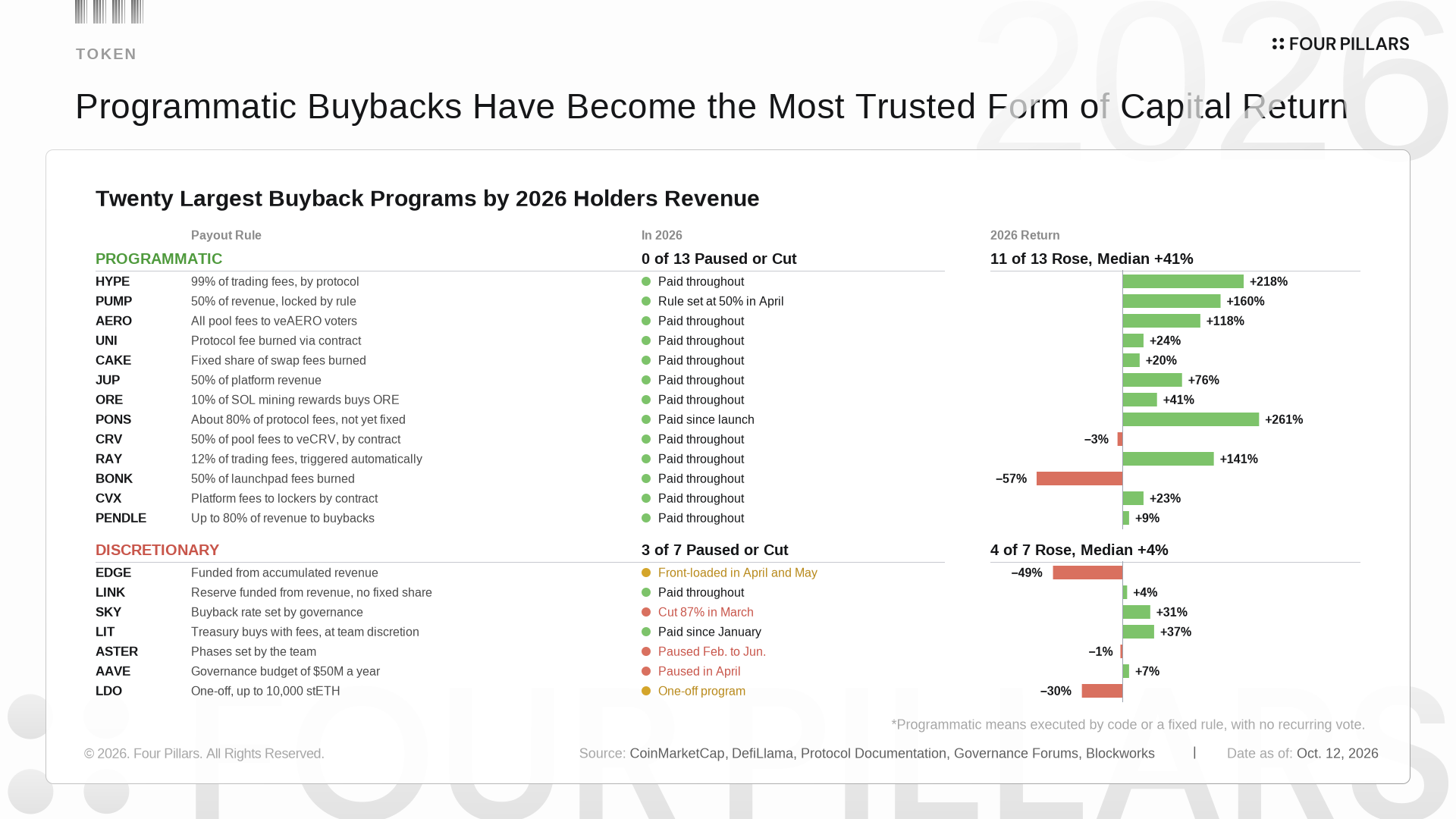
CoinMarketCap, DefiLlama, Protocol Documentation, Governance Forum, Blockworks · As of October 12, 2026
Among the 20 largest buyback programs, 13 governed by fixed rules did not pause or reduce payments in 2026, while 3 of the 7 discretionary programs did so. 11 programmatic tokens rose, with a median return of 41%, while the median for 4 discretionary tokens was 4%. Hyperliquid and pump.fun accounted for $728 million, or 54% of total payments made by holders, demonstrating the scale of purchases funded by revenue. The sample is small, and programmatic tokens also generated more revenue relative to market cap, so performance differences cannot be solely attributed to payment rules. Nevertheless, fixed execution provides greater predictability for investors compared to discretionary treasury commitments.
Quote: Sunny Shi, Investor at Syncracy Capital
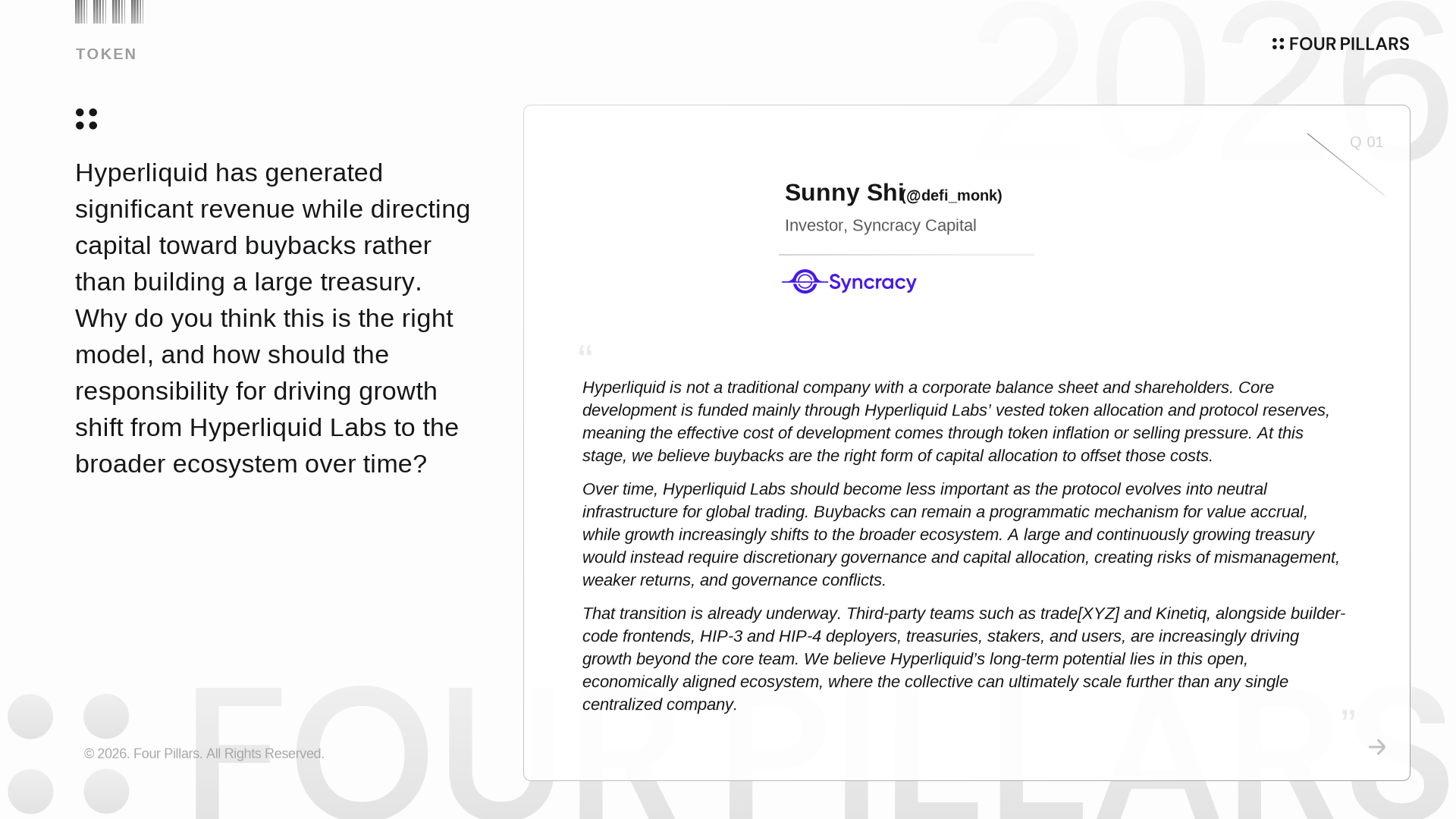
Interview: Sunny Shi
Hyperliquid has generated significant revenue while directing capital towards buybacks rather than building a large treasury. Why do you believe this is the right model? Over time, how should the responsibility for driving growth shift from Hyperliquid Labs to the broader ecosystem? Hyperliquid is not a traditional company with a balance sheet and shareholders. Core development is primarily funded through the allocation of tokens and protocol reserves from Hyperliquid Labs, meaning the actual cost of development comes from token inflation or sell pressure. At this stage, we believe buybacks are the correct form of capital allocation to offset these costs. Over time, as the protocol evolves into a neutral infrastructure for global trading, the importance of Hyperliquid Labs should diminish. Buybacks can be retained as a programmatic mechanism for value accumulation, while growth increasingly shifts to the broader ecosystem. A large and continuously growing treasury would instead require discretionary governance and capital allocation, leading to risks of mismanagement, diminished returns, and governance conflicts. This shift is already happening. Third-party teams like trade[XYZ] and Kinetiq, along with builder-code frontends, HIP-3 and HIP-4 deployers, treasuries, stakers, and users, are increasingly driving growth beyond the core team. We believe Hyperliquid's long-term potential lies in this open, economically aligned ecosystem, where collective scaling capabilities can ultimately surpass any single centralized company. ------ Sunny Shi, Investor at Syncracy Capital
Token design is maturing, with more value flowing to holders
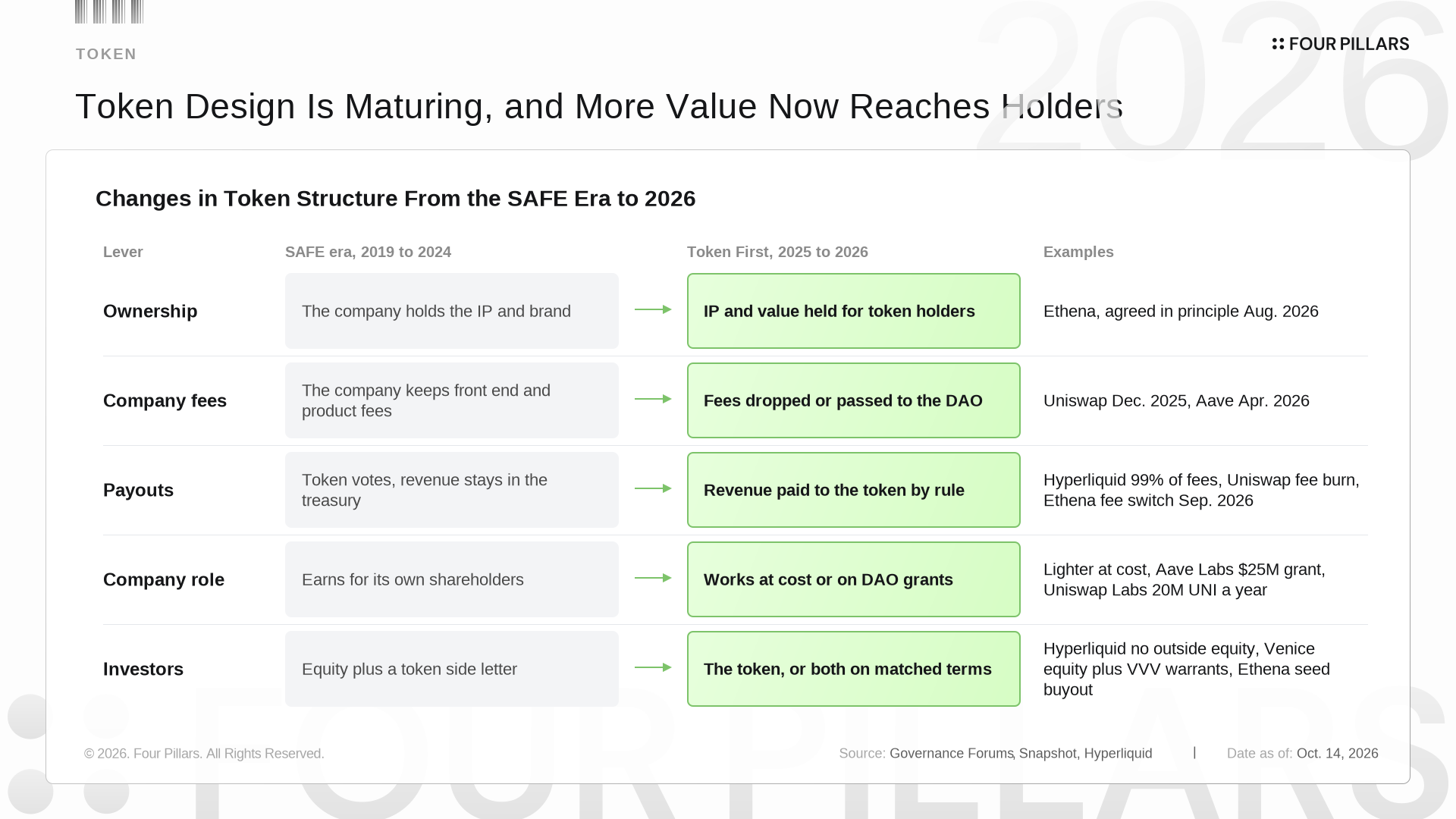
Governance forums, Snapshot, DL News, CryptoSlate, Hyperliquid · As of October 14, 2026
SAFE and token warrant models allow development companies to retain intellectual property, product revenue, and equity value, while tokens carry only limited economic rights. This structure is changing. Hyperliquid directs 99% of trading fees towards HYPE buybacks, Uniswap has initiated protocol fee burns, and Aave and Ethena are advancing proposals to transfer more economic value to their DAOs or token holders. Among the top 25 crypto applications by revenue, the proportion allocated to token holders has risen from about 16% in 2024 to 41% in 2026. However, legal protections remain incomplete, with many arrangements relying on governance decisions or company commitments rather than enforceable rights.
Token disclosures are converging towards public stock standards
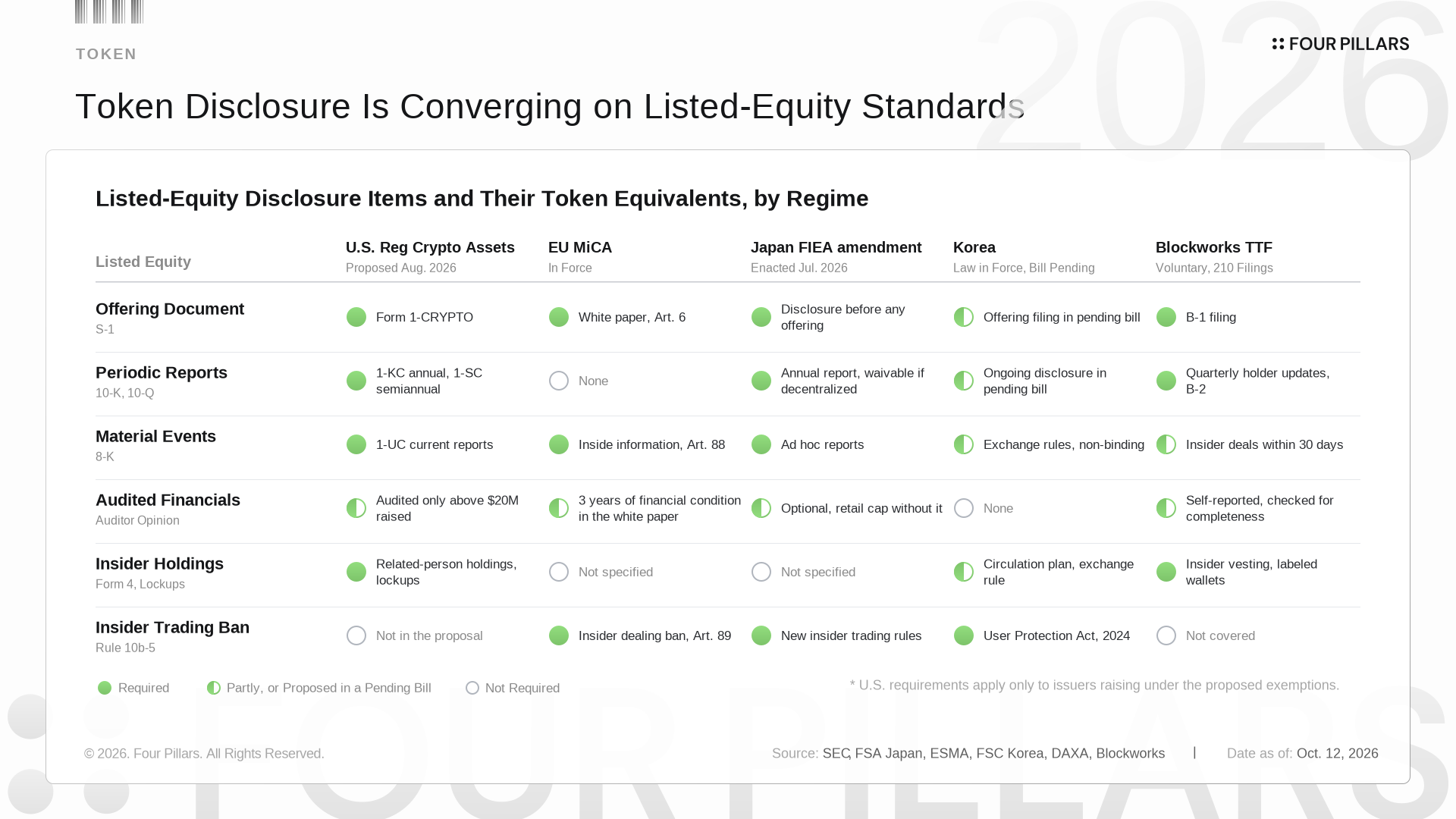
SEC, FSA Japan, ESMA, FSC Korea, DAXA, Blockworks · As of October 12, 2026
Cryptocurrency disclosure requirements are approaching the standards for publicly traded stocks. The SEC's proposed "Regulation of Crypto Assets" introduces periodic reporting and insider ownership disclosures, while Japan's 2026 legislation adds issuance disclosures, ongoing reporting, and insider trading restrictions. MiCA has imposed disclosure obligations in Europe, and South Korea is also considering broader issuer reporting requirements. Industry standards are advancing in sync with regulation, with 210 filings under the Blockworks token transparency framework, but only 39 rated as "complete." Audited financial statements remain a major weakness across jurisdictions. As reporting becomes more consistent, institutional investors will be better positioned to underwrite tokens based on financial performance and economic rights.
The market views L1 as cash-generating businesses or monetary assets
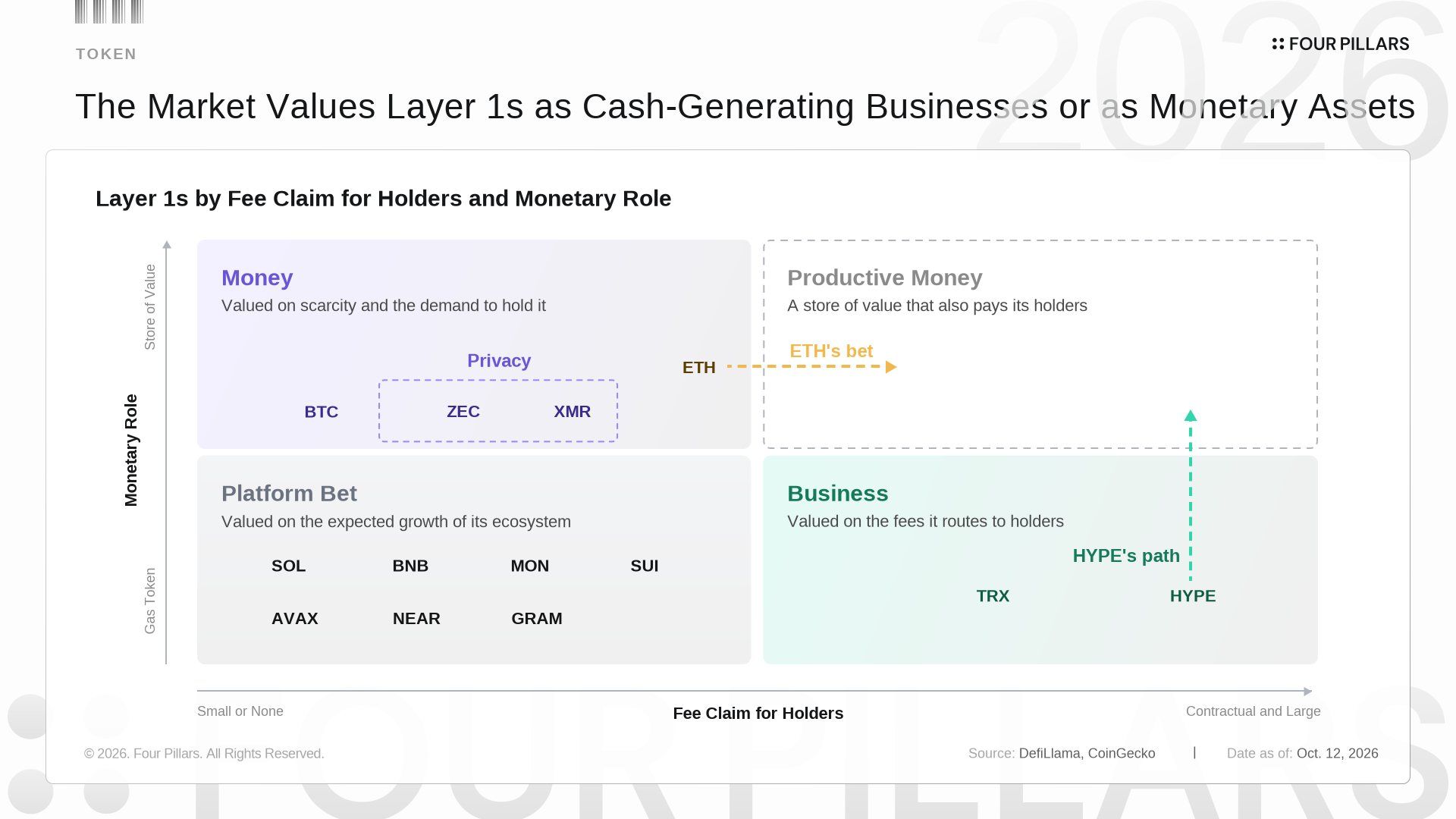
DefiLlama, CoinGecko · As of October 12, 2026
L1 valuations increasingly depend on whether tokens capture economic value or serve monetary functions. Hyperliquid's market cap is 21 times the fees tracked on its chain, Tron is at 92 times, Solana at 279 times, and Ethereum at 1706 times. The latter group relies more heavily on expectations of future ecosystem growth. The value of Bitcoin, Zcash, and Monero primarily comes from monetary demand, while Hyperliquid has established a substantial fee-funded buyback mechanism. Ethereum and HYPE are approaching these two models from opposite directions, with ETH seeking stronger economic value capture and HYPE developing a broader monetary role. Neither has fully established dual attributes.
Quantum resistance is becoming part of every chain's investment logic
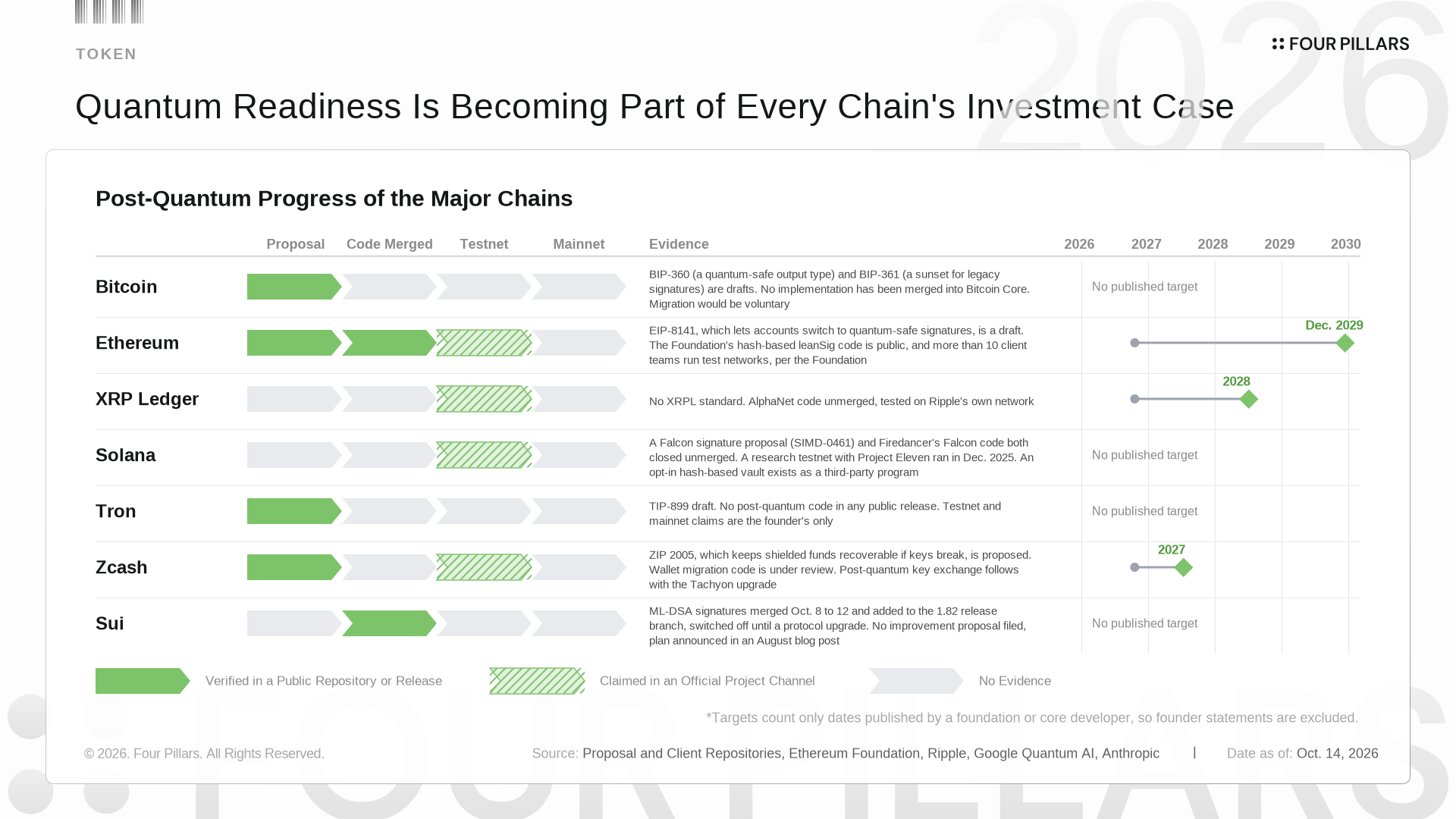
Proposal and client repositories, Ethereum Foundation, Ripple, Google Quantum AI, Anthropic · As of October 14, 2026
AI-assisted exploitations and advancements in quantum computing have heightened the importance of long-term blockchain security. Google Quantum AI estimates that elliptic curve cryptography could eventually be broken with fewer than 500,000 physical qubits, although machines capable of this do not yet exist. Among the seven major chains we examined, none have deployed post-quantum protection on their mainnets. Ethereum has the most comprehensive public migration plan, Sui has integrated post-quantum signature code, Zcash has begun work on testnets, while Bitcoin remains in the proposal stage. For long-term investors, the credibility of implementation progress and migration timelines is becoming a relevant security consideration.
Capital allocation in 2027 will expand from buybacks to reinvestment
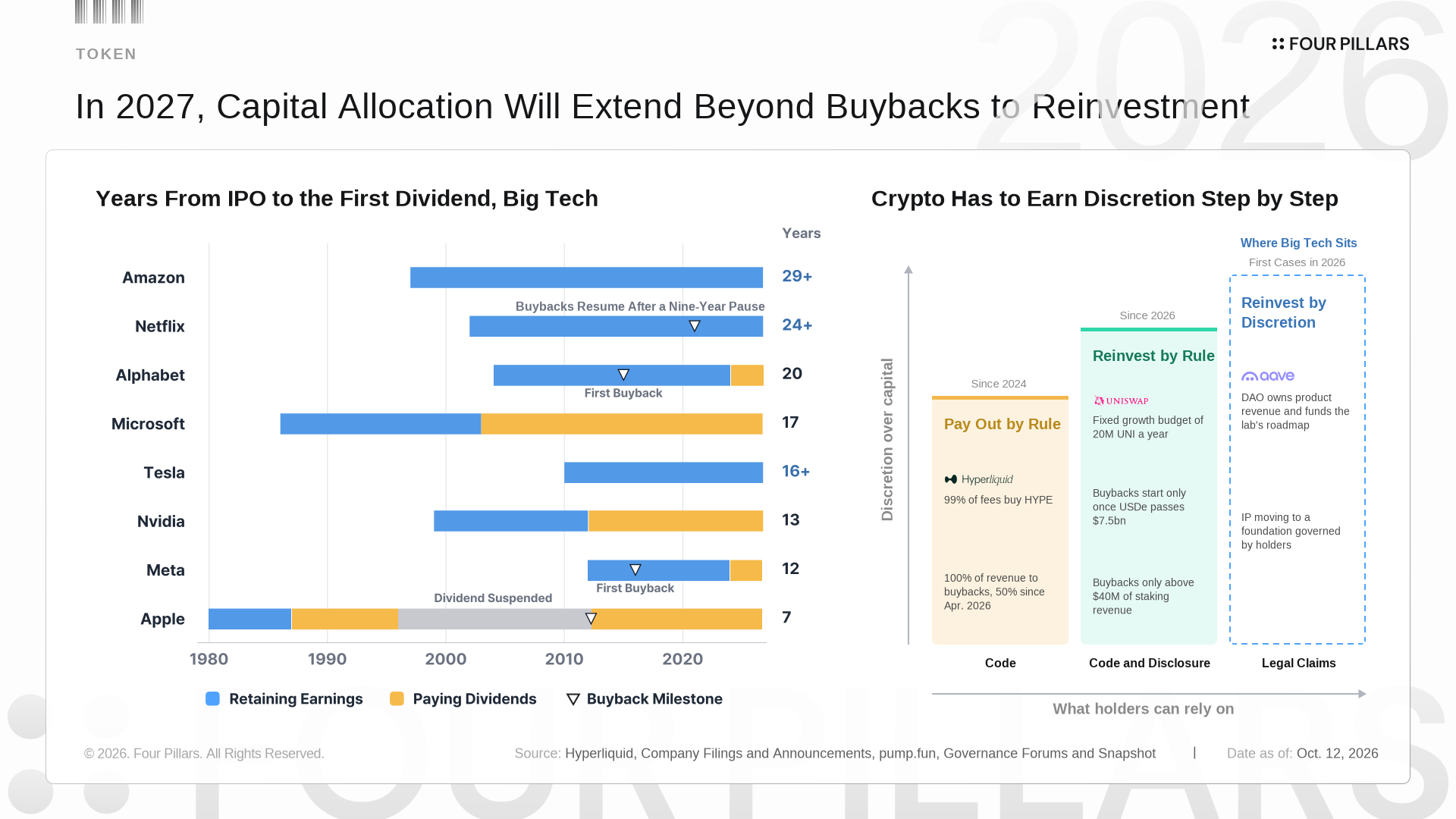
Hyperliquid, company documents and announcements, pump.fun, governance forums and Snapshot · As of October 12, 2026
Successful tech companies typically reinvest for many years before returning capital, with Microsoft, Nvidia, Meta, and Alphabet starting dividends 12 to 20 years after going public. The crypto industry has taken a different path, as token holders lack comparable legal protections and financial disclosures, making fixed buybacks a more credible commitment. Signs of a shift towards reinvestment are becoming visible: creator payments from pump.fun, Uniswap's fixed growth budget, and Aave's funding for protocol development. Morpho achieving a 111% return without paying holders also indicates that when retained earnings support growth, investors reward it. We expect protocols with transparent capital allocation policies and clear reinvestment standards to be best positioned to gain greater discretion over cash flows.
Trading Revolution
Spot versus derivatives, exchanges versus on-chain venues, and shares of OTC.
Perpetual contract trading volume is more than three times that of spot, with more shifting to on-chain
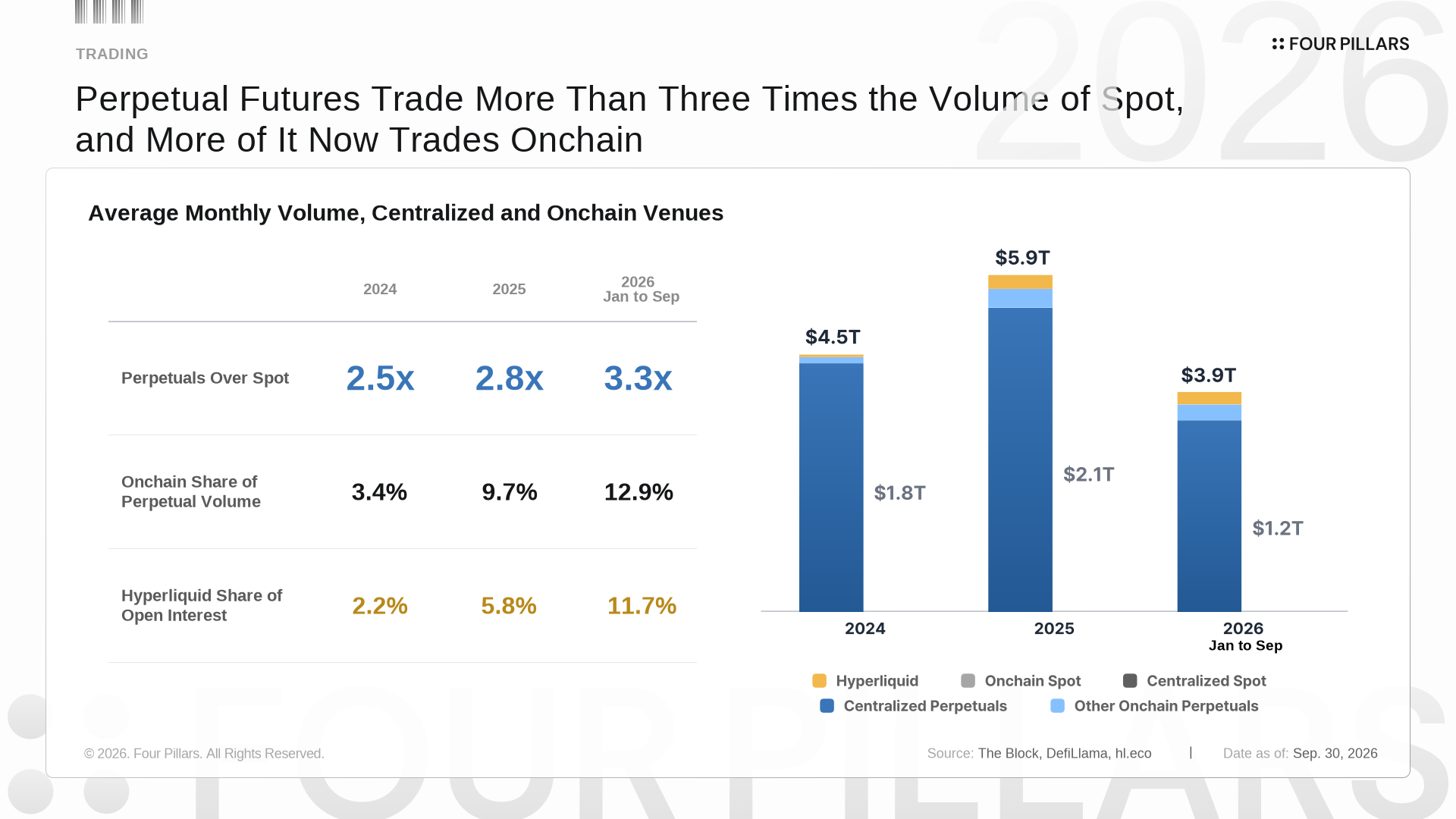
The Block, DefiLlama, hl.eco · As of September 30, 2026
In the first nine months of 2026, the average monthly trading volume of perpetual futures reached $3.9 trillion, while spot was $1.2 trillion, raising the ratio from 2.5 times in 2024 to 3.3 times. This growth is partly due to spot trading contracting faster than derivatives: centralized spot trading volume fell 47% from the average monthly level in 2025, while perpetual contracts fell 37%. On-chain perpetual contract trading volume has shown greater resilience, declining only 13%, with its share of global perpetual contract trading rising to 12.9%, compared to 3.4% in 2024. Hyperliquid accounts for about 45% of the tracked on-chain trading volume, holding 11.7% of open contracts among the major venues we compared. On-chain share remains sensitive to coverage and trading incentives, especially those that have boosted volumes at newer exchanges.
Quote: GLC Research

Interview: GLC Research
Hyperliquid is challenging centralized exchanges, with Binance actively expanding into stock and commodity perpetual contracts, and U.S. venues also incorporating perpetual contracts domestically. Where will liquidity in perpetual contracts be concentrated three years from now? Will it be a winner-takes-all market, or will different venues dominate different segments? Liquidity is a winner-takes-all game. In the futures space, CME has both an order book and a clearinghouse, while Robinhood, Schwab, Interactive Brokers, and others compete on top as frontends. Hyperliquid has the same structure on-chain but opens the frontend to everyone.
We expect perpetual derivatives to consolidate into a few order books segmented by jurisdiction, with the United States being the most significant, as it has consistently been in capital markets. Unlike vertically integrated venues like Binance, Hyperliquid is a trusted, neutral, and permissionless infrastructure, which now adds licensed markets on top: Kraken's parent company Payward plans to become the first HIP-3 deployer regulated by the CFTC, and ICE, the owner of the New York Stock Exchange, is collaborating with trade[XYZ] to create a market for U.S. traders that complies with KYC and anti-money laundering requirements. Regulation may still change significantly in three years, but we can now clearly envision Hyperliquid becoming the neutral infrastructure where most perpetual derivatives liquidity is concentrated. ------ GLC Research
Congressional Stalemate, but Perpetual Contracts Still Entering the U.S. Market
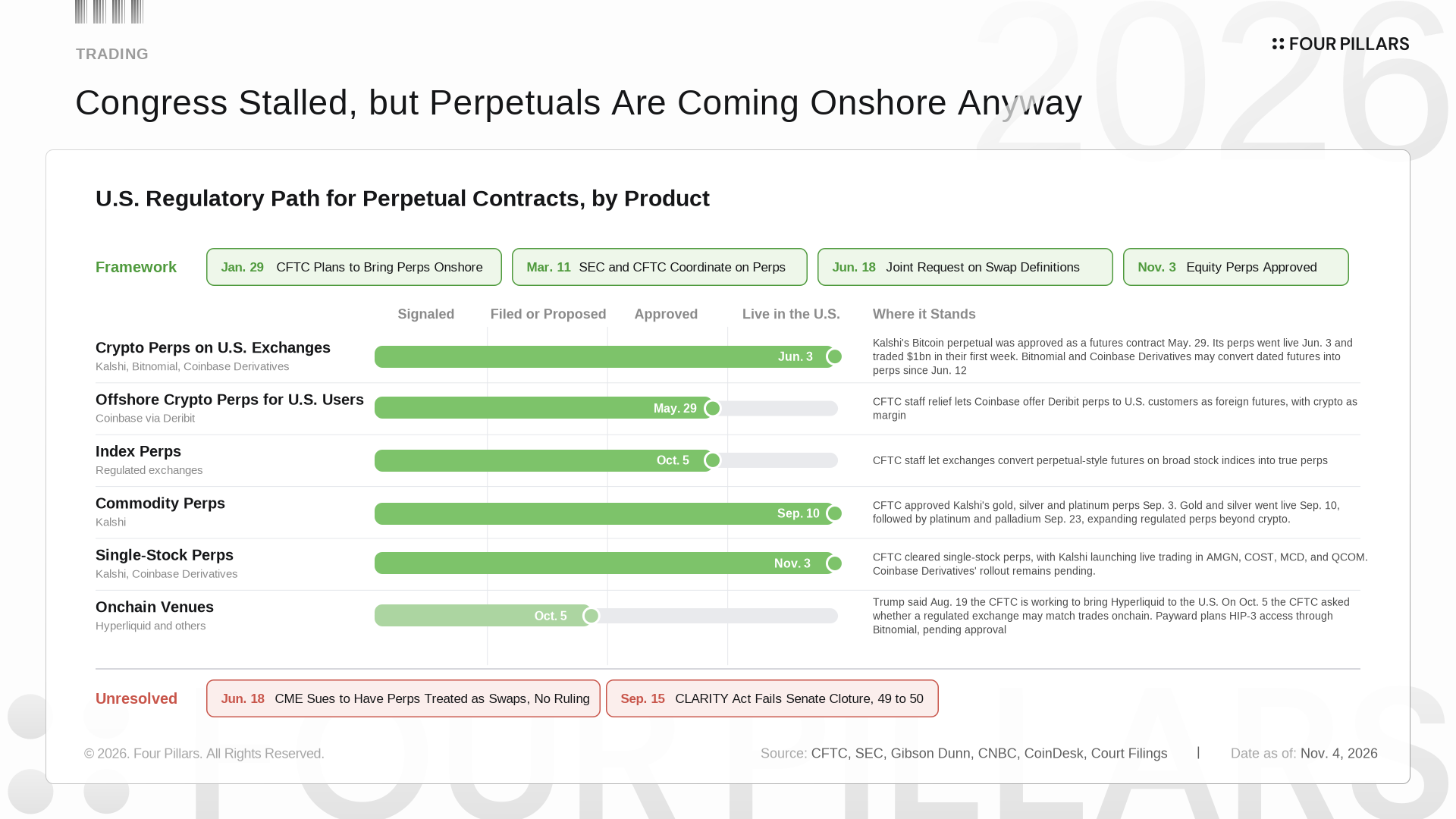
CFTC, SEC, Gibson Dunn, CNBC, CoinDesk, Court Documents · As of November 4, 2026
Despite the setback of the CLARITY Act in September, U.S. regulators accelerated the domestication of perpetual contract futures in 2026. The CFTC approved Kalshi's Bitcoin perpetual contracts in May, allowed the conversion of periodic cryptocurrency futures to perpetual contracts in June, and paved the way for commodity and broad stock index perpetual contracts, with gold, silver, and index contracts subsequently launching. On November 3, the CFTC approved single-stock perpetual contracts under the SEC-CFTC joint securities futures framework, and Kalshi launched real-time trading for some U.S. stocks on the same day. However, legal challenges remain, with CME contesting the classification of crypto perpetual contracts, and a Cboe-backed group filing a lawsuit regarding stock perpetual contracts. On-chain access is even more lagging, with the CFTC studying blockchain-based matching, and Payward seeking approval to distribute Hyperliquid's HIP-3 market through Bitnomial. Perpetual contracts are no longer just approaching the U.S. market; they are now trading domestically, although a broader regulatory framework remains contentious.
Perpetual Contracts Expanding from Crypto to Stocks and Commodities
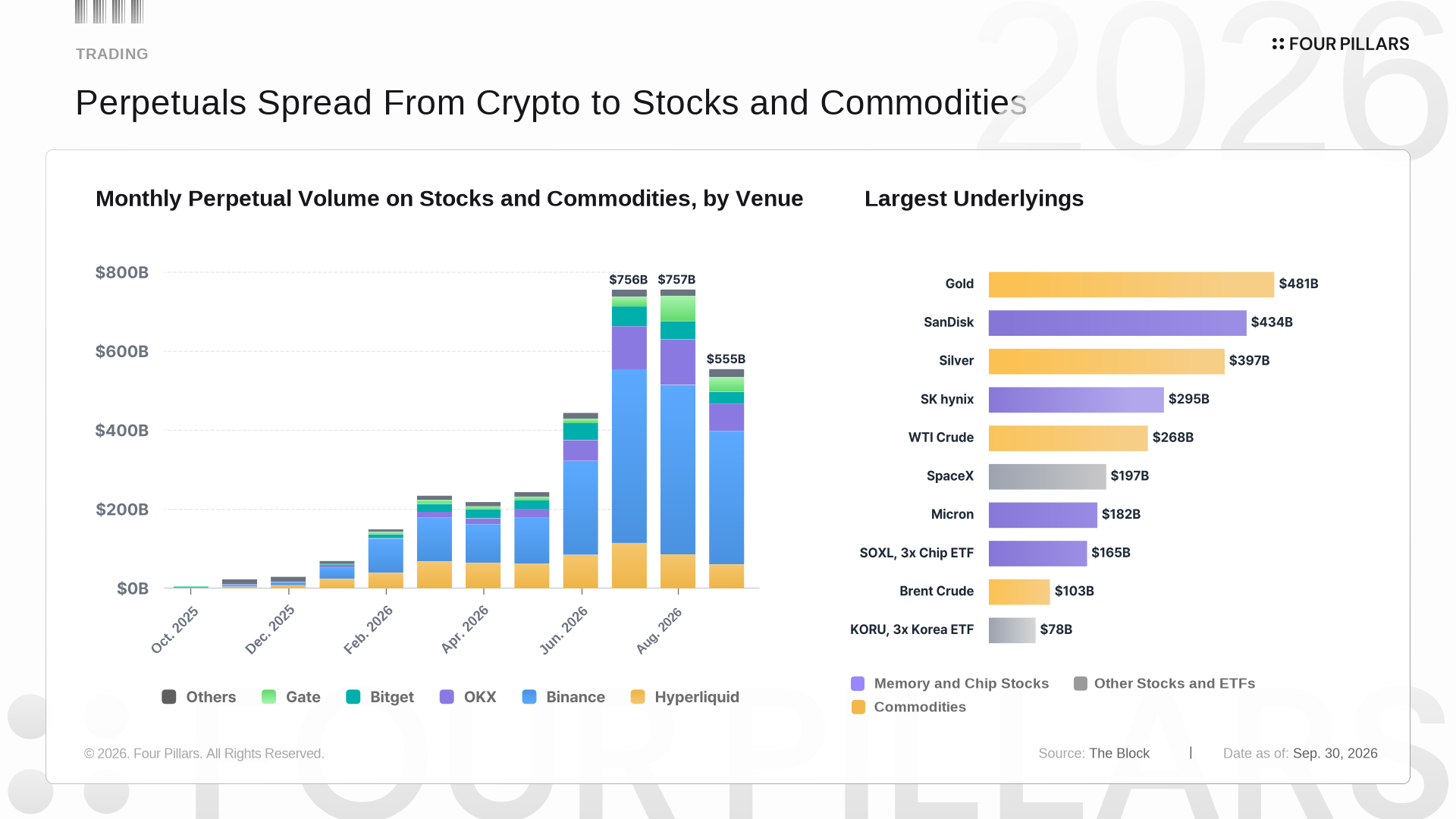
The Block · As of September 30, 2026
The monthly trading volume of perpetual contracts for stocks and commodities surged from $5 billion in October 2025 to a peak of $757 billion in August 2026. The trading volume for the first nine months of 2026 reached $3.4 trillion, led by semiconductor stocks and precious metals. Storage and chip-related assets accounted for 58% of stock perpetual contract trading volume, with SanDisk, SK Hynix, and Micron among the largest markets. On-chain trading venues pioneered this category, but centralized exchanges have since captured most of the activity. HIP-3 accounted for 37% of Hyperliquid's perpetual contract trading volume in the third quarter, while Binance led the broader category with a 61% market share in September, with Hyperliquid at 11%.
Quote: Lucas V. Schuermann, Co-founder and CEO of Variational
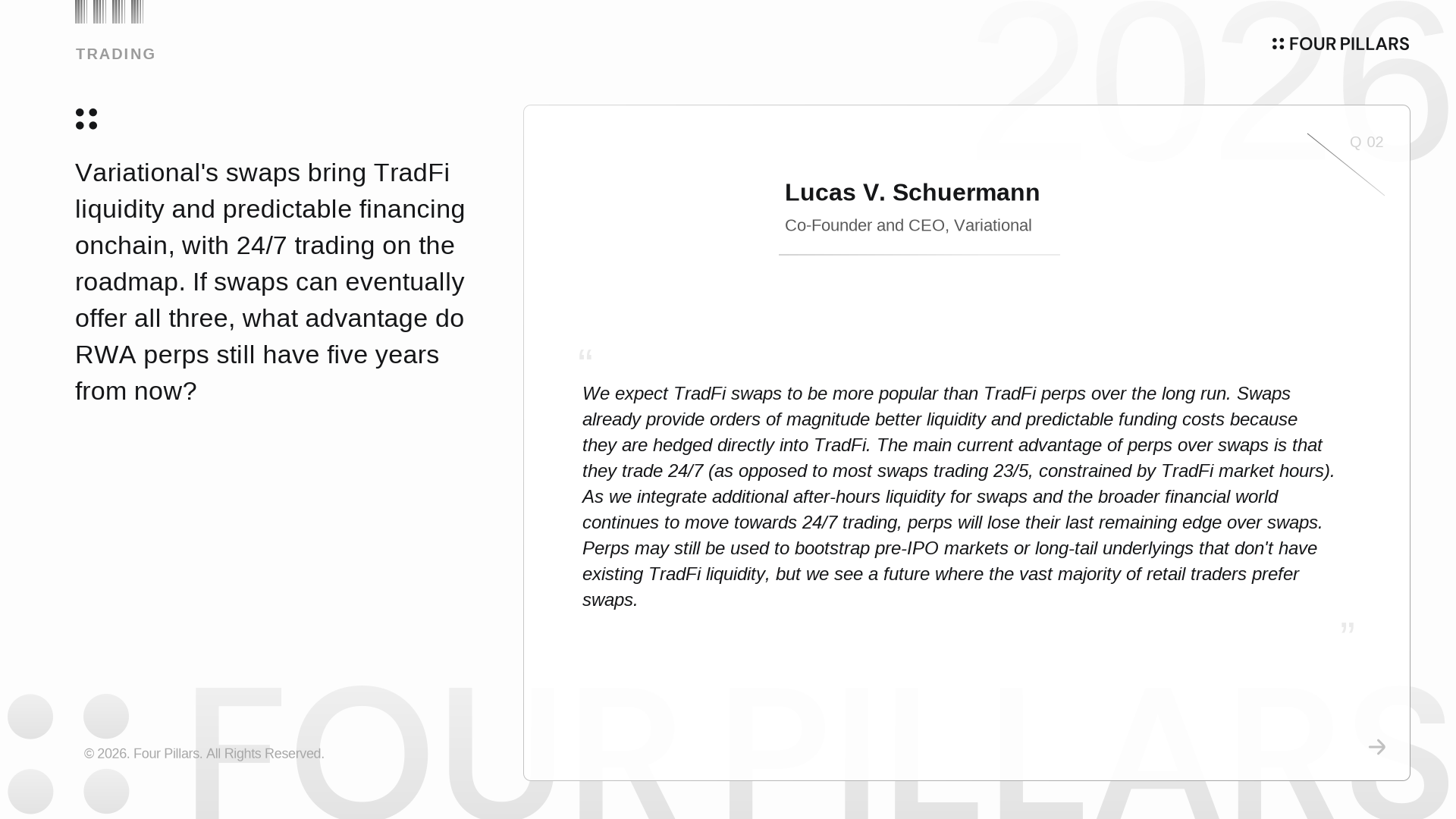
Interview: Lucas V. Schuermann
Variational's swap contracts bring traditional financial liquidity and predictable financing on-chain, with a roadmap for around-the-clock trading. If swap contracts can ultimately provide all three, what advantages will RWA perpetual contracts have five years from now? We expect that, in the long term, traditional financial swap contracts will be more popular than traditional financial perpetual contracts. Swap contracts already offer orders of magnitude better liquidity and predictable financing costs because they directly hedge into traditional finance. Currently, the main advantage of perpetual contracts over swap contracts is around-the-clock trading (while most swap contracts are limited to traditional financial hours, trading only five days a week for 23 hours a day). As we integrate more after-hours liquidity for swap contracts and the broader financial world continues to move toward around-the-clock trading, perpetual contracts will lose their last relative advantage over swap contracts. Perpetual contracts may still be used to establish a liquid market for pre-IPO or long-tail assets without existing traditional financial liquidity, but we foresee a future where the vast majority of retail traders will prefer swap contracts. ------ Lucas V. Schuermann, Co-founder and CEO of Variational
Perpetual Contracts Begin Pricing Companies Before IPOs
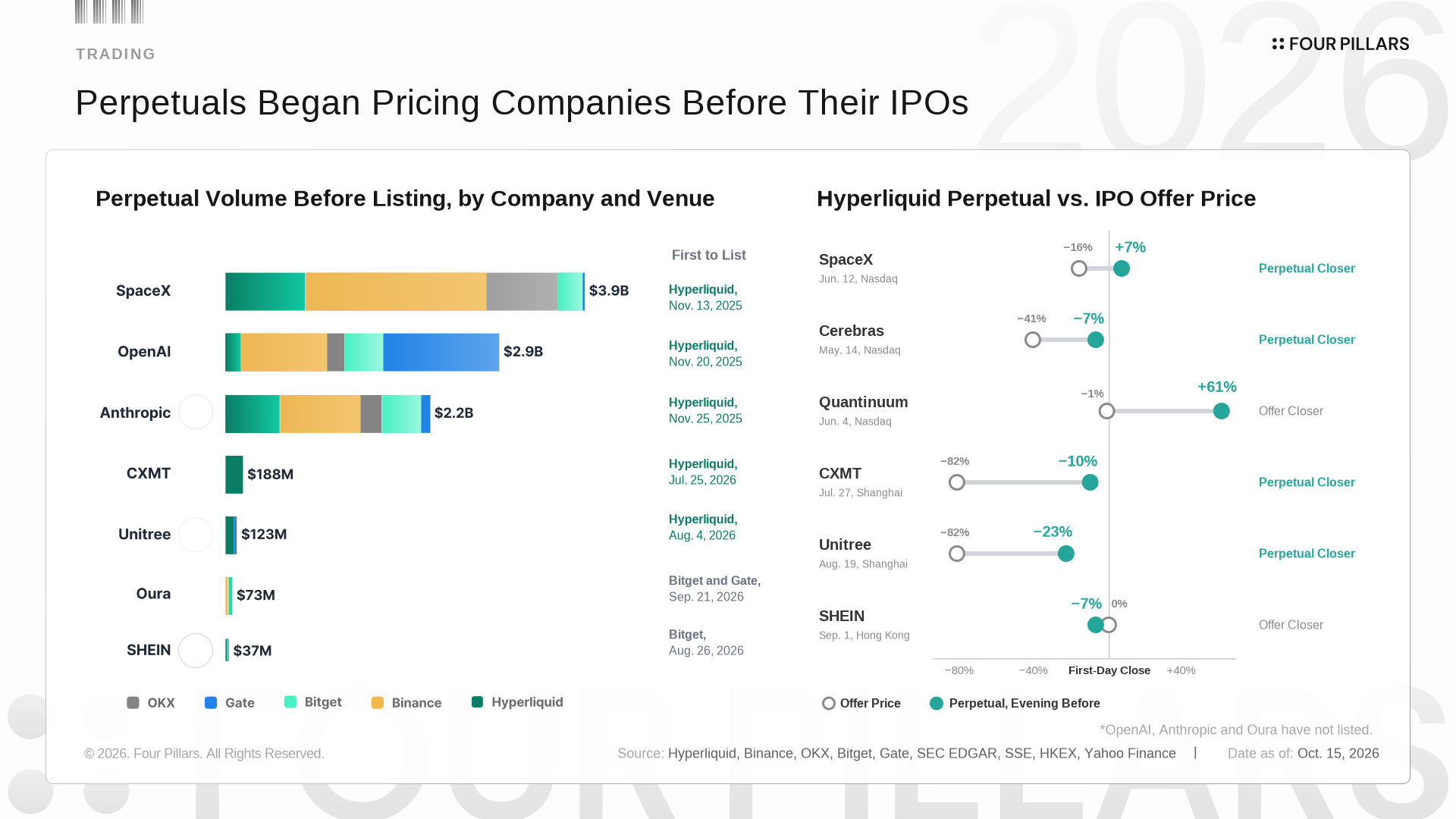
Hyperliquid, Binance, OKX, Bitget, Gate, SEC EDGAR, SSE, HKEX, Yahoo Finance · As of October 15, 2026
The pre-IPO perpetual market generated $9.4 billion in trading volume across seven companies, with SpaceX at $3.9 billion, OpenAI at $2.9 billion, and Anthropic at $2.2 billion. Hyperliquid was one of the first venues to list several of these contracts, although Binance subsequently captured the largest overall share at 40%. For the six companies going public in 2026, Hyperliquid's final pre-IPO prices were closer to the first-day closing prices on four occasions than the IPO issuance prices. Two of these instances were for Shanghai listings with unusually high first-day premiums, limiting the persuasiveness of the comparisons. Pre-IPO perpetual contracts have established a liquid market for private company exposure, but their predictive record remains preliminary.
The Path to Regulated Hyperliquid is Taking Shape
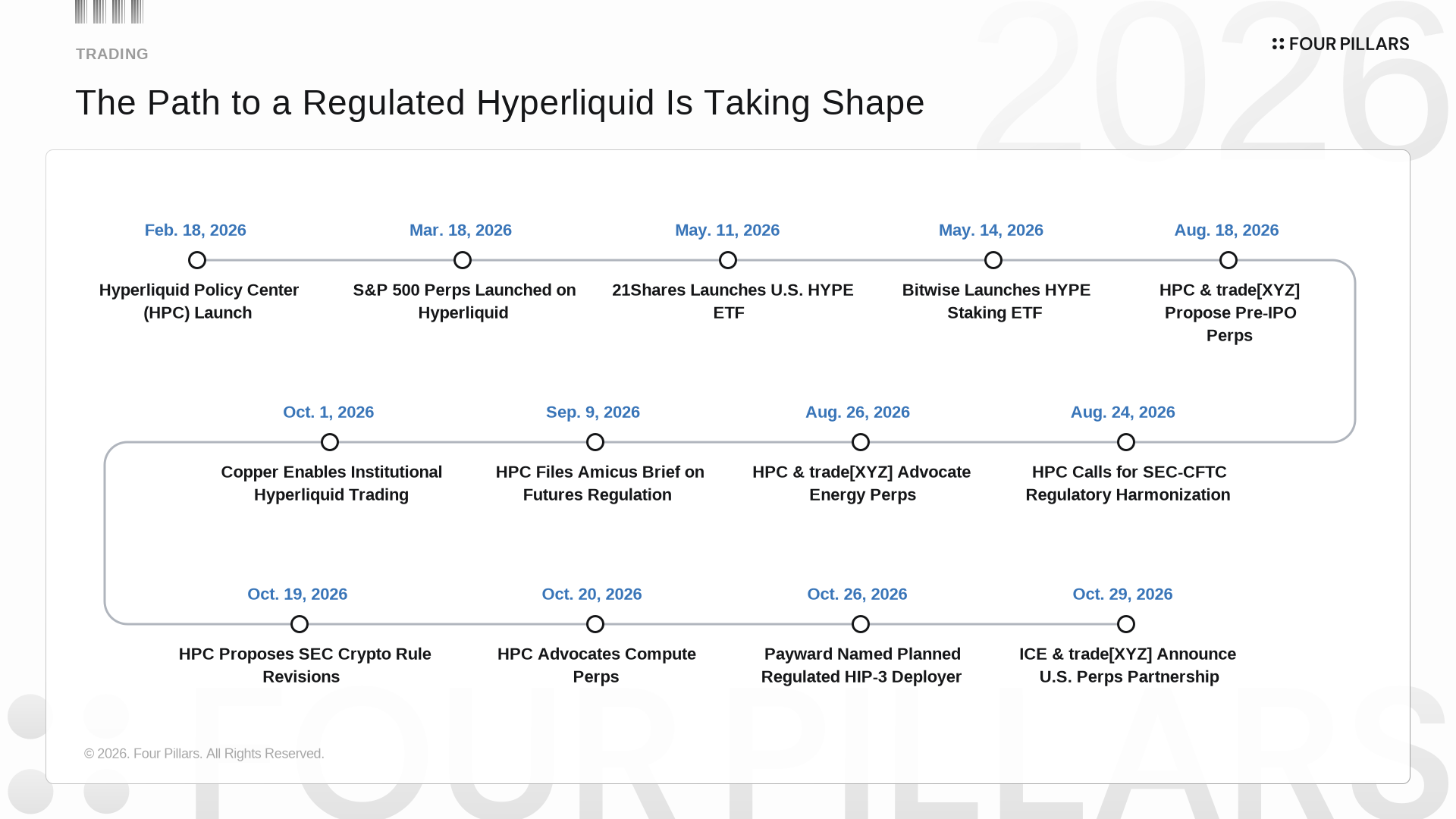
Throughout 2026, Hyperliquid accelerated its push toward U.S. regulatory boundaries. The establishment of an independent Hyperliquid policy center created dedicated policy channels for on-chain markets, while major asset management firms incorporated HYPE exposure into regulated U.S. ETF wrappers. Meanwhile, institutional infrastructure providers like Copper expanded professional access to Hyperliquid trading. Product development is also advancing in parallel. Trade[XYZ] launched the first formally authorized S&P 500 perpetual contract on Hyperliquid, while the policy center is pushing for clearer rules in the U.S. regarding pre-IPO, energy, computing power, and other perpetual markets. By the end of 2026, Payward announced plans to deploy a regulated HIP-3 market for U.S. customers, and ICE is collaborating with Trade[XYZ] to introduce a perpetual contract market based on Hyperliquid domestically. Overall, these developments indicate that Hyperliquid is gradually building a bridge connecting permissionless on-chain derivatives with regulated U.S. market infrastructure.
Predictive Market Trading Volume Grows 16 Times in a Year, Open Interest Grows Fivefold
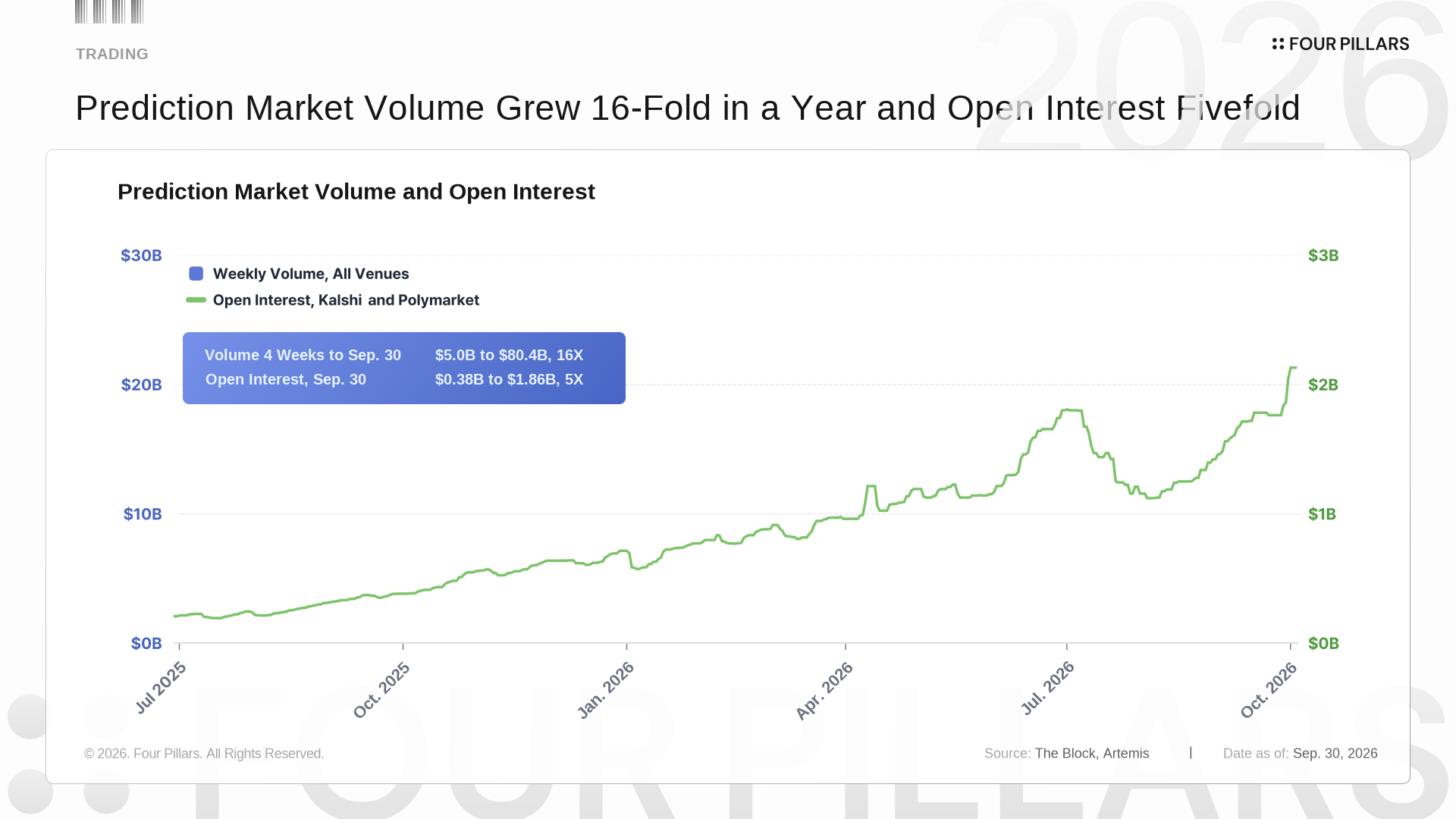
The Block, Artemis · As of September 30, 2026
In the four weeks ending September 30, 2026, predictive market trading volume grew 16 times to $80.4 billion, while open interest for Kalshi and Polymarket grew approximately fivefold to $1.86 billion. These figures measure the nominal value of contracts, with the cash-settled trading volume for both venues in September significantly lower at $18.1 billion. Institutional capital followed closely, with Kalshi and Polymarket raising funds at valuations of $22 billion and $21 billion, respectively. Distribution has also brought this category into mainstream brokerages, with Robinhood's event contract revenue reaching $156 million in the second quarter, surpassing its $100 million in cryptocurrency trading revenue. Predictive markets have become a meaningful business in retail financial services.
Quote: Ahmed Salih, Co-founder of OutcomeXYZ

Interview: Ahmed Salih
This year, predictive market trading volume grew 16 times, primarily driven by sports on Kalshi. Is sports the endgame or a stepping stone? How big can predictive markets ultimately get? Sports are a stepping stone: they have taught the general audience how event contracts work, which is why they are leading trading volume today. The greater demand lies in finance, where options and futures provide market makers with deep reference markets for hedging pricing. Bernstein expects predictive market trading volume to grow from approximately $410 billion this year to $10 trillion annually by 2035, with financial contracts accounting for 49%. At Outcome, crypto and asset price markets have accounted for about half of our trading volume. HIP-4 is built for this transition, as event contracts and the perpetual contracts, spot, and stock markets that traders use for hedging are all located within the same Hyperliquid account. ------ Ahmed Salih, Co-founder of OutcomeXYZ
Predictive Markets are Concentrating Around Kalshi
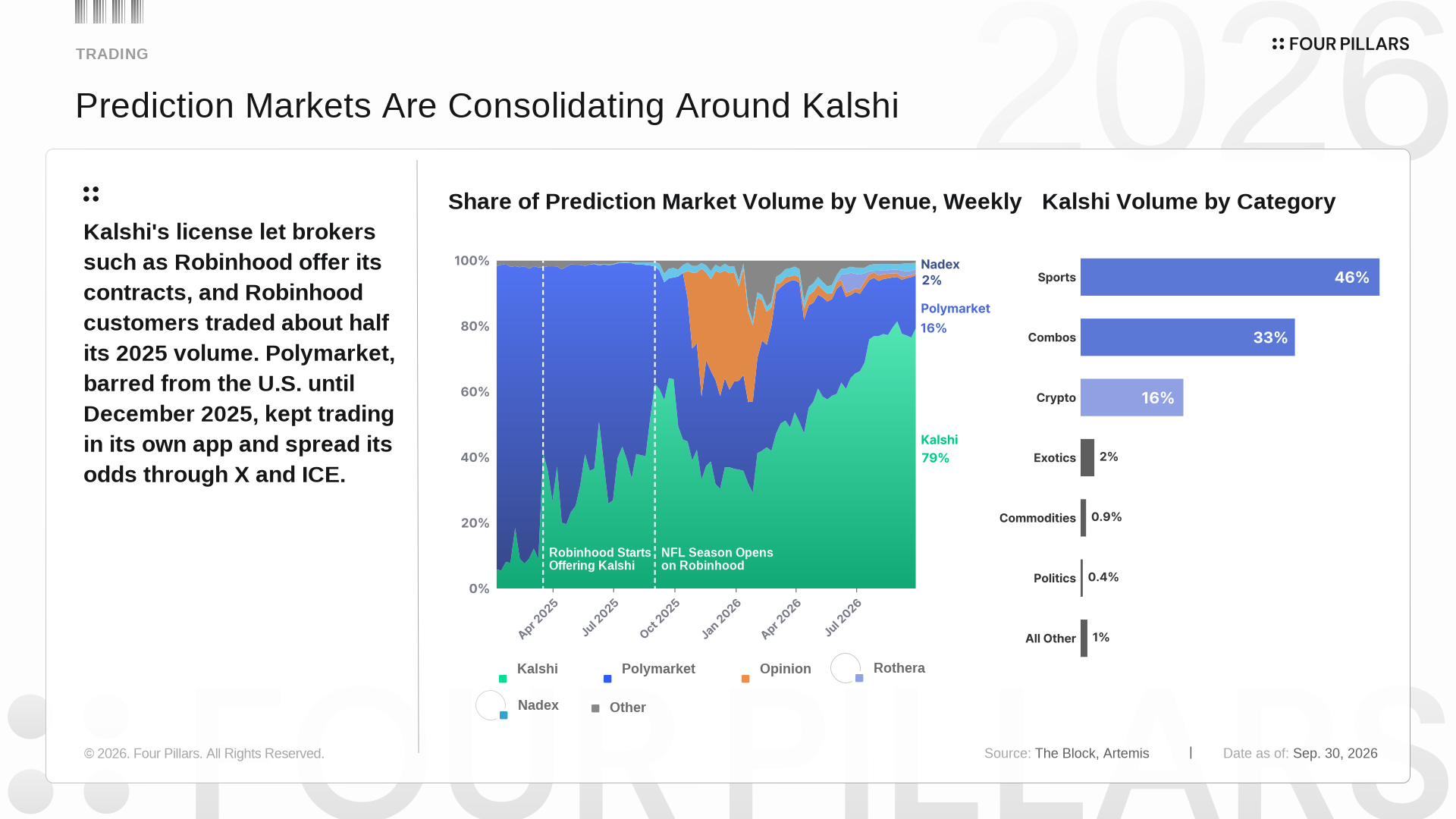
The Block, Artemis · As of September 30, 2026
By late September 2026, Kalshi accounted for 79% of the weekly trading volume in the prediction market, up from 6% in early 2025. Its expansion was partly driven by Robinhood, whose customers accounted for about half of Kalshi's trading volume in 2025, while growth was also seen through distribution by other brokerages. Polymarket did not gain access to the U.S. until December 2025, primarily relying on its own trading platform and partnerships for market data distribution. Sports accounted for 46% of Kalshi's trading volume in the third quarter, while multi-leg contracts contributed another 33%, increasing its exposure to ongoing state-level gambling disputes. Robinhood's investment in Rothera also changed the competitive landscape, giving Kalshi's main distributors their own exchange.
Trading venues no longer wait for new regulations but directly acquire licenses
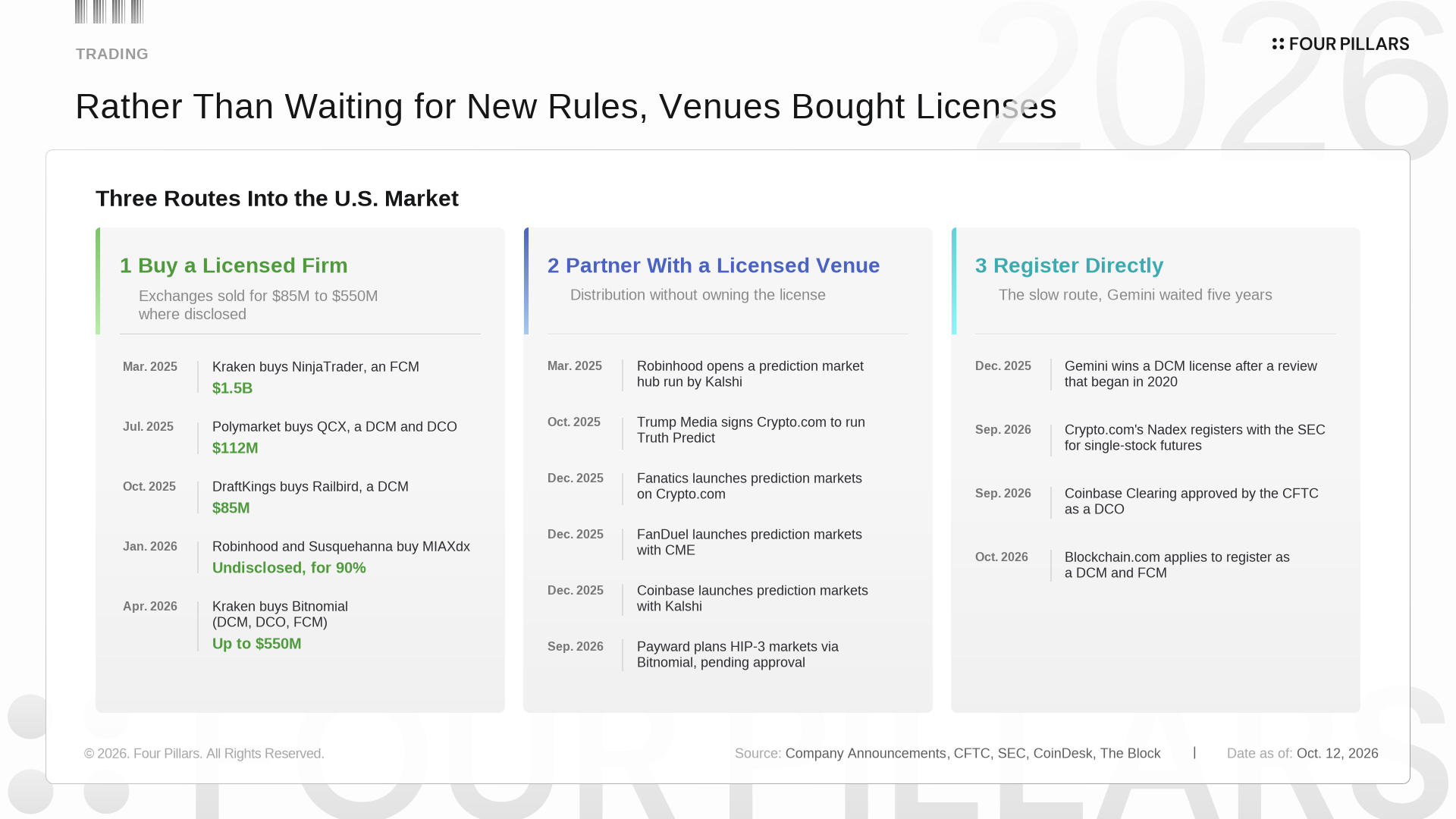
Company announcements, CFTC, SEC, CoinDesk, The Block · As of October 12, 2026
Three paths have emerged for entering the regulated U.S. derivatives market, led by the acquisition of licensed operators. Kraken, Polymarket, DraftKings, and Robinhood have all pursued acquisitions, with disclosed prices for designated exchanges ranging from $85 million to $550 million. These transactions illustrate the strategic value of regulatory authorization and the time required to obtain it. Other companies have entered through distribution agreements, including collaborations between Robinhood and Coinbase with Kalshi, as well as FanDuel with CME. Direct registration remains the slowest path, with Gemini obtaining its exchange license in December 2025 after a review that began in 2020. Regulatory access has become an important competitive asset, with existing licenses attracting significant acquisition capital.
The U.S. treats prediction markets as derivatives, while most other markets view them as gambling
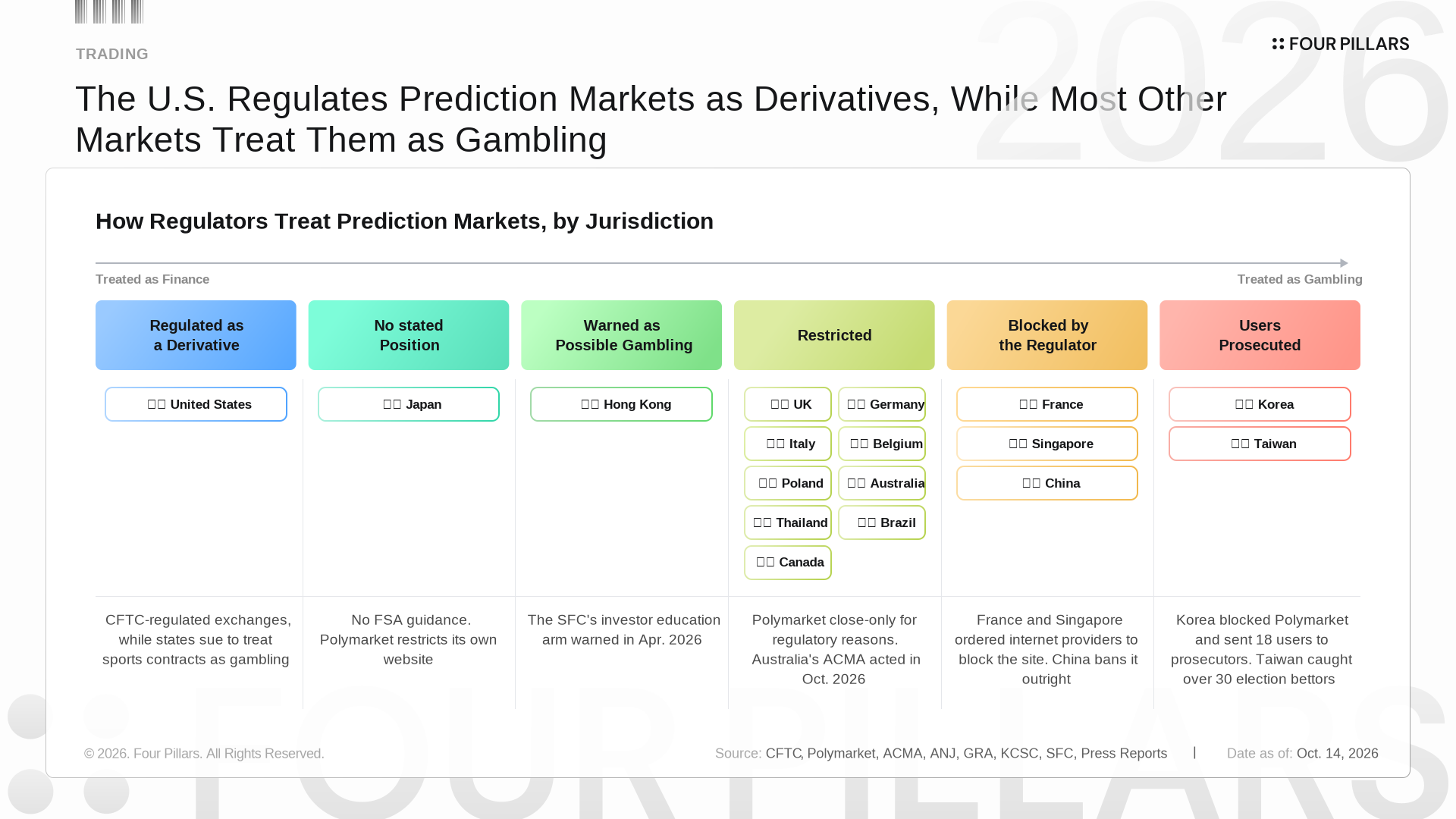
CFTC, Polymarket, ACMA, ANJ, GRA KCSC, SFC, news reports · As of October 14, 2026
Among the major jurisdictions we examined, the U.S. remains the only region that regulates prediction markets as financial derivatives, allowing Kalshi, Polymarket US, and Rothera to operate under CFTC oversight. Nevertheless, the status of sports contracts remains contentious, with conflicting rulings from federal appellate courts and ongoing state-level litigation. Most other jurisdictions impose gambling restrictions or outright ban these platforms. France and Singapore have ordered the blocking of Polymarket, while South Korea has restricted access and prosecuted users. Contracts driving growth in the U.S., particularly in the sports market, face the strictest limitations abroad. Thus, regulatory fragmentation poses substantial constraints on international expansion.
Quote: Chloe (Jungmyung) Lee, Partner at Bae, Kim & Lee LLC
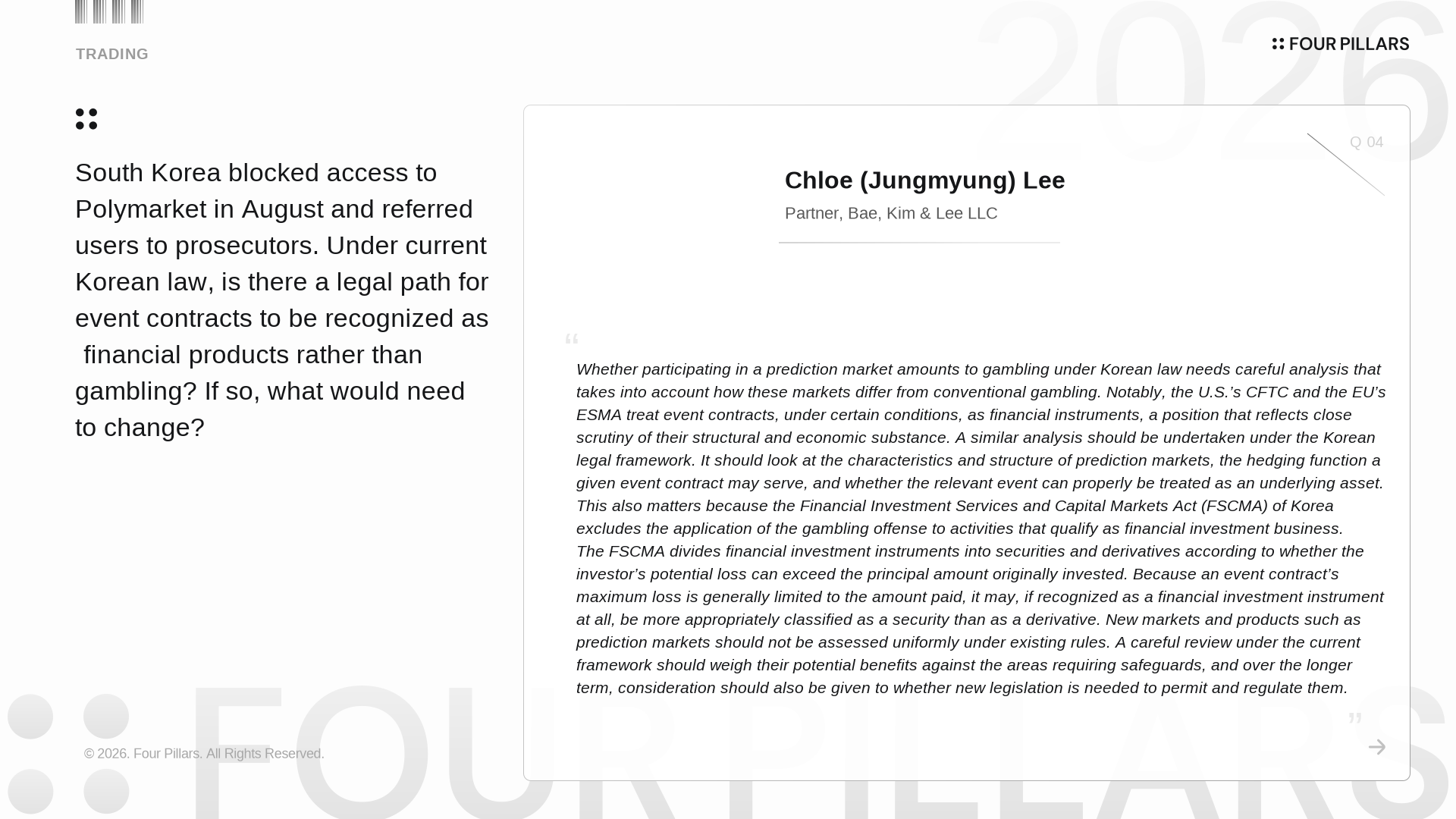
Interview: Chloe (Jungmyung) Lee
In August, South Korea blocked access to Polymarket and referred users to prosecutors. Under current South Korean law, is there a legal pathway for event contracts to be recognized as financial products rather than gambling? If so, what needs to change? Under South Korean law, whether participating in prediction markets constitutes gambling requires careful analysis, considering the differences between these markets and traditional gambling. Notably, the CFTC in the U.S. and ESMA in the EU view event contracts as financial instruments under certain conditions, reflecting a rigorous examination of their structure and economic substance. A similar analysis should be conducted under South Korean legal frameworks. It should examine the characteristics and structure of prediction markets, the hedging functions that specific event contracts may serve, and whether the relevant events can be appropriately viewed as underlying assets. This is important because the Financial Investment Services and Capital Markets Act (FSCMA) in South Korea excludes gambling offenses from activities that meet the conditions for financial investment business. The FSCMA categorizes financial investment tools into securities and derivatives based on whether potential losses to investors may exceed the initial principal invested. Since the maximum loss for event contracts is typically limited to the amount paid, if they are indeed recognized as financial investment tools, classifying them as securities may be more appropriate than as derivatives. New markets and products like prediction markets should not be assessed with a one-size-fits-all approach under existing rules. A prudent review under the current framework should weigh their potential benefits against the areas that need protection, and in the long run, consider whether new legislation is needed to allow and regulate them. ------ Chloe (Jungmyung) Lee, Partner at Bae, Kim & Lee LLC
On-chain trading is shifting towards mobile applications, and applications are becoming social networks
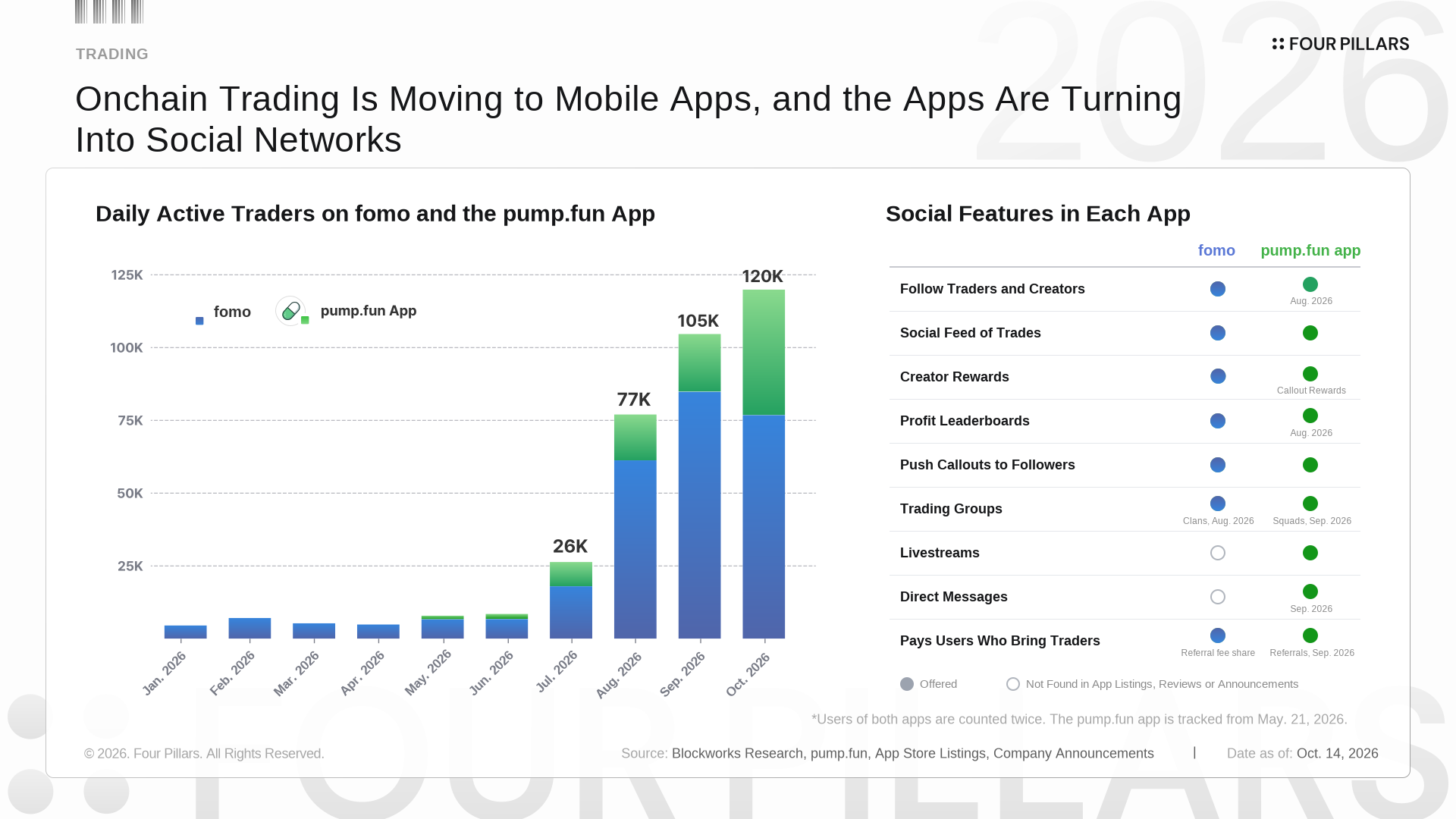
Blockworks Research, pump.fun, app store listings, company announcements · As of October 14, 2026
The daily active traders of the fomo and pump.fun mobile applications increased from about 4,600 in January to 105,000 in September, with a peak average of 134,000 on October 7. fomo's monthly net revenue reached $29.2 million in September, while pump.fun's mobile trading volume soared to $881 million. Both platforms have introduced social dynamics, leaderboards, trading groups, and referral incentives aimed at turning active traders into distribution channels. fomo has paid $6.5 million to referrers, while pump.fun reportedly offers financial incentives to attract top traders from competing platforms. Activity has eased after peaking in October, but competition is extending from execution quality to the communities built around individual traders.
Quote: Ren Yu Kong, Growth Director at fomo

Interview: Ren Yu Kong
fomo has grown from about 1,000 daily active traders to over 100,000 in a year. Why has social trading risen so rapidly? What will trading applications look like in three years? Social trading solves the discovery problem, and in financial markets, discovery is always achieved through people. A fully transparent financial social graph like fomo helps people answer what to buy, who is holding, for what reasons, and allows users to build identities and followers around their financial views, share arguments, create personal brands, and profit from them. In three years, we believe fomo will not only become one of the largest trading applications but also one of the largest social applications. Trading applications will resemble today’s open social networks, and public social trading will become the norm. ------ Ren Yu Kong, Growth Director at fomo
Trading becomes content, and traders become the new generation of opinion leaders
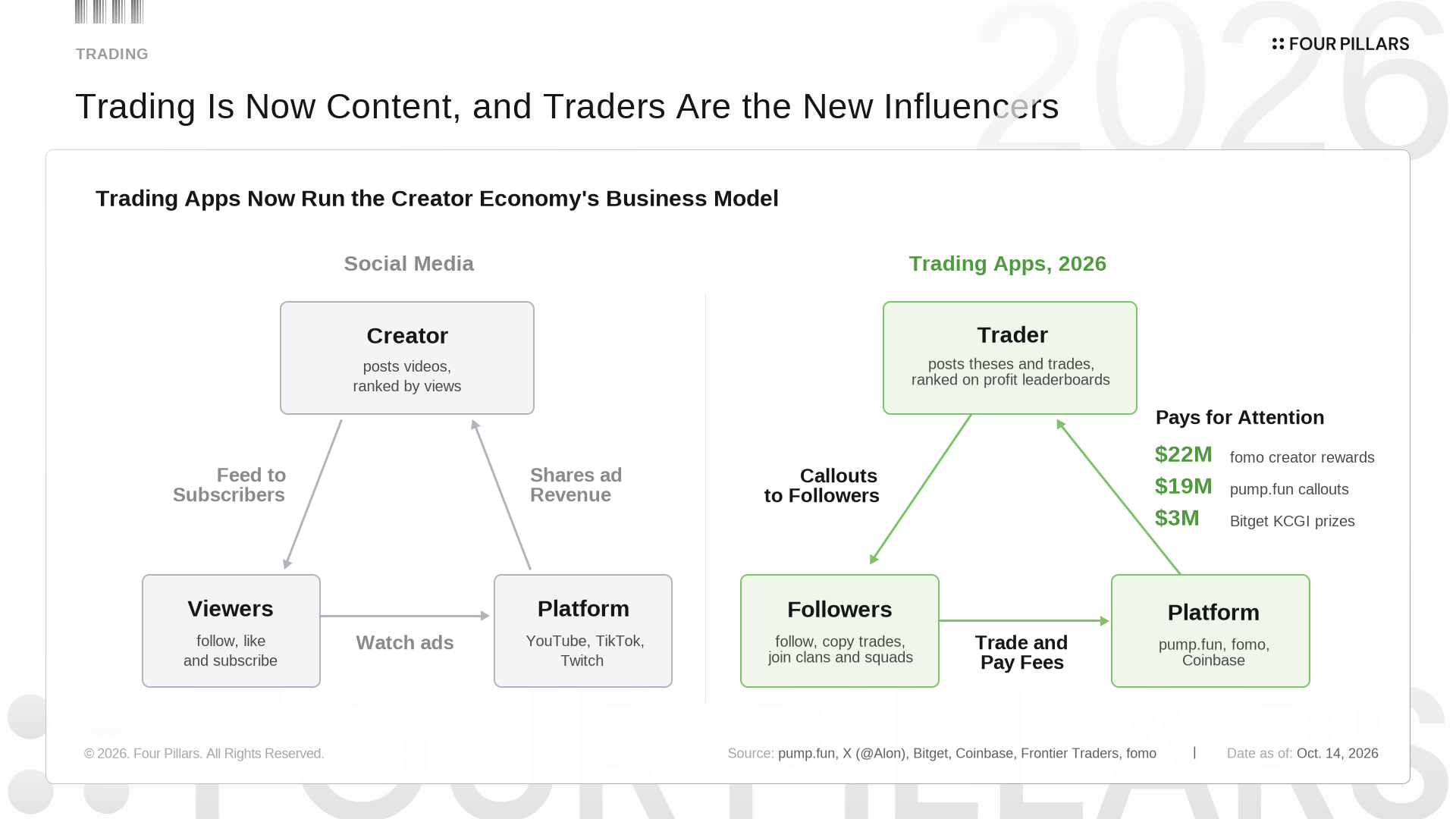
pump.fun, X (@Alon), Bitget, Coinbase, Frontier Traders, FOMO · As of October 14, 2026
Trading platforms are adopting the economic models of social media, rewarding traders who attract followers and generate trading fees through content. pump.fun paid out $19 million through its shout-out reward program within two months, although concerns about trading volume-driven junk content prompted the platform to shift towards rewarding profitable follower activities. Competitive trading has also become a form of entertainment. Bitget's KCGI attracted 83,529 participants competing for a $3 million USDT prize pool, while Coinbase, Frontier Traders, and pump.fun launched live or in-app competitions. These formats create new channels for customer acquisition, but when followers invest based on the content promoted by compensated content creators, incentive design becomes crucial.
Every major trading venue is building the same super app
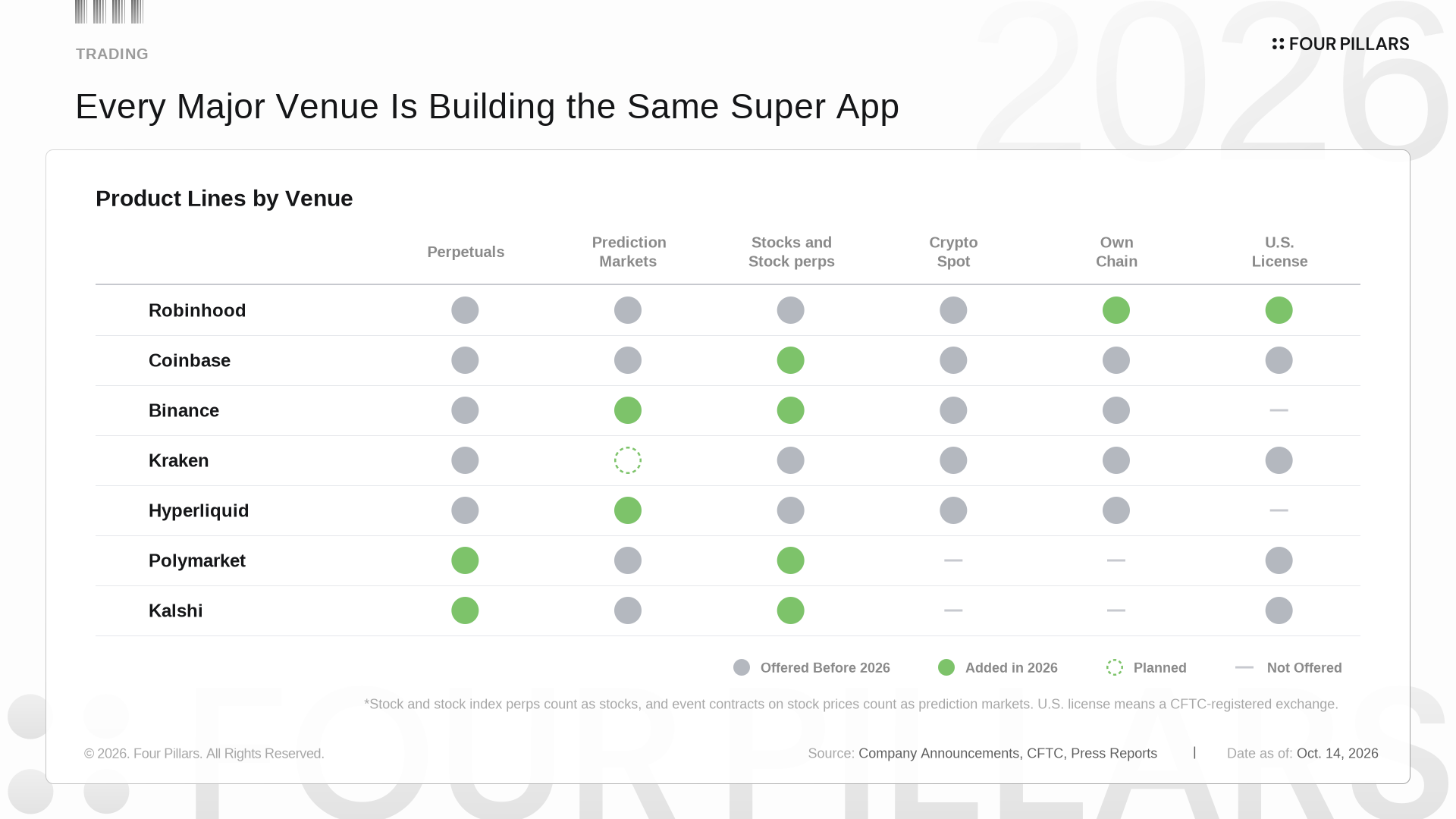
Company announcements, CFTC, news reports · As of October 14, 2026
Product offerings are converging between perpetual contract futures, prediction markets, stocks, spot crypto, and integrated blockchain infrastructure. Robinhood and Coinbase now cover all six capabilities tracked in our comparison, while Binance, Kraken, and Hyperliquid cover five. Six of the seven major venues added a product line in 2026, with exchanges entering traditional assets and brokerages expanding into crypto derivatives and prediction markets. The common goal is to integrate trading activities into a funded account. As product coverage becomes more comparable, existing customer relationships and balance control will carry greater competitive value. We anticipate that the next phase of competition will revolve around distribution, customer retention, and the economic benefits of integrated trading accounts.
Quote: Noel Chan, Senior Director of Business Development and Strategic Partnerships at MetaMask
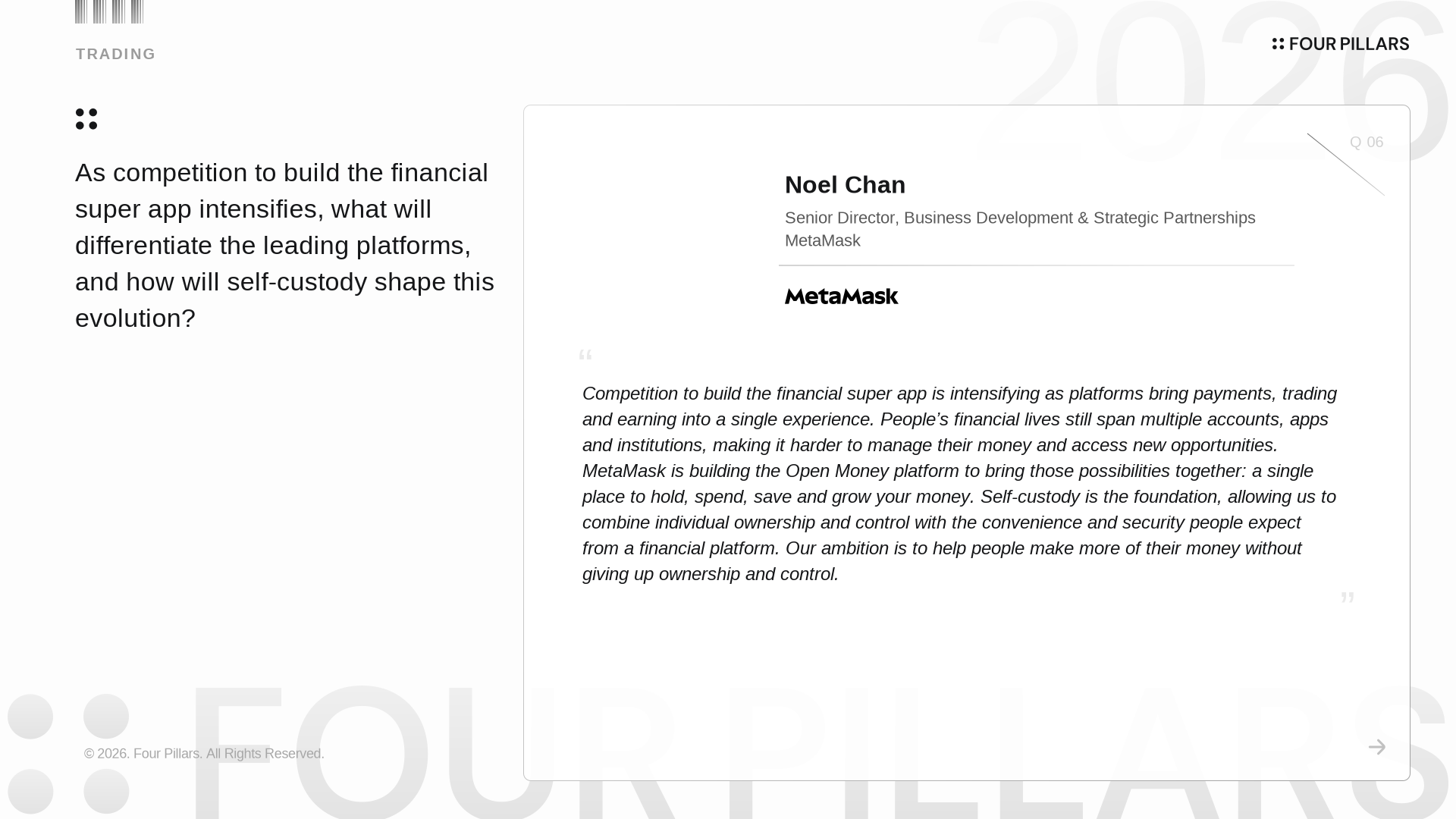
Interview: Noel Chan
As competition to build financial super apps intensifies, what will make leading platforms stand out? How will self-custody shape this evolution? As platforms integrate payments, trading, and earning into a single experience, the competition to build financial super apps is intensifying. People's financial lives still span multiple accounts, apps, and institutions, making it more difficult to manage funds and access new opportunities. MetaMask is building the Open Money platform, bringing these possibilities together: a place to hold, spend, save, and grow funds. Self-custody is fundamental, enabling us to combine personal ownership and control with the convenience and security that people expect from financial platforms. Our ambition is to help people make better use of their funds while not giving up ownership and control. ------ Noel Chan, Senior Director of Business Development and Strategic Partnerships at MetaMask
Asia is Not a Single Market
To what extent have regulations and capital progressed in South Korea, Japan, Hong Kong, and Singapore?
Asian Stablecoins Rapidly Grow by 2026, but Still Far Behind Their Currency Share
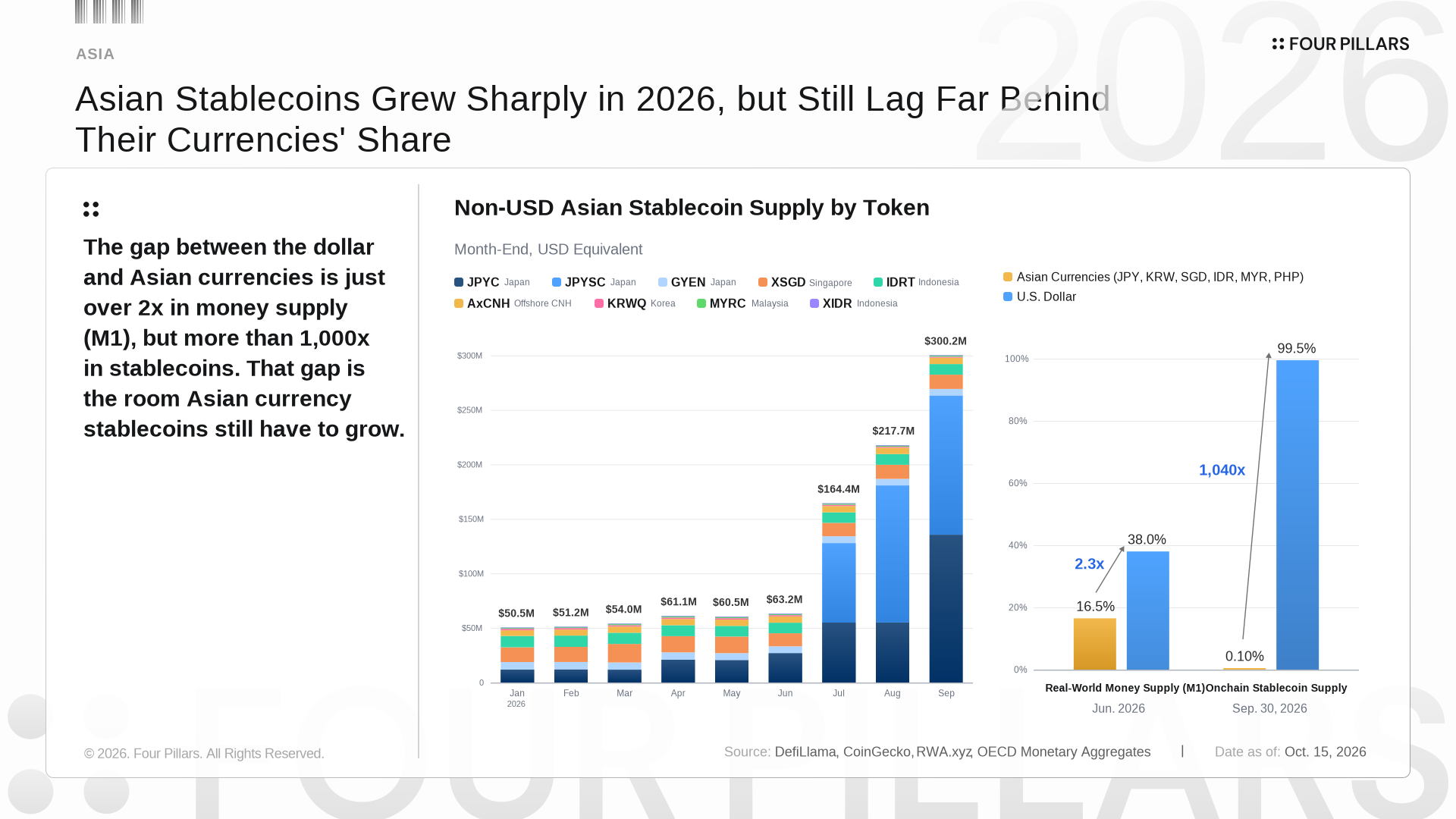
DefiLlama, CoinGecko, rwa.xyz, OECD Monetary Aggregates · As of October 15, 2026
The market capitalization of Asian currency stablecoins grew nearly sixfold by 2026, from about $50.5 million in January to about $300 million in September. The market hovered around $6,000 in the first half of the year until it began to shift in the second half with new issuances concentrated in Japan. As of September, JPYC and JPYSC accounted for about 88% of the total.
Quote: Hangil Lee, Manager of Digital Asset Business at Kakaobank
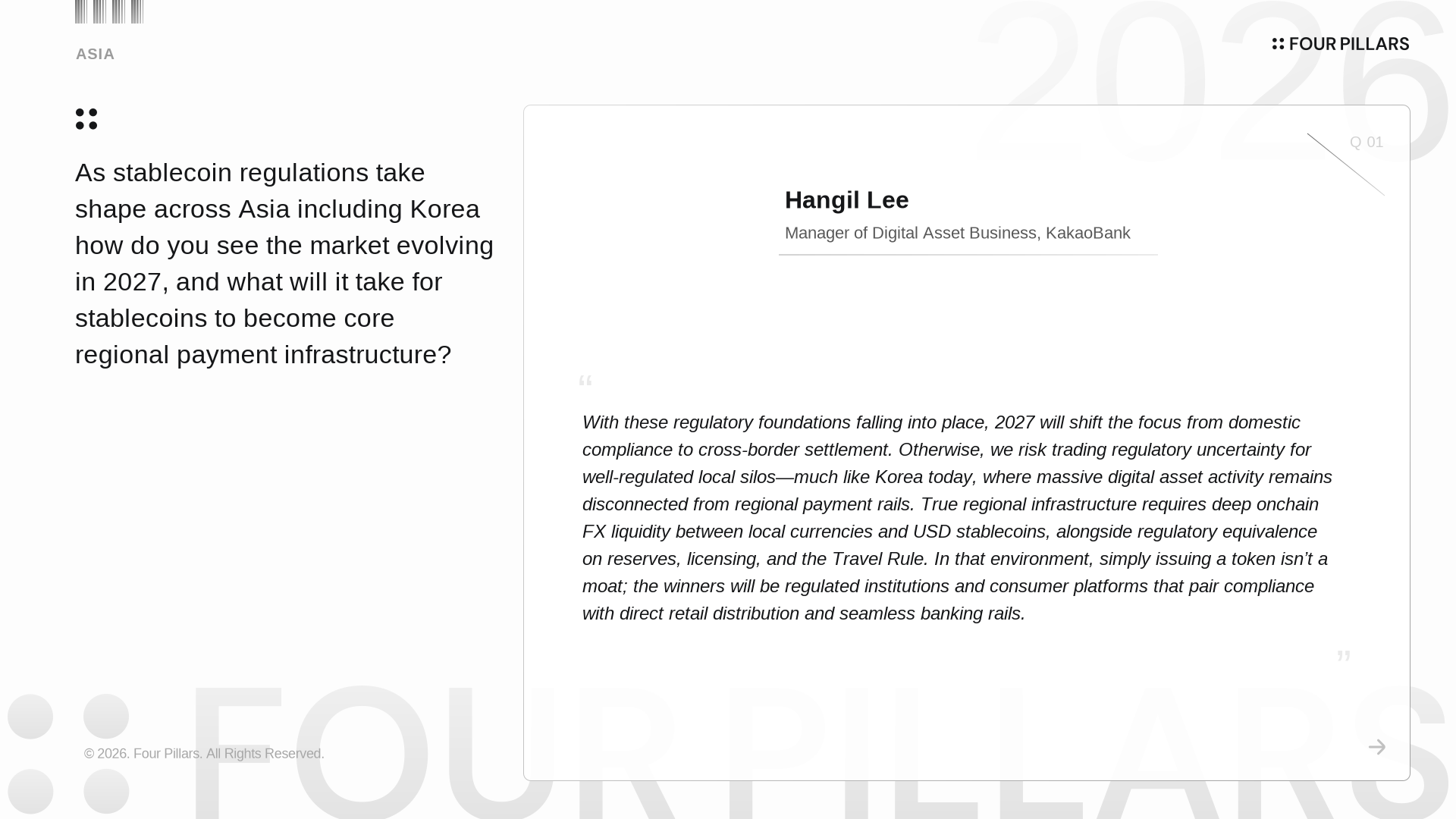
Interview: Hangil Lee, Manager of Digital Asset Business at Kakaobank
As stablecoin regulations gradually take shape across Asia, including South Korea, how do you view the market evolution in 2027? What conditions must stablecoins meet to become the core payment infrastructure in the region? As these regulatory foundations are gradually put in place, the focus in 2027 will shift from domestic compliance to cross-border settlement. Otherwise, we risk exchanging regulatory uncertainty for well-regulated local isolated markets—just like today's South Korea, where substantial digital asset activity remains disconnected from regional payment rails. True regional infrastructure needs to establish deep on-chain foreign exchange liquidity between local currencies and dollar stablecoins while achieving regulatory equivalence in reserves, licensing, and travel rules. In such an environment, merely issuing tokens is not a moat; the winners will be regulated institutions and consumer platforms that combine compliance with direct retail distribution and seamless banking rails. ------ Hangil Lee, Manager of Digital Asset Business at Kakaobank
Asian Government Bonds Account for Less Than 1% of Tokenized Government Debt
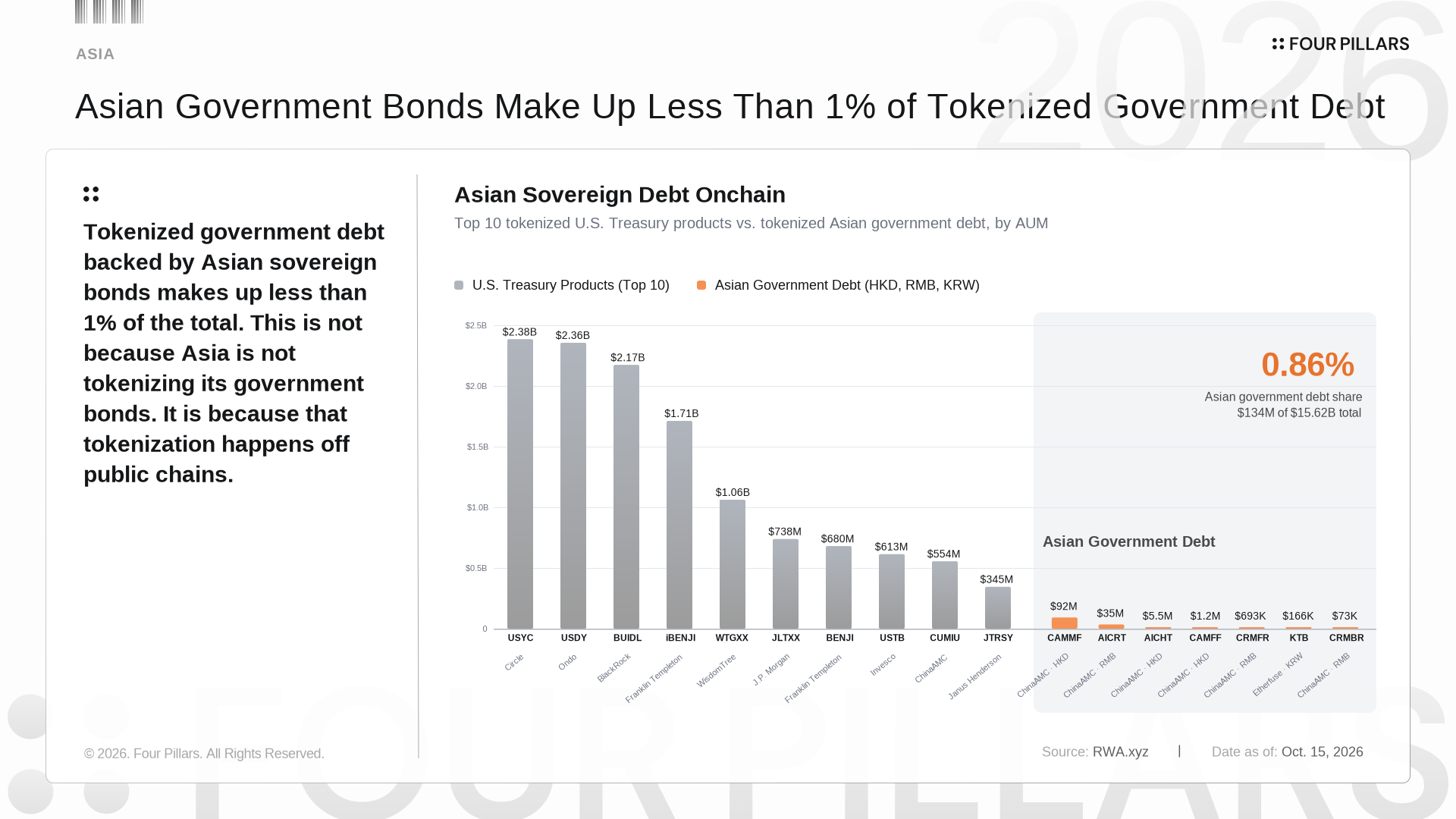
rwa.xyz · As of October 15, 2026
The market for tokenized government debt on public chains has grown to about $15.6 billion, but dollar assets account for over 99% of this. The top ten products, including Circle's USYC, Ondo's USDY, and BlackRock's BUIDL, are all backed by U.S. Treasury bonds. Products backed by Asian government bonds total only about $13.45 million, accounting for 0.86% of the market. Even the few Asian products are primarily Hong Kong dollar and Renminbi funds issued by the Chinese asset management company Huaxia Fund. Aside from that, there is only a small Korean government bond product from Etherfuse. Furthermore, Huaxia Fund's largest product is a dollar fund (CUMIU), which alone is about four times the size of all Asian products combined. Overall, on-chain investors are only looking at U.S. Treasury yields, while Asian asset management companies are following this demand.
Asia is Tokenizing Government Bonds on Sovereign Ledgers and Central Bank Settlement Rails, Not Public Chains
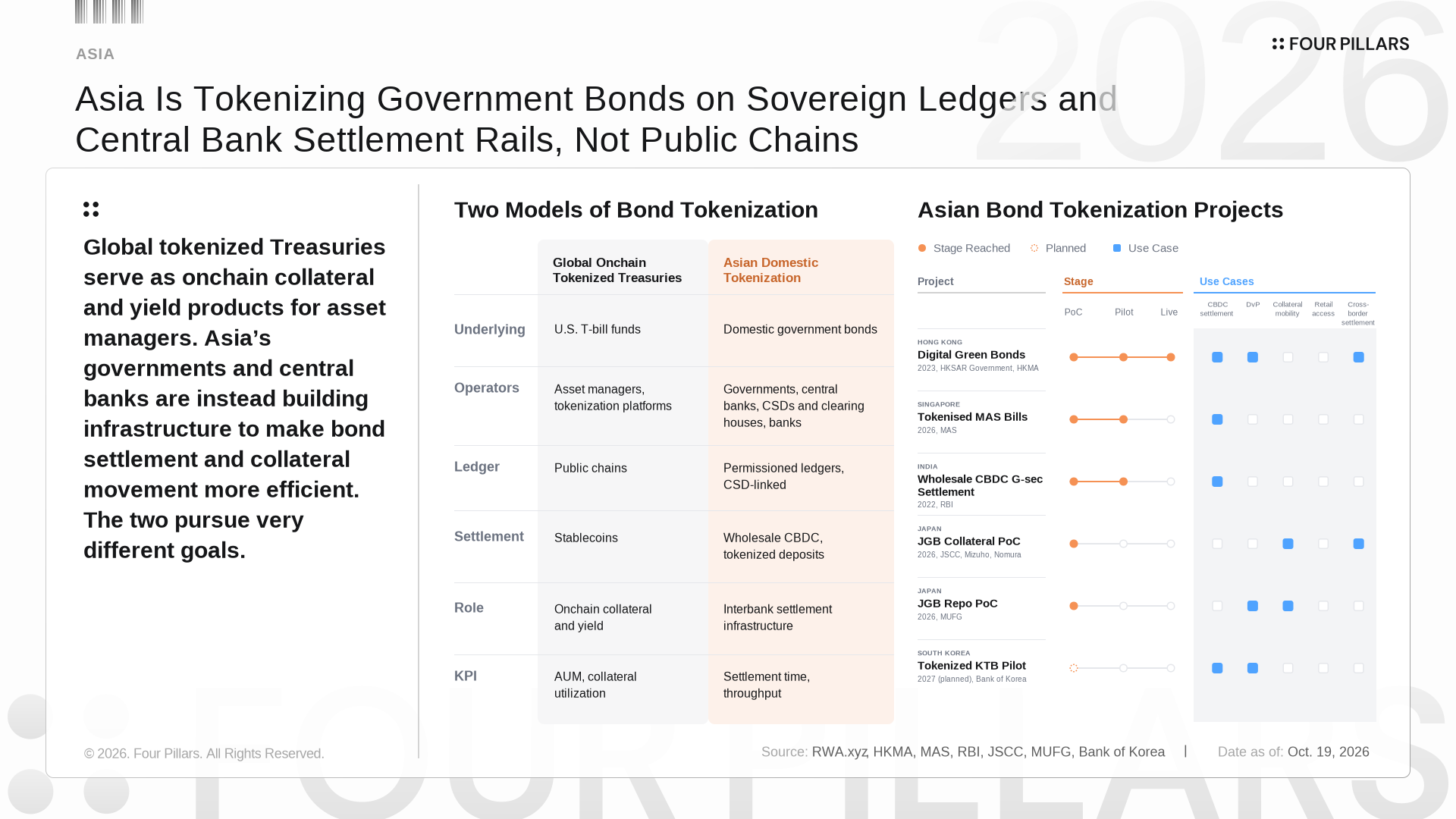
Project announcements, central bank publications · As of October 15, 2026
Tokenized government debt in Asia is virtually insignificant on-chain, but it is incorrect to conclude that Asia has a negative attitude towards bond tokenization based solely on this figure. In Asia, bond tokenization often occurs on permissioned ledgers operated by governments and central banks, with these transactions not visible on public chains. A different metric is needed to see how far bond tokenization has actually progressed in the region.
Quote: Aaron Gwak, Founder and CEO at Libeara
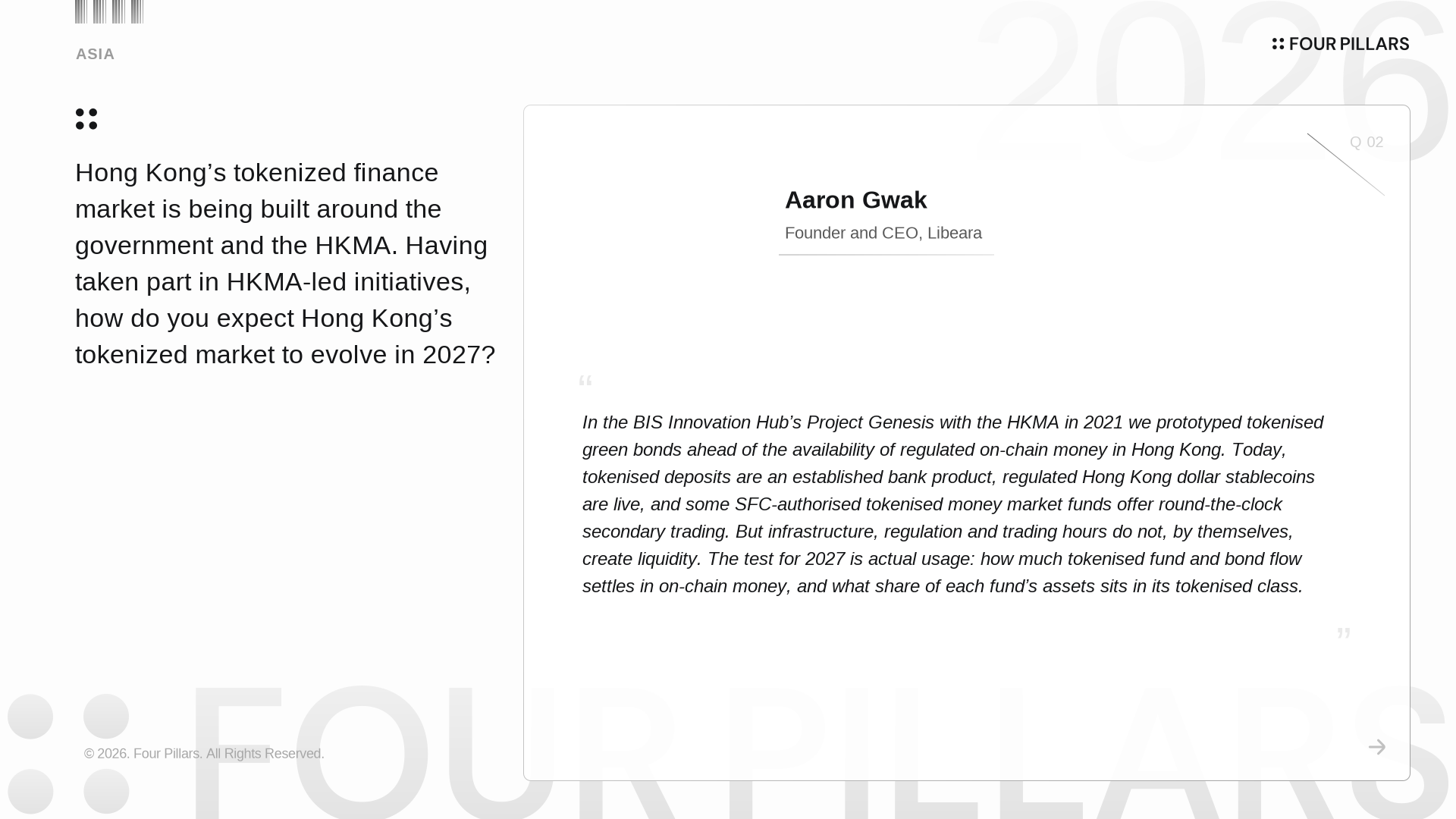
Interview: Aaron Gwak, Founder and CEO at Libeara
The tokenized financial market in Hong Kong is being built around the government and the Hong Kong Monetary Authority (HKMA). Given your involvement in HKMA-led initiatives, how do you expect the tokenized market in Hong Kong to evolve by 2027? In the Genesis project, a collaboration between the Bank for International Settlements Innovation Hub and HKMA in 2021, we prototyped tokenized green bonds before regulated on-chain currency appeared in Hong Kong. Today, tokenized deposits are mature banking products, regulated Hong Kong dollar stablecoins have been launched, and some tokenized money market funds authorized by the Hong Kong Securities and Futures Commission offer around-the-clock secondary trading. However, infrastructure, regulation, and trading times alone cannot create liquidity. The test in 2027 will be actual usage: how much flow of tokenized funds and bonds is settled in on-chain currency, and what proportion of assets in each fund is in its tokenized share class. ------ Aaron Gwak, Founder and CEO at Libeara
Quote: Xiao Xiao, Partner at HashKey Capital
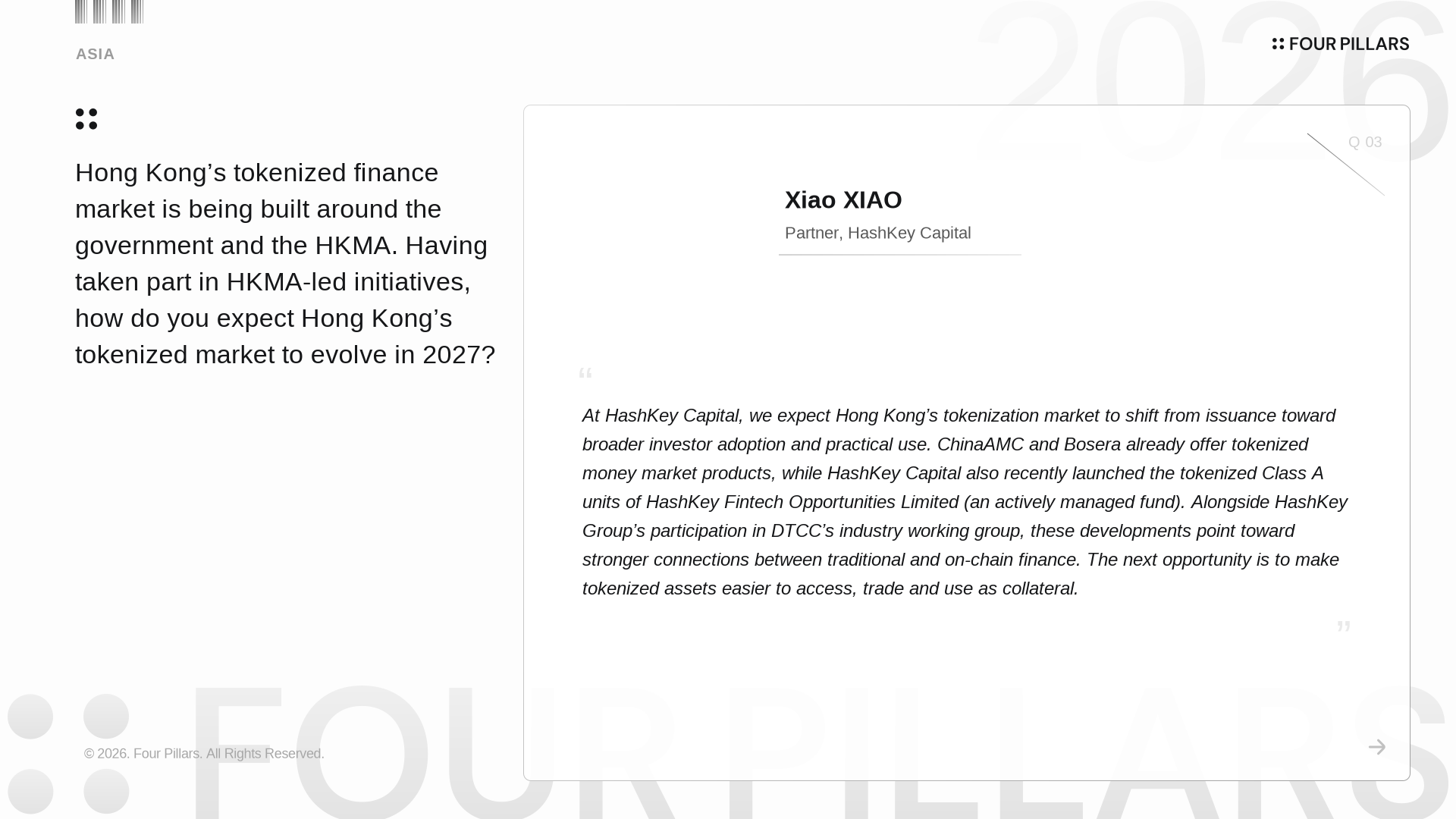
Interview: Xiao Xiao, Partner at HashKey Capital
The tokenized financial market in Hong Kong is being built around the government and the Hong Kong Monetary Authority (HKMA). Given your involvement in HKMA-led initiatives, how do you expect the tokenized market in Hong Kong to evolve by 2027? At HashKey Capital, we expect the tokenized market in Hong Kong to shift from issuance to broader investor adoption and practical application. Huaxia Fund and Bosera Fund have provided tokenized money market products, and HashKey Capital recently launched the tokenized Class A shares of HashKey Fintech Opportunities Limited (a actively managed fund). Together with HashKey Group's participation in the DTCC industry working group, these developments point to a stronger connection between traditional finance and on-chain finance. The next opportunity is to make tokenized assets easier to access, trade, and use as collateral. ------ Xiao Xiao, Partner at HashKey Capital
Progress in Asian Regulations in 2026 Varies by Country
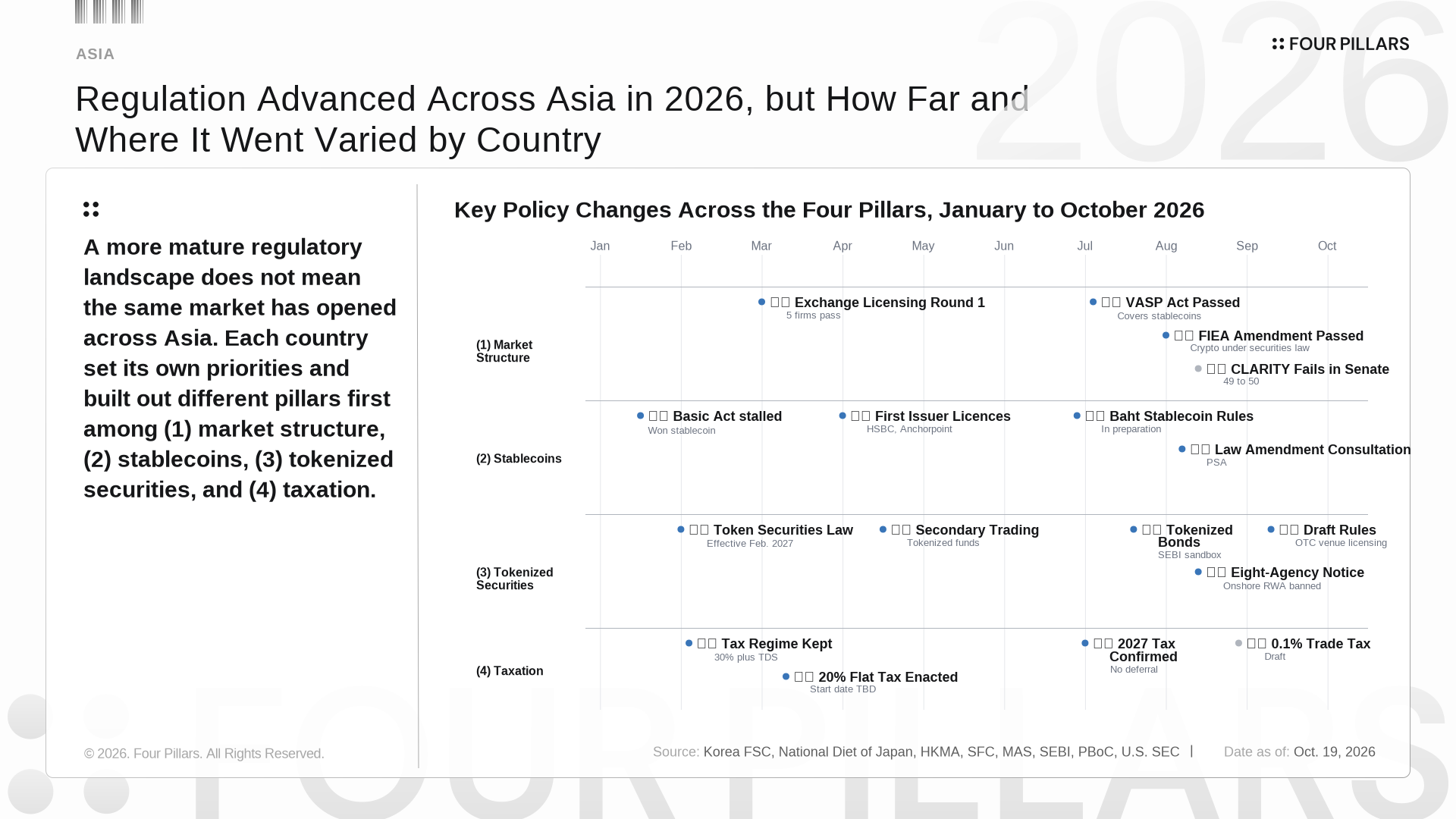
Korea FSC, National Diet of Japan, HKMA, SFC, MAS, SEBI, PBoC, U.S. SEC · As of October 19, 2026
2026 has been a year of significant progress in Asian regulations. Five regulatory agencies in the UAE finalized all rules in January, and Hong Kong issued its first stablecoin issuance licenses in April. Japan revised its tokenized securities laws, and in September, the Monetary Authority of Singapore (MAS) released a proposed amendment to the Payment Services Act to establish stablecoin issuance licenses. South Korea has also begun to open the market to corporate participation while debating its Digital Asset Basic Act.
Quote: Hyobong Kim, Partner at Bae, Kim and Lee LLC
Interview: Hyobong Kim, Partner at Bae, Kim and Lee LLC
The tokenized securities framework in South Korea and other Asian jurisdictions seems designed around closed markets limited to domestic investors and infrastructure. What limitations might arise from that? In what direction do you think these frameworks should evolve? Although tokenization has the potential to transform global capital markets, the regulatory frameworks in South Korea and other Asian jurisdictions still primarily focus on domestic investors and infrastructure. This fragmented approach may limit market liquidity, restrict cross-border investment, and undermine the benefits of tokenization. Rather than mandating a single ledger structure or imposing restrictive technical requirements, a principle-based, technology-neutral approach would be preferable. For example, public blockchains could be allowed under appropriate safeguards (such as whitelisting and transfer restrictions). To fully realize the benefits of tokenization, regulators should also consider allowing the use of stablecoins for on-chain settlements and seek greater consistency in regulatory standards among major jurisdictions. ------ Hyobong Kim, Partner at Bae, Kim and Lee LLC
Only Two of the 25 Asian Markets Fully Implement Four Policy Pillars
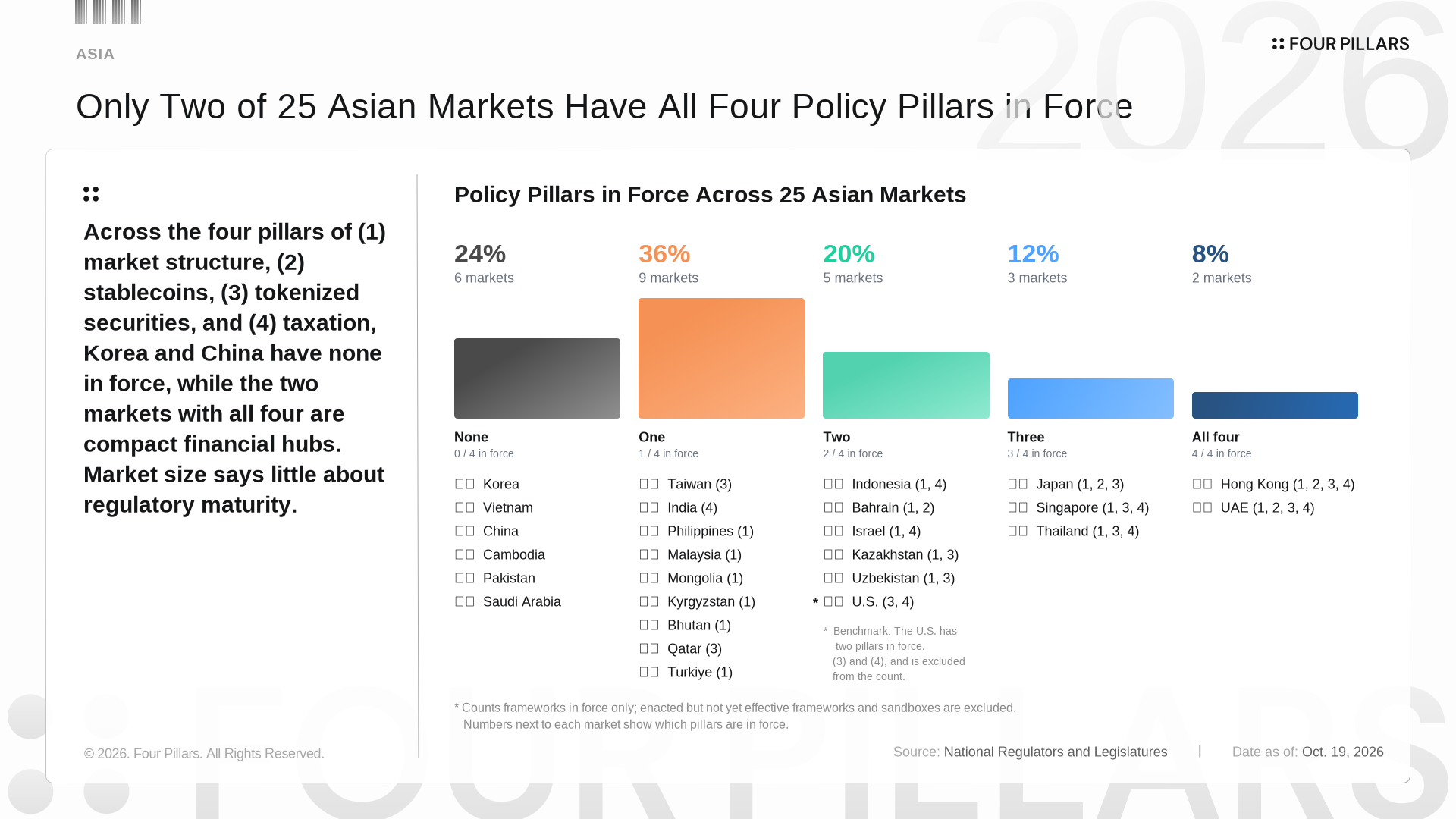
National Regulators and Legislatures · As of October 19, 2026
In 25 Asian markets, only Hong Kong and the UAE have all four pillars in effect: (1) market structure, (2) stablecoins, (3) tokenized securities, (4) taxation. Japan, Singapore, and Thailand have three pillars in place, while five markets, including Indonesia and Bahrain, have two. The largest group consists of markets with only one pillar in effect, totaling nine, while six markets, including South Korea, China, and Vietnam, have none. A large market does not necessarily mean advanced regulation. South Korea ranks among the top globally in terms of crypto trading volume, and China is a massive economy, yet neither has any pillars in effect. This distribution is precisely why Asia cannot be treated as a single entity. Markets with all four pillars coexist with those with none, and the open pillars also vary by market. Entry strategies must begin by verifying which rules are genuinely in effect on a country-by-country basis.
Quote: Mirae Asset Securities, Digital Asset Business Department
Interview: Mirae Asset Securities, Digital Asset Business Department
The securities token framework in South Korea will come into effect in 2027. How do you expect the tokenization of financial products in South Korea to unfold? Where are the opportunities? 2027 will mark the beginning of financial asset tokenization in South Korea, with tokenized securities starting to gain a foothold. Next year may be a small-scale trial period, but the direction is clear. The value of tokenization lies not in the issuance itself but in the higher capital efficiency that blockchain technology can achieve. Tokenized securities can be transferred in real-time, and returns are calculated based on the actual holding period rather than daily increments. This allows investors who buy or sell within the day to receive returns corresponding to the time they held the asset. Tokenization can also expand the use of securities as collateral and ultimately enable their cross-border transfer. 2027 will be a foundational year for these applications, led by securities firms that combine issuance capabilities, liquidity, global coverage, and blockchain expertise. ------ Mirae Asset Securities, Digital Asset Business Department
Institutional Adoption and Stablecoins Defined Asia in 2026
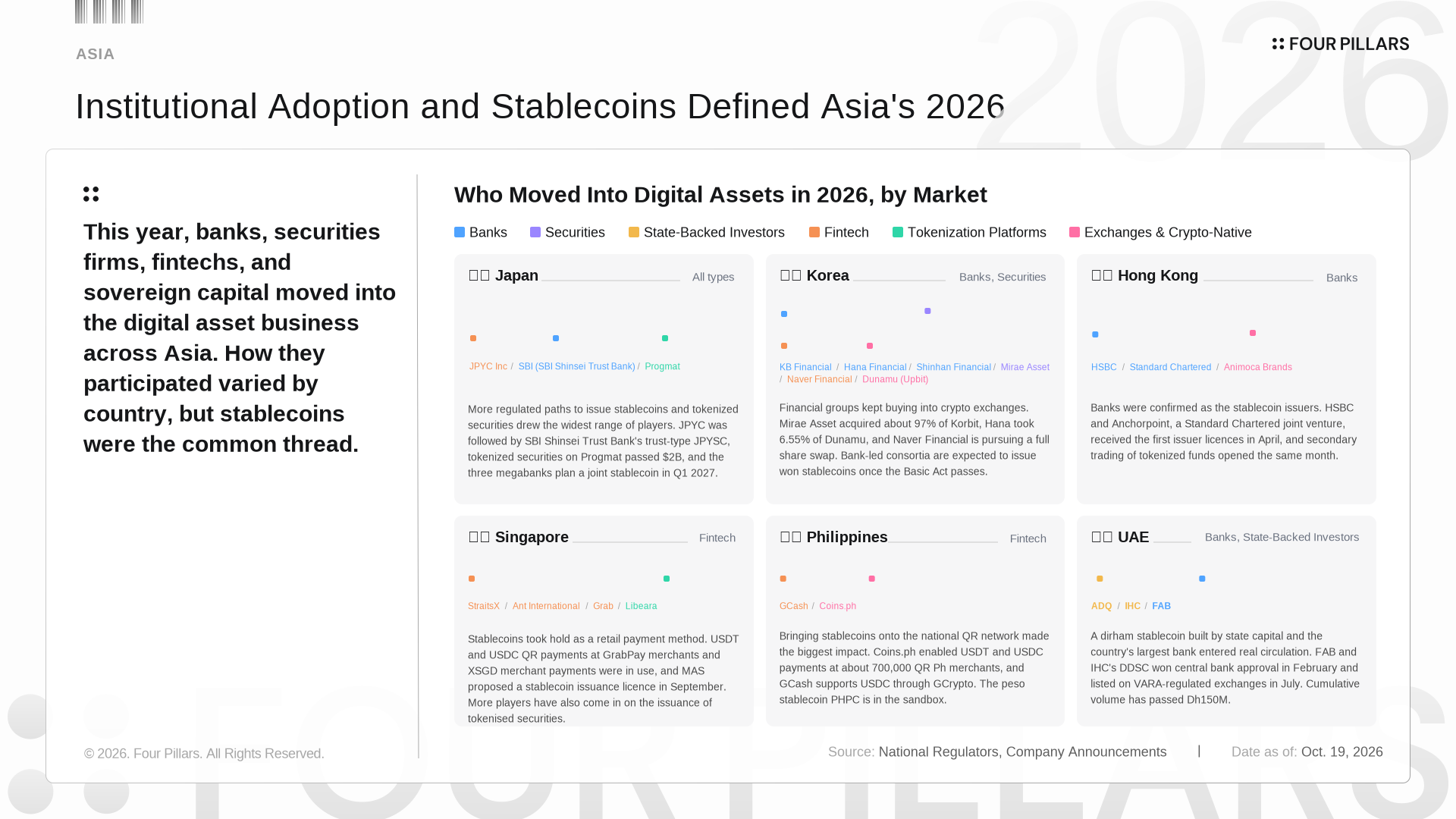
National regulators, Company Announcements · As of October 19, 2026
This year, a wide range of institutions, from banks and securities firms to fintech companies and sovereign capital, have entered the digital asset business in major Asian markets.
Quote: Alex Lim, Head of APAC at LayerZero
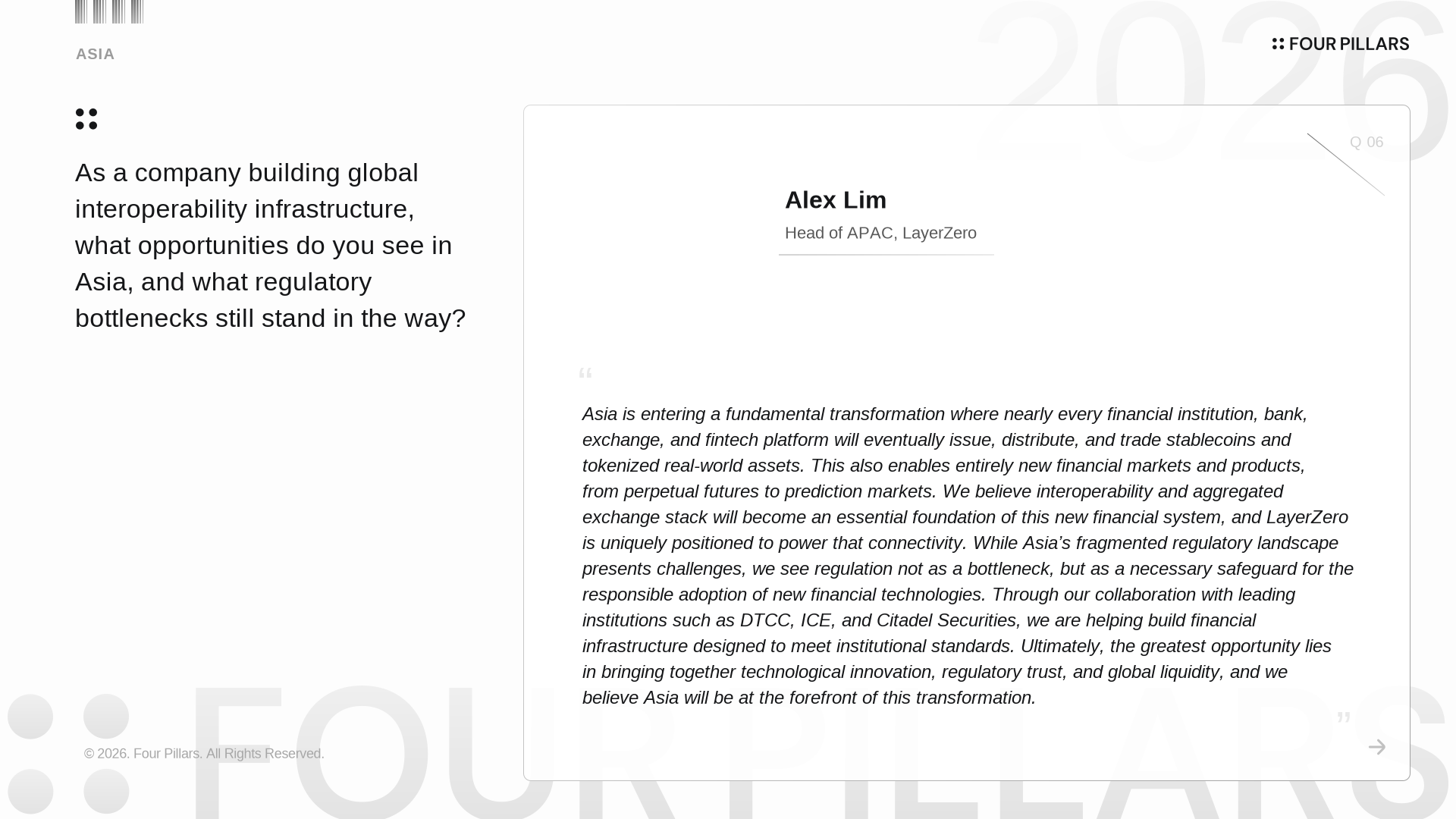
Interview: Alex Lim, Head of APAC at LayerZero
As a company building global interoperability infrastructure, what opportunities do you see in Asia? What regulatory bottlenecks lie ahead? Asia is entering a fundamental transformation, where almost every financial institution, bank, exchange, and fintech platform will eventually issue, distribute, and trade stablecoins and tokenized real-world assets. This has also given rise to entirely new financial markets and products, from perpetual contract futures to prediction markets. We believe that interoperability and an aggregated exchange tech stack will become a crucial foundation for this new financial system, and LayerZero has a unique advantage in supporting this connectivity. Despite the challenges posed by Asia's fragmented regulatory landscape, we do not view regulation as a bottleneck but as a necessary safeguard for the responsible adoption of new technologies. By collaborating with leading institutions like DTCC, ICE, and Citadel Securities, we are helping to build financial infrastructure that meets institutional standards. Ultimately, the biggest opportunity lies in bringing together technological innovation, regulatory trust, and global liquidity, and we believe Asia will be at the forefront of this transformation. ------ Alex Lim, Head of APAC at LayerZero
South Korean Retail Investors React Immediately to Market Sentiment
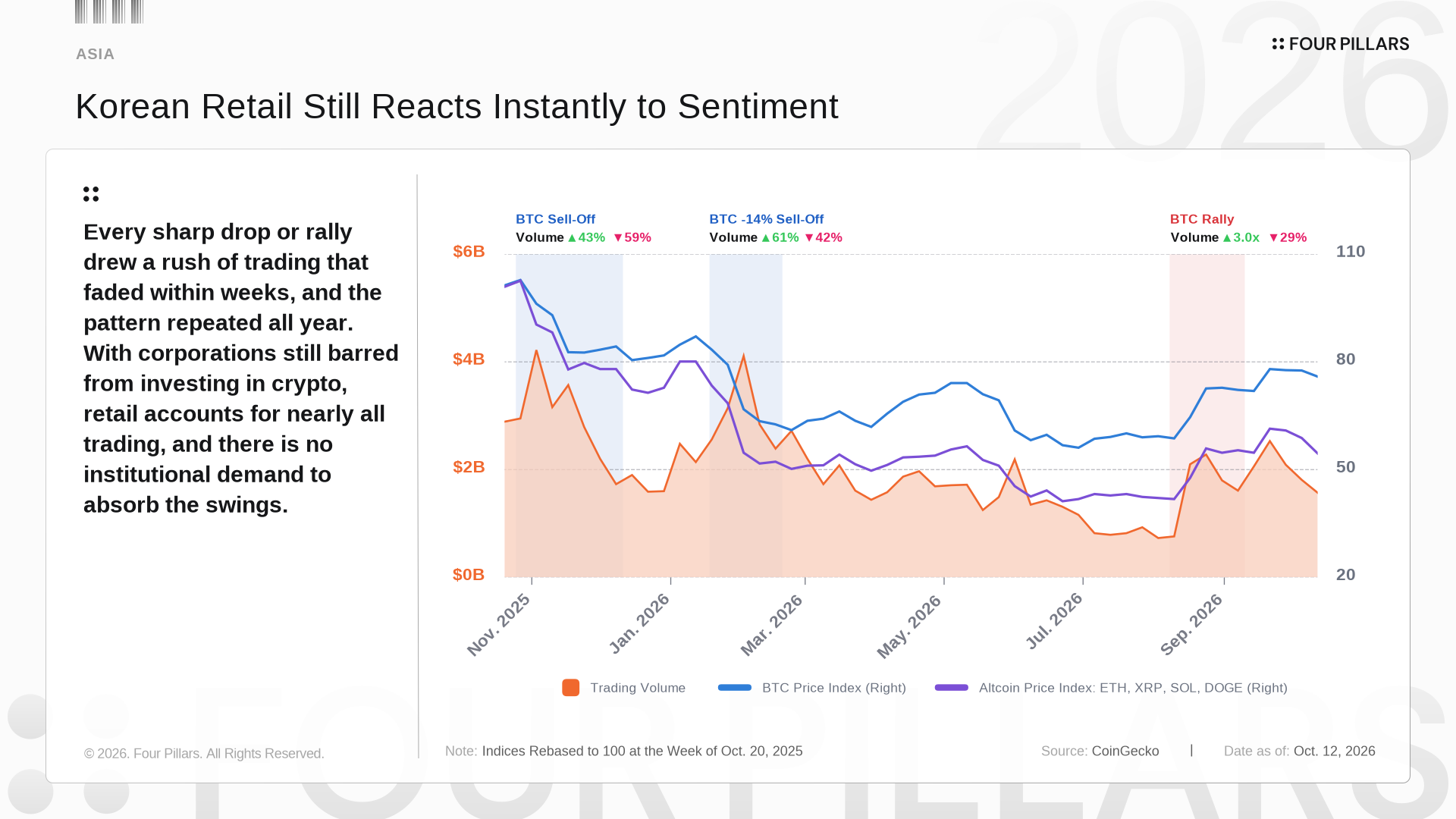
CoinGecko · As of October 12, 2026
In the past year, trading volumes on South Korean won exchanges surged during periods of market volatility, only to retreat within weeks, repeating this pattern. When Bitcoin prices began to decline in early November 2025, daily trading volumes soared to about $4.2 billion. During the sharp drop in Bitcoin in February 2026, trading volumes rose to about $4.1 billion but quickly faded. During the rebound in mid-August, trading volumes that had briefly dipped below $800 million surged back above $2 billion, but again failed to sustain.
For South Korean Exchanges, 2026 is About Laying the Foundation for New Revenue Streams
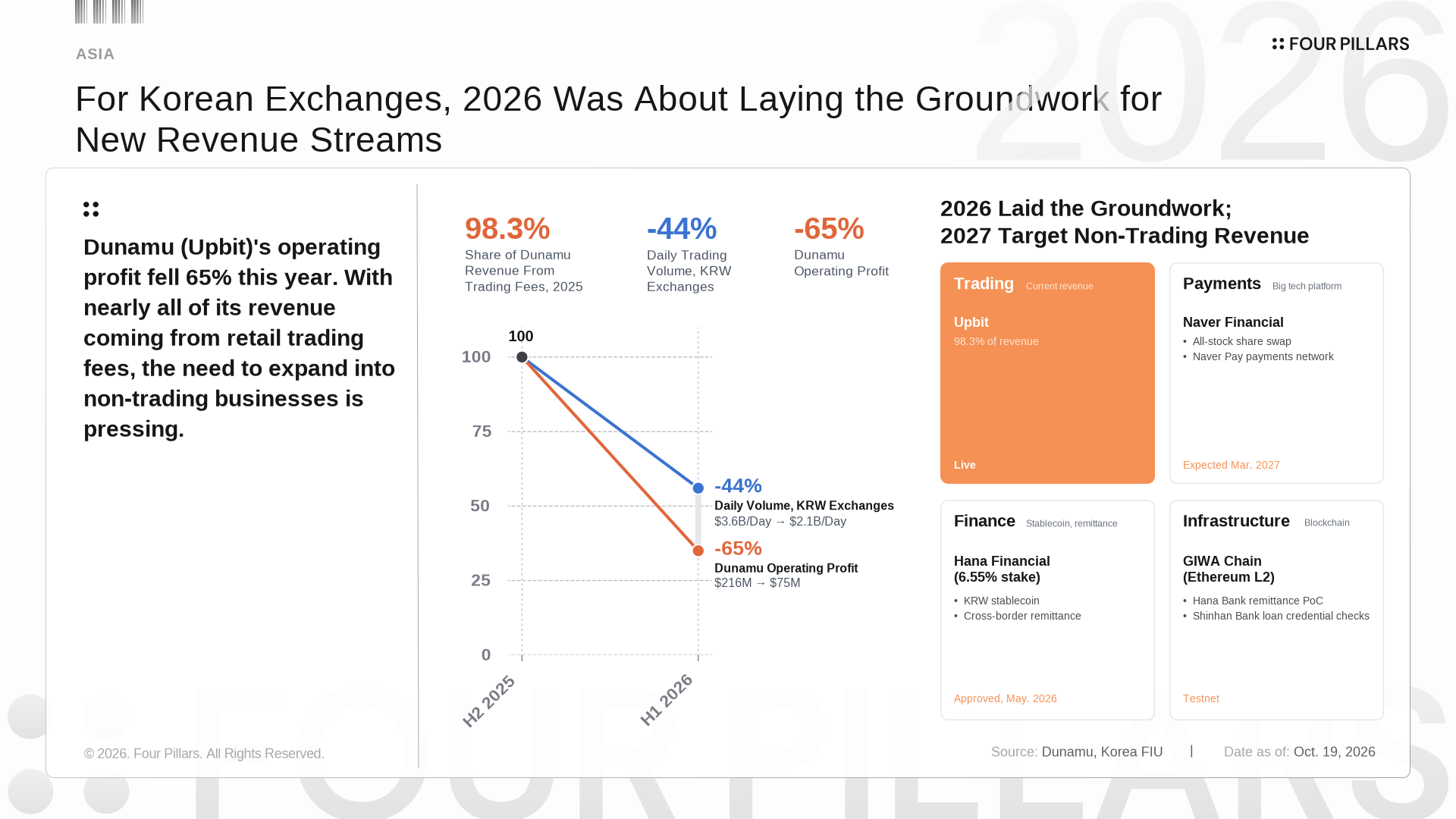
Dunamu, Korea FIU · As of October 19, 2026
The overall market in 2026 is bearish. Bitcoin fell over 40% from its peak in October 2025 to the end of June 2026, with altcoins experiencing even larger declines. As the market cooled, trading also decreased. In the first half of 2026, the average daily trading volume on won exchanges was about $2.1 billion, a 44% decline from the previous half-year. The decline has hit exchanges' profitability even harder. During the same period, Dunamu (Upbit) saw its operating profit drop 65%, from about $216 million to about $75 million, with the operating profit margin falling from 42.4% to 27.3%.
New Entrants Are Shut Out, Acquiring Exchanges Becomes the Only Way to Enter the South Korean Digital Asset Business
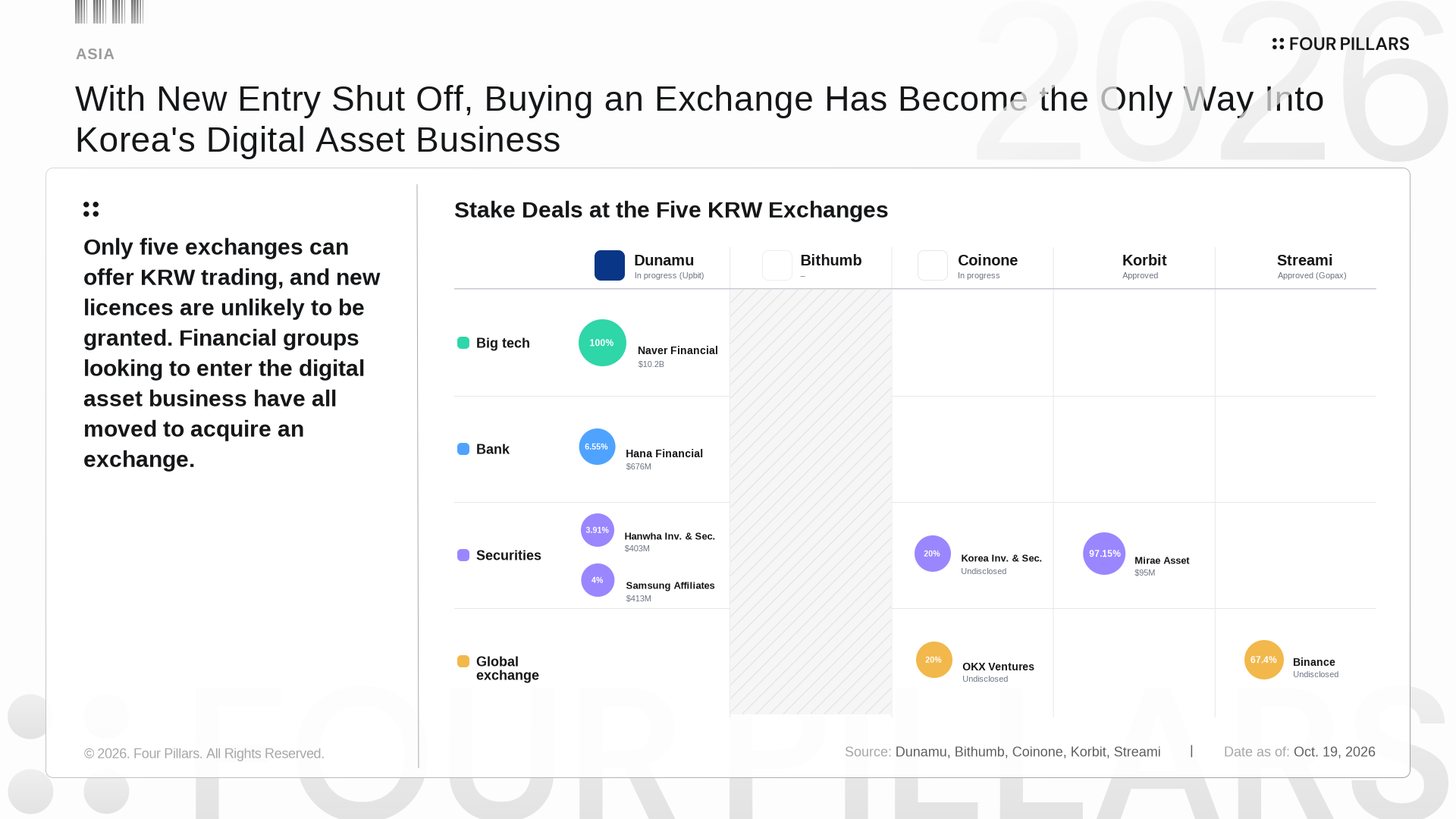
Dunamu, Bithumb, Coinone, Korbit, Streami · As of October 19, 2026
Only five exchanges in South Korea can offer won trading: Upbit, Bithumb, Coinone, Korbit, and Gopax. Since the Specific Financial Information Act came into effect in 2021, no new operators have entered the won market, and it is unlikely that new licenses will be issued in the future. For any company looking to enter the digital asset business, acquiring shares in existing exchanges is effectively the only option.
Quote: Kwansub Shim, Business Development Manager at Coinone
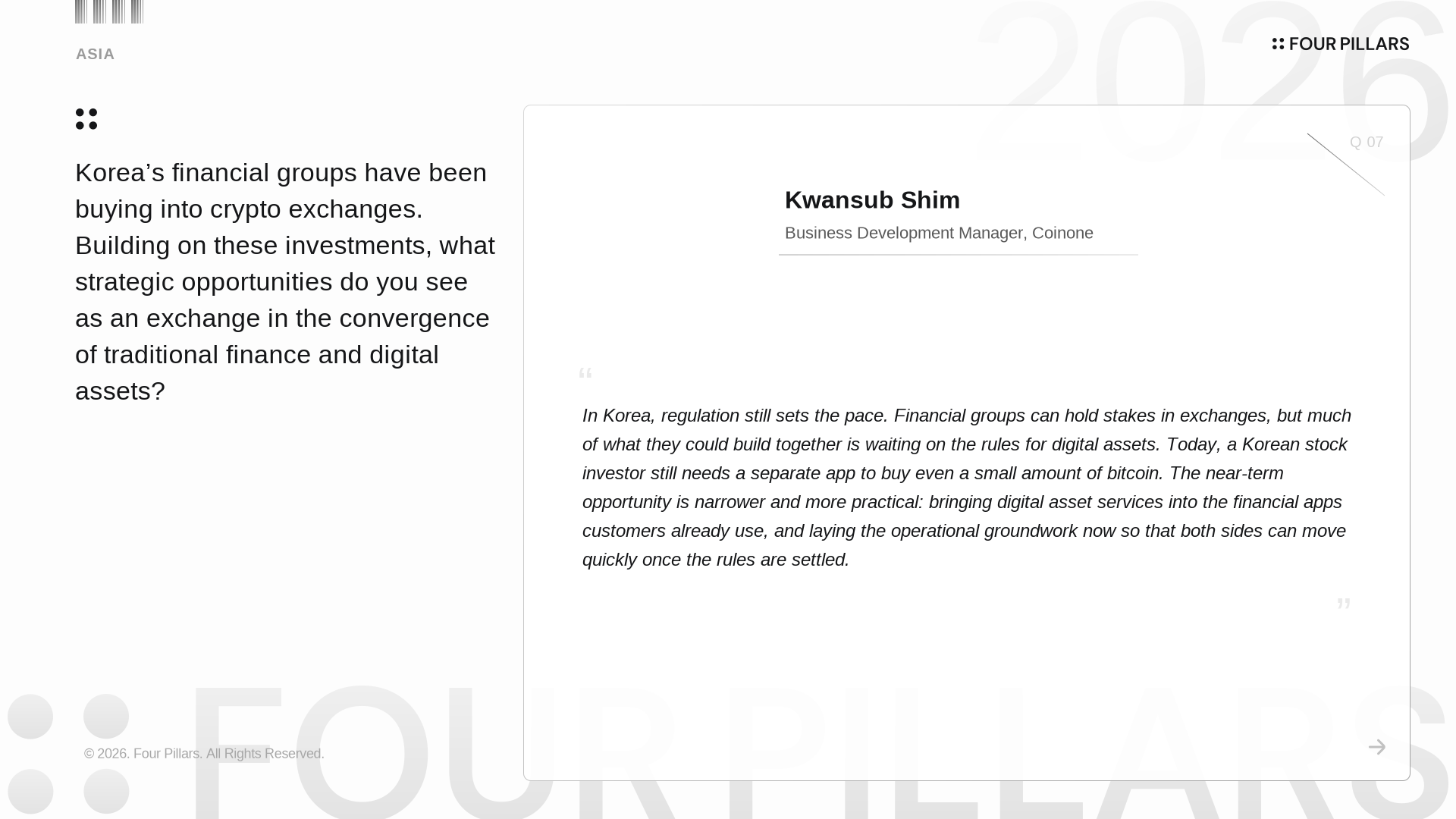
Interview: Kwansub Shim, Business Development Manager at Coinone
South Korean financial groups have been investing in crypto exchanges. Based on these investments, what strategic opportunities do you see as an exchange in the integration of traditional finance and digital assets? In South Korea, regulation still sets the pace. Financial groups can hold shares in exchanges, but most of the business they can jointly create is still waiting for digital asset rules to be established. Nowadays, South Korean stock investors need a separate application even to buy a small amount of Bitcoin. Recent opportunities are narrower but more practical: bringing digital asset services into financial applications that customers are already using and laying the operational groundwork now so that both sides can act quickly once the rules are finalized. ------ Kwansub Shim, Business Development Manager at Coinone
As a Leader in Japan, SBI is Incorporating a Complete Digital Asset Stack from Yen Stablecoins to Exchanges into One Group
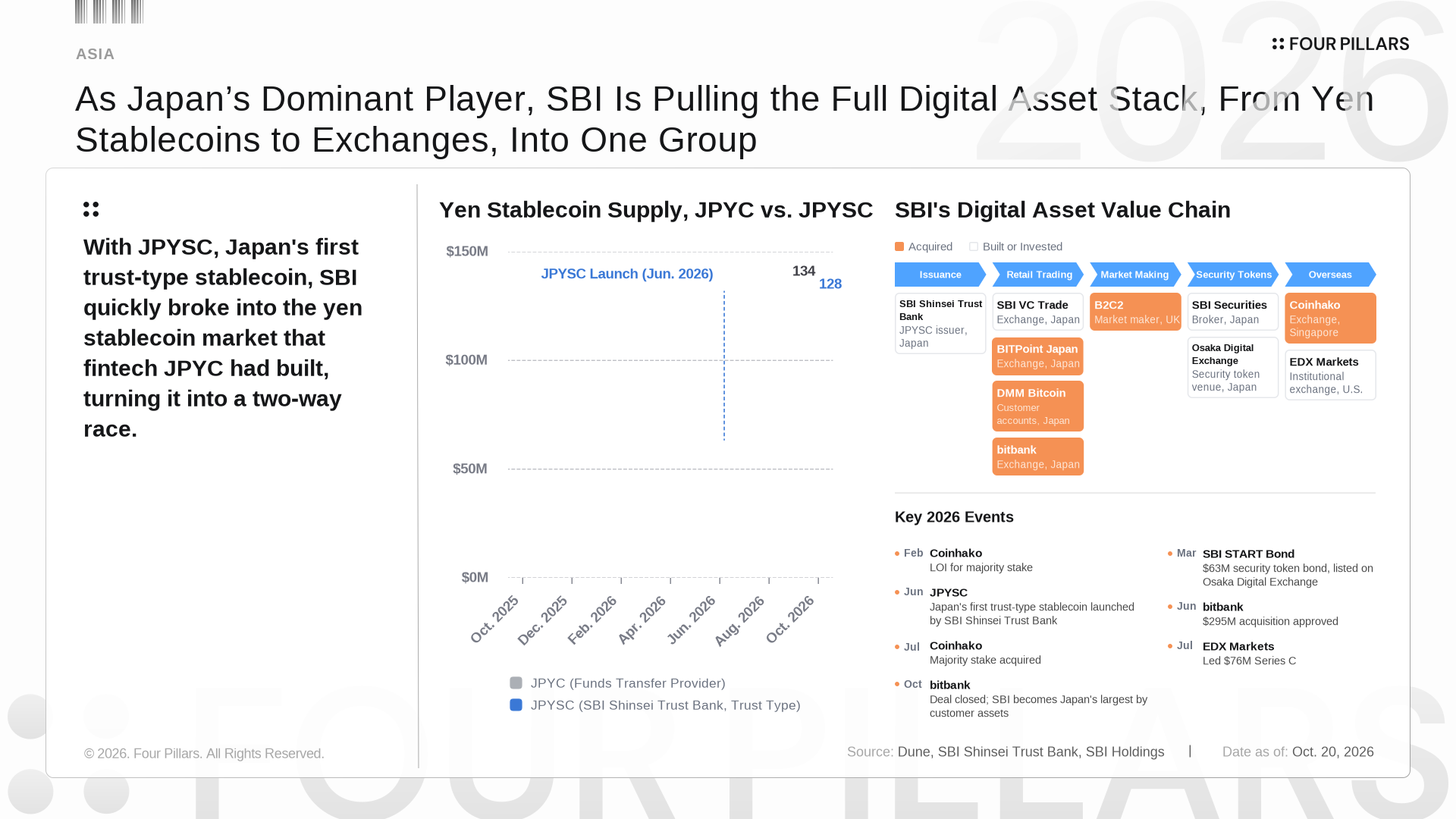
Dune, SBI Shinsei Trust Bank, SBI Holdings · As of October 20, 2026
In 2026, the yen stablecoin market is reshaped into a two-way competition between fintech companies and banks. The JPYC, issued by a funds transfer service provider, saw its issuance volume increase from about $7.6 million in October 2025 to about $134.3 million a year later. Japan's first trust-type stablecoin, JPYSC, was launched by SBI Shinsei Trust Bank in June and reached a similar scale within two months. After that, the issuance of JPYSC stagnated, while JPYC regained the lead in September.
In 2026, India Further Tightens Crypto Regulation, Shifting More Demand Overseas
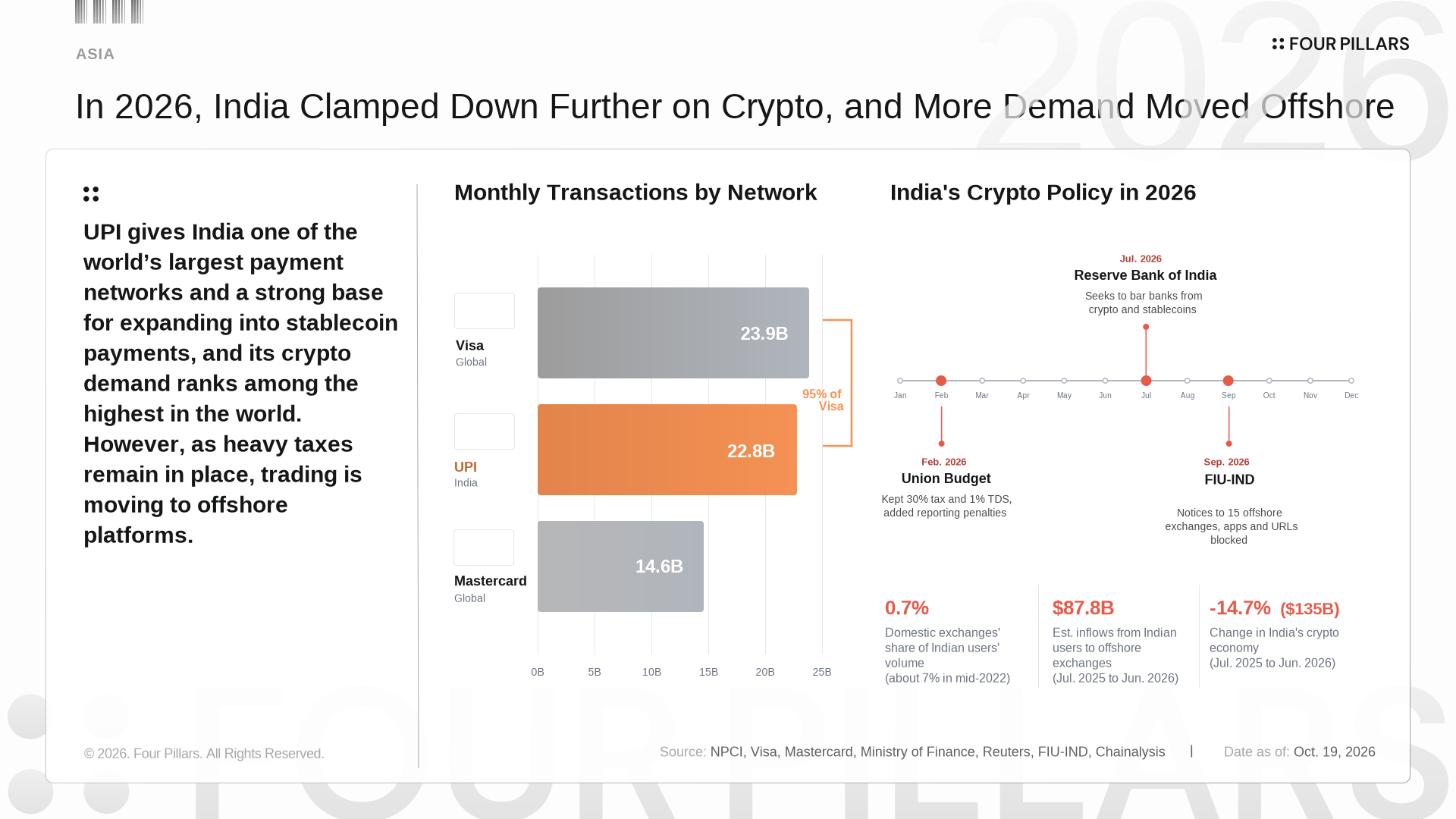
NPCI, Visa, Mastercard, Ministry of Finance, Reuters, FIU-IND, Chainalysis · As of October 19, 2026
In terms of payment infrastructure and demand, few markets have conditions as favorable as India for integrating with digital assets. UPI processes about 22.8 billion transactions monthly, comparable to Visa's global transaction volume (about 23.9 billion), and far exceeds Mastercard (about 14.6 billion). Crypto demand also ranks high annually in Chainalysis's adoption index.
Under Government Leadership, Hong Kong is Building the World's Largest Onshore Tokenized Financial Market
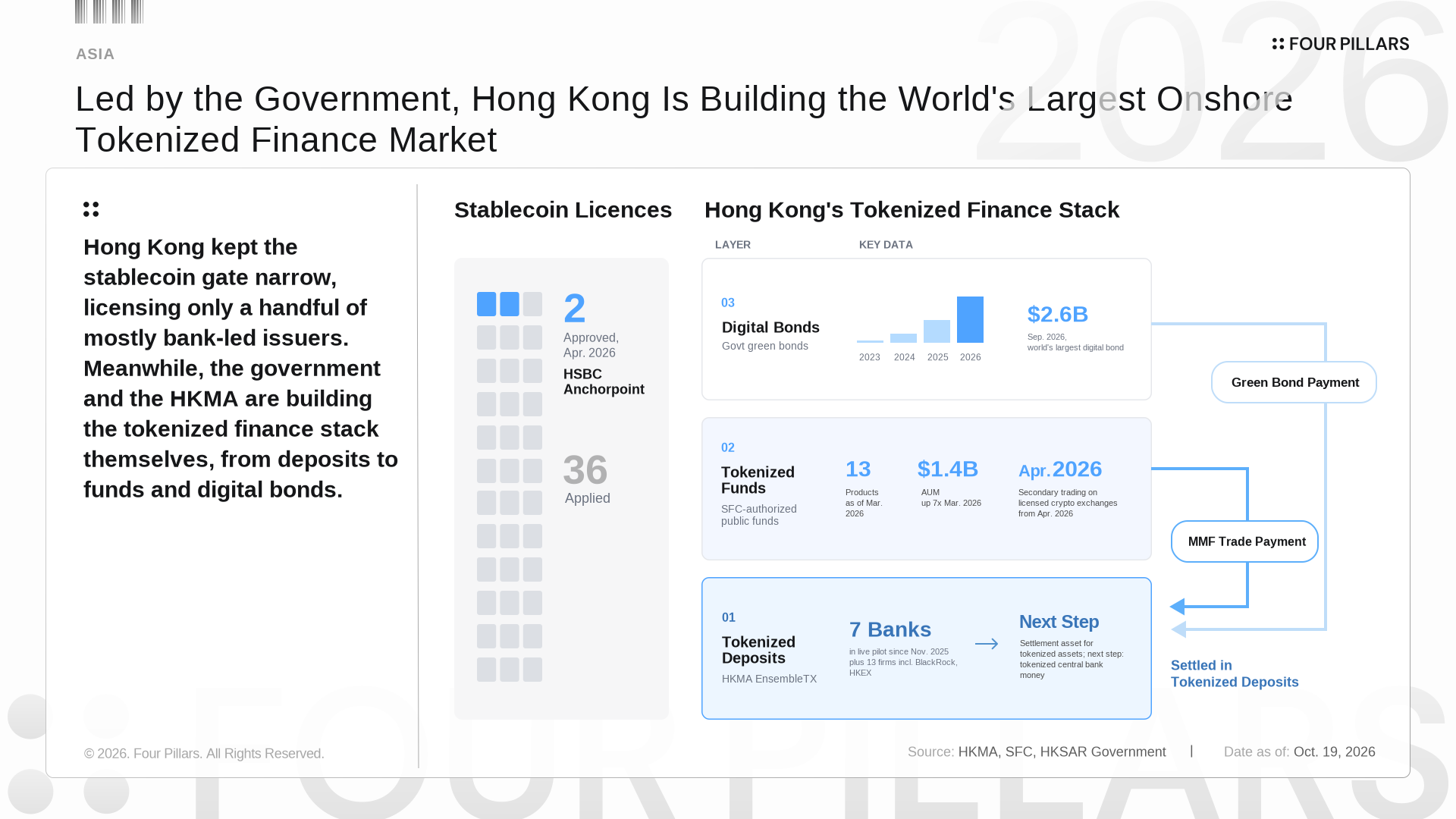
HKMA, SFC, HKSAR Government · As of October 19, 2026
Hong Kong only allows stablecoin issuance within a very narrow scope. A total of 36 issuance license applications have been submitted, but the first licenses issued in April went only to two entities: Anchorpoint, a joint venture between HSBC and Standard Chartered. Due to the regulatory authority's insistence on limiting licenses to a few firms, the bank-led issuance structure is expected to continue for some time.
After the Rulebook is Finalized, the UAE Solidifies Its Position as a Global Crypto Hub
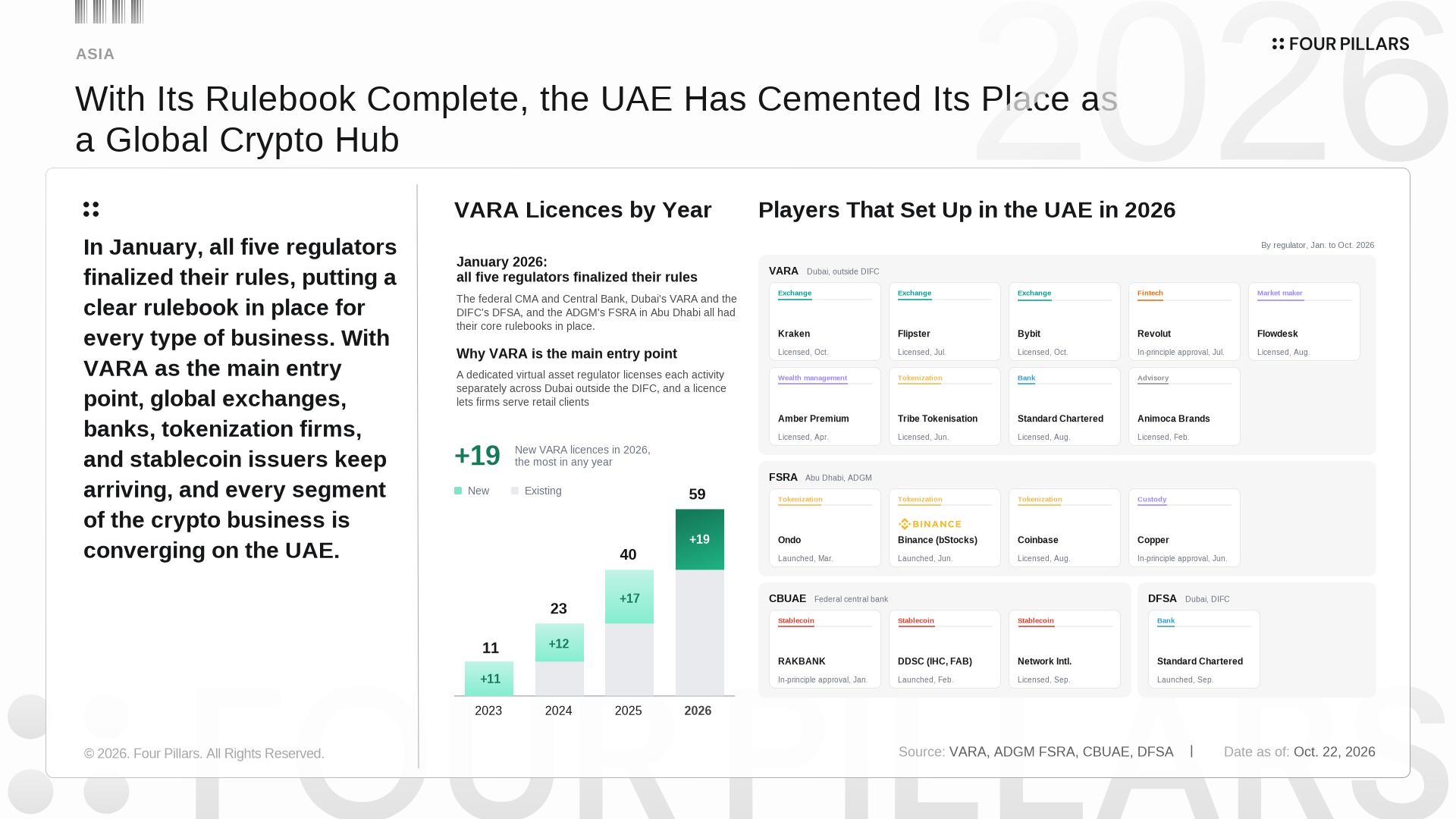
VARA, DFSA, FSRA, SCA, CBUAE · As of October 19, 2026
With the rules finalized by five regulatory agencies in January 2026, the UAE has become a market where regulations cover all areas of the cryptocurrency business. Among them, Dubai's VARA covers the widest range of activities, including exchanges, brokerage, and consulting, effectively serving as the main entry point into the UAE market. The number of new licenses issued by VARA has increased year by year, rising from 11 in 2023 to 19 this year, with a cumulative total of 59.
Quote: Robbie Nakarmi, Partner at Further Ventures
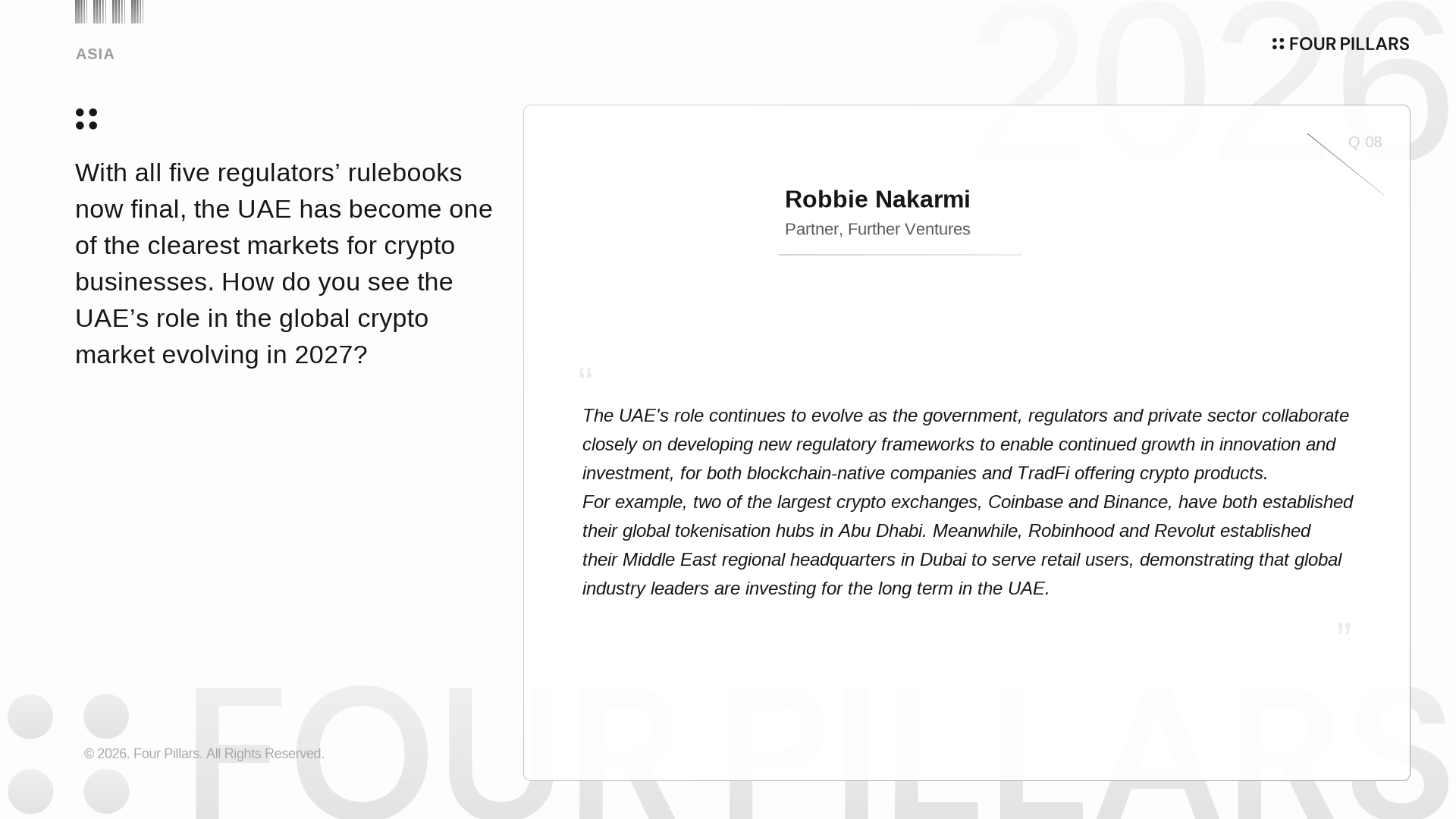
Interview: Robbie Nakarmi, Partner at Further Ventures
With the rulebooks finalized by five regulatory agencies, the UAE has become one of the clearest markets for cryptocurrency businesses. How do you see the evolution of the UAE's role in the global cryptocurrency market in 2027? The UAE's role continues to evolve, with the government, regulatory agencies, and the private sector working closely together to develop new regulatory frameworks that support the innovation and investment of blockchain-native enterprises and traditional financial companies offering cryptocurrency products. For example, the two largest cryptocurrency exchanges, Coinbase and Binance, have established their global tokenization centers in Abu Dhabi. Meanwhile, Robinhood and Revolut have set up their regional headquarters in Dubai to serve retail users, indicating that global industry leaders are making long-term investments in the UAE. ------ Robbie Nakarmi, Partner at Further Ventures
The Dawn of Agentic Payments
The new payment demands created by AI agents and the standards that support them.
Cryptocurrency agentic payments still have a long way to go before mainstream adoption
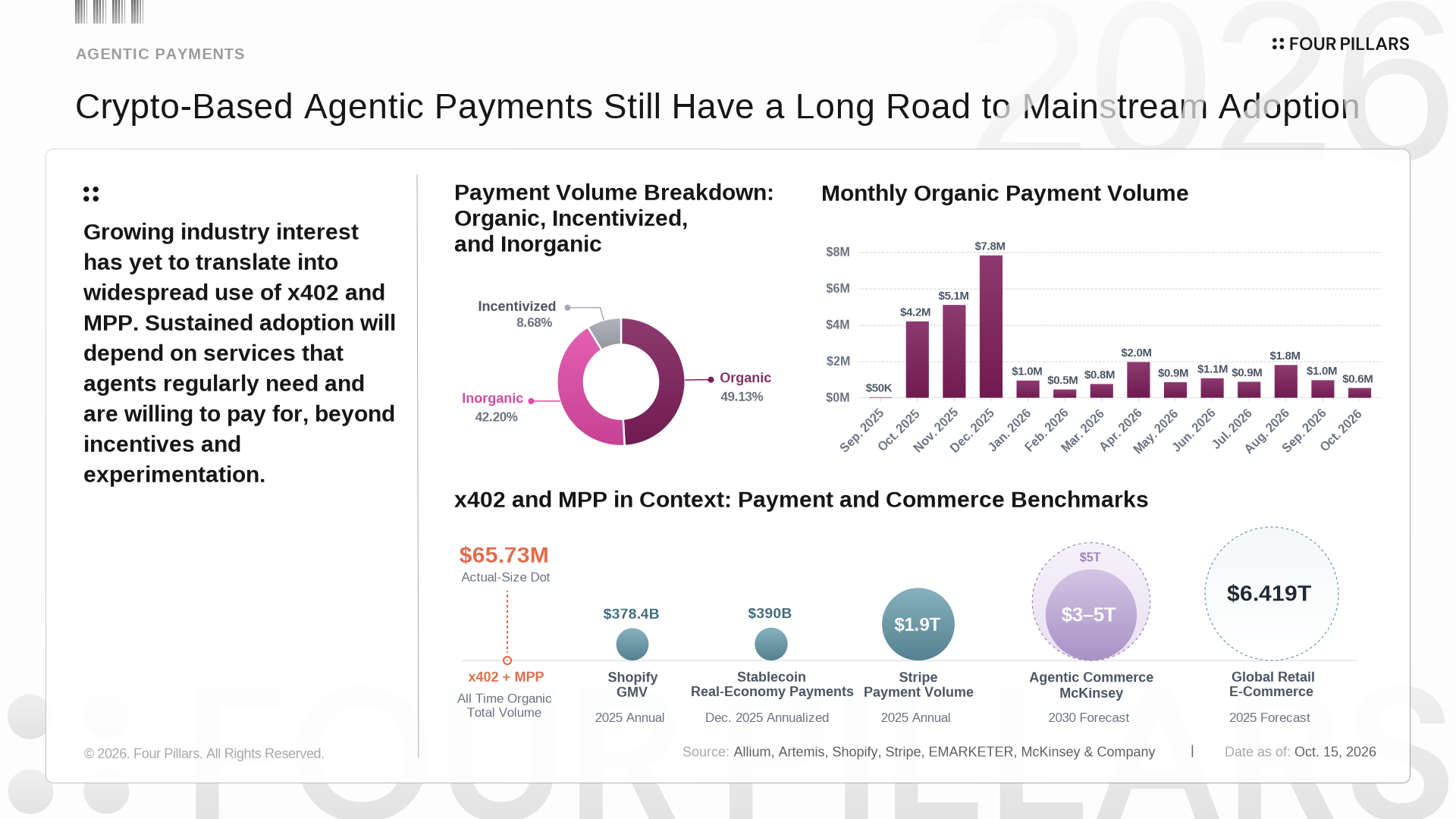
Allium, Artemis, Shopify, Stripe, EMARKETER, McKinsey & Company · As of October 15, 2026
As interest in agents grows within the industry, cryptocurrency agentic payments using x402 and MPP are entering the early stages of adoption. The cumulative natural payment volume currently stands at $65.73 million, accounting for 49.13% of the total. So far, more than half has come from human activity and incentive-driven transactions aimed at earning rewards. Therefore, transaction activity alone cannot establish a sustained demand for services. The urgent task is to develop services that agents find valuable enough to use repeatedly. Compared to mature payment and commerce markets, current transaction volumes remain small. However, as agents take on more tasks and new demands emerge, the market is likely to experience nonlinear growth that exceeds current expectations. Thus, cryptocurrency agentic payments are worth monitoring not only for their current payment volumes but also for the demand they can capture as the broader market grows.
The foundation for cryptocurrency agentic payments is taking shape
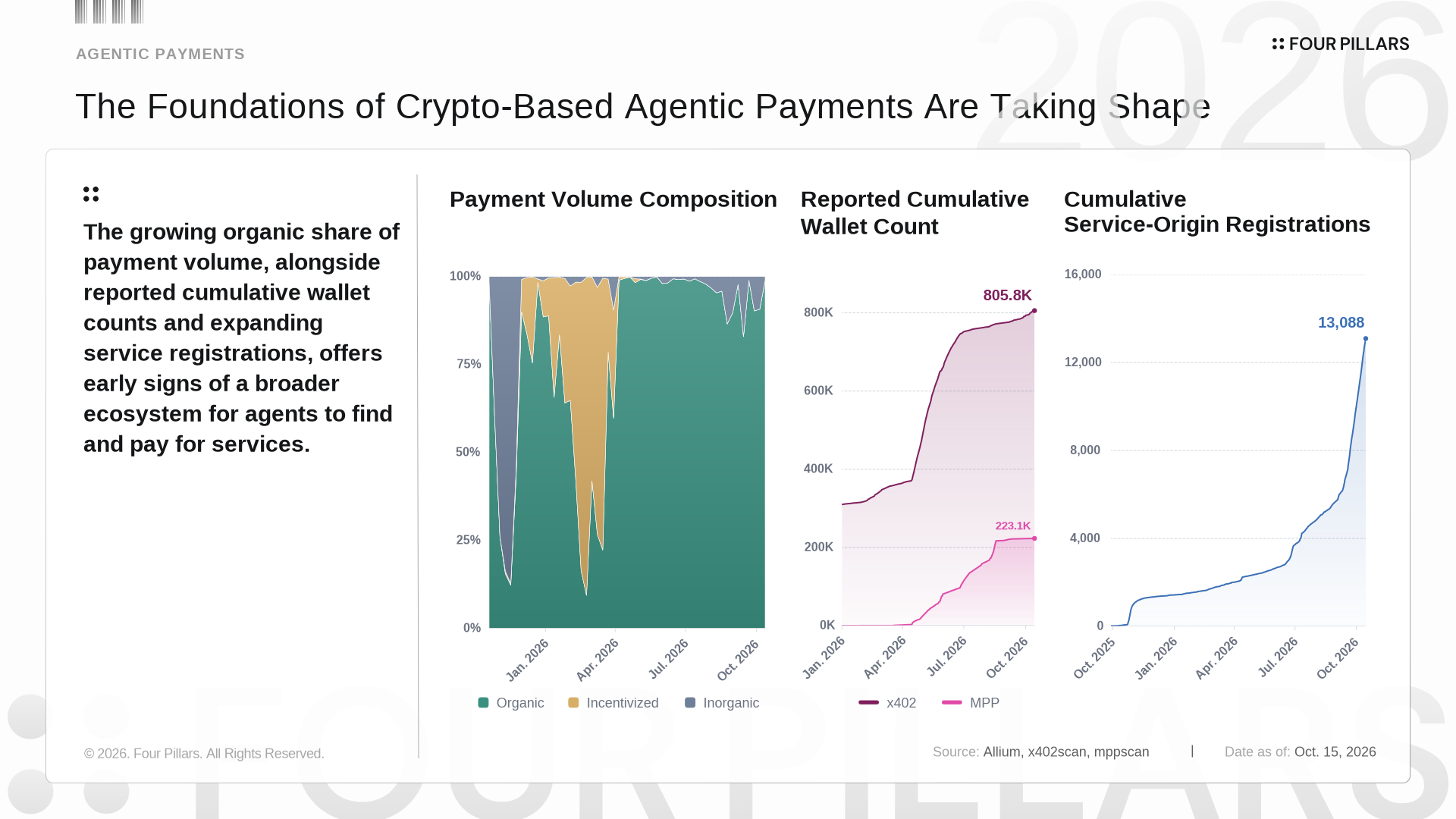
Allium, x402scan, mppscan · As of October 15, 2026
Even so, the foundation of the cryptocurrency agentic payment ecosystem is clearly expanding. As the share of natural payments in the total continues to rise, the cumulative number of wallets for x402 and MPP has reached approximately 805,800 and 223,100, respectively. The number of registered service sources has also risen to 13,088, reflecting the growth of both wallets participating in payments and the service touchpoints available to agents.
Tech and payment companies are supporting cryptocurrency agentic payments
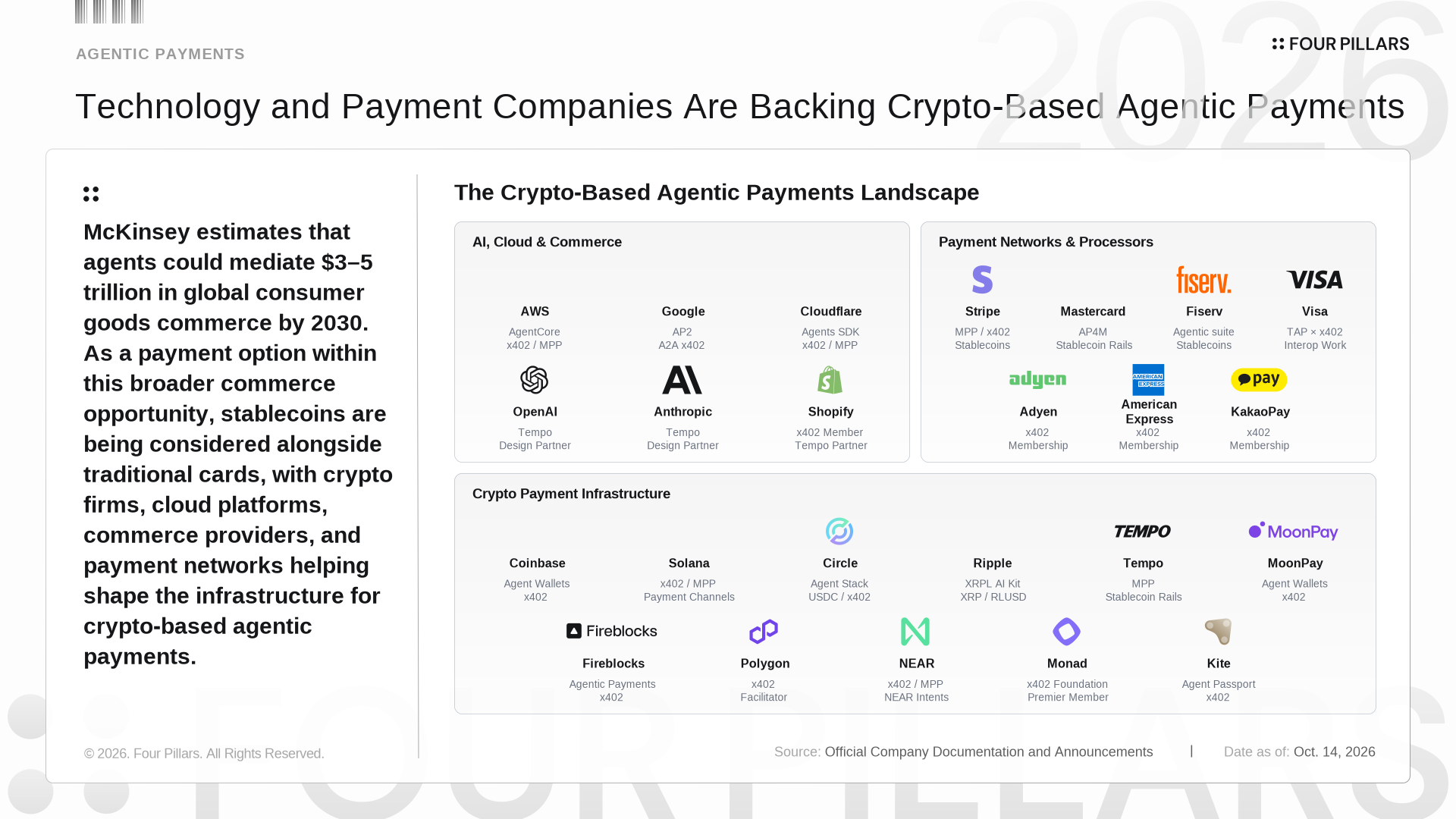
Official Company Documentation and Announcements · As of October 14, 2026
Recognizing the potential of agentic payments and commerce, cryptocurrency companies, AI and cloud service providers, commerce platforms, and existing payment companies are all participating in building the supporting infrastructure. In my view, what stands out is the customer base and distribution channels these companies already possess. Integrating payments into existing products and services creates more opportunities for cryptocurrency agentic payments to reach customers and become part of everyday use. As the market moves beyond the initial adoption phase, its direction will become clearer based on which customers use stablecoins, what transactions they conduct with stablecoins, and how these payments coexist with existing payment methods.
Major tech companies are making x402 easier to use in agent workflows
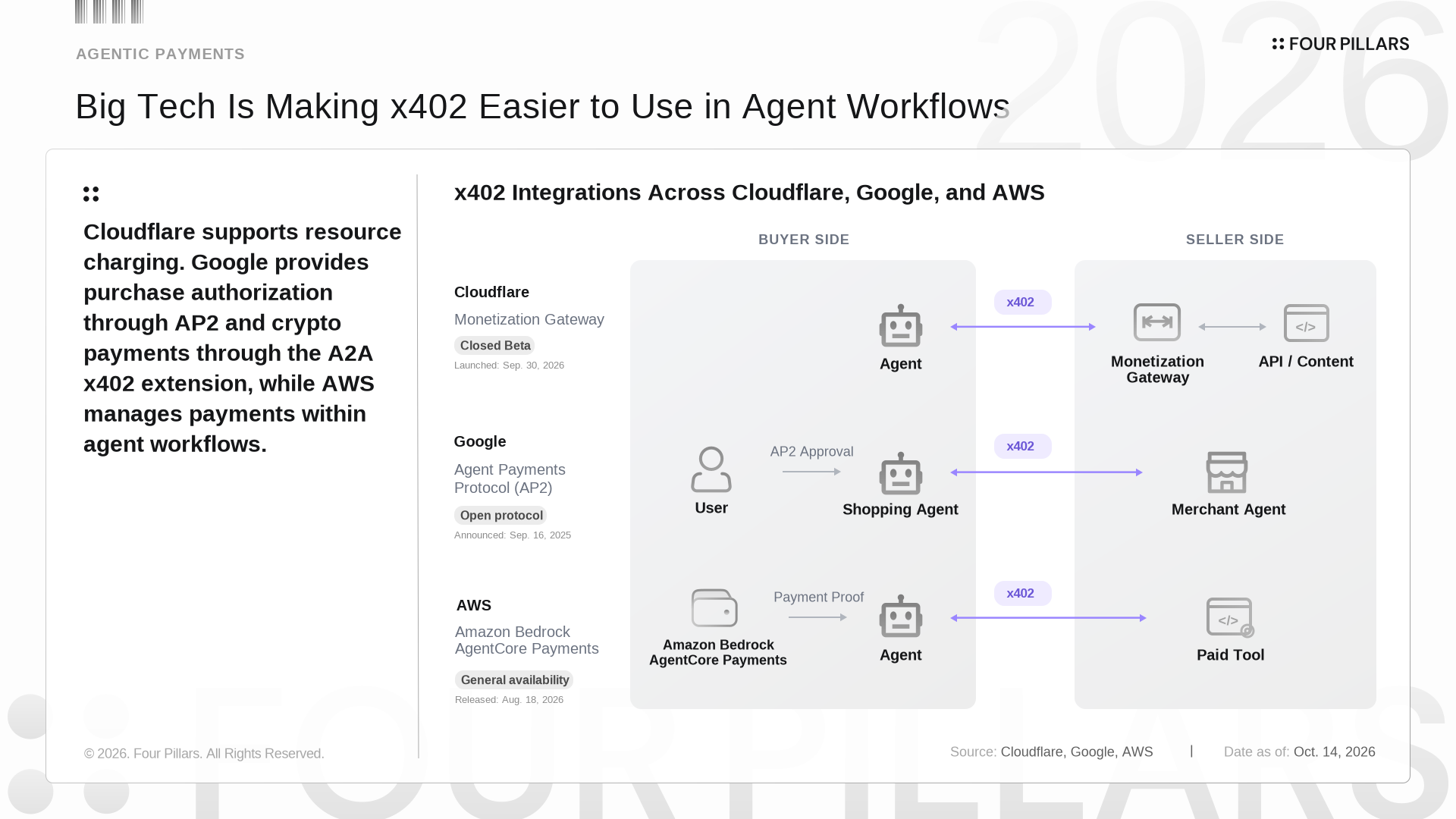
Cloudflare, Google, AWS · As of October 14, 2026
Even when using the same x402 protocol, companies are addressing different problems and reaching different customer touchpoints. Cloudflare's Monetization Gateway helps API and content providers charge agents for access via x402. Google uses AP2 to verify user-authorized purchasing rights and employs the A2A x402 extension to connect cryptocurrency payments. AWS handles the payments required when agents use paid tools during their workflows.
Quote: Kevin Leffew, Co-Author of x402
Interview: Kevin Leffew
What are the main challenges currently facing x402? What should be prioritized to drive large-scale adoption? The next challenge for x402 is to make paid tools a natural part of the agent's workflow. Agent workflows need a simple way for large language models to discover services, assess whether the expected value of a tool call justifies its cost, and complete payments without needing to register separately with each provider. The strongest use cases will come from useful workflows: agents earn money by providing services and use the earnings to purchase the resources needed to complete their tasks. The ecosystem's priorities should be concrete assessments, better developer tools, and an open ecosystem that both independent builders and large platforms can participate in. ------ Kevin Leffew, Co-Author of x402
Circle positions USDC as the default currency for cryptocurrency agentic payments, accounting for 99.8% of tracked x402 and MPP transaction volume
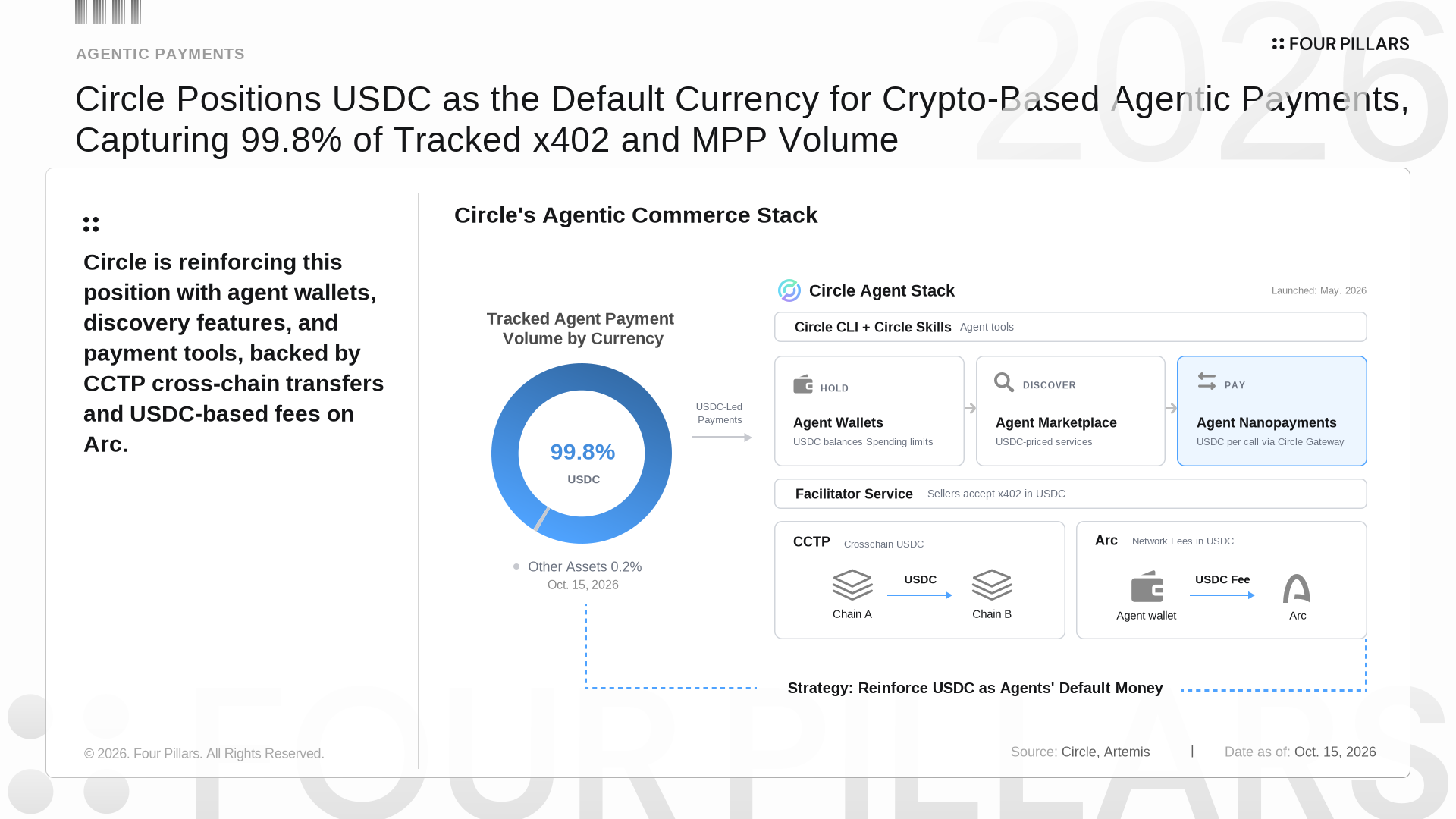
Circle, Artemis · As of October 15, 2026
Circle's strategy is to build an environment where agents can easily hold and use USDC. By currency, USDC accounts for 99.8% of the tracked agentic payment volume, dominating in the early stages. Circle is reinforcing this position by connecting wallets, service discovery, micropayments, and payment processing, while also expanding the utility of USDC through cross-chain transfers via CCTP and fees denominated in USDC on Arc.
Base and Solana lead early on x402, but the market remains open
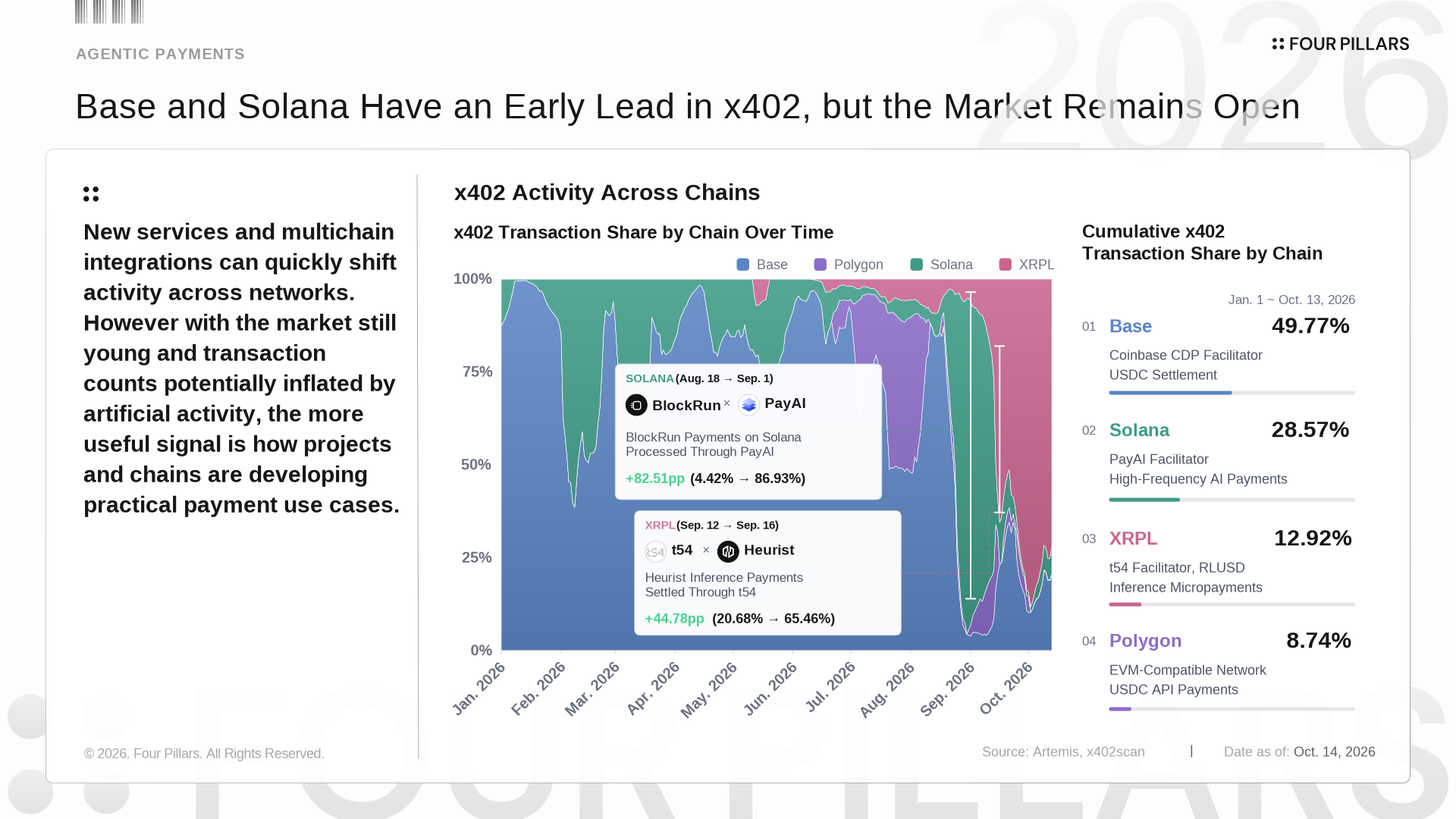
Artemis, x402scan · As of October 14, 2026
From January 1 to October 13, 2026, Base accounted for 49.77% of the tracked x402 transaction volume, while Solana accounted for 28.57%. Although these two chains lead on a cumulative basis, as shown by the examples of Solana and XRPL, the integration of specific services with payment providers can significantly alter transaction shares between chains in the short term.
x402 and MPP are evolving to make cryptocurrency agentic payments practical
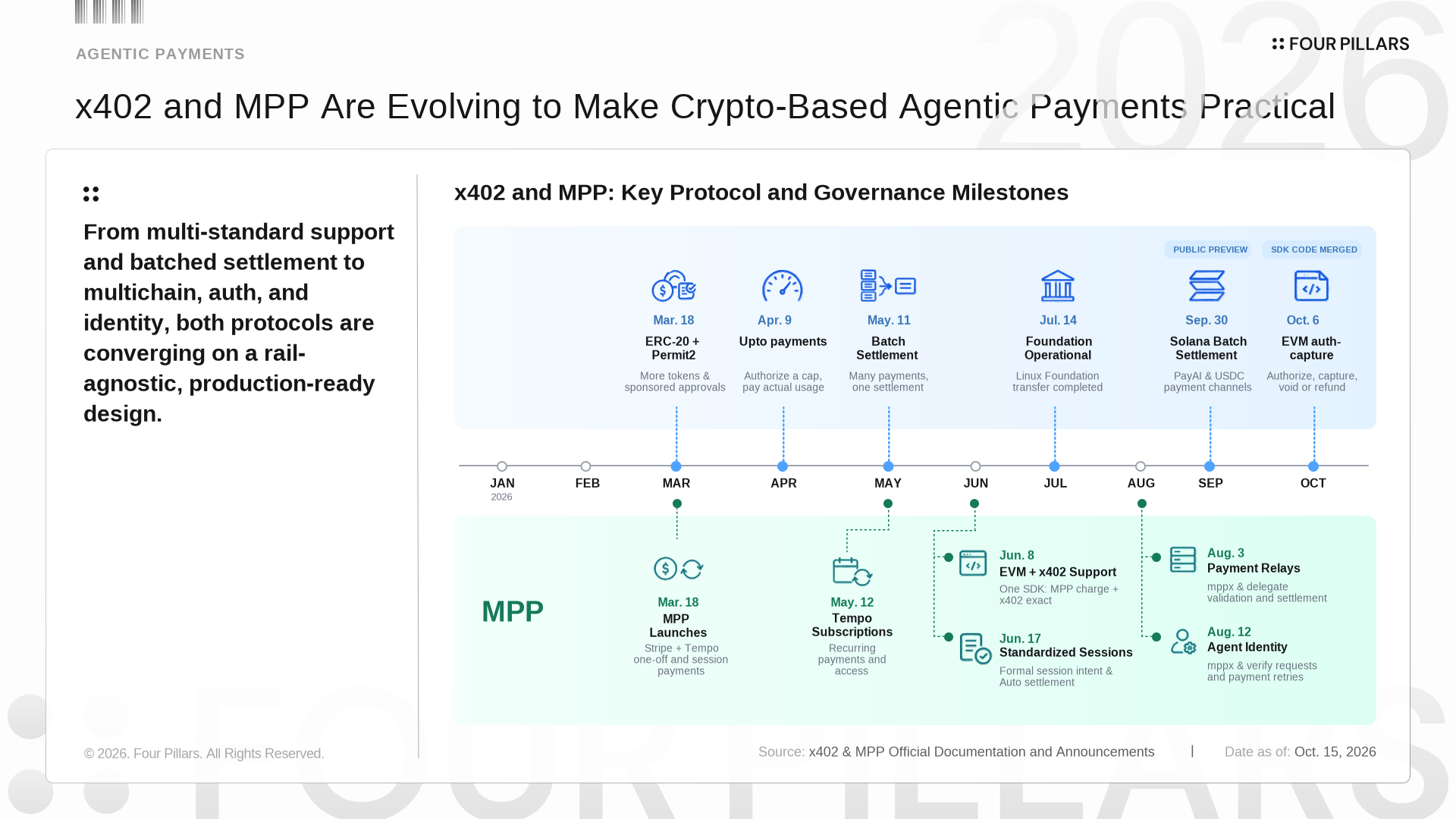
x402 & MPP Official Documentation and Announcements · As of October 15, 2026
x402 is an open protocol governed under the Linux Foundation, while MPP was co-developed by Stripe and Tempo, both expanding the payment capabilities required for agents to purchase real services. Based on its pay-per-request origins, x402 now supports capped payments and batch settlements to accommodate variable, usage-based charges and recurring micropayments. MPP's session and subscription mechanisms manage payments and access rights for ongoing service use. The addition of authorization and capture features, along with agent authentication, further broadens the types of transactions and usage patterns supported by these two protocols.
Wallets are, and will continue to be, the control towers of agent clusters
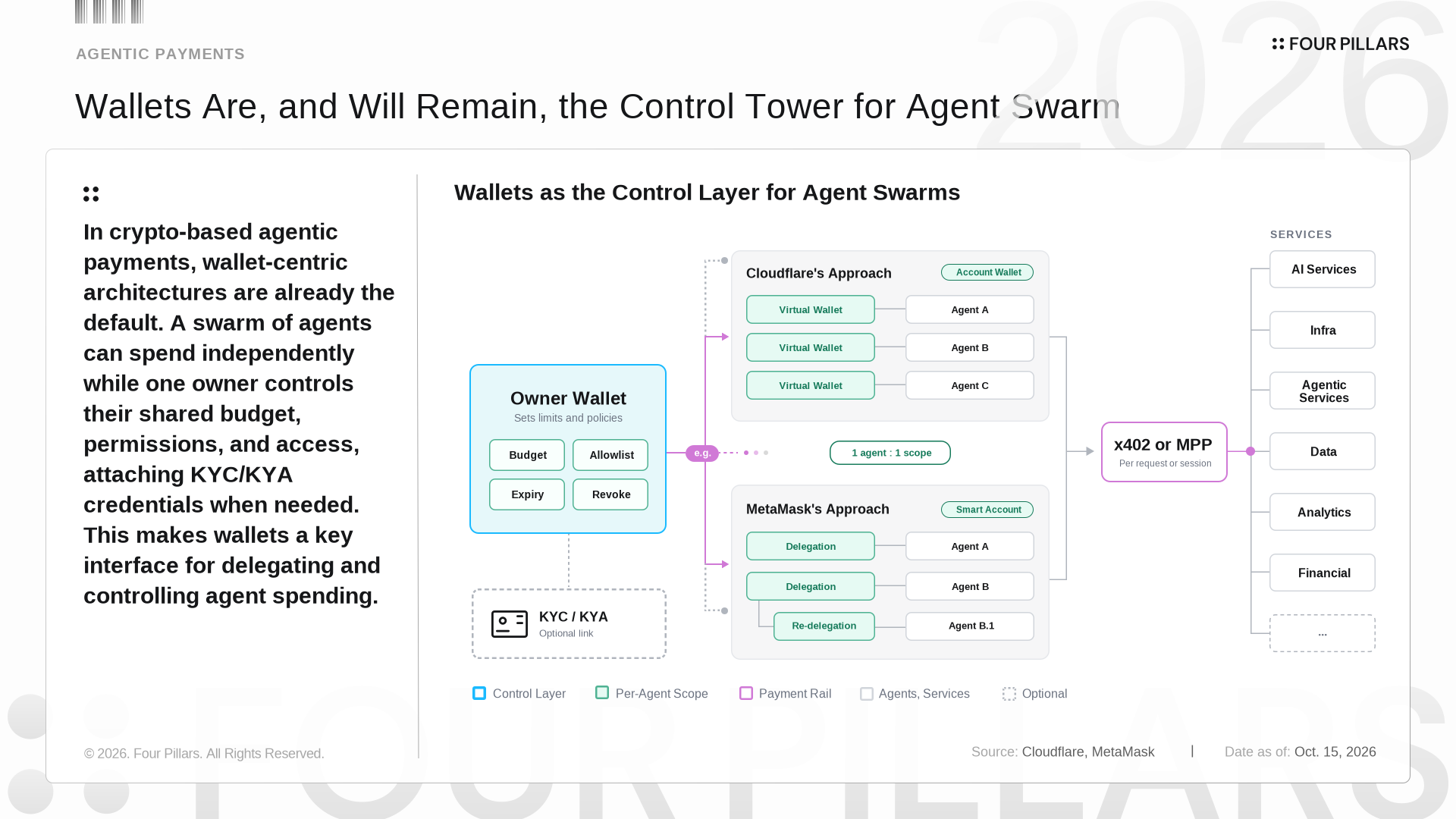
Cloudflare, MetaMask · As of October 15, 2026
When multiple agents purchase services simultaneously, controlling their total expenditure is as important as executing a single payment. Cloudflare's virtual wallet and MetaMask's delegation model adopt different implementation methods, but both allocate spending authority to individual agents under conditions set by the owner. Budget, whitelist, expiration, and revocation connect individual actions to a shared control system. This makes the wallet a key interface for delegating authority to agents. Requiring user approval for each payment reduces the benefits of running agents in parallel. Defining limits at the wallet level and delegating execution within it can maintain both autonomy and control. As wallets incorporate credentials when needed and manage expenditures across services, their competitive value will increasingly depend on the consistency with which they execute delegated authority and their role in holding assets.
ChainCatcher reminds readers to view blockchain rationally, enhance risk awareness, and be cautious of various virtual token issuances and speculations. All content on this site is solely market information or related party opinions, and does not constitute any form of investment advice. If you find sensitive information in the content, please click , and we will handle it promptly.



Popular articles