Coinbase early investor Garry: A review of the birth of 6000x returns

 The process from 300,000 dollars to 2.4 billion dollars.
The listing of Coinbase has become a milestone event in the industry, and its enormous market value has brought substantial returns to early investors, such as its early investor Garry Tan.
Garry Tan is the founder of the investment firm Initialized Capital and ranked 35th on the "2021 Forbes Global Best Venture Capitalists" list. He joined YC as a partner in early 2011, guiding the YC team in product design. On the eve of Coinbase's founding, Garry participated in its seed round financing, which has now yielded over 6000 times the return.
Recently, Garry released his reflections on this investment, and Chain Catcher has edited and translated the article without altering its original meaning, hoping to inspire you.
Author | Garry Tan
Translation | Alyson
I provided funding for Coinbase in 2012, and this is how I achieved a 6000x return on my investment.
Eight years ago, I met a founder and invested $300,000 in his company, which is now worth over $2.4 billion. That company is Coinbase, and investors have valued it at over $100 billion. This is by far my best investment.
When you see this news, who knows what the future holds? In March 2012, Brian Armstrong sent me 0.05 bitcoins under the name of his startup BitBank.
His idea was simple: to create a straightforward and transparent place for people to buy and hold bitcoins. During this time, many startups were struggling, all with similar ideas. What truly made a difference was BitBank's rebranding to Coinbase.
 This email started it all.
When I received that 0.05 bitcoins in 2012, the total market cap of bitcoin was less than $1 billion. Today, the market cap of bitcoin exceeds $1 trillion. At that time, those bitcoins were worth 23 cents; today, they are worth nearly $2500.
Shortly after I received that 0.05 bitcoins, Brian emailed me, saying he had created a prototype of the product and put it online, having been coding like crazy for the past few weeks. He also asked me, "Do you have any suggestions for finding co-founders? Is there anyone in your community who might be interested in this?"
It's funny to think back because anyone who joined back then is now a billionaire. Here’s what I replied: "The hardest part about finding partners is that you might already know the right people, but they are doing other things. You have to show these people why this matters more than anything they are currently doing. The essence of this problem is conveying your belief in the market and product to others. You already know you will have many partners in the future; you just don't know each other yet."
At that time, I received thousands of YC applications for the summer of 2012. I remember Brian made countless attempts in the application review system—finally, one click of the mouse connected Coinbase with Y Combinator. Honestly, I am really grateful to be a small part of Coinbase's critical moment, even though Brian didn't have a co-founder at that time.
01
Bitcoin was still a fringe concept back then.
In 2012, bitcoin was still a very fringe concept. Brian was an independent founder daring to pioneer in a completely new field. At that time, no one believed in bitcoin. I first discovered bitcoin on Hacker News. Here’s its first mention on the site in 2009, and these comments summarize the thoughts of most people at the time:
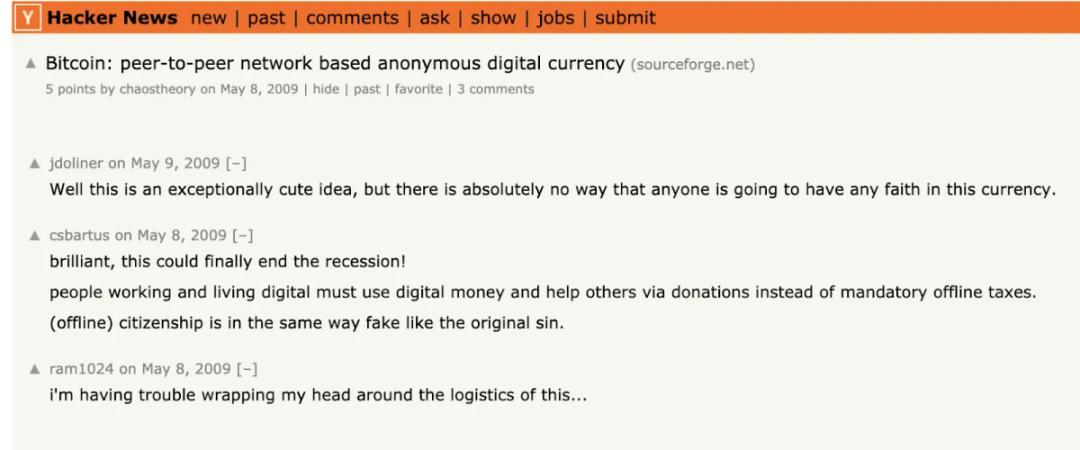 From "unlikely," "cool," "might be useful," to "I just don't get it."
This is why Brian left such a deep impression. Today, bitcoin is much more well-known, but back then, very few people had any understanding of bitcoin, let alone believed that bitcoin would be useful to society.
02
Why did I invest in Coinbase?
Just as it is hard for founders to believe, it is even harder for investors to believe, and most people would say no. But I didn't; this investment might be one of the best decisions I've ever made.
Here are the reasons why I said yes when most people said no:
First, I had already encountered some issues. I knew how difficult and scary it was to buy bitcoin in the early days. After reading about it on Hacker News, I tried to buy it on the first site, which was Mt. Gox. The experience was terrible; although bitcoin caught my attention, it was the poor design and user experience that made me feel something was wrong. I knew this couldn't be the future of bitcoin.
Second, I had ample foresight about bitcoin. I firmly believed that fiat currency could fail. In 2005, I was a software engineer developing software for Peter Thiel's hedge fund, Clarium Capital. One of the books they had employees read was "The Dollar Crisis" by Richard Duncan.
That book made me aware of the crazy events of 1971, the year Nixon took the U.S. off the gold standard, when people could no longer exchange dollars for gold. The dollar, already the reserve currency for all other central banks, suddenly became a fiat currency that could be printed at will. Today, 25% of the dollars in circulation were printed last year. So when bitcoin emerged, as Louis Pasteur once said, "Fortune favors the prepared mind." I felt very lucky to be prepared at that time.
Third, Brian is a developer. Personally, I prefer to invest in developers. For Brian, being able to build the first version of Coinbase and maintain it himself was very powerful. With a physical bank, you can protect physical currency with a physical wallet. When the internet has currency, you can use software engineering and security systems to protect it.
I knew Brian was an engineer and fraud prevention lead at Airbnb, which had already reached a valuation of billions of dollars. And at Airbnb, fraud prevention was their key department; I knew Brian was busy dealing with hackers every day. Developers maintain that state of work, showing us what the future world looks like, which is rare. That’s Brian’s quality.
03
Some things I did to help Coinbase after the seed round.
In 2013, when I first checked their seed round and helped them with early product-market fit research, during a break at work, Brian came in and said something strange had been happening all week: they had run out of operating capital at SVB and sold out of bitcoins by 9 AM. I told him it was time to raise a Series A round and start reaching out. This is one of the most important things we do for startups: help them scale their capital.
Here’s one of the emails that helped them raise this round of funding:
2013.3.3
Hi, Investors:
I want to put Coinbase on your investment list to support their Series A funding. They are the most trusted bitcoin payment platform in the world and the only exchange with a direct relationship with a federally insured U.S. bank, processing tens of thousands of dollars in transactions daily. On any given day, they account for 15% of the total transaction volume on the world's largest bitcoin trading platform, mtgox.com.
They are not constrained by demand but by capital, and every time they expand their capital, they hit the capital limits set by their bank (which increased fourfold last month). They are the only compliant site that allows people to buy bitcoins, which has benefited them immensely.
They are at the forefront of legitimizing this new cryptocurrency and recently enabled payments via Reddit (one of the top 50 websites). Some of the largest and smartest hedge funds on Wall Street, like "redacted," are using Coinbase to build long positions in bitcoin as a financial instrument.
I believe they have the potential to fundamentally reshape the two largest payment methods in the world:
1. Credit Cards ------ The internet, proud of eliminating intermediaries, relies on credit card infrastructure, with over 2.5% of each transaction processed via credit cards. ACH transaction processing is too slow, and bitcoin is poised to become the preferred transfer currency, as bitcoin transactions can be transferred without any fees and can be exchanged with dollars without a 1% fee.
2. International Remittances ------ Bitcoin is already an international currency; just as it disrupts traditional credit card transactions, bitcoin will also disrupt cross-border remittances. More and more people are using bitcoin for cross-border remittances; for example, Filipinos use bitcoin to receive payments for freelance work on oDesk and send it back home.
Today, the total value of all bitcoins in the world is about $300 million, growing 400% from last year. Given that the above two application scenarios are still in their infancy and Coinbase is at the forefront of the market, I believe this is one of the most disruptive opportunities I've ever seen.
Brian is an excellent software engineer who managed the fraud prevention team at Airbnb. Brian is the perfect choice for this field because Coinbase is a bank that doesn’t require guns for protection; it only accepts engineers for protection. They deal with a large number of hackers every day, and I have great confidence in them, so I hope you will also provide an opportunity to talk to them.
04
Reflection
Finally, let me summarize my insights on investing in Coinbase:
First, go against the tide. Can you find something that seems fringe but is fundamentally correct? Can you use history, psychology, first principles, and other thinking to substantiate your seemingly crazy idea from the ground up, telling yourself why it will sweep the world? Sooner or later, every such idea will have its day, but it must have a truly compelling tone.
Second, be a builder. The more you can do, the closer you are to opportunity. More people will want to fund you, join you, or use your product or service. Do as much of these things yourself as you can.
Third, it’s clear that a founder being able to send a very compelling email is powerful and useful. Remember when Brian sent me 0.05 bitcoins, which was only worth 23 cents at the time, but he really gave me free money. It caught my attention and showed me that Brian was seriously doing something meaningful.
In the end, I feel very lucky to have received that email, to have met Brian, and to have had the opportunity to fund this company. For this, I am very grateful.
 Risk warning
 Risk warning