How should DAO organizations effectively manage funds?

 As the expenditures and asset allocation of the protocol treasury become clearer, the next focus area will be treasury liabilities.
This article is sourced from Bankless, authored by Shreyas Hariharan, and compiled by Echo and Gong Quanyu.
DAO organizations play an increasingly important role in the DeFi ecosystem, one significant proposition being how DAO organizations, as a new entity, should manage their treasury assets. Currently, various DAO organizations manage assets exceeding $14 billion, highlighting the growing importance of their management strategies.
Recently, Llama founder Shreyas Hariharan wrote in Bankless about how DAO organizations should manage funds to better achieve their goals. It is understood that Llama primarily helps DAOs manage their treasuries, while Shreyas is formulating financial strategies for Uniswap and overseeing Aave's grant program.
1. The Future of On-Chain Treasury Management
Over the past year, DAO treasuries have seen significant growth. Top protocol DAOs have treasury assets exceeding $14 billion. So, how should treasury bonds handle these assets? To answer this question, we need to understand the purpose of the treasury.
Anything that cannot be automated should be funded by the treasury. The treasury helps DAOs fund critical developments, attract donors, and expand their networks.
They are a means to express the values of the DAO and extend its lifespan. Here are three principles of treasury management:
1) Maintain an infinite time horizon: The structure of treasury bonds should be designed to exist permanently (in some cases, treasury bonds may be dissolved).
2) Ensure inflows exceed outflows: In the long run, revenue generated from the protocol plus treasury earnings should exceed expenditures.
3) Diversification: Even if the protocol token experiences significant depreciation, treasury allocations should ensure funding for critical expenditures.
Given that most project treasuries hold all their assets in the form of their native tokens, diversification is an important area that needs focus. If the price of UNI drops by 40%, its balance sheet will also decrease by 40%.
If a price drop occurs when the protocol may need to increase expenditures (whether for LP subsidies, token buybacks, or acquisitions), it could lead to a further downward spiral in token value.
Protocol treasuries should help expand the network. If managed properly, the treasury can serve as a strategic asset to enhance the protocol's market position. If the treasury becomes significant enough, it can fund important public goods, including real-world items.
There are four functions that can help manage DAO funds: spending, asset allocation, borrowing, and public reporting. Next, I will explain how each of these functions will evolve over time.
2. Spending
The purpose of fiscal spending is to reward core contributors and attract suitable new contributors.
1) Grant Programs
For protocols with core teams doing most of the development, grant programs help build a broader network of developers. Uniswap, Compound, and AAVE have already proposed grant programs aimed at funding individuals and teams contributing to the protocol.
Taking AAVE Grants DAO as an example, we are seeking to fund a risk committee that will evaluate new listed assets, monitor reserves, and assess protocol liquidity. This committee will consist of individuals and organizations with expertise in smart contract auditing, actuarial science, legal analysis, and risk modeling.
2) Committees and DAOs
The next step is to involve current grant recipients—individuals, committees, and DAOs—in future treasury spending decisions. Committees will allocate funds to individuals and small groups within their jurisdiction.
For example, AAVE's risk committee will receive a treasury grant from AAVE Grants DAO, and they can choose to allocate it in ways they deem appropriate within the risk authorization scope. They can hire technical personnel for a project or fund specific risk-related bounties.
This expands decision-making power to more suitable types of individuals, namely verified contributors, without sacrificing too much efficiency.
3) Decentralized Treasury Spending
In DAO protocols, the allocation of funds should ultimately be distributed to contributors based on the reputation established by contributors. Individuals and groups that contribute should have more allocation power. Grant programs are the first step in finding and nurturing these contributors.
Decentralized treasury spending allows contributors to choose team members they have collaborated with, allocate points to members, generate contributor charts, and receive rewards based on their contributions. This is how Yearn's Haralape operates.
Other models of decentralized treasury spending include:
Pioneer: Builders vote on peer projects, which measures the voting results based on the voter's reputation, thus creating a leaderboard.
Mirror's writing competition: Individuals and DAOs vote on who should have access to publish on Mirror; writers already on Mirror have more votes to allocate.
Compared to projects with a centralized core team that do not receive compensation from community funds, projects like Yearn already have a more decentralized and bottom-up working structure, making it easier to transition to decentralized treasury spending.
3. Asset Allocation
The purpose of asset allocation is to ensure that the treasury can continue to fund critical developments regardless of market conditions.
1) Asset Diversification and Stablecoin Reserves
A primary task for many large protocol treasuries is to convert a portion of their assets into stablecoins. The allocation of stablecoins should at least cover a few years of operational expenses for the treasury.
Stablecoins can provide the following benefits to protocol DAOs:
Maintain or increase spending during significant market downturns;
Allow full or partial payment to governance contributors, grant recipients, and security bounty recipients in stablecoins;
Yield farming on Yearn, Aave, and Compound;
Provide liquidity in stablecoin pools.
One issue with holding stablecoin reserves is that it requires selling its own protocol tokens. This could negatively impact the market price of the tokens, but this adverse effect can be mitigated in the following ways:
First, diversify a small portion of treasury funds. For example, Uniswap could convert less than 0.5% of treasury funds into stablecoins. In contrast, here are the cash statistics for FAANG + M companies (i.e., Amazon, Microsoft):
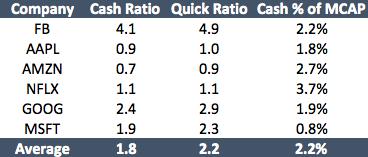
Cash Ratio = Cash / Current Liabilities
Quick Ratio = (Cash + Securities + Receivables) / Current Liabilities
Second, execute trades in a way that helps achieve the best price and minimizes front-running. Gnosis batch auctions are an effective way to decentralize treasury funds on-chain and in a trustless manner without the need for front-running.
At the same time, DAO organizations can diversify assets in several ways without selling protocol tokens:
First, earn income through stablecoins. Aave's reserve factor can generate protocol income in USDC and DAI, as well as stable assets like aTokens, which are interest-bearing assets.
Second, swap tokens with other protocol treasuries. There are few such examples, including the token swap between FWB and WHALE, as well as Yam's proposal for token swaps across the DAO ecosystem.
Ultimately, we will see on-chain asset market fund products that can help treasuries allocate stablecoins and optimize yields. For example, the stable yield index proposed by Index Coop is a product designed to generate the highest risk-adjusted stable yield.
2) Token Buybacks, Rewards, and Liquidity Preparation
Treasuries can conduct buybacks when token prices plummet. Yearn has adopted a policy under YIP-56 to regularly buy back a portion of protocol revenue in YFI. They recently executed a purchase of 28 YFI for $1.2 million, with an average price of $41,621 per YFI.
Treasuries can provide incentives for liquidity mining; they can initiate more such incentive programs through the treasury; the treasury can also become a liquidity provider across multiple protocols and earn fees for this.
4. Mergers, Investments, and Insurance
Mergers can enhance the competitive position of DAO protocols. A decentralized exchange may want to enter the lending space and find that mergers are more effective than internal development. Since NFTs can hold other assets, NFTs can own multiple treasuries and their assets for the DAO. DAOs can bid for specific NFTs representing DAO assets.
Mergers require preliminary work, and a professional merger consulting DAO can assist with:
1) Valuation of DAO assets and intangible assets;
2) The best way to finance acquisitions, i.e., the ideal combination of debt, tokens, and stablecoins;
3) Negotiating terms with governance and major stakeholders;
4) Executing protocol-level mergers when token holders from both communities approve the merger.
Treasuries can make early investments in promising projects that emerge from grant programs, but what if Uniswap's treasury invests in the next Uniswap?
Treasuries can begin diversifying by investing in blue-chip crypto assets like BTC and ETH. Currently, most crypto assets are correlated. Uncorrelated assets include stablecoins, fixed-income products, and on-chain gold. As more uncorrelated assets gain liquidity, creating an on-chain peer risk portfolio will be useful.
Treasuries may also consider purchasing insurance or short-term put options, which can help the protocol weather black swan events (such as contract hacks, economic exploits, and market downturns).
5. Borrowing
The liability function of DeFi protocol treasury balance sheets has been largely underutilized.
As the spending and asset allocation of protocol treasuries become clearer, the next focus area will be treasury liabilities. This includes fixed-rate secured loans, unsecured loans for high-rated treasuries, bond issuance, and credit lines from protocol to protocol. When conditions are right, the treasury should borrow.
Does the treasury need to sell or distribute protocol tokens to spend? The treasury could consider depositing collateral into Yearn, AlChemix, or Maker and borrowing against it.
Here are a few cases of protocol borrowing:
1) Fund development and operations;
2) Fund protocol acquisitions (e.g., Inverse financing acquisition proposal for Tonic).
Under what circumstances should the treasury borrow money instead of using existing assets?
1) Governance rights: Prevent allocating ownership and voting rights to long-term detrimental stakeholders;
2) Low financing costs: The cost of borrowing at a certain interest rate may be lower than the cost of financing through tokens;
3) Payments to contributors: Most contributors are paid in stablecoins, while long-term contributors are partially paid in protocol tokens;
4) Compound interest: Prevent gifting tokens at inopportune times, harming treasury returns.
6. Public Reporting
DAO treasuries are often considered transparent, but if you need to spend hours digging through Etherscan, forums, and voting tools to get a summary of treasury activities, is transparency really useful?
Yearn's Q1 2021 report is an excellent example of treasury information disclosure, including income statements, balance sheets, key revenue drivers, operating expenses, salaries, and priority matters for the protocol.
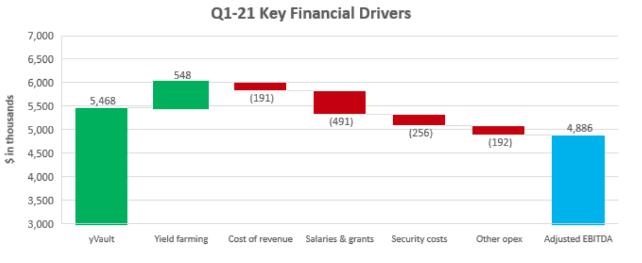
How can we generate this information so that it can be verified with on-chain data? MakerDAO uses Dune Analytics to generate real-time profit and loss and balance sheet data. The next step is to add relevant governance votes and contextual discussions. For example, every large treasury transaction should have a related "receipt" in the form of an on-chain or off-chain vote.
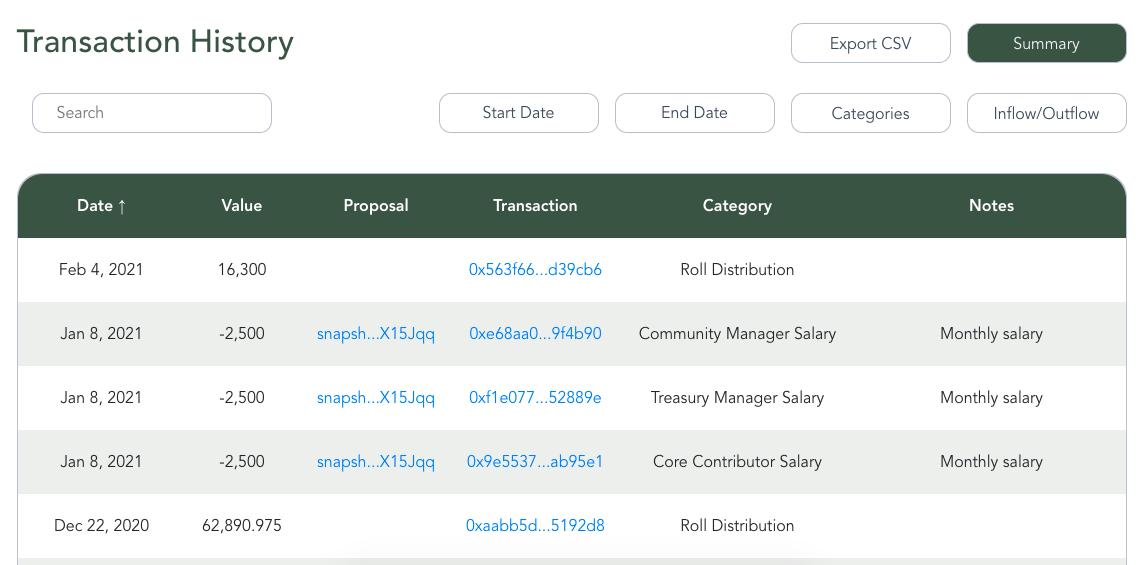
We need an on-chain SEC so that all DAO financial statements and disclosures can be easily accessed.
7. Conclusion
Treasuries help DAOs fund critical developments, expand their networks, express their values, and extend their lifespans.
This is an exciting time, as the work on governance and treasury management is still in its early stages, and templates for organizing and utilizing treasuries are being created.
The future is open for those who want to participate.
 Risk warning
 Risk warning