Messari Annual Crypto Report: 2022 Will Be the Year of DAO

 A DAO is a fluid online community whose assets are managed by contributors of the community. The DAO's tokens determine voting rights, allocate funds based on group priorities, incentivize participation, and punish antisocial behavior.
Original Title: "Crypto Theses for 2022"
Original Source: Messari
Original Compilation: DAOrayaki, DoraFactory
Most technologies tend to automate tedious tasks for marginalized workers, while blockchain automates decentralization. This not only does not lead to taxi drivers losing their jobs but instead causes centralized Uber to fail, allowing taxi drivers to work directly with customers. ------Vitalik Buterin
Our previous discussion in the regulatory section touched on Decentralized Autonomous Organizations (DAOs), but we did not focus on them. We need a complete chapter to explain them; DAOs are one of the most important structures in cryptocurrency that will change various aspects of the economy and politics, and may even change your life in the coming years. If 2020 was the year of DeFi and 2021 was the year of NFTs, then 2022 will be the year of DAOs.
So perhaps we should first answer the question, what is a DAO?
Someone once asked me this at dinner, and I blurted out that it is "a governance structure for managing community finances." That sounds pretty good.
More specifically, a DAO is a fluid online community whose assets are managed by contributors to the community. The organizational primitives of a DAO are code submitted to a public ledger rather than articles filed in Delaware; the blockchain ensures user accessibility, transparency, and exit rights (through forking). The DAO's tokens determine voting power, allocate funds based on group priorities, incentivize participation, and punish antisocial behavior. I also like this simple definition: "a digital-native community centered around shared tasks." The community is bottom-up, flexible, and loosely organized. They share a common mission and protocol (on the blockchain), internal capital, and executable social norms, and they can be used to manage anything from open-source libraries, NFT collections, social clubs, news feeds, to collaborative labor.
Orca's Julia Rosenberg and Maria Gomez also attempted to promote and formalize this definition. They wrote that a DAO is 1) open-source and blockchain-based, 2) membership is open, 3) an independent entity, 4) uses tokens to govern protocols, and 5) allocates internal capital, with the goal of 6) automating markets or functions, 7) preventing collusion, and 8) incentivizing bottom-up community participation.
As you can see, we are still exploring and vocalizing! The way we talk about them will change in the coming years. But regardless of how they are defined, they will gradually grow.
1. Enabling Tools: Wallets and Staking
If the past 18 months have truly been a necessary precursor and installation phase for a real trend, namely the social restructuring around token-managed communities, then what?
If that is the case, you may need some tools to help you securely manage tokens and exchange them peer-to-peer (DeFi), you need better ways to build and selectively share your personal identity (NFT), and ensure you can move smoothly between communities, regardless of the technology stack they use (L1-L2 bridging).
Your personal wallet is the pillar of the Web3 economic system and the wild world of DAOs, just like your personal data vault. Whether it's Metamask or Coinbase on Ethereum, Phantom on Solana, TerraStation on Terra, or others, these tokens in your treasury can unlock your access to the cryptocurrency realm and will only become more important in the coming years. Five years from now, people may look back at the current wallet landscape and laugh at us, but some solutions (like Zapper, Zerion) indicate that we are getting closer to the era where wallets can also serve as universal identifiers and data managers.
Want to join a new social app? Point and click on the avatar you want to wear in the new club. Want to bet on a game? Use real money or your friend's "social credit" score. (Opt-in without CCP). Applying for a new job? Selectively share badges and accumulated reputation that match your skills. All of this requires a front end, and the crypto wallets being built today will serve as your mobile phone, an indispensable part of your life operating system.
(Must-read: Packy elaborates in his article "The Interface Phase")
2. Entering the Rabbithole: Learning and Earning
Rabbithole is one of the most exciting trends at the forefront of cryptocurrency: "Learn to Earn."
The crypto economy is booming, and users' minds are melting from the pace of development. One of the scarcest resources is attention and genuine user engagement. Rabbithole helps users complete tasks, test new products, and earn token rewards. This is a win-win for everyone. Token teams use their funds (which are intended to allocate liquid capital resources for growth) to fund customer acquisition costs, and Rabbithole profits from helping customers, while users are also winners.
The company estimates that its users earned an incredible $175 million from the task of registering an ENS Domain, which has caught people's attention.
Large airdrops may be unsustainable in scale, but they are likely just in their infancy in practice; DAOs have a lot of money and want users. And we know how profitable this market is for those willing to pioneer: Coinbase Earn has an annualized revenue of over $60 million, arguably the highest, while other parts of the business remain underutilized.
The "Learn to Earn" model will be easily integrated into Web3 wallets and custodial wallets. They are user education programs paid for by more crypto natives, thus having more long-term holders. A blockchain could also have a Rabbithole. The world is too big (and the communities too devout?) because it's winner-takes-all; I hope "task developers" will eventually become a profitable profession within DAO communities.
If you are in college, I encourage you to spend your spring semester (perhaps redeploying your book budget to ETH fees) learning and testing different crypto protocols on Earn, Rabbithole, and elsewhere. Best case? You hit the lottery with more airdrops. Worst case? You fail, and once you show them your failing score and NFT merit badge library, you will be hired on the spot by a cryptocurrency company. (Seriously: we have applications that failed, and we love them.)
Much like Twitter > LinkedIn for networking. Learning to earn will gradually replace certificates and will largely gamify and disrupt educational funding models.
3. Working in Web3
After getting to know a project, you may want to dive deeper and make some contributions. Gig work can be spread across various projects or serve as a precursor to a full-time job in a DAO or one of its related companies. Part-time roles cover DevOps, research, governance, data science, and more. Centralized and decentralized communities are also rapidly hiring full-time roles. One crucial point is that DAOs may be one of the most profitable ways to build a lasting reputation across projects. Chris Dixon compared DAO membership to other historical analogies:
"Just as Venice did for early modern Europe, web3 is redefining how global talent gathers their knowledge and works together. Like the Homebrew Computer Club of the 1970s, a community of smart, passionate 'hobbyists' gathered in forums to patch together a new ecosystem to build groundbreaking products and experiences. These communities are organized today through DAOs, which are the primitives for coordinating web3 groups."
However, the craziness of the web3 ecosystem lies in its global accessibility. You don’t need to be born in a specific city or gain admission to a top computer science program. The bottom-up model and opt-in membership of DAOs disrupt the talent model. You can join a Discord server with one click. You can earn bounties and showcase your work proof to earn reputation points through the community's decentralized human resources and community credentials. You can directly apply for grants from DAO members or submit proposals for full-time jobs.
It is rare for people to work for multiple DAOs simultaneously unless they serve in very narrow expert roles (like creating data dashboards or other research reports) or backend functions. For most DAOs, Hollywood is the model. DAO production companies provide funding, project guidance, and team formation. These teams showcase their skills and sincerity in performances, then disperse and move on to the next. Large DAOs will be sticky employers, but most DAOs (including smaller DAOs to larger DAOs!) will be more fluid. The main difference in the Web3 "Hollywood" model is that every contributor—no matter how small—can retain royalties related to the ongoing success of the product.
The challenge we face in the West is understanding whether this will accelerate the outsourcing of white-collar jobs to the lowest-bidding contractors. Will DAOs exacerbate the poor labor dynamics that have already plagued other market providers in the gig economy?
It can be argued that the benefits will significantly outweigh the drawbacks; early contributors will at least share in the benefits of the platforms they help guide, even if these platforms drive variable labor costs. Regardless, Web3 token incentives cannot be invented.
You will one day work for a DAO; you might as well start now from alpha is highest.
4. Hierarchies, Pods, and Fluid Organisms
If you join a DAO, the first thing you will notice is that there is a new "CEO," connecting most DAOs' organizations—the Chief Community Officer. These are the people who capture the production of memes and command (hopefully) the decentralized army of network promoters. In the formative stages of a project, they can guide newcomers to the right resources, set the language and culture of the Discord server, and help manage early internal and external messaging.
This raises several questions. How do we balance choosing a new benevolent dictator and maintaining decentralized decision-making? (Mario has some thoughts… his research on token governance principles is a must-read.) How do we address "token voting" and voter apathy or collusion? (Vitalik has something to say about this.)
The crypto community quickly accepted the fact that decision-making in DAOs is very similar to traditional companies and also requires hierarchy. Governance accountability, community "HR," user and contributor engagement and communication are all important but surmountable challenges. Jai from Rari Capital has a good theory. He suggests breaking roles down into "bubbles," which allows for the existence of sub-DAOs and discrete, fluid teams, a concept pioneered and currently used by Yearn. I think this is the right framework, and it can also drive organizational scaling through written documentation.
We need to see a 100-fold improvement in information flow and decision support tools. Compared to managing a global company, it is easier to manage a global DAO or sub-DAO with NFTs or social currencies (anyone who has been abroad and internationalized knows how incredible it is to build this infrastructure), but that does not change the fact that without delegation functionality, when every micro-decision becomes an agency vote, the progress of the DAO may stagnate.
The Orca protocol* is exploring one of the cooler schemes I have seen. They utilize NFTs as access tokens, giving members a "Pod"—some discrete responsibilities and DAO financial rights. It's as simple as electing a small committee and holding them accountable for the results regularly. However, the oversight responsibility falls on the collective; in this model, the only difference between good governance and bad governance is good information (performance analysis) and voter incentives (overcoming apathy).
But in reality, our early DAOs were not that diverse—by design, they primarily rewarded early users and "the crowd." They formalized what we already know about governance: those with money make the rules. These are fair, but they are also just short-term concerns. From today's global wealth status to now, DAO contributors and users can gain liquid political capital and empowerment at an astonishing rate, and they can do so anonymously. But this also involves taxation, providing benefits, and enforcing compliance. I am not surprised to see some jurisdictions deeming unregistered DAOs illegal as a result. However, other jurisdictions may invite DAO workers with unique tax laws, which explains the difficulty of taxing without employer and bank oversight.
These experiments in this token-controlled world are so early that it almost blows my mind. This is where the future Messari needs to spend most of its resources.
5. The Treasury Management Department of DAOs
The current bull market is one of the largest wealth creation events in the brief history of cryptocurrency. Any institution or individual with reasonable risk exposure in the industry has seen their net worth/balance sheet soar 5-50 times or more in the past 18 months. Some top DeFi protocols themselves are now worth hundreds of millions, sometimes even billions, mostly in their native tokens. Two of the most active DAOs, Uniswap ($4 billion) and Compound ($1 billion), have particularly large foreign exchange reserves.
You might look at these numbers and think that DeFi protocols are financially eternal, but a deeper dive into the composition of each treasury reveals the opposite. The vast majority of "value" in these tokenized bonds comes from a reflexive belief that the market will always absorb new supply. This may happen in a bull market, but when trading volume recedes, the situation can loosen significantly. In fact, this is exactly what happened during the market crash in May.
During black swan events, token prices are at the mercy of the market. In the 2018-2019 bear market, some of the best projects relying on these reserves also struggled to survive. This is before you consider the specific risks of each asset: smart contract failures, hacks, oracle flaws, and code errors can affect token prices even before DAOs consider remedies that could impact all affected users. If the treasury is not managed properly, this could create a vicious cycle.
Other investors have noticed this as well, but despite a general call for better financial diversification in top projects, most DAOs have yet to take action. There are several reasons for this (overconfidence of developers, a desire to avoid the impression of large token holders "dumping" assets on the community, regulatory challenges, etc.), but in many cases, it boils down to a lack of visibility and decision-making tools.
Data sources like DeepDAO do a good job tracking project finances but do not provide the complete context that basic portfolio management tools can offer. Providing the community with better financial analysis can significantly improve their governance decision-making process.
This is not just about best practices in token management; it also involves a lack of professional financial managers. The entry of real financial managers presents a huge market opportunity and will help protocols diversify wisely to ensure they have good capital in various market environments. Unfortunately, you won't like the first suggestion most treasury managers propose today: start selling. If assets spike to 90% just months later, then the Q1 surge does no good for the DAO.
The entry of real financial managers into DAOs is a huge market opportunity that will help protocols diversify wisely to ensure they have ample capital in various market environments. But you won't like the first suggestion most financial managers propose today: start selling. If assets spike to 90% just months later, then the Q1 surge does no good for the DAO.
6. DAO Investor Relations
I began the previous chapter by writing about how anyone can create something that looks like ETH's third-quarter "10-Q" is so crazy. Investor relations are a crucial component of healthy financial markets. In cryptocurrency, the importance of high-quality information is up to 11 (up to 11 is a cultural catchphrase representing something maximized or clearly exceeding limits) because community relations affect how DAOs communicate with investors, liquidity partners, technical counterparties, core contributors, users, and other network drivers. Strong, transparent financial disclosures are the pillars of good corporate governance, but they are limited by quarterly accounting cycles, restricting information flow to just a few times a year.
Blockchain and DAOs provide nearly infinite improvements for quarterly reporting, as information is available for inspection at any time, with processing speed only limited by block propagation time. The open and permissionless nature of blockchain leads to a massive shift, redefining the relationship between protocols and their investors. In this world, financial data is transparent, widely available, and accessible at any time. Protocol stakeholders can track the financial status of their held assets in real-time, and information managers (like Messari) can manage updates over any time frame through a decentralized community of developers, researchers, and data scientists.
Token Terminal (basic data), The Graph (on-chain data), Nansen (fund flows), Dune Analytics (aggregated metrics), DeFiLlama (TVL), and Messari (market data and off-chain events) are now essential tools for helping users gain a comprehensive understanding of protocol-level performance. In the global decentralized analytics community, this combination of data sources provides significant results. Take Compound as an example.
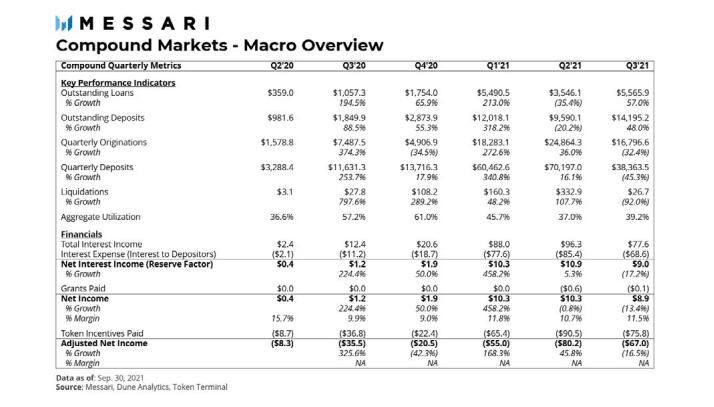
Our quarterly report provides a glimpse into the future of financial reporting. An analyst and data scientist can collaborate to summarize COMP's protocol-level lending activity in the last quarter (including macro and micro levels), as well as off-chain events related to community governance and project technical roadmaps. This report may continue to follow a familiar quarterly, monthly, or weekly rhythm, but the data is real-time, and anyone can explore and combine it.
While there is still much work to be done, the foundational cornerstones needed to build new and improved financial reporting systems are finally here. If executed properly, crypto financial statements will differ significantly from traditional financial statements. Unlike impatiently waiting for quarterly earnings reports, protocol statements are dynamic documents supported by real-time data streams directly from the blockchain. All the pieces are ready to be assembled; now it’s time to build.
7. Messari: Bundling Everything Together
What happens when you combine learning with onboarding incentives (market), a vibrant contributor marketplace (HR), improved funding management and delegation tools (finance and operations), and project reporting/community relations (management)? You have already obtained the full suite of solutions needed to build alternative political, corporate, and social structures within existing governance frameworks.
I am excited to share our vision for Messari in 2022: we are building a redacted.
8. The Legal Framework for DAOs
Managers typically do three things to discourage you from doing what they don’t want you to do: tax you, fine you (or hold you personally liable), or cut off your banking services. One thing that really needs to be figured out is how DAOs operate in the real world from the perspectives of taxation, contract law, and compliance.
In theory, DAOs are actually quite good at eliminating the "banking services" problem because they are essentially a shared bank account. They are also decent at addressing personal liability issues… if you work anonymously and you are confident that your fellow members in the DAO will do the same and are willing to accept the group's liability risk if anything goes wrong. However, if you think you can join as a member, report your taxes from the DAO, and somehow not report to the managers that you are working with an unincorporated partnership, then that would be really bad.
It’s like rolling the dice, isn’t it?
For most ordinary people, resolving contributor liability issues and incorporating DAOs and their communities into global and local tax, banking, and employment compliance will be important. a16z has offered some good suggestions on how to create legitimate DAO entities that may have flexible, independent substructures as unincorporated nonprofit associations (LexNode responded to some of the same ideas), and Wyoming is already leading the nation in this regard as it recognizes DAOs as a limited liability company. (Fun fact! In 1977, Wyoming was the first state to recognize actual limited liability companies. It took the IRS 11 years to acknowledge this status.) This will also become a requirement for most DAOs to contract work between DAOs or between DAOs and businesses.
Given the enthusiasm of this administration for cryptocurrency so far, I hope they take a similarly tough stance on illegal DAOs. Therefore, registering in the U.S. not only needs to meet reporting requirements, pay personal taxes, and submit disclosure information, but also hold individual developers with core tokens accountable in case authorities determine these are general partnerships issuing unregistered securities. I don’t blame teams for moving outside the U.S.
9. New Capital Allocators
I spent some time discussing creator DAOs and social clubs in the NFT section, so I will skip them here and focus on two particularly transformative DAOs in the last two parts of this report: Venture DAOs and Curation DAOs.
In Venture DAOs, the only limit to growth will be natural legal and regulatory constraints. The original phrase "this token is definitely a security" referred to "The DAO" itself. The demand for community investment tools, even later, proved how great the demand was for access to community investment tools used outside the closed communities of recognized investors. Since then, people have been iterating on the Venture DAO model and making it legitimate. Metacartel socialized the token investment process and provided a tool that paved the way for liquid GP incentives (more work = more rewards). The organization can invest in anything that can be tokenized: cryptocurrencies, companies, NFTs, other DAOs, virtual real estate licenses, etc. This is a flexibility in speculation that simply does not exist in the "real world," and it may not exist in the U.S. without upgrading our century-old securities laws. If you look at how isolated the crypto community is, it is almost certain that the future will be the same. Founders invest in other founders for strategic reasons, which manifest as goodwill, aligned interests with partners, staying on top of emerging trends, and keeping a close eye on other emerging projects.
Today, venture capital is investing in DAOs. Or DAO's DAOs. Or registering as investment advisors to eliminate the constraints that prevent VCs from fully embracing crypto imposed by the SEC. Late-stage investors are entering Series A. Early investors are turning to permanent capital tools. It’s almost as if smart money knows that capital markets are dynamic and evolving rapidly. Venture DAOs are already hot, and unless global regulators throw a wrench in the works, I bet that by 2025, one of the most active and largest AUM venture capital firms will be a DAO. We are already starting to see DAO mergers heat up. The next frontier is acquiring a Web2 company into a Web3 company.
10. New Information Curators
If you have been following me and Messari for a while, you know I am optimistic about token-driven information management. The v1 token management registry primitives have some flaws, but overall, managed markets can replace centralized, ad-driven algorithms, improve credentials and social signals, reduce low-value redundant work, and crowdsource high-value unique information work services.
Let’s start with the most important premise: curation markets can create crowd-sourced quality incentives for mission-aligned communities. "Quality is very subjective!" you say, and that’s true—people seem to really enjoy the dopamine (or cortisol?) they get from their current media consumption habits, which is why we are ahead of the game with these sugary, low-nutrition information sources. But web3 does three different things to change that.
- It creates incentives for portable, open user-generated data. Breaking down data silos of Web 2.0 companies will open up infinite possibilities.
- It allows you to reflect on the content you want to curate at any given time: "Hey Facebook, make me happy, make me nostalgic, inspire me, inform me, show me the conspiracy theories and all the facts about this case."
- DAOs will allow you to ally with tribal or individual signal enhancers and build a carefully curated information market around that object.
This opens up possibilities for alternatives to Google search that don’t look like page rankings but more like custom feeds. Or switch information filters based on your mood. Or get paid to be a nonsense caller in post-truth media organizations. Substack has already monetized long-form content in the intellectual dark web. What’s next?
Some content creation projects I am excited about include PubDAO, which aims to build a decentralized Associated Press. (You don’t need 100 versions of the same basic news story!) There’s Messari’s Hub and Analyst DAO for decentralized token research. BanklessDAO is doing some groundbreaking work, crowdsourcing various channels and vertically expanding crypto coverage in its community (art, DeFi, DAOs). As we mentioned earlier, we are starting to see more experiments on how long-form content is funded through Mirror.
Speaking of quantifiable data sources, the prospects are equally exciting. The Graph has turned a token management model into a decentralized blockchain data indexing platform worth billions. For token metrics, there’s Flipside’s MetricsDAO, and I believe we will soon see DuneDAO. Projects like IndexCoop enable curators and information providers to leverage their therapeutic advantages and communities to propose low-lift discretionary indices supporting new synthetic tools. These are simply not possible in regulated financial markets, or even if feasible, would take years and millions of dollars to produce effectively. Beyond crypto, Balaji has also been considering content creation rewards outside of crypto, proposing a competition to create a crowdsourced inflation dashboard.
When I launched Messari to the world in 2017, I wrote that "crypto's Bloomberg" is not a company but a network. As an industry, we finally have the tools to achieve this goal.
 Risk warning
 Risk warning