AMM Revolution Again: PropAMM is Reshaping the DEX Landscape
 Core Viewpoint

 PropAMM is not a paradigm-level innovation like flash loans or AMM, and it will not redefine the fundamental rules of DeFi, but it may be a micro-structural upgrade that DeFi must undergo before achieving mass adoption.
Author: Gu Yu, ChainCatcher
DeFi has not seen a new popular narrative for too long.
However, in the past year, a new concept in the DeFi market that has rarely been noticed by ordinary users but has been repeatedly discussed by professional traders and researchers is rapidly gaining traction: PropAMM.
Kyle Samani, co-founder of Multicoin Capital and current chairman of Forward Industries, tweeted months ago that PropAMM is one of the most important innovations in market microstructure in recent years, and he expects this structure to become the main mechanism for on-chain trading in spot, perpetual contracts, and even prediction markets this year. ETHlab has also publicly stated that it considers PropAMM to be one of the most important research directions.
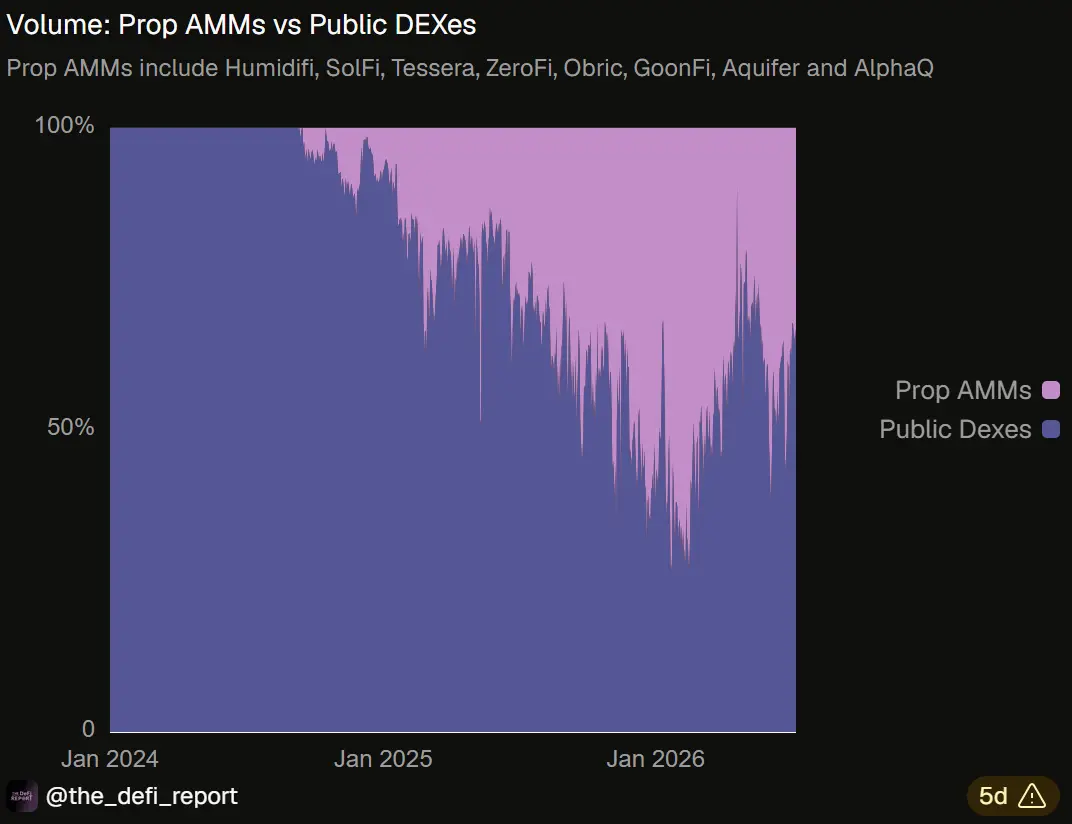
In the main battleground for the PropAMM concept, Solana, the PropAMM market share represented by Bisonfi, HumidiFi, and SolFi reached 70% of the entire DEX market at one point this year. Existing DeFi protocols like Haedal, LFJ, and Genius are also competing to launch PropAMM products on other public chains like Ethereum, Base, and BNB Chain.
Jump Crypto reported that in March 2026, leading PropAMM on Solana processed $19.87 billion in trading volume on SOL/USDC and SOL/USDT, approaching the combined trading volume of similar dollar trading pairs on Binance, Coinbase, OKX, and Bybit.
But paradoxically, this new mechanism that has influenced a large amount of on-chain trading traffic is almost imperceptible to ordinary DeFi users.
Many native PropAMM projects lack official websites, detailed documentation, and even have X accounts that hardly tweet. When users trade on aggregators like Jupiter, 0x, and LFJ, they only notice lower slippage and better execution, but may not realize that the quotes being provided are no longer from traditional AMM pools, but from a closed professional market-making engine.
This is precisely what makes PropAMM worth paying attention to: it may not change the narrative of DeFi's values like AMM, but it is quietly changing the actual experience of on-chain trading.
1. What is PropAMM?
To understand PropAMM, one must first understand the problems with traditional AMM.
Traditional AMMs like Uniswap, Curve, Raydium, and Orca essentially put liquidity into a public pool, with fixed formulas or price curves determining trading prices. Anyone can provide liquidity, anyone can trade, and the rules are transparent, open, and composable.
This was once one of DeFi's greatest inventions. But it also has inherent flaws: price updates are not flexible enough, capital utilization efficiency is not high enough, and it is easy for more professional traders to "pick off cheap goods" (MEV). When the price on centralized exchanges has changed, but the on-chain pool has not yet updated, arbitrage bots will quickly trade to bring the price back to a reasonable level. Ultimately, ordinary LPs often bear impermanent loss, and ordinary traders may encounter higher slippage and worse execution.
PropAMM operates quite differently. Instead of having countless ordinary LPs put money into a pool waiting for trades, it has a professional market-making team using its own funds and proprietary algorithms to continuously provide buy and sell quotes on-chain.
The market defines PropAMM as: an on-chain market-making program that can provide executable buy and sell prices for trading pairs, unlike passive AMMs that mainly rely on fixed curves, but can continuously adjust prices and liquidity behavior based on proprietary market-making logic.
In simple terms, traditional AMMs are like vending machines, with prices determined by public formulas; PropAMMs are more like professional counters, where market makers adjust prices based on market prices, inventory, risk, and real-time trading.
The capital in PropAMM is not spread across a wide price curve waiting for low-probability trades, but is concentrated as much as possible in "the place where the next trade is actually going to happen." This is why it can improve capital efficiency.
Kevin, the founder of HumidiFi, stated in an interview that HumidiFi uses its own inventory and predictive pricing models for quoting. Traditional AMM liquidity is passively lying in pools, while PropAMM updates prices multiple times within each block, even approaching updates every 50 milliseconds under Solana's current infrastructure.
Kevin further stated that with about $8 million in inventory, HumidiFi can regularly handle daily trading volumes of $500 million to $1 billion, a level of capital efficiency that traditional AMMs find difficult to achieve. The logic is to push the concentrated liquidity of Uniswap v3 to the extreme: all liquidity only serves the next trade, rather than sleeping at positions far from the current price.
2. Trends and Controversies
Lifinity is widely regarded as the first project to introduce a proprietary AMM model, launched on the Solana chain in January 2022. It positioned itself as an "oracle-based AMM," actively updating prices through oracle price feeds to reduce impermanent loss and guard against toxic flow, and is seen as the earliest prototype of PropAMM.
Although Lifinity proposed the early concept, it was the new generation of projects that began to emerge on Solana in 2024 that truly popularized the term "PropAMM" and formed a scaled ecosystem. The earliest core projects in this batch mainly include three: SolFi, ZeroFi, and Obric.
By 2025, projects like HumidiFi, GoonFi, and Tessera V (launched by Wintermute) began to emerge, with HumidiFi eventually becoming the largest PropAMM by trading volume on Solana, accounting for nearly 50% of all PropAMM trading volume.
In December 2025, the SoL treasury company Forward Industries announced the launch of its self-developed AMM platform BisonFi, once again changing the market landscape and surpassing HumidiFi to become the PropAMM with the highest market share on Solana.
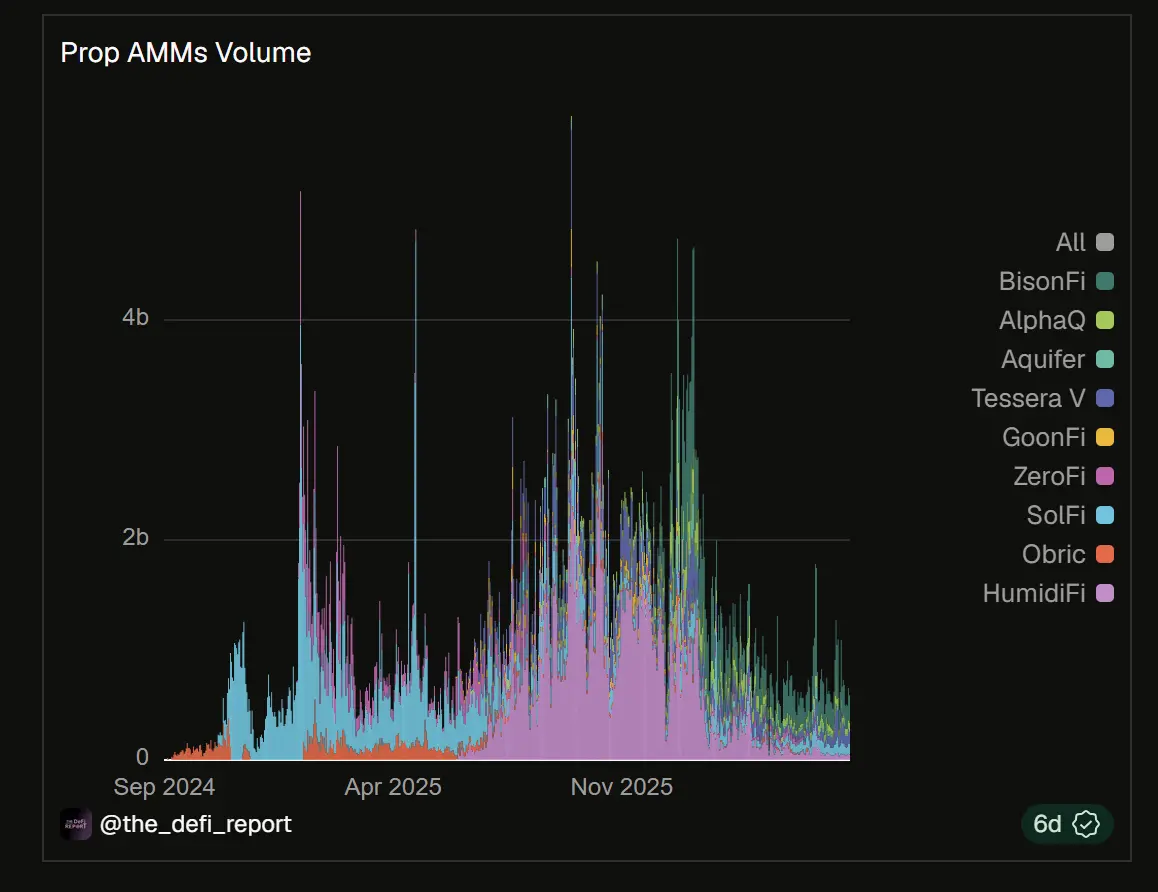
Source: Dune
According to RootData's statistics, there are currently 12 PropAMM projects in the crypto market. Considering that many projects have not officially disclosed, the potential number of projects is expected to exceed 20, and more existing DeFi protocols are announcing the adoption of PropAMM mechanisms.
However, as a major competitor to the PropAMM mechanism, Uniswap founder Hayden Adams has been quite restrained in his evaluation of PropAMM. He believes that the "efficiency" of PropAMM comes from external price sources, essentially assuming that prices are discovered elsewhere and then imported on-chain; when a market itself becomes the largest market, oracles become irrelevant. In contrast, AMMs are more ambitious because they assume they are the place where price discovery occurs.
This statement highlights the core controversy of PropAMM: is it enhancing DeFi, or is it turning DeFi into an on-chain execution layer for centralized markets?
PropAMM quotes typically rely on external market prices, private models, and professional inventory management. It is very user-friendly but not friendly to ordinary LPs, as most users cannot directly participate in market-making; it improves execution efficiency but reduces strategy transparency; it keeps more trading flow on-chain but turns liquidity provision back into a game for a few professional players.
Solana's official article also frankly states that PropAMM currently faces several issues: price updates depend on whether block leaders timely include transactions, updates still require payment, aggregator integration is not completely permissionless, most code is closed-source, users find it difficult to verify whether they are getting the best price, and currently, PropAMM does not support truly open liquidity deposits.
In March 2026, DEX aggregator protocol 0x released a report stating that some PropAMMs on the Base network exhibited systemic quote fraud. The research found that these operators utilized Base's Flashblock architecture to publish highly attractive prices in the last approximately 200 milliseconds before a block ended to attract aggregator routing, but immediately adjusted prices at the start of the next block. Such behavior typically results in traders facing an additional loss of 5 to 10 basis points—calculating to a potential loss of $500,000 per month for a single liquidity source based on a monthly trading volume of $1.1 billion.
This finding further reveals the dark side of PropAMM: when liquidity is controlled by a few closed-source professional institutions, these institutions may also exploit information asymmetry to harm user interests.
3. Why Pay Attention to PropAMM?
PropAMM is not a paradigm-level innovation like flash loans or AMMs. It will not redefine the foundational syntax of DeFi, nor will it suddenly make every user aware of a new product form.
But it may be a microstructural upgrade that DeFi must undergo before moving towards mass adoption.
Because most users do not care whether their trades are based on x*y=k, concentrated liquidity, or a proprietary quoting model from a professional market maker. What they care about is: are the prices good enough, is the slippage low enough, is the execution fast enough, and can they be harmed less by MEV and outdated prices.
The answer PropAMM provides is very realistic: for a better trading experience, DeFi may need to accept more specialized, closed, and strategic liquidity. This will have several layers of impact on the DeFi market.
First, the competitive standards for DEXs will change. In the past, DEXs competed on TVL, the number of trading pairs, and incentive intensity; in the future, more important metrics will be execution quality. For the same SOL/USDC or ETH/USDC trade, whoever can provide better execution will gain aggregator routing and user order flow.
Second, the power of aggregators will further rise. PropAMM typically does not directly target ordinary users but obtains traffic through aggregators like Jupiter, 0x, and LFJ. Whoever controls order routing can decide which type of liquidity receives trading flow. DeFi is shifting from "pool competition" to "routing competition."
Third, the role of ordinary LPs will be compressed. In long-tail assets, early projects, and community tokens, traditional AMMs remain irreplaceable; but for mainstream trading pairs, ordinary LPs find it difficult to compete with professional market makers. In the future, ordinary users may no longer directly act as LPs but participate indirectly in earnings through vaults, deposit products, protocol tokens, or open quotas from market makers.
Fourth, DeFi will resemble traditional finance more. The essence of PropAMM is to bring professional market-making, inventory management, low-latency quoting, risk control, and private strategies on-chain. It makes on-chain trading more efficient and makes DeFi more like a financial market driven by professional intermediaries.
The reason traditional finance has professional market makers is that complex markets require professional risk bearers. Early DeFi believed that code and open pools could replace everything, but the market ultimately proved that in high-frequency, high-volatility, and highly competitive trading environments, specialization remains important.
In a sense, this is a "regression," and it may weaken the early DeFi ideal of "anyone can be an LP," but it may also give on-chain markets the first real competitive execution capability against centralized exchanges.

 Risk warning


Popular articles