Morning Report | Ethereum institutional privacy technology company EthSystems officially established, creating Ethereum privacy solutions for institutions; four departments in South Korea will meet on Thursday to discuss the risks of single-stock leveraged ETFs

 July 14 Market Important Events Overview
Compiled by: ChainCatcher
What important events have occurred in the past 24 hours?
Wintermute: Bitcoin shows "bearish resilience" bottoming characteristics, key resistance level at $67,250
ChainCatcher reports that Wintermute released a market analysis stating that despite multiple geopolitical shocks such as the U.S. airstrikes on Iran and the closure of the Strait of Hormuz, Bitcoin has maintained a critical support level of $62,000, demonstrating strong resilience in the market. Last week, as U.S.-Iran negotiations were paused due to related issues, Iran attacked commercial vessels, and the U.S. launched a new round of airstrikes, Tehran announced the indefinite closure of the Strait of Hormuz, causing international oil prices to surge significantly, with Brent crude oil seeing a weekly increase of 6.3%, and the 10-year U.S. Treasury yield rising to 4.57%. The market has readjusted the probability of a Fed rate hike in September to about 61%, and the U.S. CPI data to be released this week will be a key indicator affecting expectations for the July FOMC meeting. In the crypto market, Bitcoin has remained stable despite continuous geopolitical risk events, holding the $62,000 area after a minimum pullback and gradually rising to around $64,000. Ethereum performed even stronger, with prices nearing $1,805. Meanwhile, the eight-week trend of ETF fund outflows has finally ended, with Bitcoin and Ethereum-related products recording a total inflow of about $282 million last week. Although the weekly inflow is still insufficient to confirm a trend reversal, combined with the recent continuous accumulation by whales and the market's weakened reaction to bearish news, marginal selling pressure is easing, and the market may be forming a phase bottom. Additionally, the market's reaction to Strategy selling Bitcoin has been muted, contrasting sharply with two months ago when the sale of just 32 BTC triggered a sell-off, indicating that investor concerns about potential selling pressure have significantly decreased. Currently, Bitcoin has shown "bearish resilience" bottoming characteristics, but the market still needs to wait for further confirmation. Key factors moving forward include U.S. CPI performance, whether ETF funds can continue to flow in, and developments in the Strait of Hormuz situation. If inflation data cools, and fund flows continue to improve, pushing the CLARITY Act forward, Bitcoin is expected to challenge the key resistance level of $67,250; conversely, sustained increases in oil prices and rising macro pressures may still put the $60,000 support to the test.
Fidelity Strategist: The long-term value of tokenized funds for institutions lies in balance sheet management, not 24/7 liquidity
ChainCatcher reports that according to Coindesk, Giselle Lai, Director and Digital Asset Strategist for Fidelity International in the Asia-Pacific region, stated that the most attractive long-term use case for tokenized funds for large global institutions is not 24/7 liquidity, but balance sheet management. Lai pointed out that global institutions typically need to hold cash in multiple jurisdictions, manage currency exposure, and meet regulatory requirements, while these bank deposits often do not generate returns. Compared to traditional account systems, tokenized tools can provide 24/7 interest, enhance fund transfer efficiency, and better serve institutional liquidity and collateral management needs. She also mentioned that current tokenized products are mainly applied in investment scenarios, with the most popular being tokenized money market funds primarily backed by U.S. Treasury bonds. Institutional investors are not truly concerned about the "tokens" themselves, but rather whether they can help asset management become faster and cheaper.
Four departments in South Korea to meet on Thursday to discuss risks of single-stock leveraged ETFs
ChainCatcher reports that according to The Korea Times, South Korea's financial regulatory authorities will hold a high-level meeting on Thursday to discuss the risks and countermeasures related to single-stock leveraged ETFs. This meeting is expected to take place within the framework of the South Korean government's macroeconomic and financial issue coordination mechanism known as the "F4 Meeting," with officials from the Ministry of Finance and Economy, the Financial Commission, the Financial Supervisory Service, and the Bank of Korea in attendance. Recently, the volatility in the South Korean stock market has intensified, and single-stock leveraged ETFs are receiving increasing attention from regulators and market participants. Various parties believe that these products have become significant factors driving sharp fluctuations in stock prices. Informed officials stated that regulatory authorities have been coordinating relevant plans internally in recent days, but the policy direction has not yet been finalized. Possible measures under discussion include raising margin requirements, limiting daily price fluctuations, and adjusting leverage multiples. However, regulatory officials believe that these measures may only provide temporary relief and are unlikely to fundamentally address the structural causes of market volatility.
Franklin Crypto CIO: Cryptocurrency prices are disconnected from fundamentals, institutional adoption accelerating
ChainCatcher reports that according to CoinDesk, Seth Ginns, Chief Investment Officer of Franklin Crypto, stated that although digital asset prices have not reflected the strongest fundamentals in the industry for years, institutional adoption of crypto is accelerating. Ginns pointed out that the momentum of integration between traditional finance and crypto is strong and believes that liquidity crypto investments are becoming increasingly attractive under current market conditions. He mentioned that Robinhood's blockchain initiatives are an example of the shift from traditional financial distribution to crypto infrastructure, with tokenized money market funds, tokenized stocks, and stablecoin adoption driving the integration of traditional finance and blockchain technology. Ginns expects that the Senate vote on the Clarity Act will provide more regulatory certainty for institutions and is optimistic about Hyperliquid's revenue-driven token buyback model. He also believes that DeFi protocols such as Uniswap, Aave, and Chainlink can benefit from improved token value capture mechanisms.
Dragonfly Partner Haseeb: DeFi "hacker apocalypse" has not materialized, estimated theft amount in 2026 to be about $1.89 billion annually
ChainCatcher reports that Dragonfly partner Haseeb responded on Twitter to OpenZeppelin co-founder Manuel Aráoz's previous pessimistic views on DeFi security, arguing that with models like GLM 5.2, Fable, and GPT 5.6 now online and actively used by attackers, DeFi has not experienced the anticipated "hacker apocalypse." Data from charts indicate that based on current year-to-date data and operating rates, the estimated amount stolen in DeFi in 2026 will be about $1.89 billion annually, with approximately $986 million stolen this year, lower than the levels seen in 2025, and still within historical ranges. Haseeb believes that the deeper change is that while the number of hacker attacks has increased, the scale of individual attacks has decreased more rapidly, with attackers increasingly targeting smaller protocols and abandoned projects, while larger protocols have completed more security enhancements, thus the overall safety of funds has not significantly deteriorated.
JPMorgan suggests closing U.S. Treasury long-end spread trades, awaiting CPI and Waller's testimony
ChainCatcher reports that according to Jin10, JPMorgan strategists have advised investors to close trades on the flattening of the 10-year to 30-year U.S. Treasury yield curve ahead of the release of U.S. CPI data and Federal Reserve Chairman Waller's first testimony before Congress to mitigate upcoming event risks. The strategists noted that due to escalating geopolitical tensions and hawkish comments from Fed officials, short-end U.S. Treasury yields rose by 6 basis points, and the yield curve flattened by 3 basis points. Waller expressed concerns that high inflation could become entrenched in market inflation expectations, stating that if CPI data continues to show strong core inflation pressures, the Fed will need to consider tightening monetary policy in the near term.
Stablecoin market shrinks by $10 billion in two months, overall decline of about 3%, far below 2022 bear market levels
ChainCatcher reports that the total circulation of stablecoins has fallen by about $10 billion from the peak in May 2026 to approximately $312 billion, with a decrease of $7.7 billion in June alone, marking the largest single-month dollar decline since the Terra-Luna incident in 2022. Tether USDT's supply dropped from about $190 billion to approximately $184 billion, while Circle USDC fell from nearly $80 billion to about $73 billion. However, the overall decline is only about 3%, far below the over 26% contraction seen during the 2022-2023 bear market. Market participants believe this fluctuation is a normal adjustment within a strong long-term growth trend, as the market capitalization of stablecoins had doubled within two years. A previous decline of about $9 billion was also observed from late 2025 to early 2026, followed by a return to historical highs. Positive aspects include regulatory advancements such as the GENIUS Act driving new competitors into the market, and the circulation of regulated products like Paxos' Global Dollar (USDG) increasing, with major financial institutions still expecting the stablecoin market to reach trillions of dollars by the end of this decade.
U.S. banking industry calls for tightening CLARITY Act stablecoin yield rules, warns it could impact $1.3 trillion in deposits
ChainCatcher reports that according to Cryptonomist, banking industry groups such as the American Bankers Association and the Independent Community Bankers of America are urging the Senate to further tighten provisions related to stablecoin yields in the CLARITY Act. Previously, the Senate Banking Committee passed the bill on May 14, 2026, with a vote of 15 to 9, incorporating some amendments pushed by Senators Thom Tillis and Angela Alsobrooks, but the banking industry believes that the existing text still does not fully close the incentive space for "yield-like" stablecoins. The Independent Community Bankers of America previously estimated that if the bill does not further strengthen yield restrictions, stablecoins could lead to a loss of about $1.3 trillion in deposits from the banking system and reduce community banks' lending capacity by about $850 billion, thereby affecting credit access for small businesses, agriculture, and families in underdeveloped areas.
Probability of Fed keeping rates unchanged in July at 63.1%, probability of rate hike in September at 51.4%
ChainCatcher reports that according to Jin10, CME's "FedWatch" shows that the probability of the Fed keeping rates unchanged in July is 63.1%, while the cumulative probability of a 25 basis point rate hike is 36.9%. By September, the probability of keeping rates unchanged is 28.3%, while the cumulative probability of a 25 basis point hike is 51.4%, and the probability of a 50 basis point hike is 20.4%.
a16z: TradFi is not embracing DeFi models, but accelerating the adoption of blockchain technology
ChainCatcher reports that a16z published a blog post stating that as traditional financial institutions accelerate their exploration of blockchain technology, the market generally believes that a comprehensive integration of DeFi (decentralized finance) and TradFi (traditional finance) will occur in the future, forming a new financial model through the combination of decentralized finance and institutional distribution systems. However, the reality may not be so. The core motivation for traditional financial institutions to adopt blockchain is not to embrace decentralization but to value its commercial benefits in reducing costs, improving settlement efficiency, expanding distribution channels, and optimizing customer relationship management. What is more likely to emerge in the future is a new type of "programmable financial infrastructure" based on blockchain's underlying technology, optimized for institutional needs, rather than a simple integration of traditional finance and DeFi. Institutions are selectively absorbing some technical capabilities from DeFi and modifying them according to their regulatory, risk management, and operational requirements. For example, atomic settlement can reduce counterparty risk, shared ledgers can lower back-office reconciliation costs, and programmable funds can automatically execute processes such as interest payments, margin management, and corporate actions. Automated market-making models are also being applied to on-chain foreign exchange and tokenized asset pricing. However, at the same time, the native DeFi features of open access, anonymity, and trustless execution often conflict with institutions' requirements for compliance, control, and accountability. Therefore, cases like JPMorgan's institutional blockchain projects, BlackRock and Franklin Templeton's tokenized funds, are essentially not traditional finance entering DeFi, but rather using blockchain technology to improve existing financial business processes. In the future, the blockchain industry will have two development paths: on one hand, enterprises and financial institutions will continue to drive the implementation of regulatory-compliant blockchain infrastructure, expanding the industry scale through applications like stablecoins, tokenized assets, and on-chain settlements; on the other hand, open networks will continue to play the role of innovation sources, continuously generating new financial primitives and market mechanisms, providing technical reserves for future institutional infrastructure. TradFi and DeFi are not in competition but are developing together in different directions. Traditional finance may not fully adopt DeFi models but will gradually adopt parts that suit its needs. The real integration may ultimately occur at the underlying blockchain network level, rather than one side replacing the other. For developers, the key is not to chase all markets simultaneously but to clarify the target audience: for institutions, products need to be built around compliance, risk control, and long-term business processes; for open networks, exploration of innovation, liquidity, and network effects should continue. The future financial system may operate on blockchain infrastructure, but the most important innovations may still come from open networks first.
Probability of Fed keeping rates unchanged in July at 58.3%, probability of rate hike in September at 51.2%
ChainCatcher reports that according to Jin10, CME's "FedWatch" shows that the probability of the Fed keeping rates unchanged in July is 58.3%, while the cumulative probability of a 25 basis point rate hike is 41.7%. By September, the probability of keeping rates unchanged is 24.9%, while the cumulative probability of a 25 basis point hike is 51.2%, and the probability of a 50 basis point hike is 23.9%.
Probability of Fed rate hike in July rises to about 45%
ChainCatcher reports that according to Jin10, U.S. short-term interest rate futures indicate that the probability of a Fed rate hike in July is about 45%, up from 35% earlier on Monday.
Ethereum institutional privacy tech company EthSystems officially established, creating Ethereum privacy solutions for institutions
ChainCatcher reports that the Ethereum institutional privacy tech company EthSystems has announced its official launch and received strategic funding support from ecosystem backers such as Bitmine, Sharplink Gaming, and Joe Lubin. EthSystems focuses on developing privacy technologies for banks, asset management companies, and other regulated entities, enabling institutions to execute financial transactions on the Ethereum network at scale while protecting sensitive information such as transaction details and customer identities. The company was founded by the core team of the Ethereum Foundation's Institutional Privacy Task Force (IPTF). The team has publicly conducted a year-long open-source development on the EthSystems website and has established partnerships with several central banks, regulatory agencies, large banks, and asset management institutions. EthSystems stated that while institutions have begun exploring stablecoins, tokenized assets, and Ethereum-based settlement solutions, large-scale adoption still faces privacy and compliance challenges. Financial institutions need more than just access to blockchain networks; they require a complete infrastructure that meets business confidentiality protection, regulatory requirements, and compatibility with existing financial systems, aiming to create a "selective disclosure" privacy architecture that allows transaction participants to view only the information they are authorized to access while retaining the core advantages of Ethereum's decentralization, security, and openness, and complementing two other organizations: Ethlabs, focusing on Ethereum core protocol and infrastructure development; Ethereum Institutional, responsible for institutional collaboration, education, market research, and ecosystem coordination; EthSystems, focusing on application layer technology, transforming institutional needs into practical privacy protocols and financial systems.
Stablecoin payment startup Velocity completes $38 million Series A financing, led by Dragonfly
ChainCatcher reports that according to Fortune magazine, stablecoin payment infrastructure startup Velocity announced the completion of $38 million in Series A financing, led by crypto investment firm Dragonfly, with participation from Coinbase, Capital One Ventures, and Wintermute. Velocity CEO Eric Queathem did not disclose the latest financing valuation. Founded in 2025, Velocity focuses on providing stablecoin payment solutions for enterprises, payment service providers, fintech companies, and financial institutions, helping them optimize cross-border payments, fund settlements, and fund management processes using dollar-pegged tokens. Currently, Velocity has covered markets in the U.S., parts of Europe, and Australia, and plans to use the new funds to apply for licenses to expand into Africa and Latin America, while also investing in building a more secure asset custody infrastructure and developing new features, including stablecoin yield products.
DeepMind co-founder predicts AGI could be achieved in a few years, calls for establishment of cutting-edge AI standards regulatory body
ChainCatcher reports that Google DeepMind co-founder Demis Hassabis recently published an article predicting that artificial general intelligence (AGI) could be achieved in just a few years, with its transformative impact expected to be ten times that of the industrial revolution, and its development speed ten times faster. He pointed out that as the potential risks of cutting-edge models in areas such as cybersecurity, nuclear energy, and biology become increasingly prominent, there is an urgent need for the industry to establish solid safety protections for future AI systems with autonomy and self-improvement capabilities. To balance technological innovation and safety risks, Hassabis called for the U.S. to take the lead in establishing a "cutting-edge AI standards agency" similar to the Financial Industry Regulatory Authority (FINRA). This agency would operate through public-private partnerships or self-regulatory organizations, managed by independent technical experts and representatives from the open-source community, primarily funded through industry contributions. Its core function would be to develop dynamic scientific assessment protocols, initially requiring cutting-edge labs to voluntarily submit for review 30 days before releasing models, with plans to eventually transition to mandatory market entry testing, while non-cutting-edge models from startups or academic institutions would be exempt. This framework aims to address unknown crises through a technology-driven review mechanism and to promote a global consensus on AI risk management.
Bank of America survey shows 83% of investors expect the Fed will not raise rates before November
ChainCatcher reports that according to Jin10, a Bank of America fund manager survey shows that 83% of investors expect the Fed will not raise rates before the November midterm elections in the U.S.
Cap team responds to Stabledrop controversy, admits early commitment error and clarifies insider rumors
ChainCatcher reports that in response to recent market controversies regarding the reduction of Stabledrop shares, Cap founder Benjamin issued a statement apologizing and providing a detailed response. He stated that the team prematurely committed to an airdrop scale of 11 million when funding had not yet been fully secured, but subsequent changes in market conditions led to a fundraising amount below expectations, resulting in the actual airdrop pool shrinking to 4.2 million. To avoid substantial principal losses for early YT (yield token) holders, the team temporarily adjusted the originally planned linear distribution scheme to a "capital preservation but no profit" restructuring model to ensure no one incurs losses, which applies equally to all wallets. Meanwhile, in response to community concerns about a related whale address allegedly "internally boosting scores," Benjamin clarified that the wallet belongs to a former colleague and is not operated by the team, and that project treasury funds have not been utilized. Additionally, he emphasized that the Cap protocol is still functioning healthily, and the decline in TVL observed over the weekend was primarily due to a spike in borrowing rates for USDM on Aave in MegaETH, leading arbitrageurs to exit, unrelated to the recent airdrop controversy, with all redemptions having been processed smoothly.
Coinbase: Bitcoin's relative resilience under multiple bearish pressures may indicate the market is bottoming
ChainCatcher reports that Coinbase Institutional stated that U.S. non-farm payrolls fell far below expectations, but the escalation of conflicts in the Middle East has brought inflation risks back into focus. The market is shifting towards pricing in "high rates maintained for longer," with financial conditions tightening further, putting pressure on long-term risk assets, and the probability of another rate hike within the year is also rising. Under multiple bearish pressures, BTC has only dropped about 2%, and this relative resilience may indicate that the market is undergoing a bottoming process.
PinGo reports theft of 840,000 tokens: risks have been swiftly controlled and contract upgrades completed
ChainCatcher reports that according to official news, PinGo stated that its reward contract was recently attacked by hackers. The hackers exploited a permission verification vulnerability to illegally claim 840,000 PINGO tokens. PinGo officials pointed out that the security incident has been effectively controlled, remaining assets have been migrated, and relevant contract upgrades have been completed. The officials emphasized that PINGO tokens and related private keys remain secure, and the reward claiming function has been reopened.
EU sanctions "most active ransomware operator in history" Stern, involved in over $300 million in ransom flows
ChainCatcher reports that the U.S., EU, and UK jointly announced sanctions against a group involved in state-level hacker organizations, cybercrime gangs, and their infrastructure providers, which have collectively caused billions of dollars in losses to global businesses, critical infrastructure, and government agencies. Among them, the EU's sanctions against Russian cybercriminal Vitaly Nikolayevich Kovalev (alias "Stern") have garnered significant attention. The EU has identified Stern as one of the core managers of the notorious Trickbot Group ransomware group, which includes several high-risk ransomware variants such as Conti ransomware and Ryuk. On-chain analysis shows that wallet addresses associated with Stern have received over $300 million in ransom payments, potentially making him the "largest confirmed ransomware operator" to date. Analysis indicates that the $300 million only represents Stern's personal earnings, while the overall illegal income of the Trickbot group may be much higher. On-chain fund flows indicate that Stern has had transactional ties with multiple ransomware ecosystems, including Ryuk, Conti, Diavol, Karakurt, Royal, and Quantum. Investigations show that Stern plays a role similar to "CEO" within the Trickbot organization, responsible for budget management, personnel recruitment, infrastructure procurement, and attack planning.
AI compliance infrastructure company Hadrius completes $27 million financing, led by CRV
ChainCatcher reports that according to PR Newswire, AI compliance infrastructure company Hadrius announced the completion of $27 million in seed and Series A financing, led by CRV, with participation from Y Combinator, Pathlight Ventures, and founders of Altruist, Jump AI, and FINNY. The new funds will be used to build AI-native compliance infrastructure for the financial services industry, integrating decentralized compliance reviews, risk monitoring, and regulatory document management into a single intelligent workflow through Agentic AI technology.
SK Hynix ADR ignites market divergence, Huobi HTX to live stream analysis of new logic in AI chip investment
ChainCatcher reports that according to official social media news, Huobi HTX will hold a live stream today at 20:30 on the theme "The First Major Test of AI Chip Faith: SK Hynix ADR's Three-Day Journey, from a 13% Surge to a Korean Stock Market Circuit Breaker." At that time, crypto KOLs such as MEJ, Mao Mao Jie, 77, and Zhen Cheng Xiao Dao Shi will be invited to discuss the dramatic price fluctuations of SK Hynix ADR after its listing, whether the high valuation logic of the AI chip sector is facing its first pressure test, and future investment opportunities in the AI computing industry, while analyzing global tech stock trends and the rotation of funds in the crypto market to explain the next stage of trading themes in the AI narrative for investors.
Data: Bitcoin spot ETFs saw a total net outflow of $425 million yesterday, with Grayscale BTC net inflow of $53.376 million leading the way
ChainCatcher reports that according to SoSoValue data, yesterday (Eastern Time July 13) Bitcoin spot ETFs saw a total net outflow of $425 million. The Bitcoin spot ETF with the highest single-day net inflow yesterday was Grayscale's Bitcoin Mini Trust ETF BTC, with a single-day net inflow of $53.376 million, bringing the historical total net inflow for BTC to $2.547 billion. The second was VanEck ETF HODL, with a single-day net inflow of $6.1399 million, bringing HODL's historical total net inflow to $1.142 billion. The Bitcoin spot ETF with the highest single-day net outflow yesterday was Fidelity's ETF FBTC, with a single-day net outflow of $246 million, while FBTC's historical total net inflow stands at $9.905 billion. As of the time of publication, the total net asset value of Bitcoin spot ETFs is $74.79 billion, with an ETF net asset ratio (market cap relative to total Bitcoin market cap) of 5.99%, and historical cumulative net inflows have reached $50.852 billion.
Data: Ethereum spot ETFs saw a total net outflow of $15.4092 million yesterday, with Fidelity FETH leading the outflow
ChainCatcher reports that according to SoSoValue data, Ethereum spot ETFs saw a total net outflow of $15.4092 million yesterday. The Ethereum spot ETF with the highest single-day net outflow was Fidelity's ETF FETH, with a single-day net outflow of $15.4092 million, bringing FETH's historical total net inflow to $2.134 billion. As of the time of publication, the total net asset value of Ethereum spot ETFs is $9.458 billion, with an ETF net asset ratio (market cap relative to total Ethereum market cap) of 4.43%, and historical cumulative net inflows have reached $10.958 billion.
Data: LAB will unlock 16.23 million tokens on July 14, accounting for approximately 1.6% of total supply
ChainCatcher reports that according to CoinLaunch data, LAB Terminal will welcome a token unlock for investors on July 14, with the unlock amount being 16.23 million LAB, accounting for approximately 1.6% of the maximum supply. This unlock corresponds to a value of about $4.06 million, accounting for 8.5% of the investor share, approximately 5.0% of the current market cap. Meanwhile, the total allocation for investors is 192 million LAB, of which 94.6 million LAB have been unlocked, accounting for 49.27% of that allocation; subsequent monthly unlocks of 16.23 million LAB will occur from August 14 to December 14, 2026. Additionally, 70.8% of the token supply is still marked as "Untracked," with the page indicating that this data is unavailable, and related tokens may be unlocked at any time. In terms of market performance, LAB is currently priced at $0.3777, with a 7-day decline of 97.6%, and a current market cap of approximately $12.2 million.
Binance.US CEO: The exchange is rebuilding, aiming to regain 20% market share in the U.S.
ChainCatcher reports that according to CoinDesk, Binance.US CEO Stephen Gregory stated that the exchange is in a rebuilding phase after two years of regulatory setbacks, aiming to regain 20% of the U.S. cryptocurrency market share. Binance.US plans to attract customers back through ultra-low fees, new regulated products, and deeper liquidity. Over the past two years, Binance.US has been affected by multiple regulatory lawsuits and enforcement actions, leading to a significant decline in its market share in the U.S. The exchange was previously one of the largest cryptocurrency platforms in the U.S., holding about 20% of the market share at its peak in 2022. The current management of Binance.US stated that the company will focus on compliant operations and launch new product lines that meet U.S. regulatory requirements to rebuild user trust. Binance.US is an independent operating entity of the Binance Group in the U.S., completely separate from the global Binance platform in terms of operations and legal entities.
New Hampshire governor signs Blockchain Basic Laws to protect blockchain innovation and crypto users
ChainCatcher reports that New Hampshire Governor Kelly Ayotte signed HB 639 last week, making it law. This bill, known as The Blockchain Basic Laws, provides protection for cryptocurrency innovation and usage in the state and allows for the establishment of special blockchain dispute case files in the superior court. New Hampshire passed a strategic Bitcoin reserve bill last year, allowing the state treasurer to invest up to 5% of public funds in Bitcoin, as well as precious metals such as gold and silver. The state's executive council recently vetoed a proposal allowing the New Hampshire Business Finance Authority to promote Bitcoin-backed municipal bonds.
Waller: Any changes to the Fed's balance sheet policy will be announced in advance
ChainCatcher reports that according to Jin10, Fed Chairman Waller stated that any changes to balance sheet policy will be announced in advance.
Meme Popularity Rankings
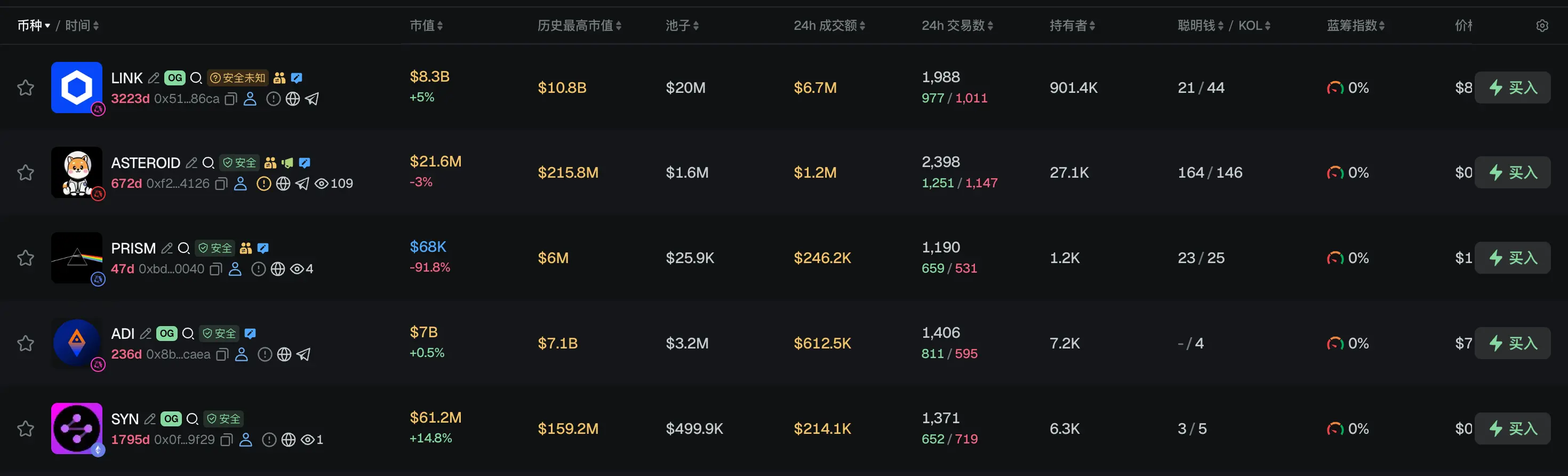
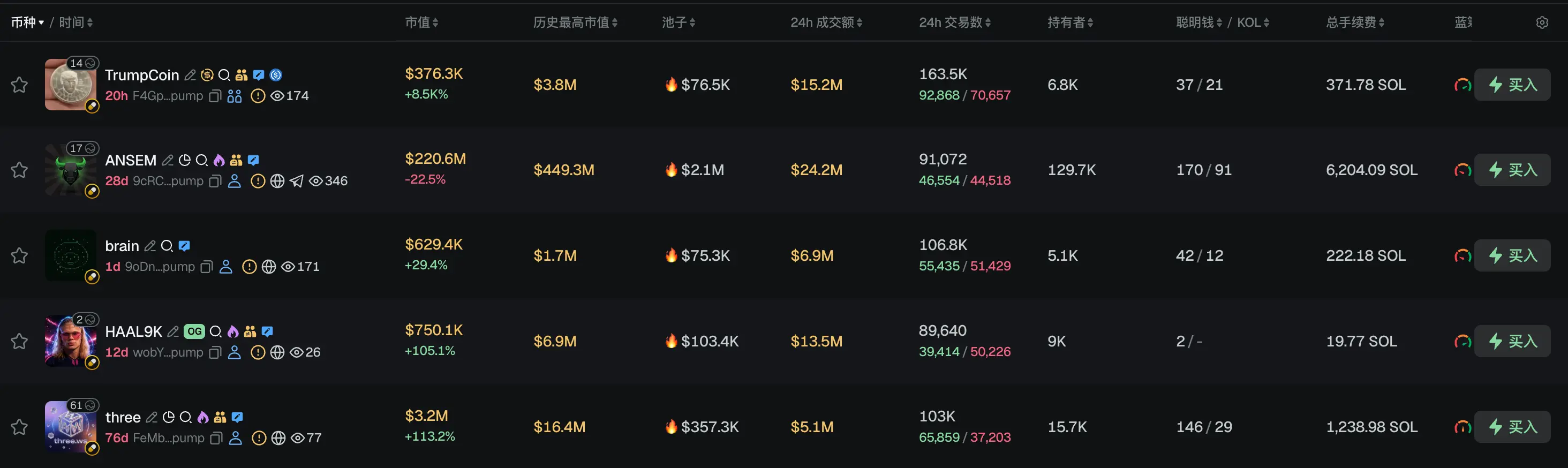
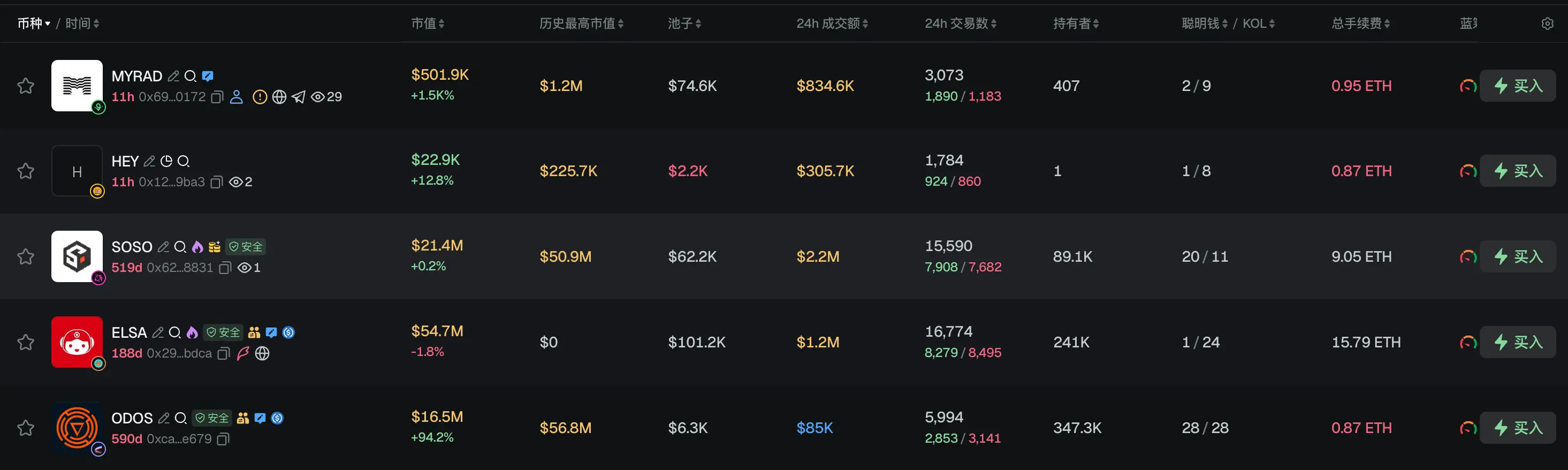
According to data from the meme token tracking and analysis platform GMGN, as of July 15, 09:30,
The top five popular ETH tokens in the past 24 hours are: ASTEROID, LINK, PRISM, ADI, SYN
The top five popular Solana tokens in the past 24 hours are: TrumpCoin, ANSEM, brain, HAAL9K, three
The top five popular Base tokens in the past 24 hours are: MYRAD, ELSA, SOSO, ODOS, Surplus
What are some noteworthy articles to read in the past 24 hours?
Circle CEO's lengthy article: The Agent Economy is disrupting value creation and circulation
In such a world, how should people live, spend their time, and be recognized? This is the most profound open question posed by this economic model. This architecture does not directly provide answers but creates possibilities for better answers. Which answer to choose depends on us. This is the entire argument, which ultimately returns to the starting point. The agent economy is the on-chain economy: artificial intelligence provides labor, while the on-chain layer provides the form in which currency, decision-making, coordination, and ownership can be expressed. This architecture has its pros and cons, with its default mode being centralization, concentrating income, power, and all the infrastructure that can be weaponized. But for the first time, we also have tools that can widely distribute ownership, outcomes, and governance rights, allowing the same mechanism to shift towards shared prosperity.
These three tokenization models are likely to coexist for many years to come. The core point: there are various models of tokenized stocks. We believe that the blockchain networks most likely to benefit from tokenized growth include Ethereum, Solana, BNB Chain, Avalanche, and Canton Network. Chart 1: Third-party platforms currently dominate the tokenized stock market, while Ethereum, Solana, and BNB Chain account for most of the on-chain assets.
The hundredfold meme coin LAB approaches zero, a review of the entire operation process
The bigger issue points to the exchanges. Scaling detection of manipulation is indeed difficult, and freezing assets without judicial documents lacks basis, but the halo of Alpha listing, exposure on hot lists, and perpetual contract pipelines have collectively created a false sense of security for this asset. Retail investors' anger often falls here. Simon Dedic, while criticizing market makers, directly pointed the finger at the platforms that cooperated in the release. Some community users also pointed out that under normal circumstances, exchanges would issue warnings and confiscate related profits if they discovered project parties manipulating the market, but LAB's manipulation has persisted for so long that it is hard not to suspect that the platform is also a beneficiary. A more general sentiment is that the market neutrality touted by exchanges has become an invisible harvest for retail investors in the face of obvious control, and the so-called listing review now looks more like an empty promise.
How long can the storage boom last?
However, we now need to remain calm. Stock prices are like a mirror, reflecting people's expectations for the future. When these expectations are too high, if reality is even slightly lower than expected, stock prices can collapse instantly. The higher the peak, the deeper the valley. This principle applies to stock prices, not just market size. Every time a bubble bursts, there is a scene where billionaires who became rich at the peak of the bubble have to significantly reduce their assets as the economic recession arrives. We are currently in a period of economic prosperity, and it is the right time to prepare for an economic recession. This prosperity will not last forever. History shows that positive growth in the storage market can last at most five years, after which a downturn period will follow (at least on the surface). The higher the peak, the deeper the valley. Therefore, I strongly urge companies currently enjoying prosperity: "While the prosperity continues, you should prepare for an economic recession."
Media reports mention that shipping industry officials have expressed concerns about Trump's latest move to impose fees, stating that according to their assessments, such actions would violate international law. One industry official questioned Trump's remarks, saying, "How can this make navigation safer? What kind of guarantees can it provide?" Trump has notified Congress that hostilities with Iran have resumed. According to reports from the U.S. on Monday, Trump has formally informed Congress that hostilities with Iran have resumed. In a letter to congressional leaders on the 10th, Trump wrote that the U.S. military conducted "defensive strikes" against targets within Iran on the 7th. It is reported that this letter has further intensified the dispute between Congress and the White House, despite Congress having previously voted to require the president to end hostilities or seek approval to continue actions, the White House insists that Trump, as commander-in-chief, is acting within constitutional powers.
 Risk warning


Popular articles