The events surrounding the Block.one account release by the EOS node: the parent company kicked out by the community

 The nodes chose to revoke B1's power status. In the context where EOS has become a joke in the industry and B1 has long lost the support of the community, this may be an opportunity for EOS.
Author: Chen Zhe
For most people, EOS is a name that brings sadness. Of course, the sadness comes from its market performance. As the absolute leader in 2018, with labels like "Blockchain 3.0," "Ethereum killer," and "the founder is the genius developer BM," EOS was highly regarded in the industry.
But as everyone knows, after a brief ecological explosion in 2018, the leader began to fall. There are many reasons for EOS's disappointment, including interaction experience, user thresholds, and even the inaction of certain nodes. However, what disappointed all investors the most was the parent company behind EOS, Block.one (hereinafter referred to as B1).
As one of the richest companies in the industry, no one expected that the $4.2 billion raised by EOS would result in almost no ecological support. In the current environment where major new public chains are launching hundreds of millions of dollars in ecological incentives, the EOS ecosystem still lacks substantial community support and has fallen into a vicious cycle of developer and user loss.
Even so, the parent company B1 has still taken no action, seemingly no longer developing EOS. Meanwhile, EOS founder BM announced his departure from B1 and hinted at conflicts with B1 CEO Brendan Blumer, while some executives at the company are relatives of CEO Brendan.
In short, the entire EOS ecosystem, from investors to developers to nodes, is very dissatisfied with B1.
This has made today's event of "node voting to cancel B1 account EOS release" even more monumental.
B1 Account 66 Million EOS Locked
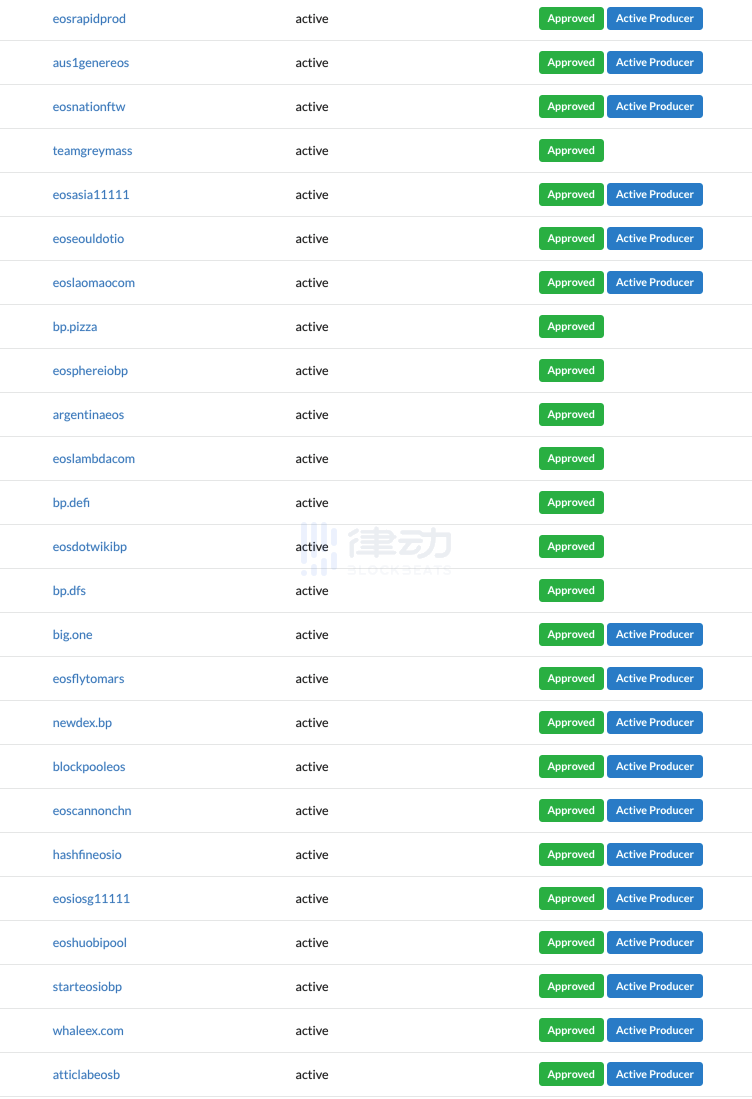
On December 8, it was discovered through a browser that the 17 main nodes of the EOS network executed a proposal to "stop releasing tokens from B1's account."
According to the browser, the current B1 account holds 68 million EOS. Based on the approved proposal, the 2 million EOS balance in the B1 account is available, but the 66 million EOS that have not been released can no longer be utilized.
The current total supply of EOS is approximately 1.04 billion, and the locking of the B1 account is equivalent to locking up 6% of the total supply. The sentiment quickly reflected in the secondary market.
EOS has suffered from B1 for a long time. While there is joy, BlockBeats is eager to know why the nodes chose to cancel the release operation of the B1 account. B1 is the most powerful institution in the EOS ecosystem and holds voting rights. Many nodes have received votes from B1, and 66 million EOS is enough to do many things. What exactly happened with B1? We reached out to EOS nodes.
What Happened
The story begins last month, on November 8, when B1 announced it would transfer 45 million EOS to Helios, citing the creation of an EOS venture capital fund, developing institutional-level EOS financial products, and creating infrastructure for developers. In simple terms, it was to empower EOS.
Brock Pierce, the founder of Helios, is quite famous as the founder of the stablecoin Tether, and he is also a co-founder of B1.
However, some noticed that B1 actually intended to sell the tokens, transferring 45 million EOS to Helios for sale. In fact, it was discovered that they had already sold 8 million EOS, which raised concerns. The unsold tokens from B1 should belong to the community. Therefore, the EOS Foundation (ENF, EOS Network Foundation), as a community representative, began negotiations with B1.
Over the course of a month, both parties discussed various proposals but failed to reach an agreement. Eventually, ENF discussed a final proposal with EOS nodes:
- B1 transfers 45 million EOS to Helios, 30 million EOS to ENF, 1 million EOS to the EOS ecological financing platform Pomelo, and another 1 million EOS to the governance system EdenOS;
- Return EOS-related IP, including community accounts, eos.io domain name, etc., to the community;
- Set the deadline before December 8.
To encourage B1 to agree to this proposal, someone in the community raised a multi-signature proposal on December 1:
- Stop the release of unsold tokens.
- Remove voting rights from the B1 account.
Stopping the release does not mean freezing the account; the account still belongs to B1, but B1 cannot continue to release the unsold tokens.
On the day the proposal was initiated, 7 main nodes agreed to the proposal. In the following 5 days, 6 more main nodes and 5 backup nodes also agreed. According to EOS network rules, when 15 main nodes agree to a proposal, it will be executed.
On B1's side, under pressure from 13 multi-signature approvals, they announced on December 6 that they would donate the corresponding amount of EOS to various organizations, but in the announcement, they stated that all donations still required consensus from all parties. The community felt that B1's response lacked sincerity, and there was no mention of EOS IP.
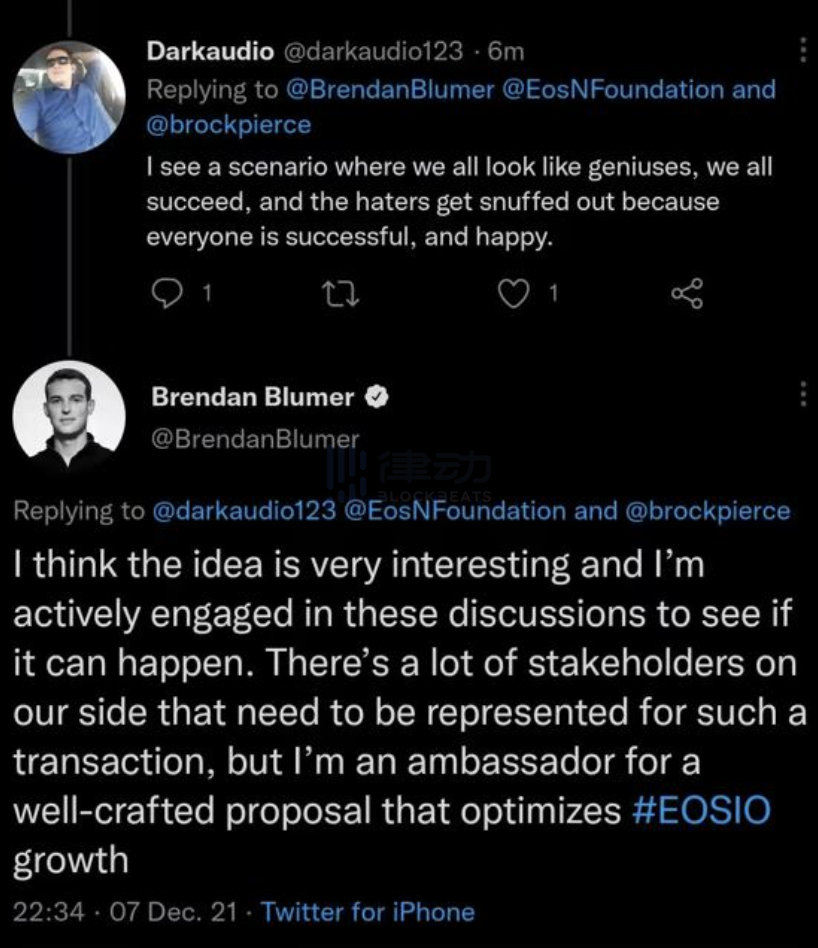
Then, this morning, B1 CEO Brendan responded on Twitter regarding EOS IP (now deleted), saying, "This is an interesting (or can be understood as 'haha') idea, and many stakeholders need some time, etc." It should be noted that by the time he made this response, the deadline set in the proposal, December 8, had already passed. The community was completely disappointed with B1.
Thus, a total of 17 main nodes and 8 backup nodes agreed, and the nodes executed the proposal to prohibit B1 from continuing to release, locking 66 million EOS.
The Future of EOS
It's a bit early to talk about the future, but it is certain that the EOS network is about to become different.
A few days ago, the EOS Foundation stated during a live broadcast that EOS would support EVM in the coming months. This may be one of the most efficient ways to scale the ecosystem, as Ethereum's ecological status is unshakeable, and the addition of EVM can attract many developers and users.
Moreover, the actions of the 17 nodes regarding the B1 account are unprecedented. From a certain perspective, the nodes' choice to revoke B1's power position, in the context of EOS having become a joke in the industry and B1 having lost public support, may present an opportunity for EOS.
We can even envision another possibility: could the nodes invite BM, who has conflicts with B1, to return to the EOS community? It doesn't seem impossible. In fact, some nodes are already considering this matter.
After all, this is a win-win situation. The EOS community gains the return of its founder, and if EOS regains popularity, BM can also clear his name.
Without B1, EOS is increasingly resembling a DAO.
 Risk warning
 Risk warning


Popular articles