Vitalik has finally admitted to Ethereum's major strategic mistakes. Are you still holding your position?
 Core Viewpoint
 "No matter the reason, this means that the original vision of Layer2 and its role in Ethereum no longer holds significance, and we need a new path," Vitalik said.
Author: Gu Yu, ChainCatcher
After the ETH price hit a new low since May of last year, Ethereum founder Vitalik Buterin published a lengthy article today reflecting on the long-standing core Layer 2 strategy of Ethereum, planning to increase investment in Layer 1, which is expected to have a sensational impact on the entire crypto industry.
The initially Rollup-centric roadmap defined Layer 2 as Ethereum-supported sharding, providing trustless block space. In this article, Vitalik seems to have abandoned the "Rollup-centric" scalability model he previously advocated, noting that the decentralization speed of Layer 2 is "far slower than expected" while Ethereum's underlying scalability is progressing, and many Layer 2 solutions are unable or unwilling to meet the trust guarantees required for true sharding.
"These two facts, for whatever reason, mean that the original vision of Layer 2 and its role in Ethereum are no longer meaningful, and we need a new path," Vitalik said. To outsiders, these statements suggest that Vitalik acknowledges the Layer 2 narrative is nearly outdated, with more focus shifting to scaling Layer 1 itself in the future.
Since the proposal of Layer 2, it has become one of the most sought-after concepts in the crypto industry, with nearly a hundred Layer 2 solutions like Polygon, Arbitrum, and Optimism emerging, raising over $3 billion in total funding, playing a key role in scaling Ethereum and reducing user transaction costs, with several tokens having a long-term FDV exceeding $10 billion.
However, under the strong competition from Solana's high-performance blockchain, the performance advantages of Layer 2 have not been fully realized, and the industry influence of its ecological projects has also been declining. Currently, only the Base ecosystem remains active at the forefront of the crypto industry, representing Ethereum Layer 2.
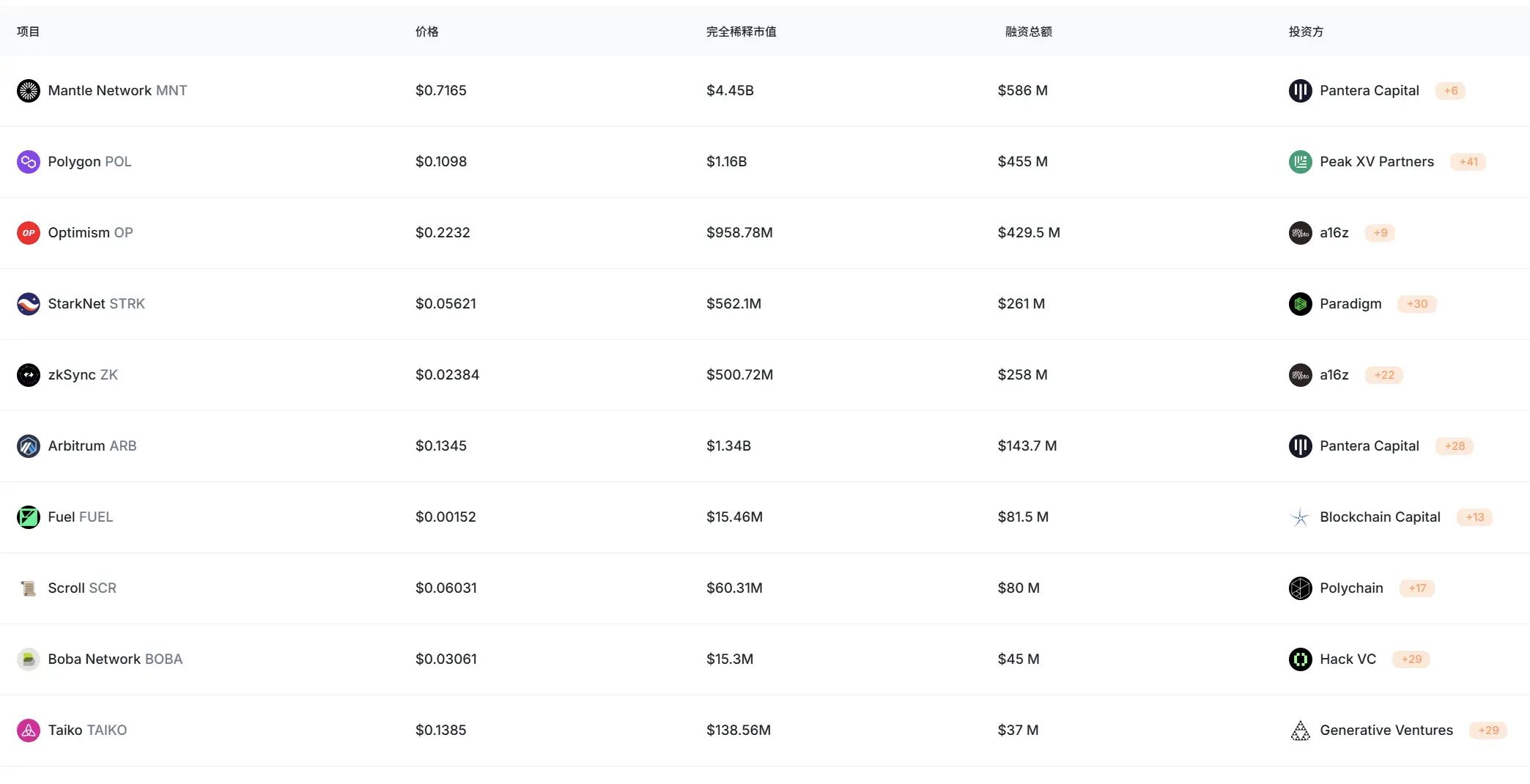
Mainly published Layer 2 token market value and financing data Source: RootData
In addition, Layer 2 outages continue to occur frequently. On January 11 of this year, Starknet experienced another outage after years of operation, with post-incident reports indicating that a state conflict between the execution layer and the proof layer led to about 18 minutes of on-chain activity rollback. Last September, Linea was down for over half an hour. On December 24, the Taiko mainnet went down for 30 minutes due to an ABI issue, indicating that they are still in an unstable state on a technical level.
In fact, Vitalik previously proposed a framework for measuring the decentralization of Rollups, which is phased, from Stage 0 (a centralized trust committee can veto transactions), Stage 1 (smart contracts begin to have limited governance rights) to Stage 2 (representing complete trustlessness).
Despite nearly a hundred Ethereum Layer 2 projects having emerged, only a very few have progressed to Stage 1. The Layer 2 project Base, incubated by Coinbase in 2023, only reached Stage 1 last year. Vitalik has criticized this point multiple times in the past. According to L2beat statistics, among the top 20 Rollup projects, only one project has reached Stage 2, which is the decentralized privacy protocol Aztec's product zk.money, but this product is currently stalled in development. The other 12 projects belong to Stage 0, heavily relying on auxiliary functions and multi-signatures.
Vitalik pointed out that Layer 2 projects should at least upgrade to Stage 1; otherwise, these networks should be regarded as more competitive, vampire-like "Layer 1 networks with cross-chain bridges."
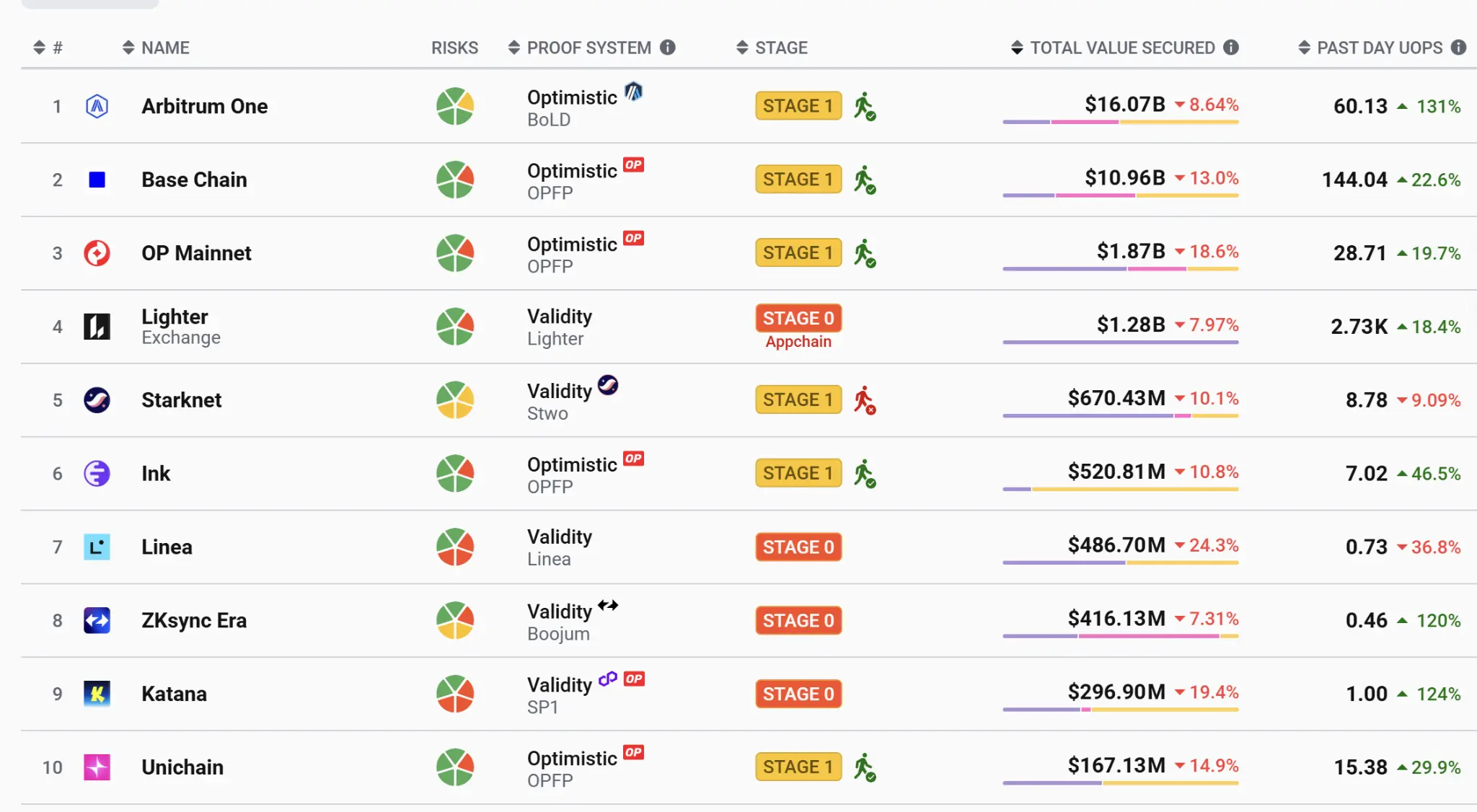
Source: L2beat
In addition to potential corporate interests that may delay the decentralization process of Layer 2, Vitalik pointed out that there are also technical challenges and regulatory concerns. "I have even seen at least one company explicitly state that they may never want to go beyond the first stage, not only for technical reasons related to the security of ZK-EVM but also because their clients' regulatory requirements demand they have ultimate control," he said.
However, Vitalik has not completely abandoned the concept of Layer 2 but has further broadened his view on the goals that Layer 2 should achieve.
"We should stop viewing Layer 2 as Ethereum's 'branded sharding' and the social status and responsibilities that come with it," he stated. "Instead, we can see Layer 2 as a complete spectrum, which includes chains fully trusted and credit-supported by Ethereum with various unique properties (not just EVM), as well as various options with different degrees of connection to Ethereum, which everyone (or robots) can choose to pay attention to based on their own needs."
Regarding future development directions, Vitalik further suggested that Layer 2 projects should focus on added value in competition, rather than just scaling. Suggested development directions include: privacy-focused virtual machines, ultra-low latency serialization, non-financial applications (such as social or AI applications), application-specific execution environments, and extreme throughput beyond what the next generation of Layer 1 can support.
Additionally, it is worth noting that Vitalik once again mentioned ZK-EVM proofs, which can be used to scale Layer 1, as a pre-compiled layer that is written into the base layer and "automatically upgrades with Ethereum."
In the past year, with the restructuring of the Ethereum Foundation and two network upgrades, Layer 1 has become one of the core strategies, one of the goals being to gradually increase the gas limit through multiple iterations, allowing L1 to handle more native transactions, asset issuance, governance, and DeFi settlements without overly relying on L2. In this year's Glamsterdam upgrade plan, several improved technologies aim to reduce manipulation and abuse related to MEV, stabilize gas rates, and lay an important foundation for future scalability improvements.
In earlier statements, Vitalik indicated that 2026 will be a key year for Ethereum to regain lost ground in self-sovereignty and trustlessness. Plans include simplifying node operation through ZK-EVM and BAL technology, launching Helios verification RPC data, implementing ORAM and PIR technology to protect user privacy, developing social recovery wallets and time-lock functions to enhance fund security, and improving on-chain UI and IPFS applications.
Vitalik emphasized that Ethereum will correct the compromises made in node operation, application decentralization, and data privacy over the past decade, refocusing on core values. Although this will be a long process, it will make the Ethereum ecosystem stronger.
Appendix: In response to Vitalik's article and views, many industry professionals have also expressed their opinions. Here are some highlights extracted by ChainCatcher:
Wei Dai (1kx Research Partner):
I am glad to see Vitalik discussing the hindsight errors of the Rollup-centric roadmap. However, asking "What would I do if I were at the L2 level today?" misses the point.
The key is not what Vitalik would do, but what these L2 levels and application teams will do. L2 levels and their applications will always prioritize their own interests over those of Ethereum. To bring L2 levels to Stage 1 or achieve maximum interoperability with Ethereum, it must be ensured that doing so is valuable.
For a long time, this issue has been defined as a security problem (L2 levels need L1 levels to support functionality and CR). But in reality, the most important thing is whether Ethereum's L1 can provide more users and liquidity for L2 levels and applications. (I think there is no simple solution, but the direction of efforts in interoperability is correct.)
Blue Fox (Well-known Crypto Researcher):
What Vitalik means is that L2 has leveraged L1, but in terms of value feedback or ecological feedback, L2 has not done well. Now L1 can scale on its own without relying on L2 for scalability. L2 must either align with L1 (native rollup) or become L1.
What does this mean? It's bad news for general-purpose L2, but good news for L2 application chains, as we have consistently said before. L2 application chains can play creatively and provide value feedback to the ecosystem.
Jason Chen (Well-known Crypto Researcher):
With Ethereum itself scaling, the most significant change is that gas fees are now comparable to those of L2, and gas fees are expected to continue to decrease. With ZK gradually coming online, the speed will also be comparable to that of L2, so L2s are now in a very awkward position. Vitalik's tweet essentially announces that the initial phase of L2's historical mission to scale Ethereum has been completed. If new narrative angles for L2 are not found soon, L2 will become a relic of history and be eliminated.
For project teams, the main goal of developing L2 is still to earn transaction fees, but L2 no longer holds any significance for users, as gas fees and performance are not significantly different from the mainnet.
L2 was born from Ethereum and will die with Ethereum; the disputes between the emperor and the vassals have also come to an end.
Haotian (Well-known Crypto Researcher):
I have mentioned more than ten times in previous articles that the general-purpose Layer 2 strategy is no longer viable, and each Layer 2 should transform into a specialized Layer 2, which is essentially a type of Layer 1. I did not expect that after guiding the long Stage 2 strategic alignment, many Layer 2s still became "sacrificial pieces."
Layer 2, especially general-purpose Layer 2, carries a heavy developmental burden. Initially, it faced the technical alignment issue with Ethereum's security, then there were regulatory issues regarding the centralization of Sequencers after token issuance, and finally, it encountered the burden of being "falsified" due to weak ecological nurturing. The fundamental reason is that all Layer 2s initially depended on Ethereum Layer 1 for survival, and when Ethereum realized it could not protect itself and began to dominate Layer 1 performance evolution, Layer 2 lost any imaginative space to empower Ethereum, leaving only burdens and troubles.
 Risk warning
Popular articles