




Analysis of mistX: A DEX integrated with Flashbots and no trading gas fees

 This is the first DEX integrated with Flashbots.
Author: zZ
Recently, the transaction costs on the Ethereum network have nearly reached their lowest point in the past year. Crypto practitioners are beginning to reflect on whether Ethereum is declining in the face of the impact from EVM-compatible public chains like BSC and Heco. Is it the case that the plummeting market has reduced the wealth effect, leading to a decline in Ethereum's activity? Or are there other reasons for the decrease in Ethereum's transaction costs?
Since Ethereum's transaction costs are related to on-chain data, perhaps on-chain data can provide some answers.
Here, Rhythm BlockBeats chooses the daily trading volume of Uniswap, the largest DEX on Ethereum, and the number of daily active addresses on the Ethereum network as a comparison.

Data source: glassnode
From the on-chain data compiled by glassnode, it seems that the low transaction costs on Ethereum are not due to a decline in Uniswap's activity or the number of transactions on the Ethereum chain.
From an economic perspective, rising transaction costs are typically due to short-term profitability or the time cost being higher than the transaction cost. Therefore, perhaps the decrease in Ethereum's transaction costs is related to the recent widespread use of Flashbots by miners.
According to the latest data disclosed by Flashbots, in the past 30 days, it has extracted a total of $284 million worth of 100,500 Ethereum in MEV. Meanwhile, the total transaction fees on the Ethereum network in May amounted to $1.03 billion.
This article is not meant to continue discussing Flashbots and MEV, but rather to introduce the recently launched DeFi product "mistX," created by Alchemist and powered by Flashbots.
No Plans, No Roadmap, But the Project Will Exceed Your Imagination
Opening the Alchemist official website, the first page states, "No development team, no company, and no plans or roadmap; the only plan is to have no plan." This idea originates from a tweet by the well-known developer Stephane Gosselin (thegostep). Stephane Gosselin is a core developer of Ampleforth (AMPL), and Flashbots is also developed by him.
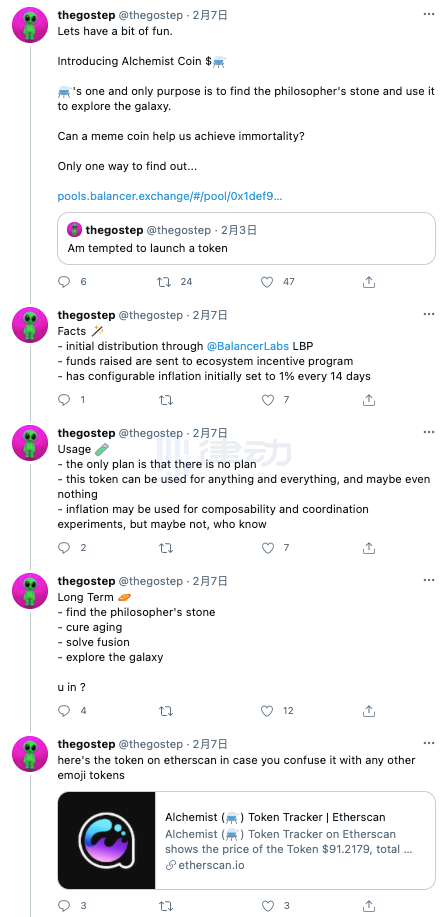
Although Alchemist claims to have no team, it revealed that the current multi-signature private key holders in the community include "ees2oo," "salash," AMPL co-founder and CTO Brandon Iles, "Fiskantes," and SushiSwap co-founder 0xMaki.
Public information shows that mistX is the first DEX product launched by Alchemist. It is the first decentralized trading platform integrated with Flashbots, which may fundamentally eliminate the dark forest problem.
Preventing Front-Running, Manipulating Trades, and Preventing Sandwich Attacks
mistX's official statement claims it can prevent front-running, manipulating trades, and sandwich attacks. Here, we will explain the principles of mistX using an article from Paradigm.
Taking transaction hash 0x669796b2b32c95421ce493975d7796561e5d98c79fe6de9c0f8e41911bbded1a as an example.
The trader wants to sell at least 9,234 USDC using 82.9 MIST (see image ①). In the actual trading process, the trader received 9,327 USDC (see image ②).
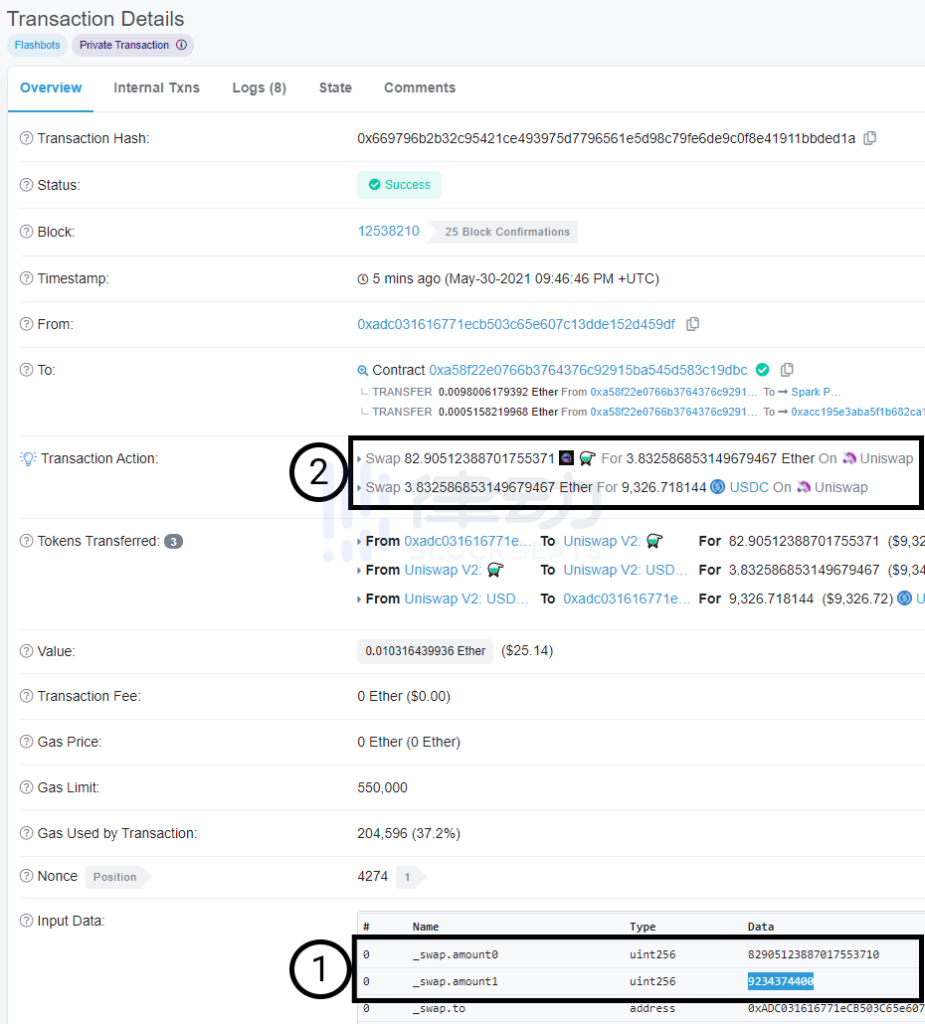
The innovation of mistX lies in bundling transactions to be published in Flashbots' private memory pool rather than the public memory pool of the Ethereum network. This is because publishing in the public memory pool may be subject to sandwich attacks. As seen in image ③, the Ethereum browser shows that the transaction is marked as "private" before it is included in a block.

A Flashbots bundle must be:
- Executed atomically
- Mined at the top of a block
This transaction meets these criteria, as shown in image ④, where the random number position of this transaction is 1. This attribute ensures that Flashbots miners cannot perform front-running or sandwich attacks under profitable conditions. To this end, users can set a non-zero low slippage trade in mistX to ensure execution during significant volatility.
In practice, traders believe that Flashbots miners will not bundle transactions in the middle layer, as this can easily be detected by Flashbots and cut off their usage. Flashbots hopes that miners will ignore the placement of bundles until they are packed into a block.
No Gas Fee Transactions
In addition to integrating Flashbots, mistX has another feature: transactions do not require gas fees. Of course, this does not mean that transactions are cost-free.
Traders pay miner fees through a smart contract call in the Flashbots bundled transaction. This payment is conditional on the transaction being executable; if the transaction cannot be executed, meaning it exceeds the trader's set slippage range, the contract will refuse to pay the miner fees. In other words, if the slippage of the transaction is too large, the miner will not package the transaction.
This method differs from CowSwap, which also does not require gas fees, as CowSwap only eliminates the risk of transaction execution, while mistX eliminates transaction risk altogether, so traders do not need to worry about transaction failures.
Traders primarily pay transaction fees in two ways:
- Withdrawing a portion of ETH from the trading funds to pay miner fees;
- Paying miner fees from the user's wallet balance, currently still using ETH, but in the future, stablecoins may be used for payment.
As seen in image ⑥, this transaction paid 0.0099 ETH to the Starfire mining pool and 0.0005 ETH to the mistX wallet. The method of calculating mistX transaction costs is entirely the same as using the public memory pool, both using gas price * gas limit = final ETH used.

In terms of transaction costs, mistX will use more gas fees. In this article's example, a total of 205,000 gas was consumed, while executing the same transaction on Uniswap would consume 160,000 to 180,000 gas. The main difference is that using mistX incurs two additional transactions: one for paying the miner fee and one for paying the mistX wallet fee.
How to Become a Certified Alchemist?
Alchemist's token MIST was initially launched in February through a Balancer LBP, raising 35 ETH from 1 million MIST.
MIST has no lock-up period, and the total supply increases by 1% every two weeks, with 50% of the newly minted tokens allocated to the Aludel reward pool; 25% for the community; and 25% deposited into the MIST liquidity pool. The Aludel reward pool is a smart contract that rewards liquidity providers for the MIST/ETH trading pair on Uniswap. As of the time of writing, the total supply of MIST has risen to 1.07 million, with 9,560 holders.
To become a community-certified Alchemist, one must first purchase MIST and provide liquidity on Uniswap V2 with an equivalent amount of ETH. It is important to note that currently, choosing to provide liquidity on Uniswap V3 will not qualify for final certification and rewards from the Aludel reward pool.
After providing liquidity, you will receive UNI-V2 liquidity tokens. Then, visit the official Crucible NFT platform to mint a "Crucible NFT" using the UNI-V2 liquidity tokens. Once the Crucible NFT is minted, you will receive rewards from the Aludel reward pool. As of the time of writing, a total of 4,930 Crucible NFTs have been minted across the network.
After minting the Crucible NFT, join the Alchemist official Discord and send "!join" in the #welcome channel. You will then receive a private message from the bot "Collab.Land." After completing the signature authorization as instructed in the message, your identity in the Discord group will change to certified alchemist.

The Alchemist community is still in its infancy, but from mistX, it is clear that it has grand ambitions. Becoming a certified alchemist seems more like a shared risk (skin in the game). For ordinary traders, DEX aggregation platforms may still be the most convenient and cost-effective trading platforms. However, the emergence of mistX brings a fresh perspective to the somewhat fatigued market by integrating Flashbots to prevent front-running, manipulating trades, and sandwich attacks, as well as enabling no gas fee transactions.
 Risk warning
 Risk warning

Popular articles