Uniswap is trapped in an innovation dilemma
 Core Viewpoint
 The various iterations of Uniswap are one of the sources of vitality in the DeFi market. However, since 2023, Uniswap has not proposed any substantial innovations, instead sticking to traditional business explorations such as application chains and Launchpads, leading to a decline in token prices and market influence.
Author: Gu Yu, ChainCatcher
In the crypto industry, the speed of innovation is often an important criterion for measuring the vitality of a protocol. However, Uniswap, which once single-handedly opened the DeFi Summer, seems to be slowing down.
Looking back at the evolution of Uniswap, its iteration pace has always been known for its rapidity: V1, featuring the AMM mechanism, was born in 2018; V2 introduced ERC-20/ERC-20 pairs in 2020; V3 launched concentrated liquidity in 2021; and V4 proposed programmable Hooks in 2023. On average, Uniswap throws out an innovative mechanism every 1.5 years, reshaping the flow of hundreds of billions of dollars.
However, time has frozen at April 2026, nearly three years since the announcement of the V4 proposal, and the market still has not seen any updates on the next version of Uniswap.
Currently, Uniswap's product dynamics still revolve around Uniswap V4, which can transform Uniswap from a fixed-function AMM into a highly programmable liquidity platform. The core innovation of this version is Hooks, a modular, programmable plugin that allows developers to insert custom logic throughout the pool's lifecycle, such as implementing dynamic fees, limit orders, TWAMM (time-weighted average market making), MEV protection, loss hedging, custom oracles, continuous clearing auctions (CCA), and almost limitless functionalities.
In other words, many developers previously needed to fork Uniswap to achieve certain specific functions, leading to Uniswap's liquidity being diverted to many forked DEXs. Now, developers only need to write a Hook contract to significantly enhance the customization of Uniswap's liquidity pools.
Although in June 2023, Uniswap announced the specific concept of V4, for safety reasons, this version underwent nine independent audits and a large-scale security competition, causing its mainnet launch to be delayed from the initially planned Q3 2024 to the end of January 2025.
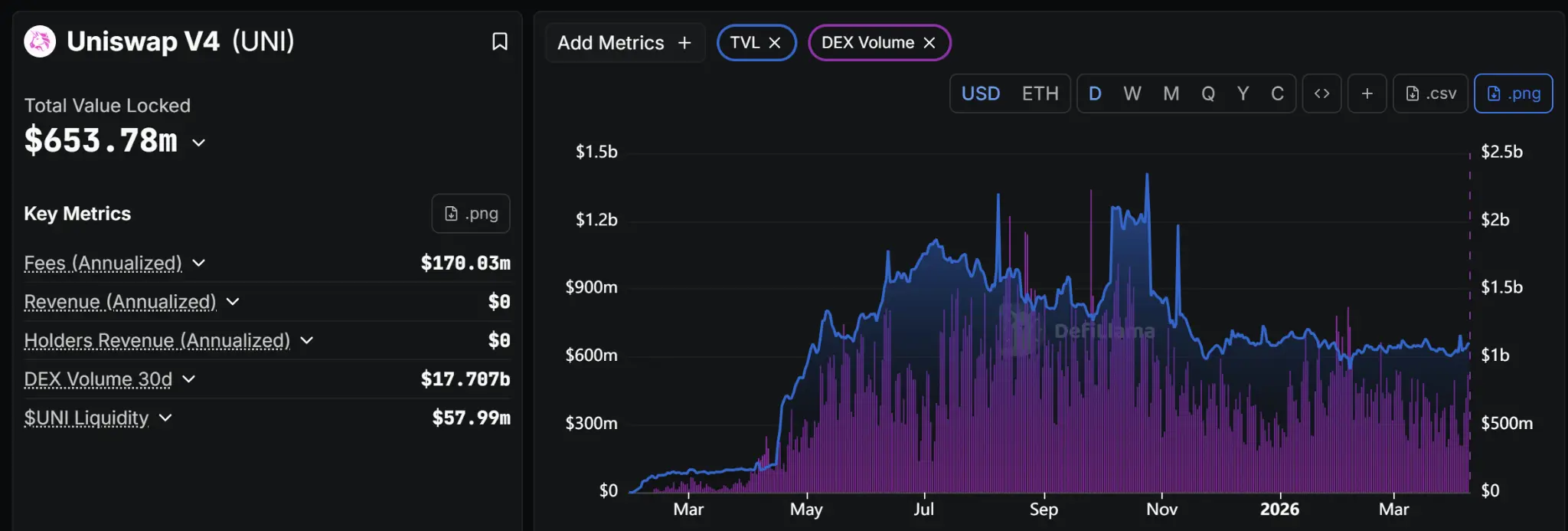
After its launch, the total locked value of Uniswap V4 peaked at over $1.2 billion, currently falling back to $650 million, but still only 40% of the V3 version and lagging behind the V2 version.
At the same time, Uniswap is also "conforming" to accelerate its expansion in usage scenarios and markets. In the past six months, Uniswap has successively launched on blockchains such as Linea, Tempo, X Layer, and Monad to seize market opportunities in emerging blockchains. On the other hand, Uniswap is fully expanding its API partnerships, with recent adopters including Anchorage Digital, Ledger, Privy, and MetaMask.
Of course, Uniswap has not been without new moves on the product front in recent years, such as the application chain Uniswap and the CCA token auction product, both of which have received significant market response.
In February 2025, Uniswap's application chain Unichain officially launched its mainnet, attracting over 90 DeFi protocols for integration, with TVL dropping from a peak of $900 million to the current $36 million.
By the end of 2025, Uniswap announced the launch of the continuous clearing auction feature (CCA), specifically for price discovery and liquidity initiation for new assets, and successively collaborated with Aztec and Rainbow to complete token sales.
However, it must be pointed out that by 2025, application chains and token auctions are very "old-fashioned" business models in the crypto field, with many existing projects facing bottlenecks in their main businesses exploring "chain launching" and Launchpad-type businesses. Uniswap has also begun to "follow suit" in joining this trend, but its actual impact is very limited.
In earlier years, Uniswap also made significant acquisitions of products like Genie and Crypto: The Game to explore areas such as the NFT trading market and on-chain gaming, but subsequent data reflected that these were two failed acquisitions.
In the past year, Uniswap's growth director Sarina Siddhanti, COO Mary Catherine Lader, strategic and operations director Zach Wong, chief legal officer Katherine Minarik, and venture capital director Julia Rosenberg have all left, reflecting Uniswap's efforts to control operational costs and its struggles with growth.
Uniswap's overall decline is also reflected in the price of its governance token UNI. In the past year, UNI's price has dropped by more than 74%, falling below $2 at its lowest, significantly higher than the overall decline of mainstream coins, which has led to analysts in the market complaining about UNI tokens having "no real value."
In September 2025, Arca's chief investment officer Jeff Dorman responded to a tweet from Uniswap founder Hayden Adams regarding the protocol's data performance, stating: "We are not bearish on Uniswap, but we are bearish on UNI. In today's market and the ever-changing regulatory environment, it is just a completely meaningless token. Your and your venture capitalists' positions do not matter; either switch to a revenue distribution or buyback model, or simply don't have a token."
To respond to market doubts and give more value to UNI, the Uniswap Foundation initiated a proposal last November to enable the protocol fee switch for Uniswap V2 and V3 and use it for UNI buybacks and burns, while also burning 100 million UNI from the treasury. Subsequently, UNI saw a short-term increase of nearly 38%, peaking above $9.
According to DeFillama data, Uniswap's recent daily fee income is between $100,000 and $200,000, with a total income of $3.93 million over the past 30 days, and an annualized income of about $46 million, still lagging behind other DeFi protocols like PancakeSwap, Jupiter, Lido, and Aave.
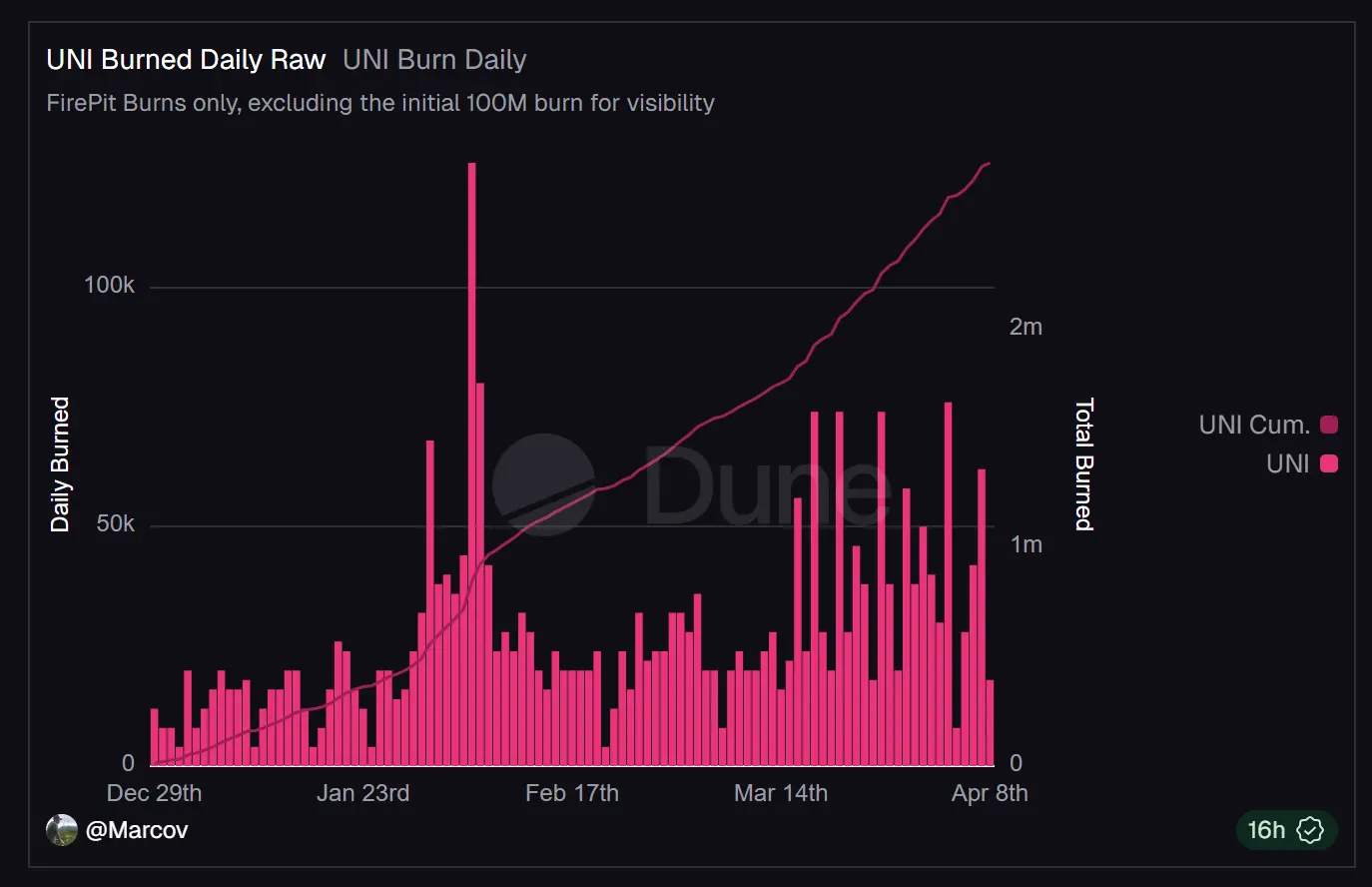
Uniswap's awkward situation is actually a reflection and projection of the dismal state of the DeFi industry: a lack of underlying innovation, exhausted industry narratives, and liquidity being repeatedly consumed in fragmentation and stock games.
However, Uniswap remains one of the few leading DeFi protocols that have not been hacked, with no incidents of funds being stolen at the protocol level, and it is still the decentralized trading protocol with the highest total locked value, maintaining its industry status and user trust.
But will there be a Uniswap V5? If so, when will it arrive? Can Uniswap continue to be the engine for the next wave of DeFi Summer?
 Risk warning
Popular articles