Messari: A Detailed Explanation of Stacks' Operating Mechanism and Token Economic Model

 To become an ecosystem, developers must be able to efficiently build applications on it. This requires smart contract compatibility. And this is exactly what Stacks is doing.
Original Title: 《It's Time to Stack(s) Bitcoin Up》
Author: Cristiano Ventricelli
Translated by: Xuejing, Chain Catcher
Bitcoin was originally envisioned as a peer-to-peer decentralized cash system, recently referred to as "value storage," but it can actually be much more than that. One might argue that El Salvador's recent adoption of Bitcoin as legal tender has made Bitcoin a means of payment. What Bitcoin truly lacks is the concept of an ecosystem. To become an ecosystem, developers must be able to efficiently build applications on it. This requires smart contract compatibility. And that is exactly what Stacks is doing.

How did Stacks begin?
The evolution of Stacks began in 2013. The project was created by founders Muneeb Ali and Ryan Shea. Stacks is the product of Muneeb Ali's doctoral thesis, which detailed an internet framework that could be built around the Bitcoin blockchain. This framework is known as Blockstack. Participation in the Y Combinator batch in 2014 made initial research and development possible. Muneeb Ali and Ryan Shea raised funds from Union Square Ventures, Naval Ravikant, SV Angel, Winklevoss Capital, and others in the early stages.
The project raised $47 million through a token sale in 2017 and $23 million through the first SEC-certified U.S. Reg A+ and Reg S offerings in 2019. Over 4,500 Stacks holders participated in these offerings, including USV, Lux, DCG, Winklevoss Capital, Blockchain Capital, Foundation Capital, Hashkey, Fenbushi, and others. In 2020, Blockstacks was renamed to Stacks. In January 2021, the Stacks 2.0 mainnet launched and became compatible with Clarity smart contracts.
Stacks addresses the main challenges of building on Bitcoin
There are two fundamental challenges to building applications and smart contracts on Bitcoin:
Scalability: The transaction capacity of the Bitcoin blockchain is limited.
Contract security: To protect the security of the Bitcoin blockchain, the scripting language for smart contracts is very limited.
Stacks has provided solutions to both of these issues. Stacks does not deploy smart contracts directly on the Bitcoin chain but executes smart contracts on its own Layer 1 blockchain and uses Bitcoin solely for settlement.
How does the Stacks blockchain communicate with the Bitcoin blockchain? A new consensus mechanism called Proof of Transfer (PoX) allows Stacks miners to write new blocks on their own blockchain using the mining energy consumed by the same miners on the Bitcoin blockchain. Therefore, no additional energy consumption is required.
Increasing speed with micro (blocks)
Speed is crucial for decentralized applications. It is well known that the Bitcoin blockchain is slower than most chains that support smart contracts. Since every block generated on Stacks must be stored on Bitcoin, it can be assumed that Stacks' speed must be less than or equal to that of Bitcoin.
To address this issue, Stacks has designed a mechanism that allows its blockchain to take full advantage of the time between two blocks produced on Bitcoin through intermediate smaller blocks called microblocks. These blocks can utilize faster confirmation speeds, allowing microblocks to be confirmed from Stacks to Bitcoin when Bitcoin confirms a block, achieving final confirmation. Thus, microblocks can increase speed while leveraging the security of the Bitcoin network.

Smart contracts require Clarity
The Stacks blockchain uses the Clarity programming language to support smart contracts. Clarity differs from the most common smart contract languages for two main reasons:
1) Decidable language: Turing (in)completeness is a property of machines; if it can be encoded, then it can theoretically (not) solve any problem.
However, the time required to solve "any" problem is obviously unknown and not necessarily bounded from above. Turing-complete programming languages like Solidity have a wide range of technical possibilities, most of which are not utilized most of the time.
In fact, the gas fee consumption model reduces the theoretical scope of programming design and encourages developers to choose simpler, more economical smart contract structures.
However, Turing-complete languages increase the surface area for bugs, making it more difficult to write secure code. The Clarity coding language is decidable (Turing incomplete). This makes it more secure and allows developers to see what the code will do before running it.
2) Code that can be audited: This property allows non-technical users who cannot audit smart contract code to see the exact state of their balances in the UI before running the smart contract.
Proof of Transfer (PoX) and Stacking
The traditional proof-of-work (PoW) mechanism on the Bitcoin blockchain works essentially like this: miners consume electricity to guess the hash of the previous block, and the first miner to guess correctly receives Bitcoin as a reward for their efforts.
All Stacks transactions are settled in Bitcoin. This allows Stacks transactions to benefit from the security of Bitcoin. Since the Stacks blockchain needs to broadcast its block headers to the Bitcoin blockchain, implementing a proof-of-work algorithm on Stacks would mean additional energy consumption.
Stacks chose a more energy-efficient mechanism that uses Bitcoin as "digital energy," which Stacks miners use instead of electricity. This mechanism is called Proof of Transfer (PoX), which allows leveraging and expanding any PoW chain, such as Bitcoin.
This consensus mechanism involves two parties: miners and stackers.
1) Miners: With PoX, miners do not convert electricity and computing power into block rewards and transaction fees. Instead, they transfer Bitcoin to Stacks token holders. This allows Stacks token holders to earn Bitcoin from the consensus. This process is called Stacking. Leaders are elected on Bitcoin, and new blocks are written on the Stacks blockchain. Their cost function is represented by the amount of Bitcoin they commit to transferring on the Bitcoin blockchain.
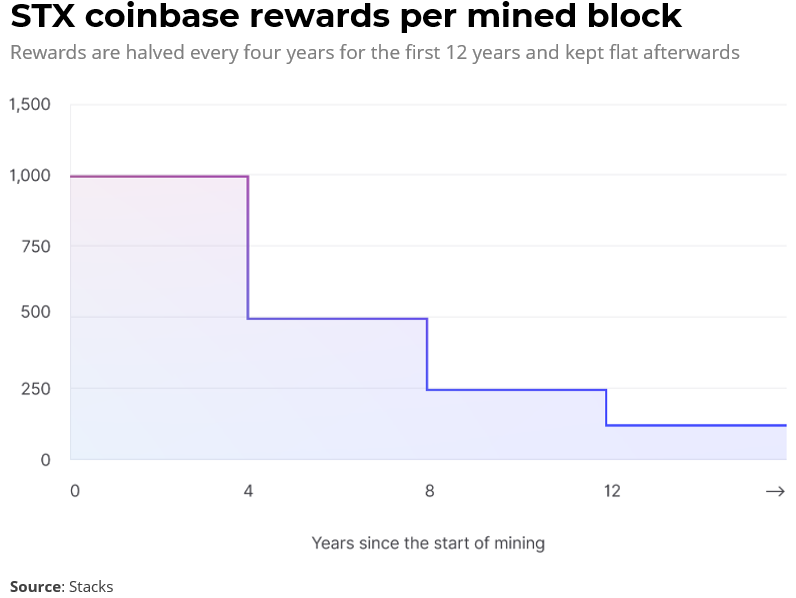
The miner responsible for mining the next block (also known as the "leader") is elected on the Stacks blockchain through a verifiable random function, with the chance of being elected increasing with the amount of Bitcoin transferred relative to other miners. Elected miners receive rewards in the form of STX tokens in addition to transaction fees. To avoid misaligned incentives when mining on the Stacks blockchain instead of the Bitcoin blockchain, the reward for each block decreases over time according to the Bitcoin halving schedule.
 2) Stackers: They temporarily lock STX to support the security and consistency of the network. As a reward, stackers earn BTC, which miners transfer as part of PoX. Depending on the amount of STX held, they can choose to stack independently or join a stacking pool. STX holders (or mining pools) controlling certain threshold amounts of STX will be able to issue a signed message to lock their STX tokens for a period, specify the Bitcoin address to receive funds, and signal (vote) on the current version/fork of the Stacks chain. This information is useful for (honest) miners on the network. Stackers provide Bitcoin addresses to receive the Bitcoin rewards sent by miners.
In summary, with PoX, miners do not convert electricity into computing power to earn block rewards. Instead, they leverage already mined Bitcoin to transfer it to stackers. This approach utilizes Bitcoin's proof of work without further environmental impact.
What does it mean for miners to earn STX rewards and stackers to earn BTC rewards? Stackers earning BTC can rely on a more mature and stable cryptocurrency than STX. This will help increase the initial adoption rate within the community and reduce reliance on the native STX cryptocurrency. On the other hand, miners can achieve more diversification by earning cryptocurrencies beyond BTC, but their success essentially depends on Bitcoin. By using the native cryptocurrency, miners can join the Stacks blockchain in a permissionless manner. Miners and stackers contribute to the dynamics of the STX market in a complementary way: stackers provide buying pressure as they are incentivized to lock STX to earn BTC rewards. Thus, miners can invest in mining activities knowing that the STX tokens received as rewards will be well supported in the market.
What is the difference between PoX and proof-of-stake (PoS) mechanisms? The first difference is that miners and stackers are not the same entity, whereas in PoS, they can overlap. Additionally, miners actually spend tokens to participate in miner elections, while validators in PoS combine their capital in the form of native tokens to help achieve consensus.
In contrast to PoS blockchains, the Stacks blockchain can fork because it is not affected by the "weak subjectivity" problem. Weak subjectivity means that no miner/validator can identify the "correct" chain without trusting other nodes. The ability to fork allows the blockchain to survive critical failures that severely affect the functionality of PoS chains. Finally, participants in the consensus (i.e., stackers) receive rewards in a different token (BTC) than those locked in the blockchain (STX).
Currently, over 436 million STX (over $1.1 billion) are locked in stacking, accounting for over 30% of the circulating supply of STX. The average stacking APR is in the range of 8-10%.
How does Stacks compare to similar projects?
The projects that can be considered closest to Stacks are Liquid Network, Lightning Network, and RSK. However, Stacks differs from each of these three projects in the following characteristics:
1) The historical record of Stacks is stored on Bitcoin. This differentiates the Stacks blockchain from sidechains like Liquid Network and gives Stacks a higher level of security. Malicious attackers creating private forks on Stacks would expose themselves before the Stacks blocks on the Bitcoin blockchain are finalized. Honest miners can take action to prevent the attack.
2) The STX token is not tied to BTC. Unlike Liquid Network, the value generated on the Stacks blockchain serves as a security underpinning without needing to provide incentives for maintaining a link between Bitcoin and sidechain tokens.
3) Stacks transactions are independent of Bitcoin transactions. Since Stacks is not a Layer 2 solution like Lightning Network, its utility goes beyond mere scalability improvements on Bitcoin.
4) Stacks miners are independent of Bitcoin miners. This makes Stacks different from merged mining chains like RSK, whose network security relies on a group of Bitcoin miners, which in some cases could be a single entity with critical influence over decentralization.

STX Token Economics
For most Layer 1 blockchain native tokens, the Stacks cryptocurrency STX is designed to pay for transaction fees and smart contract execution. This means that the long-term value of Stacks depends on the growth of the Stacks ecosystem and the demand for Clarity smart contracts, as:
- Due to high transaction fees, miners can see an increase in mining value, providing them with an incentive to acquire STX to participate in consensus.
- STX stackers will benefit from the growth of the Stacks ecosystem, as their rewards in Bitcoin depend not only on coinbase rewards but also on network usage.
The genesis block of Stacks contains 1.32 billion STX. In 2017, Stacks raised approximately $47 million through an initial coin offering (ICO), with investors purchasing STX at $0.12. In 2019, two SEC-regulated token offerings occurred: the Reg S offering raised $7.6 million at a price of $0.25 for STX, while the Reg A+ offering raised $15.5 million at a price of $0.30 for STX.

The economic model of Stacks was updated in October 2020, shifting from an adaptive burn-and-mint mechanism to a diminishing issuance model, with future supply expected to reach approximately 1.818 billion by 2050. The reduction in issuance is achieved through three halvings.

What is happening with Stacks?
The Stacks ecosystem is experiencing solid organic growth, primarily driven by the following components:
- CityCoins------CityCoins has created an innovative protocol that allows communities to contribute to the financial resources of cities by sending STX in exchange for rewards. Contributors can provide their STX through the Stacks protocol. 30% of the STX sent is collected by the city through a custodial wallet. The remaining 70% provides STX rewards for CityCoin stackers.
- Miami was the first city to join the project, even making headlines before the city's mayor, Francis Suarez, announced that his salary would be paid in BTC. The total value of the Miami wallet has exceeded $20 million, accounting for about 20% of the city's annual tax revenue. New York has also joined the initiative, and more cities are expected to follow based on positive public perception.
- DeFi------The first DeFi platform to launch on the Stacks blockchain is Arkadiko. The project aims to issue a stablecoin called USDA through self-repaying loans. Arkadiko's total value has reached $60 million. Another promising project is Alex, a DeFi protocol that allows users to issue and trade their own tokens, lend and borrow without the risk of liquidation, and participate in yield farming. Alex recently raised $5.8 million in a funding round led by White Star Capital.
- NFTs------The Stacks ecosystem hosts some very popular collectibles: 1) Punks: They are everywhere, and the Stacks ecosystem is no exception. StacksPunks are the Stacks counterpart to the top Ethereum avatar project CryptoPunks, recently introduced on the Stacks blockchain, with trading volume exceeding $1.5 million. 2) Megaponts: The most famous collectible in Stacks, with NFT sales reaching $2.2 million. Megapont will release its interactive minting in December. 3) BitcoinBirds: The second most popular collectible, with NFT sales reaching $1 million. 4) Satoshibles: The world's first cross-chain NFT bridge connecting Ethereum and Bitcoin. This is an avatar series originally launched on Ethereum. As the name suggests, no community in the crypto space can appreciate the artistic creations inspired by the anonymous Bitcoin creator more than the Bitcoin community itself.
Additionally, STX stackers can also choose to earn NFTs as stacking rewards. This is facilitated by a project called BoomBox, which now has a total value exceeding $1 million.
What does the future hold for Stacks?
The Stacks blockchain is undergoing a significant upgrade, namely Stacks 2.1. The 2.1 upgrade will not occur automatically. It will only activate when the network permits. The upgrade is expected to provide some backward-incompatible features that will help improve the overall functionality of the Stacks blockchain, such as:
Stacking improvements: These features will make stacking more efficient in terms of timing (no missed reward cycles due to cooldown periods) and the funds used (users can freely move their STX from one cycle to another and reclaim STX not used to earn rewards).
Clarity improvements: These features will allow programmers to leverage more built-in functions, better parsing, and conversion primitives. Additionally, developers can build stacking derivatives on top of Stacks using PoX reward information.
In-band blockchain upgrades: These features will allow miners and STX holders to vote on the "stop date" when implementing backward-incompatible upgrades (such as the current 2.1 upgrade) and vote to extend the deadline for the PoX mechanism.
Reliability improvements: These features will help adjust runtime costs, freeing up more space for iterative smart contracts, better managing Bitcoin flash blocks, improving miner sorting weight, and making multi-signatures and validations independent of the order in which they arrive.
Furthermore, the Stacks team is currently enhancing interoperability with different blockchains through the following "bridges":
Stacks Bridge------A cross-chain transfer service that allows NFT-based ETH or STX owners to transfer their NFTs between blockchains.
Banana Bridge------This bridge allows Megakongs to transfer from Ethereum to Stacks and vice versa. Bitcoin NFTs will soon be accessible to metaverse projects.
Orbit Chain------Recently partnered with Gala Games to expand into the gaming industry, currently bridging Stacks. In the past year, over $10 billion in asset value has been bridged from networks such as ETH, BSC, Polygon, Klaytn, ICON, and Ripple.
Conclusion
Given the technical reasons mentioned, introducing smart contracts to Bitcoin is an extremely ambitious plan. A fair question might be whether it is really worth the effort when there are so many other blockchains available for DeFi, NFTs, and other applications.
However, Bitcoin can be considered the largest community, one of the most secure and decentralized blockchains, and a global application unmatched by any other token currently. As the cryptocurrency market gains broader adoption, decentralization and network robustness are crucial for large and systemically important institutions. Bitcoin is such a network. It is logical for Satoshi's creation to accept the challenge of smart contract compatibility.
In the dawn of a multi-chain era, the world's most famous blockchain seems to lag far behind its competitors in terms of product offerings. Stacks has established a theoretically sound and operationally flexible infrastructure to fill this gap and elevate Bitcoin to a new level.
 Risk warning
 Risk warning

Popular articles