



Understanding the influencer Web3 project RSS3: Is the "next-generation information index" true innovation or a pseudo-concept?

 Why has RSS3 attracted the attention of many Web3 enthusiasts? Is the business logic valid?
整理:Richard Lee,链捕手
As long as you are not born after 2000, you must have heard of "RSS subscription." RSS, short for Really Simple Syndication, provides website information summaries, allowing users and applications to deliver article titles, summaries, full texts, and other information to subscribers in a standardized format. Users can aggregate different information sources by subscribing to RSS links from various websites and read this content within a single tool.
The RSS3 Protocol, with the slogan of providing "next-generation internet information summaries (Feeds)," is a recently popular Web3 concept project. RSS3 was founded by Natural Selection Labs in May 2021, launched its testnet in September, and has since released products such as Web3 Pass (user profiles) and Revery (information tracking and social platform), receiving investments from well-known institutions like Coinbase Ventures and Dragonfly Capital last December.
1. Products and Application Scenarios
The main products launched by RSS3 currently are Web3 Pass and Revery, the former being a user profile similar to a Facebook personal homepage, while the latter serves as an information summary aggregator.
(1) Web3 Pass
Web3 Pass obtains users' on-chain footprints through wallet connection and user signature verification. Initially, it supports verification for Ethereum and BSC addresses. After clicking to add a new account, users confirm ownership of a specific account by "signing" a message through MetaMask or Wallet Connect.
Once an address is verified, its associated assets will be stored in the RSS3 file and displayed on the personal profile page via Web3 Pass. Currently, Web3 Pass supports displaying on-chain addresses, domain names, POAP footprints, donations (such as which projects are supported in Gitcoin donations), etc. Users can freely drag and arrange these assets and information, and they can also choose to hide footprints or assets they do not wish to disclose.
Web3 Pass also offers a naming service—RNS, similar to Ethereum Name Service (ENS), but provided by the RSS3 protocol. Users with RNS can generate a personal RSS3 address link, which can be displayed in "prominent" positions on Twitter, allowing others to view and follow your personal profile at any time.
According to the RSS3 team, RNS is non-transferable and does not expire. Registering for RNS requires burning 1 PASS token, which can only be obtained through the whitelist, and the application for this whitelist is currently closed. In response to the question about "whether there will be an airdrop for early users of Web3 Pass," the RSS3 team stated that "it is still under discussion."
(2) Revery
Revery is an aggregator for viewing subscribed information, serving as the "minimum viable product" of RSS3, launched on December 25 last year and currently running on the RSS3 Pre node.
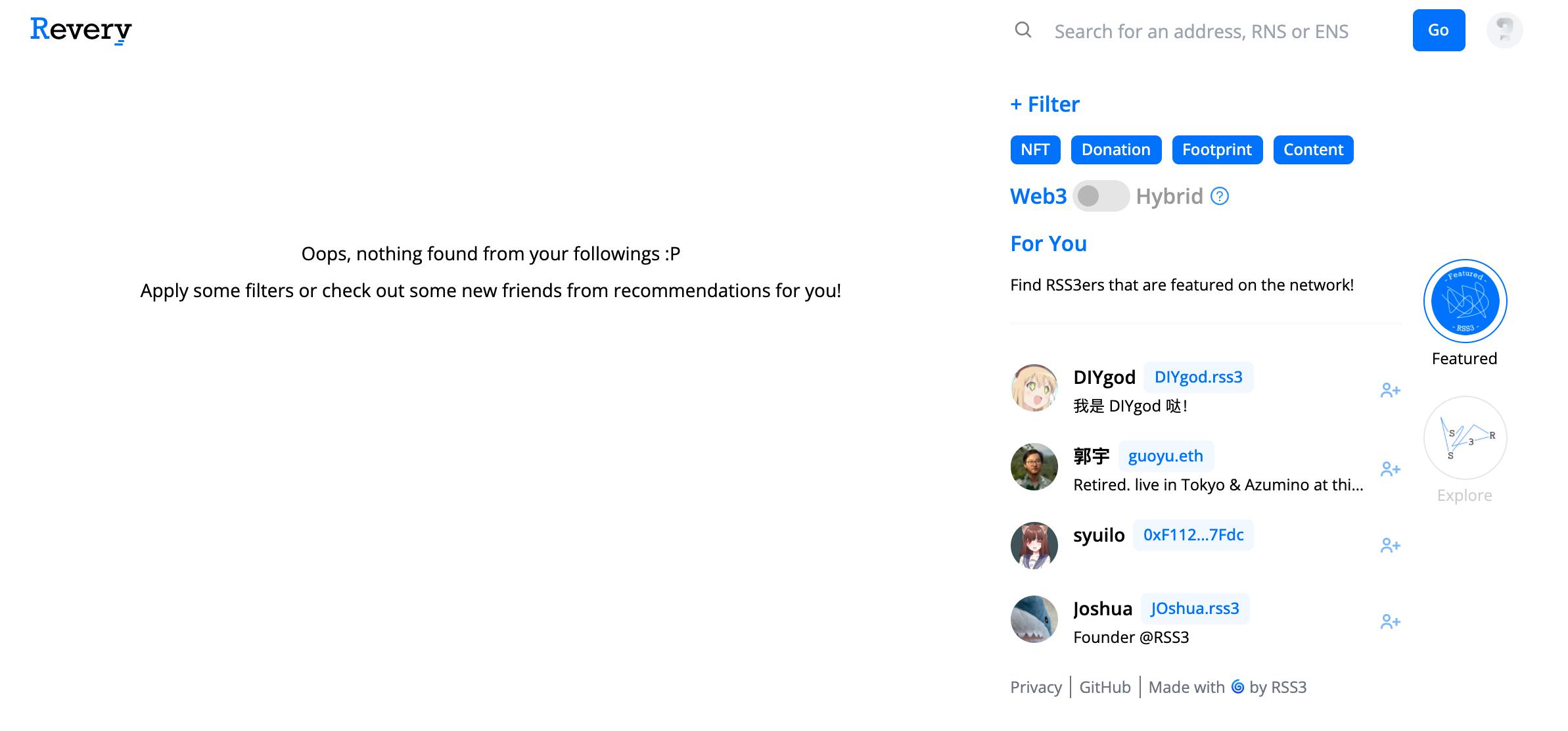
Users can "follow" a certain number of users based on searches or recommendations, and the activities of those users will be displayed on the page. Revery also provides a filtering function, allowing users to choose to view only specific categories of information, such as NFTs, donations, footprints, etc.
The recommendation algorithms for social network information have always attracted attention. Revery offers two recommendation methods: "Featured," which includes curated information sources from the RSS3 protocol, and "Explore," which provides random recommendations. However, the specific algorithm mechanisms for both recommendation methods have not been disclosed.
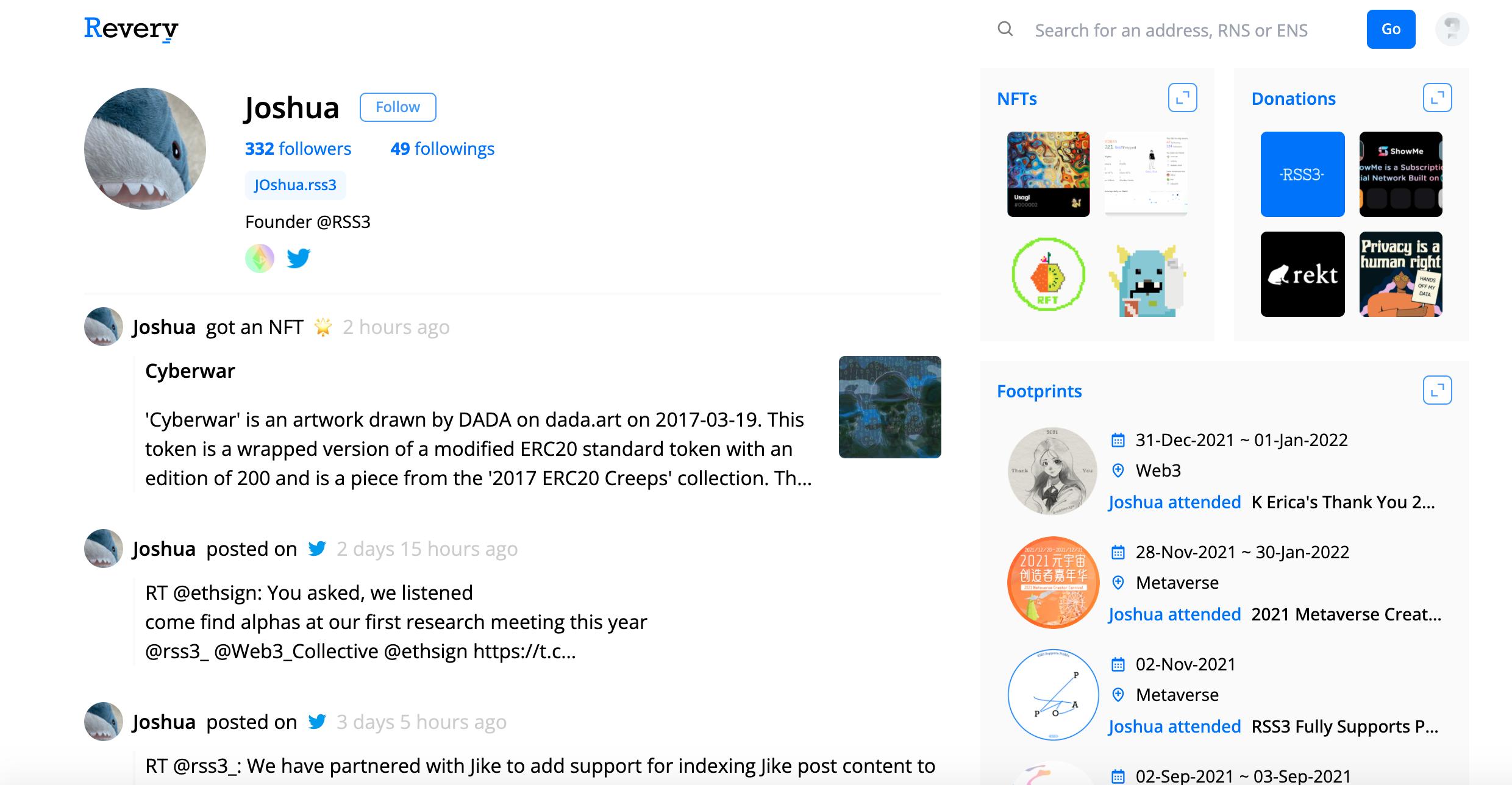
Revery page of RSS3 founder Joshua
It is worth noting that the information sources of Revery are not limited to platforms with Web3 concepts like Ethereum. According to the RSS3 team, in addition to on-chain networks, social platforms built in a federated manner, such as Mastodon (referred to as "长毛象" in the Chinese community) and Misskey (a decentralized microblogging platform), which are not based on blockchain networks, are also included, as well as centralized platforms like Twitter that relatively respect user data ownership.
The standard for this by the RSS3 team is: "As long as data ownership is verifiable and indexable, the RSS3 network will treat it as part of the content environment."
Thus, Revery provides a "Web3/Hybird (mixed)" viewing option, where, when this switch is turned on, the activities/speeches of followed users on Web2 platforms like Twitter will also be displayed on the homepage. When turned off, only the activities of the other party on on-chain applications like Decentraland, Mirror, and NFTs will be shown.
Target Application Scenarios
Regarding the application of RSS3, it has a slogan: "Aiming to become the pillar of future social, content, and e-commerce applications by providing content, distribution channels, and economic environments." For ordinary users, compared to the decentralized personal profiles of centralized internet, RSS3's products aim to aggregate and display information from multiple platforms, including information related to on-chain applications, providing social boasting, friendship, and even recruitment functions in a trustless manner.
On the commercial application level, RSS3 claims to provide distribution channels based on social graphs, offering pathways for social media information distribution and e-commerce. For information producers and creators, RSS3 hopes to break the current situation of "media being tightly connected to platforms," aggregating the largest consumer groups and providing an efficient monetization channel without platform commissions for media and creators.
However, the Web3 information aggregation scenario has also faced skepticism from some industry professionals. For instance, Tokeninsight CEO Wayne recently mentioned on Twitter regarding Web3 that he stated, "There are still those doing RSS subscriptions. This may offend people, but isn't this thing something that has been eliminated by history? Why does putting a Web3 coat on it make it advanced? Make it politically correct?"
2. Operational Mechanism
As of now, the pre-nodes of RSS3 are operated by the RSS3 team, and there is still a distance from its vision of "decentralized" information indexing and distribution. Additionally, according to the team, the current pre-nodes of RSS3 are still unstable, so they have not yet been open-sourced.
In the white paper officially released on January 11 of this year, Natural Selection Labs detailed the future operation and incentive plans.
(1) Network Operation Mechanism
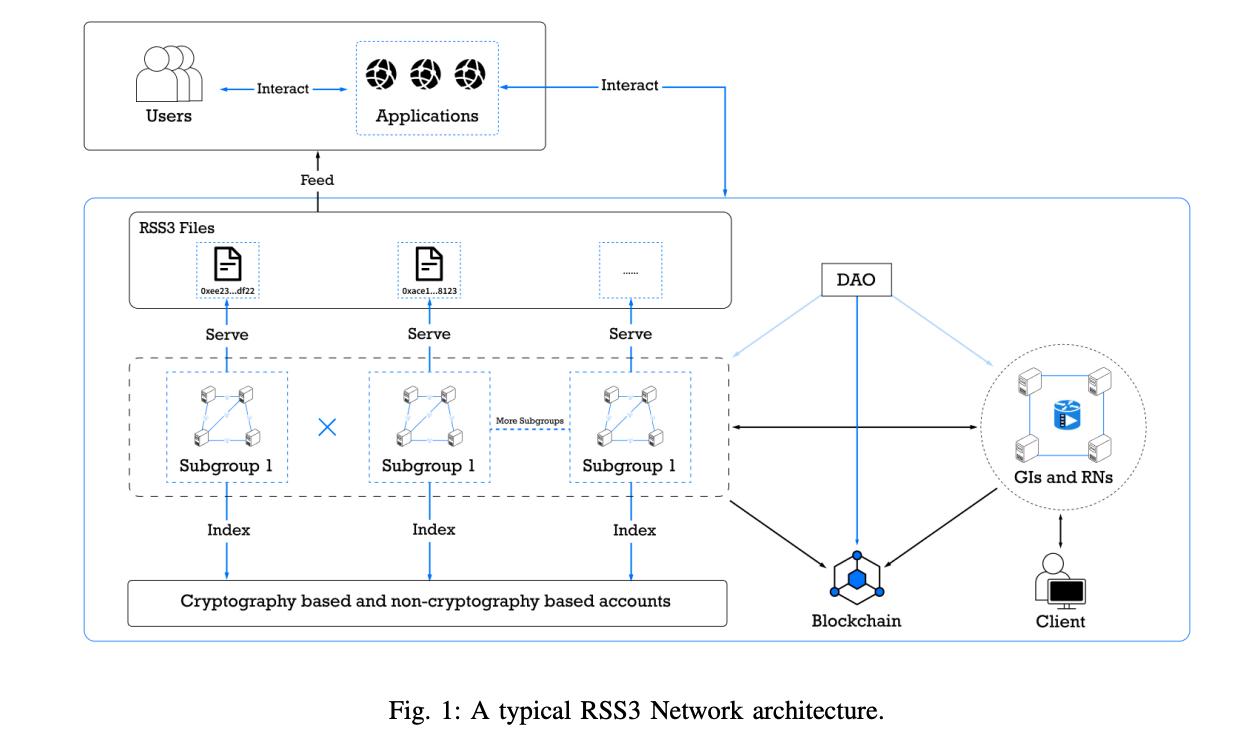
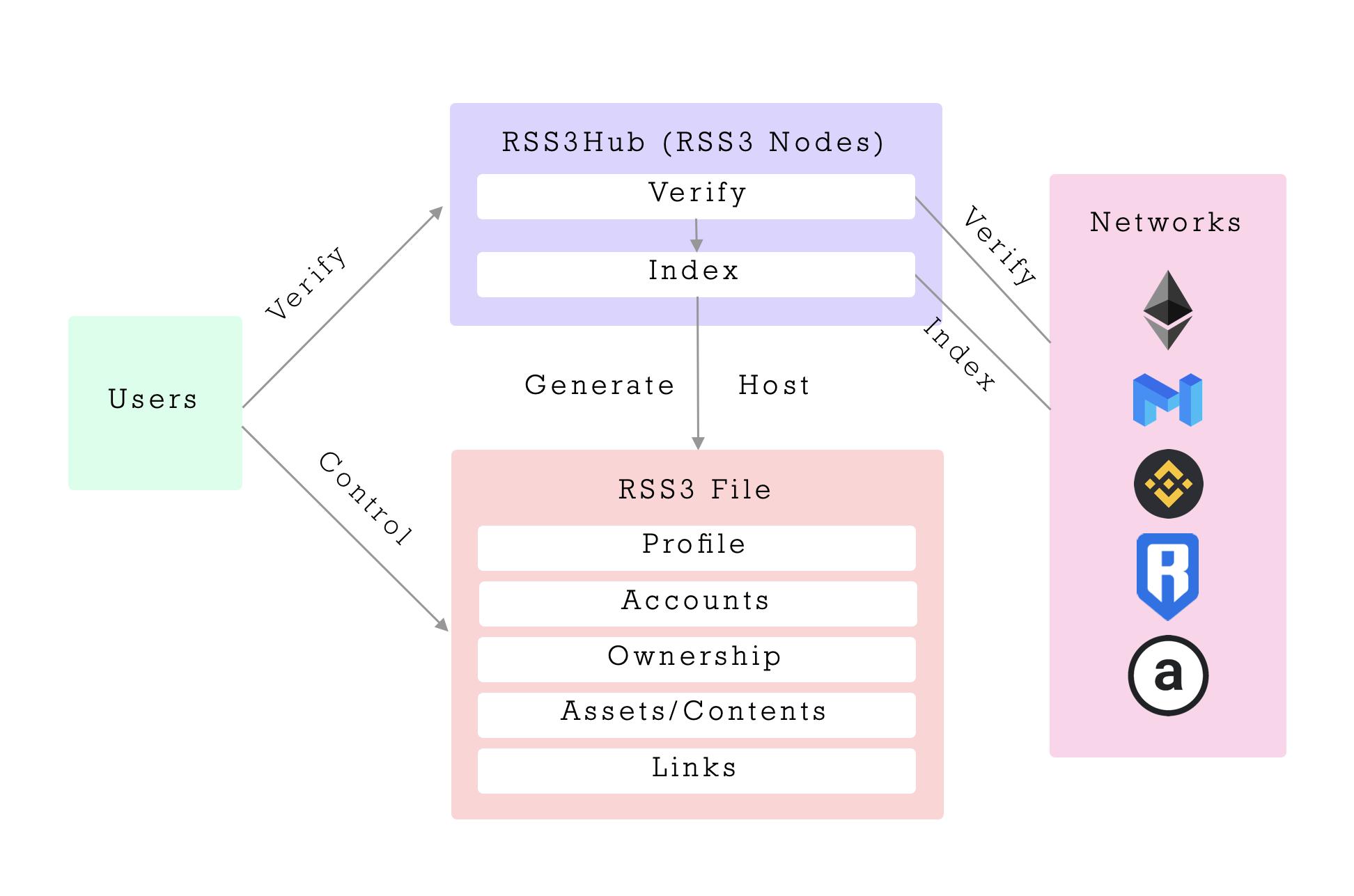
According to the white paper, the "online footprints" formed by user interactions with applications are stored in units called "RSS3 files." These RSS3 files are indexed and processed by one or more subgroups, each consisting of several service nodes (responsible for file hosting). Consensus must be reached within the same subgroup before determining the indexed content.
Subgroups are managed by GI (Global Indexer), which is also responsible for sending client requests to subgroups.
A GI consists of two parts: (1) a group of relay nodes for assisting routing; (2) a group of archiving modules for archiving the network to facilitate fault recovery in case of network crashes.
Service nodes and GI are elected by the RSS3 DAO. Candidates may have hardware and property staking requirements, with specific rules set by the DAO.
(2) Incentive Mechanism
Regarding incentives, the RSS3 team believes that the existing "transaction-based reward model" is only applicable to financial-related applications and does not work in other areas like social media.
Therefore, the RSS3 team expects to incentivize participants through network profits generated from advertising, value-added services, and social economic activities. Rewards are divided into three stages:
Stage 1: System Incentives. The system rewards the network to encourage usage. As the number of users increases, system rewards will decrease, inversely proportional to network adoption rates;
Stage 2: Hybrid Incentives. It is expected that after the network adoption rate increases, profits will be generated through advertising, value-added services, and social economic activities, and the earnings will be distributed in the form of network rewards;
Stage 3: Self-sustaining Incentives. All rewards are provided by rewards generated by the network, and the system will no longer provide any form of incentives.
According to the white paper, participants eligible for incentives include: node operators, developers, content creators, special contributors, and DAO.
3. Project History
RSS3 was founded by Joshua in May 2021, and in August of the same year, it secured millions of dollars in seed funding, with investments from Sky9 Capital, Mask Network, ByteDave, Hash Global, Fosun Group co-founder Liang Xinjun, Wen Chen, Variable Capital, SPT Capital, and Huofeng Capital's Chen Yuetian.
According to PANews, Joshua claims to have initially worked on RSS-related applications in 2018, during which he discovered the famous RSS project RSSHub on GitHub.
"This application was a failure; I didn't expect this experience to help me. After that, I began working on various types of social network projects and gradually shifted my focus to distributed social and content networks," Joshua said.
In the second half of 2020, Joshua recalled RSSHub and hoped to "extract its essence and discard its dross," and contacted its creator DIYgod. Subsequently, with the help of Mask Network founder Suji, Natural Selection Labs completed its seed round financing. Additionally, Joshua stated that Suji was also the first to suggest changing the project name (previously "AIR") to "RSS3."
In September 2021, Natural Selection Labs launched Web3 Pass, and in December, Revery was launched.
In December 2021, RSS3 announced the completion of a new round of financing, with CoinShares Ventures as the lead investor, and well-known investment institutions and investors such as Coinbase Ventures, Dragonfly Capital, Mask Network, HashKey Group, Arweave, Dapper Labs, and Balaji Srinivasan participating.
In December 2021, the Web3.0 portal Mask Network announced a strategic partnership with the Web3 information aggregation protocol RSS3 in areas such as user footprint integration, Gitcoin donations, and NFT functionality integration.
In January of this year, the development team released the official white paper based on the original Lightpaper.
 Risk warning
 Risk warning