Is there another story behind MicroStrategy's "All in Bitcoin"?

 The price of Bitcoin briefly fell below MicroStrategy's holding cost, and there are rumors in the market that it may have secretly sold over 8,000 Bitcoins.
Written by: ForesightNews
Last year's cryptocurrency bull market attracted a number of publicly listed companies in the U.S., and Elon Musk shifted from promoting U.S. stocks to endorsing Bitcoin. Companies like Tesla also purchased a significant amount of Bitcoin in addition to their main business operations. However, the sharp downturn in the market this year has led these companies to report over a hundred million dollars in impairment losses in their 2021 annual reports and 2022 Q1 reports. Additionally, some Bitcoin mining companies that went public last year and previously expressed a "hodl" attitude have begun to show intentions to sell some of their Bitcoin. As of now, it seems that the only publicly listed company still claiming it will not sell any Bitcoin is MicroStrategy.
But has this software company, which has almost turned Bitcoin purchases into its main business, really not sold any Bitcoin as it claims? Some clues on-chain have raised our doubts.
MicroStrategy's Journey of Bitcoin Accumulation
MicroStrategy announced its Q1 2022 financial report on May 3, Beijing time, revealing that the company currently holds 129,218 Bitcoins at an average cost of $30,700. In Q1, the company again recorded an impairment provision of $170.1 million for Bitcoin, resulting in a loss of $130.8 million for the quarter.
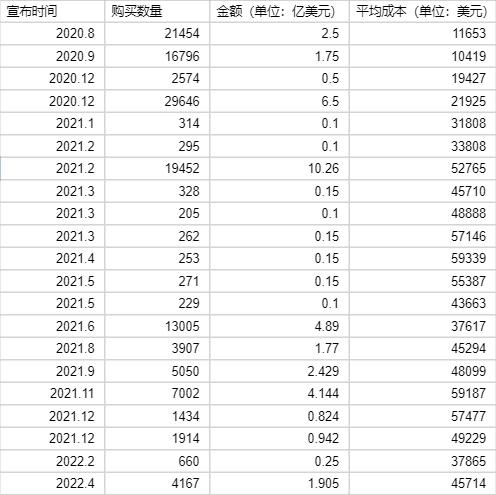
The earliest public announcement of MicroStrategy's Bitcoin purchases can be traced back to August 11, 2020, when MicroStrategy stated that it had spent $250 million to acquire 21,454 Bitcoins based on its asset allocation strategy outlined in its Q2 2020 financial report. After announcing in mid-September 2020 that it would purchase another 16,796 Bitcoins for $175 million and would treat Bitcoin as its primary reserve asset, MicroStrategy embarked on an unstoppable journey of accumulation. The author has compiled the records of MicroStrategy's Bitcoin purchases to date as follows:
According to on-chain data from OKLink, excluding exchanges acting as custodians, MicroStrategy ranks third among companies holding more than 100,000 Bitcoins, following Block.one and the already defunct Mt. Gox.
Is the Claim of "Never Sold" True?
In fact, there were suspicions last year that MicroStrategy was secretly selling Bitcoin while simultaneously using the concept of Bitcoin to inflate its stock price and cash out. According to an article on AMBCrypto, a document submitted by MicroStrategy to the SEC in August 2021 showed that its CFO and CTO sold $7 million worth of stock in July, and the top eight executives were estimated to have earned about $175 million in the crypto space within just one year.
Crypto KOL Whale suggested that MicroStrategy's CEO Michael Saylor and other executives might be implementing a "pump-and-dump" strategy, speculating that MicroStrategy transferred its held Bitcoins to another LLC for sale, thus avoiding disclosure to the SEC.
Last month, a Twitter user discovered that a wallet address suspected to belong to MicroStrategy was secretly selling Bitcoin. The user indicated that MicroStrategy's main custody address is 1P5ZEDWTKTFGxQjZphgWPQUpe554WKDfHQ, and another custody address is 1FzWLkAahHooV3kzTgyx6qsswXJ6sCXkSR. During sales, MicroStrategy would transfer Bitcoin from the main address to the second address and sell through Coinbase and OKX. If these two addresses are indeed MicroStrategy's holding addresses, then it has sold over 8,000 Bitcoins to date.
Subsequently, MicroStrategy CEO Michael Saylor denied this speculation, stating that as a publicly listed company, any changes in Bitcoin holdings must be disclosed.
The address starting with 1P5Z is widely recognized by many as MicroStrategy's Bitcoin holding address, primarily due to the quantity of Bitcoin held and the timing and amount of accumulation changes overlapping with the information disclosed by MicroStrategy.
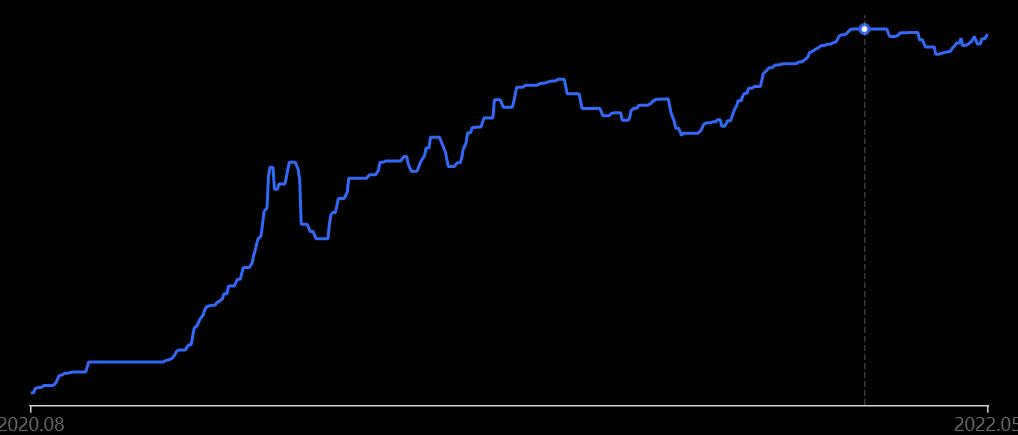
Statistics of changes in holdings for this address, source: OKLink
However, some opponents have raised doubts about this. On one hand, this address began accumulating Bitcoin in 2019, not in August 2020 when MicroStrategy first announced its purchases; on the other hand, this address is not a multi-signature address, which seems too reckless for a publicly listed company, and the address resembles that of a personal address belonging to a Bitcoin whale.
From its 2021 annual report, I found that MicroStrategy did not generate any non-operating income, such as from the sale of fixed assets, but it remains questionable whether the auditing firm could discover that MicroStrategy sold Bitcoin.
Overall, based on the financial reports, MicroStrategy's current main business does not have the capacity to repay billions of dollars in debt, and the increasing leverage in Bitcoin purchases will eventually force it to sell some Bitcoin to reduce risk. The claim of never selling may largely be just a gimmick. However, whether it has sold Bitcoin in the past two years will forever remain "Schrödinger's cat" until it discloses its holding addresses.
The cryptocurrency bull market since 2020 has led to the entry of numerous institutions from traditional finance and technology sectors, with Bitcoin once widely regarded as "digital gold," prompting institutions to view it as a "cure" for enriching asset allocation to hedge against risks in traditional financial markets. However, since this year, Bitcoin has shown a high correlation with U.S. stocks, and its risk-hedging properties are continuously weakening. While it remains uncertain whether the "faith" of newly entering institutional investors will waver in such an environment, the notion that institutions only buy and never sell Bitcoin as a long-term fundamental support may need to be reconsidered.
 Risk warning
 Risk warning