




Terra is falling apart, what should happen to its ecological projects?

 The problems faced by Terra are complex, and some developers in its ecosystem are actively seeking alternative solutions.
Author: Shiwen, Planet Daily
Looking back at the development of Terra over the past year, the price of LUNA reached a high of $119.18, and its market capitalization once hit $41 billion. Its ecosystem has launched over 100 projects, covering DeFi, the metaverse, gaming, NFTs, and more, with DeFi projects making up the majority.
According to DeFi Llama data, Terra's TVL peaked at $31.35 billion, ranking second. Due to its high participation and capital volume, Terra DeFi has also been dubbed TeFi. Additionally, TeFi projects require the use of UST as the main stablecoin for their liquidity pairs, which has accelerated the use of UST. The market capitalization of UST grew from $180 million at the beginning of 2021 to $18.7 billion in early May 2022, positioning it as a leader in the algorithmic stablecoin sector.
Moreover, most of the protocols launched on Terra are native to the chain, demonstrating the appeal of the Terra chain to developers.
However, the recent decoupling of UST has plunged the entire crypto market into turmoil. As of now, the price of LUNA tokens has nearly reached zero, and the "collapse" has triggered a chain reaction that has caused losses exceeding 80% for projects related to Terra. Once regarded with high hopes and considered to be in an "absolutely spectacular operational state, almost unaffected by market turmoil," the L1 public chain Terra is now facing a severe decoupling of its native algorithmic stablecoin UST and a debt crisis, leading to a market panic, with no effective countermeasures in sight, making it difficult to escape its predicament.
Impact of UST Decoupling: Complete Collapse of the Terra Ecosystem
Since UST is the main stablecoin for liquidity pairs in the Terra ecosystem, the UST decoupling event has had a massive impact on DeFi projects on Terra. Any DeFi project that involves liquidity pools composed of UST and LUNA has been severely hit.
According to DeFi Llama data, Terra's TVL has dropped to $500 million, and the top 10 protocols in its ecosystem have seen significant shrinkage, with a 7-day average decline of about 93%.
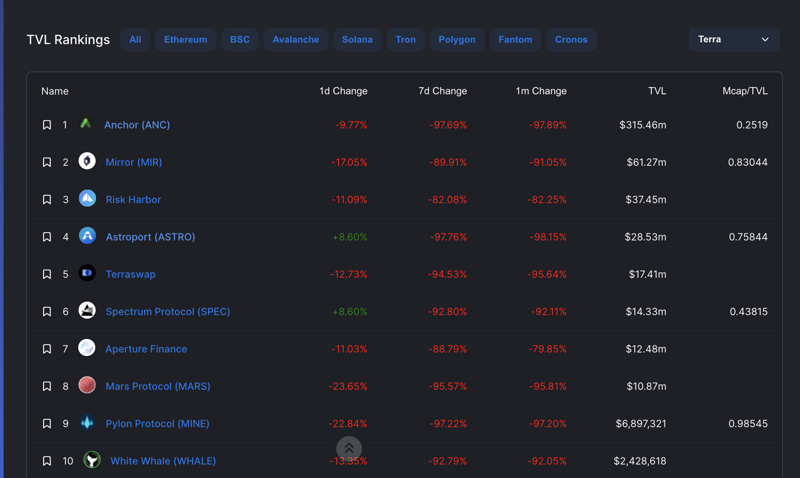
Anchor is the most important lending protocol in the Terra ecosystem, notable for allowing users to earn around 20% APY simply by depositing UST. Anchor stabilizes this interest rate through rewards from multiple PoS chains. Consequently, a large number of investors flocked to the Anchor protocol, seeking stable returns through deposits.
As of May 5, Anchor's TVL rose to $17 billion, while the market cap of UST was $18.7 billion, indicating that nearly all UST in the market had been deposited there. This also shows the high degree of correlation between Anchor and the Terra chain ecosystem, where a single thread can affect the whole fabric.
Now, with the decoupled UST unable to maintain its 20% APY, a large number of users have withdrawn funds from Anchor, causing its TVL to plummet from $17 billion to around $3 million, a decline of 98%. The native token ANC has also dropped from $2.18 to $0.22. To avoid further collapse, Daniel Hong drafted an "emergency proposal," suggesting that Anchor modify its interest policy to protect its yield reserves from depletion. If the proposal passes, Anchor will implement a target interest rate of 4%. However, it will not be a fixed yield but will fluctuate between 3.5% and 5.5% based on demand for services and the amount of yield reserves. This is still far from the previous 20% APY. Losing such an attractive condition means that even if Anchor can survive this crisis, it will never return to its original state.
Astroport and TerraSwap are both AMM DEXs in the Terra ecosystem that facilitate the exchange and flow of all assets on Terra. Among them, Astroport accounts for over 75% of all DEX liquidity on Terra. According to a report by Messari, LUNA-UST and bLUNA-LUNA are the top two trading pairs on Astroport, accounting for nearly 90% of the trading volume. The decline in the prices of LUNA and UST has also had a huge impact on Astroport, with liquidity sharply decreasing and its TVL dropping by about 98%.
Additionally, the yield aggregator Nexus Protocol on Terra has seen its vaults liquidated for approximately 395,000 bLUNA, 70 bATOM, and 1,900 bAVAX. Preliminary calculations estimate Nexus Protocol's total losses at around $600,000.
More seriously, some protocols on Terra adopted a Lockdrop model, allowing users to lock UST in the protocol in exchange for token rewards at the launch of the protocol. However, these UST have not yet reached their unlock time, and Terra faces the risk of halting block production at any moment (in fact, it has already paused twice). Users hope to unlock UST early to recover some losses, but the unlocking of a large amount of UST will bring more selling pressure to the market. This has put significant pressure on both users and protocols.
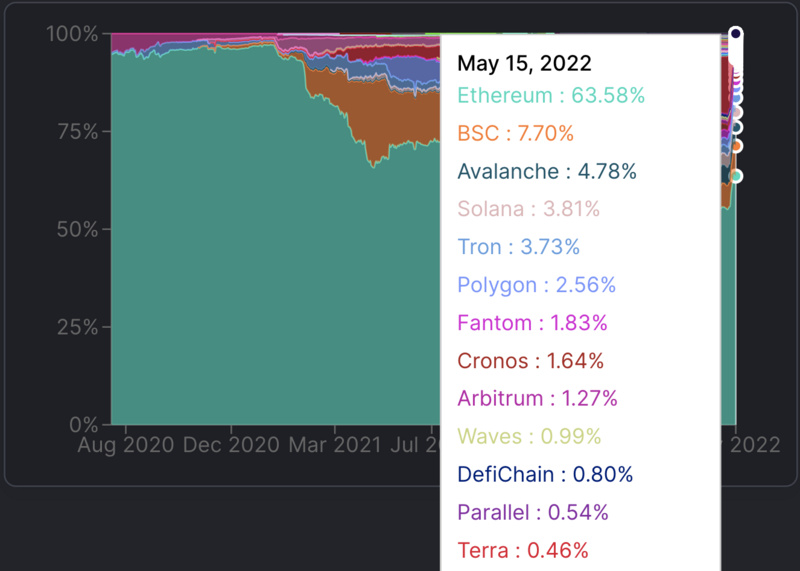
From a market perspective, the TVL of the Terra chain has dropped to 0.46% of the total across all public chains, significantly impacting most DeFi projects not on the Terra chain. Among them, the total TVL of lending protocols fell by $68.85 billion in a single week, a decline of 38%, a drop of this magnitude has rarely been seen in history.
Where Do Terra Developers Go from Here?
Reflecting on the past year of Terra, diligent developers, aggressive leaders, support from top institutions, and a bullish crypto market have all played indispensable roles in Terra's rise. But most importantly, it is its core commitment to building a series of financial applications around UST that the Terra empire is built upon.
As UST decouples and the Terra ecosystem collapses, with applications facing liquidation, this belief is gradually crumbling, delivering a fatal blow to ecosystem builders. Should they continue to wait for Terra's subsequent solutions to revive the ecosystem, or abandon Terra and seek other paths? Developers must make plans early.
In a recent Terra proposal, the team plans to initiate a hard fork of Terra to protect the community and developer ecosystem by restructuring the chain without a stablecoin. Do Kwon believes the top priority now is to stabilize the Terra chain and retain as many developers as possible. Only then can they explore the issue of decentralized currency. In other words, Do Kwon is prepared to temporarily abandon UST. However, maintaining the Terra ecosystem without a stablecoin could pose significant risks and cause value destruction.
First, Terra considered the role of UST from the outset. All ecosystem applications it developed pointed to a common goal: to enable UST to gain adoption on a larger global scale, so most DeFi projects are closely linked to it. If UST is abandoned, most protocols may not function properly. Redeployment would be necessary, which requires time, funding, and manpower, posing a huge challenge for developers.
Secondly, it can be said that most Terra developers were attracted by the financial ecosystem built around UST, and they stayed on Terra for a common interest and belief. If Terra undergoes a hard fork, a community without a shared belief will have to face the situation where different stakeholders cannot reach a consensus, leading to disputes arising from chaotic community governance, further forks, and user attrition, which would further result in ecological value loss and community fragmentation.
As the situation has developed, the Terra ecosystem has begun to split, with many protocols on Terra exploring new paths—migrating to other public chains.
The most discussed new home is Cosmos. Since Terra is a Cosmos SDK blockchain using Tendermint consensus, and Terra has activated IBC functionality, assets and data can be seamlessly transferred between Terra and other IBC-supported chains (such as Cosmos Hub, Secret Network, Juno Network, etc.). Therefore, the same underlying technology and close ecological ties have led many to believe that the Cosmos ecosystem is the best choice for Terra developers.
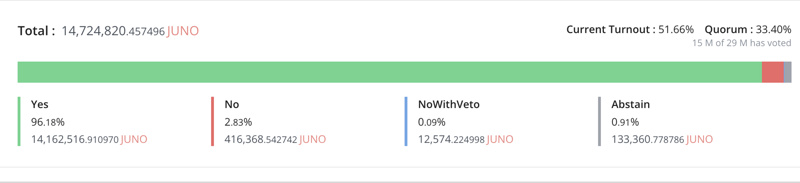
For example, Juno Network, a smart contract public chain in the Cosmos ecosystem, has stated that several Terra projects have already contacted them and are interested in migrating to Juno Network for development. Consequently, Juno Network proposed a rescue plan for the LUNA community, which will allocate a total of 1,000,000 JUNO (700,000 JUNO from the Juno community pool and 300,000 JUNO from the Juno development fund) to the Terra Developer Fund Multi-sig for project migration and ongoing development of the Juno ecosystem. Additionally, Juno Network plans to establish a developer DAO for these developers, hoping to help the community and developers out of the current predicament. As of 8:30 AM on the 16th, this proposal has a support rate of 96.18%, with voting ending in 4 days.
At the same time, the NFT marketplace Stargaze, built on Cosmos, has also stated that it is developing tools and a development fund to assist Terra projects in migrating.
The advantages of Cosmos have quickly attracted the attention of some Terra projects. For instance, the liquidation collateral protocol Kujira on Terra has decided to leverage the Cosmos ecosystem and Cosmos SDK to build its own sovereign L1 chain for a quick restart and operation.
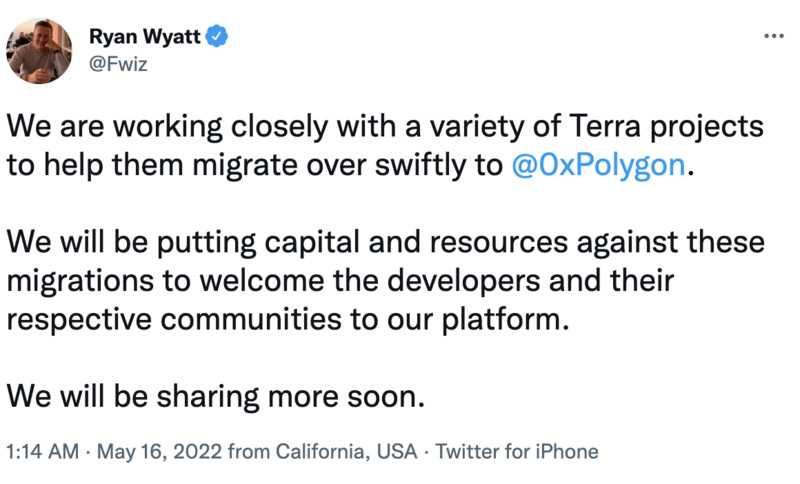
Moreover, other public chains have extended olive branches to Terra developers. For example, Kadena is also prepared to offer $10 million to attract Terra developers. The Fantom team has expressed their welcome to Terra Luna projects seeking new chains and can provide funding plans. Ryan Wyatt, CEO of Polygon Studios, has also tweeted that he is working with many Terra projects to help them quickly migrate to Polygon and will invest funds and resources to assist in their migration.
Some developers are also actively seeking alternatives. The staking protocol Stader and the NFT project Stoned Ducks Lifestyle Club have decided to migrate to the steadily developing Ethereum. Many NFT projects on the Terra chain are attracted to Solana's NFT ecosystem, as well as its strong community and DAO foundation, and have decided to migrate to Solana, including HellCatsNFT, Hero NFT, Smoked Ape, GenesisWolfNFT, and others.
The exact news and more details regarding the Terra hard fork still require final discussions and decisions from the community. The issues currently facing Terra are complex. For developers, there are many choices ahead, as major public chains and L2s led by Avalanche and Polygon are gradually rising and expanding their ecosystems, attracting more developers and institutional attention. Therefore, for developers, Terra is no longer the best choice. Where to go in the future remains to be seen, and Terra developers need to make decisions as soon as possible.
 Risk warning
 Risk warning

Popular articles