Dialogue with Folius Ventures Founder: New Opportunities in Web3 for B2C, Asia-Pacific Entrepreneurs Have a Significant Advantage

 Entrepreneurs in the Asia-Pacific region really do not need to underestimate themselves. The next step in the development of the cryptocurrency industry requires people with different ways of thinking to work together, and there are many opportunities at the traffic layer and application layer.
Interview: Zhu Enmin, Chain Catcher
Interviewee: Jason Kam, Founder of Folius Ventures
In 2022, the hottest game in the Web3 industry was undoubtedly STEPN. As one of the early lead investors behind it, Folius Ventures (Chinese name "Yi Ye Chuang Tou") quickly rose to fame, becoming one of the most outstanding emerging venture capital firms this year, with other representative investment projects including Project Galaxy, Scroll, CyberConnect, and many other star projects.
It is worth noting that Folius Ventures limits its investment targets to the Asia-Pacific region and Chinese entrepreneurs. The founder of the institution, Jason Kam, whose Chinese name is Jin Qiu, is a Chinese who grew up in Hong Kong. At 32 years old, Jason has a strong background in investment banking, having worked in Wall Street investment banks, New York family offices, and hedge funds, and has long focused on emerging markets in the Asia-Pacific region.
Another identity that Jason is familiar with is his Twitter account @MapleLeafCap, where he has shared many insightful views on Web3, DeFi, GameFi, and other topics since 2018.
On the first morning of August, Chain Catcher invited Jason for an in-depth conversation while he was attending Blockchain Week in South Korea. In this dialogue, Jason shared Folius Ventures' investment strategies and achievements, discussed hot topics such as Ethereum upgrades, bear market cycles, and the development direction of Web3, and also offered his thoughts on the dilemmas faced by Chinese entrepreneurs and potential solutions.
Jason believes that the next chapter of Web3 will be written by B2C applications, and that in the next 5-10 years, entrepreneurs in the Asia-Pacific region will have a significant advantage over their European and American counterparts. Below is the detailed dialogue between Chain Catcher and Jason:
Chain Catcher: Please introduce your experience in the crypto industry and the story behind founding Folius Ventures.
Jason: My Chinese name is Jin Qiu, and I was born in 1990. I lived in Hong Kong until high school and then moved to the United States. I graduated from Carnegie Mellon University in 2012 and have been working on Wall Street ever since, moving between investment banks and family offices. For the past four to five years, I worked at a hedge fund in New York, focusing primarily on small-cap companies in emerging markets worldwide, with a particular emphasis on Chinese-related enterprises and conducting in-depth research. That is my professional background.
I became interested in cryptocurrencies in early 2018 when the market turned bearish. After starting to pay attention, I created a Twitter account (@MapleLeafCap) to anonymously analyze cryptocurrencies from a traditional finance perspective. During the DeFi summer, I found it very interesting and shared many insights. Through Twitter, I met many industry peers, who turned out to be executives and even GPs of various funds, and we had very close exchanges. Eventually, they encouraged me to jump into this industry, and after gaining their support, I decided to resign and pursue this professionally.
I resigned in May 2021 and founded Folius Ventures in September of the same year, with investors including Framework, Galaxy, Dragonfly, and others. For investors, my role is more like their foothold in the Asia-Pacific region, and their presence is often behind our investments. We are also currently raising funds this year, which will allow us to continue investing significantly in the crypto market.
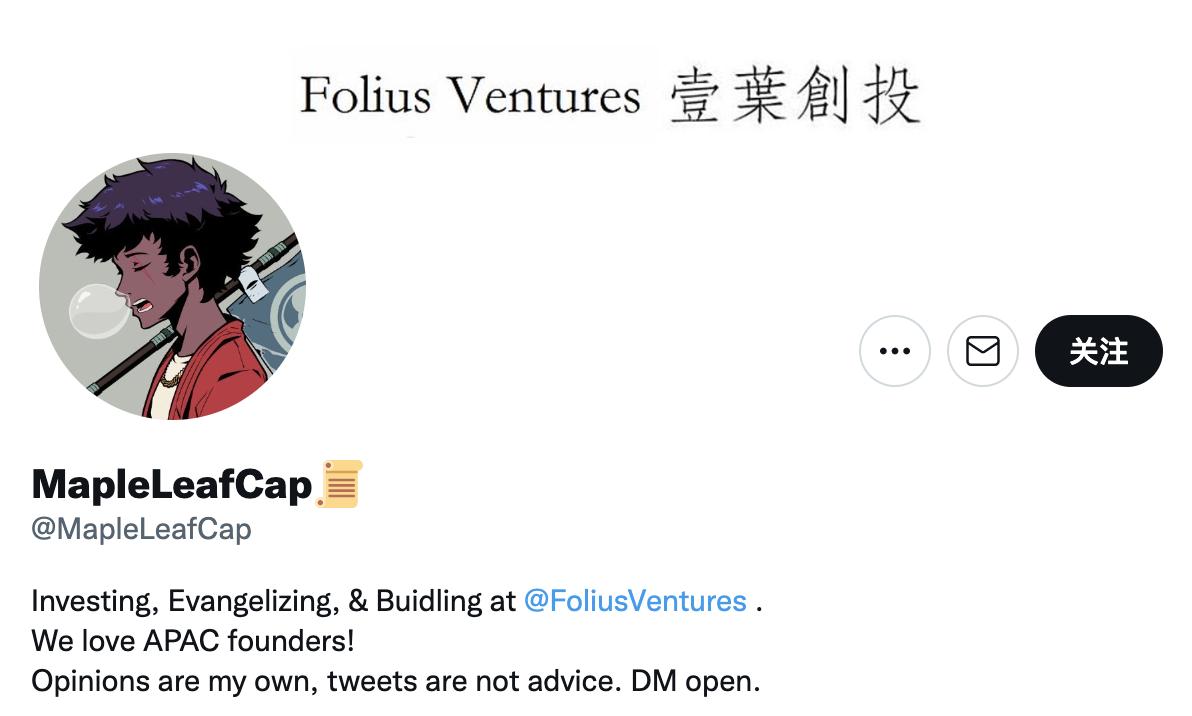
Jason Kam's Twitter account.
Chain Catcher: What are the main differences between Folius Ventures and other investment institutions?
Jason: Folius differs from typical investment institutions in three main ways:
First, we have a regional preference, focusing on investing in entrepreneurs and projects in the Asia-Pacific and Chinese-speaking regions.
Second, although our company is called Folius Ventures, it is actually structured as a Cayman hedge fund. Our investment targets are 2/3 in the secondary market and 1/3 in the primary market, with a three-year lock-up period and a quarterly gate, making it a mixed investment structure. We also prefer small to medium-sized early-stage companies. In the primary market, we focus on seed and Series A rounds, ideally with valuations below $200 million. In the secondary market, we aim to buy companies with a fully diluted valuation (FDV) below $500 million during bear market cycles. Throughout the cycles, we prefer not to hold large-cap tokens like BTC and ETH.
Third, I view the crypto industry as a "Roujiamo" (Chinese meat sandwich), where the middle layer (the meat) is very technology-driven, while our company leans more towards the top and bottom layers of the sandwich, which are the foundational infrastructure and tools that come with a SaaS business model, capable of growing with the industry; or the top-layer applications that can bring significant traffic to the industry.
Overall, Folius is a mixed investment institution focused on the Asia-Pacific region, leaning towards early-stage investments, and paying more attention to business logic and application-side investments.
Chain Catcher: Specifically, what are your investment strategies and styles?
Jason: My previous job mainly involved looking at secondary companies in emerging markets worldwide, which has several similarities with many companies in the current crypto market:
First, the crypto market is also an emerging market, but it exists in the virtual world rather than the real world.
Second, in emerging markets, corporate governance is generally poor, often characterized by major shareholders' control structures, and they may not understand how to communicate with secondary market investors, potentially engaging in practices that harm the interests of minority shareholders. In the crypto market, token holders have no recourse against the company, meaning that assessing the character and ethics of a founding team, as well as their commitments to stakeholders, is crucial.
Third, in any country undergoing different development cycles, there are patterns indicating which types of companies will perform better. Additionally, many business models can be effectively transplanted from developed countries to developing countries. In this process, local investors may not have seen these business models before, creating arbitrage opportunities in pricing or value discovery. Meanwhile, the crypto market is not only an emerging market but is also undergoing a transition from infrastructure building to a thriving commercial landscape.
Considering these three points, many experiences from investing in emerging markets can be replicated in the crypto market. Personally, my investment strategy includes four main considerations: First, examining the character and ethics of the founding team, as this directly determines whether value can be captured and whether the project can endure; second, assessing whether the chosen sector for the project has long-term growth potential; third, within this framework, evaluating whether the business model is sustainable and can genuinely generate revenue; and fourth, determining whether the project has a capable team that can solve problems.
In fact, this approach is very similar to my past investment thinking in the secondary market. If the industry continues to move forward, I believe the Web3 market will increasingly resemble Web2 internet companies or Nasdaq, and the methodologies for assessing business logic will remain applicable.
Chain Catcher: How do you evaluate Folius's investment achievements since its establishment? Can you talk about your most successful and most regrettable investments?
Jason: Since our establishment in September last year, we have made about 50 investments in the primary market, half of which are small positions aimed at strategic small investments that can benefit the overall portfolio, essentially making friends. The other half consists of substantial investments, typically ranging from $250,000 to $2 million. Currently, only five of these tokens have gone public, two of which are losing money, while the other three—STEPN, Project Galaxy, and Sportium—have returns ranging from several times to 100 times.
The private placements in the primary market account for about 20% to 25% of our total investment amount, which is quite good. In the secondary market, from September last year to now, we have experienced a slight loss of about 10%-20%. This is mainly due to considerations regarding the crypto cycle, as we have been aiming to hold more cash and have adopted a very conservative style.
In terms of results, STEPN is one of our most successful investments. STEPN aligns very well with Folius's founding mission as a mobile-to-consumer product that can drive traffic to the entire industry, and the founding team is a typical group of Chinese entrepreneurs with rich Web2 experience. We were very fortunate to find such a project.
A regrettable investment might be Magic Eden. When it was just starting, I got to know the founding team through some friends, but I was only looking to recruit for Folius and didn't strongly pursue or invest in the project after hearing about it. Looking back now, if I had sat down to seriously evaluate it at that time, I would have invested in this project, and I regret missing such an opportunity.

The blockchain game application STEPN, led by Folius Ventures.
Chain Catcher: Now that the market has turned bearish, how has this affected your investment pace? How long do you think this bear market will last?
Jason: Overall, the pace in the secondary market has slowed down as we wait for opportunities; however, the primary market remains unchanged, and we will continue to invest. In the secondary market, we have been very conservative since last September. I hope to invest in 15 to 25 small to medium-sized tokens at the lowest point of the bear market when valuations are very low, accompanying them through the next bull market cycle. In the primary market, I actually don't see any major issues; we will continue to invest, aiming to find 25 to 35 very good startups within the next 24 months.
In my personal view, given the current high leverage and the potential for economic recession, the Federal Reserve is likely to make significant mistakes. If the Federal Reserve makes a fatal error, it could lead the global economy into a recession, whether deep or shallow, which may happen next year.
Before that, I believe the potential shift of the Federal Reserve and the market's speculation about this shift will allow us to enjoy a fairly good risk rally in the next 3-6 months, so this may be a process of rising first and then falling. Why might we transition from a risk rally to a recession next year? It could be that after this shift, the Federal Reserve may tighten policies again when risk assets reach the next peak, feeling the need to suppress strong investment sentiment in the market, which would lead to very negative consequences.
I predict that this bear market cycle will end next year when governments around the world inject liquidity back into the market, helping the market's economic recovery while also boosting the prices of risk assets again. The ultimate bull market may occur at the end of 2023 or in 2024, as the Federal Reserve resumes its easing policies.
Why do I emphasize the issue of liquidity? Because I firmly believe that the Web3 industry is a continuation of Nasdaq; it is an early Nasdaq for small-cap markets, closely related to risk assets.
Another important point is that I believe in the next bull market cycle, Bitcoin will completely decouple from the overall Web3 industry, and the future crypto cycles will not progress based on the three to four-year Bitcoin halving cycle. Web3 will increasingly resemble Nasdaq, developing its own rhythm, and as Bitcoin's advantages diminish and the halving cycle becomes less pronounced, it will be challenging for me to predict Bitcoin's future trajectory.
Chain Catcher: Web3 is currently a hot topic in many industries. What do you think are the main misunderstandings that the Web2 industry has about Web3?
Jason: The first misunderstanding is that what exists in this industry is correct, and what is native is good, which is actually not true.** When I talk to many entrepreneurs, they feel that there are some seemingly correct methodologies in Web3, assuming from the start that these methodologies are correct, such as the necessity of building a community, conducting airdrops, or having a whitelist for NFTs. They believe that entering Web3 is similar to entering Web2, with established methodologies and strategies.
In reality, there is no paradigm in this industry; it is a very chaotic and early-stage field. Entrepreneurs should think from first principles, not underestimate themselves by thinking that their Web2 experience is wrong and that new things are right. They can and should think critically about new ideas and have the courage to propose their own original strategies.
The second misunderstanding is that they believe they must seek endorsement from good capital. Of course, this may have been the case in the past, as many projects were still in a large infrastructure, B2B era. However, if this industry increasingly shifts towards applications in the future, capital may just be capital; the founder's understanding of the product will largely determine whether it can succeed, rather than relying solely on capital endorsement. Therefore, in many cases, if you are seeking financing, I believe you should focus more on how to improve the product, which will be more beneficial.
Other questions such as: Are there many Ponzi schemes in the crypto industry? Are there no viable business models in the crypto industry? Should we decentralize? I think these doubts and reflections are very healthy.
Chain Catcher: Which directions in Web3 do you find most promising? Which ones do you not favor?
Jason: I am most optimistic about four directions:
First, a new entertainment and technology sector for consumers. This includes games related to Web3, gamified applications that connect with Web3, and consumer goods, luxury items, and IP willing to incorporate Web3 modules, corresponding to familiar names like Axie Infinity, STEPN, Yuga Labs, and Azuki. Entertainment does not necessarily need to connect with real life and can carry enormous traffic, with users themselves being potential consumers. Even in Web2 or other past industries, this has been the most profitable, fastest-growing, and capable of capturing value.
Second, digital organizations. Web3 is very suitable for "illegal financing." If you have ideas and experience, you can leverage Web3's value network for financing and profit-sharing, effectively giving wings to your dreams.
Third, native financial sectors in Web3. If the top-tier business models in Web3 develop significantly in the future, the demand for finance will inevitably expand, and financial models that cannot be supported now will be supported in the future. For example, companies that integrate insurance, underwriting, and final auditing, or direct non-collateral lending companies.
Fourth, Web3 login methods. This means having a unified account that holds all your data and allows direct payments. This account system is far superior to the fragmented, information-only Web2 account systems of the past.
I am not very fond of two directions:
First, homogeneous basic financial products. These products exist singularly on different public chains and have no real significance. I am personally not very interested in investing in this gradual innovation in DeFi.
Second, developing SaaS tools and infrastructure for upper-layer applications. These entrepreneurs may have seen the tremendous success of SaaS companies in Web2 and naturally believe they should do the same in Web3 at this stage.
Of course, I do not deny that such companies may also be very successful in the future, but building this infrastructure at the current nascent stage of the industry, especially when the end applications have not yet been discovered, seems to me to be a laborious and thankless task, and relatively lazy in thinking. However, there are some very obvious needs, and we are also very optimistic about innovative infrastructure and tool directions; I am mainly referring to areas with clear path dependencies.
Startups should now directly push applications and seek use cases. Truly excellent companies can explore amidst the fog of war, and at present, they should be integrated and not require infrastructure to do anything; they should inherently possess these capabilities.
Chain Catcher: You mentioned on Twitter that "the next chapter of Web3 should be written by B2C applications." Why do you say that? What should be the innovative direction for B2C products? How can they better connect with consumers and the real world?
Jason: I believe it should start with a small application, possibly incorporating some of Web3's current profit-sharing systems or business models, and iterating based on that. In other words, it is about finding a scenario where Web3's account system and profit-sharing strategies can be applied, continuously experimenting with different business models.
Specifically, apart from financial applications, there could be a Web3-native browser that incorporates a Web3 wallet, where the ultimate monetization method might still be through advertising, but the advertising revenue would not be entirely given to shareholders; instead, it might be shared with some users browsing the site. Since everyone needs to browse websites, why not use one that pays me?
We still need to find some high-frequency scenarios, both entertainment and non-entertainment, to see if users' interests can be shared from equity, while allowing users to reasonably and fairly bring in new users and enhance application advantages; this requires exploration.
Chain Catcher: You invested in the Africa-rooted crypto application Jambo. How do you view such Web3 super applications? Could this become a new centralized monopoly product?
Jason: Investing in Jambo is actually about recognizing its potential to uncover many interesting native Web3 projects in Africa, which I do not see in China or Southeast Asia.
I think Jambo needs to consider what types of applications can be effectively integrated with Web3 components to provide a better experience in the African countries it operates in. This will require gradual exploration, possibly developing one app at a time, which is worth experimenting with. After all, it is hard to imagine that a Western team could outperform a local team in B2C in Africa. As for what specifically to do, it needs continuous thought, perhaps something as simple as a utility payment function or a straightforward x-to-earn application, and so on.
As for whether there will be a Web3 super application or what it might look like, to be honest, I don't know. The reason Web2 super applications became super applications was that they emerged after the cost of information transmission decreased, resulting in several applications with network effects that captured significant market share and incorporated many other functions. For Web3, I am unsure what such blockbuster applications will look like, or even if there will be a product with strong network effects like in the past.
I should add that whether centralization is an issue depends on the foundational resource layer. Appropriate decentralization is necessary; if we do not balance the costs of tampering with the benefits through competitive means, the industry has no reason to exist.
However, for the top-tier companies, what can be implemented? What can bring more users to the industry? What kind of products can be created using Web3 components? I think this is a spectrum; ultimately, the future of this industry will not be dictated by the current crypto-native Web3 players, but by the ultimate winners, those who control 100 million users. History is written by the victors.
Therefore, there is no need to be overly constrained by what the industry currently favors or considers orthodox, as this restricts entrepreneurs' own thinking; there are not so many rigid frameworks.

The African crypto application Jambo, invested by Folius Ventures.
Chain Catcher: What should a more reasonable Web3 application that meets your expectations look like?
Jason: An application that incorporates Web3 features must focus on what users already own and have a strong binding with certain financial scenarios. This financial attribute does not mean it can make money, but rather that users are in a community of shared interests, or that the application has a strong value capture orientation. Compared to a similarly competitive Web2 application, a Web3 application can implement some very intuitive different profit-sharing models, which I believe is the most worthy direction to explore.
What should it specifically look like? It should be a new attempt to minimize the cost of value transfer, allowing users to experience various conveniences in different scenarios. For example, if I own an NFT, because this is an account system observable by anyone, based on my actual ownership of this NFT, the commercial derivative scenarios can become very practical. In the past, Pinduoduo's account system could not be utilized by Tencent, as Tencent could not see what Pinduoduo had, and Pinduoduo was unwilling to open up. But now, if everyone recognizes your NFT on the blockchain, it can be called upon to provide you with unique product experiences.
Secondly, there are many homogeneous products on the internet. Why should I use your product instead of others? Now, the resource allocation system in Web3 provides a new approach; in the past, it was free to use, but now I can create money out of thin air with my own currency to let you use my product, and the value of this token or profit-sharing system originally belonged to shareholders. I distribute this originally shareholder-owned profit to users in a more competitive manner, ultimately transforming the triangle between developers, consumers, and investors into a more cooperative model, reminiscent of a cooperative from the past.
Of course, this model currently has many shortcomings. The biggest drawback is that it can easily present itself in a Ponzi-like manner. Additionally, early entrants can rent-seek on the backs of later entrants, and early entrants can continue to earn profits without contributing value, which needs urgent resolution. However, I do not see this as a bad thing, as there can be many interesting innovations in the model.
For example, if users do not contribute value, then their profit-sharing should also decrease accordingly, and it may ultimately lead to a model where users need to invest, and even if they do not necessarily make money, they have the opportunity to gain significant returns. These models can develop rapidly in a commercially competitive system, allowing for the construction of many things. In these two aspects, Web3 applications can think more about this; my understanding may not be superior to that of entrepreneurs, and I am more waiting for entrepreneurs to tell me what it should look like.
Chain Catcher: The Ethereum 2.0 upgrade is likely to occur in the coming months. How do you view its prospects? What changes will it bring to the industry?
Jason: This may contradict mainstream views, but the Ethereum upgrade will basically have no impact on our future investments, especially in application directions. Because Ethereum's transition to PoS will change the overall architecture, it may become easier and more convenient for top-tier developers. This may also have a significant impact on prices, with Ethereum experiencing considerable volatility. However, Ethereum is already facing a lot of competition, and applications or other companies in the industry will choose the public chains or resource layers that suit them best.
Overall, I believe that such technology-driven changes and upgrades do not have a decisive significance for the advancement and development of the entire industry; the decisive significance should come from the successful applications at the top tier.
Chain Catcher: In your Twitter bio, you mentioned, "The development of Web3 in the next 10 years will not exclude the Asia-Pacific region, especially the Chinese, and will shine brightly." Given Folius Ventures' commitment to supporting the Asia-Pacific market and Chinese entrepreneurs, you seem to have confidence in the Asia-Pacific market and Chinese entrepreneurs. What reasons lead you to have such optimism about Chinese entrepreneurs?
Jason: This is closely related to the mission behind founding Folius. The Asia-Pacific or Chinese-speaking regions have historically been underdeveloped in the Web3 field, largely because the crypto industry has not yet reached a point where it can explode in the Asia-Pacific region. In the past 5 to 10 years, the development of Web3 has been foundational, focusing more on product categories and states; it has been a decade emphasizing ecosystems, infrastructure, tools, and building consensus. In other words, it has been a decade for B2B products.
Europe and America have excellent engineers across three generations, who are very skilled at building such B2B ecosystems. However, the Asia-Pacific region mainly consists of younger engineers from the post-80s and 90s, whose career paths have developed alongside the rise of China's B2C industry starting in 2005. In other words, their engineering experience is in B2C and applications, which is at odds with the entire blockchain development process, so they may not excel in public chains and infrastructure.
Looking ahead to the next 5-10 years, if the crypto industry is to achieve significant development, it will inevitably lead more people to enter the field in a B2C manner. At that time, entrepreneurs in the Asia-Pacific region will compete on the same stage as their European and American counterparts. I believe that Asia-Pacific entrepreneurs have no disadvantages; in fact, they may have advantages, particularly in their rich product experience and aggressive strategies for capturing market share. Most importantly, they work harder—men like oxen, and women like men. The quality and quantity of work in a month may be two to three times that of European and American engineers, but the cost may be half or even one-third. Therefore, in a paradigm that requires rapid iteration and new product thinking, Asia-Pacific entrepreneurs have a significant advantage.
Unfortunately, the advantages and prospects of Asia-Pacific entrepreneurs are not matched by the capital support they face. The capital for Asia-Pacific entrepreneurs comes from two main sources: one is traditional Web2 institutions in China, but these capitals are not very decisive in entering Web3 and often have many constraints, ultimately not necessarily helping entrepreneurs. The second is seeking foreign capital, but foreign capital may not see or truly understand and trust these entrepreneurs due to language and cultural differences. I do not even believe that European and American investment firms have the ability or willingness to find Chinese entrepreneurs in the seed round. The third source is domestic Web3-native funds, which have mostly come from Bitcoin, mining, or speculative activities in the past, and do not align with the future development direction of the industry. These crypto-native investors in the Asia-Pacific region may have overdrawn their credibility and currently lack ideas for strengthening new directions, while also having high demands for short-term capital returns, which may not suit the new batch of Asia-Pacific Web3 entrepreneurs who genuinely want to build something.
For these reasons, although this is a grand, B2C application-oriented track, the support from European and American capital is completely unequal, leading to significant mismatches in valuation and opportunities. Therefore, I think it is worth placing heavy bets. If anyone is interested in discussing, especially those who want to do long-term things, please be sure to find us. We are committed to building a reputable and credible brand that collaborates with long-term-oriented entrepreneurs.
Chain Catcher: In the current context of going overseas to start a business, what difficulties do Chinese entrepreneurs face in the Web3 space? What suggestions do you have for this?
Jason: B2B is difficult to do. If we look at it from the perspective of top-tier applications that directly face consumers and bring traffic, I believe that entrepreneurs in the Asia-Pacific region will face three major constraints:
First, the need for cognitive improvement. After all, there is a time lag in the transmission of information from English-speaking regions to China, and there is a pain point in learning cutting-edge industry information and discussing it with industry professionals.
Second, misunderstandings about overseas markets. If the entrepreneurial team has only been competing domestically in China without truly understanding or creating a universally appealing blockbuster product for overseas markets, their understanding of the product, UI, UX, or final development may be flawed. If they are entering overseas markets, this flaw could be fatal.
Third, the need for small but beautiful new strategies. Similar to the second point, for a very niche and scattered international market that may not yet have practical applications, the large-scale go-to-market (GTM) and product development models that China relies on may not be suitable. Instead, it may be more appropriate to try small, beautiful attempts and excel in one area. The strategies may differ and require strong adaptation.
These three points are common challenges faced by entrepreneurs in the Asia-Pacific region. How to solve them? I believe it can only be improved through team building; entrepreneurial teams really need some members with overseas perspectives. I actually strongly recommend experimenting, starting with a very small function, finding the right point, and then gradually expanding. It is also advisable to communicate with good institutions or reputable investors in the industry early on to seek direction, which will be very helpful.
Moreover, entrepreneurs really need to think carefully before proceeding about what is dross in the native Web3 scene, what can be borrowed, and to discard many things that seem correct in the industry. I believe that Asia-Pacific entrepreneurs do not need to underestimate themselves; the next step in the development of the crypto industry actually requires people with different thinking patterns to work together to elevate the user base to a new level. In the next cycle, there will be many opportunities at the traffic and application layers.
Chain Catcher: Which cities in the Chinese-speaking region do you see as promising for developing the crypto industry?
Jason: Shanghai, Hangzhou, and Singapore.** These cities have the highest density of potential entrepreneurs and existing Web3 entrepreneurs in the Chinese-speaking or Asia-Pacific region. Shanghai and Hangzhou have extremely high densities of capital, startups, and large companies, and from the perspective of P8 or P9 executives, these two cities also have the highest talent density, with many excellent programmers looking to start their own businesses.
After this year's New Year, it is evident that the level, thinking, and background of entrepreneurs in the Asia-Pacific or Chinese-speaking regions are significantly higher than last year or at any time in the past. This is likely because they see opportunities in the crypto industry while their Web2 industries are under pressure. In the Web2 industry, there are no special opportunities, and VCs are not investing. Working for overseas Web2 companies may not be appealing either. In the competitive environment of the Web2 industry, equity incentives may have already diminished or suffered greatly, making it less meaningful.
Amidst many choices, trying their luck in Web3 has become a significant reason for many Asia-Pacific entrepreneurs to step out. With a substantial leap in both quantity and quality, the transition from early ideas to startups, products, market shares, and even discourse power can occur within a 6 to 24-month process.
Related articles:
《Folius Ventures: On the Eve of Transitioning from 1 to N, Looking Ahead to the Future of Web3》
 Risk warning
 Risk warning